Tag Archives: Pulp Fiction

The Man From La Mirada Perdida—i & ii

A Don Coyote & Saundra Pansy Mystery

by Mike Servante

i


—Ever work for a private investigator before?

—I can’t honestly say that I have.

—But you’ve had experience working in an office, answering phones, typing?

—It’s all there in the resume.

—Yes, of course. So why don’t you tell me in your own words.

—I was a receptionist for a law firm, Stag, Stagger,& Staggered. I answered phones, took messages, routed calls, sorted mail and put it in the appropriate mailboxes. And did some light typing. The legal secs did the important stuff.

—Just a minute, did you just say legal sex?

—No, no, legal secretaries, that’s what they were called, legal secs, legal secretaries.

—Alright, go on.

—The firm had an investigator on retainer, but I never saw him. Only his mail.

—Only his mail what?

     “His mail, envelopes, packages, legal briefs, that sort of thing.”

—I see, mail, briefs, packages.

—But that was a while back. I haven’t been in an office environment since I got married.

—You’re married?

—Was. Widow.

—Oh, I’m sorry. My condol. . . .

—It was several years ago.

—Yes.

—And I’ve had to rejoin the workforce.

—Your husband, uh, Mr. Pansy?

—Corrigan, Jake Corrigan. Pansy is my maiden name.

—Ok. Mind if I call you Saundra? Or Sandy?

—If it comes with a pay check, I’m ok with that, though I’m not particularly fond of Sandy.

—Pay check, right, good you brought that up. If you were to accept this assignment I can only use you parttime, three days a week. Monday, Wednesday, and Friday, eight till noon, I will pay you for your time each week on Friday. I hope those are enough hours for you. Maybe once business picks up we can add more time.

—That’s fine. Like I said I’m rejoining the workforce after years of being a housewife. I’d like to take it slow. Plus I get Jake’s pension.

—Oh, yes, pension, that’s good. What did your husband do?

—He was a cop.

—Really? That’s very interesting, a cop?

—He never talked to me about the job. Said he didn’t want to depress me.

—I see. That was thoughtful.

—I have a question. Do I call you Don or Mr. Coyote?

—Boss is fine.
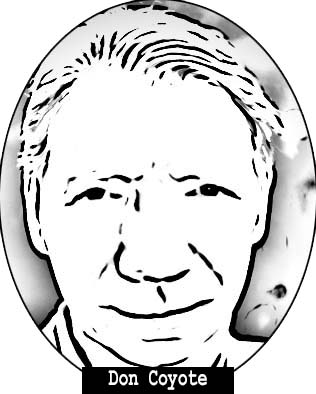


dcovaltxtI’m a good judge of character. She was in her late forties, going gray pixie cut that went with the pixie face, dangling silver earrings, intense blue eyes, mascara thick eyelashes, not so subtle green shadowed and precisely drawn eyebrows. Her lipstick was a synthetic shade of orange and probably applied with a palette knife.     

 What choice did I have? The only other applicant was a high school girl who had arrived with her mother who wisely stayed in the car. She’d snapped her gum while looking around the small office, bewildered, pointed to the typewriter, and asked, “What’s that?”

This woman in the colorful summer dress and gold brocade shrug appeared evasive and reluctant when I asked about her experience. Anyone can write a resume, I wanted to get the depth of her understanding by how she used her words and if she was familiar with the nomenclature.

She brought up sex almost immediately. I don’t want to say that I have that effect on women, but I am not uninitiated in the ways of the world. When I questioned her bringing it up, she covered skillfully and made it out to be a misunderstanding on my part. I don’t make those kinds of mistakes. And as if to further tease, she brought up male briefs and packages. I wasn’t born yesterday. Packages, that was just blatant.

Next she tried the pity angle. Widow. What was I supposed to say? How did he die? And she coldly brushed off my expression of sympathy. I could tell she was desperate to get the job, her repeated emphasis on the need to return to the workforce, but maybe at her age it’s a challenge, and she’s desperate.

I guess that’s something I’ve never known, I come from money. My grandfather was a jeweler, from the Ukraine, one of three Koyoskozko brothers who were headed to Alaska during the gold rush to claim their fortune. Grandpa jumped ship in San Francisco, tired of puking his guts at every swell of a wave. He apprenticed to a jeweler, a fellow countryman, and learned the business. With the ’06 quake, the business was destroyed. Like many made homeless by the catastrophe, he headed north, following the circumference of San Pablo Bay until he reached the wet lands on the northwest side of the bay once owned by General Vallejo. There on a river that drained into the bay sat a relatively untouched settlement known as Petaluma. He took it to be an Indian name. He was successful, changed his own name to something easier to pronounce, Coyote, though at the time he didn’t realize its import as a mythical figure in the lore of his adopted country. Eventually he had jewelry outlets in every major burg in the valley. My father inherited the business and became even more prosperous by investing in real estate. When he died I inherited millions. He’d eased out of the jewelry business a while ago although I had worked for him as a courier when I was going to the University in San Francisco. I often carried satchels of very valuable jewels in the trunk of my Impala as if they were nothing more than a bag full of old tennis togs. I had a permit to carry, then, and still do.

That woman is wily, I’ll give her that. When I politely asked if I could address her by her first name she immediately turned it into an offer of a job.


sandy2ovaltxtI don’t know who he thought he was, thinning red hair, tall and gangly with quite a beak, too. He dressed conservatively for this neck of the woods, slacks, open collar shirt. I’ll admit I was desperate. After Jake’s passing, I had to keep up the house payments and that meant cutting corners on other necessities. Besides, being housebound as a homemaker for a couple dozen years, I was ready to re-experience life as a single woman.

My husband used to say I was a ditz, but what did he know, he was a lummox. Jake worked as a Napa PD patrol officer till he dropped dead at Swank’s Steakhouse in Santa Rosa. The red meat in his gut didn’t agree with the red meat of his heart. As someone from his family said at the wake, “He larded up.” Certainly no one on my side of the family would have said it, out loud, at any rate. And it was true that the slim handsome police cadet I married turned into a wide load, pot-bellied, booze swilling porker right before my eyes. The sorrier he felt for himself, the more pounds he put on, and the meaner he got. He was an accident that didn’t wait long to happen.

I’m from around here, born, bred, and schooled. My folks and their folks and their folks before them were pioneers in these parts, chicken ranching, sheep and cattle, apples and prunes, they did just about anything that had to do with growing or grazing. Of course Coyote Jewelers was known far and wide. My wedding ring came from their showroom in Sonoma, or as my dad used to call it, Sonombula because it was a sleepy little town back then, before it got overrun by grapevines and all the snobby money, snooty attitude, and high prices that followed. Growing grapes was suddenly an art when all it was really was just good farming. That’s my stock. I’m not afraid of honest work and I expect to be respected for doing it.

I knew enough to be on my guard, having worked as a waitress while I was taking secretarial courses at the local business school. Guys always bring sex up and then when you call them on it, they act all offended like and pretend that’s not what they meant. Happened at the office, too. And though I hadn’t expected it to come up in the job interview, there it was. Everyone knows a legal sec is short for legal secretary just as a para is short for paralegal. If I hadn’t got married I think I would have tried for paralegal, get the training and all.

In the meantime, I needed to get work and his acting like a jerk wasn’t making it easy. I wasn’t going to catch the drift? Mail, package, briefs. I come from a big family, brothers, cousins, uncles, all of them brain in the gutter. I’ve heard it all. And I wasn’t going to fall for it. If that’s what he thought, he had another think coming. Saundra Pansy was never a pushover whatever you thought of the name.

Guess he got the drift. Boss said I was to start Monday, eight sharp.


ii

—It’s not electric?

—Um no, but it’s authentic.

—It looks like it weighs a ton.

—It’s a 1939 Royal KMM with the patented Magic Margin system. See, if you hold down the right or left margin lever and slide the carriage to the desired location you ‘magically’ set the margin. It still has the original round glass-topped keys. I paid $5 for it at a flea market, and it still works as well as when it was new. I even ordered extra ribbons.

—Right. . . ribbons. That’s quite a museum piece.

—Oh, it is perfectly functional.

—And this lever?

—That’s the carriage return.”

—Ok, now I remember seeing a video of one being used when I was in business school. We practiced typing on electric typewriters.

—But you assured me you could type!

—Oh yeah, no problem, if it’s qwerty, I let my fingers do the walking, and I can do it blindfolded. I can also do Gregg but it’s been a while so I might be a little rusty.

—Greg?

—Yeah, you know, the shorthand guy.

—Shorthand?

—Transcription. Like I said, it’s been a while.

—Good, good, for now typing will be enough. And this is an elegant machine. You shouldn’t have any problem with it, freshly oiled and cleaned.

—You don’t have a computer?

—No I don’t believe in computers. But look, I even had some stationary printed.

—Stationary?

—I hired a graphics firm to design the letterhead and the logo. Don Coyote & Associates, Private Investigations. I think the howling coyote in the oval frame like that is quite well done.

—That looks like a wolf.

—No, no. I’ve been assured that it is, in fact, a coyote.

—Have you ever seen a coyote in the fur?

—I’ve seen pictures. Many pictures.

—Well, alrighty then, if that’s the case.

—Oh, no, no case yet, but I’m hoping in the near future to develop some leads, lure clients in need of investigative services.

—And in the meantime is there any correspondence you’d like me to write, calls you’d like me to make, appointments you want me to schedule, dictation? I’m ready to get down to business.

—Good, and I don’t know if I have to point this out, but that is what is called a rotary dial on the telephone. It’s a 1937 Stromberg Carlson, very rare.

—It works? I thought it was just part of the décor. Like the typewriter.

—It is in perfect working order, as functional as the day it rolled off the assembly line. It has the original bell. Wait till you hear it!

—I’ll assume it doesn’t take pictures.

—Of course not. The telephone is for the ear, not the eyes. This is not some Dick Tracy outfit with wrist radios and video phones. Don Coyote, Private Eye, is nothing if not authentic!

—Ok, you’re the boss. I’m ready to get to work. I just don’t want to waste your time and money sitting around not doing anything.

—Well, first of all you need to get familiar with the type of job you’ll be doing and probably the best way to do that is to begin by creating a catalog of the files and reference books in my office.

—Like a librarian?

—I have a collection of rare pulp fiction magazines and obscure post war crime fiction paperbacks. Oh, and my film noir library, private eye memorabilia, crime scene photos. I would recommend that you read a few of those novels to get a feel for the business. I’m thinking along the lines of Mike Hamm. . . .

—You’re going to pay me to read?

—Well, no, I see it as something you could take home and do. To bring you up to speed. A private eye’s secretary requires specialized knowledge.

—So I would be doing more than just typing and filing? That sound like I’d need specialized training. On company time.

—Are you going to answer that?

—Don Coyote & Associates, Private Investigations, how can I direct your call? One moment please. It’s for you.


dcovaltxtI don’t know how to say this. My expectations might have been too unrealistic. She chews gum. Maybe she was nervous. I suspect that she is rather unqualified and I will eventually have to let her go. As my father used to quote my grandfather as saying, “The biggest problem in running a business is employees.” She is rather plain in a well-scrubbed sort of way. And maybe someone should have told her that colorful plastic jewelry was no longer as popular as it might have been, if ever, in the fifties, say. And even though she was made up to match the bangles and bracelets, she couldn’t hide her lack of refinement when I showed her to her desk.

That typewriter is a classic machine, indestructible, a workhorse. I couldn’t believe my luck. It was from an estate sale, everything had pretty much sold at auction except for a few odd items, like gooseneck lamps, and the old typewriter. One of the heirs was selling them at a flea market where, on occasion, I browse, looking for old magazines and paperbacks. A hand printed sign propped on the machine read BOAT ANCHOR? $5 or B/O. Finding a typewriter repair shop and restoring it was probably the hardest and most expensive part. Even the repairman had never encountered this old of a model, a 1939 Royal. His experience had been mainly on lightweight plastic chassis portables and dreadnaught electric office machines. He also repaired watches, something else experiencing technological displacement.

As soon as I questioned her competence she immediately brought the conversation around to sex. She said she was alright with quirky, and then something that she had done blindfolded with someone named Greg involving shorthand, whatever kinky fetish that was, but I could just imagine. I can only assume she was desperate. She kept saying that it had been a while. Then she brought up computers. And that’s a sore spot with me. I find them dehumanizing. Unfortunately I can become quite irrational when confronted with the issue. I deflected by showing the stationary I had printed but she wanted to make an argument about whether it was a wolf or a coyote depicted in the oval of the logo. I can see that she has a petty side.

I definitely got the feeling that she was in over her head. She was undoubtedly confused by the rotary dial on the telephone. She tried to laugh it off by making a joke. I have very little patience with mockery especially when it pertains to the degradation of values under assault from the techno sphere. I’ll admit it, I’m a technophobe.

And when I suggested that she educate herself for the role she would play as a secretary to a private investigation firm, she turned it into a labor negotiation. I was about to assert my prerogative as the employer when the phone rang. I’ll admit, she did answer the call quite professionally.


sandy2ovaltxtHoo boy! I didn’t think I realized what I was getting into. That machine, a manual typewriter, was carpel tunnel syndrome waiting to happen. I thought he was kidding. Maybe a monitor would cleverly pop up from a hidden compartment on the mahogany desk. No such luck.

I had to remind him again that I was qualified as a secretary, I’d even included a copy of my diploma from Empire Business College with my resume. I found a clean copy that my crazy friend Lola Lamont hadn’t altered the heading of the certificate to Vampire Business College though in truth that’s what we all called it—they didn’t suck you blood, just your money. But from the look on his face, it might have been TMI, too much information.

Then he trots out this stationary with a heading like it was from a comic book. A picture of a coyote, he says, in a clunky oval frame. It was a wolf. I’ve seen coyotes numerous times. Even shot one on my uncle Brad’s sheep ranch over by Two Rock. I know what a coyote looks like. They’re vermin. But he’d seen pictures.

And speaking of pictures, he had to point out the antique telephone like I haven’t ever seen pictures on ones almost exactly like this one. My gran even had one on her bookshelf, used it as a bookend to hold up her collection of picture albums. He got a little touchy at my joke about taking pictures so I’m going to guess he had his funny bone surgically removed.

But I gotta hand it to the guy, his setup is right out of an old black and white movie which I can’t watch because without the color, there’s no meaning, and I lose interest real fast. The place is on Western just off the main drag in what used to be the original family jewelry store, a three story brick walk-up. The downstairs showroom is now an antique store so he doesn’t have to go far for his décor. His office is on the second floor, the door at the end of the hallway at the top of the stairs. It’s one of those old wooden doors with a frosted glass panel on the upper half and in gold lettering it says Don Coyote & Associates. I haven’t a clue who the associates are but I figure I’ll find out soon enough. Inside is a small reception area with a couple of old chairs up against the wall and across from the big mahogany desk where I’m supposed to work. There’s another door on which is written in the same gold lettering, Don Coyote, Private Investigator, and call me crazy, but I’m guessing that’s where the files and reference books are that he wants me to catalog. And read.

He has another think coming if he thought I was going to take work home. If I learned one thing from Jake Corrigan, it’s don’t take the job home. And the only thing I’m going to flip when I get there is the channels. Even McDonald’s pays you when they train you to flip burgers. I could see that that was going to be a bone of contention. If you want me to do a special job, train me. I’m a fast learner. I was about to let him know where I was coming from when the phone rang. It startled me at first. It was loud. And it was a real bell, not an electronic facsimile. I picked up the handset and immediately went into receptionist mode. It was a woman’s voice. She was sobbing, “Help me, oh please, Don Coyote.”
Next time: la bola desnuda or don’t go bowling naked

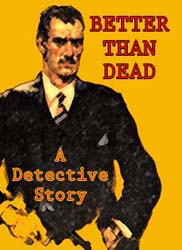
Better Than Dead—30

by Colin Deerwood

Ads131

The cops finally caught up with me. Hogan, specifically. I had stopped at the newsstand around the corner from Hopper’s Diner, the daily blat’s headline blaring Bombers Blast Britain. It was another headline below the fold that caught my eye, Missing Ridley Constable Sought For Questioning. I was curious. Maybe Marie had stirred up a ruckus. I was on my way back to Alice’s old basement studio from the passport bureau with my new identity tucked in the breast pocket of my darker than tan suit coat. Almost two weeks had passed since I’d snuck back into the bad Apple. A lot had changed, and for me, for the better.

The five grand from the sale of the art piece had done wonders for my spirits, only the best mash, and my wardrobe, only the best haberdasher. It had also gone to the Uptown Downtown barber shop over on Seventh where I had had my mug given a going over. When I stepped out of the chair I was sporting a precise VanDyke. It went well with my sporty beige fedora with the fly fish feathers in the band and my new identity as Dr. Jerome Paulsen, O.D. Maybe the freedom of having a pile made me reckless. People were still looking for me. I’d let my guard down. But in my dark glasses and new duds, even the newsboy didn’t recognize me at first, and I’d been buying newspapers, girlies, pulps, and my Lucky Strikes from him for years.

I considered buying the latest issue of the crime fiction magazine, Black Mask. I’m not a big reader, especially of imaginary crime, but my old mug was on the cover of this one. I could see where Larry Jakes had got the color of the bruise under one eye just right.

I was about to take a closer look when I heard a familiar voice behind me. “You think you can fool me, wisenheimer? I’d know you anywhere, even in your dark glasses. You’re what every parent’s bad dreams are made of.”

I couldn’t help but grin. Jake Hogan and I went way back to the old neighborhood where I’d grown up, mostly on the street. He’d been the rookie beat cop back then. We were all wisenheimers to him, Ralphie Silver, Stevie Silverman, and me as well as a handful of other faces on the block. We thought we were the toughest guys on the East Side. He threatened to haul us down to the station just to get our attention, and when that didn’t work, and we got older, he did haul us in, and that meant that our parents had to come and get us, and sometimes that was worse than being taken in. “I guess I should say thanks for keeping an eye of me all these years.”

“Where’d you get the money to suit up like that? Last time I saw you, you looked like you were sharing a wardrobe with a moth.”

“Inheritance?” I coughed.

“Oh yeah, who from? I know it ain’t from your old man. And I don’t think it’s from your mother, either.”

“A rich uncle.”

“He got a name?”

“Ned. Ned Ask.”

“Ned? That the best you can come up with?”

“Honest. His full name is Nedan T. Ask.”

“What’s the T stand for?”

“I dunno, Ted, Tom?” All of a sudden I felt like I was ten years old again, caught doing something I wasn’t supposed to do.

“That’s a nice story, wisenheimer, but I still got to take you downtown.”

“Come on, Hogan, you don’t think I had anything to do with Ralphie’s murder, do ya?”

He shook his head slowly, giving me the patented intense cop stare. “No, I don’t think you did Ralphie, wisenheimer. You ain’t got the guts or the brains.”

“Then whadya want with me?”

“Oh, I got questions about that crew that ended up full of holes at Kovic’s warehouse. But it ain’t only me, the government boys wanna have a word.”

“Listen, Hogan, this is all Ralphie’s fault.”

“There you go, blaming a dead man. I can’t say I’m surprised.” He jerked his thumb over his shoulder. “Let’s go.”

“Wait, wait. Let’s talk about this. There’s something you should know.” My chances at a clean getaway were fading fast. If Hogan took me in, I’d be a sitting duck for Kovic’s stoolies and anyone else who would want to get their hands on me. And I wanted to avoid the feds at all costs. “How about I buy you a cup of coffee over at Hopper’s diner?” I was gonna throw in the offer of a donut but I know how sensitive cops can be about that. “You know Ralphie,” I pleaded, “it was always his schemes that got the rest of us in trouble. And this whole chain of events started because Ralphie said he had a job for me. Hear me out. Ok?”

Hogan cocked his head to one side, surprised. He’d never heard any of us beg, no matter how deep a mess we were in.

Ads132

“It all started with Kovic’s daughter.”

“Don’t tell me.” Hogan smirked over his cup of steaming java.

“Naw, nothing like that.” And I went on to tell him about how Ralphie Silver had set it up. I was going to be paid to find the mob boss’s daughter. Ralphie thought he could maybe get some of his gambling debt forgotten if I could bring her back to daddy. She had a history of running away and the old man usually sent one of his goons to retrieve her. But this time, it was way out of State, and South. His dapper boys would have been made out to be city slickers and the local law would be onto them like white on rice. As I could pose as a traveling salesman on my way through town without any problem.

Hogan grunted and shook his head when I told him how Kovic had stiffed me and left me for dead in a ditch on the island. And how I was determined to get what was owed me, with interest. But in the meantime, my pal, Al, the pearl diver at Madame Cho’s chop-suey joint, hooked me up with his sister, Della, who wanted me to find her boyfriend who had stolen something from her. “That’s how I got pulled in on suspicion of murdering him.”

“Yeah, I remember that. I knew that wasn’t you. It was a professional hit. I can’t figure why. He was a no account pimp. And his girlfriend wanted something he stole from her? I wonder what that was.”

I shrugged. “I never got the chance to find out.” I left out the fact that I had filched the postal slip from Della’s mailbox. “Of course that was before I knew that she and her brother were part of a robbery gang who called themselves the Thieves of Bombay.” And before I knew that waiting to be picked up at the post office was the exotic erotic jade, the Empress’s Cucumber.

I thought about the empty bank deposit envelope in the cigar box back at the basement studio where I was lying low, and the postal package notice it had once held. Della with her dying breath had told me she had mailed the jewelry box containing the rare jade to herself. Why was the postal slip missing? I was certain Rebecca had it on her that day. But she was dead. No one survives a fall four stories up.

“So not long after that, I’m in a phone booth where I find an address book somebody forgot. I woulda returned it but I couldn’t read it.” I didn’t want to say I lifted the wallet from a man drowning in the East River.

“I told ya, you shoulda stayed in school.”

“Naw, nothing like that. I can read alright. This wasn’t in regular writing. Something called Serial writing.”

“Serial writing? You mean like in the pulps?”

“I don’t think so. Whatever it was, it was Greek to me.”

“Waitaminute. Do you mean Cyrilic?”

“Yeah, probably. That sounds right. No way I can return it if I can’t read it so I stick it in my pocket. I go to buy a cheap suit from a tailor, see, and as he is taking my measurements, I’m trying on the suit coat, the address book drops out of my old one. He picks it up and gives it back to me and when he does, he sees the writing. He’s kinda shocked, probably because I don’t look the type to be reading that cockamamie scrawl. And he’s right. I do ok with the ABC’s and I don’t see why I gotta know anything else. Anyway, he says he can’t read it well but he knows someone who might, a rabbi, at some uptown address, and that I should see if he can’t help me.”

“Are you going somewhere with this, wisenheimer? If you keep droning on, I’m gonna need another cup of coffee.”

“Well, as it turns out the tailor has a daughter. . . .”

“Ok, I shoulda seen that coming.”

Ads133

I had to watch my step with the story. Hogan didn’t need to know about the diamonds. It was best that I stuck with the beef I had with Kovic. I had tipped him to the crates of machine guns at the Serbian Social Club where I had gone, foolishly, to enact some kind of revenge because my old man taught me, somebody hits you, hit them back twice as hard. He didn’t say anything about a brick wall and hitting it twice as hard hurts twice as much. And I’d told Hogan about the heist at the Customs Warehouse and the threat to the grand jury investigating Kovic’s control of the waterfront. But how to explain Rebecca.

“Is she the one that jumped off the roof of that social club?”

“She didn’t jump. There was an explosion, remember? She was knocked off the terrace.” I didn’t have to tell him that it was Rebecca’s father who had built the bomb and planted it there on orders from Herr Doktor Soloman and his clandestine diamond syndicate.

“We never found a body so unless she walked, you’re imagining things.”

I had to think on that for a bit. “So Kovic grabs me, he thinks I set the bomb. They scram before the keystones can get there, and take me with them to the warehouse. Which is where you found me in the aftermath of the shootout.”

Hogan shook his head. “I can’t figure that one out. Once we started making identification of the bodies at Kovic’s warehouse, we realized we were on to an international gang that target the wealthy for their jewelry and their art. We’d been after them for a while as the ones who had been taking down high society penthouses and their art collections. I don’t see how Kovic fits in there. And the feds are still looking for him.”

“I don’t either but I heard he wanted me dead. And which is why I took it on the lam and laid low up in the Lakes country waiting for it to blow over. That’s where I learned my uncle had died and he had left me a little something in his will. I’m just in town wrapping up some business. I like it up in the country and I’m thinking of going back there to live. Start a new life, stay out of trouble.”

Hogan snorted. “Not a chance. Besides there’s the little matter of the victim’s statement.”

“Victim?”

“Yeah, a certain Alice Neal. About a month ago she was attacked in her studio by two men who were looking for you and the dame. Only thing that stopped them from murdering her was a crazy Czarist and his rapier. You’re an acquaintance of Miss Neal? You were seen leaving her dwelling recently. ”

“I’ll bet Kovic was behind it.”

Hogan shook his head. “Kovic’s goons don’t wear goggles. That one’s still a mystery. The same crew shot up a diamond dealer a while back. So far all the leads point to Chinatown.”

“Forget it, Jake, it’s Chinatown.”

He laughed and it was a rare occasion when he did that. “I’m gonna thank you for the cup and I’m still gonna extend my hospitality and invite you downtown to sample some of the swill they call java.”

“Wait, what if I told you something that would get you in good with the G-men and get you a load of commendations and maybe even a handshake with the mayor.”

Hogan didn’t get where he was by ignoring situations that would put him in a good light. “I’m listening.”

“I know where Kovic is hiding out. You think that information could buy me a pass?”

“I could take you down to the precinct and beat it out of you.”

“Listen, Hogan, I just want to move to the country and get out of this rat race, make an honest living.”

“You should have quit while you were ahead, wisenheimer. Honest ain’t in your blood, and why would a rat leave the race when that’s the only thing he knows.” He sat back in the booth, a spiteful grin creasing his mug. “But ok, spill.”

Ads134

“Chinatown.” That’s when it all fell into place. Hogan saying that all the leads pointed to Chinatown was the piece I was missing. The goggle bandits, of course. They resembled owls. And that’s what Max Feathers was called by the Chinese denizens in the neighborhood of his pawn shop, māo tóu yīng, the cat headed eagle. The Owl.

I stood in a doorway across the street from the pawn shop. I’d left Hogan holding up his end of the bargain. “For once you done something right, wisenheimer,” he’d said, “Just don’t leave town.” I had every intention of leaving town. My bags were packed and I’d made arrangements with Annie Bassinger, the tugboat captain. There was a freighter due to sail in the wee hours of the next morning and I was going to be on it. But first I had to take care of some unfinished business.

The front of the shop was dark, but a light shone against the ceiling at the far back where Max sat in his cage. I’d gone back to the basement studio and looked in the cigar box again. The empty deposit envelope, the cloth sachet that had held the uncut rocks, and slipped Rebecca’s peashooter into my pocket. The street was the usual hustle and bustle for the time of day, wagons and trucks and a smattering of foot traffic but mostly further up the block where the street stalls were set up. I waited for an old woman, bent forward on a cane, a scarf close around her face, to wobble past the entrance to the shop before I made my move.

The bell over the door tinkled. I quickly made my way through the racks of clothing and stacks of boxes to the cage. Max, his back to me, seated in his chair didn’t turn around until I was right up to the counter. He blinked at first and then nodded in recognition. “Lackland Ask, to what do I owe this pleasure?”

“I got a bone to pick with you, Max.”

An evil smile creased his unshaven cheeks and he rolled his chair up to the teller caged counter. “Should I put you on a waiting list?”

“I’m taking cuts, Max. I brought that diamond here for you to appraise. And I told you I was gonna cut you in on the deal when the rabbi’s people paid me off for the address book. But you had to get greedy, you wanted it all.”

This time he laughed, exposing the ruins in his mouth. “Is that not the purpose of this madness? To want it all, to get it all?”

“You offered Rebecca the red brocade dress as an engagement present delivered to the address she gave you. You figured that’s where the diamonds were and you sent your boys to get them.”

“Do nothing in half measures, I learned long ago. Not only were the diamonds an opportunity but you, yourself, as well. With Mr. K’s price on your head, it was one I could not pass up.”

“Keep your hands where I can see them, Max. I know you’ve got a gat squirreled away on the shelf below.” I pulled the pistol from my pocket and pointed it at him.

He grinned and shrugged. “If you must know, I would have the diamonds and the finder’s fee from Mister K. My owls swooped in on their prey only to meet with fierce resistance and find the diamonds gone and you missing. I assumed that you and the diamonds had left together. I had your so-called office watched. The super was very cooperative. The sister act failed to fool him. He alerted my man who followed them to the woman’s studio. My owls swooped in only to find you not there and themselves dead. Unfortunate, but often the fate of soldiers for the cause.”

The bell over the door tinkled as someone entered the pawn shop. “Closed!” Max called out not taking his eyes off me or the gun. And then “Guānbì” in case it was one of the locals. The bell above the door sounded again. “The diamonds have entered the market so I hear. Whomever had them has made a tidy profit, and judging by your accouterments, you have come into some money. Only one thing puzzles me. According to my sources, the person who sold the uncut gems was a woman. Do I have to ask? Someone you know?”

That confused me, someone, a woman, had sold the uncut diamonds, and it must have shown. I hesitated as he brought the automatic to bear on me. “But I have you, Ask, and Mr. K’s offer is still standing. His current troubles with the authorities will be short lived and has not slackened his thirst for revenge.”

I pulled the trigger and nothing happened. I pulled it again with the same results.

Max was enjoying my panic. “You will kill me with your comedy, Lackland Ask. You in your fancy clothes, ridiculous beard, dark glasses, and toy pistol. I will die laughing. But before that happens, you will suffer a horrible death at the hands of Yan Kovic.”

Out of the corner of my eye I caught a movement followed by the shadow of a shape. Max didn’t realize until too late that we were not alone. It was the old woman in the head scarf I’d seen creeping along the sidewalk before I entered the pawn shop. Only it wasn’t an old woman after all. It was Rebecca. And she had a gun in her hand, a big gun. “Try this on for laughs, Max.” Her revolver barked. Max held his chest with a look on his face like something he ate didn’t agree with him, a lead pill, as he slowly spilled out of his chair and onto the floor behind the counter.

“Becky! I thought. . .the explosion. . .you fell. . . .”

“I didn’t fall, Lack. I jumped.” She pointed the gun at me. “I jumped from the ledge to the fire escape just as the bomb went off. I was certain that you were dead. In the commotion I was able to get out of the building unseen.”

“You’re alive!” I wanted to hold her in my arms but the gun wouldn’t let me.

“I don’t want to see you again, Lack. Don’t come looking for me, otherwise I will be forced to kill you. Forget me, you don’t even know my real name.”

Ads135

How could I have been so blind? I kicked myself with the thought of how I had been fooled all the way back to the studio where I grabbed my satchel and left without leaving a note. I needed to make my exit before more bodies started piling up, one of which, to believe Rebecca, could very well be mine. All the same my mind was feverishly trying to make sense of how Rebecca was alive when I’d been certain she was dead, shocked and relieved because I’d been blaming myself all this time. What didn’t square was how she had the diamonds all along and had no intention of giving me my cut. How could I have missed that? I’m nothing if not skeptical, I can spot a con a long way coming. But not this, dazzled by a pretty face and womanly wiles.

She brushed off the double cross, saying that she needed the money to finance her goal of fighting fascism and the oppression of the working class wherever it arose. And the way she saw it, there was a lot of that in the States.

This was not the naïve kid I thought I was protecting from the mean cruel world. The tables were turned and I was the dupe being led around by a sharp cookie.

She didn’t want to go into detail about what she’d been up to since the night of the explosion, the night we’d made love in the shabby hotel, but I assumed fencing the diamonds had been some of it. She had some unfinished business she said, and it had to do with the jade, the Empress’s Cucumber, which explained the empty bank deposit envelope. But why be so careless to leave those things behind in the cigar box?

With a shrug of cruel indifference, she explained that she had redeemed the package with the postal call slip, and it contained the Empress’s Cucumber that Della had mailed to herself. The only problem was that the jade was a fake, a soapstone replica. Someone had switched the authentic jade with an imitation jade cucumber.

I had to think about that for a bit. The only time that the swap could have been made was when it was in the possession of Della’s pimp boyfriend, the one who was murdered. The Thieves had got it in a heist of a collector’s penthouse. Then someone stole it from them and left the fake behind. It was a wily move and I knew exactly just who could have pulled it off. He was gargling blood and thrashing on the floor behind the counter, The Owl.

Rebecca had come to the same conclusion when she discovered that it was a replica. She had stumbled upon the authentic jade after Max had offered her an engagement present. It had been a ruse to get her address where he would have the red brocade dress delivered, assuming, correctly, that the diamonds would be found where she lived. Max was hiding the Empress’s Cucumber in plain sight. She’d never received the red dress either, it was still hanging on the rack, so she was taking it and the jade as well.

That’s the way I’ll always remember her, revolver pointed at me, dress over one arm, imperial green brocade box in the other, backing out the door to the hubbub of the street outside. Rebecca was not who I thought she was. That accent, the innocent act, had me fooled good. I figured I wasn’t the first and I wouldn’t be the last. She wanted the power to change the world because she was a formidable woman, the money from the sale of the rocks and the authority of the Empress’s Cucumber would make her what the Chinese call qing guo qing cheng, a terrifyingly powerful woman. A flash of red and she was gone. I had to wonder, is she working for Uncle Joe or just a rebel with a just cause, the Joan of Arc in all women? That’s why when I think of her I think of her as the Red Empress.

I stood atop the accommodation ladder looking out over the smear of lighted early morning skyline behind the scrim of a thick fog. In the churning waters below, the stern of the tug Narcissus was pulling away from the freighter’s towering hull. I’d said my goodbyes to Annie, telling her that she was one of the reasons I wished I could stay. “Then stay,” she pleaded, “Get your seaman papers. Ship out to the West Coast, Hawaii, I hear it’s pretty safe out there.” But, nah, my old man was one, and that wasn’t me. Robal, one of Annie’s crew, had given me the name of someone to look up when I got to Havana who would connect me with someone else to get me the rest of the way. Valparaiso, no one would ever think of looking for you there, an old mobster told me once. I was travelling light, a change of clothes and my new name as a visually impaired optometrist, like it said on my passport. Some people might appreciate the irony and refer to me as “the blind man”, a really private eye. Maybe I could get into the art collection con south of the Equator. Open an art gallery, call it The Blind Man.

The first mate interrupted my reverie and indicated the direction with an outstretched arm. “This way to your cabin, Dr. Paulsen. The Captain looks forward to meeting you at breakfast.” I stepped through the hatch and into the passageway where fastened to the bulkhead was a life ring displaying the ship’s name, the S.S. Van Dyne.

END


Is there a sequel in the making? Featuring The Red Empress, The BlindmanThe Owl, and Mr. K? Stay tuned to Dime Pulp, The Serial Pulp Fiction Magazine!

Carriers V-VII

by Mark DuCharme

-v-

In truth it wasn’t the door I finally broke through, but the plastered drywall frame it had been latched to. When I managed to accomplish that feat— and not without some terrible cost to my bones— I remember her laughing. This struck me as odd, for the sight we found within those L-shaped quarters was hardly amusing. Her own father— for that is what she called him— Gruber, that crazy old goat— lay there with a great red stream trickling from his neck. He was obviously, incontestably dead— had died by most horrid means— yet it was quite unimaginable what beast, either human or animal, might have entered his chamber and delivered the wound. (Still more unimaginable, I had heard nothing of what must have been a terrible struggle, given the condition of the scene, with books and papers strewn about, though our adjoining apartments were only separated by a thin layer of drywall, through which I used to routinely hear even Gruber’s faintest mumblings.)

I remembered what Dr. Greenway had said. I looked closer at the departed— and yes, there were two wounds indeed, two small wounds, somewhat close, and exactly at the site of the jugular, just as the good doctor had described. In addition, I now noticed, from that closer vantage, the somewhat gray complexion of the skin and the increasingly jaundiced look in the eyes. No, this was no work of a beast as we know it, nor an intruder; Gruber, that strange, crazy old man, had clearly fallen victim to the plague. Well, that, at least, explained why I had heard no struggle: presumably, there had been none. And then it hit me: he had to be taken to the facility, and sooner than later! Gruber was now what my bosses would call a carrier. And even if I were off-duty, you see, I simply couldn’t let a carrier sleep— to go on sleeping. I had to get him to the facility as fast as I could.

His daughter— or the creature claiming to be such— seemed to feel less urgently or sadly about all of this than me. It’s not that she exulted; rather, a blankness overtook her affect, out of which she seemed lost to herself, benumbed. Perhaps the shock of loss had overwhelmed her; I suspected as much, but could not judge with certainty, having only just met her— yet she suddenly seemed not in this world at all, but in another.

“Can you help me get him down to my truck?”  My question seemed to jar her. She stared into space a moment, then regained herself.

“Sure,” she nodded, half smiling. I had him by the armpits. She was about to grab his feet, but then blinked in awareness, veered, and made her way to the great, old, wooden desk where Gruber kept his ravings— the ones in written form, at least.

“Here, this is for you,” she said, handing me an envelope on which “Johnny” had been scrawled in idiotic hand. “He told me he wanted you to have it.”

I attempted to stuff it in my back pocket, but suddenly realized I was still attired in plaid, woolen pajamas. “Excuse me,” I said, looking down in embarrassment, then set the body back down and went straight back to my quarters. Once there, I hastily threw on yesterday’s pants, shirt and socks, in addition to my winter coat, a trench resembling military wear of several bygone eras ago. I tossed the envelope upon the small table that serves all my nutritional, social (when I have visitors) and business needs, but then thought better of it: this Mr. Thorne, or one of his agents, might well intrude again while I’m away, and though I doubted the envelope contained more than ravings, if only out of respect for the dead, I thought it best to keep it out of that Thorne’s reach. I stuffed it hastily into the inside pocket of my overcoat.

“What’s your name,” I inquired, on returning. I thought it best to have a way to contact her— just in case.

“Analeise. Analeise Gruber. You can call me Ana.”  A smile broke upon her pallid face, and her brown eyes suddenly, briefly, regained their luster.

“That doesn’t matter now,” I retorted, striving to keep this all on strictly business terms.  “Give me your card.”

I had no reason to expect that she would have one, but she produced a rectangular, off-white piece of stiff cardstock from her small, decorative, gold lamé handbag. It wasn’t until the next day that I noticed it was the same thick, off-white stock with the same dark, almost blood-red font as the card that Thorne, or someone in his employment, had deposited on my pillow.

We carried the body down the dilapidated, crooked flights of stairs. She was surprisingly much stronger than she looked.

forrest_german_expressionism

-vi-

Although I did briefly consider taking Old Gruber straight to the arena, I judged that there would be enough time to take him directly to the facility before going to pick up my cargo. And besides, what else was there to do now? I wasn’t going to be able to get back to sleep, and even if I could, I wouldn’t be able to sleep for long. Besides, it was still dark. Sunup wouldn’t happen for a good hour. I considered waiting till the sun’s first rays, but the problem with that idea was twofold: if I did that, I’d never be able to get to the arena in time, and I was afraid of what might happen if I left Gruber alone before dawn. Oh, I’ve heard stories! You see, it seems that carriers sometimes can wake up. I don’t know much about it (or I didn’t then), but I knew enough to know that I didn’t want him left unattended in the event that did happen. Uneasy as I felt about the idea of driving him in the dark to the facility, I was more afraid of the alternative. So I went back upstairs, grabbed some food to eat in my cab, and I was off, down crooked streets.

Yet all that time, I felt that strange old fool’s dead, yellow eyes staring at me, hauntingly, in the rearview, neither quite alive nor entirely dead. Must I tell you how I feared him?

His eyes were cold, dead, now fully yellow— most devoid of expression. That blank, almost idiotic twist  of his mouth— one achieved only through his death throes— threatened to break suddenly into a smile, a most wicked and evil grin. I watched for it, almost as carefully as I watched the twisted roads ahead of my careening vehicle— but I swear it never occurred.

I was racing down Pico Avenue— I mean really racing! Dawn was fast approaching. I could see better now, in the new, bluish half-light. I put my boot to the pedal and zoomed past trouble— for what had I, exactly, to fear? Wasn’t I a Transporter, an official agent of the Company? Who was anyone to interrupt my racing? Even the police didn’t care!

I was delirious with excitement and relief. The slowly awakening sun seemed to mark the end of my fears about Old Gruber, at least for the time being. I was getting close to the facility, when suddenly I turned a corner and caught a flash of rosy, post-dawn light in the rearview as I passed the towering hulk of an abandoned, formerly auspicious office structure. For all I knew, carriers were having their way in there at that very moment.

I turned another corner and at last could see the facility looming ahead in the distance.

10

-vii-

When I arrived, there was no one there, no dockworkers, no flatbeds on which to dump the remains. Now that the sun was almost fully up, I felt a little safer— and that was good, for it suddenly occurred to me that I would have to carry the old man in— and I had no idea whether the building would be open or not! Suddenly, the colossal mistake of my hasty decision fully dawned on me. For all I knew, I wouldn’t be able to leave him there at all— would have to transport him, in fact, back to the arena, to pick up my other cargo, only to race back here again before the pink sun sank.

I looked back through the tiny window separating the driver’s cab from the carriage proper. I could see no change in Gruber: same yellow eyes, same gray complexion (perhaps just a shade grayer now), same twisted half-smile. Perhaps my fears had been unfounded after all, I exulted to myself, in the eerie, bright light of new-day.

I steeled myself and exited the cab, swerved round, and unlocked the rear door of the transport. He didn’t move at all. Whatever had I been thinking?

I entered, situated my arms about his (I could tell) stiffening corpse, and lifted him up, as one would lift a new bride, and carried him out of the carriage, making my way toward the narrow flight of stairs leading up to the platform.  I reached the top and headed to the door next to the warehouse gates. If anyone was there— if I had any hope of dropping off Old Gruber at this hour— that was where I might find him. I set down the stiff assortment of limbs and knocked hard— knocked and knocked with all my might, upon the heavy, unrelenting steel door. I knocked for what felt like nearly a quarter hour, and I was just about ready to give up, when I heard faint, approaching footsteps, some rustling keys, and a sharp metallic click. The door swung slowly open, and I could see Carlos behind it. He looked like he was still half asleep. I had no idea he would be here this early.

“Sorry, Carlos, but I got one for ya. I’ll be back at the usual.”  He nodded mutely, then I turned and scooped up the cadaver— for what else was he now?— and brought it through the doorframe. I had never been through that door, but there was a pallet on the other side, and I decided that would be as good a place to leave Old Gruber as any. I laid him there, and Carlos kind of nodded, while making vacant eye contact. I veered back and walked out without saying goodbye. He hadn’t said a word the whole time.

Contents Vol. 3 No. 7

Welcome to Volume Three, Number Seven of Dime Pulp,
A Serial Pulp Fiction Magazine

CARRIERSfi2 Carriers by Mark DuCharme returns with it’s gothic air of  shadowy creatures who might just be the living dead. Carriers is a vampire novella with touches of black comedy and satirical bite, and is told from the perspective of its unreliable narrator and protagonist, Johnny. It takes place during a “plague” that has been going on for two years in an unnamed city. Dead bodies litter the streets, hallways, and homes. A corpse disposal company hires people like Johnny to transport them to a facility at the edge of town with the very important stipulation that the bodies be delivered there before sundown. No one ever says why. Read more in the latest installment of  Carriers, Episodes III & IV .

LCinset21Phyllis Huldarsdottir returns  with the continuing adventures of Airship Commander Lydia Cheése (pronounced “Chase”) searching for her anti-Commonwealth renegade father, Commodore Jack, with the help Doctor Professor Jean-Pierre Serre-Pain, proprietor the Madame Ophelia’s Ophidiarium, a traveling snake show, and his associates, former circus strongman, Vlady, and Serpina, the snake girl. On the run from IOTA (the Investigative Office of The Admiralty), she has narrowly escapes capture by her nemesis, Chief Inspector Karla Kola, in Oldest Orleans, and now with the help of a young wannabe airship pilot, Pyare, must traverse the Central Massif to rendezvous with Serre-Pain and the dirigible that will take them on a mercy mission to HOAR (the Horn Of Africa Republics), base for the anti-Commonwealth ICERS. Read more in Episode XI of Cheése Stands Alone!
Batman-Logo-121Pierre Anton Taylor’s dark crimefighting serial, Just Coincidence is about a privileged young man with the unremarkable name of Wayne Bruce who returns to the site where his father once had his business, a battery manufacturing plant, and where he often spent his childhood days hanging around the factory and the neighborhood. His return is haunted by the mysterious circumstances surrounding his father’s death and the vague feeling that his uncle is somehow involved. Appalled by the poverty and crime of the place he remembers fondly, he is moved to resolve the injustice of the socially marginalized and to wreak vengeance on those he believes are responsible for the death of his father. In this new episode, the young crimefighter continues to investigate the unexplained death of his father, and the robbery murder of old Rick, the candy store owner, as well as the strange new street drug, Wacky Waxx. Read more in Act 2, Scene 2, Part 3
BTD headLast but certainly not least, Colin Deerwood’s long running serial, Better Than Dead, A Detective Story, continues its unpredictable peregrinations featuring private detective Lackland Ask, aka Stan Gardner, aka Sam Carter, on the run again when he learns that his bucolic hideaway in the Three Lakes area is also where his nemesis, mob boss Yan Kovic, aka Mr. K, is ducking the feds. Now it is even more imperative that he make himself scarce, especially after a crooked local constable in league with Mr. K’s hoods try to finish him off. In the meantime, thanks to the moonshiner’s daughter and a lusty cousin, he learns a surprising revelation about his paternity. On his return to the big city from the country, still on the lam, Lackland Ask has to scare up some cash and make plans to flee the country under an assumed name with one minor hitch: he has to be blind. Read more in Better Than Dead, Episode 29.

FYI: Available for readers of Dime Pulp who may have missed a few issues or lost the thread of a serial,  Dime Pulp Yearbook 21, featuring the novels (The Last Resort and Better Than Dead) and the short fiction (Hard Boiled Myth and Gone Missing) of Volume One’s 12 issues,  is joined by Dime Pulp Yearbook 22, featuring the complete pulp Western, On The Road To Las Cruces, continuing episodes of  a detective story, Better Than Dead, the opening chapters of new serial novels, Just Coincidence and Cheése Stands Alone, the short fiction of Hard Boiled Myth and Polka Dot Dress, as well as Dropping A Dime’s pithy pulp observations.  Volume Two’s 10 issues are available for perusal in their entirety by simply clicking on the links in this paragraph or on the menu bar above.

If you’ve made it this far, click  on the links above to read the entertaining  serial contents of Volume Three, Number 6

Special Note: Dime Pulp, A Serial Pulp Fiction Magazine has changed its posting schedule from  monthly issues to once every forty-five days (more or less—mostly more). Thus Volume Three will (hopefully) consist of eight issues (much to the relief of the overworked writers and production staff). Thank you for your understanding.

 —Perry O’Dickle, chief scribe
and word accountant


Carriers III-IV

by Mark DuCharme

-III-

The sign outside the office read “LAMAR GREENWAY, M.D.”  For a man of that distinction, my doctor friend was quite the character. I knocked but didn’t wait for a distracted “come in” from behind the door’s frosted pane. There was no secretary or nurse, just a one-room office with some cabinets and a door on the opposite leading to the adjoining “clinic.”  Dr. Greenway slouched behind a desk in between, a cigarette dangling from fleshy lips, and a steak sandwich in one of his large hands while the other jotted notes on some stained medical record.

He looked up but didn’t smile, then looked back down to finish his note, put down his cigarette in the ashtray (overfull, as always) and— using both hands now— took a large bite from the steak sandwich, letting horseradish and a little juice dribble out the other end. The steak was rare: just the way he liked it. After hasty mastication, he swallowed, set down the repast, wiped his fingers on his trouser fronts, stood up and, leaning forward, extended his big, greasy hand, never smiling the whole time.

“Pinky! Good to see you!”  I shook that hand, which was somewhat clammy, and had a looser grip than you’d expect from such an imposing figure.

Dr. Lamar Greenway was a fairly corpulent man— obese, if you want to know the truth— tall and big-boned. He carried his weight as most heavy people do, strategically, and with a kind of grace that might at times be compared to a dancer’s. It would have been hard to guess his age, but for hints of gray in the carefully groomed circular beard that ringed his surprisingly small mouth. Curly hair was abundant on his scalp and cut stylishly. A suit jacket hung off the back of his chair, threatening to pull it to the floor when he stood. His vest and pants matched that jacket’s color, but his collar was open to his loosened tie, and his sleeves were rolled up, revealing strong forearms.

“Sit down— sit down,” he beckoned, and did so himself. “What brings you in?”

I eyed him warily before I spoke. When I did, it was strategic. “Doc, I know you’re busy, and I don’t want to take up more time than I need. But I’m a little worried, and it would do me good to have a talk with you about— well, you know— some things.”

I tried to look at him with that blank expression, that unknowingness, that seemed the raw currency of the day.

He was unruffled, but gathered his thoughts, as if to appear polite. When he spoke, it was purposefully, as if he’d already had this conversation before— as if the script had been played out.

“Pinky, you know, these are troubled times.”  He didn’t even look at me directly. “It’s understandable, even normal, to get a little anxious now and then.”  I swallowed, then looked toward the floor, in an effort to gather my own thoughts.

“Can you tell me, Doc, what you know about this plague,” I said when I looked up.

“What do you want to know, Pinky?”

“Well, for starters, why is it so important that I deliver my cargo before dark? It seems kind of strange that—”

He cut me off officiously. “It’s company policy, Pinky. You know that as well as I do.”

“But why is it the policy? What’s the reason?”  I met his gaze, and after a moment, he looked down, pausing.

“Pinky,” he replied, when he looked up soberly, still shunning my gaze, “there are things about this plague you don’t really want to know. Trust me. Some things are best left”— he paused, this time for emphasis— “to the professionals.”

“But look, I work with those— things— every day. For my own protection, Doc, I got to know,” I replied, rather proud of myself. I was playing my naïve-but-sincere card for all it was worth.

Doctor Lamar Greenway looked me straight in the pupils, but yet a little furtively, and took a long pause. Then he found his most recent cigarette stub in the rather disgusting, crowded depository, relit the nubbin, and took a longer drag off it than you’d have thought it could bear. His eyes were level, and did not avoid mine, but neither did they seek mine out. He looked weary, as if he hadn’t slept well lately.

Then he looked at me straight. There was some sort of force he had when he did that, which was quite rarely. But there it was, all the sudden, startling.  He took another drag, then averted his gaze just as easily as he’d thrust it upon mine, then regathered his thoughts once more. He turned back to face me.

“I don’t know much about this plague, to tell you the truth— if that’s what you want to know.”  His eyes were level, and his face would have suited a hard game of poker. It wasn’t easy to know if he was telling the truth or not, but still, I was sure he was lying. He continued.

“What I do know is mostly what we don’t. I mean the medical community.”  He took another drag, then paused. “Okay, here is what I’ve seen.”

“I’ve seen patients infected with that— thing. You’ve seen those yellow eyes; I know you have. But here’s another telltale clue: the ones who have it all have two close puncture wounds. It’s kind of peculiar. Usually, they’ve got them on the neck, pretty near the jugular. But I’ve seen ‘em, and not a few times too, in other places— mostly on the inside wrists and along the inner forearms, where veins tend to bulge. Once or twice, I’ve seen ‘em on the thighs. Once, I even saw those wounds all over  a corpse’s body.”

He seemed a little disgusted with himself, for just for a moment. I wondered why. But just then, he looked back up, and squarely at me. If you could say one thing of him, he was a confident bastard, though perhaps a less accomplished one than he let on.

“Look, Pinky,” he confided, “you ought not mess with such things. You don’t know what you’re dealing with. You’d best leave it be.”

“Okay, Lamar— may I call you that,” I said, smiling, trying another tactic. “Just one more thing: what can you tell me about Artemas Thorn?”

Anger crossed his face. “Just where did you hear that name?”

“Around.”

I could tell by his eyes that he didn’t buy my evasion. He made no attempt to conceal his anger this time. “Look, don’t ever say that name again, at least around me. And keep your nose out of things that don’t concern you!”  He was clearly pissed off; I had overplayed my hand.

I could see that I would get no further with him now. Also, his anger had made the interview suddenly uncomfortable, so I made polite but insincere apologies and left quickly. Still, as I entered the shabby elevator— too shabby for one leading up to such a tidy, if modest, doctor’s office— I wondered just who this Thorn character was, and why so few cared to talk about him, especially if he was so prominent. And I wondered, further, why Dr. Greenway feared him— for that is what I sensed. I am normally a man who keeps to his own business. Nobody says anything to me, and I don’t say anything back: that’s what I pride myself on. But Gruber’s ravings and Doc Greenway’s fierce defensiveness were all starting to become a little unsettling. Was there really something about this Thorn character that I ought to be worried about? I mean, even if he was my landlord (and I doubted it, for I clearly recalled signing a lease with Brood Properties, LLC— oh yes, I am a man who reads all the legal documents very carefully), what could it matter? The documents I most carefully read made no mention of a Mr. Thorn. So how is it that he could have owned the room— if you want to know, it was two rooms, counting the combination living and sleeping quarters and the kitchenette; the bathroom is down the hall— that I currently occupied, and with such satisfaction? And I wondered, too, if it was really worth going to the trouble to find out.

GE Woodcut1

-IV-

As it turned out, I didn’t have to wonder. When I got back to my quarters, I found a business card left too prominently on my pillow. “Artemas Thorne,” the card bearer’s name read, in very dark, red letters. I wondered now about the obvious: the Greek goddess whom the first name suggests, and the surname, thorn, something sharp. Yet it was a man’s name— the masculine variant of the spelling. I already knew Thorne was a man, whoever or whatever else he might be. And I also knew his ancient namesake was the Greek goddess of hunting. I found the name perplexing, and my reaction to it even more so. I mean, why should I care about the etymology, no doubt coincidental, of a man’s name? Yet the name itself seemed to set off all kinds of alarms that I couldn’t quite wrap my mind about.

It must have been the concierge who left that card, for how else could it have gotten there? She was an old, somewhat feeble woman, though she’d only been here maybe three years at most, and she’s most worthless at her job. I mean, it takes a good effort for her to even climb those stairs, with all that huffing and puffing. And for what? She can’t really do anything once she gets up here, to the third floor, where I live; she’s much too infirm. In fact, she rarely makes it all the way up here at all anymore. But who else could it have been? This Artemas Thorne character? But why? Even if he were the landlord— even if crazy old Gruber had been right, which I seriously doubted— why would Thorne “introduce” himself suddenly now? He can’t have known that I’d been asking about him with Doc Greenway, just a few hours before. I mean, there are rules about such things— very serious rules. Patient confidentiality and whatnot. Oh no! And further, even if he had some clue, some whiff of information, he’s still not part of the Company. The Company is very strict about the flow of information, and Doc works for the company, just like I do. We’re all employees, you see. We’re all non-carriers, dealing with carriers, and in my case, transporting them. That’s really all that any of us are: Doc diagnoses and treats; I transport. We all have our assigned roles, you see, and it’s best not to look outside too far. In any case, it’s best for me.

Yet somehow, the card both annoyed and frightened me. What right had he, for one thing— even if he were the landlord— to let himself into my chamber, or force that feeble concierge (Mrs. Dittleboffer was her name) to climb those harrowing flights, only to deposit a stiff, off-white piece of rectangular cardstock in blood-red font upon my very pillow? I vowed then and there to ignore such an impolite intrusion and to take Gruber’s advice (which in this instance, might have been rather sage after all, I now judged) and seek no further this Mr. Artemas Thorne, this remarkably mysterious but somehow prominent man, whom some at least knew and feared.

I would have lived up to my vow, I am certain, were it not for the chain of events that intervened.

Deep in the night, I was awakened by an urgent knock at my door. Although somewhat groggy from the sudden transition between dreams and waking, I am proud to report that I leapt up promptly, and as promptly (though not without some slight stumbling) made my way to the entry to my quarters, from whence I had heard the rude interruption. I unlatched the bolt, then blinked at the light which greeted my eyes, so unaccustomed was I in that moment even to the brightness of the grayly dim hallway bulb.

A figure was standing there, with the light behind its unlit face. In the few seconds it took my eyesight to adjust, and my still rather imbalanced mental state to attempt the abrupt transition from hazy consciousness and dreams, I tried to gather my wits and focus my vision. When I had done at least the latter, I noticed that the hazy figure, when seen more carefully, was, though a mysterious sight, not an altogether unpleasant one. Some might have called her comely, though after such an abrupt awakening, I confess no adjectives immediately were at my disposal. She was brunette and slender, wearing a gray suit jacket and skirt and black heels, and had an urgent expression, unlike most you see on the street these days.

“What is it,” I managed to get out.

I recall that her mood the whole time was grave and impatient.

“May I come in?”

I should have asked more questions, but my thoughts weren’t quite connected to my voice yet.

I nodded, and she crossed the threshold with a heel click and then turned to me, her large brown eyes clearly conveying a practiced note of distress. Her perfume was a sickly sweet jasmine that crowded out the air. “My father’s not answering his door,” she said, with a tone that matched her body language.

I tried to compose myself, though in fact I was just starting to realize that I needed rather badly to pee, and furthermore that I was somewhat hungry. I decided to try to cut the rude interview short.

“What does that have to do with me?”

“Well, aren’t you Johnny?”

She had called me “Johnny.”  My name’s not  Johnny. It isn’t Pinky, either. That’s when I knew she was Gruber’s daughter. No one else ever calls me Johnny.

“What happened,” I asked. The shock of seeing her had slowly started to awaken me.

She looked at me with those brown eyes again, but they seemed warmer now. She smiled. I had nothing to fear, I thought. But then, a more grave demeanor overtook her.

“My dad isn’t answering the door,” she explained, expecting me to figure out what I already had.

“What do you want from me?”  It was a reasonable question, but her answer wasn’t.

“Help me break it down.”

I was taken aback. I didn’t know this woman at all, and all the sudden she was asking me to break into someone’s apartment to find out if its occupant, her father she claimed, was alright. Furthermore, though I confess I was strangely drawn to her, I was also equally a bit distrustful of her, and even repelled by her company. Moreover, I had my position at the Company to consider. I mean, breaking through a man’s own oaken door in the dead of night just might have consequences— just might!

“Why should I risk that?”  The question was what I was thinking, though I hadn’t intended to let it blurt out so frankly.

“Why not?”  She smiled, in a way that I thought alluring but still set me on edge. And it was then that I really noticed the scarlet-red, lipsticked smile on a surprisingly death-pale face framed by shoulder-length, jet-black hair, straight and silky.

“Okay,” I said. I don’t know why I said it. She smiled some more.

Bursting through that goddamned, thick, oaken door nearly killed me.


Next Time: Gruber No More (Or The Plague Next Door)

Cheése Stands Alone XI

by Phylis Huldarsdottir

Cast of Characters (Partial):

nouveau lydia1ovlbluCaptain Lydia Cheése (pronounced “Chase”), Airship Commander for Aerosud, a luxury liner airship company based out of São Paulo in the Empire of Brazil, who is searching for her father, Commodore Jack Cheése, an outlaw and antigovernmental rabble rouser.

serpainovl2Professor Doctor Jean-Pierre Serre-Pain, proprietor of Madame Ophelia’s Ophidiarium, a traveling snake show, who has abducted Lydia to get her to pilot an illegal unregistered airship to HOAR (the Horn Of Africa Republic) on a mission of mercy in exchange for helping her find her father.

Untitled-1Serpina, a young girl who serves as Serre-Pain’s assistant and snake handler and who is also a psychic Vessel.
 

vladyovlVlady, an older bearlike man also in the employ of Madame Ophelia’s Ophidiarium and a traveling circus strongman Lydia recognizes from her past.


PyarePyare
, a young man with dreams of being an airship pilot, and member of LBFDS (the League Bousculier Francaise Du Sud) helping Lydia and Serpina rendezvous with Serre-Pain and Vlady at an illegal airship.

pax victorianaPax Victoriana, a period of peace imposed by the Clockwork Commonwealth and its enforcement arm, The Admiralty, dating from the beginning of Queen Victoria’s reign to the present for a total of 180 years which includes the TSR (Temporal Shift Realignment) of 56 PV (1893 AD) after which Commonwealth calendars where recalibrated to reflect Her Royal Majesty’s peaceful rule (following the devastation of the first Pandem and its resurgence 30 years later as Pandem II).

karlakolaChief Inspector Karla Kola, head of the IOTA squad charged with capturing Commodore Jack Cheése and Lydia’s nemesis and pursuer.


Chapter XXV

Lydia felt dirty. She hadn’t washed in days, really washed bio clean in weeks. Her pores were caked. And a hard rain was falling, chilling the air and blocking the light. They had made it to the chapel just as the rain began. The primary reason the chapel was abandoned was that it did not have a roof. A stone archway and overgrown trellis provided a refuge of sorts out of the rain from the downpour. Pyare had removed the slot velo’s bioweave tarpaulin from the boot and they clustered under it as large drops splashed in the pooling rain at their feet.

Serpina had withdrawn into herself, huddled, arms folded acrost her chest. Pyare was agitated, scowling and fidgeting. They had hidden their vehicles in the underbrush overtaking the crumbling stone walls at the edge of a deep darker wood. Now they awaited a let up in the weather. They could travel cross country following the occasional stream or animal track and the contours of the landscape keeping to a southwest direction. They would undoubtedly run into clansmen. Everything depended on which of the clans they encountered. If they were Fourierists or Communards, there could be a problem. Briefly that was Pyare’s plan and he assured Lydia that he had an acutely sensitive sense of direction.

Lydia had not been impressed. With the best of luck it would take them at least two days to reach Autre Lyons. The biobars were not enough to sustain them over that time.

“We’ll have to go raw,” he’d offered cavalierly, “We’ll forage, berries, wild fruit, gardens, maybe even fish.”

The thought still alarmed her. Organic material. Lydia shuddered.

Why am I here? She stared at her hands clasped before her around her knees. It was simple enough, or started out that way. She remembered her father as the most reasonable of men, except. There was a flash point. She’d heard stories, and witnessed once while her grandmother, Brie, was dying, the incredible energy of his anger. The last time she saw him was when he wished her good luck as she left to train at the Admiralty Air Academy. Brie had passed the year before and left her son a small fortune, large even by Commonwealth standards. He was never around much, traveling. She never really knew him as an adult. And now ten years later she was a hunted fugitive because she was looking for him.

Jack Cheése had retired as a ranking officer in the Admiralty Medical Corps, a top bio research clinician with the rank of Commodore, as had been his father, Harvey T., and the aged patriarch, great grandfather Bart who had been in the forefront in the fight against the global black mold infestation and variant spoors which some had claimed was an invasion from a hostile planet, disproved by great grandfather and his formulated bacterial strain that neutralized the spread of the invasive rapidly reproducing mold. Bart was one of the heroes of Pandem One, as they called it, a team of men in white lab coats conducting tests, analyzing, experimenting, failing, succeeding, and finally producing a strain that would stop the replication. From that work a number of novel bacterial strains were developed and later refined to serve industry and society. A second outbreak, long after the great Bart had retired, of a mutating fractal variant that further devastated large regions of the globe, especially in the Northern Hemisphere, wiping out vast tracts of forests and grass lands down to mineral soil. Grandfather, Harvey T, was involved in what was dubbed Pandem Two, but primarily in research on the campus of the Mendel Institute for Biological Research which had developed the reproductive drive, the technology that revolutionized modern airship transportation. She had never learned what her father’s work involved only that it was top secret. His retirement from the Corps was unexpected, hardly anyone retired from the Admiralty, but was attributed to his mother’s death.

When she returned at holiday break after her first semester she found him gone, He had disappeared, leaving not a word. His friends in Rio Paulo were mystified. Everyone feared the worst, an accident. Polite inquiries were made with the police, hospitals, a missing person’s report filed. IOTA was notified as he was a retired Admiralty officer. The men in the black hats had interviewed her, asking their probing insinuating questions. She was put off by their arrogant demeanor.

And then it was time to return to the Academy overlooking the dunes of Gdansk. She’d considered dropping out when she received a message in the most unlikely place. She had wandered into a bookstore in a plaza near the family home in Rio Rio which everyone pronounced Rio-io. She was browsing for something to keep her mind off the worry for her missing father and resigning her dream of becoming an airship captain.

She’d picked up a book titled Don’t Tell Anyone, the story of an illicit affair late in the reign of the Queen, around the time of her rapprochement with her nephew, Wilhelm. It was by the bestselling Commonwealth author Anthony Blair, also available on voice box. It was on a table display of a new memoir of a Panam War veteran titled, I Am Alive. She was also attracted by a rather bold spine that read Have Faith in large gilt letters.

Lydia had returned to the Triple A, as the cadets called it, and resumed her studies and training under the sponsorship of the Brazilian airship behemoth, Aerosud Luxury Air Ships. Friends in Rio Rio kept her apprised of any news of which there was none. Jack Cheése had disappeared without a trace. The Emperor’s secret service had closed its investigation. She had friends and in-laws at the Court in Nova Brasilia because of her Guzman connection, her husband being one of that royal clan. No one knew anything or was saying anything if they knew. He was missing and presumed dead.

She had graduated at the top of her class with distinction as well as a gold medal in combat arts in her final year, defeating the reigning champion, her Russair rival, Karla Kola. Her compulsory two year service in the Admiralty Air Corps was spent in an intelligence brigade stationed at the Clockwork Commonwealth’s embassy compound in Greater Houllas in the Slave State Republic of Texas in charge of the lighter than air transport pens, an assignment certainly well below her abilities. She did distinguish herself during the Bushwhacker Rebellion, ferrying hostages to safety after the ceasefire. She should have been stationed at the Admiralty Headquarters in Greater London, but that post went to Karla Kola, her raven haired nemesis. The feeling that she had been singled out, sidelined, isolated from the real intelligence action stayed with her through her service. Upon discharge she began her career as an airship pilot, rising in rank to Captain with the honorific of Commander when she was put in charge of the large luxury dirigibles.

It was while she was stationed in Greater Houllas that she’d first heard the rumors of an anti-government agitator known as Commodore Jack. She had gone to the favelas that had grown up around Greater Houllas and found herself in an early American artifact shop. The shopkeeper, obviously a native with long white hair and a scar on his forehead, had eyed her suspiciously. She browsed among the artifacts of the old West, native bead work and antique weapons, arrowheads and real skin moccasins. On the door to the shop was an announcement for a boxcast titled The Queen Is Light, The Victorian Mirage, one whose subject would be banned in the CC, by an underground boxcaster who went by the name of Commodore Jack. She noted that the broadcast was on a prohibited band, one most certainly monitored by IOTA as not only was it illegal to tune in to the frequency but it required some illegal modifications to the box receiver filter. In the lawless USSR, those prohibitions were regularly ignored, despite the treaty with the Crown.

The modifications were easy enough to make on an unsanctioned box she bought on the black market. She recognized the voice of the boxcast immediately and it shock her so that she had to power down the device. Once the spinning of her thoughts subsided and the realization that it was her father’s voice, she tuned back in to the banned frequency. Yes, it was her father spewing toxic chemtrails, a soup of gibberish antigovernment conspiracy theories and ICER propaganda, and invective against the royal family, especially the crown prince, Victor, whom Commodore Jack claimed was a hologram. It was trash and she was mortified that it was in her father’s voice. She soon learned, after discrete inquiries, that Commodore Jack’s boxcasts were immensely popular in the unaffiliated states of North America and on the African and Indian subcontinents. She couldn’t comprehend that her father would subscribe to such sloppy thinking and base idiocy. It disgusted her.

Nonetheless, she was determined to find him. Perhaps he had been kidnapped by anti-monarchists and rebel environmentalists who were predicting a climate change that would cover the earth in glaciers. She felt that she had to talk to him, convince him of his error, and if all else failed, commit him to a care facility in Rio Rio. Her first inquiries resulted in visits from the men in the black hats with more of their insinuations. She realized then that she was under surveillance by IOTA.

She had hit upon a solution. She remembered that her father read the London Tines, a micro-macro manufactured food gastro culture magazine, religiously. He read every word even the classified ads at the back of the magazine. She had placed her notice asking for information to his whereabouts using her father’s childhood nickname of “Pepper” along with a tidy reward to be paid in Victorines.

The answer had come in the person of Jean-Pierre Sere Pain and his itinerant medicine snake show at which point she was effectively kidnapped to pilot an unregistered airship from the vicinity of Autre Lyons to Djibouti in the Horn Of Africa Republic, a rat’s nest of air pirates, Icers, and anti-Commonwealth discontents, on a mission of mercy. In return for her assistance, she would be reunited with her father or at least receive assurances of his proof of life.

Which was how she found herself listening to the rain beat on the tarp covering her and her two companions and watching pearls of light form along its frayed edge.


Chapter  XXVI

A house stood attended by large oaks and surrounded by a gaggle of geese, picking and rooting and disputing loudly suddenly alert to their presence. The house was quiet in itself and a lazy canopy of smoke hovered about the chimney and indicated that it was inhabited. The road leading up to it appeared well traveled and as Lydia and her companions drew closer they could make out a faded signboard hanging over the entrance. It depicted a lion and a bear in an embrace, either dancing or fighting. The geese raised a ruckus and reared back with their wings flapping in challenge to the intruders.

The trio had spent the previous day slogging through the underbrush. Once the rain had let up, they had left the soggy shelter of the abandoned chapel, their destination, the vague misty shape of the steep sided razorback ridge of the upper Massif. They made their way slowly, laboriously, climbing higher, scurrying across the barren fields from copse to copse of trees and in the shadows of large boulders. They’d watched the air activity taking place below, close to where they had just left, from their vantage point on the steep hillside. The gendarmes had deployed observation blimps and light gliders that circled over the tree tops like birds of prey.

Once the sun went down, they had had to take shelter under a rock outcropping on the upside of the slope. The bio energy bars had long been devoured and their trek having itself devoured the consumed energy, they ended up hungrier than ever. Fortunately Pyare had had the presence of mind to roll up the tarp, slinging it over his shoulder, and they huddled under it, keeping close to each other and sharing their exhaustion and sweaty body heat.

The earthy scents assailed Lydia’s nostrils. It reminded her of bivouacking with the other cadets in her squad at the Air Academy. It had been pleasant because of the camaraderie of her peers. And she didn’t dream that years later she’d ever be called to experience exposure to the elements again. She didn’t feel like making small talk, numb as she was from the encroaching cold. And Pyare’s enthused optimism had retreated to dour brooding. Yet Serpina’s physical closeness to the young man had turned her cheeks rosy, eyes half closed as if she were seeing something at a distance.

The discomfort of the makeshift shelter had caused them to continuously shift position and displace previously advantageous perches in trying to seek some comfort on the rough rocky ground. Finally, Pyare rolled himself up into a ball and Serpina spooned him, Lydia having no other choice but to wrap her arms and the trap around both of them.

First light found them cresting a ridge and staring down into a rough rock strewn valley coursed with ravines and fissures. Conifers and oak groves dotted the rolling expanse as clumps of bright greenery.

Serpina had pointed down to a layer of smoke hovering above a row of oaks. There was a small settlement in the crook of a paved road. They knew that they could get food in the village but also ran the risk of being detained by the local militia. They’d agreed to keep to the fields and the hillside, avoiding the inhabitants if at all possible. They could easily be mistaken for refugees and turned over to the authorities.

Pyare had gone ahead of them to reconnoiter, looking for a farm or an orchard where food might be found. He’d returned shortly grinning, a smear of purple around his mouth. He had found an abandoned vineyard and had retrieved a few clusters of grapes the birds and animals had missed.

Serpina had plucked the fruit eagerly. Lydia was a little more cautious. Ingesting unprocessed organic matter was something she was not wild about. She had brought the deep purple pearl to her nose to gauge its scent, but that told her nothing. She put it in her mouth and rolled it around her taste buds. Earthy, but then she was covered in dirt so why should it matter. She bit down. The liquid that filled her mouth shocked her and she’d almost spit it out. A sweet sourish taste that wasn’t entirely unpleasant led her to sample a few more until she was no longer concerned that the fruit was not factory grown.

Somewhat refreshed they’d followed a stream from which Lydia had wet a handkerchief to wipe some of the dirt from her face but according to Serpina’s comments, now her face was streaked with mud and she looked like a wild savage.

It was about then that they crossed a little stone bridge to find themselves before the public house at the sign of the bear and the lion guarded by a flock of geese. Accompanying the honking fowl was the aroma of cooking food which hasten their advance at the behest of their stomachs.

Lydia in the lead paid no heed to Pyare’s comment that they were about to encounter one of the clans, the most dreaded of them all, the Ancient Order of the Phalange, if the sign board said what he thought it meant.


Next Time:  The Ancient Order Has An Odor

Contents Vol. 3 No. 6

Welcome to Volume Three, Number Six of Dime Pulp,
A Serial Pulp Fiction Magazine

carriersfiDime Pulp is please to introduce a new seral fiction titled Carriers by Mark DuCharme (yes, that’s his real name). Born in Detroit, Michigan, Mark earned a BA from the University of Michigan and moved to Colorado in 1990 to attend the Jack Kerouac School of Disembodied Poetics at Naropa University, where he earned an MFA. A widely published author, Mark lives in Boulder where he works as an English instructor. Carriers is a vampire novella with touches of black comedy and satirical bite, and is told from the perspective of its unreliable narrator and protagonist, Johnny. It takes place during a “plague” that has been going on for two years in an unnamed city. Dead bodies litter the streets, hallways, and homes. A corpse disposal company hires people like Johnny to transport them to a facility at the edge of town with the very important stipulation that the bodies be delivered there before sundown. No one ever says why. Read Carriers, Episodes I & II to learn why.
LCinset21Phylis Huldarsdottir returns after a one issue hiatus with the continuing adventures of Airship Commander Lydia Cheése (pronounced “Chase”) searching for her anti-Commonwealth renegade father, Commodore Jack, with the help Doctor Professor Jean-Pierre Serre-Pain, proprietor the Madame Ophelia’s Ophidiarium, a traveling snake show, and his associates, former circus strongman, Vlady, and Serpina, the snake girl. On the run from IOTA (the Investigative Office of The Admiralty), she has narrowly escapes capture by her nemesis, Chief Inspector Karla Kola, in Oldest Orleans, and now with the help of a young wannabe airship pilot, Pyare, must traverse the Central Massif to rendezvous with Serre-Pain and the dirigible that will take them on a mercy mission to HOAR (the Horn Of Africa Republics), base for the anti-Commonwealth ICERS. Read more in Episode X of Cheése Stands Alone!

Batman-Logo-121Also returning after a one issue absence is Pierre Anton Taylor’s dark crimefighting serial, Just Coincidence. A privileged young man with the unremarkable name of Wayne Bruce returns to the site where his father once had his business, a battery manufacturing plant, and where he often spent his childhood days hanging around the factory and the neighborhood. His return is haunted by the mysterious circumstances surrounding his father’s death and the vague feeling that his uncle is somehow involved. Appalled by the poverty and crime of the place he remembers fondly, he is moved to resolve the injustice of the socially marginalized and to wreak vengeance on those he believes are responsible for the death of his father. In this new episode, the young crimefighter continues to investigate the unexplained death of his father, and the robbery murder of old Rick, the candy store owner, as well as the strange new street drug, Wacky Waxx. Read more in Act 2, Scene 2, Part 2

BTD headLast but certainly not least, Colin Deerwood’s long running serial, Better Than Dead, A Detective Story, continues its unpredictable peregrinations featuring private detective Lackland Ask, aka Stan Gardner, aka Sam Carter, on the run again when he learns that his bucolic hideaway in the Three Lakes area is also where his nemesis, mob boss Yan Kovic, aka Mr. K, is ducking the feds. Now it is even more imperative that he make himself scarce, especially after a crooked local constable in league with Mr. K’s hoods try to finish him off. In the meantime, thanks to the moonshiner’s daughter and a lusty cousin, he learns a surprising revelation about his paternity. After a fatal gun battle with Kovic’s hoods, he and the moonshiner’s daughter must now dispose of the bodies. This episode features a very rare occurrence of Ursus Ex Machina  and the obligatory pulp sex scene. Read more in Better Than Dead, Episode 28 , Dime Pulp’s longest running serial fiction!

FYI: Available for readers of Dime Pulp who may have missed a few issues or lost the thread of a serial,  Dime Pulp Yearbook 21, featuring the novels (The Last Resort and Better Than Dead) and the short fiction (Hard Boiled Myth and Gone Missing) of Volume One’s 12 issues,  is joined by Dime Pulp Yearbook 22, featuring the complete pulp Western, On The Road To Las Cruces, continuing episodes of  a detective story, Better Than Dead, the opening chapters of new serial novels, Just Coincidence and Cheése Stands Alone, the short fiction of Hard Boiled Myth and Polka Dot Dress, as well as Dropping A Dime’s pithy pulp observations.  Volume Two’s 10 issues are available for perusal in their entirety by simply clicking on the links in this paragraph or on the menu bar above.

If you’ve made it this far, click  on the links above to read the entertaining  serial contents of Volume Three, Number 6

Special Note: Dime Pulp, A Serial Pulp Fiction Magazine has changed its posting schedule from  monthly issues to once every forty-five days (more or less—mostly more). Thus Volume Three will (hopefully) consist of eight issues (much to the relief of the overworked writers and production staff). Thank you for your understanding.

 —Perry O’Dickle, chief scribe
and word accountant


Cheése Stands Alone X

by Phylis Huldarsdottir

Cast of Characters (Partial):

nouveau lydia1ovlbluCaptain Lydia Cheése (pronounced “Chase”), Airship Commander for Aerosud, a luxury liner airship company based out of São Paulo in the Empire of Brazil, who is searching for her father, Commodore Jack Cheése, an outlaw and antigovernmental rabble rouser.


serpainovl2Professor Doctor Jean-Pierre Serre-Pain, proprietor of Madame Ophelia’s Ophidiarium, a traveling snake show, who has abducted Lydia to get her to pilot an illegal unregistered airship to HOAR (the Horn Of Africa Republic) on a mission of mercy in exchange for helping her find her father.

Untitled-1Serpina, a young girl who serves as Serre-Pain’s assistant and snake handler and who is also a psychic Vessel.


vladyovlVlady, an older bearlike man also in the employ of Madame Ophelia’s Ophidiarium and a traveling circus strongman Lydia recognizes from her past.


PyarePyare
, a young man with dreams of being an airship pilot, and member of LBFDS (the League Bousculier Francaise Du Sud) helping Lydia and Serpina rendezvous with Serre-Pain and Vlady at an illegal airship.


pax victorianaPax Victoriana, a period of peace imposed by the Clockwork Commonwealth and its enforcement arm, The Admiralty, dating from the beginning of Queen Victoria’s reign to the present for a total of 180 years which includes the TSR (Temporal Shift Realignment) of 56 PV (1893 AD) after which Commonwealth calendars where recalibrated to reflect Her Royal Majesty’s peaceful rule (following the devastation of the first Pandem and its resurgence 30 years later as Pandem II).

karlakolaChief Inspector Karla Kola, head of the IOTA squad charged with capturing Commodore Jack Cheése and Lydia’s nemesis and pursuer.


Chapter XXII

Lydia Cheése, Airship Commander, cast an eye across the small fenced courtyard cluttered with an array of rusted hulks and parts to land conveyances. The chaos was reflective of the way she saw her own predicament, also chaotic. She had been abducted into this other world less than two weeks earlier. She had been grasping at straws in finding ways to reach her father. She was desperate, and that straw had floated her up the Loire to Oldest Orleans, from whose ramshackle suburbs she was trying to flee. Now she was looking at sorry excuses for transportation. That wasn’t the only thing that made her heart race. There was no telling how soon the two policemen they had overcome and trussed up would be discovered and raise the alarm.

Serpina stood off to one side as Pyare pushed open the iron door to the large rusted metal shed with broken windows replaced by the thick webs of the gallows spiders and a faded sign that read “Steam Is Clean. There was the stink of lubricant and bio sludge among the innards of bio drives tinged with surviving colonies, some as large as a hand, iridescent, and imploded bio batteries leaking a pale florescent coral ready to burst at a touch like giant puff ball mushrooms.

The door to the shop groaned open. In the dark unlit space, Lydia recognized the shiny bulk of the heavy transport SLOT, the Spring Loaded Overland Transport. The spring turbine took up two thirds of the triple track axles giving the vehicle its wedge shape. They were notoriously slow and she couldn’t imagine outrunning police flitters or even their bio boosted velos in one of them.

Pyare must have read her thoughts, or perhaps Serpina had read them and transmitted them to him. He yanked at a tarp to uncover the double wheeled SLOT V model. It was an updated version of the ones she remembered from the SLOT V races she attended when she was enrolled at the Admiralty Air Academy. Often her fellow cadets would compete on the tarmac in the shadows of the large dirigible pens. That had been long ago, forever, it seemed. This particular SLOT with the magnetic torque rewinder could be quite fast. It still looked like a segmented bug with the seat and wide handlebars in front of its oversized turbine.

“There’s only one problem.” Pyare made a face. “It can only carry two.”

“Yes, Serpina and myself.”

“You won’t be able to traverse the Massif without my help. And there are the Clans.” At Lydia’s frown, he added, “And have you ever driven a SLOT V? It can be pretty tricky.”

Something had caught her eye otherwise she would have made a point of decisively correcting his assumptions with a litany of her accomplishments on spring loaded velos. She had made out the shape of the hoop behind a stack of boxes and shelving. It had been a while since she’d seen one or even thought of them, an item from her youth in São Paulo, competing in the Junior Brazilian Monoroda League tournaments, a monowheel. She strode closer to get a better look. The gilded letters of its manufacturer said it was a Hemming. She glanced over her shoulder at Pyare, “Does the monowheel still run?”

Pyare laughed, “It does if you want a broken arm. Or head.” When Lydia continued to move the large wheel out from behind the clutter, “Only maniacs can ride that thing. And Doyle, the guy who owns this shop, is the only maniac I know who’s been able to stay in the saddle for more than a kilometer!”

“Too bad I can’t show you my first place trophy from the LBJM, Liga Brasileira Júnior de Monoroda. My ability to steer one of these was one of the factors that qualified me for the Air Academy. An Airship is a snap compared to these contraptions.” All of a sudden she felt elated, here was something she could control and it solved their problem. “Serpina can ride with you and I will follow on the mono.”

Lydia rolled the wheel out into the courtyard. The seat had collected dust and some harmless mold, the kickstand resisted at first but finally sprung loose to prop the monowheel up so that she could examine it more closely. The gyro gear was stiff and she had to give it a few turns before it responded. The traction hub looked well lubricated. And the ratchet lever on the spring mount took a few kicks before the key began to wind. She straddled the seat within the hoop of the wheel, gripped the handlebars and released the clutch. The monowheel leapt forward like an eager colt.

Chapter XXIII

There had to be a plan. Lydia insisted. Mere setting out across open country in the belief that they would arrive in Autre Lyons without a map or a guide was folly. What were the expectations of success without proper planning? Her Academy training was showing. First, how many klicks would they have to cover?

Pyare said he had heard of a man who had traveled the distance in two days, dawn to dusk. The man had been shown the secret path by an old clansman, an ancient track traveled by the local inhabitants for hundreds, even thousands, of years.

The Massif had been spared the infestations that had devastated the countryside to the Northwest, a vast area now under the governance of the Clockwork Commonwealth since the very first viral bio infestation, more than a hundred years ago, and administered from Greater London, the seat of the Crown and the Admiralty. Every country that had been afflicted was in some way indebted to the Commonwealth for its quick work in staunching and containing the spread of the toxic bacteria. Large tracts of land around the world, some the size of small countries, bore the scars of these vast deserts. Some blamed the weather patterns and, of course, bio pollution. It was learned only too late that the biologic solution to stopping the spread of the plague on photosynthetic life acted as well as a petro-phage, reducing much of the world’s underground oil wealth to mere brackish water, coal veins collapsing to dust, mountains crumbling, sink holes undermining, entire villages swallowed up by the earth.

The great devastation occurred worldwide leaving large swaths unlivable and even contaminated. The countryside suffered the most and then the urban centers suffered from the influx of refugees. There were food shortages as once arable land had been rendered barren. And riots. It was brutal. Many many people lost their lives to the “human epidemic” as it was sometimes called. What humans did to each other was madness in the service of survival.

The Clockwork Commonwealth under the direction of the Queen and the Admiralty had signed an agreement with most of the world’s countries and independent states, including the Empire of Brazil and its subsidiary clients on the African continent, but particularly those of the Northern Hemisphere affected by the worst loss of territory—the snow dunes of Siberia, the dead lands of subarctic Canada, the wastelands of St. Louis, the Missouri breaks, and the Mississippi trickle—that they would work together to never allow a situation like that to develop again. But all that was ancient history.

“But of course, some areas like the Massif have survived.” It was almost like Serpina was reading her mind. “And because it has survived, it has become a special property, frozen in time by governmental edict, penetrable but impenetrable. People have been known to disappear travelling through the Massif, never to be seen again. Nothing has changed there in over a hundred years, probably even longer, eons perhaps. It is populated with robbers and thieves, poachers, secret blood thirsty cults, and peasants.”

“Don’t believe what you’ve heard about the Massif. Most of the horror stories are put out by those who live there. They don’t want people nosing about, especially refugees.” Pyare shrugged, “And they don’t like strangers—can’t say I blame them.”

“Then how do you propose to cross this so-called hostile terrain. We can’t very well fly over it.” Although at that very moment, Lydia wished that she could. She was a sky pilot, her feet did not belong on the ground.

“There’s something else. I need to find something else to wear. This makeshift skirt will not last long on the monowheel. I need trousers!”

Serpina giggled.

Pyare quipped, “Yes, I was wondering about your Frida the Fearless outfit. Is it some kind of costume?”

“Your trousers!”

Serpina laughed out loud.

Pyare smiled at Serpina and Lydia, and then stopped. “You’re serious.”

Chapter XXIV

Lydia slipped into Pyare’s trousers. The urgency of their plight didn’t leave any room for argument thought that certainly was the young man’s intent, Serpina had laid a hand on his arm at his first objection. The legs were long and required a few upward turns to clear the ankles of her heavy real leather boots. The belt with the large brass clasp depicting Frida the Fearless cinched her waist waspishly. “This is real wool? Not lab manufactured?” She ran her hands over her hips. “Rough but with. . .substance. I will return them when I can find suitable exchange, perhaps when we arrive in Autre Lyons.” She folded the hood of the burnoose back keeping it fastened at the neck and over the shoulders of her snakeskin jacket. She fit the bullet shaped helmet she had found under the seat compartment, along with the gauntleted gloves, on her head.

Pyare had to be satisfied with the saggy stained coveralls that belonged to the mechanic who was shorter and not as slim. He glared at Lydia as he seated himself on the SLOT V with Serpina mounting behind him. “You look formidable.”

Lydia touched two fingers to her temple in salute and bade him to go ahead with a wide but grim smile. “You don’t look so bad yourself.” She was referring to the dark purple tugglemus he’d wrapped around his head. A large shop smock engulfed his makeshift outfit making him seem larger, intimidating. The turbine whined straining against the clutch before the SLOT V shot out onto the road

She eased the monowheel forward to follow them. It was going to be a bumpy challenge considering the road’s patchwork of pavements and pot holes. The monowheel was designed for the smooth surface of the racing tracks in the velodromes. She had rarely taken one out of the stadium, and then only her great skill had averted any spills, the centers of gravity so unpredictable but she finally got the wobbles under control. She raced to catch up with Pyare and Serpina who had disappeared around a curve on the road ahead. Leaning into the turn, she felt it. What it was like to be in full control as a singular force of being and machine returning as a visceral memory. How old had she been then? That ambition and that drive, a certain recklessness. It had been tucked away, a memento of a transition into life as a cadet in the air academy, graduating as a lighter than air pilot with a gold medal in the close combat competition, and her term of service as an ensign with the Admiralty at the embassy in Greater Houllas, the capitol of the United Slave State Republics, during the Bushwacker’s Insurrection. Her installation as a pilot with the Aero Sud fleet upon her release from service. And soon, as had been planned by her mother and aunts, she wed.

In no time, Lydia had sight of Pyare and Serpina as they were emerging out into the countryside, leaving behind the sparsely populated edges of Outer Orleans. Now the roads followed the contours of the terrain. Terraced knolls and fields were covered with bio tents where workers tended the rows in wide straw hats. The original plan had been to join one of these labor gangs as a way out of Oldest Orleans. Until Chief Inspector Karla Kola, her nemesis from their Air Academy days, and whose Russair team she had helped defeat in the close combat competitions, showed up at the checkpoint with a squad of her IOTA agents. At least now they were well away from the city. But by now the police were likely on the alert, and they had become fugitives and refugees. The road sped past tangles of growth reclaiming the ground where houses sat abandoned. The few heavy transports, steamers or the lumbering cargo SLOTS, were easily overtaken and passed without peril. She was feeling comfortable in her monowheel, still alert to any quirks, like the gyro ratio always needed adjustment, especially after navigating curves. But it had the requisite power. At one point in the road, a stretch that ran like a straight line to the horizon, she sped up and passed Pyare with the wave of her gloved hand. He glared back at her grimly, Serpina, a beatific smile on her lips, her head pressed against the young man’s back, arms secured around his waist, and holding on like she was riding on a cloud.

Lydia’s sense of triumph didn’t last. The wheel was losing speed, the rotations slowing like the spring had come unwound. A peculiar odor said the power pack under the seat had overheated. She should have checked the coolant before they set off. But this model usually had an auxiliary. Unless it had been cannibalized. She hated dealing with chemistry. She came from a family of scientists and doctors. A lot of her Academy mates had gone into industrial bioengineering when they couldn’t pass the flight requirements but elected to stay in the Navair sector. She would have just as soon joined the circus, like her mother, than become an airship drive chemists. They all had God complexes.

Pyare screeched to a stop. He wasn’t gloating. “A good thing you stopped.” He pointed further down the road. “Serpina says we’ve gone too far. Something’s there, beyond those trees. Something lurking.”

“Lurking?”

Serpina nodded solemnly. “Yes, I feel it. Anxiety. Elation. Fear. Rage.”

“Possibly police, a checkpoint?”

Pyare nodded. “Possibly. Or a farmer’s market. Either way we don’t want to take any chances.” He pointed behind them, “There’s a road a few klicks back. It leads to an old abandoned chapel. We can hide the slot and the wheel there. Then we walk.”

Lydia nodded in agreement, staring at the open drive compartment. The odor of the power pack spelled trouble. “The pack is baked. I have to change it out. If there is an auxiliary.”

Pyare dismounted, the spring of his velo whining at the restraint. “Doyle always kept one.” He opened a compartment on the inside rim of the wheel behind the seat. He reached in and held up a charged power pack wrapped in a coolant net. He pulled back when Lydia reached for it. “Let me do it.” He yanked the pungent spent pack out with the thongs set in the compartment door. It crackled when it hit the ground. The auxiliary unit fit snuggly and engaged immediately, the wheel chain spinning with new energy.

Reversing course, Lydia followed close behind the slot velo and considered their future prospects. Walking would require energy and unlike the monowheel they didn’t have auxiliary packs for themselves. How were they going to cross the Massif on foot without food or drink? Pyare had liberated a few bio power bars from the mechanic’s pantry that smelled as unappetizing as they looked. Still, the future looked bleak as if they were staring into an abyss of uncertainty. The path she was on had started out of concern for her fugitive antigovernment father, Commodore Jack Cheése, and now she had become a fugitive as well, pursued by agents of IOTA. Soon enough, they arrived at the turn off and the rugged road to the abandoned chapel. There was something else she didn’t care for and there wasn’t anything she could do about it. Dark ominous clouds had rushed across the sky and blocked the light of the already hazy sun. It was going to rain.


Next Time: The Clans of the Massif

Act Two, Scene 2, pt.2

by Pierre Anton Taylor

Crime occupied his mind. Not just petty crime or corporate crime. Murder. He had little doubt. The lab tests were inconclusive. It didn’t matter. Whoever was behind his father’s death was sophisticated. It was made to look like a heart attack. Not uncommon for a man of his age. Wayne wasn’t convinced. It didn’t pass the sniff test.

And old Rick’s death was murder, there was no question. The police had yet to apprehend the suspect because they didn’t have a suspect. Robbery was the motive, they claimed. The candy store had been doing better business because of the construction and renovation of the old Battery Works next door. Someone was envious. Or greedy. Or both.

Wayne Bruce looked out over the night scape of the city at his feet from the penthouse terrace. Christmas decorations and neon advertisements brightened the streets of the business district below. A skating rink had been installed at City Center. The sound of voices and music, caroling, could be heard faintly, carried by the frigid wind. He had slipped the extreme weather mask off his face to sit above his forehead. The collar of his jet black jacket was sealed by the mask’s overlapping skirt. The lightweight thermal gloves sealed at the wrists kept out the below zero chill. Knuckles reinforced by a granular composite packed to punch. His tightfitting downhill racing leggings, also black, topped a pair of solid custom made steel toed boots.

His pager sounded in the pocket of his jacket. He didn’t bother with it. He knew what it was. The ghost number. His ghost father was calling him to revenge. To avenge his death. And that of poor old Rick. To serve justice to those who would do evil. He would go, out into the frigid night, down to the ice and slush of the darkened streets. There he would face his adversaries.

Turning to reenter the penthouse, he caught a glimpse of his reflection in the wide darkened glass of the sliding doors. It was a silhouette, a lithe dark shadow, the mask rumpled on the top of his head gave the impression of tiny protrusions resembling a pair of horns or ears. He was an avenging angel, he thought, or something else with wings.

Sliding open the door to the penthouse to retrieve his parajump gear, he was reminded of what the maintenance man had said, complaining when the door jammed off track and allowed the December wind to whistle through and snow to pile up on the expensive carpeting. “This suite’s got problems with doors.”

He was surprised. He was unaware that there was a door problem.

“Oh, a couple of times. Before Mr. Bruce died. I told them they needed to replace the whole thing because it hadn’t been installed properly when they changed the casing from French doors to double sliders.” And as an afterthought, “The door to the service access, right about the same time. The key pad failed. I had to call the company. Never had that problem with a lock and key.”

Apparently a minor inconvenience. “They, the Electrolocks Company, sent a technician out right away and he just replaced the entire unit, didn’t take more than fifteen minutes.”

Wayne had been given the grand tour of the Legacy Towers security setup. It was adequate without being intrusive, mostly motion detectors and remote cameras monitored after hours by the night manager, and by a concierge and assistants morning to evening. The service access keypads allowed entry to the upscale suites and flats whose activation triggered the ceiling camera, recording, time stamping, and alerting the monitoring staff. State of the art, the general manager had assured him.

“That’s one of the reasons it took them so long to get in here when the accident happened. That keypad stopped working again. The new overnight man didn’t know how to enact the bypass. Or hadn’t been told how to. It was a mess, as you can imagine, the fire department, the ambulance, the cops.”

What were the odds of a keypad failure so soon after replacement?

“They’re a big company, Electrolocks, they service most of the buildings in the downtown district. They had a good rep. I mean, until this happened. But I know their service supervisor went nuclear, accused the plant staff of tampering with the device, using unauthorized parts because he was sure he was going to be sued because of a malfunctioning keypad.” But for the hint of self-satisfaction, there was more. “When he was told that his guy had installed it, he claimed that they had no record of the service call and no tech had been dispatched to this address. The concierge was tearing his hair out by then. And if that wasn’t enough. The door to the penthouse elevator started acting up,” confiding, “I don’t do elevators.”

There was the drop as if the wind had been caught by surprise and the blur of lights and shadow until the wing snapped taut and lifted him above the roofs of the tall buildings below.

Wayne dragged the equipment out onto the terrace overlooking the city night skyline and set it at the edge of the parapet. The maintenance man had made the point.

“They had to call the elevator company to send a repairman out. It wasn’t the usual crew, just a couple of guys who said they were sent from the main office because it was a priority job. They knew what they were doing. Didn’t take them long. It looked like a cheap plastic ballpoint pen, or something like that, had got caught up in the track. Probably one of the cops or firemen dropped it when they were milling around after they found Mr. Bruce.”

A cheap plastic pen had lodged in the elevator door track impeding it’s closure. What happened to it? Was it discarded at completion of the repair? Returned to the shop accompanying the repair report? And then discarded? Nor was there any certainty that it was a plastic pen, it just appeared to be a clear plastic tube shattered at one end.

Wayne unzipped the large duffel and extracted the wing suit, a prototype he’d had the BATS Lab put together, the product of long discussions and brainstorming with fellow base jumpers and sky divers, some of whom were aeronautic engineers. The sheer wing panels unfolded and tail piece stretched in place, it looked like a paper airplane ready to be launched by a rubber band. So much for high-tech, he thought to himself. The object was to hang under the wing structure and glide down, the body webbing of the suit providing the drag and extra maneuverability.

The surveillance system and laser discs in his father’s office the Smith Brothers had uncovered still remained a mystery. The material could not be accessed without a combination of letters and numbers typed into the keypad and so the expectation of learning what the old man had recorded was muted. One of the electronic techs at the lab was of the opinion that it might take a while, but it could be done. It appeared to be a custom proprietary system. He’d asked Robin to work with the tech. If anyone could come up with a novel approach, it was Robin.

But other than that big surprise in the middle of his discussion with the Smith Brothers about the source of the salting of the grounds at the old Battery Works with toxic substances, the question was who had the most to gain from declaring it a toxic site and getting the government to pay for it. It was serious fraud and it likely required some collusion between interested parties, first dun the feds, and then sell it dirt cheap to developers and investors. It sounded like good business, and a lot of hands needing to be greased. He wondered how much old dad knew about that arrangement. Had he been killed for his opposition? Supposing he had opposed it.

Wayne had stepped on that idea with both feet. It was instinct. He wanted to preserve a memory of a beginning, the grounds for Wallace Bruce’s successful business empire, but also his early memories of it as a thriving community, a family of sorts when everybody knew his name or nicknamed him Triple A or Battery Boy. That’s what he was holding on to. And by converting the old battery factory site into a battery museum as well as a showcase for his antique car collection, converting the old office building to a satellite office for Bruce Advanced Technical Systems, he would begin the slow restitution of a neglected, bombed-out part of the city to the vibrant community it once was. That was the plan at least, the Bruce Give Back plan.

He had given the Smith Brothers, Rosy and Goldie, the information that Robin had learned about JKR Corp. That was a company owned or at least fronted by Joseph Kerr in partnership with Riddler Corp. There was a lot of background of Kerr and Rosy knew some of it. “A place to start,” Rosy had commented. “Riddler is a different proposition, a front company behind another front company, it’s an enigma. We don’t know who we are dealing with,” he’d cautioned. but the brothers, arrogant as ever, had laughed it off. “This is our meat!”

The wind whipped at him as he lifted himself onto the stone parapet that ringed the penthouse terrace. Harness cinched tight across his chest, he slipped his feet into the stirrups of the tail piece, the wing frame rattling at the frigid gusts. He did not look down, a rookie mistake, and let himself drop forward, angling into the thin freezing air. There was the drop as if the wind had been caught by surprise and the blur of lights and shadow until the wing snapped taut and lifted him above the roofs of the tall buildings below. The controlled flight pressed the arctic weather mask against his face, modified goggles keeping his vision clear as he maneuvered his descent toward the blinking rooftop beacon in the distance.

In the past week he had extended the distance of his night flights. This was the third and longest of his attempts, bringing him closer to the outer city district, less than a mile from his base at the Battery Works. Bion Ripley had installed the beacons at the different locations. Now that the work at renovation of the office building on the old factory grounds had progressed beyond the rebuilding phase, Wayne had employed him as a manager and neighborhood advisor. Bion was enthusiastic about Wayne’s plan to revitalizing the area. Otherwise, he knew that if something wasn’t done soon, and the neighborhood was further degraded due to drugs, delinquency, petty crime, and homelessness, then it was only a matter of time before the city razed the district and sold it off to out of state, or even foreign, investors. That, and an affection for old Rick, made them collaborators.

At the last minute, he caught hold of the brick ledge with one hand but not before he was vaulted over the side and slammed into the side of the building.

And Bion had learned something disturbing surrounding the shooting at the candy store. He was convinced that the murder of the old man was not the result of a robbery. There was still cash in the register drawer, not a lot, because it appeared that Rick had moved the midday take into the hidey-hole, and it was still there. It was the other thing that was disturbing.

“When they were done with the crime scene, I went in and took a look around. I found the stash in the hole, behind the candy counter, where he always dropped it, untouched. And I looked around for anything that was missing or out of place. At first I missed it because I didn’t pay a lot of attention to the display. But then it hit me, there was candy missing!”

It was difficult to believe that someone had killed the old man over a candy bar.

“It wasn’t a candy bar. It was the Wacky Wax. All of it!”

Even so, to shoot someone over an off brand wax candy seemed, at the very least, deranged.

“I know it sounds crazy, killing somebody over crappy candy. So I asked around, and someone offered to sell me some Wacky Wax. And the way they told me, I knew. They were selling drugs and using the same packaging as the wax candy.” Bion had shown him the package and it looked exactly like the original except that an extra X had been added to the name. Bion had explained, but Wayne quickly grasped the reasoning. Someone had access to the manufacturer of the ersatz candy, the packaging at least, and was using it to sell drugs.

“I copped some of the Wacky Wax with the extra X and here’s what I found. You snap open the wax candy and there inside is a little lozenge of the drug. And it’s cheap. People are getting strung out behind this junk, whatever it is, and it’s flooding the district.”

There was no question as to who was behind it. One of the many enterprises that could be laid at Joe Kerr’s doorstep. Wayne had sent a sample to his lab. The initial analysis had confirmed his suspicions. It had properties similar to morphine and heroin, but effective in miniscule amounts. He had said nothing when he read the report. He knew very well where he had encountered that substance before. Not that he’d had anything to do with it. It was Charlotte Taste’s party drug of choice. On the street, it was known as Wacky Waxx. In the elite circles that his ex-fiancé traveled, it was known as TDF, To Die For. But what did they care. If things got out of hand, they just checked in to a clinic, like the one Linus Paul operated, got themselves a full body blood transfusion, and they were as good as new. On the street, Wacky Waxx left you to die in the gutter like so much dust and debris.

Thinking about Charlotte always scattered his concentration. He was right on top of the beacon and he had to act right away. He yanked on the ripcord to release the rigid wing and felt himself drop toward the rooftop, but too quickly. He had misjudged. The heavy wingsuit now was just a liability. He landed on both feet and rolled. He was too close to the edge of the roof. The momentum was carrying him over. At the last minute, he caught hold of the brick ledge with one hand but not before he was vaulted over the side and slammed into the side of the building. It knocked the wind out of him although the wing suit had cushioned much of the blow. Still he was dangling five stories above the deserted street below. With a great effort he grabbed the ledge with his other hand and pulled himself back up onto the roof and lay there letting his racing heart calm down. A thought crossed his mind. Charlotte would be the death of him.


Next Time: A Dark Knight Disrupts The Wacky Waxx Factory

Better Than Dead—28

by Colin Deerwood

Ads121

Thorny was a problem. He wasn’t where I left him after I’d clobbered him with the can of beans. I froze in front of the cabin’s porch. The Scout was still there. But the shadows were deeper and longer as the sun settled behind the trees at the other end of Little Lake. My ears piqued, I listened for any sound that he was nearby. I crouched lower, head cocked. I examined the dark shadowed undergrowth among the trees, ahead and behind me. If I was lucky, Thorny ran off when the shooting started. A snap of shrub or stick turned my attention to the path leading over into the berry bramble. If he still had his shooter, I was fish in a barrel. I ducked around the fireplace where the cook’s earlier fire smoldered and sent up puffs of smoke. I was looking for something to defend myself with. I picked up the skillet. It was heavy but too small and I didn’t think I’d have much luck batting bullets away with it. There was an assortment of forks but no knives. I knew where the knives were. In the kitchen. But I’d have to get into the cabin through the front door. A wide open target. I grabbed a length of firewood from the kindling pile. It was too short. Now I was sure something was coming from the direction of the brambles by the rustling and commotion. The loud grunts. Maybe I’d broke his skull when I walloped him with the gunny sack weighted with a can of beans and a jar of white lightning. And he was writhing in a death agony in the berry bushes. I grabbed a stout faggot from the smoldering coals in the fireplace and poked my head around the corner of the cabin. Even in the encroaching dark it was obvious something was shaking the bushes. It had to be Thorny.

“He was dripping blood from his jaw!”

I looked at the stick in my hand. It was smoking. The tip was a red hot coal. If I got close enough, I could poke him in the eye. I dashed across the yard to the shadows of a large lilac bush that Granny had planted there many years ago. I realize that the glowing end of the stick was a dead giveaway and was about to toss it when I heard a sound I was sure Thorny could never make. And I was right.

A large bear stepped into the clearing and poked its nose in the air. I knew enough to bury my leavings when I was done eating for the day. But I figure that Ruthie had left in a huff and didn’t bother to clean up. The bear stretched its neck toward the outdoor kitchen and then stopped because it heard it too. Someone was coming up the trail from next door, and I knew it was Marie. And she wouldn’t see the bear until she was right up on top of it.  I had to do something quick, no matter how foolish.

I jumped out of the shadows and brandished my brand while giving as loud and terrible shouts as I could manage. The bear was not impressed. Standing on its hind legs reminded me why it is not wise to confront a bear with a stub of smoldering wood. Even in the dim light I was pretty certain that the red drool dripping from its muzzle was not berry juice.

I waved the stick in front of me anyway. In the process, like a magic wand, the tip of the stick flared up with an angry flame, all that smoldering energy suddenly released. I was surprised, but the bear even more so. It settled back on its haunches and then turned and trotted off like it had never been there. No one would believe it if I’d have told them. Nobody but Marie who had seen the whole thing.

“You sure scared off old Abe,” she said, “He don’t like fire.”

“You know the bear?”

“Oh, sure. He’s been rooting around here for years. He won’t bother you if you don’t bother him.”

“He was dripping blood from his jaw!”

“You sure?” I could see that worried her. She shifted the rifle in her hand and stared in the direction the bear had fled. “What about Thorny?”

“Right over there by the Indian is where he came up on me. He had brought Kovic’s hoods along. Those are the two dead mugs over by your pa’s still. I figure Thorny came to and hearing the gunshots coming from your place made a run for it. Maybe I didn’t hit him as hard as I thought I had.”

“Well, it’s getting dark and we need to take care of other business.”

“The only business I can think of is me leaving here, and in a hurry.”

“No. I got to run my pa over to Doc Gallup to see after his wound. And there are two bodies that need taking care of.”

“What are you talking about?”

“You brought the mess. You have to help clean it up.”

“What, you want me to bury them?”

“No. We’ll take ‘em over to Middle Lake and dump them there.”

“Middle Lake?”

“Nobody’ll ever find them.”

It was like she’d done it before. She had it all worked out. I would cart the bodies down to their dock and load them in her pa’s skiff while she took him to see the local sawbones.

“That could take all night. What if Thorny comes back with reinforcements?”

She handed me the rifle. “You know how to use this, don’t you?”

Ads122

I could have just as well taken off. Why should I care about the bodies? I planned to be long gone. I should have never listened to Ralphie Silver and agreed to take the job of looking for Kovic’s hophead daughter. I had to get my revenge after what he did to me. But that led me to Rebecca and the diamonds. And Al’s sister, the Empress’s Cucumber, the Thieves Of Bombay. My life was beginning to sound like one of Max’s crazy adventures. But Max, why hadn’t I thought of Max? All of a sudden it was all beginning to make sense.

Kovic’s mugs were dead weight. There was no way I was going to carry the bodies over my shoulders. I rummaged around the moonshiner’s shed by the light of a kerosene lamp, on the lookout for any booby traps, until I found a canvas tarp covering an old flatbed heap. I rolled the first body into the folds and dragged it down to the boat dock. The lake was calm and quiet and  the sound of the body bouncing against the gunnels echoed across the expanse. I had a bit of a struggle getting the bear trap off the other one’s leg, but he was a smaller guy and he dragged real easy.

Once I got both the corpses settled, I took time for a cigarette from the pack I liberated from  one of the thugs. “I Smoked A Dead Man’s Smokes” I thought sounded like a good story that might appear in one of those men’s magazine, depending on what you thought “smoke” stood for. He wouldn’t have any use for them anymore. For a couple of gunsels on Kovic’s payroll, they were surprisingly light in the money clip. Maybe they were hoping to replenish the dosh by icing me. Whatever the reason, it was mine now. If they weren’t going to be found, what difference did it make.

I’d finished two cigarettes and I might have closed my eyes a bit because Marie startled me when she called my name. “Stan?” I had been thinking about Thorny. He was a loose end, and still a danger if he got his wits about him. But first things first.

Besides I was the spitting image of Uncle Ned who I had just learned was probably my father and with whom she had been madly in love.

Marie fired up the outboard motor and steered out across the calm night lake waters, the bodies slumped at our feet. It had been a while since I thought of the size of Little Lake, a long narrow stretch of water that ended three quarters of a mile at the far end at a dam and spillway into Middle Lake. The last few rains had brought the lake levels up and the spillway roared even over the puttering of the outboard.

The moonshiner’s daughter angled the boat out of the strong current and touched the deserted finger of beach above the dam. The swarm of mosquitos weren’t as bad as during the late summer evenings she claimed, but it didn’t mean they were absent. I could hear them divebombing, looking for any patch of exposed flesh which on Marie was plentiful. It didn’t seem to faze her. And when I slapped the back of my neck where it felt like a squadron of them had landed, she laughed. “Penny Royal, that’s what keeps ‘em away.” And she slapped at a bare arm, “Most of ‘em, anyway.” She help me drag the bodies to the overlook and drop them down the chute. They were swallowed by the dark and the churning froth at the bottom. We didn’t say much to each other as we looked out over the dark distance of the swamp that was Middle Lake. It wasn’t until we were half way across the lake that she thought to say something. “When I said pa never did shoot nobody, I lied a little. But the ones he did was before my time, mostly city bootleggers. His first wife. Her boyfriend. All swamp meat for the skeeters.”

Ads123

I was exhausted so I didn’t resist when Marie invited me into her bed. I’d once teased her about the boys at her school. “They’re only after one thing.” But she did admit to kissing one or two. “Just a peck, never a bushel” she says mischievously. Then on second thought, “Well, almost never.” I was her first man, the others were just boys. Besides I was the spitting image of Uncle Ned who I had just learned was probably my father and with whom she had been madly in love. I was road tested and put through my paces. After all that, I had no problem dropping off to sleep. And she woke me at first light to say she was going to retrieve her pa who’d spent the night in Doc Gallup’s surgery.

I figure I’d be making tracks as well, and she walked with me to where I’d left Ned’s motorcycle in front of Granny’s cabin. I knew what she was thinking and I was going to have to say no. A wisp of mist rose over the lake’s waters and the cool air was little respite from what promised to be another scorcher. Morning light seeped through the branches of the trees and illuminated the wooded glade the cabin occupied. The Indian was still standing and the gunny sack I had walloped Thorny with, both the can of beans and the jar of shine, no worse for the wear. I didn’t detect any brains on it. The clout had just knocked him out. From the corner of my eye I caught the gleam of metal at the edge of the path to the berry patch. It was Thorny’s pistol.

“Did you lose a shoe?”

I could see what Marie was pointing to, a man’s scruffy  half boot, and just up from it I made out a shape that didn’t belong to the bramble. Two and two were coming together to make sense. This was exactly the spot where the bear was fussing about when I’d come back looking for Thorny. I thought he’d run off when his pals hadn’t come back after all that gunfire. I was wrong.

I hunched down next to the body to get a closer look, Thorny was obviously better than dead, he was, in fact, the deadest of all.

A thin gold chain with a charm depicting a candleholder, what Granny used to call a chamberstick, was wrapped up with the hundred dollar bill.

Marie crouched beside me. She had come to a similar conclusion. “I can’t believe old Abe did this. He must be getting senile.”

“That’s what it looks like.” His jugular had been severed and he’d bled out. I stepped away from the body and back into the clearing near where Thorny and I had had our last encounter. Splotches of blood were visible in the dirt and weeds leading up to the bramble where the body lay.

I pointed to where the trail of blood began. “He must have run into the bear here. The question is, how long was the bear in the brambles? Was it before Thorny highjacked me? Not that much time passed between when I knocked him out and Kovic’s thugs started shooting and chased me and then ran into you and your pa. If I had to guess, I’d have to say that the bear was there at the time of the first shots fired. It probably scared him and he attacked the first thing he came upon. Thorny.”

Marie gave a little squeal. “Oh, this is just like in one of those William Powell movies!”

“But here’s the problem. The amount of blood at the beginning of the trail is just a few smears and globs.” I didn’t want to get too technical with her. “So I’d say his throat was slashed after he started bleeding. Because where he fell the ground is soaked with blood.”

“What does that mean?”

I crouched down next to the body again. “We’re assuming that the bear did this. One swipe with his big claws slices the artery in his neck. But if you look closer at the wound, it’s not as big as you’d expect, not bear claw big anyway. And besides he’s been shot.”

“Shot. How can you tell?”

I pointed to his chest. “That is a bullet wound. And for all I know, so is the one in his neck, the one that made sure he was dead.” I reached into the breast pocket of his shirt and fished around. “Those fools were firing blind in the dark. They missed me and got him. That, or it was the bear.” I pulled out a folded bill. It was a C note. The C note Kovic owed me. It took the long way around and it finally got to me.

“What’s that?”

A thin gold chain with a charm depicting a candleholder, what Granny used to call a chamberstick, was wrapped up with the hundred dollar bill.

“A necklace. You want it?”

She jerked away, repulsed, and then just as quickly brought it closer for a better look.

“That’s her charm necklace, the candleholder!”

“Whose?”

“Judge Chandler’s daughter, my friend, Sissy!”

Ads124

Finding Sissy’s necklace opened a can of worms. First, Marie was dumbstruck and began tearing up.

“How could I have been so stupid!”

I tried to console. “It’s not your fault.”

“It’s as plain as the nose on your face.”

It had been a while since anyone thought my nose was plain. It has been bumped, tweaked, bent, target of not a few fists, and, as a result, broken. It probably stopped being plain around the time I turned thirteen.

“All those girls. The ones that went missing. Year after year. Some were thought drowned, some just were missing, runaways to the big city. I knew a lot of them. Or knew of them because they had, well, you know, a reputation. And I’ll bet they’d all gone on a ride with Thorny!”

I could have said that the evidence was circumstantial, but she didn’t want to hear that. I let her rage. She jumped to her feet, using words that I didn’t think she knew, spit at the corpse, and then kicked it before running off sobbing. Her parting words were, “I’ve got to go get pa.”

Who am I to step on a man’s dream?

I was left with another body to dispose of. I didn’t think it would be wise to ferry it over to the Middle Lake dam in broad daylight. And I was itching to be gone. I hiked up to the road and down to where Thorny’s heap was parked. I figured the gray coupe behind it belonged to Kovic’s men. I started up the constable’s green ragtop and drove it on the overgrown track to Granny’s and eased it down the hill till I was even with the berry bushes. Thorny was dead weight but I was inspired to get what I had in mind done. I tied him to the steering wheel with an old rope I found in the backseat and released the handbrake. The wheels rolled about half a turn before stopping. I put my shoulder to the rear bumper. That did the trick. The green Ford started slowly down the hill toward the lake. Then it picked up speed, hurtling toward the dilapidated dock. It was going to be a tight squeeze between the dock and the big boulder at the bottom and I worried it might get trapped before the jalopy hit the water. Gravity took its course and sent the motor carriage up the side of the boulder, somersaulting into the lake with an impressive splash. I didn’t waste any time watching Thorny begin his descent to the bottom of Little Lake, a little lake but a deep one.

I buzzed into Ridley in no time and met no one on the road with the exception of a few farmers and their horse carts. I recognized one as Three Fingers McGee headed over to open his farm stand who craned his head slowly in disbelief as I sped past. I was in a hurry to get away from the lakes. If the city was hell, this place was worse.

The grease monkey at the Livery Stables wasn’t too sure what I meant when I said I was leaving the Indian Scout with him, and he should talk to Ruthie about buying it. I didn’t mention that by rights I was the rightful heir to old Ned’s property. And I told him he didn’t have to worry about getting any grief from Thorny. Ever. I bided my time by the soda machine and listened to him tell me the story of his life and what it was like growing up hereabouts, telling me how he’d always had a crush on Ruthie even though she was older and married with kids. I didn’t say anything. Who am I to step on a man’s dream?

Finally the bus from Big Lake made a stop and I got on. I might have looked a little rough but the bus was near empty and I dragged my satchel to the rear and stretched out across two seats. The can of beans weren’t going to  do me any good, but the jar of clearlight would ease my traveler’s bones. I had a half pack of expensive foreign cigarettes and an unexpected hundred dollar bill. I thought of Marie. I thought of Rebecca. I thought of Grace. I didn’t have much luck with women. Maybe I wasn’t trying enough. But I didn’t have time for any entanglements. I had to concentrate on my plan to flee the country and leave the cops, the feds, the mob, the diamond syndicate, the Thieves of Bombay far behind. Getting a passport and a new identity was next on the list.

The driver honked his horn a couple of times and then slowed down and pulled to a stop at the edge of the highway. I wouldn’t have thought anything of it if he hadn’t shouted, “You’re going to get yourself killed standing in the middle of the road like that, young lady!”

I knew the sound of the voice that was going to answer.


Next Time: Back Into The Frying Pan