Tag Archives: Pierre Anton Taylor

Act Two, Scene 2, Part 3

by Pierre Anton Taylor

Charlotte Taste was an enigma. She and her brother, Larry, were among the wealthiest siblings, barring royalty, in the world. Her wealth was old while Wayne was a second generation captain of industry, part time daredevil and rock climber, and himself an enigma. They’d been attracted to each other, he, not all that personable or outgoing as the old man, always on the sell, and she, just the opposite, impulsive, ready to jump at any opportunity, of which he was one, dark, brooding, masculine. She did not share his interest in high risk sports. Her high adventures were mostly cerebral. And she ran with a jet-setting Euro-trash crowd of minor aristocrats always on the lookout for new thrills and new playgrounds. Yet they gelled as a complimentary couple, as that was how they were depicted on the society page. “Post-debutante and popular hostess Lottie Taste seen here with young Wayne Bruce, antique car collector, world traveler, and Bruce Enterprise’s VP of Research and Development, having recently returned from a mining exploration in Mali for his daddy, Wallace “Battery Man” Bruce.”

Wayne had been all set to take his place on the board of directors and help steer Bruce Enterprise into the future. He was encouraged by Linus Pall, a member of the board, and the old man’s lawyer physician advisor. Linus was also Charlotte and Larry’s guardian and manager of their trust, having served in a similar capacity to the Tastes.

It would be easy to say they’d cooked it up, but Pall and old Dad thought that he and Charlotte should enter society as a married couple as an assurance to the stockholders that the company was in stable hands and the future of BE was in stable settled hands of someone intent on making a family. He had been struck silent by their proposition although not necessarily put off. After some good natured cajoling from his two elders, he agreed to consider the option of marriage. Pall insisted in leaking the news to the gossip column as soon as he got word he’d proposed to Charlotte.

Charlotte was coy, finding it quite funny and assuring him that she wasn’t laughing at him when he told her of the plan, but at the two old match makers so out of touch, it another fifteen years it would be the turn of the century and they were acting like some feudal lords. Yet she had agreed that it was a good idea because she felt safe when he was around.

He’d left for Mali shortly after the announcement and when he returned everything had changed.

A mottled metal service door creaked open and a dark shape exited in a shaft of light and heat before the door closed again. A flame lit the profile of a chin and nose, smoke inhaled and exhaled.

The wind coursing down the brick canyons of the deserted industrial district rattled the air vents on the roof where he was perched. Once he’d recovered from the landing and gathered his gear, he rappelled down the brick wall of the old cotton factory to the street below. The street lights had been neglected or damaged and except for the ambient light glancing off of stretched of drifted snow and plowed berms, shadows engulfed the deserted road.

He had questioned Bion about the drug operation he’d encountered in locating the drug laced Whacky Waxx. Being an ex-Marine, the black man was familiar with the particulars of reconnaissance. Besides, he’d laughed, everyone knew where the factory was or had moved to because no one can keep a secret. Some people just have to brag and word gets around.

Something else Bion related had caught his attention. The drug lab was under Joe Kerr’s protection, and whenever the narcotics squad raided a location, they always came up empty handed. The word was that Penn Quinn, the owner of the tavern directly across from the Old Battery Works, had somebody, a relative, on the police force, who always had information for sale. He acted as the middle man, the man in the know, for a cut of the action.

Wayne had been suspicious of Quinn from the beginning, a pair shaped man, bald as a seal. His tavern was a den of thieves and trouble makers from the rural lands on the outskirts of the district. He’d had Robin do a deep dive into the property and business records of Quinn’s Tavern. It had potential and he could consider purchasing it and turning it into a restaurant or diner catering to visitors at the Wallace Bruce Memorial Park and Antique Motor Car Museum, change the T  in the name to a C as in Cavern.

He’d watched from the shadows of an alleyway. A mottled metal service door creaked open and a dark shape exited in a shaft of light and heat before the door closed again. A flame lit the profile of a chin and nose, smoke inhaled and exhaled. Wayne had come across lookouts at the front of the building and a car with a motor running down the street. If they were narcs they weren’t very subtle, but likely they were just one more layer of eyes around the perimeter. The man at the front entrance had stamped his feet in the after midnight below zero cold.

According to Bion, the factory was on the third floor of the abandoned apartment building. With few exceptions all the windows were boarded over with plywood. He had tested the rough brick edifice for irregularities gaging potential for toe holds and finger grips. He was just about to begin the climb when the door opened.

He recognized J-van by the size and the profile in the flicker of flame, and if he was at the drug factory so was I-van, out of the hospital and crutches. It would double his pleasure to put them out of business. I-van’s threat to kill old Rick still echoed in his recent memory.

J-van banged on the door with his secret knock after he’d tossed the cigarette butt. Wayne had waited until the door closed behind the large man to reestablish his grip on a nub of rough brick to begin his climb up the sheer face of the building.

When he’d voiced his suspicions about the circumstances surrounding his father’s death to Detective Gordon James, the older man had listened politely. His advice was to leave these matters to the professionals. For one, they would not be invested in following a narrative that was not based on the facts of the evidence. Speculation was out of their purview. His hands were tied in reopening the investigation. Hearsay was not enough. He could have the body exhumed but that would take a court order for which there was no real evidence or it could be requested by the surviving spouse in the absence of evidence, and even them the result woold likely prove inconclusive. Wayne already knew that Trish would never agree to it.

On the climb up, a toe perched on the ledge beneath a boarded window, he was able to peer through a crack between the planks. A dim light shown at a distance but not enough to discern anything but shadows. And finally gaining the roof burdened with piles of snow and ice, he had carefully made his way across the field of pipes and vent hoods. What looked like the remnants of a rooftop garden confirmed his suspicion that the roof was accessed from the interior of the building. A puddle was visible around the base of one of the exhaust vents emitting a sour fetid heat. He assumed it was coming from the drug factory below. Cigarette butts littered the old mounds of snow and ice and the frozen impression of footprints led to a door inset into the brick chimney enclosure.

He examined the metal fire door and the frame. It was almost as old as the bricks surrounding it, and just as sturdy. There didn’t appear to be an outside handle. The door had to be opened from the inside. He tried prying along the edges and the bottom on the chance it was not secure, but it wouldn’t budge. The smokers must have propped the heavy door open when they took their rooftop break. He considered dropping over the side and gaining access by removing  boards from a window but the possibility of discovery was too great.

Wayne had come equipped for a different plan. From the small backpack that fit between his shoulder blades, he extracted a small vial of prank oil, often called skunk oil and sold in novelty shops along with poo-poo cushions and itch powder. Old Rick had a rack of such fare in a dusty corner of the candy store. He recalled the old black man complaining that the gag items never sold, that they were just there because Kerr’s sales rep made him carry them.

Also from the backpack, he recovered a spray can of insulating foam from the construction site at the old Battery Works. He unstopped the vial of noxious oil and prying one of the louvres on the ventilation hood open, reached in and poured the entire contents into the duct. He turned his attention to the exhaust vent, spraying foam into the opening, the white polyurethane billowing like a cloud of whipped cream effectively sealing the vent.

Wayne placed himself to one side of the door and waited. First he heard bumping and banging followed by shouts. He could tell by the noise that someone was trying to break open a window from the inside. Then he heard the distinct trample of feet on stairs amidst more yelling and retching when suddenly the door to the roof burst open. One person flew out the door, bent over, coughing, followed by another, almost crawling on all fours, gasping for breath, and running blindly into the first.

He slipped past them and descended into the brightly lit factory space, a filter mask over his mouth and nose. A woman, hair bound in a kerchief and wearing a dusty grey smock, was on her hands and knees, vomiting, He could understand why. Even with the specially designed nostril inserts, the smell of the skunk oil was nauseating. He wasted no time. Removing the thin cylinder of a battery operated atomizer from a pocket, he directed the spray at the powdery substance near a set of scales. The effect on the drug was almost instantaneous. The white powder turned an orange hue, a chemical process akin to oxidization that rendered the substance useless. He searched the surrounding tables and benches of the makeshift factory for more of the product. What he found were more Whacky Waxx wrappers and a hot plate on which a pot of a waxy substance bubbled. He ripped open a few more bags of the powdery drug and emptied them onto the table, and sprayed it with his chemical neutralizer.

The sobbing, retching woman had gotten to her feet and when she caught sight of him, screamed, knocking over the wax works as she ran for the exit at the far side of the lab. Wayne took a last look around at his handiwork and sprinted up the stairs to the roof. The two men on the roof had recovered some, coughing and wheezing, but didn’t know what to make of him, yet roused themselves to come after him. Just as one of them was close enough to grab him, Wayne dropped over the side of the roof, the man almost following him over. The line he had secured there held, and he let himself be guided down the length of rope in a quick repel.

The commotion had brought a crowd of factory workers and residents of the derelict squat milling around outside in the freezing AM street. There was loud talking and exclamation of disgust and a lot of swearing. Wayne slipped from shadow to shadow distancing himself from the scene as the men on the roof were shouting warnings of the intruder to those below. But it was too late. The damage had been done, and he’d accomplished what he’d set out to do.

esl1The reasoning behind the stealth of his action, the risky wingsuit flight from the penthouse, other than another opportunity to recharge the adrenaline, was that he was certain he was being watch, followed. Even as he made his way to the Battery Work along the deserted streets, the sirens wailing in the distance, fire and police, he stayed out of sight, reversing his path, scaling walls, cutting through alleys. He saw no one, but then the temperatures were freezing in the dark AM.

The alert doorman at the Regency had made a comment in passing as he’d exited the lobby out to his waiting car recently. Wayne had greeted the man with his customary “what’s new?” but this time rather than replying “every day is a gift,” the doorman had observed that the phone company was back fixing the problem they hadn’t fixed the last time, giving a slight nod of his head in the direction of the pale blue van near the open manhole across the street. A man in olive green coveralls had emerged from the service access. Something didn’t fit about the manner of the man and who he was supposed to be. He had a sixth sense about these things. He was not a workman, an engineer perhaps, upper management, but not your run of the mill tech.

He’d asked his secretary once he got to his office at Bruce Enterprise to check with the phone company and  inquire about any telephone repair work being done in the vicinity of the Regency Arms. The reply came back negative. And when he used his own transportation to travel around the city and out to the Battery Works site, he’d begun noticing a pattern of utilitarian vehicles floating up into his rearview and then dropping away to be replaced by different yet similar sedans with maximum horse power under the hood. Someone was investing a lot of manhours in tracking his routine which varied little, occupied with the business of renovation at the old Battery factory and his duties overseeing the BATS Lab. On the other hand, there were some activities he didn’t want others to know about.

Wayne approached the silent darkness of Penn Quinn’s Tavern, a red neon knot in one window flickering. The two story brick building consisted of the bar and some storage space on the bottom floor and a quartet of residential units above the business. One of those apartments looked out across the intersection where Central butted into Battery and directly across from the candy store, its door and windows boarded in plywood to prevent vandalism. The graffiti was to be expected. It was from that window above Quinn’s Tavern that the witness claimed to have seen someone, a kid, exiting the store after old Rick was shot.

He loped across the dark street and into the alleyway behind the candy store and down to his access over the wall to the newly refurbished Lab satellite office building where he kept a private suite that included a wardrobe and facilities with a whirlpool tub.

He had taken to prowling the neighborhood, often in disguise, and at night, trying to get a feel for the dereliction and neglect that poverty had visited on the once thriving district. What he saw was petty crime and the hooligans that perpetrated it. A few times he had stepped in and thwarted whatever lawlessness he could, but he was not the police. Nor was the police much in evidence especially as the nights grew darker and colder. The press had stopped obsessing about the outlaw vigilante terrorizing the citizenry. And listening to Bion and the construction crew, he could gauge what the word on the street was saying about a foiled robbery at a mom and pop grocery store or a scotched mugging. The bad guys were a little more cautious in their criminal activities and looking over their shoulders for the phantom in black who would put the hurt on them in no uncertain terms.

Wayne was awakened by the alarm clock early that morning before the crew arrived to begin work. He started the coffee and turned on the television in what would eventually be the employee lounge. The morning news show was working a breaking story and had gone live to the scene of a three alarm fire in the industrial district. As the on-scene camera panned across the flashing lights of the fire equipment and the fire fighters directed their hoses at the smoke and flames erupting from the upper story, he knew immediately what he was looking at. It was the building he had left several hours ago, the Whacky Waxx drug factory. The on scene reporter was telling the camera that three bodies had been located in the abandoned building as it had been being used by squatters seeking shelter from the cold. Firefighters were conducting a search for more victims but were hampered by toxic smoke possibly from chemicals illegally stored on the premises. They believed that the fire was started by an overturned hot plate.

Wayne stared out the window at Bion sliding open the gate to allow the crew access to the grounds of the Battery Works. The realization that he was at least partially responsible for those deaths alighted on his shoulders like a dark winged specter.

Next Time: Interlude

Contents Vol. 3 No. 6

Welcome to Volume Three, Number Six of Dime Pulp,
A Serial Pulp Fiction Magazine

carriersfiDime Pulp is please to introduce a new seral fiction titled Carriers by Mark DuCharme (yes, that’s his real name). Born in Detroit, Michigan, Mark earned a BA from the University of Michigan and moved to Colorado in 1990 to attend the Jack Kerouac School of Disembodied Poetics at Naropa University, where he earned an MFA. A widely published author, Mark lives in Boulder where he works as an English instructor. Carriers is a vampire novella with touches of black comedy and satirical bite, and is told from the perspective of its unreliable narrator and protagonist, Johnny. It takes place during a “plague” that has been going on for two years in an unnamed city. Dead bodies litter the streets, hallways, and homes. A corpse disposal company hires people like Johnny to transport them to a facility at the edge of town with the very important stipulation that the bodies be delivered there before sundown. No one ever says why. Read Carriers, Episodes I & II to learn why.

LCinset21Phylis Huldarsdottir returns after a one issue hiatus with the continuing adventures of Airship Commander Lydia Cheése (pronounced “Chase”) searching for her anti-Commonwealth renegade father, Commodore Jack, with the help Doctor Professor Jean-Pierre Serre-Pain, proprietor the Madame Ophelia’s Ophidiarium, a traveling snake show, and his associates, former circus strongman, Vlady, and Serpina, the snake girl. On the run from IOTA (the Investigative Office of The Admiralty), she has narrowly escapes capture by her nemesis, Chief Inspector Karla Kola, in Oldest Orleans, and now with the help of a young wannabe airship pilot, Pyare, must traverse the Central Massif to rendezvous with Serre-Pain and the dirigible that will take them on a mercy mission to HOAR (the Horn Of Africa Republics), base for the anti-Commonwealth ICERS. Read more in Episode X of Cheése Stands Alone!
Batman-Logo-121Also returning after a one issue absence is Pierre Anton Taylor’s dark crimefighting serial, Just Coincidence. A privileged young man with the unremarkable name of Wayne Bruce returns to the site where his father once had his business, a battery manufacturing plant, and where he often spent his childhood days hanging around the factory and the neighborhood. His return is haunted by the mysterious circumstances surrounding his father’s death and the vague feeling that his uncle is somehow involved. Appalled by the poverty and crime of the place he remembers fondly, he is moved to resolve the injustice of the socially marginalized and to wreak vengeance on those he believes are responsible for the death of his father. In this new episode, the young crimefighter continues to investigate the unexplained death of his father, and the robbery murder of old Rick, the candy store owner, as well as the strange new street drug, Wacky Waxx. Read more in Act 2, Scene 2, Part 2
BTD headLast but certainly not least, Colin Deerwood’s long running serial, Better Than Dead, A Detective Story, continues its unpredictable peregrinations featuring private detective Lackland Ask, aka Stan Gardner, aka Sam Carter, on the run again when he learns that his bucolic hideaway in the Three Lakes area is also where his nemesis, mob boss Yan Kovic, aka Mr. K, is ducking the feds. Now it is even more imperative that he make himself scarce, especially after a crooked local constable in league with Mr. K’s hoods try to finish him off. In the meantime, thanks to the moonshiner’s daughter and a lusty cousin, he learns a surprising revelation about his paternity. After a fatal gun battle with Kovic’s hoods, he and the moonshiner’s daughter must now dispose of the bodies. This episode features a very rare occurrence of Ursus Ex Machina  and the obligatory pulp sex scene. Read more in Better Than Dead, Episode 28 , Dime Pulp’s longest running serial fiction!
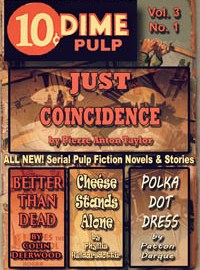
FYI: Available for readers of Dime Pulp who may have missed a few issues or lost the thread of a serial,  Dime Pulp Yearbook 21, featuring the novels (The Last Resort and Better Than Dead) and the short fiction (Hard Boiled Myth and Gone Missing) of Volume One’s 12 issues,  is joined by Dime Pulp Yearbook 22, featuring the complete pulp Western, On The Road To Las Cruces, continuing episodes of  a detective story, Better Than Dead, the opening chapters of new serial novels, Just Coincidence and Cheése Stands Alone, the short fiction of Hard Boiled Myth and Polka Dot Dress, as well as Dropping A Dime’s pithy pulp observations.  Volume Two’s 10 issues are available for perusal in their entirety by simply clicking on the links in this paragraph or on the menu bar above.

If you’ve made it this far, click  on the links above to read the entertaining  serial contents of Volume Three, Number 6

Special Note: Dime Pulp, A Serial Pulp Fiction Magazine has changed its posting schedule from  monthly issues to once every forty-five days (more or less—mostly more). Thus Volume Three will (hopefully) consist of eight issues (much to the relief of the overworked writers and production staff). Thank you for your understanding.

 —Perry O’Dickle, chief scribe
and word accountant


Act Two, Scene 2, pt.2

by Pierre Anton Taylor

Crime occupied his mind. Not just petty crime or corporate crime. Murder. He had little doubt. The lab tests were inconclusive. It didn’t matter. Whoever was behind his father’s death was sophisticated. It was made to look like a heart attack. Not uncommon for a man of his age. Wayne wasn’t convinced. It didn’t pass the sniff test.

And old Rick’s death was murder, there was no question. The police had yet to apprehend the suspect because they didn’t have a suspect. Robbery was the motive, they claimed. The candy store had been doing better business because of the construction and renovation of the old Battery Works next door. Someone was envious. Or greedy. Or both.

Wayne Bruce looked out over the night scape of the city at his feet from the penthouse terrace. Christmas decorations and neon advertisements brightened the streets of the business district below. A skating rink had been installed at City Center. The sound of voices and music, caroling, could be heard faintly, carried by the frigid wind. He had slipped the extreme weather mask off his face to sit above his forehead. The collar of his jet black jacket was sealed by the mask’s overlapping skirt. The lightweight thermal gloves sealed at the wrists kept out the below zero chill. Knuckles reinforced by a granular composite packed to punch. His tightfitting downhill racing leggings, also black, topped a pair of solid custom made steel toed boots.

His pager sounded in the pocket of his jacket. He didn’t bother with it. He knew what it was. The ghost number. His ghost father was calling him to revenge. To avenge his death. And that of poor old Rick. To serve justice to those who would do evil. He would go, out into the frigid night, down to the ice and slush of the darkened streets. There he would face his adversaries.

Turning to reenter the penthouse, he caught a glimpse of his reflection in the wide darkened glass of the sliding doors. It was a silhouette, a lithe dark shadow, the mask rumpled on the top of his head gave the impression of tiny protrusions resembling a pair of horns or ears. He was an avenging angel, he thought, or something else with wings.

Sliding open the door to the penthouse to retrieve his parajump gear, he was reminded of what the maintenance man had said, complaining when the door jammed off track and allowed the December wind to whistle through and snow to pile up on the expensive carpeting. “This suite’s got problems with doors.”

He was surprised. He was unaware that there was a door problem.

“Oh, a couple of times. Before Mr. Bruce died. I told them they needed to replace the whole thing because it hadn’t been installed properly when they changed the casing from French doors to double sliders.” And as an afterthought, “The door to the service access, right about the same time. The key pad failed. I had to call the company. Never had that problem with a lock and key.”

Apparently a minor inconvenience. “They, the Electrolocks Company, sent a technician out right away and he just replaced the entire unit, didn’t take more than fifteen minutes.”

Wayne had been given the grand tour of the Legacy Towers security setup. It was adequate without being intrusive, mostly motion detectors and remote cameras monitored after hours by the night manager, and by a concierge and assistants morning to evening. The service access keypads allowed entry to the upscale suites and flats whose activation triggered the ceiling camera, recording, time stamping, and alerting the monitoring staff. State of the art, the general manager had assured him.

“That’s one of the reasons it took them so long to get in here when the accident happened. That keypad stopped working again. The new overnight man didn’t know how to enact the bypass. Or hadn’t been told how to. It was a mess, as you can imagine, the fire department, the ambulance, the cops.”

What were the odds of a keypad failure so soon after replacement?

“They’re a big company, Electrolocks, they service most of the buildings in the downtown district. They had a good rep. I mean, until this happened. But I know their service supervisor went nuclear, accused the plant staff of tampering with the device, using unauthorized parts because he was sure he was going to be sued because of a malfunctioning keypad.” But for the hint of self-satisfaction, there was more. “When he was told that his guy had installed it, he claimed that they had no record of the service call and no tech had been dispatched to this address. The concierge was tearing his hair out by then. And if that wasn’t enough. The door to the penthouse elevator started acting up,” confiding, “I don’t do elevators.”

There was the drop as if the wind had been caught by surprise and the blur of lights and shadow until the wing snapped taut and lifted him above the roofs of the tall buildings below.

Wayne dragged the equipment out onto the terrace overlooking the city night skyline and set it at the edge of the parapet. The maintenance man had made the point.

“They had to call the elevator company to send a repairman out. It wasn’t the usual crew, just a couple of guys who said they were sent from the main office because it was a priority job. They knew what they were doing. Didn’t take them long. It looked like a cheap plastic ballpoint pen, or something like that, had got caught up in the track. Probably one of the cops or firemen dropped it when they were milling around after they found Mr. Bruce.”

A cheap plastic pen had lodged in the elevator door track impeding it’s closure. What happened to it? Was it discarded at completion of the repair? Returned to the shop accompanying the repair report? And then discarded? Nor was there any certainty that it was a plastic pen, it just appeared to be a clear plastic tube shattered at one end.

Wayne unzipped the large duffel and extracted the wing suit, a prototype he’d had the BATS Lab put together, the product of long discussions and brainstorming with fellow base jumpers and sky divers, some of whom were aeronautic engineers. The sheer wing panels unfolded and tail piece stretched in place, it looked like a paper airplane ready to be launched by a rubber band. So much for high-tech, he thought to himself. The object was to hang under the wing structure and glide down, the body webbing of the suit providing the drag and extra maneuverability.

The surveillance system and laser discs in his father’s office the Smith Brothers had uncovered still remained a mystery. The material could not be accessed without a combination of letters and numbers typed into the keypad and so the expectation of learning what the old man had recorded was muted. One of the electronic techs at the lab was of the opinion that it might take a while, but it could be done. It appeared to be a custom proprietary system. He’d asked Robin to work with the tech. If anyone could come up with a novel approach, it was Robin.

But other than that big surprise in the middle of his discussion with the Smith Brothers about the source of the salting of the grounds at the old Battery Works with toxic substances, the question was who had the most to gain from declaring it a toxic site and getting the government to pay for it. It was serious fraud and it likely required some collusion between interested parties, first dun the feds, and then sell it dirt cheap to developers and investors. It sounded like good business, and a lot of hands needing to be greased. He wondered how much old dad knew about that arrangement. Had he been killed for his opposition? Supposing he had opposed it.

Wayne had stepped on that idea with both feet. It was instinct. He wanted to preserve a memory of a beginning, the grounds for Wallace Bruce’s successful business empire, but also his early memories of it as a thriving community, a family of sorts when everybody knew his name or nicknamed him Triple A or Battery Boy. That’s what he was holding on to. And by converting the old battery factory site into a battery museum as well as a showcase for his antique car collection, converting the old office building to a satellite office for Bruce Advanced Technical Systems, he would begin the slow restitution of a neglected, bombed-out part of the city to the vibrant community it once was. That was the plan at least, the Bruce Give Back plan.

He had given the Smith Brothers, Rosy and Goldie, the information that Robin had learned about JKR Corp. That was a company owned or at least fronted by Joseph Kerr in partnership with Riddler Corp. There was a lot of background of Kerr and Rosy knew some of it. “A place to start,” Rosy had commented. “Riddler is a different proposition, a front company behind another front company, it’s an enigma. We don’t know who we are dealing with,” he’d cautioned. but the brothers, arrogant as ever, had laughed it off. “This is our meat!”

The wind whipped at him as he lifted himself onto the stone parapet that ringed the penthouse terrace. Harness cinched tight across his chest, he slipped his feet into the stirrups of the tail piece, the wing frame rattling at the frigid gusts. He did not look down, a rookie mistake, and let himself drop forward, angling into the thin freezing air. There was the drop as if the wind had been caught by surprise and the blur of lights and shadow until the wing snapped taut and lifted him above the roofs of the tall buildings below. The controlled flight pressed the arctic weather mask against his face, modified goggles keeping his vision clear as he maneuvered his descent toward the blinking rooftop beacon in the distance.

In the past week he had extended the distance of his night flights. This was the third and longest of his attempts, bringing him closer to the outer city district, less than a mile from his base at the Battery Works. Bion Ripley had installed the beacons at the different locations. Now that the work at renovation of the office building on the old factory grounds had progressed beyond the rebuilding phase, Wayne had employed him as a manager and neighborhood advisor. Bion was enthusiastic about Wayne’s plan to revitalizing the area. Otherwise, he knew that if something wasn’t done soon, and the neighborhood was further degraded due to drugs, delinquency, petty crime, and homelessness, then it was only a matter of time before the city razed the district and sold it off to out of state, or even foreign, investors. That, and an affection for old Rick, made them collaborators.

At the last minute, he caught hold of the brick ledge with one hand but not before he was vaulted over the side and slammed into the side of the building.

And Bion had learned something disturbing surrounding the shooting at the candy store. He was convinced that the murder of the old man was not the result of a robbery. There was still cash in the register drawer, not a lot, because it appeared that Rick had moved the midday take into the hidey-hole, and it was still there. It was the other thing that was disturbing.

“When they were done with the crime scene, I went in and took a look around. I found the stash in the hole, behind the candy counter, where he always dropped it, untouched. And I looked around for anything that was missing or out of place. At first I missed it because I didn’t pay a lot of attention to the display. But then it hit me, there was candy missing!”

It was difficult to believe that someone had killed the old man over a candy bar.

“It wasn’t a candy bar. It was the Wacky Wax. All of it!”

Even so, to shoot someone over an off brand wax candy seemed, at the very least, deranged.

“I know it sounds crazy, killing somebody over crappy candy. So I asked around, and someone offered to sell me some Wacky Wax. And the way they told me, I knew. They were selling drugs and using the same packaging as the wax candy.” Bion had shown him the package and it looked exactly like the original except that an extra X had been added to the name. Bion had explained, but Wayne quickly grasped the reasoning. Someone had access to the manufacturer of the ersatz candy, the packaging at least, and was using it to sell drugs.

“I copped some of the Wacky Wax with the extra X and here’s what I found. You snap open the wax candy and there inside is a little lozenge of the drug. And it’s cheap. People are getting strung out behind this junk, whatever it is, and it’s flooding the district.”

There was no question as to who was behind it. One of the many enterprises that could be laid at Joe Kerr’s doorstep. Wayne had sent a sample to his lab. The initial analysis had confirmed his suspicions. It had properties similar to morphine and heroin, but effective in miniscule amounts. He had said nothing when he read the report. He knew very well where he had encountered that substance before. Not that he’d had anything to do with it. It was Charlotte Taste’s party drug of choice. On the street, it was known as Wacky Waxx. In the elite circles that his ex-fiancé traveled, it was known as TDF, To Die For. But what did they care. If things got out of hand, they just checked in to a clinic, like the one Linus Paul operated, got themselves a full body blood transfusion, and they were as good as new. On the street, Wacky Waxx left you to die in the gutter like so much dust and debris.

Thinking about Charlotte always scattered his concentration. He was right on top of the beacon and he had to act right away. He yanked on the ripcord to release the rigid wing and felt himself drop toward the rooftop, but too quickly. He had misjudged. The heavy wingsuit now was just a liability. He landed on both feet and rolled. He was too close to the edge of the roof. The momentum was carrying him over. At the last minute, he caught hold of the brick ledge with one hand but not before he was vaulted over the side and slammed into the side of the building. It knocked the wind out of him although the wing suit had cushioned much of the blow. Still he was dangling five stories above the deserted street below. With a great effort he grabbed the ledge with his other hand and pulled himself back up onto the roof and lay there letting his racing heart calm down. A thought crossed his mind. Charlotte would be the death of him.


Next Time: A Dark Knight Disrupts The Wacky Waxx Factory

Contents Vol. 3 No. 4

Welcome to Volume Three, Number Four of Dime Pulp,
A Serial Pulp Fiction Magazine

In this issue of  Dime Pulp, A Serial Pulp Fiction Magazine,  Colin Deerwood’s long running 40’s pulp detective serial, Better Than Dead,  Phyllis Huldarsdottir’s steampunk Cheése Stands Alone, and Pierre Anton Taylor’s crime fighting Just Coincidence, combine to give the reader their dime’s worth of Serial Pulp Fiction!

FYI: Available for readers of Dime Pulp who may have missed a few issues or lost the thread of a serial,  Dime Pulp Yearbook 21, featuring the novels (The Last Resort and Better Than Dead) and the short fiction (Hard Boiled Myth and Gone Missing) of Volume One’s 12 issues,  is joined by Dime Pulp Yearbook 22, featuring the complete pulp Western, On The Road To Las Cruces, continuing episodes of  a detective story, Better Than Dead, the opening chapters of new serial novels, Just Coincidence and Cheése Stands Alone, the short fiction of Hard Boiled Myth and Polka Dot Dress, as well as Dropping A Dime’s pithy pulp observations.  Volume Two’s 10 issues are available for perusal in their entirety by simply clicking on the links in this paragraph or on the menu bar above.

If you’ve made it this far, go ahead and follow the links below to reading entertainment with the serial contents of Volume Three, Number 4

Special Note: Dime Pulp, A Serial Pulp Fiction Magazine has changed its posting schedule from  monthly issues to once every forty-five days. Thus Volume Three will consist of eight issues (much to the relief of the overworked writers and production staff). Thank you for your understanding.

 —Perry O’Dickle, chief scribe
and word accountant


dparcbtd

“Lackland Ask is the name. ‘Lack’ to my friends, ‘Don’t’ to those who think they’re funny. You might have seen my portrait on the cover of Black Mask, the crime fiction magazine. This is my story. It starts with a blonde. This kind of story always starts with a blonde.” Thus begins the seemingly non-stop, endless narrative of Better Than Dead in which women are not the only trouble although most of it, told with the wit and street savvy of Runyon and Parker.

Better Than Dead—26


LCinset21In March of 1892, a Scotsman by the name of Arthur C. “Artie” Doyle was hanged by the neck until dead after being found guilty of a string of grisly murders of prostitutes in Whitechapel. At that moment, history veered off its presumed course and headed in a direction all its own in which the Great War never happened because the Kaiser was afraid of offending his grandmother, Queen Victoria, whose life has been prolonged by the wonders of biology. Her reign, known as the Pax Victoriana has lasted 180  years maintaining as many Victorian airs as possible while making accommodations to rapid advances in bio technology. Cheése Stands Alone poses a steampunk question, can Captain Lydia Cheése  (pronounced “Chase”) find her father, the antigovernment turncoat and radical, Commodore Jack “Wild Goose” Cheése. And furthermore, will her quest take her around the globe and through alternate world histories in the requisite 80 days or is it the beginning of a lifelong journey?

Cheése Stands Alone IX


JCA1S3In Just Coincidence, a privileged young man with the unremarkable name of Wayne Bruce returns to the site where his father once had his business, a battery manufacturing plant, and where he often spent his childhood days hanging around the factory and the neighborhood. His return is haunted by the mysterious circumstances surrounding his father’s death and the vague feeling that his uncle is somehow involved.  Appalled by the poverty and crime of the place he remembers fondly, he is moved to resolve the injustice of the socially marginalized and to wreak vengeance on those he believes are responsible for the death of his father. A personal coincidence brings together dark prince and dark knight joined in a fateful and tragic quest for justice.

Act Two, Scene 2, Part 1


Act Two, Scene 2, pt.1

by Pierre Anton Taylor

Harold had called an emergency board meeting, It almost turned into an intervention with Wayne as the focus. Present were his mother, Trish, and Dr. Linus Pall. Two other members of the board were out of reach and two others were connected via conference call. Harold had returned from DC and the news was not positive. The contract was officially under review. He assured them that it was just a technicality but Wallace Bruce’s sudden death had sent up flags and because the agency was itself under congressional review, they were going to proceed according to the letter of the law and order a full audit of Bruce Enterprise. An outside accounting firm would have to be engaged and it would be costly. “The PR office will be on the alert for any adverse publicity that could affect the company’s place in the standings and putting a positive spin on anything that might reflect badly on the brand.

“Wall had been pushing hard on expansion and acquisitions and took some risks. But he fought hard to be in the running with fierce competition from companies with offshore manufacturing in Indonesia. He was very proud that he could stamp American Made on our products.”

Harold went on to explain that negotiations were ongoing so no need to panic although Wallace’s death could not have come at a more critical time. And that, more than ever, the company’s future depended on research and development represented by the work being done at Bruce Advanced Technical Solutions.

Eyes rested briefly on Wayne. He set his jaw and met their gazes. He had been briefed on most of what Harold was saying when his uncle had returned from DC. The mention of BATS replayed a conversation he’d had with the lab supervisor regarding the sample taken from the carpeting in the penthouse where old dad had died. The high concentration of acetate was still unexplainable and inconclusive.

It had occurred to Wayne during the repeated viewings of the footage of the elevator to the penthouse and his father entering it alone the night of his death, that if there was any foul play it would have occurred in that box. But how? Unless the elevator was the killer.

He steeled a glare at Dr. Pall. He may have been the last one to see his father alive if what Charlotte had said was true. His attempts to meet with the good doctor face to face had been canceled or rescheduled as if he were being avoided. He was sure it had to do with his breaking off the engagement with Charlotte. Pall had been outraged by it.

“I’ve put on retainer a security consultant, Smith Brothers Security, to investigate the circumstances surrounding the designation of the old battery works as a toxic site and look for signs of impropriety. Any hint of culpability must be minimized to zero. If you understand what I mean. That we are taking the initiative on this matter will be further evidence that there was no attempt or intent to defraud the Toxic Cleanup Fund.” Harold paused to look at the notes in front of him.

“They were represented to me as an entirely reputable and reliable investment in the specialty toxic cleanup business.” Linus Pall adjusted the water glass in front of him to line up with the top right corner of the blank notepad in front of him at a forty-five degree angle. “I tendered my resignation as soon as I learned of the allegations. I’m on a number of boards, charitable organizations as well, and for the most part I’m just another hand at the table.” He smiled as if to himself secretly. “I’m in the business of business. That’s what I do. I’m a physician, and attorney, and I’m also the director of a world renowned rehabilitation clinic catering to an exclusive international clientele. Membership on various boards allows me access to potential clients that we can best serve.”

Pall lifted his gaze from his hands folded in front of him and addressed Wayne. “I was your father’s physician so you can imagine my shock at his heart attack. I knew him to be in good health for a man of his age although he did disregard my advice on his eating and drinking habits, not enough of the former and too much of the latter. And as his personal attorney I was his close confidant and advisor. I am positive that Wallace Bruce had no foreknowledge that there might be anything improper about the toxic site designation at the abandoned battery factory. He was in fact appalled by the report of toxic chemicals after all this time. He was diligent about ensuring a safe environment for his workers and abiding by the disposal regulations. He did admit that some contamination could have occurred and might have been missed when they closed the old plant down. ‘There’s no clean way to make a battery’ I’ve no doubt you’ve heard him say many times before. Yet he believed that the future was in portable energy, that it would power the technology of the future. He was nostalgic about the old battery factory even as it became a liability. Again, being an astute businessman, he resigned himself to having the cleanup done, razing the old brickworks, and selling the land to developers to recoup the cost.

“Walace is the reason Bruce Enterprise exists today. It is his legacy and that is what is at stake, as is the fate of the company. We must move on and not waste any more time or resources on the trivial matter of the Battery Works. It may have been his humble beginnings but it is dwarfed by the stellar accomplishments of his later years. He was a force of nature, but his wind has died down.” Pall wet his lips with the water in the glass and returned it to the exact same spot.

“Fortunately Harold is at the helm now. This has always been a family enterprise. Your mother understands the need for a united front if the BE brand is to have a future and continue as an innovator in portable energy devices. You have an opportunity to contribute by presenting yourself as a corporate leader, a responsible businessman following in your father’s footsteps, not a mountain climbing sky diving martial arts playboy with nothing better to do than dabble in philanthropy with a valuable piece of property in a misguided attempt to appease his guilt. Going through with the marriage to Charlotte Taste would have been more of a level headed decision for a captain of industry and an indication that you voted for the future of Bruce Enterprise. Yet you insist on wallowing in the past. Tell me what will this memorial do other than inflate your ego. What good will your defiance of common sense do? Forget this obsession and get your life back on track! Otherwise, it is madness!”

“And why does it have to be in the most crime infested part of the city?” Trish added. “Drive by shootings, muggings, drug dealing. I can’t imagine a more unsavory location. And the police still haven’t caught that vigilante terrorizing innocent people.”

Wayne had heard his mother’s complaint before. And his argument was that the kind of crime that was committed in East Central was due to poverty. And he’d wanted to add that it was the kind of crime that occurred in corporate boardrooms that was responsible for that poverty and was rarely if ever prosecuted.

Celia Grove, one of the longest serving board members and someone he had grown up knowing as Aunt Celia, chimed in. “You speak of legacy, Linus, and your focus is strictly business, but Wallace Bruce’s legacy also includes charitable work, philanthropy, the repaying the service and work of his employees. That legacy of giving back to the community makes him an honorable man. And what Wayne proposes honors his father and does it by bringing jobs back to the depressed area. And I might add that as his father’s heir he has the latitude to pursue that aspect of the corporation’s mission.”

Dr. Pall fidgeted, staring at the black box in the center of the table from which the voice emanated. “We already know that, Celia!” Linus and Celia were rivals, hardly friends, perhaps because it was believed that at one time Celia had been old dad’s paramour and that both she and Linus could claim exclusive rights to a certain intimacy with the deceased.

Trish spoke up. She disliked Celia for obvious reasons as well as what she deemed was the woman’s holier than thou attitude. “Celia has a point. Wallace particularly enjoyed that aspect of his wealth. He reveled in the ritual of giving his money away not so much for the good that it might do but because it made him feel god-like, that his generosity could affect so many people and that they would see him as a benefactor in their lives, name their children after him. It solidified his moral ground. He was on his way to being a bronze statue of himself, anyway. That said, I agree with Linus. The renovations at the old battery factory is a distraction. Wayne, dear, you must understand that our focus must be solely on weathering this awful audit.”

“That brings up another issue,” Celia interrupted from the box at the center of the conference table. “We just did a full audit not more than two years ago, I believe. Couldn’t we just amend that audit, bring it up to date?”

There was a pause as Harold took a deep breath and rolled his eyes.

“I mean, it would get it done quicker,” Celia added, “and it wouldn’t be as costly.”

Harold nodded his head impatiently as if she could see him. As he was about to answer, the low whistle of snoring was audible as the remaining board member indicated his presence.

“Celia, yes, we’ve already said that. I don’t know why you brought it up again when we had already discussed it earlier and I explained to you why what you suggested will not satisfy the review committee.” Harold signaled to his secretary who was hovering outside the glass door to the conference room. She opened the door partway to announce, “The Smith Brothers are here.”

Wayne had known the Smith Brothers, Trey and Mark, when they attended the same elite prep school. Back then they were known to everyone as “Rosy” and “Goldy.” Trey’s ruddy complexion resulted in that moniker. Mark’s almost platinum locks named him. Wayne had run into them socially a few times since their school days. Trey, William Smith III, was still ruddy complected but had lost the baby fat and had acquired the broad shoulders of an athlete. Mark sported a buzz cut, gone was the disco look of an earlier time. That they had matured might have been an overstatement. They had certainly settled into adulthood, hardened by a cynicism that comes from dealing with others they considered inferior to them. The schools they attended had made clear the dividing line between them and the others. And Smith Brothers had made it a business in keeping the others at a distance from those like them who could afford their security services.

Smith Brothers Security had been founded by their father, a former police detective with ambition, and his brother, a well-known defense attorney. In that way Wayne and the Smith Brothers were alike—they both toiled in their fathers’ figurative vineyard. Otherwise, he  had nothing in common with them.

After they had been introduced to the board and pleasantries exchanged, Harold had adjourned the meeting. He was confident that Wayne would brief the brothers on the details of the matter. Trish and Linus left deep in conversation, with Linus offering a parting shot, “Keep in mind what I said, Wayne.”

There was an espresso bar in the anteroom of the executive office which the executive secretary had served them in the inner sanctum. The brothers and Wayne sipped from their demitasses, Wayne seated in the large leather armchair usually occupied by his father and opposite the glass topped low table where Trey sat in the adequate leather couch. Mark leaned against the edge of the large desk commanding easily a quarter of the space.

Trey set his demitasse on the table and made a show of taking in the grandeur of the large windowed office. “Nice digs, Way. Is this where you hang out?” “Way” was a nickname he had acquired in prep school where it was usually paired with “out” or “no.” And as a privileged class no one used the word “work.” In their world one created a presence, like the gods of myth, by hanging out and making things happen.

“No, this is the old man’s. I have an office at the BATS Lab. And I’m renovating the old office at the Battery Works so I can hang out there while I supervise the conversion of the property into a showplace for my antique car collection.”

Mark had wandered over to the wide windows overlooking the surrounding high-rises and rooftops of the downtown business district. “Nice view,” he remarked, mostly to himself. Then turning to them, “Hard to believe you’d trade this in for that rundown ghetto around the old factory.”

“Was that when you discovered the toxic waste problem? What led to your suspicion that the report was falsified?” Trey asked after glaring at his brother for being so undiplomatic.

Wayne considered his answer. He didn’t trust the Smith Brothers. He wondered how much Harold had told them. He understood that they were merely window dressing, a cover designed to give the impression that the company was being proactive. He was certain nothing would come of it.

“Two things. One was that I was surprised that there was any toxic material at the site. My father prided himself on a clean operation. One of the reasons he shut down manufacturing at the old plant was that he could no longer guarantee that the safety guidelines were met. The other reason is that the old battery works has an historical value in the growth of this city and the neighborhood it supported.”

“Ah, nostalgia,” Trey nodded, “Nice when you can afford it.”

Mark had wandered over to stand in front of the wide set of bookshelves and their leather bound volumes, nodding in appreciation. “Your old man had good taste in literature. This is quite an investment in intellectual capital. All the great minds gathered in one place. Right at your fingertips.” He turned and smiled at Wayne and his brother. “And it looks like he invested in a state of the art surveillance system as well.”

To Wayne’s surprise Mark ran a hand along one edge of the bookshelves until he found what he wanted. With a faint hum a panel of books slid forward and dropped down to reveal electronics, a flat narrow box with a tiny green light glimmering in one corner.

“There’s a camera there,” Mark said pointing to a spot in the ceiling overlooking the desk. “I’ll bet I can find a mic in the desk. And probably one in the light fixture where you’re sitting. I wouldn’t be surprised if there’s a camera too.” He laughed. “Your old man had this place bugged!”


Next Time: What The Discs Reveal

Contents Vol. 3 No. 3

Welcome to Volume Three, Number Three of Dime Pulp,
A Serial Pulp Fiction Magazine

In this issue of  Dime Pulp, A Serial Pulp Fiction Magazine,  Colin Deerwood’s long running 40’s pulp detective serial, Better Than Dead, hapless city rat Lackland Ask, hiding out from the mob in the country, runs into more trouble from a shotgun toting moonshiner and his star struck daughter, and has to wonder why everyone keeps mistaking him for a dead man.

In Lydia Cheése’s post axial shift world, the reader enters an unfamiliar historical realm peopled by historically familiar names. In Phyllis Huldarsdottir’s Cheése Stands Alone, biology takes the lead as the premier science and physics is just something engineers do. The world is steam powered and airships are the primary mode of intercontinental transport. The Pax Victoriana has lasted 180  years thanks to the machinations of the Admiralty and its intelligence network, IOTA.

In Act Two, Scene 1, part 3, of Pierre Anton Taylor’s Just Coincidence, a classic tale of vengeance gone wrong with overtones and correspondences from popular illustrated hero literature, Wayne Bruce is made an offer he shouldn’t refuse and meets his nemesis, Joe Kerr, in person for the first time. His response to being targeted in a drive-by is swift and original.

FYI: Available for readers of Dime Pulp who may have missed a few issues or lost the thread of a serial,  Dime Pulp Yearbook 21, featuring the novels (The Last Resort and Better Than Dead) and the short fiction (Hard Boiled Myth and Gone Missing) of Volume One’s 12 issues,  is joined by Dime Pulp Yearbook 22, featuring the complete pulp Western, On The Road To Las Cruces, continuing episodes of  a detective story, Better Than Dead, the opening chapters of new serial novels, Just Coincidence and Cheése Stands Alone, the short fiction of Hard Boiled Myth and Polka Dot Dress, as well as Dropping A Dime’s pithy pulp observations.  Volume Two’s 10 issues are available for perusal in their entirety by simply clicking on the links in this paragraph or on the menu bar above.

If you’ve made it this far, go ahead and follow the links below to reading entertainment with the serial contents of Volume Three, Number 3

Special Note: Dime Pulp, A Serial Pulp Fiction Magazine has changed its posting schedule from  monthly issues to once every forty-five days. Thus Volume Three will consist of eight issues (much to the relief of the overworked writers and production staff). Thank you for your understanding.

 —Perry O’Dickle, chief scribe
and word accountant


ask1234fi

“Lackland Ask is the name. ‘Lack’ to my friends, ‘Don’t’ to those who think they’re funny. You might have seen my portrait on the cover of Black Mask, the crime fiction magazine. This is my story. It starts with a blonde. This kind of story always starts with a blonde.” Thus begins the seemingly non-stop, endless narrative of Better Than Dead in which women are not the only trouble although most of it, told with the wit and street savvy of Runyon and Parker.

Better Than Dead—25


chase23In March of 1892, a Scotsman by the name of Arthur C. “Artie” Doyle was hanged by the neck until dead after being found guilty of a string of grisly murders of prostitutes in Whitechapel. At that moment, history veered off its presumed course and headed in a direction all its own in which the Great War never happened because the Kaiser was afraid of offending his grandmother, Queen Victoria, whose life has been prolonged by the wonders of biology. Her reign, known as the Pax Victoriana has lasted 180  years maintaining as many Victorian airs as possible while making accommodations to rapid advances in bio technology. Cheése Stands Alone poses a steampunk question, can Captain Lydia Cheése  (pronounced “Chase”) find her father, the antigovernment turncoat and radical, Commodore Jack “Wild Goose” Cheése. And furthermore, will her quest take her around the globe and through alternate world histories in the requisite 80 days or is it the beginning of a lifelong journey?
Cheése Stands Alone VIII


JCA1S3In Just Coincidence, a privileged young man with the unremarkable name of Wayne Bruce returns to the site where his father once had his business, a battery manufacturing plant, and where he often spent his childhood days hanging around the factory and the neighborhood. His return is haunted by the mysterious circumstances surrounding his father’s death and the vague feeling that his uncle is somehow involved.  Appalled by the poverty and crime of the place he remembers fondly, he is moved to resolve the injustice of the socially marginalized and to wreak vengeance on those he believes are responsible for the death of his father. A personal coincidence brings together dark prince and dark knight joined in a fateful and tragic quest for justice.

Act Two, Scene I, Part 3


Act Two, Scene 1, Part 3

by Pierre Anton Taylor

Wayne made his way through Joe Kerr’s warehouse maze of shelves and bins alert to any hint that he was being followed. The door to the street was unsecured. He slipped the lock and stepped out onto the pavement before glancing back. No one was there. He pulled the collar of his long black overcoat up around his ears and set out into the blustery freezing afternoon. He didn’t expect Kerr or his goons to offer a ride back to the Battery Works.

He’d received a message on his pager when he’d been talking to the crime boss. He glanced at the readout. He knew the number. He would call Robin on a secure line when he got to the satellite phone the Lab had installed in his Plymouth Fury. Otherwise, he was looking at a slog back through the neighborhood to the Lab’s temporary office.

Trash piled up along the curbs only emphasized the squalid conditions of the old neighborhood. He’d walked these streets as a youngster reveling in the vibrant activity of manufacturing shops giving machine rhythm to his pace. Most of those were now empty lots and crumbling bricks adorned by mounds of old gray snow. Cars raced by screeching around deserted corners in a hurry to get away from nowhere going nowhere. In his memory, the streets bustled with people in and out of businesses when Central was a busy local shopping district. Now the storefronts were shuttered, their boarded windows and doors gathering litter and graffiti. A pool hall in the middle of the block was still functioning as a meeting place for truants and delinquents looking for opportunities that would likely get them arrested. He passed by giving barely a glance at the wide windowed entrance where dim overhead lighting picked out hunched shoulders and silhouetted cues.

He rolled to the ground as the sedan sped past, gunfire bursting from the passenger’s side.

On the opposite side of the street between two abandoned cars a group of youngsters were playing an improvised game of hockey on a wide patch of ice, the result of a leaking pipe from the used appliance store closed by the police as an outlet for stolen goods. They paused their game to consider the lone dark figure striding toward the bright entrance of the Korean convenience store, neon liquor logos beaming a sour red. Adult foot traffic was unusual unless they were derelicts or lost. Too easy to get jacked on foot. Anyone who was anyone had wheels even if it was just two on a board.

As Wayne approached the end of Central where it teed into Battery, Penn Quinn’s Tavern was a grimy oasis of light illuminating the dark peripheries of a fading winter afternoon at the dead end occupied by the Battery Works. By the number of cars parked along the curb, the tavern was doing good business undoubtedly drawn by a televised sports event.

A car pulled up at the corner, idling as he approached. He changed his course and crossed the street between the unoccupied parked cars. If he had to, he could duck into the bar. He was naturally suspicious, and if it was paranoia, he’d count it as a survival skill. He didn’t slacken his pace, judging the distance from the curb in front of Quinn’s to the deserted candy store across the street and further down the block to the secure gate of the Battery Works. He wasn’t going to be intimidated. He wasn’t lacking in pride which often overrode caution. His best option was to keep to the cover of the few vehicles and the abandoned van parked near the old apartment building behind the tavern.

Wayne tensed as he heard the engine rev up and glanced back in its direction. The dirty white Trans Am maneuvered slowly onto Battery, cruising slowly past as he stepped into the shadows of the abandoned van. Once the Trans Am reached the dead end of the street and would have to turn around, he planned to make a run for the gate.

His move had been anticipated. As he stepped out into the roadway, the muscle car accelerated in reverse, tires smoking. He rolled to the ground as the sedan sped past, gunfire bursting from the passenger’s side. He could hear the thud of the rounds hitting the side of the van as he made himself small and dove between the parked cars. He poked his head up to peer over the front fender of an old 50’s Dodge dreadnaught and saw the Trans Am squeal to a stop, its front end rotating ninety to point back down Central. A few more round erupted from the driver’s side before it sped away narrowly missing a motorcyclist turning onto Battery.

He stepped back out onto the roadway, the single headlight of the motorcycle bearing down on him. He put up his arm to shield his eyes. The motorcycle skidded to a halt as it reached him skidding a half circle. He recognized the 1980 Suzuki Katana and the green, red, and yellow leathers of the rider. Robin.

The visor of the black helmet went up and a smirk appeared. “Let me guess. You forgot to tip.”

“We need to follow the shooters. Find out who they are!”

Robin nodded and handed him the backpack. “Ok, hop on. You get to wear the hump.”

Wayne donned the backpack and settled in the saddle behind Robin, The Katana reared on its back wheel like a trusty paint and sped after the shooters. Their taillights were visible racing down Central. Then the brake lights blinked briefly as they took a corner and disappeared. The Suzuki was at the corner in no time at all, cutting in behind a passing car making the turn. They were headed toward the Arnold Expressway. The Suzuki was closing fast as the Trans Am made for the onramp. At the last minute it swerved off, jumping the low barrier, and sped down the surface street running under the overpass.

The Suzuki leapt the divide to follow, fishtailing as it landed, Wayne gripping the frame with his knees and clutching the sides of Robin’s leathers.

An arm and a shoulder appeared out of the passenger side along with a muzzle flash and then another. Wayne tapped Robin on the shoulder and pointed to the side of the road, “Pull over!”

As they watched the car speed away, Wayne shook his head. “Not worth getting you shot over this. I have an idea.” He pointed after the car disappearing from view. “They’re heading for the gravel pits and the abandoned asphalt plant. There’s no exit in that direction. Maybe they think we’ll follow them and they can ambush us.” He indicated the dirt track going up the side of the embankment. “I used to ride dirt bikes up that way as a kid. The main rail line from the cement factory is up there too. They’re going to have to take a detour around the gravel pits and pass under the railroad trestle bridge before they get to the asphalt plant. That’s where they’re likely to make their stand. If we go offroad we can beat them to the bridge.”

Robin didn’t need any urging, goosing the Suzuki up the narrow dirt path among the frozen weeds and the low tangle of wiry shrubs. The ground was muddy in spots but they crested the rise and came up to the railroad track. The gravel and rock along the rail bed was enough to give them traction and the Katana raced toward the trestle bridge that crossed the ravine and the unpaved road below.

From that vantage Wayne could see the Trams Am skirting the largest of the water filled gravel pits the size of a small lake. He hopped off the saddle and sprinted to the edge of the bridge, searching for something. He bent down and found a large black railroad tie that had been abandoned at the side of the tracks. He ran back to Robin. “You wouldn’t have a rope in that backpack would you. And I’m going to need your helmet.”

“No rope, just some cargo bungees I use to tie down the bike with in the back of my pickup.” Robin unclasped the chin strap, pulling the helmet up and letting the cascade orange hair fall to her shoulders. “I hope you’re not thinking of jumping off the bridge. This is a very expensive helmet.” Concern didn’t show on her rosy cheeked pale complexion.

Wayne has zipped open the backpack and removed the two long bungee cords. “What are these, three footers?”

Robin nodded, “Yeah, and they’ll stretch to twice that length. You’re not thinking of doing what I think you’re going to do?” she asked with bright surprise.

“That remains to be seen. What else have you got in here?” Wayne held up a can of black spray paint.

Robin blushed, accentuating her robin breast red hair. “Uh, a little hobby I indulge myself in my off hours.” She laughed and then, “A girl’s got to have a life, especially after dark. Besides, someone’s got to save the world.”

Wayne could see the Trans Am taking the final bend around the gravel pit and heading toward the trestle bridge. Then he heard it before he saw it, the large diesel engine with its bright cyclopean eye taking up the horizon of the tracks and sounding a few warning hoots of its horn.

Helmet on his head, he collected the bungees, slipping the can of spray paint into his pocket, and raced to the trestle bridge. He lifted the nine foot long railroad tie to his shoulder and then walking the rumbling rail like a tightrope to put himself directly over the road below. The large diesel hooted frantically as it approached, a shriek of brakes being fruitlessly applied. He could see through the gaps in the rails that the Trans Am was still kicking up dust as it began passing under the bridge. He had to time it just right. He let the tie drop, and not waiting to gauge the impact, loosened the two bungees, hooking them together with one end attached to the gleaming smooth steel of the rail. He jumped.

It was easily a thirty foot drop and he had to release his grip when the bungees reached full extension, not before, and not after it began retracting. But the diesel didn’t allow him that choice. He felt the tug as the bungee caught but almost immediately as it passed overhead, the slack as he fell the rest of the way to the road below. He landed hard rolling forward to lessen the impact as he’d been taught in sky diving practice. His right shoulder and the helmet caught the brunt of the shock in the somersault to land him shakily on his feet.

Wayne snatched up the weapon and pointed it at the kid trying to squeeze himself past the wood pillar.

The dirty white Trans Am had skidded to a stop further down the dirt road, it’s front end hanging perilously over the ice caked waters of a gravel pond. The railroad tie had impaled the roof just behind the windshield like a toothpick through a club sandwich.

Wayne reached the driver as he staggered out from the wrenched open door of the skewered muscle machine. He was a short stocky man in a red hooded sweatshirt with a chrome .45 in his hand. He appeared bewildered, looking back at his wheels with the creosote ornament and then at the dark helmeted figure nearly on top of him. He raised the gun at Wayne. He did not expect the cloud of misted black paint to blind him. He shrieked clawing at his eyes.

Wayne head butted him sending the man to his knees. He kicked the gun out of the driver’s hand and it skittered across the frozen dirt of the road, over the berm at the edge the gravel pit, and settled on the thin ice crust which gave way under its weight and sank from view.

Wayne heard the yells, and calls for help, from the passenger trapped inside the two door sedan. He ducked his head in to catch a glimpse of the inside and a shot brushed him back. The passenger, a big overweight kid with a short dark ponytail, was stuck with the choice of opening the door on his side over the frigid waters of the pit or crawling out through the driver’s side. The railroad tie was blocking one option. The dirty white hardtop was on the verge of tipping into the gravel pond from the passenger’s struggle with obstacle.

“Help me out, please, I promise I won’t shoot!

“Throw you gun out and then we can talk.” Wayne kicked the rear bumper for emphasis.

“Okay, okay!” The chrome pistol careened off the door frame before dropping to the ground.

Wayne snatched up the weapon and pointed it at the kid trying to squeeze himself past the wood pillar.

“No, no, don’t shoot!” he pleaded falling back against his door and causing the car to wobble a little more.

Satisfied the panic was genuine or he would have used another weapon if he’d had one, Wayne tossed the chrome to join its twin in the drink. Hopping on the trunk and then the roof, he set his shoulder on the protruding tie, wrapped his arms around it and pulled up. It didn’t budge. The tottering car shifted forward.

The shooter inside screamed, “What are you doing?!”

Wayne tried again, giving the tie a twist and another tug to loosen it, and pulled it up part way. He jumped to the ground as the kid scramble to get his bulk across the seats for the open door. The combined motion of the two caused the Trans Am to shift its center of gravity and the front end slowly started sliding into the pond.

The kid began a panicked wail as Wayne edge to the door and tossed in one end of the bungee cord. Bracing himself on the berm, he held tight and pulled when he felt the tension of the bungee in the kid’s grip. The Trans Am lurched sideways, the right front submerged. Stretched to the limit, the line allowed the kid to pull himself free from the sinking sedan scrambling through the pond’s edge. Wayne hauled him up and over the berm like an old truck tire.

He set his boot on the large boy’s back as he tried to get up. “You made a mistake. Whoever put you up to this made a mistake. Killing someone is a mistake. Missing them is an even bigger mistake.”

“No, no,” the kid protested, “we wasn’t supposed to kill him! Just scare him is all.”

“You should be the one who is scared. Vengeance is swift for those who commit crimes on my turf,” he growled, “I’m the new boss and what I say goes. Pass it around.” Over his shoulder, the Trans Am continued in its icy baptism by showing its underside, lurching forward, sinking deeper.

Later that evening, the East Central precinct sent a patrol car to investigate the report of gunfire near the railroad overpass on the road to the old asphalt plant. They found two men secured to the beams of the trestle bridge with bungee cords and a sedan that had been reported stolen earlier in the day partially submerged in a gravel pit.


Next Time: Act II, Scene 2, Part 1—The Case For Murder.

Contents Vol. 3 No. 2

Welcome to Volume Three, Number Two of Dime Pulp,
A Serial Pulp Fiction Magazine

In this issue of  Dime Pulp, A Serial Pulp Fiction Magazine,  Colin Deerwood’s long running 40’s pulp detective serial, Better Than Dead, hapless city rat Lackland Ask, hiding out from the mob in the country, runs into more trouble from a shotgun toting moonshiner and his star struck daughter, and has to wonder why everyone keeps mistaking him for a dead man.

In Lydia Cheése’s post axial shift world, the reader enters an unfamiliar historical realm peopled by historically familiar names. In Phyllis Huldarsdottir’s Cheése Stands Alone, biology takes the lead as the premier science and physics is just something engineers do. The world is steam powered and airships are the primary mode of intercontinental transport. The Pax Victoriana has lasted 180  years thanks to the machinations of the Admiralty and it’s intelligence network, IOTA.

In Act Two, Scene 1, part 2, of Pierre Anton Taylor’s Just Coincidence, a classic tale of vengeance gone wrong with overtones and correspondences from popular illustrated hero literature, Wayne Bruce is made an offer he shouldn’t refuse and meets his nemesis in person for the first time.

FYI: Available for readers of Dime Pulp who may have missed a few issues or lost the thread of a serial  Dime Pulp Yearbook 21, featuring the novels (The Last Resort and Better Than Dead) and the short fiction (Hard Boiled Myth and Gone Missing) of Volume One’s 12 issues,  is joined by Dime Pulp Yearbook 22, featuring the complete pulp Western, On The Road To Las Cruces, continuing episodes of  a detective story, Better Than Dead, the opening chapters of new serial novels, Just Coincidence and Cheése Stands Alone, the short fiction of Hard Boiled Myth and Polka Dot Dress, as well as Dropping A Dime’s pithy pulp observations of Volume Two’s 10 issues, and ready for perusal in their entirety by simply clicking on the links in this paragraph or on the menu bar above.

If you’ve made it this far, go ahead and follow the links below to reading entertainment with the serial contents of Volume Three, Number 2

Special Note: Dime Pulp, A Serial Pulp Fiction Magazine has changed its posting schedule from  monthly issues to once every forty-five days. Thus Volume Three will consist of eight issues (much to the relief of the overworked writers and production staff). Thank you for your understanding.

 —Perry O’Dickle, chief scribe
and word accountant


ask1234fi

“Lackland Ask is the name. ‘Lack’ to my friends, ‘Don’t’ to those who think they’re funny. You might have seen my portrait on the cover of Black Mask, the crime fiction magazine. This is my story. It starts with a blonde. This kind of story always starts with a blonde.” Thus begins the seemingly non-stop, endless narrative of Better Than Dead in which women are not the only trouble although most of it, told with the wit and street savvy of Runyon and Parker.

Better Than Dead—24


chase23In March of 1892, a Scotsman by the name of Arthur C. “Artie” Doyle was hanged by the neck until dead after being found guilty of a string of grisly murders of prostitutes in Whitechapel. At that moment, history veered off its presumed course and headed in a direction all its own in which the Great War never happened because the Kaiser was afraid of offending his grandmother, Queen Victoria, whose life has been prolonged by the wonders of biology. Her reign, known as the Pax Victoriana has lasted 180  years maintaining as many Victorian airs as possible while making accommodations to rapid advances in bio technology. Cheése Stands Alone poses a steampunk question, can Captain Lydia Cheése  (pronounced “Chase”) find her father, the antigovernment turncoat and radical, Commodore Jack “Wild Goose” Cheése. And furthermore, will her quest take her around the globe and through alternate world histories in the requisite 80 days or is it the beginning of a lifelong journey?

Cheése Stands Alone VII


JCA1S3In Just Coincidence, a privileged young man with the unremarkable name of Wayne Bruce returns to the site where his father once had his business, a battery manufacturing plant, and where he often spent his childhood days hanging around the factory and the neighborhood. His return is haunted by the mysterious circumstances surrounding his father’s death and the vague feeling that his uncle is somehow involved.  Appalled by the poverty and crime of the place he remembers fondly, he is moved to resolve the injustice of the socially marginalized and to wreak vengeance on those he believes are responsible for the death of his father. A personal coincidence brings together dark prince and dark knight joined in a fateful and tragic quest for justice.

Act Two, Scene I, Part 2


Act Two, Scene I, Part 2

by Pierre Anton Taylor

Wayne’s curiosity got the best of him when the man named Joseph Kerr had requested a word with him. He had approached the open Town Car door with the human pylon standing next to it with cautious determination. The man in the back seat was wearing a camel hair top coat, a somber Homberg of darker caramel and a pair of round lens dark glasses, the kind that blind men are often depicted wearing. His nose was thin with a slight bulb at the end and the lines around his mouth were those of someone who laughed a lot.

Joe Kerr, in fact, wanted more than just a word and suggested that they sit down and have a talk about business. He was a businessman and Wayne Bruce was a businessman. They had a lot in common. Kerr suggested his office a few blocks away in the warehouse that housed his novelty distribution center.

Wayne remembered it as the space occupied by a machine and metal shop when he frequented the area as a youngster, a large square brick building with high windows and wide doors. Ripley had thrown him a worried look when he had accepted Kerr’s invitation. He’d handed Bion the keys to his Fury and told him he would pick it up back at the Battery Works before climbing in next to the man with long narrow fingers wrapped around the head of an ornate cane depicting a grimacing gargoyle.

Now he was being given a tour of the large space occupied by the ranks of shelves and bins, crates bulging with synthetic dayglo colored plastic shapes representing the merest abstract anthropomorphic configurations. The rows and rows of girly magazines and video tapes in a caged lockup on the one side and the off brand candy and snack aisle on the other. Anything advertised in the back of men’s magazines or the back covers of super hero comic books came from places like Kerr’s warehouse. The magic trick manuals or water babies or itching powder, poo-poo cushions, hand buzzers, glowing yo-yos, and skunk oil. As they approached the lighted enclosure of Kerr’s office, he stopped and held up an object from one of the racks and held it up to show Wayne.

“I got a whole warehouse of plastic junk. Want to know what outsells just about everything in this warehouse?” Kerr waited as if he were expecting Wayne to know the answer. “With the exception of the X rated smut, that’s in a class of its own.” He held up an object in a cloth bag with draw strings at the top. “This!” He squeezed the bag and the sound of  a diabolical obnoxious laughter was emitted by the mechanism inside. “The Laugh Bag!” he said triumphally, virtually mimicking the laughter of the gadget. “The best seller by all. I’ll bet there’s a Laugh Bag in every village, every town, every city all over the world. It’s the Kilroy Was Here of the novelties!” When Wayne did not tumble to the reference, Kerr smirked and extended his arm to usher him into his office.

“Can I offer you a drink?” Kerr indicated the cadenza displaying the square cut glass decanters.

Wayne politely declined with a shake of his head. Even if he did drink he wouldn’t likely imbibe until later in the day, unwind after a long day of activity. This was in no way the kind of wake he’d imagined for old Rick Richards, the candy man.

Kerr poured his own few fingers and indicated the creased leather couch fronted by a glass topped low oval table. Kerr took his seat in a large leather chair that engulfed him like a giant hand behind the wide sturdy desk with multiple telephones strategically placed across the top indicating that he didn’t use a secretary. From this position he had a full peripheral view of his surroundings. Mounted on the wall behind him was a large brass disc at whose center was the gargoyle represented in silver on the head of his cane. It was also safe to assume that one of the large rings on his long slender hands depicted the same mocking contortion of derisive laughing.

Wayne was curious. He wasn’t in the least intimidated by Kerr’s grandiose theatrics and lack of couth, his repulsive undisguised greed. The associates, the driver and the bodyguard, had stayed outside the office but in plain view beyond the door to Kerr’s office. He was a hoodlum, boss of his cover operation from which he controlled the less than legal schemes and enterprises. Nothing happened in the East Central district without his say so. And Wayne had not asked him for permission.

Robin had done a deep dive on him, looking into his finances, his police record, his business associates, past and present. To begin with, JKR, the drayage firm whose bid had been accepted by Bruce Enterprise for the toxic cleanup of the old battery site was owned in partnership by Joseph Kerr and Riddler Corp. Robin had yet to track down who owned that offshore account.

Kerr had a criminal record as a younger man for extortion and GBH but had flown under the radar for the last couple of decades. Robin seemed to think that his low profile was due to the fact that he was being groomed for leadership in the organization and had protection at least politically. He’d been associated with some known mobsters in the East and had recently setup shop one state over before expanding into the East Central district with his novelty distribution center which appeared to be his only legitimate enterprise on this side of the state line.

There were accusations of fraud and bribery, obstruction of justice, witness intimidation, none of which were ever charged and taken to court. He had set himself up as the boss of his territory of rundown tenements and abandoned business and was buying up property cheap and bringing in other investors from the East. He had allies on the city council who wanted to raze the entire area and offer it to developers cheap for generous kickbacks.

Wayne had already scuttled the plans to demolish the old battery works. A lot of money was at stake, and he had just stepped on their toes.

Kerr held the narrow metal cylinder up accusingly. “This was found in an apartment not far from here. The scene of an altercation in which a young neighborhood man was severely injured and may never walk again.”

Kerr looked up from his drink with a satisfied smile. “I only met your old man a couple of times, but I could tell that he was a real straight shooter. He didn’t waste no time on formalities. And I’m gonna assume you’re the same way. So lemme tell you why I think we should work together. You’re a business man and I’m a business man and we occupy the same turf, if you get my drift. No reason we can’t work things out.

“I think you got a good idea there with the antique car museum on the old battery factory property. This area needs some culture. And it would revitalize this side of town decimated so long by street crime.” He made a grimace that was meant to be sad but was only halfhearted. “Property values are gonna sky rocket, and that benefits a lot of investors.” He paused to look at his hands and the drink in one. “I understand the city council still has to vote on the go ahead of your proposal. I don’t think there’ll be any problem, do you?”

Wayne regarded the thin man in the fashionable pinstriped suit wearing a wicked smirk with thin disdain. “I’ve been assured that the votes in favor are there. Everything is above board. And the project will be approved.”

“Aren’t there some members of the council who are skeptical, maybe even hostile, about your proposed museum art gallery community center park? They believe it is a waste of valuable commercial space. That your plan is an ill-advised joke, a rich kid’s folly, an unneeded extravagance.”

“I’ve read the criticism in the paper. As Bruce Enterprise has made me sole custodian of this corporate asset, I can do with it as I please.”

“What if I told you I could guarantee that you could get a unanimous vote for the memorial to your father?”

“I don’t need a unanimous approval, just a majority.”

Kerr formed a pained grin. “One of the arguments against your plan is that this district is a high crime area and visitors will be put in harm’s way if they venture to your park and museum.”

“There’s crime because people need jobs to survive, not robbing candy stores. I plan to create jobs.”

“Not if there’s an upsurge of crime in the district.  There have  been sightings of some kind of masked vigilante character harassing and attacking people in the neighborhood. All of these factors could conceivably swing the vote the other way is all I’m saying.”

“I’m quite aware of that. You apparently believe that you have a solution .”

Kerr cackled, eyes narrowed on Wayne with a particular venomous glint. “You might say that. My idea is that we form a partnership. I help you get the votes for the memorial to the old man and you help me clean up on the real estate. Everybody’s happy, they get what they want.” He gave a smug grin. “You see, there’ll always be a need for real estate just like in this world of gadgets there’ll always be a need for batteries.” He gestured expansively to his warehouse. “Energy and property will always have a future!”

“With due respect, Mr. Kerr, you and I don’t appreciate the value of money in the same fashion. You amass money to gain power over others, enslave them with your filthy lucre. I use my inherited millions to defuse power, to lessen the impact of the exploitation of resources, animal, mineral, or vegetable. That is the difference.”

“You’re just as hard headed as your old man, and a bleeding heart do-gooder to boot!” Kerr exploded.

Wayne fixed his gaze on the narrow framed man vibrating with anger, the direct opposite of mirth. “He must have told you to pack sand as well.”

Kerr reached inside his suit coat and held out a slender metallic object. “Ever see one of these before?”

Wayne shrugged. “A pen? Although it appears too large to be practical.”

Kerr pointed one end at him and a blinding bright light ignited at the tip.

Wayne blocked the light from his eyes with his hand. “A penlight, that’s nothing new.”

“This one is special. Beside the intensity of the light. See when I twist the end, the whole flashlight becomes a strobe. And when I give it another turn, the light beam is red, and then when I give it a final twist the strobe is also red. Trippy as the youngsters say. I’ve seen a lot of penlight gadgets in my business but I’ve never seen one quite like this.”

“Where did you get it,” Wayne asked certain that he knew.

“Someone gave it to me. Right away I wanted to order a case of them for my inventory. Only one problem with that. They’re not for sale because nobody makes them!” Kerr grinned mischievously like something was tickling him up his sleeve. “I had one of my more technically adept guys, former safe cracker, take it apart. There’s a serial number inside the battery casing that incidentally holds two triple A high capacity Bruce Batteries, and the guy says they’re rechargeable. That must be something brand new because I never heard of such tiny batteries being rechargeable. It took some digging but we traced the serial numbers to the manufacturer. Their records showed that this lot of casings was sold to Bruce Advanced Technological Systems.”

“I’m not surprised. The BATS Lab is always engineering new and innovative battery gear. The rechargeable batteries is something else the Lab is working on. Right now they’re trying to work out a glitch that causes the batteries to catch fire if they’re left activated for too long.”

Kerr glanced down to the penlight in his hand and quickly turned it off.

“This is probably a prototype of some kind,” Wayne explained. “Where did you say you found it, again?”

Kerr held the narrow metal cylinder up accusingly. “This was found in an apartment not far from here. The scene of an altercation in which a young neighborhood man was severely injured and may never walk again. He and his friends were in the apartment when they were attacked by a masked man. The young man who sustained the injury was thrown from the second story to the street below. The masked man left this device behind so whoever it is has some connection to your BATS Lab, I would guess, to be in possession of this one of a kind item. Don’t you agree?” Kerr’s grin was diabolical in its glee.

“Not necessarily. The Lab produces hundreds of prototype and when they think they have something with commercial viability they send it out to consumer protection organizations for testing and review. When the testing is done, the devices are returned with comments by the individuals who tested them. This one was not returned, apparently.” Wayne’s calm smile seemed to enrage Kerr.

“What if I turned this thing over to the cops and told them that it belonged to Bruce Labs? They could probably lift fingerprints off it.”

Wayne shrugged. “The cylinder is knurled, I doubt that they can retrieve prints from it.”

Kerr’s brow clouded. “The city council would be interested in the fact that the masked vigilante is using a prototype Bruce Enterprise device and that maybe he is an employee of Bruce Advanced Technology Services.”

Wayne pursed his lips to keep from laughing. “That would be quite a stretch. I think your friends on the council would expect more from you in the way of incriminating evidence. And while we’re at it, I would like to thank you for recovering Bruce Enterprise property.” Wayne stood up and held out his hand. “I can take charge of the prototype and return it to its proper section at the Lab. There might even be a reward. I’ll give my secretary your particulars. ”

Kerr reacted by pulling his hand away then thought better of it, handing the penlight to Wayne.

“Right now I think our talk, businessman to businessman, is over, and I hope that we have come to a mutual agreement not to have to do so again.” Wayne stepped to the office door and turned the handle.

“One thing I can tell you, Bruce, is that you’re not going to get the votes for the project,” Kerr called after him. “You can take that to the bank!”

Wayne turned his most blasé face to the narrow man. “If at first I don’t succeed I will try, try again. Besides I have lawyers! Any adverse finding by the city council with end up on appeal and in court.”

“Problem with lawyers, “ Kerr screeched after him as he exited the office and past the two men guarding the door, “they’re not bullet proof!”

Next Time: Scene I, Part 3  The Drive-by


Contents Vol. 3 No. 1

Welcome to Volume Three, Number One of Dime Pulp,
A Serial Pulp Fiction Magazine

In the first issue of 2023, Dime Pulp, A Serial Pulp Fiction Magazine celebrates Colin Deerwood’s long running 40’s pulp detective serial, Better Than Dead, at the beginning of its third year! According to author Deerwood, he had not started out to write a serial fiction but was merely writing descriptions of the actions portrayed on the covers of old pulp magazines. “They began as sketches,  no more than a couple of paragraphs,” he said in a recent interview, “With few exceptions, never longer than a page.” Deerwood would be the first to admit that what had started out as an idle exercise has taken on a life of its own.

For Phyllis Hularsdottir, Cheése Stands Alone was a chance to make imaginative use of her degree in the Psychology of Speculative History and her interest in the multiverse theory of cosmology. “I wanted to posit a shift in the science world at a point in history where biology takes the lead as the premier science and physics is just something engineers do,” she replied recently to a query. In Lydia Cheése’s post axial shift world, the reader enters an unfamiliar historical realm peopled by historically familiar names.

Pierre Anton Taylor, known around the office as ‘Pete,’ revealed at a recent writers meeting that he thought that the post-war pulp heroes were unrealistic and had gotten too big for their spandex. “There is never a good reason for revenge, no matter what ghosts are haunting you.” His Just Coincidence is a classic tale of just such vengeance gone wrong with overtones and correspondences from popular illustrated hero literature.

Patton D’Arque made his debut in Dime Pulp with his two-part short story, Gone Missing (Dime Pulp, Vol. 1, Nos 2,3) about a couple of grumpy and dangerous ex-cops turned investigators. He returns with the conclusion of his two part short story, Polka Dot Dress, a tale of conspiracy, assassination, hypnosis, and a mysterious woman in a polka dot dress. “I had no idea how it was going to end until I got there because I actually thought I was going someplace else with it,” he wrote in a recent email. But as a famous poet once said, “Speculation is the brain’s bread and butter.”

FYI: Dime Pulp Yearbook 21 contains the novels (The Last Resort and Better Than Dead) and the short fiction (Hard Boiled Myth and Gone Missing) of Volume One’s 12 issues,  available for perusal in their entirety. If you missed a few issues or lost the thread of a serial, clicking on the link at the beginning of this paragraph or on the menu bar above is a good way to catch up.  Dime Pulp Yearbook 22,  featuring all the fantastic serial stories  from Volume 2 in their entirety, will be available before too long.

If you’ve made it this far, go ahead and follow the links below to reading entertainment with the serial contents of Volume Three, Number 1

Special Note: Dime Pulp, A Serial Pulp Fiction Magazine has changed its posting schedule from  monthly issues to about once every forty-five days. Thus Volume Three will consist of eight issues (much to the relief of the overworked writers and production staff). Thank you for your understanding.

 —Perry O’Dickle, chief scribe
and word accountant


Knapp-Felt 1930 1930s USA mens hats

“Lackland Ask is the name. ‘Lack’ to my friends, ‘Don’t’ to those who think they’re funny. You might have seen my portrait on the cover of Black Mask, the crime fiction magazine. This is my story. It starts with a blonde. This kind of story always starts with a blonde.” Thus begins the seemingly non-stop, endless narrative of Better Than Dead in which women are not the only trouble although most of it, told with the wit and street savvy of Runyon and Parker.

Better Than Dead—23


PD dress1The violent event that occurred more than half a century ago is brought into focus in an assisted living home for an elderly woman whose memory of that time is blocked much to the frustration of an academic researcher and her partner who who see the old woman as the key to uncovering who was behind the conspiracy that changed the course of history.

Polka Dot Dress II


LCinset21In March of 1892, a Scotsman by the name of Arthur C. “Artie” Doyle was hanged by the neck until dead after being found guilty of a string of grisly murders of prostitutes in Whitechapel. At that moment, history veered off its presumed course and headed in a direction all its own in which the Great War never happened because the Kaiser was afraid of offending his grandmother, Queen Victoria, whose life has been prolonged by the wonders of biology. Her reign, known as the Pax Victoriana has lasted 180  years maintaining as many Victorian airs as possible while making accommodations to rapid advances in bio technology. Cheése Stands Alone poses a steampunk question, can Captain Lydia Cheése  (pronounced “Chase”) find her father, the antigovernment turncoat and radical, Commodore Jack “Wild Goose” Cheése. And furthermore, will her quest take her around the globe and through alternate world histories in the requisite 80 days or is it the beginning of a lifelong journey?

Cheése Stands Alone VI


Batman-Logo-1In Just Coincidence, a privileged young man with the unremarkable name of Wayne Bruce returns to the site where his father once had his business, a battery manufacturing plant, and where he often spent his childhood days hanging around the factory and the neighborhood. His return is haunted by the mysterious circumstances surrounding his father’s death and the vague feeling that his uncle is somehow involved.  Appalled by the poverty and crime of the place he remembers fondly, he is moved to resolve the injustice of the socially marginalized and to wreak vengeance on those he believes are responsible for the death of his father. A personal coincidence brings together dark prince and dark knight joined in a fateful and tragic quest for justice.

Act Two, Scene 1, Part 1