Tag Archives: Pierre Anton Taylor

Contents Vol. 4 No. 4

Welcome to Volume Four, Number Four of Dime Pulp,
A Serial Pulp Fiction Magazine

Die Like A Man, Thierry La Noque’s debut serial novel,  is a story of a man who gives a friend a ride only to be pulled in deeper and deeper into the events surrounding the brutal murder of the daughter of a prominent businessman featuring  hunky young wannabe private eye, Ray Philips.  
Lydia Cheése (pronounced “Chase”) continues her mission to fly an unauthorized dirigible to Djibouti in Phyllis Huldarsdottir’s round-the-world steampunk adventure,  Cheése Stands Alone.  
Wayne Bruce survives his ordeal in the Southern Sahara and emerges as a new man with a new mission in Pierre Anton Taylor’s crimefighter drama, Just Coincidence.


chase blurbFIPhyllis Huldarsdottir’s Cheése Stands Alone, the continuing adventures of Airship Commander Lydia Cheése (pronounced “Chase”) in the search for her anti-Clockwork Commonwealth renegade father, Commodore Jack, with the help Doctor Professor Jean-Pierre Serre-Pain, proprietor the Madame Ophelia’s Ophidiarium, a traveling snake show, and his associates, former circus strongman, Vlady, and Serpina, the snake girl. On the run from IOTA (the Investigative Office of The Admiralty), she has narrowly escapes capture by her nemesis, Chief Inspector Karla Kola, in Oldest Orleans, and now with the help of a young wannabe airship pilot, Pyare, must traverse the Central Massif to rendezvous with Serre-Pain and the dirigible that will take them on a mercy mission to HOAR (the Horn Of Africa Republics), base for the anti-Commonwealth ICERS. Read more of Cheése Stands Alone in Episode XV.


JCblurb1fiPierre Anton Taylor’s dark crimefighting serial, Just Coincidence is about a privileged young man with the unremarkable name of Wayne Bruce who returns to the site where his father once had his business, a battery manufacturing plant, and where he often spent his childhood days hanging around the factory and the neighborhood. His return is haunted by the mysterious circumstances surrounding his father’s death and the vague feeling that his uncle is somehow involved. Appalled by the poverty and crime of the place he remembers fondly, he is moved to resolve the injustice of the socially marginalized and to wreak vengeance on those he believes are responsible for the death of his father.  The backstory to his emergence as a crimefighter is revealed in Just Coincidence, Act Three, Scene I, Part 2


DLAM5

Die Like A Man, a brand new serial novel by Thierry La Noque, is a meta noir of a man who gives a friend a ride only to be pulled in deeper and deeper into the events surrounding the brutal murder of the daughter of a prominent businessman and the attempts to cover it up and place the blame on someone else. Ray Philips, a martial arts instructor, sometime event security, and bouncer working toward getting his private investigator’s license in a world where the private eye is quickly becoming an anachronism, is hired to find a missing husband, the famous crime novelist and infamous drunk, Stan Giordino by his petite pierced drug addicted wife, Stella. A stolen cache of drugs and money only complicates and implicates the wannabe detective, and puts him over his head and his life in danger. Not to mention that his girlfriend, Cissy, is dying of cancer.  Die Like A Man III Die Like A Man IV


FYI: Available for readers of Dime Pulp who may have missed a few issues or lost the thread of a serial,  Dime Pulp Yearbook 21, featuring the novels (The Last Resort and Better Than Dead) and the short fiction (Hard Boiled Myth and Gone Missing) of Volume One’s 12 issues, is joined by Dime Pulp Yearbook 22, featuring the complete pulp Western, On The Road To Las Cruces, continuing episodes of  a detective story, Better Than Dead, the opening chapters of new serial novels, Just Coincidence and Cheése Stands Alone, the short fiction of Hard Boiled Myth and Polka Dot Dress, as well as Dropping A Dime’s pithy pulp observations.  Volume Two’s 10 issues are available for perusal in their entirety simply by clicking on the links in this paragraph or on the menu bar above. Dime Pulp Yearbook 23 is now available featuring a full year’s worth of Just Coincidence and Cheése Stands Alone, and the complete Better Than Dead novel, as well as the early chapters of Mark Ducharme’s gothic serial, Carriers.

If you’ve made it this far, click  on the links above to read the entertaining  serial contents of Volume 4, Number4!

 —Perry O’Dickle, chief scribe
and word accountant


Act Three, Scene I, Part 2

by Pierre Anton Taylor

Even with the correct code the reinforced storm door at the back of the old candy store adjacent to the Battery Works resisted Wayne’s efforts at first. Snow drifting up across the back step swirled in the wind. Once opened he hurried back to the dark shape against the brick wall and bundled it over his shoulder. The old woman was still conscious, but without knowing how long she had been in the snow drift he couldn’t tell how much danger she was in. He laid her out on the cot in what had once been old Rick’s bedroom office and storage area. Most everything had been emptied out, either after the first rash of break-ins or when repossessed by the distributors. What remained were an assortment of odds and ends, party supplies, and the dust that accompanied their life on the shelves. As well, a metal frame kiosk, it’s plastic gewgaws hanging from the hooks displaying soap bubble pipes, kazoos, ball and jacks, joy buzzers, itch powder, skunk oil, whistles, and yo-yos.

He found the light switch and flicked it. The room stayed dark. He retrieved a flashlight from a sleeve pocket of his leathers and shined the light at her face. Laverne Early moved her head away instinctively and mumbled something that sounded like “I’m cold.” True, the back room of the candy store was meat locker frosty but not the windblown minus chill of outside. He felt her bare hands. Icy. He slapped the backs, massaging them to get the blood circulating, and then set about removing her boots. The sock were wet and cold, the feet shriveled almost blue. He turned his head as she muttered, “Cat.” Eyes closed, she flinched in a kind of delirium and then seemed to gag before coughing and expelling a less than fragrant breath.

“Miz Early, can you hear me? Are you alright?” He felt hopeless for a moment when she didn’t reply. “Can you open your eyes and look at me? Look at the flashlight?”

Her eyes opened with a snap. At the same exact time the ceiling light burst bright with restored power. He was just as startled as the old woman was, but she was the one who screamed. He realized then that he had not removed his helmet. The cat lady’s fright turned to anger when he did. “What have you done with my Cat?” She tried to sit up and fell back struggling to remain seated. “You! Stay away from my daughter! Where is she?”

Wayne sat back on his haunches and contemplated the old woman, her disheveled appearance, head wrapped with a scarf in a ragged winter hat, the smears and stains of living in the same clothing for months, unwashed, stale, acrid. “What happened? Where is your daughter?”

Now her face contorted in pain and tears ran down the wizened cheeks. “Where you took her, you rotten bastard!” She bared her teeth. “You’re all the same. You just want one thing. Leave her alone.” And she tried sitting up again, successfully. “I gotta get out of here. Go find her.”

“Where, Miz Early, where are you going to look? I’ll help you.”

The old woman stared at him, puzzled. “Who are you? Where am I?”

“My name is Wayne Bruce. You’re in the back of old Rick’s candy store. I found you in the snow against the back wall of the battery factory. You could have died if I hadn’t found you. We have to get you some place warm.”

She shook her head violently, “No! Gotta find Cat, my daughter. Gotta go.”

“Where, Laverne, where are you going to go?”

“There,” she said, pointing toward the curtained doorway into the candy store.

“The store?” But at the shake of her head he understood that she meant somewhere beyond the store and he knew where. Penn Quinn’s Tavern.

He stood abruptly and flicked the light off at the faint sound coming from the front of the store. Maybe it was just the wind rattling the eaves of the old building. He let his eyes adjust to the dark, taking a deep breath and concentrating. It wasn’t the wind. Someone or something was at the front door. He stepped into the empty store and crouched low before the bare glass candy display, his eyes fixed on the doorway.

A shaft of gray light fell across the floor and with it a swirl of wind and snow as the door opened briefly to admit a shadowy hooded figure.

Wayne turned the flashlight at it and it held up an arm to block the light in its eyes.

“What are you doing here?” Ripley lowered his arm as Wayne directed the beam away. “I could ask you the same question.”

Wayne gestured him to follow him into the back room. He switched on the light and pointed to the old woman. “I found her in a snow bank behind the store. We have to get her some place warm, maybe a hospital. She could have frostbite. And she sounds delirious. Something about her daughter missing.”

Ripley knelt before the cat lady, held one of her hands in his and looked into her sorrowful eyes. “Laverne, it’s me, Bion, are you alright? What’s this about Cat? Where is she?”

Laverne shook her shoulders and sobbed. “I don’t know. They took her?”

“Who took her?” Wayne insisted.

Laverne stared at him with thinly veiled disdain.

Ripley stood up. “First things first. We gotta see if you are all right. So let’s get something warm into you.” He rummaged in a stack of boxes and held up an electric kettle. He grinned. “You’d think I’d packed this place up myself.” He filled the kettle from the sink in the next room and then set it on the little table by the cot and the electrical outlet. “Now I know there’s some tea and maybe some soup packages in one of the boxes.”

“You never answered my question, Bion. What were you doing here?”

Ripley held up a box of tea bags. “I thought so!” And then pointed it in the direction of door. “I got a page. It’s automatic. A trouble alarm from the Battery Works. I figured that it was the storm. Knocked the power out and thought I’d come and check it out. I live just a couple blocks over. And it is kind of my job. I saw the light in the candy store. Which brings me to my question of why are you here?”

“Wait a minute, you got a page?”

“Yeah, that’s the way it’s set up. If the power goes out at the plant or there’s some kind of electrical hiccup, the phone system sends out a page to the designated duty person and plant supervisor which most of the time is me. Don’t tell me that you got a page, too, and you came to check it out?”

“What does your readout say?”

“It’s just the phone number of the Battery Works.”

Wayne retrieved his pager from his jacket pocket and showed the display to Ripley. “Is this the number?”

“Yeah, that’s it.”

The kettle whistled shrilly. But Wayne paid no notice. The number on his pager, his murdered father’s number, was the same as the one Ripley had received on his pager. How was that possible? Unless. . . .

Bion poured the hot water over the teabag in the cup he handed her. “Ok, Laverne, tell me what’s going on.” He sat on the cot next to her. “Where’s your daughter?”

The old woman blinked at the warmth in her hands. “We had to leave the shelter because them boys come in and started trouble. You know, J-van and them. They followed us and said they would buy us something to eat and drink at Quinn’s. Cat didn’t want to, but they took us in anyway, and it was warm and it was a while since I’d eaten. And then, I don’t know, I had a couple of drinks. They kept asking her questions. They were just pestering her because she’s a girl. And they are boys, stupid men.” She looked up at Wayne when she said that.

Ripley read his look and place a hand on her arm. “Ok, then what happened? Did Cat leave?”

“I don’t know, I must have fallen asleep. It was so nice and warm in there.” She looked up startled at a sudden realization. “I had to find Cat! They said she left. I have to find Cat. I didn’t believe them. She wouldn’t leave without me.”

Wayne nodded to Bion, he was thinking the same thing. Cat might still be at Penn Quinn’s Tavern, held against her will.

“They tricked me!” the old woman blurted, sobbing.

Wayne picked up his helmet. “She might still be there.”

Ripley shook his head. “They might be packing. And if Penn Quinn is involved in this, you know he’s got a gun.” He stood up. “I found this stuffed in the gate when I came to work last Friday.” He unfolded the square of paper he pulled from his coat pocket. “Thought you might want to see it.”

It was a handbill with a notice requesting information regarding the vigilante and offering a reward. It was made to look like an official flyer that might be distributed by the police. A framed shadowy figure stood out at the center below the bold letters demanding “Have You Seen This Man?” The contact number was for an entity he wasn’t familiar with, The East Central Merchants Association. A five hundred dollar reward was offered.

“Who are the East Central Merchants Association? And why are they so concerned about the vigilante? Isn’t he some kind of crimefighter?”

“Bion shook his head. “Word is that it’s a front for Joe Kerr and his band of crooks. Quinn is one of them. And the thugs at the appliance store that got busted for fencing stolen goods. All of them rotten apples. And like Kerr, dangerous.”

Wayne smiled at the handbill and folded it to put in his pocket. “I’ll keep this in case I run into him. If it is a him. Right now I’m going to find Cat.”

“All I’m saying is be careful.”

Lavern Early, revived by the hot tea, glared at Wayne. “Stay away from my daughter!”

Ripley turned to the old woman. “Now hush, Laverne. We’re trying to help you. No need to talk like that.”

Wayne strode to the corner after donning his helmet and examined the wire frame kiosk with the assortment of toys. He lifted a couple packages of yoyos from their hooks. At Ripley’s questioning look, he shrugged. “Never know, they might come in handy.”

In disbelief, Bion shook his head. “Yo-yos?” he questioned the shadowy figure of Wayne Bruce exiting the candy store.

Laverne Early leaned forward holding the steaming cup to her lips and followed Ripley’s gaze. “Who does he think he is?”


Contents Vol. 4 No. 3

Welcome to Volume Four, Number Three of Dime Pulp,
A Serial Pulp Fiction Magazine

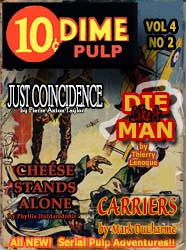
Die Like A Man, Thierry LaNoque’s debut serial novel,  is a meta noir of a man who gives a friend a ride only to be pulled in deeper and deeper into the events surrounding a brutal murder, the daughter of a prominent businessman, and attempts to cover it up and place the blame on someone else. Drugs and money are involved in this second installment featuring La Noque’s young hunky wannabe private eye, Ray Philips. As well, Mark DuCharme ties up all the loose ends to bring his dark, sometimes humorous, gothic serial, Carriers, to its finale. Lydia Cheése (pronounced “Chase”) continues her mission to fly an unauthorized dirigible to Djibouti in Phyllis Huldarsdottir’s round-the-world steampunk adventure,  Cheése Stands Alone.  Wayne Bruce survives his ordeal in the Southern Sahara and emerges as a new man with a new mission in Pierre Anton Taylor’s crimefighter drama, Just Coincidence.


carriers vanMark DuCharme’s Carriers and it’s gothic air of  shadowy creatures who might just be the living dead is a vampire novella with touches of black comedy and satirical bite, told from the perspective of its unreliable narrator and protagonist. Taking place during a “plague” that has been going on for two years in an unnamed city, dead bodies litter the streets, hallways, and homes. A corpse disposal company hires people to transport them to a facility at the edge of town with the very important stipulation that the bodies be delivered there before sundown. No one ever says why. Read the final installment of  Carriers, Episodes XIII .

chase blurbFIPhyllis Huldarsdottir’s Cheése Stands Alone, the continuing adventures of Airship Commander Lydia Cheése (pronounced “Chase”) in the search for her anti-Clockwork Commonwealth renegade father, Commodore Jack, with the help Doctor Professor Jean-Pierre Serre-Pain, proprietor the Madame Ophelia’s Ophidiarium, a traveling snake show, and his associates, former circus strongman, Vlady, and Serpina, the snake girl. On the run from IOTA (the Investigative Office of The Admiralty), she has narrowly escapes capture by her nemesis, Chief Inspector Karla Kola, in Oldest Orleans, and now with the help of a young wannabe airship pilot, Pyare, must traverse the Central Massif to rendezvous with Serre-Pain and the dirigible that will take them on a mercy mission to HOAR (the Horn Of Africa Republics), base for the anti-Commonwealth ICERS. Read more of Cheése Stands Alone in Episode XIV.


JCblurb1fiPierre Anton Taylor’s dark crimefighting serial, Just Coincidence is about a privileged young man with the unremarkable name of Wayne Bruce who returns to the site where his father once had his business, a battery manufacturing plant, and where he often spent his childhood days hanging around the factory and the neighborhood. His return is haunted by the mysterious circumstances surrounding his father’s death and the vague feeling that his uncle is somehow involved. Appalled by the poverty and crime of the place he remembers fondly, he is moved to resolve the injustice of the socially marginalized and to wreak vengeance on those he believes are responsible for the death of his father.  The backstory to his emergence as a crimefighter is revealed in Just Coincidence, Act Three, Scene I, Part 1


DLAM5

Die Like A Man, a brand new serial novel by Thierry La Noque, is a meta noir of a man who gives a friend a ride only to be pulled in deeper and deeper into the events surrounding the brutal murder of the daughter of a prominent businessman and the attempts to cover it up and place the blame on someone else. Ray Philips, a martial arts instructor, sometime event security, and bouncer working toward getting his private investigator’s license in a world where the private eye is quickly becoming an anachronism, is hired to find a missing husband, the famous crime novelist and infamous drunk, Stan Giordino by his petite pierced drug addicted wife, Stella. A stolen cache of drugs and money only complicates and implicates the wannabe detective, and puts him over his head and his life in danger. Not to mention that his girlfriend, Cissy, is dying of cancer.  Die Like A Man 3&4


FYI: Available for readers of Dime Pulp who may have missed a few issues or lost the thread of a serial,  Dime Pulp Yearbook 21, featuring the novels (The Last Resort and Better Than Dead) and the short fiction (Hard Boiled Myth and Gone Missing) of Volume One’s 12 issues, is joined by Dime Pulp Yearbook 22, featuring the complete pulp Western, On The Road To Las Cruces, continuing episodes of  a detective story, Better Than Dead, the opening chapters of new serial novels, Just Coincidence and Cheése Stands Alone, the short fiction of Hard Boiled Myth and Polka Dot Dress, as well as Dropping A Dime’s pithy pulp observations.  Volume Two’s 10 issues are available for perusal in their entirety simply by clicking on the links in this paragraph or on the menu bar above. Dime Pulp Yearbook 23 is now available featuring a full year’s worth of Just Coincidence and Cheése Stands Alone, and the complete Better Than Dead novel, as well as the early chapters of Mark Ducharme’s gothic serial, Carriers.

If you’ve made it this far, click  on the links above to read the entertaining  serial contents of Volume 4, Number3!

 —Perry O’Dickle, chief scribe
and word accountant


Act Three, Scene I, Part 1

by Pierre Anton Taylor

From the wide window of his penthouse in the Legacy Arms, Wayne Bruce considered the whirling tempest. The wind whipped the flurry of flakes against the skyscrapers, obscuring them at times and then just as quickly revealing the ranks of tall buildings impervious to the onslaught. It was not a time to try out his aerial antics in search of crime in the inner city. He still felt the weight of guilt from his last foray, the deaths that had resulted in his breaching of the abandoned building where the drug lab had been housed.

Shock headlines had claimed that the inferno was the work of a vigilante, one who had been rumored operating in the East Central part of the city. Talking heads decried the lawlessness. The District Attorney was quoted as saying that taking the law into one’s hands only leads to tragedy. And that no matter how well meaning, the fight against crime was best left to professionals. She also vowed to apprehend the perpetrator of these attacks.

At the city paper news desk, a reporter with the byline of Valerie Vicks had written a feature article on the mysterious crimefighter who had so recently set out to battle rampant crime and corruption in one of the city’s poorest neighborhoods. Relying on witness testimony and rumors, the reporter had pieced together an ineffectual campaign against crime. She had pointed out a very significant flaw in the “pseudo crusader” plan. The unspoken truth was that it wasn’t a problem one man could solve. Even if he were the wealthiest man in the world.

But this late afternoon, with the snow storm shutting down the city, that wasn’t the only thing weighing on Wayne’s mind. Robin, with assistance from the engineers at BATS Lab, had been able to bypass the encryption allowing access to the laser disks from the old man’s surveillance system. The data load, they’d ascertained, was light, signifying that the system was relatively new or had been used only occasionally. There was a remote control wired to the recorder at the old man’s desk that would allow him to record meetings in his office at will. The time stamp on the recovered video displayed the dates they were recorded, going back a little over eighteen months and argued for its relatively recent installation.

When he’d viewed the material, what he’d seen was his father, Wallace Bruce, in meetings with his staff. And his brother, Harold, of course. Usually one of his secretaries would be visible taking notes. And when she wasn’t, it was an occasion for cigars and scotch, and as old Dad had once remarked, “when the real business gets done.” Linus Pall was present in many of the recordings. As his father’s lawyer and physician, it was to be expected. Then there were men he didn’t know or recognize, businessmen, corporate leaders, like old Bruce, and from the cut of their suits, they afforded luxury and privilege. Even meeting their ilk in person as his father’s protege, he’d felt the prickle of irritation at their mannered superiority. Whoever they were, they were serious in their disposition, severe in some respects, which had immediately aroused his suspicions. And there were no secretaries taking notes. The audio track had been corrupted in the process of extracting the visual data resulting in garble and white noise. Robin had assured him that the lab techs were working on reconstructing the data but it would take some time.

Seeing himself had been startling at first. He rarely went to corporate headquarters and to the old man’s eagle’s nest, or belfry, as he’d sometimes thought of it. He was too busy with his extracurricular activities. And the times he was present were generally social or ceremonial affairs judging by the cocktail glasses. Charlotte was in a few of those, as was Trish.

There was one instance Wayne remembered specifically discussing the trip to Mali. Dr. Fledermann was present as well, sour faced, wanting to object to what old Dad was saying, and recalled it as the moment that Wallace Bruce had appointed him as the director of the BATS Lab. He had not been aware of it at the time, but Feldermann was staring daggers at him when his father made the announcement.

For the most recent footage, it appeared that the recorder had been run continuously, activated by a motion detector, time stamped over a period just before and shortly after Wallace Bruce’s death. It appeared that the old man had been in his office late the day prior, and following there had been a flurry of activity by staff, frequent visitations from Harold issuing orders and looking over papers handed to him by old Dad’s confidential secretary. Dr. Pall made a few appearances, often accompanied by Harold. It didn’t seem unusual. His uncle was taking charge of the reorganization. Pall had been his father’s close advisor. They had reason to consult. In one instance their body language indicated a disagreement, a dispute in which Pall had placed a finger in front of Harold’s face, agitated and emphatic in what he was mouthing. Wayne read what Pall was saying. It looked like he was saying “Charlotte.”

Wayne had replayed the footage to make certain he was hearing what he was seeing. There was no doubt, Pall was distinctly mouthing Charlotte’s name but anything else was lost in guess work. Harold’s reaction had been just as vehement in the denial of what the  doctor was insisting. He replayed the footage in his memory. What were they arguing about? The time stamp indicated that it had occurred on the day of the old man’s funeral. Pall and the acting head of Bruce Enterprise were meeting in his father’s office later that day. He could understand that they might want to conduct some post mortem business, strategize, but how did Charlotte figure into the picture? He had broken up with her, true. It was a decision he’d made upon his return from Mali. He wanted to reconsider their engagement. Although he enjoyed her company, her wit to his darker proclivities, their pairing was taking on an air of inevitability, as if it were following a script. And he had other ideas. Questions.

Who was he, and who did he want to be? Shouldn’t he be satisfied with the benefits of the wealth he was heir to? Or should he pursue the mission of justice for the sufferers of misfortune at whose root was the corruption and wealth of the privileged few? It left him sleepless, an insomnia that only death could cure. Sleep would only come with the resolution to the mystery of his father’s death. As for the end to the injustice in the world, nothing but a dream, a fitful ache that begins in the gut, the ancient seat of knowledge, and ends up between the ears as a throbbing obsession. It would be easy enough to continue as a prince of industry, and never question the path of his career, as a leader, as an innovator, perhaps? He had such ambition, his father’s spirit lived in him, only quieter and maybe more disaffected of the vanity that comes with privilege. Yet now at the prow of his future, he was being pulled into an undiscovered country, one that coupled compassion with a thirst for a specific vengeance against the oppression of capital. He could be a champion of those proud people who suffered at the whims and scorn of insolent corporate greed. That the disadvantaged should be returned their birthright, a freedom to live or die, to sleep, to endure untroubled dream’s advantage. It would be easy enough to let that inclination toward justice die on the vine. Was it really his to regret? He had made a commitment to Charlotte, and although he had broken their engagement, he understood that it could be easily repaired, attributed to the shock of his father’s sudden death. It would please his mother, certainly, and Pall would be placated, undoubtedly poised to insert himself at the beginning of a commercial dynasty. And Harold would be satisfied to helm Bruce Enterprise as president and CEO without any immediate threat from Wayne. But he couldn’t let a guilty conscience make him a coward, let his better instincts be overshadowed by overthinking. His short stay in the refugee camp had upended his world and he had resolved to make a difference,  a momentous decision that could not be ignored as merely wishful altruism of a new money aristocrat. And there was his father’s ghost and the suspicious circumstances of his death.

Wayne had uncovered in the process of moving his wardrobe into the penthouse, the metal traveling case that had belonged to old Fledermann. It was sitting in the middle of the desk in the study. So much had transpired since his return from Africa. The metal case with its field notes had lost in importance. He had snapped the locks and opened the case that emitted a sharp acrid odor, one that he immediately recognized as that of the arid lands of the Sahel. A metal clipboard still gripped a sheaf of stained dogeared notes and lab reports. Vials of sand were secured in a row in the lid of the case. File folders wedged into the bottom along with a few prescription pill bottles that had nothing to do with the research. The old scientist had been having heart palpitation and other health problems, one of the reasons why Wayne was replacing him as head of the Lab.

Wayne flipped through the papers attached to the clipboard. Nothing caught his eye, the letterheads suggested that they were all interdepartmental memos. The clip board had a compartment on its back, and he undid the clasp. A manila envelope fell out and onto the desk. There was no addressee or return address. As he picked it up he saw the note that Harold had sent him via messenger on the desk. It was about the family meeting he had scheduled the next day before the reading of the will. As a postscript his uncle had added “Charlotte will be in attendance.”

That had left him conflicted. He didn’t understand why she would be present at the family meeting. And he thought he had been quite clear that his decision was firm, they would not be wed. It occurred to him that Trish and Harold might be trying to affect a reconciliation. He wouldn’t put it past Trish. And there was Linus Pall. He had a vested interest in their union.

Wayne turned his attention again to the sealed manila envelope. It was bulky, too bulky for documents. As he picked up the ornate letter opener from the blotter, his pager pinged. He knew what number was on the display without looking at it. It was the ghost of old Dad’s, calling him to the Battery Works. Someone was in trouble.

He dialed a number and punched in a code. It was something he had worked out with Robin. He changed into his bike leathers, checking the watch on his wrist. If he didn’t receive an answering page, he could assume that she would be in the parking garage in fifteen minutes. He accessed the service entrance to the penthouse and rode down to the basement in the freight elevator. He waited in the shadows of a pillar in the underground parking garage, a blind spot to the security cameras. Before too long, the distinct sound of a motorbike echoed in the cavernous space. Robin steered the bike to a dark corner and dismounted, leaving the keys in the ignition. She unfolded a large shopping bag when she reached Wayne and handed him the helmet, depositing her bundled riding gear into the bag. Undoing the ponytail, she let her long red hair fall to her shoulders.

“You know there’s a blizzard out there, right? And it’s freezing,” she said with a shiver. 

“I’ll wait till you board the elevator before I leave. Take a cab back to your place and I’ll meet you there when I’m done.”

“You sure you don’t want me to ride with you? That seat holds two.”

“No, not this time.” Wayne watched in silence as a party of couples exited their parked car and strolled casually to the parking garage elevator. “Ok, here’s your chance.”

“I know I don’t have to say this but, watch your back,” Robin cautioned over her shoulder.

Once the elevator doors closed, Wayne rode the bike out into the traffic of the blustering snowstorm whipping between the concrete and steel canyons. If there were watchers tonight, they most certainly were seeking refuge from the storm, and their surveillance likely impaired. He dodged the cabs, and few limousines, lumbering commercial carriers and delivery vans until he reached the outskirts of the downtown area, and sped east toward the bleak snowbound fringes of urban decay. He knew that city would not deploy the snowplows until after midnight. He would have to make his own way through the drifts and snow banks. The wind was howling like a banshee, effectively muting the sound of the motorcycle’s engine. He wiped the accumulation of snow and ice off his visor. His approach would not be noticed. The streets were deserted, and he wondered who would even be out in such weather intent on inflicting thoughtless misery on others. Penn Quinn’s Tavern appeared deserted although a red knot of neon glowed in the small oval side window.

Wayne meant to access the Battery Works from the alley behind the shuttered candy store as he had done on his stealth missions several times before. The narrow rutted path was blocked by a drift. He dismounted and muscled the wheels through the snow. On the lee side, he made out an overturned shopping cart, tufts of snow caught on the metal ribs and covering the piled boxes and clothing in disarray. Someone homeless had abandoned their cart to seek shelter he assumed. Then he noticed the boots, and the legs attached to the boots, and the body stretched out against the wall. He recognized Laverne Early, the woman they called the cat lady. When he reached her she was still breathing. He sat her up and spoke her name. She cautiously open her eyes and belched a sour wine breath at him. And then, eyes wide with fright, she screamed, “What have you done with my Cat?”


Next Time: The Honey Of His Music

Contents Vol. 4 No. 2

Welcome to Volume Four, Number Two of Dime Pulp,
A Serial Pulp Fiction Magazine

Dime Pulp debuts a new serial novel, Die Like A Man, by Thierry La Noque, in Volume 4, Number 2. It is a meta noir story of a man who gives a friend a ride only to be pulled in deeper and deeper into the events surrounding a brutal murder of the daughter of a prominent businessman and the attempts to cover it up and place the blame on someone else. Drugs and money are involved in this initial outing of La Noque’s wannabe private eye, Ray Philips. As well, Mark DuCharme’s gothic Carriers is quickly approaching its denouement. Lydia Cheése (pronounced “Chase”) continues her mission to fly an unauthorized dirigible to Djibouti in Phyllis round the world steampunk adventure,  Cheése Stands Alone. And in Just Coincidence, Wayne Bruce survives his ordeal in the Southern Sahara and emerges as a new man in Pierre Anton Taylor’s crimefighter drama. 

carriers vanMark DuCharme’s Carriers and it’s gothic air of  shadowy creatures who might just be the living dead is a vampire novella with touches of black comedy and satirical bite,  told from the perspective of its unreliable narrator and protagonist. Taking place during a “plague” that has been going on for two years in an unnamed city, dead bodies litter the streets, hallways, and homes. A corpse disposal company hires people to transport them to a facility at the edge of town with the very important stipulation that the bodies be delivered there before sundown. No one ever says why. Read more in the latest installment of  Carriers, Episodes X-XII .

chase blurbFIPhyllis Huldarsdottir’s Cheése Stands Alone, the continuing adventures of Airship Commander Lydia Cheése (pronounced “Chase”) in the search for her anti-Clockwork Commonwealth renegade father, Commodore Jack, with the help Doctor Professor Jean-Pierre Serre-Pain, proprietor the Madame Ophelia’s Ophidiarium, a traveling snake show, and his associates, former circus strongman, Vlady, and Serpina, the snake girl. On the run from IOTA (the Investigative Office of The Admiralty), she has narrowly escapes capture by her nemesis, Chief Inspector Karla Kola, in Oldest Orleans, and now with the help of a young wannabe airship pilot, Pyare, must traverse the Central Massif to rendezvous with Serre-Pain and the dirigible that will take them on a mercy mission to HOAR (the Horn Of Africa Republics), base for the anti-Commonwealth ICERS. Read more of Cheése Stands Alone in Episode XIII.
JCblurb1fiPierre Anton Taylor’s dark crimefighting serial, Just Coincidence is about a privileged young man with the unremarkable name of Wayne Bruce who returns to the site where his father once had his business, a battery manufacturing plant, and where he often spent his childhood days hanging around the factory and the neighborhood. His return is haunted by the mysterious circumstances surrounding his father’s death and the vague feeling that his uncle is somehow involved. Appalled by the poverty and crime of the place he remembers fondly, he is moved to resolve the injustice of the socially marginalized and to wreak vengeance on those he believes are responsible for the death of his father.  The backstory to his emergence as a crimefighter is revealed in Just Coincidence, Interlude II
dlamfi1

Die Like A Man, a brand new serial novel by Thierry La Noque, is a meta noir story of a man who gives a friend a ride only to be pulled in deeper and deeper into the events surrounding the brutal murder of the daughter of a prominent businessman and the attempts to cover it up and place the blame on someone else. Ray Philips, a martial arts instructor, sometime event security, and bouncer working toward getting his private investigator’s license in a world where the private eye is quickly becoming an anachronism, is hired to find a missing husband, the famous crime novelist and infamous drunk, Stan Giordino by his petite pierced drug addicted wife, Stella. A stolen cache of drugs and money only complicates and implicates the wannabe detectives, and puts him over his head and his life in danger. Not to mention that his girlfriend, Cissy, is dying of cancer. The beginning to this meta noir begins here: Die Like A Man 1&2

FYI: Available for readers of Dime Pulp who may have missed a few issues or lost the thread of a serial,  Dime Pulp Yearbook 21, featuring the novels (The Last Resort and Better Than Dead) and the short fiction (Hard Boiled Myth and Gone Missing) of Volume One’s 12 issues,  is joined by Dime Pulp Yearbook 22, featuring the complete pulp Western, On The Road To Las Cruces, continuing episodes of  a detective story, Better Than Dead, the opening chapters of new serial novels, Just Coincidence and Cheése Stands Alone, the short fiction of Hard Boiled Myth and Polka Dot Dress, as well as Dropping A Dime’s pithy pulp observations.  Volume Two’s 10 issues are available for perusal in their entirety by simply clicking on the links in this paragraph or on the menu bar above. Dime Pulp Yearbook 23 will be available in early February ’24 as part of the annual archival review.

If you’ve made it this far, click  on the links above to read the entertaining  serial contents of Volume 4, Number 2!

 —Perry O’Dickle, chief scribe
and word accountant


Just Coincidence: Interlude II

by Paul Anton Taylor

Wayne had awakened in a smoky miasma to the drone of voices and a rhythmic rattling, tapping. He was not surprised, as if he were revisiting a dream, a welcoming inevitability. He’d been calm, not overcome by the strangeness of his surroundings, yet clammy skinned and weak. A heavy breathing had accompanied exhalations and inhalations close to his cheek. Glazed, acknowledging the dim light, his eyes had focused on the dark visage hovering in his periphery. Lined and creased above a short gray beard, the dark eyes of the old man had seemed to look right through him as if he were not there.

The face that had floated above his belonged to an elder in the group of refugees who had fled the fighting further north. Women out foraging had found Wayne and brought him to their camp site. Yet the man’s expressions, the look about him, had been intimately familiar. It had not dawned on him immediately, occupied as he had been in piecing together the tatters of memory of the previous span of days, but when it did, he’d felt a genuine astonishment of cosmic interconnection. The face belonged to that of a childhood friend, someone he had met as a youngster in old Rick’s candy store adjacent to the Bruce Battery Works. He’d remembered the name as if it had always been on the tip of his tongue. Michael. He was the son of Mr. Rick’s cousin’s granddaughter and about the same age as Wayne had been back when superhero comic books were a preadolescent preoccupation.

That memory nagged him even after everything had been resolved. How the face of the old African healer had been that of his friend, a friend with whom he’d felt instant rapport, but a friendship that had lasted no more than one summer vacation yet had felt like it was the best he could remember. Most of his friends were chosen by Trish, his mother, and there were few, if any, of African ancestry. When Wayne had returned to the Battery Works during the Fall holiday break, Michael had moved to another state, never to be seen or heard from again. Mr. Rick had answered his inquiries with something about people making bad choices, born to lose.

He’d made a bad choice. Leaving Dr. Fledermann behind in a desperate attempt to find help. Once the sun had set, he’d helped Alfred into the cooling protection of the stranded Land Rover. He had hoped that they would be reported missing once they failed to return from the expedition. Brebeuf or Yousoff returning with help had been the slim prospect he’d held on to. Fledermann improved a little once the heat of the day subsided. Stretched out in the rear of the vehicle, the old man had groaned and murmured and complained. Intent on the growing dark and the steep drop in temperature, Wayne only half listened to the random spouting, the insistence that their predicament was not the way it was supposed to happen. But eventually, if only to break the monotony, he’d advanced the question, what wasn’t supposed to happen?

Fledermann had lapsed into silence after that, offering no answer. His breathing unperturbed although shallow, Wayne had assumed that the old man had fallen asleep. So he’d been startled by Alfred’s clear assertion, “I refused to agree to that!” He’d repeated it again and then with a moan, “I am such a fool! I’ve been betrayed!” And again the mantra that what had happened wasn’t supposed to happen. That it was not something he’d agreed to. Yet bit by bit Wayne had pieced together that perhaps the mission had had a dual purpose. Not only the search for diatomite but another more sinister objective, something that had to do with the future of Bruce Enterprise.

He’d slept fitfully that night and the following day had not been an improvement on the previous one. He’d kept his eyes fixed to the horizon in the direction from which they’d come, willing the rescuers to materialize, but to no avail. And the day had heated up quickly, the abandoned vehicle no longer a shelter, he had carried a semiconscious Fledermann to the shade of the anemic acacia. By then he’d felt the full impact of their dire predicament. The water would not last and the old man would not survive much longer. And another realization had crept into his consideration. He had to save himself and if in doing so he could save the old man, then it was the choice he had to make.

Not long after his vision of Michael, perhaps that evening, he’d had another visitor, a young French Moroccan woman. Her name was Mina, an itinerant nurse with the local UN refugee effort who spoke little English. Thanks to that one year in a Swiss boarding school, Wayne knew enough French to communicate with her. She had just arrived on her regular rounds and had been taken to him. Before that the elder and a few of the women in the camp had ministered to him, offering a little food and water, shelter in a primitive lean-to of twigs. She was the one who had related to him how he had been found, semi-conscious with nothing but an empty canteen and an aluminum field case. She hadn’t known anything about Dr. Fledermann, nor had anyone from the camp. Mina had only sporadic contact with the UN Mission in Timbuktu with the antiquated radio in her Peugeot cargo van that served as a clinic. She had tried to contact the base camp but couldn’t be certain her transmission had been picked up. In the meantime, she had to continue with her duties attending to the refugees. She had pronounced that he was out of danger, but that he needed to rest. She had also told him that he owed his life to the old man he thought of as Michael.

Wayne had pieced together what he could remember, setting off in the direction of the road that had brought them here. He’d made a bad choice, but anxiety had turned into panic and he had to act. He was no match for the searing heat, yet he’d known he couldn’t stop. He hadn’t been able to make anything sensible in those ripples of memory only the intensity of the brazen wash of light. The sensation of being carried had stayed with him. As did the blur of voices and the chanting between the chasms of catalepsy.

In his reorientation, his model had been nothing he could compare with. The smells, the smoke, the oppressive heat wrinkled air, and the languid dark bodies conserving energy in anticipation of a cooler part of the day. Gaunt black faces came to peer at him and murmur a few words or grunts of acknowledgement. He had managed to lift himself on his elbows, shakily, taking in the stirring in the camp as Mina set up her clinic around which people were beginning to gather, some so sick they had to be carried. He had awakened in a different world, one so different that it defied comprehension. What he’d witnessed was not poverty, but a suspension of time, a place that had always been there but always kept out of sight, denied. That was what had changed. His privileged view had been put into stark perspective and so many of his assumptions became untenable and he could not unsee the suffering and misery.

The helicopter had arrived the next day with all the roaring intensity of an angry god. It was a military ship and on board were a Bruce Enterprise representative and a UN doctor. He’d been flown to the main hospital in Bamako and given a physical. He had then learned that Dr Alfred Fledermann had been found a day earlier when Brebeuf returned with help, and that he was in critical condition in the isolation ward. He’d been advised to recuperate for a few days himself before flying back to the States and he hadn’t refused. There’d been too many things crowding his mind and he’d felt he needed the time to process his confusion before returning to the other world, a world that masked cruelty in the guise of prosperity and whose humanity was a sham. Besides he’d wanted to get a chance to talk with the old doctor, get him to elaborate on what he’d been babbling about, what was it that had gone wrong and what did it have to do with him and the future of the Bruce business empire? He’d never got the chance. The BATS lab director had been flown to a more advanced care facility in Italy, the Bamako hospital overcrowded and understaffed as it was. It had been on the tarmac at the airport boarding the company jet that he’d been informed that Fledermann’s plane never reached its destination. He’d thought he’d left it all behind, but it stayed with him: a mystery to resolve, injustice to be righted, and revenge to be exacted.


Next Time: Act 3, Scene 1

Contents Vol. 4 No. 1

Welcome to Volume Four, Number One of Dime Pulp,
A Serial Pulp Fiction Magazine

van3The new year at Dime Pulp begins with the return of Carriers by Mark DuCharme and it’s gothic air of  shadowy creatures who might just be the living dead. Carriers is a vampire novella with touches of black comedy and satirical bite, and is told from the perspective of its unreliable narrator and protagonist, Johnny. It takes place during a “plague” that has been going on for two years in an unnamed city. Dead bodies litter the streets, hallways, and homes. A corpse disposal company hires people like Johnny to transport them to a facility at the edge of town with the very important stipulation that the bodies be delivered there before sundown. No one ever says why. Read more in the latest installment of  Carriers, Episodes VIII-IX .

Also returning to the start Volume 4 off on the right foot are Dime Pulp regular authors Pierre Anton Taylor and Phyllis Huldarsdottir  with Phyllis’s steampunk adventure,  and Perre’s crimefighter fiction, Just Coincidence.

lcnew2Phyllis Huldarsdottir returns  with Cheése Stands Alone, the continuing adventures of Airship Commander Lydia Cheése (pronounced “Chase”) in the search for her anti-Clockwork Commonwealth renegade father, Commodore Jack, with the help Doctor Professor Jean-Pierre Serre-Pain, proprietor the Madame Ophelia’s Ophidiarium, a traveling snake show, and his associates, former circus strongman, Vlady, and Serpina, the snake girl. On the run from IOTA (the Investigative Office of The Admiralty), she has narrowly escapes capture by her nemesis, Chief Inspector Karla Kola, in Oldest Orleans, and now with the help of a young wannabe airship pilot, Pyare, must traverse the Central Massif to rendezvous with Serre-Pain and the dirigible that will take them on a mercy mission to HOAR (the Horn Of Africa Republics), base for the anti-Commonwealth ICERS. Read more of Cheése Stands Alone in Episode XII.

Batman-Logo-121Pierre Anton Taylor’s dark crimefighting serial, Just Coincidence is about a privileged young man with the unremarkable name of Wayne Bruce who returns to the site where his father once had his business, a battery manufacturing plant, and where he often spent his childhood days hanging around the factory and the neighborhood. His return is haunted by the mysterious circumstances surrounding his father’s death and the vague feeling that his uncle is somehow involved. Appalled by the poverty and crime of the place he remembers fondly, he is moved to resolve the injustice of the socially marginalized and to wreak vengeance on those he believes are responsible for the death of his father.  The backstory to his emergence as a crimefighter is revealed in Just Coincidence, Interlude I

dime dropFIAlso returning for the 2024 inaugural issue is Dropping A Dime, the editor’s pithy commentary on pulp fiction, this time asking the vital question What Is It About Poets and Pulp? 

FYI: Available for readers of Dime Pulp who may have missed a few issues or lost the thread of a serial,  Dime Pulp Yearbook 21, featuring the novels (The Last Resort and Better Than Dead) and the short fiction (Hard Boiled Myth and Gone Missing) of Volume One’s 12 issues,  is joined by Dime Pulp Yearbook 22, featuring the complete pulp Western, On The Road To Las Cruces, continuing episodes of  a detective story, Better Than Dead, the opening chapters of new serial novels, Just Coincidence and Cheése Stands Alone, the short fiction of Hard Boiled Myth and Polka Dot Dress, as well as Dropping A Dime’s pithy pulp observations.  Volume Two’s 10 issues are available for perusal in their entirety by simply clicking on the links in this paragraph or on the menu bar above. Dime Pulp Yearbook 23 will be available in early February ’24 as part of the annual archival review.

If you’ve made it this far, click  on the links above to read the entertaining  serial contents of Volume 4, Number 1!

 —Perry O’Dickle, chief scribe
and word accountant


Just Coincidence: Interlude I

by Pierre Anton Taylor

The faint smell of tear gas greeted them as they stepped out of their lodging at the old colonial hotel and into the heat of early day. There were two Land Rovers parked in the road. One of them was their transport, the other was for their armed escort. There had been demonstrations the previous day in the capitol of Bamako, the radio had announced. Government troops had fired on protesting students and there were reports of casualties. A smaller demonstration in Timbuktu had been dispersed in the twilight hours. The hotel manager assured them that it was just a minor disturbance. Disgruntled youths, he’d explained. They were headed north into the desert’s edge, the Sahel.

Wayne Bruce had accompanied the director of the BATS Lab, Doctor Alfred Fledermann, to the Republic of Mali and the ancient city of Timbuktu on a fact finding mission. Fledermann was retiring and had taken on the job of mentoring Wayne into the responsibilities of the position. It was no secret that the director would have preferred someone with a scientific background to oversee the Lab, not a tabloid fodder daredevil. Yet he was loyal to the old man, Wallace Bruce, who had believed in him as a callow young researcher and appointed him to head the Bruce Battery Works R&D division decades earlier. If it were any consolation, young Bruce was intelligent, and serious, if not a little too earnest. There was the shadow of a cape about him.

The previous evening, in the lounge of the hotel, they had met with the man who would be their guide, a Frenchman named Roland Brebeuf, a holdover from the old colonial days who knew the terrain and the sparse population that peopled it. There were was lithium to be mined in the south, but Fledermann wasn’t interested in lithium. He was after diatomite. Brebeuf had been incredulous. Sand?

There is sand, and there is silica. There are many types of sands and sources, from minerals to vertebrate excretion, Alfred had explained before they’d flown to Africa. Think of the ocean floor as one large litterbox as well as a graveyard. Most beach sand is a combination of rock, bone, and fish excrement. Diatomite is a peculiar type of sand made from microscopic fossilized algae millions of years old. The location of this silica deposit was once part of a vast shallow inland sea whose shore had been the grasslands that were now the Sahara. That’s where they were going.

Wayne was a little young to get excited about sand, but he accepted the scientist’s word that this particular silica had potential for producing a distinctive kind of glass that would be beneficial to Bruce Enterprise. Fledermann had developed a process that gave the compound unique properties advantageous in light harvesting. The future lay in solar energy he’d insisted, no matter what anyone said. “He who controls the production of batteries controls the world. After all, once you’ve harvested the energy of those photons, where are you going to store them? Batteries, of course.” Of course, that succinctly summed up the Bruce Enterprise mission.

Missing his accustomed foil, Brebeuf had hurled an invective at Fledermann. “You wanted sand! There’s your blasted sand!” pointing in the direction of the stranded vehicle.

They would have to be on their guard on this expedition. Brebeuf had warned that there were bandits to the north, antigovernment militias, Tuaregs. As the winding road rose up into the mottled sienna scrub lands sparsely wooded with windshaped acacia, they passed men and donkeys laden with spindly desiccated branches to be sold as fire wood in town. Wayne looked back at the mud and earth edifices receding in the distance. This whole world was made of sand. And discounting the modern accouterments, he marveled that this had been a way of life for centuries, millennia, a place whose environment had shifted from semi tropical to the brittle savannahs of shrubs and anemic grasses. It was a dry eviscerated soil that would not support much life. But at one time it had. And the people who inhabited the Sahel had learned to bend and  survive, adapt to the geological shift.

Once they left the main track, passing through a village that was not much more than sticks and mud and stretches of blue canopied shelters, their progress was slowed by the rough going. The driver, a black man with the welts of scarification across his cheeks, argued with Brebeuf about which rise to take and which wadis to follow. Some of it was in French which Wayne could understand, but otherwise the heated exchange was a spitfire of patois that was much too fast for him. It was like having an old married couple in the front seat. And it could be amusing until it wasn’t. By then the heat of day had intensified. Although most of their effort was to try to stay seated, the exertion made then sweat profusely.

A wrong turn had landed them in a bowl, a dry depression that with an occasional rain became a watering hole. The sides were steep and repeated attempts to climb out had only dug the rear wheels deeper into the soft sand. The driver, whose name was Youssouf, and Brebeuf berated each other all the while the three of them, including elderly Fledermann, set their shoulders to the back of the Rover while their escorts watched from the side of the crater having stopped just in time to avoid the same mistake. They found the drama between the driver and the guide quite entertaining and added their own jibes and taunts. One must have struck a nerve and which caused Youssouf to climb up to the rim where they were standing and confront one of the armed men. Brebeuf had scrambled up the embankment after him, waving his arms to try to defuse the tension, all the while offering mollifying words. There ensued a frantic parlay that eventually resulted in a calming of the hostilities but with the escort telling them they could pack sand, and driving away.

The sun was almost directly overhead and to continue was to only invite heat stroke. Their vehicle offered little shelter and captured the heat like a tin roof. The contention between driver and guide continued but nervously subdued. They of course blamed each other for their predicament. Brebeuf led them to a spindly acacia some distance from the fissure that had swallowed the Rover. They would have to wait out the heat of the day before putting their backs to getting the Rover out of the ravine. In the meantime, Youssouf would head back to the encampment they had passed a dozen or so miles back and try to recruit some help. The heat had visible effect on Fledermann. Wayne had erected a canopy under the acacia from a tattered tarp in the boot of the Rover. It was an unrelentingly hot, the scorching air frying sinuses with every breath, searing the lungs, the shade from the acacia hardly worthy of its name. They had a reserve of water and some food which Brebeuf advised to ration. The supplies for their expedition were in the Rover the armed escort had driven off in. There was no telling how long they would stuck.

Missing his accustomed foil, Brebeuf had hurled an invective at Fledermann. “You wanted sand! There’s your blasted sand!” pointing in the direction of the stranded vehicle. Supine, Fledermann panted, licking his lips, eyes closed, head turned to one side. “Something is not right,” he breathed. Wayne had given him shallow sips from his canteen. “This is not the way it was supposed to happen,” the old man groaned. Wayne had tried to make Albert as comfortable as possible in the oppressive heat that seemed to be squeezing the life out of him. The horizon shimmered in silent exhaustion. Nothing stirred in the feral landscape. It sounded like an echo at first, the gunshot coming from a distance. Brebeuf had stood rigid as if he had been  hit, his hand to his throat. He had given Wayne a quick furtive glance before he’d run off in the direction his driver had gone. “Youssouf!” he called out repeatedly, stumbling in the burning dust.

With Brebeuf gone, he’d been left to care for Dr. Fledermann. He’d only carried a small rucksack for his camera and extra film. The remainder of his gear was gone. Rummaging through the stranded vehicle had been like trying to recover an ice cube from an oven, the chassis and frame searing him several times, upholstery close to molten. He’d managed to retrieve his pack and Alfred’s aluminum field case with documents and maps. The grilling sapping his strength, he’d collapsed under the acacia. Alfred had moved or rolled from where he’d left him, almost as if he was trying to crawl off, but not managing more than a body width. He’d looked up at Wayne through pained half closed eyes. “Save yourself,” he’d said. “I’ve been such a fool.”


Next Time: The Ordeal Continues

Contents Vol. 3 No. 8

Welcome to Volume Three, Number Eight of Dime Pulp,
A Serial Pulp Fiction Magazine

CARRIERSfi2Carriers by Mark DuCharme returns with it’s gothic air of  shadowy creatures who might just be the living dead. Carriers is a vampire novella with touches of black comedy and satirical bite, and is told from the perspective of its unreliable narrator and protagonist, Johnny. It takes place during a “plague” that has been going on for two years in an unnamed city. Dead bodies litter the streets, hallways, and homes. A corpse disposal company hires people like Johnny to transport them to a facility at the edge of town with the very important stipulation that the bodies be delivered there before sundown. No one ever says why. Read more in the latest installment of  Carriers, Episodes V-VII .
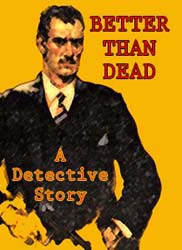
btdv2n10fiIssue 8 brings to a close Colin Deerwood’s long running serial, Better Than Dead, A Detective Story, featuring the unpredictable peregrinations of private investigator Lackland Ask, aka Stan Gardner, aka Sam Carter, and now Dr. Jerome Paulsen, O.D. leaving on a freighter for Cuba one step ahead of the law, the mob, and the draft board. All the loose ends (and there were many) are tied up or disposed of (are they?), and now the fugitive confidential agent can exit stage left. Find out how the story ends in Better Than Dead, Episode 30.  (A note from the author reminds us that the cover of this issue is from an original Black Mask magazine, c. 1940, and as such was the catalyst and inspiration for the more than 150 pages of serial crime fiction that followed. )

doncoyoteThis issue also introduces a new private eye, Don Coyote,  brain child of Mike Servante, a newbie to the musty (and labyrinthine) halls of serial crime fiction although an aficionado of the genre, in a metatextual story that promises to be a lot of fun, titled The Man From La Mirada Perdida, A Don Coyote & Saundra Pansy Adventure. Read  inaugural episodes i & ii in this latest offering of imaginative crime fiction from Dime Pulp.

Dime Pulp regular authors Pierre Anton Taylor and Phyllis Huldarsdottir were unfortunately caught up in the  seasonal vortices that often cause time displacement, especially as the days get shorter,  and the imprudent certainty that there is still plenty of time to get everything done.  Phyllis’s steampunk adventure, Cheése Stands Alone, will return in Vol. 4, Number 1 in early 2024, as will Pierre’s crimefighter fiction, Just Coincidence.

FYI: Available for readers of Dime Pulp who may have missed a few issues or lost the thread of a serial,  Dime Pulp Yearbook 21, featuring the novels (The Last Resort and Better Than Dead) and the short fiction (Hard Boiled Myth and Gone Missing) of Volume One’s 12 issues,  is joined by Dime Pulp Yearbook 22, featuring the complete pulp Western, On The Road To Las Cruces, continuing episodes of  a detective story, Better Than Dead, the opening chapters of new serial novels, Just Coincidence and Cheése Stands Alone, the short fiction of Hard Boiled Myth and Polka Dot Dress, as well as Dropping A Dime’s pithy pulp observations.  Volume Two’s 10 issues are available for perusal in their entirety by simply clicking on the links in this paragraph or on the menu bar above. Dime Pulp Yearbook 23 will be available in late January ’24 as part of the annual archival review.

If you’ve made it this far, click  on the links above to read the entertaining  serial contents of Volume Three, Number 8

Special Note: Dime Pulp, A Serial Pulp Fiction Magazine has changed its posting schedule from  monthly issues to once every forty-five days (more or less—mostly more). Thus Volume Three will (hopefully) consist of eight issues (much to the relief of the overworked writers and production staff). Thank you for your understanding.

 —Perry O’Dickle, chief scribe
and word accountant


Contents Vol. 3 No. 7

Welcome to Volume Three, Number Seven of Dime Pulp,
A Serial Pulp Fiction Magazine

CARRIERSfi2 Carriers by Mark DuCharme returns with it’s gothic air of  shadowy creatures who might just be the living dead. Carriers is a vampire novella with touches of black comedy and satirical bite, and is told from the perspective of its unreliable narrator and protagonist, Johnny. It takes place during a “plague” that has been going on for two years in an unnamed city. Dead bodies litter the streets, hallways, and homes. A corpse disposal company hires people like Johnny to transport them to a facility at the edge of town with the very important stipulation that the bodies be delivered there before sundown. No one ever says why. Read more in the latest installment of  Carriers, Episodes III & IV .

LCinset21Phyllis Huldarsdottir returns  with the continuing adventures of Airship Commander Lydia Cheése (pronounced “Chase”) searching for her anti-Commonwealth renegade father, Commodore Jack, with the help Doctor Professor Jean-Pierre Serre-Pain, proprietor the Madame Ophelia’s Ophidiarium, a traveling snake show, and his associates, former circus strongman, Vlady, and Serpina, the snake girl. On the run from IOTA (the Investigative Office of The Admiralty), she has narrowly escapes capture by her nemesis, Chief Inspector Karla Kola, in Oldest Orleans, and now with the help of a young wannabe airship pilot, Pyare, must traverse the Central Massif to rendezvous with Serre-Pain and the dirigible that will take them on a mercy mission to HOAR (the Horn Of Africa Republics), base for the anti-Commonwealth ICERS. Read more in Episode XI of Cheése Stands Alone!
Batman-Logo-121Pierre Anton Taylor’s dark crimefighting serial, Just Coincidence is about a privileged young man with the unremarkable name of Wayne Bruce who returns to the site where his father once had his business, a battery manufacturing plant, and where he often spent his childhood days hanging around the factory and the neighborhood. His return is haunted by the mysterious circumstances surrounding his father’s death and the vague feeling that his uncle is somehow involved. Appalled by the poverty and crime of the place he remembers fondly, he is moved to resolve the injustice of the socially marginalized and to wreak vengeance on those he believes are responsible for the death of his father. In this new episode, the young crimefighter continues to investigate the unexplained death of his father, and the robbery murder of old Rick, the candy store owner, as well as the strange new street drug, Wacky Waxx. Read more in Act 2, Scene 2, Part 3

BTD headLast but certainly not least, Colin Deerwood’s long running serial, Better Than Dead, A Detective Story, continues its unpredictable peregrinations featuring private detective Lackland Ask, aka Stan Gardner, aka Sam Carter, on the run again when he learns that his bucolic hideaway in the Three Lakes area is also where his nemesis, mob boss Yan Kovic, aka Mr. K, is ducking the feds. Now it is even more imperative that he make himself scarce, especially after a crooked local constable in league with Mr. K’s hoods try to finish him off. In the meantime, thanks to the moonshiner’s daughter and a lusty cousin, he learns a surprising revelation about his paternity. On his return to the big city from the country, still on the lam, Lackland Ask has to scare up some cash and make plans to flee the country under an assumed name with one minor hitch: he has to be blind. Read more in Better Than Dead, Episode 29.

FYI: Available for readers of Dime Pulp who may have missed a few issues or lost the thread of a serial,  Dime Pulp Yearbook 21, featuring the novels (The Last Resort and Better Than Dead) and the short fiction (Hard Boiled Myth and Gone Missing) of Volume One’s 12 issues,  is joined by Dime Pulp Yearbook 22, featuring the complete pulp Western, On The Road To Las Cruces, continuing episodes of  a detective story, Better Than Dead, the opening chapters of new serial novels, Just Coincidence and Cheése Stands Alone, the short fiction of Hard Boiled Myth and Polka Dot Dress, as well as Dropping A Dime’s pithy pulp observations.  Volume Two’s 10 issues are available for perusal in their entirety by simply clicking on the links in this paragraph or on the menu bar above.

If you’ve made it this far, click  on the links above to read the entertaining  serial contents of Volume Three, Number 6

Special Note: Dime Pulp, A Serial Pulp Fiction Magazine has changed its posting schedule from  monthly issues to once every forty-five days (more or less—mostly more). Thus Volume Three will (hopefully) consist of eight issues (much to the relief of the overworked writers and production staff). Thank you for your understanding.

 —Perry O’Dickle, chief scribe
and word accountant