by Pierre Anton Taylor
The tattered crime scene tape in front of the shuttered candy store fluttered in the brisk wind. Dirty snow piled up along the curb and in shallow drifts against the brick wall of the old Battery Works now scrubbed clean of graffiti and ivy creepers. Wayne Bruce steered his black 1960 Plymouth Fury out of the secure gate and turned onto Central driving the few blocks to Basin Avenue. The tall steeple of Second Emanuel Sanctified Church in the distance on the crosstown thoroughfare stood out like a stiletto against the expanse of a steel gray wintery sky. He turned into the chain link fence enclosed parking lot adjacent to the historic old church. A small group of people were gathered out front dressed in dark overcoats and hats, some held purses, dabbed their eyes, spoke somberly, and shook their heads in sorrow.
He recognized one of them as Bion and apparently, by the wave of his prosthesis, he had been recognized. He parked at the far end under the basketball hoop that served as a half court when the lot was empty. On the other side of the fence was the windowless brick expanse at the back of the St. George Gospel Mission. He locked and set the alarm to his classic car before heading to the front of the church and the awaiting mourners. It was his second funeral in a month, and for someone else he held a deep affection. It made him angry. It made him mad.
Bion Ripley, in a brown suit and sober red tie, acknowledged the troubled countenance with a nod and said, “Come on up, they’re just about to start.”
By the entrance to the old wooden church a tattered lightbox marquee proclaimed in bold black letters, Funeral, Mr. Richard Richards. Beneath the name of the church and affirmation of its history, Est. 1922, Reverend Warren Locke, Pastor was simply stated. The funeral goers were mostly elderly, some attended by younger relatives or caregivers. He and Bion appeared to be the youngest of the mourners in attendance, and Bion was easily a decade older. His presence was noticed and he was side eyed and blinked at curiously.
Despite the fact that he should have been honoring the memory of the avuncular Mr. Rick, he was puzzling over his meeting with Charlotte Taste and what she hadn’t told him of his father’s last hours.
After introducing himself from the pulpit to those gathered there who knew very well who he was yet the occasion called for formality, the Reverend talked about travelling through the valley of death before seeing the light of salvation.
Wayne let his gaze wander across the sparse yet tastefully appointed vestibule, the large gold cross set up against the back toward the peak of the roof where a set of amber windows let in a celestial light, the spare marble altar, nothing more than a marble slab crossed by a white linen runner.
The Reverend declaimed what a selfless decent man Richard Richards was, cantankerous at times, but someone you could count on to do the right thing, a man with a strong sense of justice. “Alas, poor old Rick, we knew him well!” he exclaimed
A loud noise sounded at the back of the church as if something heavy had fallen. Wayne craned a glance over his shoulder. An older woman in a shabby brown overcoat and round fur hat pushing a walker tried to maneuver into a pew at the back accompanied by a slender young woman in a short leather jacket, tight jeans, and dark knit cap pulled down even with her brow. She stared back glowering, insolent, at those turning at the commotion. The reverend had not missed a beat and cued the choir of five women and two men dressed in similar vestments to start in on their version of Amazing Grace.
Wayne knew he’s seen that angry glare before but events of the previous day intruded. Despite the fact that he should have been honoring the memory of the avuncular Mr. Rick, he was puzzling over his meeting with Charlotte Taste and what she hadn’t told him of his father’s last hours.
They had met at Ciro’s, the trendy upscale eatery in the Pavilion Arcade, the equally upscale shopping district a few block from his downtown penthouse at the Legacy. She had been sitting alone at a table for two overlooking the promenade behind the restaurant’s plate glass panorama. Blonde, strikingly beautiful in a dark linen pants suit, a puffy fox fur coat draped over the back of her chair, she looked serious, almost sad, and maybe a little tense, not the customary nonchalance of the wealthy she usually exhibited. She’d given him a wistful smile when she saw him approaching.
As he seated himself opposite her, she’d said. “Black suits you, but you’ve always worn black haven’t you?” with a crooked smile. “It’s like you’re in perpetual mourning.” She could be cruel. And she’d seemed refreshed, combative, as she always did when she just returned from cures and which indicated that she had been using again and felt the need for her periodical “oil change.” But then she had the money to accommodate her whims..
He’d answered with, “perhaps you’re right,” and then asked if she had met with his father the evening of his death. At the Joker’s Wild?
She’d denied it, tilting her head to the left to make the calculation, averting her eyes. That he knew about her encounter was clearly unexpected, and she sought to deflect when he told her he had a witness.
“You’re crazy,” she snapped. “You have no idea what you’re talking about! Whoever witnessed what they think they observed in the club parking lot saw me with an older man, not a usual club goer, and you automatically made the leap that it was your father. It wasn’t your sainted father, Wayne, it was my former guardian, Linus Pall.” Then she’d set her jaw as that was all she was going to say.
“It’s all your fault!” The voice, angry, a woman’s, came from behind him.
Linus Pall, lawyer and medical doctor, had leveraged himself onto various boards across the business and non-profit community, famously as a deal maker and fixer, although no one could ever accuse him of practicing either medicine or law. He was old Dad’s confidant and to keep it confidential, his lawyer. And he was always ready with the right medical advice or prescription. As he was also Lotte’s doctor, he had once been her and her brother’s guardian as executor of the Taste Estate before they’d reached their majority. She’d admitted that he had confronted her on her relapse into drug use that evening, and that she’d promised to reenter the clinic, of which he was the founder and director. And then the old man had died. She’d waited until after the funeral to go in for the cure. She’d been incognito and not answering calls over the last few weeks. And now after the necessary transfusions, she felt much better.
At the level unemotional gaze of one who understands they’re being lied to and the heavy silence of disbelief, she felt compelled to offer an explanation. It was just by chance that she was in the parking lot partying with a few friends when Pall’s limo had driven by and he’d recognized her—there had been a pile up on the Arnold Expressway and the driver had taken a short cut to their destination on the surface streets through the warehouse district where the club was located. They’d waved and giggled when the limo came around to stop in front of them thinking that a celebrity had arrived to go clubbing. She’d been startled almost sober when she’d faced an angry Linus Pall who proceed to berated her in front of her friends. He’d told her that if he hadn’t been in such a hurry for an urgent meeting he’d have shipped her off to the clinic immediately. And then he left. There were other men in the back of the limo, businessmen she thought, and one of them was old Dad.
After the choir’s soulful rendition of Mary Don’t You Weep, Reverend Locke extracted a final “Amen” from the gathering and the congregation stirred from their mourning pews and shook themselves to their feet, a few with audible moans and grunts, and straggled back down the aisle toward the exit. Wayne and Bion rising from their pew exchanged glances with the understanding that there was more to talk about outside.
The Reverend was already at the portal greeting several of the mourners that he knew, shaking hands, blessing them, shaking hands, thanking them. He smiled large when Wayne approached, extending both hands in fraternal greeting. “Mr. Bruce, so nice of you to come. Mr. Richards would certainly appreciate the honor of your presence at his memorial.”
The Reverend’s squeaky obsequiousness required a further appraisal. The man was not short on style although short in stature, well-coiffed, manicured nails, soft hands grasping his, in a stylishly expensive suit beneath the equally stylish robes of office, tasteful touches of gold and maybe make-up, and the smell of sandalwood, a scent Wayne found unpleasant. He nodded solemnly, “He was like a great uncle to me, family. I cherish his memory. He. . . .”
“It’s all your fault!”
The voice, angry, a woman’s, came from behind him. He turned and recognized the woman in the large brown coat and fur hat, a she-bear with her cub, steel gray hair down to her shoulders, and pushing her walker toward him.
“It’s all your fault!” she repeated, the young girl with her, smirking and mocking, as if his reaction to the woman’s accusation was hilarious. “You are the reason old Rick is dead!” She pointed an accusing finger at him.
Wayne took a breath, looking at both Bion and the Reverend to gauge if they were as surprised as he was at the outburst.
“Old Rick is the first domino to fall. I curse you, Wayne Bruce, old Rick’s ghost will be revenged!”
The Reverend stepped forward, “Now Laverne, you behave yourself and show a little respect. Mr. Bruce was Mr. Richards’ beloved friend. Why are you casting aspersions at a time like this?”
“Doesn’t matter!” the older woman retorted, “What he thought he was doing was good was actually bad. If he hadn’t started in on doing all that work, tearing down and building up, evicting all those poor critters off to the inhuman society where most likely they’ll be euthanized, and all of a sudden old Rick’s smelly old candy store which was ready to die all on its own gets brought back from the dead. . . .”
The young woman at her elbow sneered a chortle, “Zombie candy store next door to a bat factory. . .dark, ma.”
The older woman paid no noticed to the interjection. “Because he was getting new customers from the work going on at the factory and all of a sudden he’s doing business and business means money, something a lot of people around here don’t have, and money attracts the criminal element who think they can take what they want, and it’s not just the down on their luck, some who already have, they want it all.”
“I hardly see. . . .” Wayne started to say.
“You hardly see? Here’s what you need to see, Mr. High and Mighty Rich Man. You may think you’re doing the community a favor by coming in to revitalize! These dribs and drabs you are doling out are just tokens like some lord passing out his benevolence. But you see, there’s real people you’re dealing with, some living in shabby rundown apartments, some living in basements, coal bins, in their cars, or on the street under the Central Overpass, and there are consequences for meddling in our lives.
“All of a sudden you drop down from above in your antique toy car and think you’re going to make everything better. That candy store and that cranky old man could have struggled along until they just wasted away in the way of nature intended and then the city could come and tear it down, that and that pile of bricks next to it. He didn’t deserve to die the way he did. It’s all your fault! You provoked the change! Things will never be the same. Old Rick is the first domino to fall. I curse you, Wayne Bruce, old Rick’s ghost will be revenged!”
The Reverend leapt in, “Now, now, that’s enough, Laverne Early, I will not allow cursing in the House of the Lord! I demand that you leave immediately! You have committed a sacrilege! I will pray for you to find solace in your bitter feral soul, but you must go,” and pointing to the door with an outstretched vestment draped arm assumed the classic pose of expulsion, clearly distressed and embarrassed.
“I’m sorry you feel that way, Ms. Early.” Wayne said, a little perplexed but still feeling the sting of her accusations. “Old Rick told me that you were once an employee at Bruce Enterprise, is that right?”
Laverne glared at him with smoldering hate. “Old Rick was a fool! Out of my way! Come on, Cat, we’re leaving!”
“The police say it was a robbery.”
Wayne watched the woman negotiate the steps with the help of her daughter, saddened by her anger. He wanted to acquit himself of the accusation that he was responsible for Rick’s death. The words had stung and his motives, seeking justice, had been challenged, put into question.
The Reverend assured him. “Pay her no mind. Laverne has seen some hard times. She is without a home, a roof over her head, much of the time, particularly at this time of year, and having a hellion for a daughter has only made the pain, the bitterness, the sense of futility and injustice, worse.”
They watched as Laverne Early pushed her walker across the cracked concrete of the sidewalk, never glancing back, although her daughter, Cat, managed a couple of surreptitious smirks in their direction.
“But while we are on the subject of youngsters and at risk youth,” the Reverend had laid a manicured hand on Wayne’s arm, “I would like to invite you to visit our Youth Guidance Resource Center and Recreation Hall. With your offices soon to be located in our area, your interest in the wellbeing and practical education of the next generation of our community would be a greatly appreciated. We offer counselling, job interview orientation, tutoring, home economics, household repair, and apprenticeship programs. All these activities require staff and that is an ongoing expense.”
“I understand, Reverend Locke. I would be happy to make a recommendation to my mother’s Be Well Fund.”
Locke grinned, pleased, and gave a nervous laugh. “Thank you so much, Mr. Bruce, can I call you Wayne? We have been blessed by a grant from the Be Well Foundation for which we are exceedingly grateful. It helps us keep a roof over our heads and our space, the recreation hall and offices, functioning. But as the saying goes, the devil is in the details, so it is in the incidentals of the center’s day to day operation. Your interest, perhaps as a member of the board, would be a valuable addition to our out-reach mission.”
There was no mistaking the drift of the preacher’s spiel, and Wayne smiled to himself. If you’re going to grift, do it for a good cause. “I’ll talk to my attorney and get back to you.” He shook the reverend’s hand and faced his eyes. “I would be glad to help when I have the time. I’m certain that we can come to an accommodation. Mr. Ripley,” he indicated Bion waiting at the bottom of the steps, “can reach me if necessary.”
Bion chuckled under his breath as they walked to the entrance to the parking lot. “You can always count on the Rev to pass the plate. Praise the Lord who help themselves help themselves.
Wayne grinned. “You have to be bold to save some souls.” They’d reached the curb by the chain-link gate. “So what’s the word on the robbery on the street? It hasn’t caught much coverage in the newspaper and almost nothing on TV. I talked to the Assistant DA, Ray Tso, an old school friend, but he can’t say anything. The detective I know at Robbery Homicide said he’d like to tell me but as it is still an ongoing investigation, and he can’t divulge any of the details. I can’t even get a copy of the initial police report. What I’ve pieced together so far is that someone heard the gunshot and called it in. I’m guessing it was someone in the apartment above Penn Quinn’s tavern. The report in the paper was that he thought it was a backfire at first, and then looked out the window to see a couple of kids tear out of the front door of the candy store. He thought it looked suspicious and called the cops. The cops found Rick shot in the throat bleeding out behind the counter. They checked the register and it was empty so concluded that it was a robbery. Does that sound like what you heard?”
“I don’t want to rule out the possibility of something malicious. Did someone have it in for him? His shooting was a grave injustice. Otherwise it might just be as Laverne Early said, my fault.”
Bio shook his head, remembering, “I was coming back from the hardware store with some door hinges and locks for the office remodel and drove up just as the cops were getting there, like I told you at the hospital. I went right in behind them. I knew it was bad when I seen him. See enough of them and you know which ones are going to survive. But there’s one thing that still bothers me. That it was kids. Now old Rick had a rep for being a hard ass old cuss, but he looked after them kids, and some of those kids had kids of their own that he looked after too and over the years he earned a kind of grudging respect from even some of the most stubborn of the bunch. I don’t think none of the kids around here would have done it. They needed the money, old Rick would have loaned it to them. No need to shoot him.”
“The police say it was a robbery.”
“Because they found the register empty.”
“That’s right.”
“But was the register opened or closed?”
“Good question.”
“If it was open there’s reason to believe robbery. Buit if it was closed? What robber would close it after grabbing the cash. It’s an extra step.”
“What are you saying?”
“Ol Rick had what he called ‘the hole.’ It was a hole in the floor behind the candy counter. He’d rigged that pipe railing along the wall so he could get around without his canes. One of the pipe footings was loose and he could swivel it to uncover the hole. When business was good, two or three time a day he would tally the register and roll up the bills and stick them in the hole. Saved him a trip of having to go to the safe in the back room. After closing, he’d take the money out of the hole and put it in the safe. And he slept with a shotgun in easy reach just around the corner.”
“So if the drawer was open, it was a robbery but they might not have got much, and it wasn’t likely to be local delinquents. If the register was closed, it was what, on purpose, an accident, revenge?” Wayne recalled I Van’s threat to kill Rick the night before the shooting. But as far as he knew, I Van had been in the hospital, and J Van was walking with crutches. It might have been others in the gang who had taken their revenge. But Ripley didn’t need to know that.
“What are you saying?”
“I don’t want to rule out the possibility of something malicious. Did someone have it in for him? His shooting was a grave injustice. Otherwise it might just be as Laverne Early said, my fault.”
“Naw, man, that’s crazy talk. I mean she said some things that you got to understand about how the underprivileged are kept down by the overprivileged and their so called humanitarianism. They only give because it makes them feel good, absolves them of the guilt of all that accumulation of exploited wealth. And sometime, as she said, it does more bad than good. You just have to get used to the fact that no good deed goes unpunished.”
Over Bion’s shoulder, Wayne watched a large black Town Car sidle up to the curb.
“You just have to accept, “Bion continued with a grin, “ that all the money you got is just going to make you suffer one way or the other,” and stopped to follow Wayne’s eyes to look behind.
A large man exited the front passenger side and adjusted his oversized overcoat around his wide shoulders before lumbering to the rear of the Town Car and opening the back door.
“Looks like we got company.”
“Well, you were going to have to meet up with him eventually.”
“Oh yeah, who’s that?”
“Joe Kerr.”

 The violent event that occurred more than half a century ago is brought into focus in an assisted living home for an elderly woman whose memory of that time is blocked much to the frustration of an academic researcher and her partner who who see the old woman as the key to uncovering who was behind the conspiracy that changed the course of history.
 In March of 1892, a Scotsman by the name of Arthur C. “Artie” Doyle was hanged by the neck until dead after being found guilty of a string of grisly murders of prostitutes in Whitechapel. At that moment, history veered off its presumed course and headed in a direction all its own in which the Great War never happened because the Kaiser was afraid of offending his grandmother, Queen Victoria, whose life has been prolonged by the wonders of biology. Her reign, known as the Pax Victoriana has lasted 180 years maintaining as many Victorian airs as possible while making accommodations to rapid advances in bio technology. Cheése Stands Alone poses a steampunk question, can Captain Lydia Cheése (pronounced “Chase”) find her father, the antigovernment turncoat and radical, Commodore Jack “Wild Goose” Cheése. And furthermore, will her quest take her around the globe and through alternate world histories in the requisite 80 days or is it the beginning of a lifelong journey?
 In Just Coincidence, a privileged young man with the unremarkable name of Wayne Bruce returns to the site where his father once had his business, a battery manufacturing plant, and where he often spent his childhood days hanging around the factory and the neighborhood. His return is haunted by the mysterious circumstances surrounding his father’s death and the vague feeling that his uncle is somehow involved. Appalled by the poverty and crime of the place he remembers fondly, he is moved to resolve the injustice of the socially marginalized and to wreak vengeance on those he believes are responsible for the death of his father. A personal coincidence brings together dark prince and dark knight joined in a fateful and tragic quest for justice.
 Bion had looked up from his cup and said, “What you call this, Rick, coffee or taffy? The cream just sits on top.”
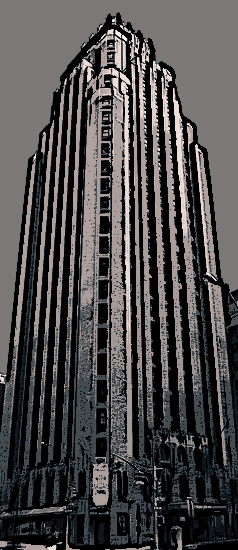 He forced himself to don his sweats and stretch the aches out of his bruised muscles. He didn’t want to overdo it, but he had to get blood flowing, working out the stiffness and swelling. He had a call in with the service and made an appointment for some body work in half an hour. By then he might be in good enough shape to face another board meeting. One of the things to be broached was the renovation of the old battery works in memory to his father and founder of Bruce Enterprise. And how that would be funded through a number of grants, federal and state, as well as the charitable foundation BE WELL, founded by Trish, his mother,. He had the votes and only Harold was against it. The consensus though was that it was a positive public relations move. They could feel good being civic minded without really having to do anything, aristo cake crumbs to the plebs in proclamation of their benevolence. If Harold made too much of a fuss, he would have to bring up the toxic site review and explain what the BATS lab has discovered. Harold was nervous over the government contracts being paused while the leadership issues were being worked out. He was heading to DC after the meeting with a plane load of lawyers for a big pow-wow with Agency lawyers.
 And then there was the nostalgia market that gave new value to well preserved auto relics of the past. His fire engine red 1954 Studebaker Commander Convertible, a restoration from a barn find, and from another company that did not make the postwar transition especially after its failed merger with Packard, taking down the venerable carriage company known for its elegance and reliability. It wasn’t about quality anymore, especially if the consumer was buying a new car every year, it was about looks. Now everyone appreciated the durability of the older cars like his 1948 Chevrolet Fleetmaster Coupe, a pale green over forest green, it was built like a tank but totally uneconomical to manufacture. For personal use, the public wanted something light, fast, the kind of transportation that might appear in comic books or science fiction movies.
 The out of service number was telling him something he was convinced. Nor did he think of it as random. He knew he would obsess over it. So why not start at the source, his father’s old office in the very building he was currently renovating. He resolved to find out and suited up in his riding leathers, the most obvious conveyance to make a stealth approach to the battery works was the modified Spyder XR he kept in storage and easily accessible. The black balaclava under the lightweight off road helmet was for an especially cold longer night.
 He’d followed them, keeping to the shadows cast by the partial moon playing peekaboo with trundling clouds ready to drop more of their cold wet. They’d disappeared around a brick corner on Central and when he’d given a quick glance in the direction they had headed, they were no longer in sight. A few doors down was the entrance to the apartment space above an abandoned vacuum cleaner store. The door was open to the stairs leading up. A bare bulb flickered at the top of the landing. Unless they’d raced down to the next block where a street light illuminated the frozen air with a brilliant halo, they would have had to veer off. The stairwell was the only likely and immediate option.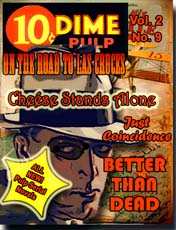
 In late February of 1908, a one-time drover, buffalo hunter, saloon owner, hog farmer, peach grower, horse rancher, US Customs inspector, private investigator, county sheriff, and Deputy US Marshal set out from his adobe home on the mesa above Organ, New Mexico accompanied by a young man in a black buggy on the journey to Las Cruces. He would never arrive. This is the story of that journey, a novel account of the last day in the life of a legendary lawman.

 He was occupying his father’s penthouse apartment now, a perk on the company dime. He could survey the entire city from his perch at the wide window looking out onto the marble deck of the balcony. The landing lights of a passenger jet heading for the municipal airport that the city council was now slated to vote on naming the Wallace W. Bruce Airport crossed his field of vision. The parallel arrays of lighted city streets and the winking red tail lights and white bright head light beams that travelled them. The cacophony of neon marking nightclub entertainment and dining, the garish ostentation of major brand billboards, the imposing corporate skyscrapers with their lighted empty offices emblazoned with their two story logos. Bruce Enterprise being one of the pretentious eyefuls with it cryptic minimalist brand of three horizontal lines followed by a full height vertical line and the three mirrored parallels again. BE, a minimalist icon if there ever was one. How many times had he stood at that window, taken in the night lit panorama and stopped his gaze at the office tower only to be nudged by that famous quote he often parodied: “To be or not to be is not the question.”
 The car service had picked him up and taken to the country club, his regular driver, Cornell, affirmed. That was just before ten. The country club listed his tee time for a foursome at ten. Linus Pall was one of the quartet, Aldo Ring, a city councilman, and also a name that was not familiar to him. One of the staff at the Pro Shop said she’d heard that there had been a loud argument in the locker room between Doctor Pall and another man who was not a club member but a guest. The restaurant staff served Mr. Bruce at his usual table and he had had his usual French Dip and iceberg lettuce salad with tomato and mayonnaise. And of course iced tea.
 When Wayne showed up at the club, it was closed but someone was inside cleaning up. It was a large open warehouse bay, painted black, catwalks skirting what was ostensibly a dance floor, cluttered with the debris of the previous night’s activity. There was a bar near the front of the door. The man sitting at the bar stool with the push broom in his hand was the manager as well as one of the bartenders, the DJ, and sometimes the doorman. His name was Peter. He’d looked at the corporate photo of Wallace Bruce and shook his head.
 Accompanying by his cogitations, Wayne’s pacing in the book lined study had brought him in front of the gas fireplace and the large portrait oil of his father that hung above the marble mantel. The old man hated the painting Trish had made him sit for as a mark of his status as a captain of industry. Old Dad had made many disparaging comments about the painting, particularly at the pretentiousness of such a display, and had hidden the canvas at the back of the wardrobe in master bedroom of the penthouse. Wayne had found it and restored to its spot above the flickering flames of the fireplace.
 The late afternoon sky, losing some of its color, was hastening toward dark. A barricade of clouds hemmed in a sinking autumn sun, scattering its light as feeble rays. The hazmat team from the BATS Lab had packed up after a forensic sampling of the soils at various depths of the contaminated area and a thorough scanning of the site with sniffers. He could expect results overnight. He folded and stowed his protective gear in the utility box in back of his ’79 Land Rover. It was a souvenir of his time in Mali. The thing he liked about the old rugged square cab Rovers, although they weren’t built for speed, was that they came in any color you wanted as long as it was green. As well, the bed was long enough to hold his matte black BMW R12 motorcycle in its canvas sheath. If he wanted to go fast. The beeping pager brought him out of his reverie.
 Wayne Bruce retrieved the device from the pocket of his leather jacket and scrolled through the display. Uncle Harold had called multiple times. Everything was Urgent and ASAP with him. And a number he remembered as belonging to Detective Gordon James with Metro Homicide. There was a third number that he didn’t recognize. Very few people had his pager number and he was certain he knew all of them.
 “I might have figured as much. Do you remember Laverne Early or was that after you were sent away to school?” At Wayne’s shrug, he continued. “When the battery business started booming and your old man began diversifying, they expanded the accounts department. That’s where Laverne worked for a couple of years. There was a rumor that she might have been seeing the boss’s brother, your uncle Harold. He was in charge of sales back then. He was quite the ladies’ man in his younger days I heard tell.
 Once on Grant, the traffic was considerably heavier than in the old neighborhood it bordered. He weaved through traffic, stopping at the light before the freeway entrance. No sign of them. His choice was to continue down Grant or get on the freeway. But would they stick to surface streets considering that the raised four lane could take them further and faster? That was the question. He raced up the onramp at the change of the light and encountered the going home gridlock. No one was going to go anywhere fast. It was like a slow moving parking lot. There likely was an accident further down, but as far as he could see, it was a horizon of rooftops inching up the overpass incline. And there in the middle of it, in the number two lane, was the black box he was looking for.
 In March of 1892, a Scotsman by the name of Arthur C. “Artie” Doyle was hanged by the neck until dead after being found guilty of a string of grisly murders of prostitutes in Whitechapel. At that moment, history veered off its presumed course and headed in a direction all its own in which the Great War never happened because the Kaiser was afraid of offending his grandmother, Queen Victoria, whose life has been prolonged by the wonders of biology. The peace of her reign, known as the Pax Victoriana, despite some major environmental disasters, has lasted 180 years keeping as many Victorian airs as possible while making accommodations to bio technology. Cheése Stands Alone poses a steampunk question, can Captain Lydia Cheése find her father, the antigovernment turncoat and radical, Commodore Jack “Wild Goose” Cheése. And furthermore, will her quest take her around the globe and through alternate world histories in the requisite 80 days or is it the beginning of a lifelong journey?
 In Just Coincidence, a privileged young man with the unremarkable name of Wayne Bruce returns to the site where his father once had his business, a battery manufacturing plant, and where he often spent his childhood days hanging around the factory and the neighborhood. His return is haunted by the mysterious circumstances surrounding his father’s death and the vague feeling that his uncle is somehow involved. Appalled by the poverty and crime of the place he remembers fondly, he is moved to resolve the injustice of the socially marginalized and to wreak vengeance on those he believes are responsible for the death of his father. A personal coincidence brings together dark prince and dark knight joined in a fateful and tragic quest for justice.
 The funeral was huge and, not surprisingly, resembled a business convention. The social occasion of old Bruce’s death itself required accommodations for those who had come to pay their respects. Politicians, local dignitaries from various denominations, prominent financiers and corporate honchos crowded the large assembly hall. Harold Bruce had made the arrangements with the exclusive Green Cove Country Club for the post interment reception which was beginning to have the air of a celebration on the verge of a cocktail party. Moderate words of tribute were spoken, tearfully, by Trish, his mother, huskily, by Harold, his uncle. Respectful, ardent words by others who had known and worked for and with him, a saint, a devoted father. When it came his turn, as the younger generation should have the final word, he had been as gracious as a psychopath, echoing their praise with a chorus of his own to the gathering of family, friends, and business associates, yet all the while considering that among them was his father’s murderer.
 “But wasn’t it an emergency?”
 “Crazy,” Wayne smiled, tucking the card into his inside jacket pocket, and glanced back at the tee box now in darkness and imagined the red canvas roof of the golf cart dropping down behind the mound and heading for the fairway. A silent vow welled up and tightened his jaw. Justice. Justice for old Dad. If it’s the last thing.
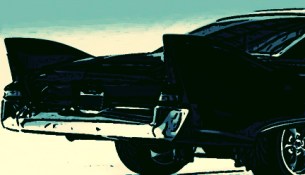 “That’s quite an antique.” A square shouldered black man on the step leading up into the store spoke the words. He was referring to the black sedan parked at the curb.
 “The Battery Man. I remember the billboards. Nobody Beats A Bruce! You that kid? I heard about you. Come on, come on in.” He pushed the door open and the hinge squeaked like a cry for help. “He’s in the back, come on.”
 Wayne paused to recall. “A quarter.” And then, “But I remember when they went up to fifty cents because I came in one day and all I had was twenty five cents, two dimes and a nickel, and you told me that the price had gone up. But you sold it to me anyway, that I could pay the rest next time.”
 Wet occupied the air and chilled it. In the yellow-brown light of the doorway to Quinn’s Tavern, the rain striking the concrete jumped like sparks off a hot griddle. The door opened quietly, disturbing neither the wide shouldered man with the bar towel over his shoulder, gaze intent on the square of color TV mounted above the bar, who laughed along with the track, a rheumy asthmatic rasp, or the other two hunched over in the shadows of a back booth, laughing, giggling, but not at the TV, a sitcom about people who frequent a bar similar to this one although certainly less sinister.
 Dime Pulp