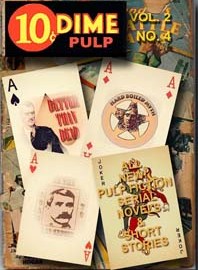
Tag Archives: Hard Boiled Fiction

Contents Vol. 2 No. 6

Welcome to Volume Two, Number Six of Dime Pulp,
A Serial Pulp Fiction Magazine

In Issue Six, Dime Pulp, A Serial Pulp Fiction Magazine, is adding two new pulp serials to the ongoing lineup. Beginning in this issue, the steampunk saga Cheése Stands Alone (previewed in Volume I, No. 6) featuring Airship Commander Lydia Cheése (pronounced “Chase”)  makes its official entry into the Dime Pulp roster. Also joining Phyllis Haldursdottir’s global saga as a new serial is Just Coincidence, a familiar fiction of dynastic intrigue and the dark revenge of a masked crime crusader.

In the first installment of Pierre Anton Taylor’s Just Coincidence, a privileged young man revisits his childhood neighborhood now a ghetto of poverty and crime. An emotional connection to an old mentor and an overwhelming nostalgia  move him to act against the injustice of social marginalization. That he is a dark prince as well as a dark knight is just coincidence.

In the steampunk world of Airship Commander Lydia Cheése, history has taken a sharp left or a right turn (depending on your point of view) in 1892 and the familiar events of history are turned upside down if they even happened at all. It is the year 180 of Pax Victoriana, one hundred and eighty years since Queen Victoria took the throne and whose persona if not the actual person, are kept alive as the paragon of world peace. Britannia still rules the waves as well as the airship lanes, mostly in the Northern Hemisphere and some of the Southern with the exception of  the carbon states New Brazil and United Outlaw Africa. Cheése Stands Alone begins with Captain Lydia Cheése  redoubling the effort to locate her fugitive father, the infamous Commodore Jack “Wild Goose” Cheése, which has brought her to the attention of  the Agents of The Admiralty (AOTA), and which will make her next three months of the year 180 PV an airship globetrotting adventure.

Number Eight of On The Road To Las Cruces reaches a crucial point in this fictional retelling of the last day in the life of a legendary Western lawman where memory becomes a dialogue with one’s self in the justification of a killing and a blind pride that leads to to death.

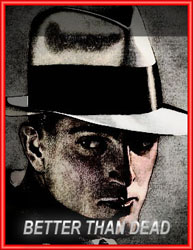
And last but not least Installment 18 of The 1940 detective story, Better Than Dead (Dime Pulp’s longest running serial), follows hapless confidential investigator Lackland Ask through another tangle of tense circumstances as his quest for revenge and profit are continually thwarted by kidnapping, murder, attempted murder as well as stolen diamonds and the mysterious jade Empress’s Cucumber. That he has a young adventuress in tow only complicates matters.

Dime Pulp Yearbook 21 contains the novels (The Last Resort and Better Than Dead) and the short fiction (Hard Boiled Myth and Gone Missing) of Volume One’s 12 issues,  available for perusal in their entirety. If you missed a few issues or lost the thread of a serial, clicking on the link at the beginning of this paragraph or on the menu bar above is a good way to catch up.

Dime Pulp continues its crime spree with two new pulp fiction serializations, Cheése Stands Alone by Phyllis Haldursdottir and Just Coincidence by Pierre Anton Taylor, as well as the continuing serialization of the pulp crime fiction of  Better Than DeadA Detective Story and the Western, On The Road To Las Cruces . If you’ve made it this far, go ahead and follow the links below to reading entertainment with the serial contents of Volume Two, Number 6

 —Perry O’Dickle, chief scribe
and word accountant


Knapp-Felt 1930 1930s USA mens hats

“Lackland Ask is the name. ‘Lack’ to my friends, ‘Don’t’ to those who think they’re funny. You might have seen my portrait on the cover of Black Mask, the crime fiction magazine. This is my story. It starts with a blonde. This kind of story always starts with a blonde.” Thus begins the seemingly non-stop, endless narrative of Better Than Dead in which women are not the only trouble although most of it, told with the wit and street savvy of Runyon and Parker.

Better Than Dead—18


otrpic1fi2In late February of 1908, a one-time drover, buffalo hunter, saloon owner, hog farmer, peach grower, horse rancher, US Customs inspector, private investigator, county sheriff, and Deputy US Marshal set out from his adobe home on the mesa above Organ, New Mexico accompanied by a young man in a black buggy on the journey to Las Cruces. He would never arrive. This is the story of that journey, a novel account of the last day in the life of a legendary lawman.

On The Road To Last Cruces ~Eight~


lydcirIn March of 1892, a Scotsman by the name of Arthur C. “Artie” Doyle was hanged by the neck until dead after being found guilty of a string of grisly murders of prostitutes in Whitechapel. At that moment, history veered off its presumed course and headed in a direction all its own in which the Great War never happened because the Kaiser was afraid of offending his grandmother, Queen Victoria, whose life has been prolonged by the wonders of biology. The peace of her reign, known as the Pax Victoriana, despite some major environmental disasters, has lasted 180  years keeping as many Victorian airs as possible while making accommodations to bio technology. Cheése Stands Alone poses a steampunk question, can Captain Lydia Cheése find her father, the antigovernment turncoat and radical, Commodore Jack “Wild Goose” Cheése. And furthermore, will her quest take her around the globe and through alternate world histories in the requisite 80 days or is it the beginning of a lifelong journey?

Cheése Stands Alone I


fury circle1fiIn Just Coincidence, a privileged young man with the unremarkable name of Wayne Bruce returns to the site where his father once had his business, a battery manufacturing plant, and where he often spent his childhood days hanging around the factory and the neighborhood. His return is haunted by the mysterious circumstances surrounding his father’s death and the vague feeling that his uncle is somehow involved.  Appalled by the poverty and crime of the place he remembers fondly, he is moved to resolve the injustice of the socially marginalized and to wreak vengeance on those he believes are responsible for the death of his father. A personal coincidence brings together dark prince and a dark knight joined together in a fateful and tragic quest for justice

Act One. Scene 1

Better Than Dead—18

by Colin Deerwood

Ads84

The streets were wet with rain again. I hopped a crosstown bus. One of the passengers, an elderly woman, let me have her seat thinking I was blind. It was Sunday, and she was in her Sunday best as were a few other women and men in their best dresses and suits, coming from or going to services. I wasn’t going to argue. I was just being cautious. Rebecca took a window seat. We stood out like Raggedy Ann and Andy in a collection of porcelain dolls.

1937_Bus1At the end of the line the late afternoon sun passing behind a cloud defined a horizon of ship yard cranes and a thicket of masts. Fenced lots echoed with the barks of loud vigilant dogs and the brick warehouses, some seeming abandoned, maintained a grim silence. The rail yard was nearby, and a block of shabby businesses: a café and bakery, a corner grocer’s, a laundry, a hotel, a snooker parlor, and the address I was looking for.

I kept to the opposite side of the street in the shadows of the elms alongside a dilapidated board fence. From behind wood pallets stacked on the bed of an unhitched horse drawn freight wagon I cased my destination.

The sun had broken through the clouds glancing orange off the plate glass of the café and blindingly into the eyes of the man standing on the stoop of the address. A large Oldsmobile breezed up and he shaded his eyes, or maybe it was a salute, before climbing down to an arched double doorway to let the big car into the garage. Yamatski’s digs weren’t the sleazy walkup I’d supposed. That gave me pause. So did what Rebecca said next.

“Lack, look at the sign above the door!”

I’d seen it. I couldn’t make out what it said. It was Greek to me, like you might find on a fraternity house near the university uptown. CC with an upside down N or maybe a U. It coulda been a mook’s version of the YMCA for all I knew.

“Serbskiy Sotsial’nyy Klub,” she breathed. “They are connect to Black Hand. It is social club for fascist.”

I got it. It wasn’t going to be easy. The social club was like a brick fortress. There was no way I was going to go in the front door, not with that mug guarding it and whoever else was behind it.

The blinking neon sign in the plate glass window of the bakery said Café Latino. It suggested I needed another cup of coffee to think things over. And while I was at it. I ordered a half a dozen donuts.

“These donuts I have had before. Sweeter than a bagel. More like cake. I have seen them eaten in the movies. Donut must first be immersed in cup of coffee,” Rebecca demonstrated.

donut scene“No, no you’re doing it all wrong! Didn’t they teach you anything in that fancy Swiss boarding school of yours?” And I showed her how, breaking off a piece and dipping it in the coffee just enough to wet it but not get it soggy. “That’s the way it’s done, kid.”

She smiled and that always got me. I had no defenses against it and any doubts I had about her, about me, just disappeared. “I like when you call me ‘kid’, it makes me feel very American. And you are right, it is much better to dip than to soak. I am learning much from you.”

I didn’t want to think she could be putting me on. And I didn’t want to be the one leading her astray even though there was no doubt that’s what I was doing. I had to put all that aside and concentrate on my next move. It was like she could read my mind.

“What will we do now, Lack?”

Above the café was a fleabag known as the Lattimer Hotel. I’d followed a wife and her boyfriend there once years ago when I was just starting out in confidential investigations. There was a narrow two shoulders wide alley between the hotel building and the social club. The room number on the address of Yamatski’s card was 404. I guessed that made it the fourth floor and to the rear. The hotel building was a floor taller that the social club at five stories. I knew what I had to do. And I had to make sure that Becky was out of the way when I did it.

“I think we should get a room.” I said and tossed my bit of donut in my mouth.

Ads85

There were water spots on the wall were at one time rain had leaked in and no one had bothered to paint over them. The bed looked like it belonged in an Army hospital and maybe it had at one time. A recent occupant had been a cigar smoker. There was a cracked mirror above the basin sink but the facilities were down the ratty carpeted hallway to the rear. A grimy window with a torn shade overlooked the roof of the building next door. I stood at it pulling on a cigarette. Becky sneezed as she sat up on the bed and looked at her surroundings with an expression that said she would have rather been somewhere else. I was waiting for the last of the light to fade before I made my move.

The desk clerk had barely looked at the register where I had signed Mr. & Mrs. Samson Delilah as he passed me the key to the room. He looked like he had other things on his mind. A racing form was spread out on the counter. He pointed to the sign leading to the stairs that said No Credit, No Elevator, No Towels, No Ballroom,. It was indeed a small hotel. And they’d missed the obvious, No Class.

I led the way up the five flights and the high ceilinged room at the end of the hallway. She hadn’t objected, looking away from me like she was preoccupied by a kind of sadness. I figured the stress of the last couple of days was getting to her, she was just a kid, no matter what she said she did in the mountains where she came from. When the door closed she pulled me to her and kissed me, hard, the sadness magically evaporated, replaced by a hungry passion.

lackbec21I was tempted, pulling her up against me, her head tilted back at my response. My judgement when it comes to women hasn’t always been the best, and maybe I could even blame my lapses on my inability to figure them out even when I gave it a try. The hardest part of this jobs was resisting that urge. How many unfaithful wives of unfaithful husbands had offered themselves as partial payment or as a bonus for my peeping, and every time I gave in I was reminded soon after of what a mistake that had been. I couldn’t afford to be swayed.

“We need to talk,” I said. I sat her on the bed and explained my plan to cross the narrow gap between the two buildings and make my way to Yamatski’s room to grab anything of value in partial repayment for my attempted murder. She would wait in the room until I made it back.

There’s a word for the look she gave me and it’s usually reserved for idiots and fools. “No, Lack, stay with me. I am being frighten. Please.” She pulled me to the bed and had me lie next to her. “Tell me why you must do this. It is dangerous. We can wait.” She indicated the room. “Even here.”

She dropped her hand on my chest which predictably affected me below the belt. She was smiling in my face and gave me a look. Even in the long shadows of the room, I could see that it was one of those, mischievous and deadly serious. That’s all it took.

Afterwards she wanted to talk about how happy she was and what she was going to do once the recovered diamonds we’re sold. I admired her confidence in the future. She said she was undecided whether to go to Hollywood or find a big city like Chicago or New Orleans in which to begin her American life. Her eyes were alive either from previous excitement or at the possibility of fulfillment of her dreams.

I told her that Hollywood was just a big slum of broken dreams with better looking people and overnight millionaires who could just as easily find themselves penniless by the morning. She’d stand out like an easter egg in the dozens of hardboiled and overcooked. I told her that her best bet if she wanted to stay incognito was a college town, they had high turnover and nobody asked a lot of questions. If I was going to ground, that’s what I’d do. But I could see by the set of her mouth that the lime light appealed to her. I told her if she was dead set on it, once she got to Chicago on the Broadway Limited, the Super Chief would take her to all the way to Los Angeles and it was just a trolley ride to Hollywood.

“Stay with me, Lack, you could teach me many things.” She had wrapped her arms around mine as if to hold me.

I nodded, staring at the ceiling, and lit another smoke. I got to my feet. I had to do what I was going to do.

Ads86

The gap between buildings was too wide to jump across. The wind was starting to pick up again ahead of another storm and rattling the rickety rails of the fire escape. Across the gap was the roof to the social club, a sloping metal affair ending at a stubby brick parapet like you might find on a tower to a castle. I thought of braiding a couple of sheets together to make a rope and maybe swing across but I’m no Tarzan. It was maddening. I was so close. There was no way I could take a running jump and make it. And the prospect of dropping five stories did not appeal to me.

I went back to the room and Becky smiled like she had won an argument.

“You have change your mind?”

“Not on your life, sister.” I was staring at the bed. I overturned the lumpy mattress. Just as I thought. A wire grid and springs attached to the frame at the foot and head of the bed and held together with wing nuts. And maybe just long enough to bridge the gap. It was worth a try. The nuts had been painted over but I managed work the ones at the foot loose. The nuts at the header looked like they’d been welded on. I was working up a sweat while the kid watched me like I had gone crazy. Maybe I had. I was a mad man in a frenzy trying to prove something to myself with no idea what that might be. Frustrated I gave the frame a kick. The header gave a groan as only metal can and folded ever so slightly forward. I gave it another nudge with my foot and it gave way a little more. It was better than nothing.

Rebecca helped me cart the frame down the hallway to the fire escape door. Getting it through the door and out to the fire escape was a little more challenging. The header was the problem. It had bent only so far yet was still too wide to fit through the door. Having moved furniture with Grace’s brother, Ted, I knew enough about angles to clear the bed frame through the narrow door with a minimum of bangs and backups.

Out on the skeletal pipes of the fire escape, maneuvering in line with the gap wasn’t a walk in the park either. But I gotta give it to the kid, she was a real trooper. Lightening opened up a bright gap in the darkening sky and I could smell the approaching rain. Not that it mattered, I was sweating like a steamed up window.

I was right about the bed frame bridging the gap but wrong about the way it might be accomplished. Attaching the header to the railing as a hook the bedframe missed the opposite roof by half a foot and maybe a couple too high. Not perfect but I could chance using it as a ramp to lessen the jumping distance. I jammed the bedpost into a corner against the bricks but it was no guarantee that the bedframe wouldn’t come tumbling after me and I would have no way to get back. I had to take that chance.

Nestled in among the packing straw were five Thompson machine guns, gleaming with oil as if they’d just been foaled.

I hauled myself carefully up on to the rail and the took a cautious step forward. The kid was putting all her weight against the header frame and I took another step. I heard and felt the welded nuts groan and begin to give, the frame dropping a few inches. I needed just one more step and leapt. And it started to rain.

The bedframe rattled free of my weight and sent shocks to the fire escape which sounded like an explosion of small hammers. I looked up and could see Rebecca’s silhouette as the rain began to sheet down. The bedframe had held. I‘d landed in the narrow gutter space of the brick battlement and it was filling quickly with water shedding off the roof. There was a peaked window with a metal ladder leading up to it I had spotted earlier as possible access in to the club. Either an attic or a loft. There was no light behind it. I had to assume it was unoccupied. I made my way up to the ladder to take a few steps up and peer in. Sheltered by the overhang I could see into the shadowed gloom of the space beyond. Maybe an attic but not a living space.

I heard the noise and turned. The kid was standing on the bedframe about halfway across and the header had come loose from where I’d jammed it. It moved forward and down under her weight. I heard the bolts snap and the frame separated from the header out from under her feet.

She threw herself forward and managed to grab the edge of the abutment. I got to her and reached up under her arm and her other shoulder and dragged her into the gutter. The bed frame made a racket rattling down the shaft and bouncing off the bricks on the way down.

And then it was quiet. And raining. My escape route, never too realistic in the first place, was gone. Plus, now I had the kid to worry about.

“I am so sorry, Lack, but I did not want to be leave alone.”

I was too wet to be angry. “Let’s get out of the storm.” And led her up the ladder to the attic window.

I broke a pane with an elbow and reached around to undo the latched. The window stuck and then creaked as it swung open. I stuck my head in and sniffed the air. Dust, and mold, and something else, machinery? I pulled myself through the narrow opening. It was dark but not pitch. There were a set of attic windows on the opposite wall of the peaked ceiling letting in a dim light. Rebecca followed, still apologizing, but her way.

“I should not have followed. It was foolish. And now we are in a musty attic with boxes and old furniture. And if you do not believe in coincidence, another attic we have found ourselves.”

“Relax, and pipe down. There’s gotta be a way off this floor to the ones below. And that’s where I’m going! We just have to make sure the coast is clear and no one is making a fuss about the clatter.”

I’d already made out the shadow of a railing to a stairway leading down under the row of windows. I listened at the top and heard nothing. I could see that they led down to a doorway by the shadowy gleam of the knob. I stepped quietly awaiting the inevitable groan of wood. I put my ear to the door. Nothing, and gave the knob a turn. The hinges sighed as the door opened into the dim overhead lights of the hallway. Now I could hear what sounded like a burble of distant voices coming up the stairwell. Someone raised their voice and some one answered back louder, closer. The tread of feet thumped the risers heading up.

I hurried back up the steps to the attic pushing the kid ahead of me. She didn’t need any urging, she knew the drill. I ducked behind a large crate covered with a tarpaulin just as an overhead bulb lit up. I could hear the door open and the unhesitant footsteps advancing.

“Naw, nothing up here, quiet as a moose,” a rough voice called out. “Dey musbe hearing tings.” Another voice responded, and the first voice answered back, “Yer right, proly it’sa hotel next door. Some crazies live or dere.” There was an affirmative answer and the voice faintly in going down the stairs, “Let’s finish up the game. We can have time for one more hand before the meeting starts.”

And then they were gone. But they’d left the light on.

I came out from behind the crate. The wood smelled fresh. There were a few more near it with the turpentine tang of newly milled lumber. Black arrows were stenciled on the outside pointing up and a script I wasn’t familiar with. But the red skull and crossed bones spoke clear enough.

“Lack, look!” Becky had found a set of flags in the corner. One was red with a white circle and an X with its legs broken, a green, white, and red one with an axe and a bundle of sticks like you might see on a dime, and a white one with a big red circle in the middle. She held up another, on a black and white ground. It looked like a red checker board pasted onto a pot of fire. “Fascists! Like I have tell you!”

yugocrates1The lid of one of the crates had been pried up and I lifted it off. All of a sudden I felt like Ali Baba minus the forty thieves, and I didn’t have to say Open Sesame. Nestled in among the packing straw were five Thompson machine guns, gleaming with oil as if they’d just been foaled. This was my ticket out. Any one got in our way they’d get the business end of old Tommy.

There was only one problem. Not a one had a drum or magazine. Without the ammo all I had was an exceptionally well-made stick. There was a claw hammer on a work bench along with a bucket of nails. I went to work. It was no use. All the other new crates were the same,  Tommy guns, but not one bullet. And I was back to square one.


Next Time: A Change Of Plan

Contents Vol. 2 No. 5

Welcome to Volume Two, Number Five of Dime Pulp,
A Serial Pulp Fiction Magazine

In this instalment of On The Road To Las Cruces,  the legendary lawman recounts his efforts to bring those accused of the White Sands Murders to trial. A foreboding dogs him as he recounts the details. Someone is approaching from behind. And then the horseman appears. What is related in the novel account of the last day in the life of this legendary lawman is as much a retelling of some history as it is how such a retelling might come about.

Better Than Dead’s seventeenth installment finds private detective, Lackland Ask, “Lack” to his few friends, realizing that, after finding the body in Alice’s apartment, his luck isn’t getting any better and that it is affecting the safety of his friends. People might start calling him “Lucky” meaning exactly the opposite.  He’s desperate and like all desperate men, he makes bad choices. His plan for revenge is taking its consequences out on him

Dropping A Dime takes a look at a few overlooked or neglected heroes of pulp literature: historian and author Ron Goulart, hardboiled novelist James Crumley, and noir author James Sallis.

Dime Pulp Yearbook 21 contains the novels (The Last Resort and Better Than Dead) and the short fiction (Hard Boiled Myth and Gone Missing) of Volume One’s 12 issues and are available for perusal in their entirety. If you missed a few issues or lost the thread of a serial, clicking on the link at the beginning of this paragraph or on the menu bar above is a good way to catch up.

Dime Pulp continues its crime spree with the serialization of 2 full length novels,  Better Than DeadA Detective Story and On The Road To Las Cruces  as well as the cranky opinions of yours truly in another rare outing of Dropping A Dime. If you’ve made it this far, go ahead and follow the links below to reading entertainment with the serial contents of Volume Two, Number Five

 —Perry O’Dickle, chief scribe
and word accountant


Knapp-Felt 1930 1930s USA mens hats

“Lackland Ask is the name. ‘Lack’ to my friends, ‘Don’t’ to those who think they’re funny. You might have seen my portrait on the cover of Black Mask, the crime fiction magazine. This is my story. It starts with a blonde. This kind of story always starts with a blonde.” Thus begins the seemingly non-stop, endless narrative of Better Than Dead in which women are not the only trouble although most of it, told with the wit and street savvy of Runyon and Parker.

Better Than Dead—17


otrpic1fi2In late February of 1908, a one-time drover, buffalo hunter, saloon owner, hog farmer, peach grower, horse rancher, US Customs inspector, private investigator, county sheriff, and Deputy US Marshal set out from his adobe home on the mesa above Organ, New Mexico accompanied by a young man in a black buggy on the journey to Las Cruces. He would never arrive. This is the story of that journey, a novel account of the last day in the life of a legendary lawman.

On The Road To Last Cruces ~Seven~


dime dropFI

In this installment of the catchall column, Dropping A Dime, erstwhile editor and word wrangler Perry O’Dickle emerges from his ink stained den to pen a tribute to the legendary albeit little known Ron Goulart, pulp fiction and comic book historian, fiction flogger under numerous pen names who wrote futuristic novels that played off the unintended Schumpeterian and most often hilarious consequences of mechano-tech—he was the gleeful saboteur of a Popular Science future. As well, in this latest installment by the man in charge of these shenanigans, the crime fiction of the two Jims, Crumley and Sallis, are given a rapid rake of the side eye and peripheral consideration.

Ron Goulart and the Two Jims


Ron Goulart and the Two Jims

Ron Goulart

Ron Goulart is the spark that originally ignited the interest in pulp fiction and led to Dime Pulp. His The Hardboiled Dicks: An Anthology and Study of Pulp Detective Fiction (1967), Cheap Thrills, An Informal History of the Pulp Magazine (1972), and The Dime Detectives (1982) were a first serious and intriguing glimpse into the genre for these offices in the mid-80s. Prior to that, Goulart’s wacky sci-fi stories of tech gone wrong (notably robots) were diverting reading characterized by his penchant for goofball humor. Sadly, Ron Goulart passed away in January of 2022 at the age of 89.

Goulart was a prolific writer, historian, and proselytizer of pulp fiction and its emergent heir, the comic book. Writing under his own name as well as over a half dozen pen names, his novels and stories were an easy read, always with a little MAD comics edge, nothing too serious or violent, slapstick certainly. The grim shadow of “noir” did not often intrude in his easy going tales.

afterRon Goulart may be viewed as a lightweight by the toting crowd but the sheer volume of his engagement in the pulp/comic genre allows him to claim the turf he helped established. He was the author of over two dozen compendiums on comics and golden age pulp fiction illustrating the comic book’s emergence from the fantastic pulp genre and the Sunday Funnies. He wrote numerous futuristic novels that played off the unintended Schumpeterian and most often hilarious consequences of mechano-tech—he was the gleeful saboteur of a Popular Science future. Of the over two dozen nonseries novels, including Clockwork Pirates (1971), The Robot in the Closet (1981), and Now He Thinks He’s Dead (1992), most are of a whacky dysfunctional Murphey’s Law universe. His Barnum System series of novels is a planetary circus of its own with such titles as Spacehawk, Inc. (1974) and Galaxy Jane (1986) among numerous other linked and obtuse permutations his agile mind could hatch: Hail Hibbler (1980), After Things Fell Apart (1970). Goulart’s era was the twenty years span from the mid-70s to the early 90s in which he wrote under many pen names (Chad Calhoun, Zeke Masters, Jillian Kearny) as well as his own, collaborating on a range of projects in the pulp comic book genres which included penning Flash Gordon stories, Vampirella, and Avenger. In the 1970s, he wrote several novels based on Lee Falk’s The Phantom (“the ghost who walks”), a character incorporating  proto-super heroes, essentially Tarzan as Batman with a brace of 45’s, for Avon Books under the pseudonym “Frank Shawn”.

That he had a sense of humor about a dystopian future of robots and AI just made his stories all the more human and entertaining. He was not overshadowed by noir even though he worked on and wrote about the genre that engendered it. The cruel macho psychopathy of hard boiled prose was not his maître. Goulart kept it light, parodying the fantastic and sometimes brutal pulp genres of sci-fi and crime fiction. He was a hack in the good sense of the word, and epitomized an era’s liberality of imagination by the range of his output, well worth a wiki lookup. A playful satirist with a riotous sense of humor as evidenced in his Groucho Marx detective series, written after the turn of century, in presenting such pulp tropes as “Lord of the Jungle,” “Secret Agent,” “Master Detective,” and “Private Eye” versions of Groucho with felicity and breezy Hollywood wit. Nor was he above writing for TV programs or penning bodice rippers under a woman’s name.

Goulart, as pulp historian, engaged in preserving a particular generic tone characteristic of an era of transition from pulp to comic book to graphic novel by being an active participant in that transition. His authoritative histories are gems of preservation and reference covering the parallel development of pulp publications and of illustrated storytelling in the form of comic strips and books. In his roles as pulp writer and scholarly aficionado, Goulart was a champion of the imagination and a real kick in the pants.

A timely Goulart retrospective is in order, a Goulart Omnibus (there is enough material for a couple collected volumes) at the very least! A festschrift, perhaps? The world needs to appreciate more of his sardonic wit. Pass the word.

The Two Jims

The two Jims, James Sallis and James Crumley (1939 –2008), could not be more different yet both represent a singular uniqueness in their stylistic genre, the crime novel. Crumley’s novels are full of gregarious bluster. Sallis’s novellas are thoughtful and subversive. Crumley’s actions and their aftermaths are full frontal view of violence’s consequences. For Sallis, what is depicted are the consequences of those actions as rueful denouements. A Crumley story usually contains enough material for at least three novels, wide ranging and galloping all over the place. They are a unique blend of the western and the private eye/finder of lost kids/kittens genre. Sallis says all he needs to say in the length of a novella. The language is precise and elliptical, Simenon-like, in evoking a mood.

James Crumley

James Crumley’s novels feature the characters of C.W. Sughrue, Viet vet drunk turned private investigator, and P.I. Milo Milodragovitch, each in their own adventures although they cross paths in the 1996 novel Bordersnakes. Crumley’s anti-heroes are both big men with big personalities and essentially mirror images of each other. Not that it matters. What carries Crumley’s novels is the sheer bravado of his storytelling. Anyone who’s ever worked as a bartender has probably come across a character like Crumley, loud, raucous, and a genial everyone’s my friend demeanor. Until the booze runs out.

tree duckBoth PIs, Sughrue and  Milodragovitch are hard drinkers, and hail from the cowboy states, Texas and Montana, the author’s home turf. They are the giants from the north exacting their version of justice in a particularly cockeyed world. A natural born storyteller, Crumley spins tales of mishaps and bad luck death defying scrapes that are often hilarious in their telling but also tragic in their own right as a history of bad choices. His characters inhabit a world of regret and wounded psyches. Often times the graphic violence seems gratuitous, yet no one would doubt the authenticity of the pictures Crumley paints. Crumley’s is a world of right and wrong with a lot of leeway gray viewed from the other side of the tracks where there is honor of a kind among outlaws and where some situations can only be resolved by violence. The plotting of the novels allows Crumley’s penchant for the shaggy dog tale and wide ranging hair of the dog that follows.

In The Long Good Kiss, a sick lovesick saga if there ever was one, Crumley defies the beat with squirrely maneuvers, digressions, soul searchingly bared and nakedly sentimental. Sughrue is the hero who must defeat the dragon, save (find) the maiden, and deal with his own demons. The common theme of these novels is of a quest for vengeance as a means to an uncertain redemption that requires guts, determination, foolish pride, and a firearm. What follows are the peripatetic permutations of Crumley’s telling. In a world ruled by violence, Crumley organizes his action like a cavalry charge or a commando operation, and often things go wrong (otherwise you wouldn’t have a story) and the hero suffers the consequences of hubris.

Most of Crumley’s novels begin in a bar (any bar) rendered accurately from long habituation. In The Long Good Kiss, Sughrue is drinking the “heart out of a spring afternoon,” and Bordersnakes starts out with Milo in a bar fight. PIs now seem only viable  in the dimlit underbelly of  prairie states (the American steppes) drinking dens where the world is still wild and desperate. And to do what they think they have to do and maybe sorta do it, they have to be Grizzly Adams cloned with a mean streets PI, a paladin in the Marlowe mode, mug like Richard Boone and shoulders like Cheyenne Bodey’s, and none of that 77 Sunset Strip cute beatnik stuff. The western had been an almost daily staple of evening TV viewing in the decades of the 60s and 70s—there was always someone stalking the dusty street ready to shoot a gun after dinner.

Crumley’s surrogates are thoughtful yet violent, men of instinctive action with not a little self-recrimination, flawed in effect, which always makes for the best PIs. His guys have another Chandleresque inflection beside the shining armor complex—they get sappy around dames, and it’s always their downfall, and always what inflicts the most pain. Crumley has no qualms in laying out all the details of betrayal and bitterness with the telling authenticity of the barroom orator. His rhetorical hooks to keep your attention, the left hook, the right hook, the uppercut, the fist to the throat, the kick in the groin so vividly depicted that they actually tickle the amygdala and tenuous (fight or flight) signals are expressed as subtle experience by their visceral hair raising realism . Crumley can do that.

His novels each have the scale of classical epics and myths in that the hero has to undergo various altruistic trials and battle the inhuman in himself and in others. Crumley never achieved mainstream success with his seven novels, The Last Good KissThe Mexican Tree Duck and The Right Madness featuring C.W. Sughrue, along with The Wrong CaseDancing Bear and The Final Country featuring Milo Milodragovitch, although The Mexican Tree Duck won him a Dashiell Hammett Award in 1994, and his work has been cited as influential to a generation of the top crime fiction authors including Connelly, Pelecanos, and Lehane.

There’s a bar in Missoula, Montana that Crumley used to frequent, hold forth, spin his stories, and gauge the effectiveness of his outrageous stories on the credulousness of his interlocutors. Reading their expressions was probably the greatest pleasure, typing up the stories was the real work. There’s an effigy of Crumley on a stool at one end of the bar where he perched and held his monologues. Better than any mantlepiece tribute. Crumley was, in Lord Buckley’s words, “God’s own drunk,”

James Sallis

James Sallis is the polar opposite of Crumley. Where Crumley might be said to use a machete to carve out his stories, Sallis uses a scalpel or, at the very least, an x-acto knife to shape his. Carefully crafted, the stories are quiet and deep. Their mood is dark, subdued, cerebral. In many respects they depict the psychological essence of noir. His characters are revealed in nuanced dialogue or by the mundane ambiguity of a scene. Throughout there is the subtle stylistic shadow and light reminiscent of German Expressionism and a dream-like melancholy framed in a meticulously considered language. Sallis’s novellas, no matter their content, are literary.

cricketLew Griffin, Sallis’s PI,  is portrayed realistically, not as a knight in shining armor, but as gritty, a survivor in spite of himself, haunted, flawed. Griffin is featured in six novellas, all titled after insects (companions of the loner or lonely man) beginning with The Long Legged Fly in 1992 and including Bluebottle in 1999, and Ghost Of A Flea in 2001.The action is often muted, viewed in the aftermath or off camera, the consequences telling the story that led to them. Lew Griffin is a black man, obviously self-educated and fond of quoting French authors, living in or on the edge of poverty in and around New Orleans. He finds people or saves them or kills them but always with lengthy soul searching consideration. He’s a tough guy because he is forced to be not because he wants to be. He has no illusions, thus the basis of his sustained noir ennui.. The tang of adrenaline is rare in Sallis’s crime fiction yet the depictions and progressions of the stories are always satisfying, literate contemplative ruminations on the human condition.

Sallis’s novel Drive (2005), about a stunt driver who moonlights as a getaway driver, was made into a successful movie starring Ryan Gosling. His John Turner series about an ex-cop, ex-con, ex-psychotherapist now deputy sheriff up Cripple Creek is his entry into the swamp noir genre  and presents no end of labyrinthian possibilities. Two of his recent novellas, Sara Jane (2019) and Others Of Our Kind (2013) are illustrations of his range as a storyteller and finesse in developing his characters, both of whom are women. Sallis moves out of the shadows in these novellas. In Sara Jane, a tale of great subtlety, the tone is the washed out yellows shading to amber of a prairie state. Others Of Our Kind is about Jenny Rowen who was abducted at age eight, and in this tale, the mood lighting is that of a not quite noir grayish blue.

Sara Jane is about a female deputy sheriff and the telling proceeds obliquely as a montage of memory revealed in elliptical snatches of reminiscence and circumstance. Understated, the story carries the reader along, meandering through seemingly unrelated threads that quietly become meaningful. Over the course of the narration, connections are made, peripheral epiphanies, illusive and open ended, flash like dry lightning. The secret of Sara Jane’s past will be revealed as the story closes but how the revelation unfolds is what makes the narrative a remarkable piece of writing. Then it’s over, and the reader is pleasantly surprised by a story carefully encapsulated by brevity and the resonance of impressions.

Others Of Our Kind offers an odd psychological study of a crime victim. How the story unfolds and how it progresses is not the expected enervated existential crisis. Absent is the moral outrage of a young girl abducted and kept in a box for two years. Absent also is an anguished recovery of identity and reconciliation with family. The expected trauma tropes give way to those of an unbound freedom, not victimhood. As an older successful professional, Jenny remains blithely unaffected by her ordeals, as a sex slave, as a mall rat. A crime of similar nature has occurred and through her professional contacts as a TV News editor she consults with the police detective who is investigating the case. Jenny’s introspection about her past provides the context over which the narrative develops. The tale is told with unusual candor in a series of set scenes that emphasize the mundane matter of fact passage of time. No high drama interposes in the precise delineation that resolves almost through sheer inertia. The story arc is vast and accounts for decades. In the epilogical resolution, the final scene is approached as if from a distance gradually closing in, and Jenny is much older now, retired to a sunshine state, at her writing desk, thoughtful, putting the finishing touches to her story, one that doesn’t accommodate the beats of formula crime fiction but works just as well. Sallis allows the story to find its own way at it’s own pace and he needs only 118 pages to do it.

Stylistically, Sallis’s stories work like films  and demonstrate the focused character-based concerns attributed to European cinema. The sensibilities are refined even if they do belong to country folk, the characterizations are centered albeit spare befitting a quotidian stroll through the psyche. His novellas are cinematic in their pacing, each like a finely wrought ninety minute story leaving you wanting more. They progress in brief narrative takes and cuts. an artful shuffle of suspenseful digressions undercutting any determining sense of purpose. Nor are they dialogue driven narratives. Rather they are etudes on framing circumstance.

The author of eighteen novels as well as the acclaimed biography Chester Himes, A Life (2001), James Sallis has been translated into German, French, and Spanish, earning acclaim in each of those languages with the Grand Prix de Littérature Policière, the Deutsche Krimi Preis, and the Spanish Brigada 21 as well as Bouchercon’s  Lifetime Achievement Award. He is also recipient of the Hammett Prize for excellence in literary crime fiction.

Besides his crime centered fiction, Sallis has published collections of short stories, poetry, criticism, scholarly studies on the role of the guitar in American Jazz, and translations from the Russian, French, and Spanish. Notably, his translation of Raymond Queneau’s Saint Glinglin (1993) leads to the assumption that Sallis is more than passing familiar with the unique approaches to the narrative by the influential French author and founder of Oulipo. He has admitted that he draws some of his esthetic for his stylistic approach from Michel Butor and Alain Robbe-Grillet, two proponents of the Nouveau Roman. Sallis captures that particular je ne sais quois élan, and seems perfectly comfortable with the novella form, one that he has undoubtedly mastered.

That’s my story and I’m sticking with it
Perry O’Dickle, for Dime Pulp

Better Than Dead—17

By Colin  Deerwood

Ads81

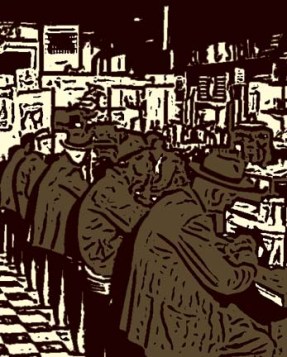
The country was going to the dogs and was being led there by the rats under the spell of the pied piper in a wheelchair. That’s what the guy sitting down the counter from me said. He wasn’t saying it to anyone in particular. What he was saying was that war was inevitable. I’d heard it all before. I didn’t care for the Marconi Messiahs or the broadcasts from the big tent evangelists predicting the storm that everybody knew was coming. If a guy wants to strut around on a stage pretending he’s god-almighty Charlie Chaplin that’s his problem and maybe he should see a head doctor, but it’s none of my beeswax. And now some squinty eyed guy by the name of Hero He Too across the wide Pacific was getting too big for his pants. If there was a war then I faced the prospect of being drafted and I wanted to avoid that at all costs. I could always take a hike to Canada but I was no dogsled jockey. South of the border, the islands, Cuba, Chile sounded exotic and full of senoritas, and all more appealing. Mister Loony, Herr Mustache, Hero He Too didn’t mean nothing to me. No matter the drumbeat, I wasn’t marching.

marconi messiahHe was going on about other things, Commies, getting loud, angry, until the cook waved a big metal spatula at him and told him to turn it down. I was looking at my hands trying to be invisible, hat pulled down over my ears, dark glasses no matter that they looked like beach wear. A problem had developed. Because of Sid’s frap between the eyes, the bruise around both of them had turned the color of a ripe eggplant. I didn’t think my nose was broken but it was still throbbing the next morning.

After the crime scene had closed down, after they led Linkov away in bracelets to the paddy wagon, his white hair in unruly spikes and his pointed beard and swirling moustache held up defiantly beneath blazing eyes, after watching Hogan in a huddle of high priced suits with Nekker and his G-men while the body from Alice’s studio was carted out to the coroner’s van, after the crowd had drifted off in clots of twos and threes and only a few of the neighbors were still giving Alice their sympathies, after that I stepped from the shadows from where I had been watching. Rebecca had managed to get closer to Alice and finally led her away, down to her studio. I followed close behind.

It wouldn’t have taken much to upset the clutter of Alice’s tiny space. The chalk outline on the floral carpet only partially contained the spread of a dark burgundy stain. The sergeant had given her the name of someone who could clean it up for her.

“Why am I struck by the total modernity of that composition?” she asked, a cigaretted hand flailing at the floor and giving that silly grin that precedes an immediate collapse.

I caught her before she hit the floor. Rebecca helped me stretch her out and then prop her feet up. I got a pillow from the bed for her head.

As I crossed the room taking in the disarray, I saw that Ted’s portrait was slightly askew, the gleam in his eyes gone. And I thought of Linkov. The peeper. I bet I could find a hole on the other side of that wall where he was accustomed to watching Alice’s sexy dance in front of the portrait of her deceased lover. If it hadn’t been for Linkov’s voyeurism no telling what harm might have come to Alice. He was the real hero.

She came to as Rebecca was patting her cheeks, eyes blinking and looking around and moaning, “I can’t stay here.”

Up in Lee’s loft, Alice sat on a small rickety chair holding the cup in both hands, sipping strong coffee, shivering still wrapped in the blanket, dragging the smoke out of a cigarette, and looking up at the skylight as the first of early morning brightened the flat pane. “What in the hell happened?”

I had to tell her about how a swim in the East River led to the possession of a valuable piece of information that could garner a small fortune in diamonds and how Rebecca had rescued me from the double crossing diamond dealers in the face of a gun battle between them and unknown assailants whose description resembled the men that attacked her in her studio, and helped me escape to her father’s Used Clothes shop where she revealed that in fact she had absconded with the diamonds and then the G-Men showed up because as it turns out her father is a bombmaker followed by the escape through the coal chute where the diamonds dropped from Rebecca’s pocket and later that night when the attempt to retrieve the diamonds from the coal bin failed I went to the cocktail lounge to collect the postal slip stolen from Della’s mailbox and ran into a gang from the funny paper who kidnapped me so Rebecca got away but only to come upon the body in her studio and that maybe her and Rebecca going to get the traveling bag from my office wasn’t such a good idea and hadn’t fooled anybody because they had been followed.

Alice looked at me blankly for a moment and then down at her cup. “What did you put in this?”

Ads82

The counterman came by and reheated my joe. He jerked his paper hatted head in the direction of the loudmouth. “”Don’t mind him. He shouldn’t read the newspaper. Gets him riled up.”

I nodded and took a sip from the cup. “Thanks. I don’t pay him no mind.”

He indicated my eyewear with his chin. “A little trouble with the missus. You’re showing purple around the edges of your fancy glasses.”

“Naw, ran into a light pole last night.”

“Howdya do that?”

“I was walking in the pitch dark and was afraid I might tumble over something and hurt myself so I went toward the streetlight, tripped over the curb, and felling into the pole. Caught me right between the eyes.”

“At least the light was better.”

I laughed for what it was worth. And he walked away and came back with a box from under the cash register. It contained a collection of lost eyewear. “Might find something better than what you borrowed from the little lady.”

That had been Alice’s suggestion earlier before Rebecca and I left the loft. “Take Lee’s sunglasses, she never wears them. You don’t want to walk around looking like a ghoul from the Saturday matinee. Somebody’ll notice you.”

blindman21As if no one would take a gander at my beat up mug wearing a pair that belonged on a Hollywood dame. I held them in my hand as I had then to compare. There wasn’t too much of a selection in the box, mostly a tangle of round wire frames and cracked lenses. At the bottom was a square set of black lenses, the kind you might see on a blind man. I tried them on and they fit with a certain weight that felt comfortable. I turned on the stool and looked at my reflection in the diner’s front window. I was unrecognizable. I slipped Lee’s pair into my jacket pocket and smiled even though it hurt. “Whadyeoweya?”

The counterman shook his head and waved away my offer. “All you need is a cane.”

Ads83

First Alice was hysterical. “What were you thinking!? They could have killed me!” I wanted to say “or worse” but I knew enough to keep my mouth shut. Then she got angry. “You bastard! How dare you!? You put my life in danger with your stupid stunt. I could have died!” Then she got quiet and that was the worst because those eyes shouted their disgust with me.

Rebecca had tried to explain that there was no way they could have suspected that they were being followed from my office. “Did they ask for Lack by name? How can you be sure that it was him they were looking for?” Alice said she didn’t remember but who else would “he” be but me. And that’s what I was thinking. That he was me and a gang of goggle wearing bandits wanted to kill that me. But who were they? I thought if I knew I could figure out how to avoid them.

I could tell by the look on Rebecca’s face when she settle on the stool next to mine that she hadn’t had any luck with the tailor shop building’s super. “There is police seal on door to my father’s shop and padlock on door to boiler room and coal bin. I do not know how we will be able to get to the diamonds.” Her shoulders hunched, ready to release a sob. I held her hand and she looked up at me.

“They are very dark your glasses, Lack. Can you see from them?”

I got the feeling she wanted to change the subject. “Yeah, I can see with them just fine. And my eyes don’t hurt as much in the bright light.”

She gave a weak smile and let out a sigh. “What will we do?”

I shrugged. I knew I had to get out of town before Kovic and his mugs caught up with me. I had an idea but didn’t let on to the kid. I would go down to the coal yard in the morning and find out who the supplier for that address was and then I’d look over the delivery schedule and get to the place before the coal was delivered and make like I was from the coal company and say I was there to inspect the chute because there was a problem last time like maybe the chute was blocked or something like that. But that would take time and I didn’t have the time or the expense account. I had to think of something.

I had started out with the idea of getting revenge for being stiffed by Kovic. It seemed like a simple enough plan. Walk up to him and fill his face full of holes. If I could get close that is. But in my state of mind, I didn’t care. I wasn’t going to get beat out of my fee or beat down trying to collect. And I almost got it, too. But I got a consolation prize instead, Yamatski’s Black Hand address book. Then I’d been rooked out of that by Solomon and his boys. I shoulda been smarter than that. They got the book and I got nothing. Unless you count the kid and the promise of pilfered diamonds.

I looked over at Rebecca and past her at the guy in the battered fedora and the equally beat up traveling case handing his business card to the counter man who inspected it with one eye closed and a squint of the other, and shrug. “We don’t need no novelties. We just sell food here,” he said.

dinerI had a card in my wallet. It was Yamatski’s card, the one that promised a reward if his address book got lost and found and gave a phone number and an address to return it to. My original idea of taking a look at his setup and maybe taking something that might be worth my trouble came back into play. It would be dangerous and I didn’t think I should drag Becky into the scheme which was essentially a burglary. But when I told her I had to be someplace, she gave me such a sorrowful look and pleaded, “What will I do while you are gone? Alice is still very angry with you, with me. I have no place to wait.”

I felt bad for the kid. Against my better judgement, which was starting to seem like a bad habit, I let her tag along. When you take a shine to someone, it comes with responsibility. Maybe that was why.


Next Time: The Philharmonic Radio Hour

Contents Vol. 2 No. 4

Welcome to Volume Two, Number Four of Dime Pulp,
A Serial Pulp Fiction Magazine

In this instalment of On The Road To Las Cruces, the name of the legendary lawman is revealed. Pat Nolan said of this novel account of the last days of the man’s life, “I had the manuscript sitting around for nearly thirty years and one day I went in with a machete and cleared out all the undergrowth until it was as spare and taciturn as the man himself. It shortened the word count considerably but it made for a better story.” What is related on the road to Las Cruces is as much a retelling of some history as it is how such a retelling might come about.

On the conclusion to All Tore Up, Helene Baron-Murdock says of her latest Hard Boiled Myth episode, “When I first created Jim Donovan of the Weston County Sheriff’s Violent Crime Unit, I just thought to use him as a mouthpiece to revisit the mayhem and murder found in Greek Myths. Yet the character in addressing how these myths can be retold cannot be conscious of the current investigation’s architypes—they are only transparent to the informed reader—and allows him to take on a life of his own. The odd development is that most of the other police officials Donovan interacts with have, like his, the names of pop music celebrities. It’s just a coincidence.” Or is it?

Better Than Dead’s author, Colin Deerwood remarked that the world of the private detective of his story, Lackland Ask, is made up entirely of language. “The language of the quotidian exchange, the patter and chatter of someone who gets ahead on guile and a few luck breaks, and which is why some episodes resemble a large shaggy dog following the scent of the imagination to wherever it may lead. The peregrinations of our everyhero are what gives pleasures to the telling of situations and predicaments only one step away from the next misstep.” But then he always says things like that.

Dime Pulp Yearbook 21 contains the novels (The Last Resort and Better Than Dead) and the short fiction (Hard Boiled Myth and Gone Missing) of Volume One’s 12 issues and are available for perusal in their entirety. If you missed a few issues or lost the thread of a serial, clicking on the link at the beginning of this paragraph or on the menu bar above is a good way to catch up.

Dime Pulp continues its crime spree with the serialization of 2 full length novels,  Better Than DeadA Detective Story and On The Road To Las Cruces  as well as the conclusion of latest installment of Hard Boiled Myth. If you’ve made it this far, go ahead and follow the links below to reading entertainment with the serial contents of Volume Two, Number Four

 —Perry O’Dickle, chief scribe
and word accountant


Ace-of-Spadesfi“Lackland Ask is the name. ‘Lack’ to my friends, ‘Don’t’ to those who think they’re funny. You might have seen my portrait on the cover of Black Mask, the crime fiction magazine. This is my story. It starts with a blonde. This kind of story always starts with a blonde.” Thus begins the seemingly non-stop, endless narrative of Better Than Dead in which women are not the only trouble although most of it, told with the wit and street savvy of Runyon and Parker.

Better Than Dead—16


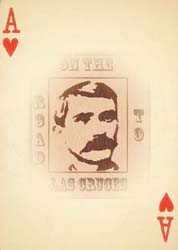
Ace-of-hearts-1f1In late February of 1908, a one-time drover, buffalo hunter, saloon owner, hog farmer, peach grower, horse rancher, US Customs inspector, private investigator, county sheriff, and Deputy US Marshal set out from his adobe home on the mesa above Organ, New Mexico accompanied by a young man in a black buggy on the journey to Las Cruces. He would never arrive. This is the story of that journey, a novel account of the last day in the life of a legendary lawman.

On The Road To Last Cruces ~Six~


Ace of Diamonds

Greek myth is rife with murder, mutilation, cannibalism, mayhem, and the ever popular incest.  Weston County Sheriff’s Detective Jim Donovan of the Violent Crimes Unit wouldn’t know a Greek myth from a Greek salad, but if he did he would find some troubling similarities to the cases he’s investigating.  Revisited as crime fiction are the strange death of Hippolytus, the agonizing death of Heracles, the slaughter of Penelope’s suitors, the Fall of Icarus,  the sparagamos of Orpheus, and the cursed lineage of Pelops.  Helene Baron-Murdock’s Hard Boiled Myth taps into the rich vein of classical literature to frame these ancient tales in a modern context.

All Tore Up—III


All Tore Up III

by Helene Baron-Murdock

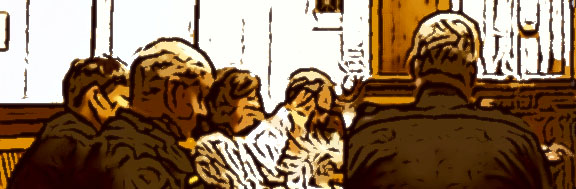
The operations briefing was scheduled for 8 AM in Conference Room Two adjacent to the squad bay. Donovan had been in the office since 5. Now he was seated at the long table watching Lieutenant Jackson tack the mug shots of the three suspects and the reconstructed sketch of O.R. Phineas onto the white board.

Rick Nelson was there too, staring into the steam of a hot cup of coffee. He had that new-baby-no-sleep look to his bleary eyes. In answering “How’s the baby” he’d offered “I think she’s a vampire. She only sleeps during the day and stays awake all night. I could be catching a few precious winks if the Loot hadn’t called me in.”
confrenceroom

Mike Jackson looked away from what he was writing on the white board. “Boss said he wanted everyone front and center. He even had me call Bobbie back.”

Lanky Townsend stopped at the doorway about to step in. “What? Bobbie Delyn? That’s cruel and usual punishment. I thought she was still going through rehab.”

“Boss’s orders,” Mike said to the white board and drawing a line connecting what he had written to the picture of O. R. Phineas that Donovan had printed out from an array of available images online. The victim had not been camera shy.

Stubby Burdon found a place at the table and set a paper hot cup down next to his file folder. “You’ll never guess who I saw in the breakroom.”

Nelson and Townsend turned to him and said “Bobbie” in unison.

“Taking my name in vain, are you?” The older woman in the doorway glared at them with mock displeasure.

“Not me, Sarge,” Burdon held up his hands in protest, “Just surprised to see you back is all.”

Sergeant Roberta Delyn had that tough cop look that only a woman can have. She was all business. No tolerance for boy games and pranks. If you messed up, she was the one who read you the riot act. At five foot five her square shoulders balanced a not exceptionally pretty face due to the white scar that ran from beneath her left ear across her cheek to the tip of her chin. A boyish dyed blond bob tucked under a ballcap, she was dressed in her usual puffy green down vest over a checked man’s shirt, a pair of Levi’s, one leg of which was wrapped in a brace, and a three toed aluminum cane. She passed behind Donovan’s chair to get to the end of the long table and casually asked, “Why are you still here?”

Donovan and Bobbie didn’t exactly have a history. Not that kind of history anyway. She’d been in Violent Crimes longer than he had. She was the Loots right hand and sometime his left foot. “Sergeant Delyn, always a pleasure.” Donovan raised his coffee cup in salute.

Jackson faced the detectives from the white board, sleeves rolled up, folder in hand. “Ok, let’s get started. Captain Voss will be delayed so we’ll start without him. Let’s hear what forensics came up with. Pete?”

“I have a question.” Bobbie had raised her hand. “Why am I here?”

“Come on, Sarge, as I explained, it was not my call.”

“I’m on sick leave, for cry’s sake!”

“You could have said no.”

“Well,” she said glaring at the other detectives at the table, “don’t expect me to ride your asses in my usual capable and efficient manner. If anybody needs me, I’ll be in the cafeteria.” At that she pushed her chair back and lifted herself, obviously in pain, to stand, and slowly shuffled her way out of the conference room and in the direction of the elevators.

Jackson shook his head. “Pete? You were saying?”

“Uh, not much new from the lab except that some of the bits and pieces are testing positive with non-human traces. Blood from the clothing of the gals matches the deceased, but other than that nothing. Samples from under their nails show no indication that they used their hands to rip the vic apart.”

“Maybe they washed their hands after,” Burdon offered.

“Jackson shook his head. “I don’t think so, Eric. Their clothing was bloody but I’m guessing it was transient. They may have handled some of the body parts. And not one has a broken nail, chewed maybe, so I’m leaning toward the idea that maybe they were bystanders, witnesses, if you will, not actually physically participating in the rendering.” He addressed Townsend again. “What kind of non-human traces? Are we talking about foxes or big cats? Bear?”

“They ruled out most of the local critters. They’re thinking something more exotic. They’re still waiting for confirmation on the sample but something along the lines of,” Townsend checked his notes, “pan troglodytes.”

“What?”

“Chimpanzee.” Donovan offered.

“I know that!” Jackson retorted.

“Our closest animal relative.”

“Yours maybe.” Which drew guffaws around the table. “Ok, Pete, anything else?”

“Dispatch got a call from a fisherman downstream from Sharon’s Crossing. Seems like we might have found the victim’s hands. Deputy’s on the way. We should know within the hour.”

“Alright, might as well have the coroner’s guys head that way, too. If they’re his hands we can get a positive id. His prints are in the system.” He turned address the white board. “Now our terrible trio here, dumb, dumber, and dumbest.” He tapped each of their photos with his pen. “Melanie, Dora, and Laurel are not being very forthcoming about what they saw and how they were involved.”

Burdon who’d been on the interrogation team volunteered, “Here’s what we’re dealing with. The Captain is sitting in. Out of nowhere, he says “Will you admit that you tore the limbs off this man because you were high on mushrooms and you floated his head down the river on a raft made of sticks.’ This is when we were grilling dumber, there in the middle. I had no idea where the heck that came from. So Dora, dumb Dora, it fits, goes ‘I dunno about the first part, I was pretty high, but yeah, his head, it seemed like the right thing to do.’ And I about. . . .”

“Uh, good, good, looks like Captain Voss is on his way,” Jackson held up his hand glancing toward the doorway. Conference Room Two became very quiet as Voss stepped in.

The Chief of Detectives nodded at his lieutenant and briefly glanced at the others at the table. “Continue Jackson, you can fill me in on what has already transpired. How is the questioning of the women going?”

“Ah, yes sir, we were just getting to that.”

Donovan knew the Loot well enough to know that when he put on that poker face, he was seething inside. He should have seen it coming when Jackson broke a little smile.

“But first Detective Donovan was going to brief us on the narrative he has developed of our victim’s movements before his murder.”

Donovan blinked, ok, Mike, you owe me one, and gathered the folders with his notes in front of him. “Yesterday, approximately 1700 hours we receive a call from the proprietor of Sharon’s Corner, Dane Carson, who said he could identify the composite broadcast on the local evening news. Earlier, approximately 1300 hours, a facial recognition search I had initiated came up with a possible id of the victim. The names matched, and in the process of questioning Mr. Carson, I learned that the victim had presented a poetry reading at his establishment, less than a week ago, last Sunday. There were approximately twenty people in attendance that evening. I interviewed one of them so far, the organizer of the event, Faye Angeli, and plan to interview the others on the list of attendees. I learned or confirmed that the victim, O.R. Phineas, was a kind of literary celebrity, a poet. Mr. Phineas was last seen driving away from Sharon’s Corner in a silver BMW convertible accompanied it would seem by our first suspect, Melanie, who had come to the reading with May Naddy, as had the other two of our charming trio. That would indicate that she has prior knowledge of the poet perhaps leading up to the time of his death.”

may naddyAt Jackon’s nod he continued. “In my interview with Ms. Angeli, who is a real estate agent, she admitted to at one time being a part of the following of radical women around May Naddy known as The Bear Cult, but had left the group after what she termed an ‘unnerving incident.’ She wouldn’t say further what she meant by that but I’d guess that she witnessed something that still leaves her shaking. It’s her contention that May Naddy is a witch, evil, at least.”

Donovan pulled a print out of a photo from the folder and slide it across the table to the Loot. “Tack that one up next to the author’s photo of Phineas.” It was a picture of May Naddy from her last major film, Mistress of the Beasts. She wasn’t wearing a lot of clothes in that one either.

“Is this your idea of a joke, Detective, a pinup on the murder board?”

“The relevance of May Naddy in all of this is in the fact that she is well acquainted with Phineas. I did a little digging on the internet and you’d be surprised with what you can come up with. Before she moved her animal rescue operation to Weston County, May Naddy had a similar enterprise on an island off the coast of Croatia. She was also a patron the performance artist, Yuri Dicey.”

“I don’t see how any of this is relevant to our investigation, Detective.” Voss wasn’t the patient sort.

“Yuri Dicey was married to Oscar Reynaldo Phineas. She was killed when one of her stunts went wrong. He was suspected at first but was eventually cleared. But if you read the comments on stories about Dicey’s death, there are people who believe that Phineas in fact had something to do with his wife’s death.”

“That’s gossip, you’ve been wasting your time reading tabloids instead of doing police work!”

“One of those people is May Naddy. She has been quoted as saying she believes Phineas killed Yuri Dicey because he was jealous. I’ll just throw this out, Naddy and Dicey were rumored to be lovers.”

“And I’d throw that in the trash where it belongs. I don’t know where your reputation comes from, Donovan, but this certainly isn’t police work!”

“Hey, look at that!” Townsend held up his smart phone. “They found the hands and printed them! He’s our guy. O. R. Phineas, poet.”

cafeteria

Donovan sat opposite Bobbie Delyn at the table in the cafeteria with a paper cup of steaming caffeinated brown water and watched her chew the end of her pencil.

“What’s a four letter word for ‘martinet’?”

“Asshole.”

“Too many letters.”

“Voss.”

“That fits, and completes the cross word ‘retired police officer,’ ‘excop’.” Bobbie gave what passed for a smile that creased her white scar like an odd punctuation. “The investigation not going well?”

“Our new chief of detectives is intent on charging the three, I wouldn’t say undeserving but nonetheless not culpable, with murder. Unfortunately other than the bloody clothing nothing indicates that they were directly responsible for the victim dismemberment. Personally, and I’m not alone with this, I think it is physically impossible for them to do it.”

“Because they’re women.”

“Of course not. Even a very strong man would be incapable of ripping a torso to shreds like that, even with tools. This guy was practically confetti.”

“Ugh, now there’s a pretty picture.” Bobbie scribbled on the edge of the newspaper thoughtfully. “Some kind of animal, then?”

“Pan Troglodytes.”

“Chimp. I know that one from doing the crosswords. But a chimp in R.K. Turis State Park? Who would. . . ?”

“Let me finish that thought for you. May Naddy and her anxious animal ark. I got Woody Ames, the animal behavior vet out of bed early this morning.”

“The County Dog Catcher as he so often calls himself. Bet he was happy.”

“Because she operates a wild animal sanctuary one of the stipulations for the permit was that Animal Control had to regularly inspect conditions on the ranch, make sure they weren’t being mistreated and such.”

“Yeah, I think I heard Woody complaining about that.”

“There’ve been problems before. One of her cheetahs escaped and went after the neighboring ranch’s sheep. Fortunately, the cheetah was defanged. It just gummed a lamb. Unfortunately the lamp died of a heart attack.

“Gummed a lamb. I don’t think I’ll ever be able to erase that from my memory.”

“So Woody has an inventory of what kind of animals she has out there. They’re mostly arthritic big cats who have seen better days, all defanged, or blind. A black bear that is so fat it can’t walk, it can only roll, a couple of dogs pretending to be wolves, llamas who’ve lost their spit, a giraffe that can’t stand, horses one step from the glue factory. . .the usual assortment of misfit four legged, feral cats, stray dogs, and two legged runaways engaged in some kind of throwback evolution. . . .”

“His words, I’ll assume.”

chimpanzee“And a crazed chimpanzee. Said when he did the inspection, the chimp was kept in some kind of cage away from everyone, including the other animals. And believe it or not, went apeshit whenever anyone came near her. May Naddy was the only one who could calm the chimp down. Female I think he said. Probably the most dangerous animal out there. His opinion.”

“If I were to draw a conclusion from what you’ve told me, May Naddy’s chimp is the perp.”

“May is linked to Phineas through Yuri Dicey who was both their lover.”

“Sounds like someone was working all the angles hoping to get to the point.”

“Naddy blamed the poet for Yuri’s death. Either she had Faye Angeli lure Phineas to Weston County or it was by coincidence. Either way, May sees her chance at revenge.”

“And uses the chimp as her hitman? From what I’ve heard they’re strong enough. But why involve the three runaways?”

“They were bait. From what I’ve read about O.R. Phineas, he was a lady’s man, left a trail of broken hearts and promises from coast to coast. The silver BMW he was last seen driving was reported missing by some gal up in Eureka. . . .”

“Surprise!”

“And who didn’t want to press charges because she was certain O.R. had just borrowed it but changed her tune to stolen when we told her we’d found it torched in a turnout off a dirt road down here. I think May used these three kids to lure him to her place. Maybe even tortured him. The lab is putting together a composite of the body parts that might show indications of torture.”

“Adding insult to injury. But wouldn’t she worry that the three women would talk if they were involved in any of it.”

“She’s got some kind of psychic grip on them. The experience was probably so horrific they’re suffering from amnesiac shock. If we let them stew a bit longer, one of them might loosen their hold on whatever false scenario they’re clinging to.”

Bobbie penciled in an answer with a grunt of satisfaction. “Might be a little complicated for the new guy.”

“He as much said I should be writing for TV cops shows. It was the most farfetched narrative he’s ever heard.”

“He won’t last long.”

“You don’t think so? I’ll be long gone, but you guys are going to have to put up with him.”

“He doesn’t fit. Who’s ever heard of a Derrick Voss. Helen Reddie over in HR told me that they had a much better candidate, guy by the name of Hendrix. He would have been a perfect fit, she said.”

Donovan took a sip of his coffee which had gone from scald to just hot. “You’re not thinking of jumping ship soon are you?”

“Me? No way. I’ve got half a dozen years before I’m eligible.” Bobbie pointed to her knee. “Unless I go out on a medical.” Then she frowned. “Wait! How old do you think I am?”

“Hey, Sarge. No offense, you just look mature for your age.”

“Geez, like I haven’t heard that one before.” She sighed and tapped the pencil eraser on the table. “So how are you going to deal with Voss the boss?”

“Mike’s getting a search warrant for the Bear Ranch. We’ll see if we can make a match with the chimp. If so, then it goes in that direction and Voss will have to follow it.”

“He was hoping for something cut and dried, this sounds sloppy and wet. So what’s the motive besides sheer cruelty and mayhem? Revenge for the girlfriend’s death?”

Donovan shrugged. “That’s one of them.” He retrieved a slim volume from his folder and passed to Bobbie.

“What’s this? Poetry? When Sunny Get Glue by O.R. Phoneas, er Phineas?”

“Yeah, Fay Angeli had an extra copy.”

“So your saying he was killed because of his poetry?” Bobbie leafed through the pages, lingered on some passages, winced, looked disgusted, sighed, and then passed the book back. “With something like that, anyone could claim justifiable homicide.”


Ω

Better Than Dead—16

by Colin Deerwood

Ads77

There was an explosion of smoke, the rumble and roar of competing conversations, cacophonies of shouts, bursts of laughter as low belly guffaws of gents or the high whinnies of fillies, the distinct clink of bottle and glass, a shuffling and scraping of chairs, and music from a coin operated Victrola over in the corner where a few couples were rubbing their bodies against each other to the lowing moans of a crooner in what passed for dancing. The heady hoppy scent of beer and sharp tang of high octane joy juice mixed in the tobacco haze that hung in the air just about at eye level. It was a lively crowd and no one noticed as I stepped up to the bar where shoulder to shoulder the serious drinkers sat on stools or leaned against it for support.

cocktail lounge1Neither of the two bartenders treading the boards pouring drinks and ringing up the sales on the big brass cash register was the tree trunk that had served me the first time when I’d stepped in to avoid a tail. I tried to wedge myself between a couple of muscle heads who weren’t interested in letting me squeeze through until they laid eyes on Rebecca. Then they became gentlemen whose mouths had dropped open and whose eyes popped out of their sockets accompanied by an ahooga horn.

It just made her smile even prettier at the attention. She was what the old Jewish ladies in the neighborhood used to say, a real  shayna punim: a pretty face. I’d looked into that pretty face with stars in my eyes, too. But something was telling me it was too good to be true.

We’d followed Alice’s suggestion and took a breather in her friend’s loft on the top floor of the building. It was a tiny place, like Alice’s studio, but big enough to be crowded with large canvases hanging on or leaning against any spare wall space below the low ceiling and skylight. Becky sorted through them as if leafing through a sheet music bin, sounding little notes of surprise or astonishment. The ones on the walls looked like swabs of brush cleaning to me.

I’d cleaned up a bit. brushed the bin dust off the elbows, lapels, and knees. I washed my mug of the coal smudges. The bruises weren’t in any hurry to leave. And enough time now had elapsed since the hot grope in the tailor shop. She was still being coy but cool. It was like she knew she had me, she didn’t have to tug on the string.

I had other things on my mind besides. The throbbing at the base of my skull was annoying. I’d been beat on a little too much lately and it was taking its toll. A good long sleep would probably take care of that. In the meantime, getting the rocks back was the first priority, fencing them to diamond dealers Rebecca said she knew or even Max Feathers if worse came to worse. That would generate enough cash for me to light out for parts unknown, far enough that any of Mister K’s mooks might accidently bump into me. But now Becky and I were partners, business partners, so to speak, and there’s no better way to ruin a romance.

We bided our time waiting for evening to get grayer in a kind of no touch tango, dancing around what each of us might be thinking.

I thought taking the back way out of the building the safest bet and we scuttled across the trash strewn backyard to the alley behind. The less we were seen the better I was going to feel. She’d tied a scarf under her chin and I had my too large fedora down over my ears. We probably looked like an old couple out for an evening walk on the mean streets of the East Side. No cars followed us with their headlights dimmed and no mugs were tailing our footsteps. We were all but invisible. And I warned the kid. If things went south or anything happened to me or we got separated she was to amscray back to Alice’s and wait till I got word to her. When it developed that getting at the diamonds wasn’t in the immediate future, I had a backup option.

“Whatallitbe?”

I’d attracted the bartender’s attention although not in the same manner that the kid was attracting the attention of the wolf in the pinstriped suit next to her. The leer of his oily grin wouldn’t pass the Hays code.

I held up two fingers and then sideways signifying a double.

“And your little sister?”

Rebecca smiled up at me and I remember how loopy she’d got on Max’s hootch.

“A Shirley Temple,” I said which prompted her to squeak with delight, “Oh, I love Shirley Temple!”

After I laid the simoleon on the bar I told the bartender that a friend of mine had left an envelope for me. I pointed to the cash register. “My name’s on it.”

He came back with the envelope. “What’s your name?”

I told him but someone was getting loud at one of the tables and he had to ask again. So I said it louder. “Lackland Ask!”

He didn’t quite hear what I said and bent his ear toward me. “Lackland Ask!” I repeated even louder. And right about then there was a lull in the barroom din and anyone who wanted to heard my name. He handed over the envelope and I pushed the two bits from my change on the bar toward him. “Gee, thanks.” He said and grinned brightly.

I’d been keeping a side eye on the skunk in wolf’s clothing trying out his con with the kid. She may have been starry eyed but she wasn’t dumb. She wasn’t going to fall for the line that he was Shirley Temple’s long lost brother, Ramon. Or was she?

lackbec1I nudged her with my elbow. “imtay otay ogay.”

She blinked once and frowned. “But Ask, I haven’t. . . .” As she turned to glance over her shoulder she saw the look on my face.

The wolf had been nudged out of the way by a snake and I felt like I’d just stepped into a frame of an Orphan Annie strip because the narrow framed ferret eyed fella in a long overcoat was a spitting image of the Asp.

He smiled one of those smiles that wasn’t a smile and I expected a forked tongue to slither out from between his tight bloodless lips. Instead he said in a high pitched voice, “So nice of you to announce yourself, Mr. Ask. If you will please come with me. Someone would like to ask you some questions, Mr. Ask.” He thought he was being funny but I could see by the way he was holding his hand that he had a gat in his coat pocket pointed at Rebecca and that he was very serious.

I nudged the envelope into the kid’s hand and murmured “Aketay isthay.” Then I turned to the large stevedore quaffing his brew behind me unaware of the little drama going on inches from him. I patted him on the derriere and when he turn to give me the mean eyes, I made a kiss with my lips. That enraged him.

He set his beer down and prepped a roundhouse.

“Ukday!’ I yelled, ducking as his fist landed square on the side of the Asp’s head. I goosed a couple of other saps scrambling for the door and within seconds the place had erupted into the brawl it had been waiting for all night.

Ads78

Once on the bricks I twirled undecided which way to run. Just before the end of the block was a service alley. I headed there all the while scanning the opposite side of the street lined with jalopies. I wanted to stay to the shadows so I crossed over, the kid on my heels. I figured to get to the main drag where I might flag a cab or duck down to the subway. It wasn’t to be.

The asp-man was rubbing his head. “I can make him talk.” He examined the tips of his fingers, blood.

It was like they’d materialized from the bricks and shadows, the Asp’s twin, a skinny guy in a tweed cap and a red scarf around his mug, a bruiser with a taffy colored bald head, arms like elephants trunks, ten penny nails for eyes, and a short shrimpy guy with a tall hat and high heeled shoes. Only it wasn’t a guy. It was Della, Al’s redheaded sister. And I had to guess that the skinny guy with the scarf was Al.

“You have something that belongs to me!” she growled in my face.

The bruiser held me up by the scruff of my coat like I was hanging from a hook. The Asp had grabbed Rebecca by the arm as she tried to get away. She reached into her pocket and smacked him on the side of the head with the flashlight. It surprised him just enough to loosen his grip and it was all she needed.

“Unray, unry!” I shouted to her as Al started to chase after her.

Della called him back. “Letter go. This is the guy we want.” I felt the slap, the taste of blood in the mouth. “You took something from my mailbox.” There was another slap but not as hard. She may have hurt her hand the first time. “I want it back!” and a knee below the belt. That hurt, and I groaned because that was all I could do. “Wherizit!”

“I don’t know what you’re talking about?”

“You’re lying!”

The giant shook me like maybe the answer would drop from my sleeves like burgled silverware.

“You took the postal slip from my mailbox in the lobby. One of the neighbors saw you. She reported to the cops but I knew it was you from her description. That’s a federal rap you know, stealing mail.” She said it with a mean smile.

The asp-man was rubbing his head. “I can make him talk.” He examined the tips of his fingers, blood.

“Give her what she wants, Lack.” Al spoke up, “You don’t wanna get hurt. Not by Sid.”

“Al,” I said, “I thought we was pals. You said I should come to you if I needed help. Are these creeps the muscle you’re talking about, Al?”

Al shrugged. “Ya shouldna takenit, Lack. I got no choice.”

“The slip!” Della screamed in my face. Then Sid’s fist caught me between the eyes. I thought I was seeing double and hearing things, the shrill eerie cries of a banshee. But it was just Sid’s twin, and he was telling Della, “Less getoutayear! Cops erondereway!” and then I realized, “the sirens!”

1935_Chrysler1Rough hands lifted me and stuffed me into the back of the Chrysler sedan and before I knew it I had King Kong, the Asp, and my shadowy old pal, Al sitting on top of me while the other snake got behind the wheel with Della seated beside him, roaring off just as the paddy wagon pulled up. One of them was sticking something sharp into my spine and it hurt.

“It’s stupid to die over a piece of paper, Lack,” Al insisted.”

The pain increased. “Ok, ok! It’s in my office over on 10th Street.”

“That dump you call an office is over on 9th, meatball. I know, I been there,” Della barked. “Don’t think you’re smart.”

“Right, 9th Street. The slip is in my office. Hidden.”

“You’re lying! I tossed the place. I didn’t find anything except dirt, flies, and soiled underwear.” She gave a smile with her tiny bone grinding teeth. “You’re a slob, you know that?”

The pressure on my spine eased some. I had to come off sincere. “No, I hid it pretty good. You wouldn’t find it unless you knew where to look.”

Della told the driver to head back toward 9th. “If he’s lying, you and Sid know what to do with him.”

Ads79

Curtis was lurking in the foyer with a broom and a dustpan when I came through the door. He looked up surprised to see me accompanied by the Asp brothers, the muscle bound gorilla, Al, and his sister, Della. He smiled at first. Then he frowned. “Hey Mr. Ask, where you been? The cops has come around lookenferya.” He gaped at Della. “And yer udder sister. From why oming.”

“Oh yeah, well, tell the cops I ain’t here.” I said as I brushed past him.

“Hey, you know the rule about visters affer fivaclock!”

One of the Sids grabbed the handle of the broom Curtis was holding and used it to smack him between the eyes. “Mind yer own business if ya know what’s good ferya.”

stairwellA herd of elephants might have been quieter climbing up the two flights to my office. Alice must have forgotten to lock the door and I walked right in. The bruiser had an iron grip on my shoulder. “Don’t try any funny business,” Sid warned. I flicked on the light and saw what Alice and Rebecca had seen earlier that day. Messes don’t have a tendency to right themselves no matter how long they’re left alone.

“Whooo! Open a window!” And one of the Sids started over to do Della’s bidding.

“Ah, nah, bad idea. It’s broken. Open it and it’ll never close.” I should have kept my mouth shut. Sid grinned over his shoulder and yanked on the sash lifts at the bottom. It would budge. At first. And then it shot up like a rocket. I heard the top pane crack and shatter. Well, I hadn’t planned on spending another winter here.

Dempsey didn’t pay them no mind. “Shadap! Some gents downtown wanna talk to ya. Somethin’ about a dead lawyer!” He pulled the cuffs from his pocket. “Yer not gonna give me a hard time, are ya?”

“In the closet.” I said pulling myself free from the baby giant who I just noticed was wearing some kind of pajama pants. But given his size, he could wear just about anything he wanted. “In the trench coat.”

“I already looked there!” Della was trying to squeeze into the closet with me.

“In the lining.” I’d palmed the postal call slip when they were dragging me up the steps. I reached in and after some rummaging to make it look like it had really been hidden, I pulled my hand back out with the orange slip that had item too large for box written across the top.

She snapped it from my hand, glanced down at it, and then gave me a suspicious glare. “I already looked there. Is this some sort of con your pulling, pepper ?”

“That’s them, officer!” Curtis was in the doorway with the beat cop. Dempsey. He was a large cop and what they call a hard man. Della’s genie may have been bigger but he wasn’t as hard. And he had a loud cop voice. Probably because he was deaf in one ear. “What the holy hell is going on here!” He had his fists on his hips, one of them holding his billy club, and the bulge in his back pocket was his pistol. “Who’s responsible for this mess!”

Curtis pointed at me. “That’s him, officer. That’s Lackland Ask.”

Dempsey’s eyes narrowed and his mouth twisted with that particular Irish determination. He strode across the room and pulled me out of the closet. “We been looking for you! Come with me.”

That was one of the few times I went anywhere willingly with a cop. “What’s the beef, officer?” I glanced around the room. The two Sids were pretending to find something interesting with the wallpaper. My pal Al had the red scarf wrapped around his nose and staring at his shoes. And the oak doorway was trying, not very successfully, to blend in with the shadows. Della looked surprised and was about to say something.

Dempsey didn’t pay them no mind. “Shadap! Some gents downtown wanna talk to ya. Somethin’ about a dead lawyer!” He pulled the cuffs from his pocket. “Yer not gonna give me a hard time, are ya?”

When I shook my head no, he put them away. And besides he wasn’t going loosen the vice grip he had on my arm. But that wasn’t how I escaped.

Ads80

Something must have happened in the room after Dempsey hustled me out. Curtis had been bringing up the rear and lingered at the door. The next thing I knew he barreled past me on the stairs with terror in his eyes, banging into the cop and throwing him off balance. Dempsey loosened his grip to catch his balance and I wrenched free. Down to the next landing I leaped overtaking Curtis, knocking him down, and then practically skipped the entire next flight of stairs, skidding into the wall. I caught myself and jumped another half dozen steps down the next flight. Dempsey was roaring behind me, yelling at Curtis laid out across the stairs to get out of the way. I made it down to the foyer and through the front door onto the stoop and the street. I looked both ways and then dashed down toward the end of the block where a large delivery truck was parked. I skidded around behind it and ducked down.

truck101I could see Dempsey pause at the top of the stoop, look around to see if he could spot me. Out of breath, he lifted his cop cap and scratched his head realizing he’d lost me. He slapped the billy in the palm of his hand a couple of times and then strode off to the call box at the other end of the block.

The night was filled sirens, but that seemed typical for a Saturday. I waited till Della and her misfits exited the building and drove away. She’d got what she wanted. Or so she thought. Rebecca was the one with the postal slip she wanted, and I had to get to her in a hurry. I cut through a couple of alleys and made my way over the few blocks to Alice’s. If she’d listened to me, she would be waiting for me there. With the diamonds I’d yet to retrieve and what I had a hunch Della’s package contained, I  might just be looking for a place on easy street.

I rounded the corner down from Alice’s studio, and there they were, a squad car blocking the street and a gaggle of blue uniforms. The cop car was stopped right in front Alice’s building. I didn’t like what that was telling me.

A crowd had begun to gather and some of the patrolmen were pushing them back. I wanted to get closer, make sure it wasn’t what I was thinking. There was a lump lying along the iron railing leading down to Alice’s A cop was down on one knee examining it and, looking up at his partner, shook his head. Then I spotted her, sitting on the steps, wrapped in a blanket, shivering, a cigarette between two fingers. Alice. A patrol sergeant by the chevrons was talking to her and writing her answers in his pocket notebook.

I had the urge to bust through the cordon to be by her side, put a protective arm around her when I felt a tug on my sleeve. It was Rebecca. Her eyes were red like she had been crying, her lips trembling.

“Oh, Lack, it was awful!” she sobbed.

I needed details. And she gave them to me in fits and starts. She had made her way back to Alice’s studio. When she arrived there were a few neighbors standing around the steps leading down. Then she saw something on the sidewalk. It was a body. She could see that Alice’s door was wide open. Fearing the worst she ran in. Alice, stunned and shaking was crouched down by the icebox. On the floor was another body. It had a huge bloody slash across its back. Seated on one of the kitchen chairs was a man. With a sword. It was Linkov.

“I screamed. And that brought Alice out of her daze. She told me not to be frightened. It was Linkov who had saved her. Two men had burst into her studio and demanded to know where you were, Lack! They were looking for you! They hit her a few times and threatened to do things to her.” She paused to see if I understood what those things might be.

I nodded, looking over at Alice, smoke trailing from her mouth as she answered the cop’s questions. “Where is he” jumped back into the forefront of my brain as a recent memory.

“She had just finished taking a shower she told me. And she said that she usually did a little dance before the portrait of Ted because she misses him so much. And that is when they burst in and began to slap her around, demanding she tell them where you were! And all of a sudden there was Linkov with his sword! He slashed them before they even knew what had happened. One fled out to the street but he is dead too, on the sidewalk.”

I put my arm around her shoulder. “That musta been pretty scary, kid, no wonder you screamed.”

“That is not why I scream, Lack. I scream because they are the same men who come to Rabbi Joseph’s apartment and start the shooting. They have the googles and the kerchiefs the same.”


Next Time: Coming To Grips With The Black Hand

Contents Vol. 2 No. 3

Welcome to Volume Two, Number Three of Dime Pulp,
A Serial Pulp Fiction Magazine

In  Pat Nolan’s novella, On The Road To Las Cruces, the legendary Western lawman details the investigation into the disappearance of a prominent New Mexican and his son in what has become known in the Territory as “the White Sands mystery” and the close call with the main suspect in a poker game.

In the latest installment of Colin Deerwood’s Better Than Dead,  hapless detective Lackland Ask must reconsider his plan of action now that the Bull Durham sack of diamonds has gone missing.  What new tricks does he have up his sleeves as he lies low in the seedier part of the city?

Dismemberment is the subject in Part Two of All Tore Up, Helene Baron Murdock’s latest Hard Boiled Myth, in which Detective Jim Donovan, on the eve of his retirement from Weston County’s Sheriff’s Office Violent Crimes Unit, puts together the pieces of a murder that eerily echoes Greek mythology.

Dime Pulp Yearbook 21 contains the novels (The Last Resort and Better Than Dead) and the short fiction (Hard Boiled Myth and Gone Missing) of Volume One’s 12 issues and are available for perusal in their entirety. If you missed a few issues or lost the thread of a serial, clicking on the link at the beginning of this paragraph or on the menu bar above is a good way to catch up.

Dime Pulp continues its crime spree with the serialization of 2 full length novels,  Better Than DeadA Detective Story and On The Road To Las Cruces  as well as a new episode of Hard Boiled Myth . If you’ve made it this far, go ahead and follow the links below to reading entertainment with the serial contents of Volume Two, Number Three.

 —Perry O’Dickle, chief scribe
and word accountant


“Lackland Ask is the name. ‘Lack’ to my friends, ‘Don’t’ to those who think they’re funny. You might have seen my portrait on the cover of Black Mask, the crime fiction magazine. This is my story. It starts with a blonde. This kind of story always starts with a blonde.” Thus begins the seemingly non-stop, endless narrative of Better Than Dead in which women are not the only trouble although most of it, told with the wit and street savvy of Runyon and Parker.

Better Than Dead—15


otrpic1fi2In late February of 1908, a one-time drover, buffalo hunter, saloon owner, hog farmer, peach grower, horse rancher, US Customs inspector, private investigator, county sheriff, and Deputy US Marshal set out from his adobe home on the mesa above Organ, New Mexico accompanied by a young man in a black buggy on the journey to Las Cruces. He would never arrive. This is the story of that journey, a novel account of the last day in the life of a legendary lawman.
On The Road To Last Cruces—Five—


HBM ArcGreek myth is rife with murder, mutilation, cannibalism, mayhem, and the ever popular incest.  Weston County Sheriff’s Detective Jim Donovan of the Violent Crimes Unit wouldn’t know a Greek myth from a Greek salad, but if he did he would find some troubling similarities to the cases he’s investigating.  Revisited as crime fiction are the strange death of Hippolytus, the agonizing death of Heracles, the slaughter of Penelope’s suitors, the Fall of Icarus,  the sparagamos of Orpheus, and the cursed lineage of Pelops.  Helene Baron-Murdock’s Hard Boiled Myth taps into the rich vein of classical literature to frame these ancient tales in a modern context.

All Tore Up—II


All Tore Up—II

by Helene Baron-Murdock

The victim’s name was Oscar Reynaldo Phineas the Third and he had a paper trail for breach of promise and intent to defraud as an unregistered nonprofit from as far away as Alexandria, Virginia, Memphis, Tennessee, Athens, Georgia, Sparta, Indiana back east to out west Antioch, and Eureka, California. They were all lower tier felonies if that, but they were shadowed by the fact that he’d been a suspect in the death of his wife, Yuri Dicey, the famed performance artist, which was later ruled accidental during a rehearsal for a routine gone horribly wrong titled “Don’t Look Back.”

sharonDonovan drove out to Sharon’s Crossing, the sun sparking at the horizon and glancing amber rays off the rolling pasture land and encroaching suburban sprawl before the Santa Lena Hwy headed further west and entered the deep shadows of dark green coniferous stands crowding the roadway fringed by barbed skylines and winding parallel to the Acre River.

Sharon’s Crossing during the heyday of the timber industry had served as the ferry point for the lumber mills on the north side of the Acre, where all the logging had taken place, shipping board feet to all points east. At the south end of the WPA era bridge and near the entrance to R.K. Turas State Park, was Sharon’s Corner, a collection of century old buildings converted to a coffee souvenir antique art shop museum and assortment of outdoor picnic tables.

Once the victim’s name was released on the local news program, the tip came in. Someone remembered seeing him at the coffee shop near the State Park where his bits and pieces had been found. It was Donovan’s to follow up.

He identified himself to the young girl behind the coffee bar which made her wince, and then to the older man that she’d called over, the proprietor. They both wore glasses, hers more stylish. Donovan guessed that she was his daughter. His name was Dane Carson and he explained that he’d been watching the news on the widescreen on the back patio and saw the sketch that he identified as Phineas.

“The Third! And this is the crazy part! The reason I knew it was the same guy is that he gave a reading here no more than a week ago!”

Donovan looked at the handbill Carson handed him. “You mean like a séance?”

“No, it was a poetry reading. He’s that poet” pointing at the photo on the flyer. “But now that you mention it, he was strange, like he really didn’t belong to this time. Old fashioned and kinda snooty like he thought he was royalty. I heard he was pretty famous. He had an argument with somebody. Just a raised voice that made me look up. But he was loud anyway. And then the way he performed the poems was really creepy. Made your hair stand on end.” Carson self-consciously patted his near bald pate. “Anne, here, usually helps me with the kitchen when there’s an event or meeting or art show reception, but I told her she could go home. Some of the stuff he was saying sounded pretty sick. She didn’t need to hear that.”

“That bad, huh?”

“Well, don’t go by me. I don’t know anything about poetry. But the audience seemed to like it.” He motioned to the wide semi enclosed area with a scattering of tables and chairs and big screen in the corner. “I just provide the space and the service.. It makes a little extra money, and I do it as a favor to Fay Angeli. She’s the one who puts on these events.” He smiled like his generosity made him a nice guy.

Donovan looked out over the tables. More witnesses, more leads, less time sitting around the office with Voss breathing down his neck. “How big was the audience.” There was potential for extra hours. Mike would approve them.

Carson considered the count intently. “Not more than twenty I’d guess. But Fay would know for sure.” Then as if something had occurred to him. “It’s usually always the same crowd, and I know a lot by sight or their names. Friends of Fay’s mostly. But a few seemed a little bit edgier.” He paused to look over his shoulder as if someone might be eavesdropping, “They came with May Naddy.”

Donovan nodded, May Naddy again. She had been big star eye-candy on the continent years ago. Then she married someone richer than God. When he died she inherited a pile as laid out in the prenup. It couldn’t be said that the old sheik wasn’t generous but his estate was parceled out like a class action suit. Donvan knew more about May Naddy than he really wanted to. His ex had gleefully kept him abreast of the scandals surrounding the buxom star. And all because he’d once remarked that she had a body that could stop a freight train. It was a quip he’d heard an older friend make when they were in high school after viewing a sword and toga epic. It was likely one of the poorly dubbed Hercules muscle and loincloth action extravaganzas where she played a scantily clad Queen of the Amazons. Her celebrity was fueled by her scandalous behavior diligently reported in the tabloids as well as by the many clothing optional heroic dramas she was featured in, including a chilling cameo as Medusa in the popular Heroes of Olympus in which she appeared without a stitch and with a coif of writhing snakes. After she married the oil rich oligarch, May Naddy dropped out of public view. Coincidentally that was right around the time Donovan’s wife had decided to bid adios as well.

May Naddy reappeared in public a dozen or so years later, soon after the death of her husband, and in Weston County, as a severe, no frills beauty, still looking like she’d just stepped off the screen of her classic films, Seven Rivers To Hades or Mistress of Beasts, but now espousing a radical male averse feminism. She’d purchased an old ranch in the hills overlooking the Acre and adjacent to the State Park. At one time the property had been a resort with cabins and a pool. It was, to hear the old timers tell it, a nude dude ranch with young studs prancing around in nothing but leather chaps, riding bareback, and, in general, titillating the guests, mostly old goats. It had been called the Bear Ranch back then but everyone referred to it as the “Bare” Ranch. The local papers took an interest in Naddy when she applied for an exotic animal permit and stated, through her lawyers, that she planned to open a refuge for abused mammals of all species. That left the door open for the two legged mammals as well as the four legged variety.

Donovan surveyed the patio and indicated the table in the corner away from the few customers. “Do you have time to answer some questions? I could use a cup of coffee.”

Carson nodded like a puppy eager to please. “Yeah, sure, coffee’s on the house. Want a dough. . . .” Carson caught himself, “Uh, Danish or something?”

Donovan chuckled . “No, I’ve had to give up the power rings. And I’ll pay for the coffee. I can’t accept a gratuity.”

post apoc sat

Fay Angeli’s pixie cut accented a perfectly shaped head, large gold hoops dangling from her shell-like ears. She was as nervous as a lap dog when she met him at the door, a nymph in the classic sense, teasing and unattainable,.

Following Carson’s directions, Donovan had driven out to her place after calling ahead at the phone number the café owner had provided and establishing her availability for an interview. Her home was up a long gravel driveway about a quarter mile off the main road set on a grassy hillock of oaks and tangles of coyote brush. A large rusting satellite dish antenna with the feedhorn pointing down at the concrete base next from the doublewide mobile home was silhouetted against the darkening sky like a relic from a post-apocalyptic B movie. He parked next to a dusty blue older model Outback, the headlights of his sedan picking out the succulent garden bordering the path to the front porch and a pergola festooned with hanging baskets of bright flowers and arrays of wind chimes clattering randomly in the faint evening breeze.

A quick look around the living room said Fay Angeli had a taste for decorating that did not skimp on exaggeration with an emphasis on the lush and layered, photos and paintings set in ornate frames or draped with sheer fabric and arranged for maximum arty effect. It was a busy feast for the eyes but Donovan wasn’t distracted. “Can you tell me how you know Mister Phineas?”

In her mid-forties, he guessed, Fay seated herself on a long orange chaise in a cheerful patterned top and form fitting sherbet green yoga pants and, cocking her platinum blonde head to one side, considered the question. “What can I tell you about Oscar Reynaldo Phineas the Third? For one thing, he never told me exactly what he was the third of. “

Donovan blinked and took a breath. She was going to be cute and the intense red of her painted lips looked voracious as if when smiling she might reveal a pair of fangs. “Can you tell me how long you’ve known Mister Phineas?” He gave her his practiced no nonsense cop stare.

She raised a bleached eyebrow and crossed her eyes thoughtfully. “I’ve known of his work for years. He’s quite a well-known poet, internationally. A genius, and a hypnotic personality. And he was cleared in the horrible accident that caused his wife’s death even if there were rumors that he was somehow involved or negligent. But one must forgive the great their failings,” she proclaimed with an assured finality.

“I started a correspondence with him some years ago after attending one of his readings in Chicago when I was back there visiting relatives. He seemed very kind and interested in my own writing and some of my art.” She motioned with her hand to indicate the paintings on the walls. “I invited him to visit if he were ever passing through Weston County merely as a courtesy, never imagining that he would take me up on the offer. He is a celebrity after all.”

She got to her feet and ambled over to a small bookshelf near a writing desk. “I have most of all his books of poetry, and he was kind enough to sign them while he was here.” She held them up as if they were precious icons. “The Cult of Eight, one of his early books, a very powerful epic that takes place in ancient Egypt. The depictions are so real it is almost as if he had lived during the time of the Pharaohs.” She held up another. “Higher Glyphs, the sequel to The Cult of Eight, and much more detailed about the secret rituals of the ancient goddess religions. He was much younger then.” She showed Donovan the jacket photo and there wasn’t much resemblance between the pictured poet and the head that had been found floating down the Acre.

“This one is called When Sunny Gets Glue,” she continued, proffering another volume, “and the least of my favorites. He was trying for the modern touch and I’m afraid it just doesn’t work for him. Too flippant and self-referential.” She gave Donovan a conspiratorial smile as he if would catch the critical dig. “But he got back on track with these last three. Although they are a little, what would you say, anti-woman? In One With The Sun, he pledges allegiance to the Greek god of poetry, Apollo, as he does in this next book, Apollo Guised, an epic about a poet travelling around the world proselytizing the glory of the sun god. And his most recent, Death Sidestepped, is a paean to immortality.”

All of that had gone over Donovan’s head as totally irrelevant. “When was the last time you spoke with Mister Phineas?”

“Well, I have to say I was flabbergasted when out of the blue he accepted my invitation to come and read in our tiny cultural outpost. And thrilled. He was staying in Santa Lena, I think in a motel north of town. He came to dinner and we had a wonderful conversation about his poetry. Then we went to Sharon’s Corner for the reading.” Staring up at him, sincere, wide eyed, she asked, “Tell me, was it really as horrible as the news said?”

“I really can’t comment on that. When did you last see him?”

She sighed and grasped a knee with both hands and leaned back searching her memory with her eyes. “That night, after the reading at The Corner café and gallery. I curate the art there and host cultural events. I was quite disappointed at the turnout. O. R. Phineas is a literary celebrity even if he is a little controversial. Still, his reading was superb, quite magical.”

A breeze passed through the porch and tickled the wind chimes as if on cue.

“You were expecting a larger audience. How many people were in attendance at the,” Donovan checked his notes, “. . .reading? I’d like a list of the all people in the audience. Those that you can identify.”

There was panic in her eyes as she sat bolt upright. “What? No!” Then “I don’t know,” she moaned sorrowfully, pleading.

“Did anything strike you as unusual that evening? Arguments, disagreements? Do these poetry meets get heated?”

She had a laugh like one of her wind chimes. “No, no, not at all, it’s a very docile crowd. I know most of them. Local artists, writers, people who don’t want to sit around and watch TV. Besides, he had everyone spell bound. He can charm the cosmos.” She got dreamy eyed remembering and then snapped out of it. “Well, except for Axel,” she explained with a grimace, “Axel Cronen, but he likes to argue just to hear himself talk.”

“And May Naddy, I understand that she was there as well.”`

Fay Angeli gasped and turned away to give her left shoulder a very hard stare. “I couldn’t say.”

“You couldn’t say if she was there?” What Donovan saw in her hesitance was fear, terror.

“Don’t you know? She’s a witch. I don’t want to even speak her name.”


Next Time: Murder Ouija Board