Tag Archives: Crime Fiction

Act One, Scene 1

By Pierre Anton Taylor

The old neighborhood had changed for the worse. The high brick wall that had once been a part of his father’s factory was covered with ivy creepers, mottles of lichen, and faded graffiti. Sickly yellowing weeds grew between the cracks in the broken sidewalk. At the curb, obscured by plastic trash and piles of leaves,  stood an old sycamore whose roots has caused the cement to buckle, a last remnant of when the area had been tree shaded, thriving, catering to the employees from the battery works..

He stood in front of the candy store he had frequented as a youngster. It hadn’t changed much, just become a little shabbier. The white paint on the double front doors had bubbled and peeled. The storefront windows near the entrance, repaired with duct tape and cardboard, looked as if a hole  had been punched through it.
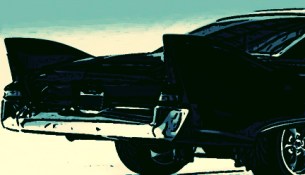
JCA1S2“That’s quite an antique.” A square shouldered black man on the step leading up into the store spoke the words. He was referring to the black sedan parked at the curb.

“It’s a 1960 Plymouth Fury. Fully restored.”

“I know that. I was about your age when I would have given my right arm for one of those.” He held up the stub of his right arm. “Instead I gave it for my country in Vietnam.”

“Oh, I’m sorry.” The young man grimaced. He always felt uncomfortable saying it because it was such a cliche. “Thank you for your service.”

“Wasn’t your fault. I just got careless. Ripley’s the name, by the way. I didn’t catch yours.”

“Wayne, Wayne Bruce.” He felt a little awkward as he extended his hand, but the black man grasped it firmly with his left.

“And what brings you to this neighborhood, Mr. Bruce? Lost? Or looking to pick up some cheap real estate?”

Wayne Bruce shook his head and glanced around again, reorienting himself after so many years. Abandoned buildings and the apartment towers that used to teem with activity now appeared worn and past their use by date. The brick enclosure to the crumbling factory site he used to think of as towering had retained some of its respectability if not its height. The candy store abutting the wall emitting a faint single source amber light, the tavern on the corner across the street where Central teed into Battery, neon beer sign sputtering in the dark round window open for business.

Ripley kept his gaze fixed on the young man, a lithe six foot two, tangle of dark hair framing a square face and jaw, dark intense eyes under darker eyebrows, and with a deferential confidence to his manner. A tailored black gabardine three quarter length coat with attached cowl draped snugly across the broad shoulders. The crew collared dark gray jersey clung to the shape of the angular torso topping a pair of slim black slacks and casual half boots.

Bruce then smiled and indicated the candy shop. “I used to come here when I was a youngster. My favorite candy was a Chunky bar. Mr. Rick still the owner?”

Ripley showed a frown and squinted at the tall young man. “You know old Rick?”

“Sure, he made the best egg-cream around.”

Ripley’s frown intensified, taking a closer look at the white man who had just parked his antique Plymouth on one of the roughest streets on the east end of the city. “No, he don’t do that no more. Hasn’t done that in a real long time, make egg-creams. Kids today don’t know what egg-cream is. But you are right, he made the best.”

A stiff breeze rattled the branches of the sycamore and persuaded some of the last leaves to release their grip and float reluctantly to the concrete. Both men looked in the direction the wind had come, at the lead gray mass hovering over the tall spires and square silhouettes of the downtown district, the tawny streak of late afternoon sky crushed by darker clouds at the horizon.

“You say Bruce? That your name? Like this place here?” Ripley pointed to the grim shadows hovering above the wall and the sign that had been creatively overwritten.. “Bruce Battery Manufacturer? That you?”

Wayne nodded. “My father.”

candystore1“The Battery Man. I remember the billboards. Nobody Beats A Bruce! You that kid? I heard about you. Come on, come on in.” He pushed the door open and the hinge squeaked like a cry for help. “He’s in the back, come on.”

Bruce didn’t need urging to step up and in. The candy store was familiar though smaller than he remembered it. The counter with the white scale, now a nicotine yellow, atop the display case of penny candy, jaw breakers, licorice whips, and candy bars. A diagonal crack mended with yellowing translucent tape ran across the display glass. On the back wall by the cash register the slotted black shelves of tobacco products mostly empty. There were plastic toys and odds and ends household items, clothespins, wooden matches, boxes of plastic forks and knives on shelves along the opposite wall. A rack next to the shelves displayed an assortment of flimsy plastic Halloween costumes and masks from the holiday a few weeks past. Boxes, some unopened, some empty, were stacked on the floor toward the rear of the small space where a doorway was covered with a threadbare flowered green curtain stirred by the sound of shuffling behind it.

“Yo! Rick! Hey! Old man! Somebody here to see you!” Ripley’s grin was mirthful, glee ringing his eyes.

A grave low voice answered, “If it’s Kerr, I already gave him my answer. What don’t he get about ‘shove it’? The curtain parted to a frown under a head of close cropped silver wool and a mean squint distorting the dark brown face. Pale framed thick lensed glasses held together at the bridge by a bulge of masking tape sat on a crooked nose, the tip of which appeared lighter than the rest of the ebony exterior.

The old man came to a stop, a walking cane in each hand, and craned his tall torso forward. “Who are you? You don’t look one of Kerr’s. . . ?” He gave a sidelong glance at Ripley who was trying to maintain his composure and not burst out laughing, and then turned to face the tall young man in black. A smile slowly cracked the harsh demeanor exposing red gums and missing teeth. “It’s you, ain’t it? I’d know that canary eating grin anywhere.” To Ripley, he snapped, “What you laughing at? I don’t see nothing funny!”

Easing himself behind the candy counter, Richard Richards, Mr. Rick to most of his customers, took up his iconic position in the eyes of the young man. “Lemme guess. A Chunky bar.” At the young man’s nod, he slide open the rear door to the display case and reached in. “You remember how much you used to pay for one of these?” he asked as he set the foil wrapped candy on the top of the counter.

chunky1Wayne paused to recall. “A quarter.” And then, “But I remember when they went up to fifty cents because I came in one day and all I had was twenty five cents, two dimes and a nickel, and you told me that the price had gone up. But you sold it to me anyway, that I could pay the rest next time.”

The old man chuckled. “That’s right. And you shoulda seen the look on your face when you realized you didn’t have the right amount. You mighta cried.”

“Did I ever pay you back? I don’t remember. I hope I did.”

“I don’t recall either. Not that it matters after all this time.” He held up the silver square. “Nowadays one of these will set you back five dollars! Think anyone can afford that?”

Ripley nodded in assent, “Not around here they can’t, that’s for damn sure!”

“This young man here used to keep track of my inventory. He knew every candy I carried and how much of it I had. He’d come in here with his daddy and name off everything I had in the case. I carried newspapers back then, and Mr. Bruce would come in for his morning and his afternoon edition. He always had this one in tow. Go straight to the glass and put his nose up against it.” He shook his head in recollection. “Time’s are gone.” And addressing young Bruce, “I’m sorry to hear of his passing.”

The tips of Wayne’s ear’s reddened, darkening them, and he twisted a grin in agreement and acceptance of the condolences. And as if to offset the tension of the emotion, he pointed to the soda vending machine’s garish edifice over to one side in the corner, the only thing that seemed out of place. “I remember the big red cooler you used to have there. It rattled whenever the compressor came on. The first time I heard it I nearly jumped out of my shorts. That and the treasure hoard of candy were my first impression of this place. And you used to have a comic book rack over there too. I spent a lot of time sitting on the floor reading them. Those are good memories, Mr. Rick.”

“Aw, you were a pest, always asking questions, you were curious about everything. And then you went away to school, somewhere, some place foreign I heard. Your mother sent you off to get a proper education. And you’d come by every once in a while when you were home visiting, and I seen you were developing into a fine young man, taking more after your ma than your husky pop, though. She only come in here with you a couple times I can remember but I could tell she was high toned.” He lowered his eyes at the memory, “She doing well, is she?”

Wayne gazed out at the failing light of the darkening street. He nodded, “Yes,” as if to himself. “Mother is doing well as can be expected. Dad’s brother, Harold, is taking care of the details, managing the Bruce business empire.” A hint of bitterness in his attitude. “Life goes on even if not for Wallace W. Bruce.” He erased the frown with a bright smile as if it had never been there. “I thought that while I was in town for the funeral I’d see if I could still get a Chunky at the only place I know that sells them.”

Rick gave an appreciative guffaw. “Well, you are in luck, this is the last one! I stopped carrying them half a dozen years ago when the price went up to two dollars. I didn’t think anyone would ever want a square of chocolate, nuts, and raisins that bad. I kept this one as a souvenir of when candy was cheaper than crack.” He pointed to the shelves behind the display glass. “You see anything in here that reminds you of a Zagnut or Good & Plenty or a Clark Bar, Abba Zaba, Big Hunk, JuJuBes, Milk Duds, or Pay Day?”

“You had those little wax bottles with fruit syrup in them. . . .”

“Yeah, Nickle-A-Nips, go for over a dollar now. I can’t get a lot of those old candies anymore. It’s my distributor, he carries all these off brands. You ever hear of a Ball Park? it’s shaped like a frankfurter, made mostly of sawdust as near as I can tell, and held together with a chocolate tasting glue. Bigga Jigga? I don’t even want to think what it’s made of, but I heard somebody lost a tooth biting into one, pulled it clean out of his gums. And Plenty Good? Just a box of hard candy pieces swept up off the candy factory floor. O’Hara’s? Some kind of high fructose soybean glop, and Dummies, just little pills of color flavored chalk. This Wacky Wax? It’s just artificially sweetened wax. That can’t be good for your gut.”

Ripley nodded vigorously, “Eat enough of that, stick a wick up your butt and call you a candle.”

“You might need a new distributor.” Wayne offered with an understated chuckle.

Rick shook his head. “No, can’t, Kerr controls the East Central District. He has a say in just about everything that gets bought and sold in this neighborhood. His guy makes me carry these knockoffs and threatens me when they don’t sell! He made me install that drink vender. It’s expensive, besides. Has to stay plugged in all the time, uses more lectricity than the rest of the shop! Usta carry his girly magazines but it just attracted the kids, and they’d want to shoplift something, sometimes because they thought they needed it, other times just because they thought they could. Sell ‘em under the counter now, you gotta ask to see ‘em, and if you’re asking, you buying one.”

“Kerr? Where have I seen that name, from around here?”

“Joeseph Kerr. That’s his warehouse down the block, in the old garment factory, you mighta seen the sign painted on the side of the building when you turned down Central coming into the neighborhood.”

“I did. Kerr Novelty, Inc. Big letters.”

“Big crook, if you ask me. Came from out east about ten years ago. He’s got his fingers in other pots, too, buying up real estate. He owns Quinn’s, the tavern across the street, and the old folks apartment building next door. I heard he was partnering with some developers for a project down at the other end of Battery. Bound to be a boondoggle like most projects in this town.”

“Calling the cops ain’t gonna do no good. They take forever to get to this end of town. Kerr’s probably paying off somebody at the precinct to lay off in his turf.”

“And he’s been looking at the old factory site, your pop’s place.” Ripley spoke up. “Heard he wants to move his operation to over there.”

Rick threw him a quick glance. “B, you know that’s just a rumor. Ain’t no truth to that.”

“Yeah, that’s what I overheard at Q’s. And you know why that’s bad news for you.”

“Yes I know, but no need to talk about something ain’t gonna happen until after I’m dead.”

“You see, man, this building, old Rick’s crib in back, the candy store, they all on the factory property. Somebody buy that factory, they get the candy store in the deal.”

Wayne cocked his head to one side, “Is that true? I’d have to look up the property deed in the company archives.”

“No, no, Bion is right. This is part of the factory property. It had been the foundry foreman’s residence before the site was converted to  Bruce Battery Works. I was one of your old man’s original employees back when he started out. Then after the accident, well, he helped me. . . .”

“Here, here,” Ripley was pointing out the window as the streetlights sparked to life at the encroaching gray, “The Up To No Good gang, I’Van and J’Van. I haven’t seen them in a while. Somebody musta bailed them out.”

Rick concurred. “They on the prowl early, looking for a stray bird. They must be desperate.”

“You know them?”

Ripley nodded solemnly, “We had occasion to get close.”

Rick chuckled, “Bion ripped open a case of whupass on those boys. They know not to mess with him.”

Bion pointed with his stub. “The redhead? That’s I’Van. He’s a nasty piece of work. The other one, the kid, J’Van, he’s dangerous because he doesn’t know how strong he is. But he’s a follower, not a leader. They do muscle for the local numbers guy, and strong arm the unwary for their nickels and dimes. They try to intimidate everyone else. Those that cross them usually end up in the hospital.”

“The bookie is in Kerr’s pocket. He couldn’t operate without his say so. His boys are the neighborhood pit bulls.” Rick added.

“And they’re taking a close look at your Plymouth at the curb. Might not be too wise to leave it parked there for long. I can go stand by it. They’ll know enough to steer wide.”

Wayne held up his hand. “No, please, I don’t think that will be necessary. Thanks for the offer, Bion, is it? An unusual name if you don’t mind my saying.”

“Naw, man, that’s cool, everybody trips over it. I got it in Nam. It’s because of my last name, Ripley. The guys in the platoon used to call me Believe It Or Not, and it got shortened to BION, and then just B, what most folks knows me calls me.”

“I don’t believe it!” Rick was leaning forward on his canes glaring out the window. “Just this minute, coming down the steps, it’s old lady Winslow, I’m sure of it.”

“Her daughter musta forgot to lock the apartment door again,” Ripley said, a trace of concern in his voice.

“She thinks she’s going shopping, got her purse and her shopping bag. . . .”

“Wait till she gets around the corner to find that the market been closed for two years now.”

“If she gets that far. I didn’t think they’d do that. They are lower than scum. Knocked her down, one of them has got her purse, laughing.”

“Call the cops!” Wayne had started toward the door.

“Calling the cops ain’t gonna do no good. They take forever to get to this end of town. Kerr’s probably paying off somebody at the precinct to lay off in his turf.”

“She might be hurt!” Ripley raced through the door, “Call for an ambulance!”

Rick replied to Wayne’s questioning look, “He was a medic in Nam. He’ll see to her till the meat wagon arrives.”

“The men, they’re gone, where. . . ?”

The old man looked up from dialing the phone, “Can’t have gone far, mighta ducked into Q’s to divvy up the loot.”

Wayne became very quiet, overcome by an ominous calm. He glanced at the Halloween display, the black domino mask with peacock feather eyebrows in its cellophane bag. He unclipped it from the rack and held it up. “How much?”

Rick shook his head. “Try it on first. See if it fits.”

Wayne ripped open the bag and plucked off the feathered decorations and slipping the mask over his eyes. “Better call for a second ambulance.”

He strode down the steps, skirted the rear fins of the Plymouth Fury and stepped quickly across the darkening street pulling the cowl up over his head as the first of the rain began to fall.

quinnsWet occupied the air and chilled it. In the yellow-brown light of the doorway to Quinn’s Tavern, the rain striking the concrete jumped like sparks off a hot griddle. The door opened quietly, disturbing neither the wide shouldered man with the bar towel over his shoulder, gaze intent on the square of color TV mounted above the bar, who laughed along with the track, a rheumy asthmatic rasp, or the other two hunched over in the shadows of a back booth, laughing, giggling, but not at the TV, a sitcom about people who frequent a bar similar to this one although certainly less sinister.

The young one looked up, questioning at first and then frowning his face into a growl at the perceived threat. The redhead jerk his eyes up from the emptied contents of the purse like a dog guarding a bone. He was about to raise his head and bark when two rigid fingers jabbed the larynx causing a choking spasm gasp for breath at the same time the base of a palm slammed into the apex of his nose with enough force to render him unconscious. As the dark haired man boy rose to defend his partner, a well-placed kick to the sternum knocked him back into the sitting position with his head bouncing against the tall booth, an open target for the elbow that struck him full face and broke his nose. The man behind the bar had just brought up the shotgun as the round glass ashtray that had been between the two unconscious thugs struck him on the bridge of the nose knocking him down.

A black gloved hand gathered the pile of belongings in the middle of the table and returned them to the purse. There wasn’t much to the loot: a change purse, a wallet stuffed with grocery coupons but no legal tender or credit cards, a lipstick tube, hair pins, an empty pack of spearmint gum, a sheaf of letters held together by a ribbon, the scent of lilac.

No one paid attention to him as he set the purse on the stoop to the apartment house where a few neighbors had gathered with umbrellas to shield the old woman who was sitting up now, looking around bewildered, rubbing the elbow she had hit after being pushed down by the hoodlums. A siren sounded close.

Ripley glanced up once to see the tall cowled figure, eyes shadowed by the black mask before the ambulance’s flashing red and ambers saturated the rain dark street. After the medics had taken over, he stood in the soaking downpour and stared at the empty curb in front of the candy store. He sensed that it was just the beginning, a perfect storm of coincidences gathering at the horizon that would rain down justice and injustice alike, and transform the lives of those who lived in the decaying industrial fringe of the city, a city whose name had always resonated as a cesspit of crime and corruption.
Next Time: Unfortunate Son

Better Than Dead—18

by Colin Deerwood

Ads84

The streets were wet with rain again. I hopped a crosstown bus. One of the passengers, an elderly woman, let me have her seat thinking I was blind. It was Sunday, and she was in her Sunday best as were a few other women and men in their best dresses and suits, coming from or going to services. I wasn’t going to argue. I was just being cautious. Rebecca took a window seat. We stood out like Raggedy Ann and Andy in a collection of porcelain dolls.

1937_Bus1At the end of the line the late afternoon sun passing behind a cloud defined a horizon of ship yard cranes and a thicket of masts. Fenced lots echoed with the barks of loud vigilant dogs and the brick warehouses, some seeming abandoned, maintained a grim silence. The rail yard was nearby, and a block of shabby businesses: a café and bakery, a corner grocer’s, a laundry, a hotel, a snooker parlor, and the address I was looking for.

I kept to the opposite side of the street in the shadows of the elms alongside a dilapidated board fence. From behind wood pallets stacked on the bed of an unhitched horse drawn freight wagon I cased my destination.

The sun had broken through the clouds glancing orange off the plate glass of the café and blindingly into the eyes of the man standing on the stoop of the address. A large Oldsmobile breezed up and he shaded his eyes, or maybe it was a salute, before climbing down to an arched double doorway to let the big car into the garage. Yamatski’s digs weren’t the sleazy walkup I’d supposed. That gave me pause. So did what Rebecca said next.

“Lack, look at the sign above the door!”

I’d seen it. I couldn’t make out what it said. It was Greek to me, like you might find on a fraternity house near the university uptown. CC with an upside down N or maybe a U. It coulda been a mook’s version of the YMCA for all I knew.

“Serbskiy Sotsial’nyy Klub,” she breathed. “They are connect to Black Hand. It is social club for fascist.”

I got it. It wasn’t going to be easy. The social club was like a brick fortress. There was no way I was going to go in the front door, not with that mug guarding it and whoever else was behind it.

The blinking neon sign in the plate glass window of the bakery said Café Latino. It suggested I needed another cup of coffee to think things over. And while I was at it. I ordered a half a dozen donuts.

“These donuts I have had before. Sweeter than a bagel. More like cake. I have seen them eaten in the movies. Donut must first be immersed in cup of coffee,” Rebecca demonstrated.

donut scene“No, no you’re doing it all wrong! Didn’t they teach you anything in that fancy Swiss boarding school of yours?” And I showed her how, breaking off a piece and dipping it in the coffee just enough to wet it but not get it soggy. “That’s the way it’s done, kid.”
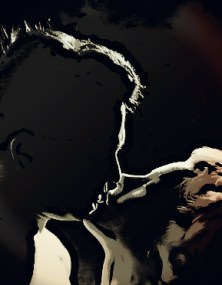
She smiled and that always got me. I had no defenses against it and any doubts I had about her, about me, just disappeared. “I like when you call me ‘kid’, it makes me feel very American. And you are right, it is much better to dip than to soak. I am learning much from you.”

I didn’t want to think she could be putting me on. And I didn’t want to be the one leading her astray even though there was no doubt that’s what I was doing. I had to put all that aside and concentrate on my next move. It was like she could read my mind.

“What will we do now, Lack?”

Above the café was a fleabag known as the Lattimer Hotel. I’d followed a wife and her boyfriend there once years ago when I was just starting out in confidential investigations. There was a narrow two shoulders wide alley between the hotel building and the social club. The room number on the address of Yamatski’s card was 404. I guessed that made it the fourth floor and to the rear. The hotel building was a floor taller that the social club at five stories. I knew what I had to do. And I had to make sure that Becky was out of the way when I did it.

“I think we should get a room.” I said and tossed my bit of donut in my mouth.

Ads85

There were water spots on the wall were at one time rain had leaked in and no one had bothered to paint over them. The bed looked like it belonged in an Army hospital and maybe it had at one time. A recent occupant had been a cigar smoker. There was a cracked mirror above the basin sink but the facilities were down the ratty carpeted hallway to the rear. A grimy window with a torn shade overlooked the roof of the building next door. I stood at it pulling on a cigarette. Becky sneezed as she sat up on the bed and looked at her surroundings with an expression that said she would have rather been somewhere else. I was waiting for the last of the light to fade before I made my move.

The desk clerk had barely looked at the register where I had signed Mr. & Mrs. Samson Delilah as he passed me the key to the room. He looked like he had other things on his mind. A racing form was spread out on the counter. He pointed to the sign leading to the stairs that said No Credit, No Elevator, No Towels, No Ballroom,. It was indeed a small hotel. And they’d missed the obvious, No Class.

I led the way up the five flights and the high ceilinged room at the end of the hallway. She hadn’t objected, looking away from me like she was preoccupied by a kind of sadness. I figured the stress of the last couple of days was getting to her, she was just a kid, no matter what she said she did in the mountains where she came from. When the door closed she pulled me to her and kissed me, hard, the sadness magically evaporated, replaced by a hungry passion.

lackbec21I was tempted, pulling her up against me, her head tilted back at my response. My judgement when it comes to women hasn’t always been the best, and maybe I could even blame my lapses on my inability to figure them out even when I gave it a try. The hardest part of this jobs was resisting that urge. How many unfaithful wives of unfaithful husbands had offered themselves as partial payment or as a bonus for my peeping, and every time I gave in I was reminded soon after of what a mistake that had been. I couldn’t afford to be swayed.
“We need to talk,” I said. I sat her on the bed and explained my plan to cross the narrow gap between the two buildings and make my way to Yamatski’s room to grab anything of value in partial repayment for my attempted murder. She would wait in the room until I made it back.

There’s a word for the look she gave me and it’s usually reserved for idiots and fools. “No, Lack, stay with me. I am being frighten. Please.” She pulled me to the bed and had me lie next to her. “Tell me why you must do this. It is dangerous. We can wait.” She indicated the room. “Even here.”

She dropped her hand on my chest which predictably affected me below the belt. She was smiling in my face and gave me a look. Even in the long shadows of the room, I could see that it was one of those, mischievous and deadly serious. That’s all it took.

Afterwards she wanted to talk about how happy she was and what she was going to do once the recovered diamonds we’re sold. I admired her confidence in the future. She said she was undecided whether to go to Hollywood or find a big city like Chicago or New Orleans in which to begin her American life. Her eyes were alive either from previous excitement or at the possibility of fulfillment of her dreams.

I told her that Hollywood was just a big slum of broken dreams with better looking people and overnight millionaires who could just as easily find themselves penniless by the morning. She’d stand out like an easter egg in the dozens of hardboiled and overcooked. I told her that her best bet if she wanted to stay incognito was a college town, they had high turnover and nobody asked a lot of questions. If I was going to ground, that’s what I’d do. But I could see by the set of her mouth that the lime light appealed to her. I told her if she was dead set on it, once she got to Chicago on the Broadway Limited, the Super Chief would take her to all the way to Los Angeles and it was just a trolley ride to Hollywood.

“Stay with me, Lack, you could teach me many things.” She had wrapped her arms around mine as if to hold me.

I nodded, staring at the ceiling, and lit another smoke. I got to my feet. I had to do what I was going to do.

Ads86

The gap between buildings was too wide to jump across. The wind was starting to pick up again ahead of another storm and rattling the rickety rails of the fire escape. Across the gap was the roof to the social club, a sloping metal affair ending at a stubby brick parapet like you might find on a tower to a castle. I thought of braiding a couple of sheets together to make a rope and maybe swing across but I’m no Tarzan. It was maddening. I was so close. There was no way I could take a running jump and make it. And the prospect of dropping five stories did not appeal to me.

I went back to the room and Becky smiled like she had won an argument.

“You have change your mind?”

“Not on your life, sister.” I was staring at the bed. I overturned the lumpy mattress. Just as I thought. A wire grid and springs attached to the frame at the foot and head of the bed and held together with wing nuts. And maybe just long enough to bridge the gap. It was worth a try. The nuts had been painted over but I managed work the ones at the foot loose. The nuts at the header looked like they’d been welded on. I was working up a sweat while the kid watched me like I had gone crazy. Maybe I had. I was a mad man in a frenzy trying to prove something to myself with no idea what that might be. Frustrated I gave the frame a kick. The header gave a groan as only metal can and folded ever so slightly forward. I gave it another nudge with my foot and it gave way a little more. It was better than nothing.

Rebecca helped me cart the frame down the hallway to the fire escape door. Getting it through the door and out to the fire escape was a little more challenging. The header was the problem. It had bent only so far yet was still too wide to fit through the door. Having moved furniture with Grace’s brother, Ted, I knew enough about angles to clear the bed frame through the narrow door with a minimum of bangs and backups.

Out on the skeletal pipes of the fire escape, maneuvering in line with the gap wasn’t a walk in the park either. But I gotta give it to the kid, she was a real trooper. Lightening opened up a bright gap in the darkening sky and I could smell the approaching rain. Not that it mattered, I was sweating like a steamed up window.

I was right about the bed frame bridging the gap but wrong about the way it might be accomplished. Attaching the header to the railing as a hook the bedframe missed the opposite roof by half a foot and maybe a couple too high. Not perfect but I could chance using it as a ramp to lessen the jumping distance. I jammed the bedpost into a corner against the bricks but it was no guarantee that the bedframe wouldn’t come tumbling after me and I would have no way to get back. I had to take that chance.

Nestled in among the packing straw were five Thompson machine guns, gleaming with oil as if they’d just been foaled.

I hauled myself carefully up on to the rail and the took a cautious step forward. The kid was putting all her weight against the header frame and I took another step. I heard and felt the welded nuts groan and begin to give, the frame dropping a few inches. I needed just one more step and leapt. And it started to rain.

The bedframe rattled free of my weight and sent shocks to the fire escape which sounded like an explosion of small hammers. I looked up and could see Rebecca’s silhouette as the rain began to sheet down. The bedframe had held. I‘d landed in the narrow gutter space of the brick battlement and it was filling quickly with water shedding off the roof. There was a peaked window with a metal ladder leading up to it I had spotted earlier as possible access in to the club. Either an attic or a loft. There was no light behind it. I had to assume it was unoccupied. I made my way up to the ladder to take a few steps up and peer in. Sheltered by the overhang I could see into the shadowed gloom of the space beyond. Maybe an attic but not a living space.

I heard the noise and turned. The kid was standing on the bedframe about halfway across and the header had come loose from where I’d jammed it. It moved forward and down under her weight. I heard the bolts snap and the frame separated from the header out from under her feet.

She threw herself forward and managed to grab the edge of the abutment. I got to her and reached up under her arm and her other shoulder and dragged her into the gutter. The bed frame made a racket rattling down the shaft and bouncing off the bricks on the way down.

And then it was quiet. And raining. My escape route, never too realistic in the first place, was gone. Plus, now I had the kid to worry about.

“I am so sorry, Lack, but I did not want to be leave alone.”

I was too wet to be angry. “Let’s get out of the storm.” And led her up the ladder to the attic window.

I broke a pane with an elbow and reached around to undo the latched. The window stuck and then creaked as it swung open. I stuck my head in and sniffed the air. Dust, and mold, and something else, machinery? I pulled myself through the narrow opening. It was dark but not pitch. There were a set of attic windows on the opposite wall of the peaked ceiling letting in a dim light. Rebecca followed, still apologizing, but her way.

“I should not have followed. It was foolish. And now we are in a musty attic with boxes and old furniture. And if you do not believe in coincidence, another attic we have found ourselves.”

“Relax, and pipe down. There’s gotta be a way off this floor to the ones below. And that’s where I’m going! We just have to make sure the coast is clear and no one is making a fuss about the clatter.”

I’d already made out the shadow of a railing to a stairway leading down under the row of windows. I listened at the top and heard nothing. I could see that they led down to a doorway by the shadowy gleam of the knob. I stepped quietly awaiting the inevitable groan of wood. I put my ear to the door. Nothing, and gave the knob a turn. The hinges sighed as the door opened into the dim overhead lights of the hallway. Now I could hear what sounded like a burble of distant voices coming up the stairwell. Someone raised their voice and some one answered back louder, closer. The tread of feet thumped the risers heading up.

I hurried back up the steps to the attic pushing the kid ahead of me. She didn’t need any urging, she knew the drill. I ducked behind a large crate covered with a tarpaulin just as an overhead bulb lit up. I could hear the door open and the unhesitant footsteps advancing.

“Naw, nothing up here, quiet as a moose,” a rough voice called out. “Dey musbe hearing tings.” Another voice responded, and the first voice answered back, “Yer right, proly it’sa hotel next door. Some crazies live or dere.” There was an affirmative answer and the voice faintly in going down the stairs, “Let’s finish up the game. We can have time for one more hand before the meeting starts.”

And then they were gone. But they’d left the light on.

I came out from behind the crate. The wood smelled fresh. There were a few more near it with the turpentine tang of newly milled lumber. Black arrows were stenciled on the outside pointing up and a script I wasn’t familiar with. But the red skull and crossed bones spoke clear enough.

“Lack, look!” Becky had found a set of flags in the corner. One was red with a white circle and an X with its legs broken, a green, white, and red one with an axe and a bundle of sticks like you might see on a dime, and a white one with a big red circle in the middle. She held up another, on a black and white ground. It looked like a red checker board pasted onto a pot of fire. “Fascists! Like I have tell you!”

yugocrates1The lid of one of the crates had been pried up and I lifted it off. All of a sudden I felt like Ali Baba minus the forty thieves, and I didn’t have to say Open Sesame. Nestled in among the packing straw were five Thompson machine guns, gleaming with oil as if they’d just been foaled. This was my ticket out. Any one got in our way they’d get the business end of old Tommy.

There was only one problem. Not a one had a drum or magazine. Without the ammo all I had was an exceptionally well-made stick. There was a claw hammer on a work bench along with a bucket of nails. I went to work. It was no use. All the other new crates were the same,  Tommy guns, but not one bullet. And I was back to square one.


Next Time: A Change Of Plan

Contents Vol. 2 No. 5

Welcome to Volume Two, Number Five of Dime Pulp,
A Serial Pulp Fiction Magazine

In this instalment of On The Road To Las Cruces,  the legendary lawman recounts his efforts to bring those accused of the White Sands Murders to trial. A foreboding dogs him as he recounts the details. Someone is approaching from behind. And then the horseman appears. What is related in the novel account of the last day in the life of this legendary lawman is as much a retelling of some history as it is how such a retelling might come about.

Better Than Dead’s seventeenth installment finds private detective, Lackland Ask, “Lack” to his few friends, realizing that, after finding the body in Alice’s apartment, his luck isn’t getting any better and that it is affecting the safety of his friends. People might start calling him “Lucky” meaning exactly the opposite.  He’s desperate and like all desperate men, he makes bad choices. His plan for revenge is taking its consequences out on him

Dropping A Dime takes a look at a few overlooked or neglected heroes of pulp literature: historian and author Ron Goulart, hardboiled novelist James Crumley, and noir author James Sallis.

Dime Pulp Yearbook 21 contains the novels (The Last Resort and Better Than Dead) and the short fiction (Hard Boiled Myth and Gone Missing) of Volume One’s 12 issues and are available for perusal in their entirety. If you missed a few issues or lost the thread of a serial, clicking on the link at the beginning of this paragraph or on the menu bar above is a good way to catch up.

Dime Pulp continues its crime spree with the serialization of 2 full length novels,  Better Than DeadA Detective Story and On The Road To Las Cruces  as well as the cranky opinions of yours truly in another rare outing of Dropping A Dime. If you’ve made it this far, go ahead and follow the links below to reading entertainment with the serial contents of Volume Two, Number Five

 —Perry O’Dickle, chief scribe
and word accountant


Knapp-Felt 1930 1930s USA mens hats

“Lackland Ask is the name. ‘Lack’ to my friends, ‘Don’t’ to those who think they’re funny. You might have seen my portrait on the cover of Black Mask, the crime fiction magazine. This is my story. It starts with a blonde. This kind of story always starts with a blonde.” Thus begins the seemingly non-stop, endless narrative of Better Than Dead in which women are not the only trouble although most of it, told with the wit and street savvy of Runyon and Parker.

Better Than Dead—17


otrpic1fi2In late February of 1908, a one-time drover, buffalo hunter, saloon owner, hog farmer, peach grower, horse rancher, US Customs inspector, private investigator, county sheriff, and Deputy US Marshal set out from his adobe home on the mesa above Organ, New Mexico accompanied by a young man in a black buggy on the journey to Las Cruces. He would never arrive. This is the story of that journey, a novel account of the last day in the life of a legendary lawman.

On The Road To Last Cruces ~Seven~


dime dropFI

In this installment of the catchall column, Dropping A Dime, erstwhile editor and word wrangler Perry O’Dickle emerges from his ink stained den to pen a tribute to the legendary albeit little known Ron Goulart, pulp fiction and comic book historian, fiction flogger under numerous pen names who wrote futuristic novels that played off the unintended Schumpeterian and most often hilarious consequences of mechano-tech—he was the gleeful saboteur of a Popular Science future. As well, in this latest installment by the man in charge of these shenanigans, the crime fiction of the two Jims, Crumley and Sallis, are given a rapid rake of the side eye and peripheral consideration.

Ron Goulart and the Two Jims


Ron Goulart and the Two Jims

Ron Goulart

Ron Goulart is the spark that originally ignited the interest in pulp fiction and led to Dime Pulp. His The Hardboiled Dicks: An Anthology and Study of Pulp Detective Fiction (1967), Cheap Thrills, An Informal History of the Pulp Magazine (1972), and The Dime Detectives (1982) were a first serious and intriguing glimpse into the genre for these offices in the mid-80s. Prior to that, Goulart’s wacky sci-fi stories of tech gone wrong (notably robots) were diverting reading characterized by his penchant for goofball humor. Sadly, Ron Goulart passed away in January of 2022 at the age of 89.

Goulart was a prolific writer, historian, and proselytizer of pulp fiction and its emergent heir, the comic book. Writing under his own name as well as over a half dozen pen names, his novels and stories were an easy read, always with a little MAD comics edge, nothing too serious or violent, slapstick certainly. The grim shadow of “noir” did not often intrude in his easy going tales.

afterRon Goulart may be viewed as a lightweight by the toting crowd but the sheer volume of his engagement in the pulp/comic genre allows him to claim the turf he helped established. He was the author of over two dozen compendiums on comics and golden age pulp fiction illustrating the comic book’s emergence from the fantastic pulp genre and the Sunday Funnies. He wrote numerous futuristic novels that played off the unintended Schumpeterian and most often hilarious consequences of mechano-tech—he was the gleeful saboteur of a Popular Science future. Of the over two dozen nonseries novels, including Clockwork Pirates (1971), The Robot in the Closet (1981), and Now He Thinks He’s Dead (1992), most are of a whacky dysfunctional Murphey’s Law universe. His Barnum System series of novels is a planetary circus of its own with such titles as Spacehawk, Inc. (1974) and Galaxy Jane (1986) among numerous other linked and obtuse permutations his agile mind could hatch: Hail Hibbler (1980), After Things Fell Apart (1970). Goulart’s era was the twenty years span from the mid-70s to the early 90s in which he wrote under many pen names (Chad Calhoun, Zeke Masters, Jillian Kearny) as well as his own, collaborating on a range of projects in the pulp comic book genres which included penning Flash Gordon stories, Vampirella, and Avenger. In the 1970s, he wrote several novels based on Lee Falk’s The Phantom (“the ghost who walks”), a character incorporating  proto-super heroes, essentially Tarzan as Batman with a brace of 45’s, for Avon Books under the pseudonym “Frank Shawn”.

That he had a sense of humor about a dystopian future of robots and AI just made his stories all the more human and entertaining. He was not overshadowed by noir even though he worked on and wrote about the genre that engendered it. The cruel macho psychopathy of hard boiled prose was not his maître. Goulart kept it light, parodying the fantastic and sometimes brutal pulp genres of sci-fi and crime fiction. He was a hack in the good sense of the word, and epitomized an era’s liberality of imagination by the range of his output, well worth a wiki lookup. A playful satirist with a riotous sense of humor as evidenced in his Groucho Marx detective series, written after the turn of century, in presenting such pulp tropes as “Lord of the Jungle,” “Secret Agent,” “Master Detective,” and “Private Eye” versions of Groucho with felicity and breezy Hollywood wit. Nor was he above writing for TV programs or penning bodice rippers under a woman’s name.

Goulart, as pulp historian, engaged in preserving a particular generic tone characteristic of an era of transition from pulp to comic book to graphic novel by being an active participant in that transition. His authoritative histories are gems of preservation and reference covering the parallel development of pulp publications and of illustrated storytelling in the form of comic strips and books. In his roles as pulp writer and scholarly aficionado, Goulart was a champion of the imagination and a real kick in the pants.

A timely Goulart retrospective is in order, a Goulart Omnibus (there is enough material for a couple collected volumes) at the very least! A festschrift, perhaps? The world needs to appreciate more of his sardonic wit. Pass the word.

The Two Jims

The two Jims, James Sallis and James Crumley (1939 –2008), could not be more different yet both represent a singular uniqueness in their stylistic genre, the crime novel. Crumley’s novels are full of gregarious bluster. Sallis’s novellas are thoughtful and subversive. Crumley’s actions and their aftermaths are full frontal view of violence’s consequences. For Sallis, what is depicted are the consequences of those actions as rueful denouements. A Crumley story usually contains enough material for at least three novels, wide ranging and galloping all over the place. They are a unique blend of the western and the private eye/finder of lost kids/kittens genre. Sallis says all he needs to say in the length of a novella. The language is precise and elliptical, Simenon-like, in evoking a mood.

James Crumley

James Crumley’s novels feature the characters of C.W. Sughrue, Viet vet drunk turned private investigator, and P.I. Milo Milodragovitch, each in their own adventures although they cross paths in the 1996 novel Bordersnakes. Crumley’s anti-heroes are both big men with big personalities and essentially mirror images of each other. Not that it matters. What carries Crumley’s novels is the sheer bravado of his storytelling. Anyone who’s ever worked as a bartender has probably come across a character like Crumley, loud, raucous, and a genial everyone’s my friend demeanor. Until the booze runs out.

tree duckBoth PIs, Sughrue and  Milodragovitch are hard drinkers, and hail from the cowboy states, Texas and Montana, the author’s home turf. They are the giants from the north exacting their version of justice in a particularly cockeyed world. A natural born storyteller, Crumley spins tales of mishaps and bad luck death defying scrapes that are often hilarious in their telling but also tragic in their own right as a history of bad choices. His characters inhabit a world of regret and wounded psyches. Often times the graphic violence seems gratuitous, yet no one would doubt the authenticity of the pictures Crumley paints. Crumley’s is a world of right and wrong with a lot of leeway gray viewed from the other side of the tracks where there is honor of a kind among outlaws and where some situations can only be resolved by violence. The plotting of the novels allows Crumley’s penchant for the shaggy dog tale and wide ranging hair of the dog that follows.

In The Long Good Kiss, a sick lovesick saga if there ever was one, Crumley defies the beat with squirrely maneuvers, digressions, soul searchingly bared and nakedly sentimental. Sughrue is the hero who must defeat the dragon, save (find) the maiden, and deal with his own demons. The common theme of these novels is of a quest for vengeance as a means to an uncertain redemption that requires guts, determination, foolish pride, and a firearm. What follows are the peripatetic permutations of Crumley’s telling. In a world ruled by violence, Crumley organizes his action like a cavalry charge or a commando operation, and often things go wrong (otherwise you wouldn’t have a story) and the hero suffers the consequences of hubris.

Most of Crumley’s novels begin in a bar (any bar) rendered accurately from long habituation. In The Long Good Kiss, Sughrue is drinking the “heart out of a spring afternoon,” and Bordersnakes starts out with Milo in a bar fight. PIs now seem only viable  in the dimlit underbelly of  prairie states (the American steppes) drinking dens where the world is still wild and desperate. And to do what they think they have to do and maybe sorta do it, they have to be Grizzly Adams cloned with a mean streets PI, a paladin in the Marlowe mode, mug like Richard Boone and shoulders like Cheyenne Bodey’s, and none of that 77 Sunset Strip cute beatnik stuff. The western had been an almost daily staple of evening TV viewing in the decades of the 60s and 70s—there was always someone stalking the dusty street ready to shoot a gun after dinner.

Crumley’s surrogates are thoughtful yet violent, men of instinctive action with not a little self-recrimination, flawed in effect, which always makes for the best PIs. His guys have another Chandleresque inflection beside the shining armor complex—they get sappy around dames, and it’s always their downfall, and always what inflicts the most pain. Crumley has no qualms in laying out all the details of betrayal and bitterness with the telling authenticity of the barroom orator. His rhetorical hooks to keep your attention, the left hook, the right hook, the uppercut, the fist to the throat, the kick in the groin so vividly depicted that they actually tickle the amygdala and tenuous (fight or flight) signals are expressed as subtle experience by their visceral hair raising realism . Crumley can do that.

His novels each have the scale of classical epics and myths in that the hero has to undergo various altruistic trials and battle the inhuman in himself and in others. Crumley never achieved mainstream success with his seven novels, The Last Good KissThe Mexican Tree Duck and The Right Madness featuring C.W. Sughrue, along with The Wrong CaseDancing Bear and The Final Country featuring Milo Milodragovitch, although The Mexican Tree Duck won him a Dashiell Hammett Award in 1994, and his work has been cited as influential to a generation of the top crime fiction authors including Connelly, Pelecanos, and Lehane.

There’s a bar in Missoula, Montana that Crumley used to frequent, hold forth, spin his stories, and gauge the effectiveness of his outrageous stories on the credulousness of his interlocutors. Reading their expressions was probably the greatest pleasure, typing up the stories was the real work. There’s an effigy of Crumley on a stool at one end of the bar where he perched and held his monologues. Better than any mantlepiece tribute. Crumley was, in Lord Buckley’s words, “God’s own drunk,”

James Sallis

James Sallis is the polar opposite of Crumley. Where Crumley might be said to use a machete to carve out his stories, Sallis uses a scalpel or, at the very least, an x-acto knife to shape his. Carefully crafted, the stories are quiet and deep. Their mood is dark, subdued, cerebral. In many respects they depict the psychological essence of noir. His characters are revealed in nuanced dialogue or by the mundane ambiguity of a scene. Throughout there is the subtle stylistic shadow and light reminiscent of German Expressionism and a dream-like melancholy framed in a meticulously considered language. Sallis’s novellas, no matter their content, are literary.

cricketLew Griffin, Sallis’s PI,  is portrayed realistically, not as a knight in shining armor, but as gritty, a survivor in spite of himself, haunted, flawed. Griffin is featured in six novellas, all titled after insects (companions of the loner or lonely man) beginning with The Long Legged Fly in 1992 and including Bluebottle in 1999, and Ghost Of A Flea in 2001.The action is often muted, viewed in the aftermath or off camera, the consequences telling the story that led to them. Lew Griffin is a black man, obviously self-educated and fond of quoting French authors, living in or on the edge of poverty in and around New Orleans. He finds people or saves them or kills them but always with lengthy soul searching consideration. He’s a tough guy because he is forced to be not because he wants to be. He has no illusions, thus the basis of his sustained noir ennui.. The tang of adrenaline is rare in Sallis’s crime fiction yet the depictions and progressions of the stories are always satisfying, literate contemplative ruminations on the human condition.
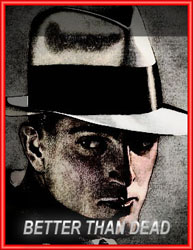
Sallis’s novel Drive (2005), about a stunt driver who moonlights as a getaway driver, was made into a successful movie starring Ryan Gosling. His John Turner series about an ex-cop, ex-con, ex-psychotherapist now deputy sheriff up Cripple Creek is his entry into the swamp noir genre  and presents no end of labyrinthian possibilities. Two of his recent novellas, Sara Jane (2019) and Others Of Our Kind (2013) are illustrations of his range as a storyteller and finesse in developing his characters, both of whom are women. Sallis moves out of the shadows in these novellas. In Sara Jane, a tale of great subtlety, the tone is the washed out yellows shading to amber of a prairie state. Others Of Our Kind is about Jenny Rowen who was abducted at age eight, and in this tale, the mood lighting is that of a not quite noir grayish blue.

Sara Jane is about a female deputy sheriff and the telling proceeds obliquely as a montage of memory revealed in elliptical snatches of reminiscence and circumstance. Understated, the story carries the reader along, meandering through seemingly unrelated threads that quietly become meaningful. Over the course of the narration, connections are made, peripheral epiphanies, illusive and open ended, flash like dry lightning. The secret of Sara Jane’s past will be revealed as the story closes but how the revelation unfolds is what makes the narrative a remarkable piece of writing. Then it’s over, and the reader is pleasantly surprised by a story carefully encapsulated by brevity and the resonance of impressions.

Others Of Our Kind offers an odd psychological study of a crime victim. How the story unfolds and how it progresses is not the expected enervated existential crisis. Absent is the moral outrage of a young girl abducted and kept in a box for two years. Absent also is an anguished recovery of identity and reconciliation with family. The expected trauma tropes give way to those of an unbound freedom, not victimhood. As an older successful professional, Jenny remains blithely unaffected by her ordeals, as a sex slave, as a mall rat. A crime of similar nature has occurred and through her professional contacts as a TV News editor she consults with the police detective who is investigating the case. Jenny’s introspection about her past provides the context over which the narrative develops. The tale is told with unusual candor in a series of set scenes that emphasize the mundane matter of fact passage of time. No high drama interposes in the precise delineation that resolves almost through sheer inertia. The story arc is vast and accounts for decades. In the epilogical resolution, the final scene is approached as if from a distance gradually closing in, and Jenny is much older now, retired to a sunshine state, at her writing desk, thoughtful, putting the finishing touches to her story, one that doesn’t accommodate the beats of formula crime fiction but works just as well. Sallis allows the story to find its own way at it’s own pace and he needs only 118 pages to do it.

Stylistically, Sallis’s stories work like films  and demonstrate the focused character-based concerns attributed to European cinema. The sensibilities are refined even if they do belong to country folk, the characterizations are centered albeit spare befitting a quotidian stroll through the psyche. His novellas are cinematic in their pacing, each like a finely wrought ninety minute story leaving you wanting more. They progress in brief narrative takes and cuts. an artful shuffle of suspenseful digressions undercutting any determining sense of purpose. Nor are they dialogue driven narratives. Rather they are etudes on framing circumstance.

The author of eighteen novels as well as the acclaimed biography Chester Himes, A Life (2001), James Sallis has been translated into German, French, and Spanish, earning acclaim in each of those languages with the Grand Prix de Littérature Policière, the Deutsche Krimi Preis, and the Spanish Brigada 21 as well as Bouchercon’s  Lifetime Achievement Award. He is also recipient of the Hammett Prize for excellence in literary crime fiction.

Besides his crime centered fiction, Sallis has published collections of short stories, poetry, criticism, scholarly studies on the role of the guitar in American Jazz, and translations from the Russian, French, and Spanish. Notably, his translation of Raymond Queneau’s Saint Glinglin (1993) leads to the assumption that Sallis is more than passing familiar with the unique approaches to the narrative by the influential French author and founder of Oulipo. He has admitted that he draws some of his esthetic for his stylistic approach from Michel Butor and Alain Robbe-Grillet, two proponents of the Nouveau Roman. Sallis captures that particular je ne sais quois élan, and seems perfectly comfortable with the novella form, one that he has undoubtedly mastered.

That’s my story and I’m sticking with it
Perry O’Dickle, for Dime Pulp

Better Than Dead—17

By Colin  Deerwood

Ads81

The country was going to the dogs and was being led there by the rats under the spell of the pied piper in a wheelchair. That’s what the guy sitting down the counter from me said. He wasn’t saying it to anyone in particular. What he was saying was that war was inevitable. I’d heard it all before. I didn’t care for the Marconi Messiahs or the broadcasts from the big tent evangelists predicting the storm that everybody knew was coming. If a guy wants to strut around on a stage pretending he’s god-almighty Charlie Chaplin that’s his problem and maybe he should see a head doctor, but it’s none of my beeswax. And now some squinty eyed guy by the name of Hero He Too across the wide Pacific was getting too big for his pants. If there was a war then I faced the prospect of being drafted and I wanted to avoid that at all costs. I could always take a hike to Canada but I was no dogsled jockey. South of the border, the islands, Cuba, Chile sounded exotic and full of senoritas, and all more appealing. Mister Loony, Herr Mustache, Hero He Too didn’t mean nothing to me. No matter the drumbeat, I wasn’t marching.

marconi messiahHe was going on about other things, Commies, getting loud, angry, until the cook waved a big metal spatula at him and told him to turn it down. I was looking at my hands trying to be invisible, hat pulled down over my ears, dark glasses no matter that they looked like beach wear. A problem had developed. Because of Sid’s frap between the eyes, the bruise around both of them had turned the color of a ripe eggplant. I didn’t think my nose was broken but it was still throbbing the next morning.

After the crime scene had closed down, after they led Linkov away in bracelets to the paddy wagon, his white hair in unruly spikes and his pointed beard and swirling moustache held up defiantly beneath blazing eyes, after watching Hogan in a huddle of high priced suits with Nekker and his G-men while the body from Alice’s studio was carted out to the coroner’s van, after the crowd had drifted off in clots of twos and threes and only a few of the neighbors were still giving Alice their sympathies, after that I stepped from the shadows from where I had been watching. Rebecca had managed to get closer to Alice and finally led her away, down to her studio. I followed close behind.

It wouldn’t have taken much to upset the clutter of Alice’s tiny space. The chalk outline on the floral carpet only partially contained the spread of a dark burgundy stain. The sergeant had given her the name of someone who could clean it up for her.

“Why am I struck by the total modernity of that composition?” she asked, a cigaretted hand flailing at the floor and giving that silly grin that precedes an immediate collapse.

I caught her before she hit the floor. Rebecca helped me stretch her out and then prop her feet up. I got a pillow from the bed for her head.

As I crossed the room taking in the disarray, I saw that Ted’s portrait was slightly askew, the gleam in his eyes gone. And I thought of Linkov. The peeper. I bet I could find a hole on the other side of that wall where he was accustomed to watching Alice’s sexy dance in front of the portrait of her deceased lover. If it hadn’t been for Linkov’s voyeurism no telling what harm might have come to Alice. He was the real hero.

She came to as Rebecca was patting her cheeks, eyes blinking and looking around and moaning, “I can’t stay here.”

Up in Lee’s loft, Alice sat on a small rickety chair holding the cup in both hands, sipping strong coffee, shivering still wrapped in the blanket, dragging the smoke out of a cigarette, and looking up at the skylight as the first of early morning brightened the flat pane. “What in the hell happened?”

I had to tell her about how a swim in the East River led to the possession of a valuable piece of information that could garner a small fortune in diamonds and how Rebecca had rescued me from the double crossing diamond dealers in the face of a gun battle between them and unknown assailants whose description resembled the men that attacked her in her studio, and helped me escape to her father’s Used Clothes shop where she revealed that in fact she had absconded with the diamonds and then the G-Men showed up because as it turns out her father is a bombmaker followed by the escape through the coal chute where the diamonds dropped from Rebecca’s pocket and later that night when the attempt to retrieve the diamonds from the coal bin failed I went to the cocktail lounge to collect the postal slip stolen from Della’s mailbox and ran into a gang from the funny paper who kidnapped me so Rebecca got away but only to come upon the body in her studio and that maybe her and Rebecca going to get the traveling bag from my office wasn’t such a good idea and hadn’t fooled anybody because they had been followed.

Alice looked at me blankly for a moment and then down at her cup. “What did you put in this?”

Ads82

The counterman came by and reheated my joe. He jerked his paper hatted head in the direction of the loudmouth. “”Don’t mind him. He shouldn’t read the newspaper. Gets him riled up.”

I nodded and took a sip from the cup. “Thanks. I don’t pay him no mind.”

He indicated my eyewear with his chin. “A little trouble with the missus. You’re showing purple around the edges of your fancy glasses.”

“Naw, ran into a light pole last night.”

“Howdya do that?”

“I was walking in the pitch dark and was afraid I might tumble over something and hurt myself so I went toward the streetlight, tripped over the curb, and felling into the pole. Caught me right between the eyes.”

“At least the light was better.”

I laughed for what it was worth. And he walked away and came back with a box from under the cash register. It contained a collection of lost eyewear. “Might find something better than what you borrowed from the little lady.”

That had been Alice’s suggestion earlier before Rebecca and I left the loft. “Take Lee’s sunglasses, she never wears them. You don’t want to walk around looking like a ghoul from the Saturday matinee. Somebody’ll notice you.”

blindman21As if no one would take a gander at my beat up mug wearing a pair that belonged on a Hollywood dame. I held them in my hand as I had then to compare. There wasn’t too much of a selection in the box, mostly a tangle of round wire frames and cracked lenses. At the bottom was a square set of black lenses, the kind you might see on a blind man. I tried them on and they fit with a certain weight that felt comfortable. I turned on the stool and looked at my reflection in the diner’s front window. I was unrecognizable. I slipped Lee’s pair into my jacket pocket and smiled even though it hurt. “Whadyeoweya?”
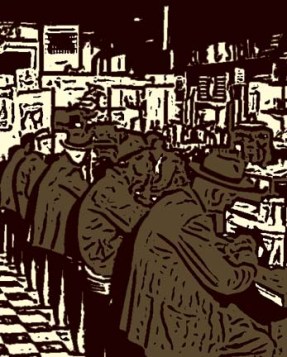
The counterman shook his head and waved away my offer. “All you need is a cane.”

Ads83

First Alice was hysterical. “What were you thinking!? They could have killed me!” I wanted to say “or worse” but I knew enough to keep my mouth shut. Then she got angry. “You bastard! How dare you!? You put my life in danger with your stupid stunt. I could have died!” Then she got quiet and that was the worst because those eyes shouted their disgust with me.

Rebecca had tried to explain that there was no way they could have suspected that they were being followed from my office. “Did they ask for Lack by name? How can you be sure that it was him they were looking for?” Alice said she didn’t remember but who else would “he” be but me. And that’s what I was thinking. That he was me and a gang of goggle wearing bandits wanted to kill that me. But who were they? I thought if I knew I could figure out how to avoid them.

I could tell by the look on Rebecca’s face when she settle on the stool next to mine that she hadn’t had any luck with the tailor shop building’s super. “There is police seal on door to my father’s shop and padlock on door to boiler room and coal bin. I do not know how we will be able to get to the diamonds.” Her shoulders hunched, ready to release a sob. I held her hand and she looked up at me.

“They are very dark your glasses, Lack. Can you see from them?”

I got the feeling she wanted to change the subject. “Yeah, I can see with them just fine. And my eyes don’t hurt as much in the bright light.”

She gave a weak smile and let out a sigh. “What will we do?”

I shrugged. I knew I had to get out of town before Kovic and his mugs caught up with me. I had an idea but didn’t let on to the kid. I would go down to the coal yard in the morning and find out who the supplier for that address was and then I’d look over the delivery schedule and get to the place before the coal was delivered and make like I was from the coal company and say I was there to inspect the chute because there was a problem last time like maybe the chute was blocked or something like that. But that would take time and I didn’t have the time or the expense account. I had to think of something.

I had started out with the idea of getting revenge for being stiffed by Kovic. It seemed like a simple enough plan. Walk up to him and fill his face full of holes. If I could get close that is. But in my state of mind, I didn’t care. I wasn’t going to get beat out of my fee or beat down trying to collect. And I almost got it, too. But I got a consolation prize instead, Yamatski’s Black Hand address book. Then I’d been rooked out of that by Solomon and his boys. I shoulda been smarter than that. They got the book and I got nothing. Unless you count the kid and the promise of pilfered diamonds.

I looked over at Rebecca and past her at the guy in the battered fedora and the equally beat up traveling case handing his business card to the counter man who inspected it with one eye closed and a squint of the other, and shrug. “We don’t need no novelties. We just sell food here,” he said.

dinerI had a card in my wallet. It was Yamatski’s card, the one that promised a reward if his address book got lost and found and gave a phone number and an address to return it to. My original idea of taking a look at his setup and maybe taking something that might be worth my trouble came back into play. It would be dangerous and I didn’t think I should drag Becky into the scheme which was essentially a burglary. But when I told her I had to be someplace, she gave me such a sorrowful look and pleaded, “What will I do while you are gone? Alice is still very angry with you, with me. I have no place to wait.”
I felt bad for the kid. Against my better judgement, which was starting to seem like a bad habit, I let her tag along. When you take a shine to someone, it comes with responsibility. Maybe that was why.


Next Time: The Philharmonic Radio Hour

On The Road To Las Cruces ~Seven~

by Pat Nolan

new badge hd 24Fourteen years had passed since the old buzzard died. Lately his memories of Ash had been frequent.

That he had considered writing another book would have been reason enough to conjure the raucous spirit of his old friend and drinking companion. The hours they had spent, sometimes into early morning, drinking, talking, and thigh slapping he remembered with a wry fondness. Ash had always done most of the talking. And all of the writing. He had watched his friend hunched over the roll top desk by the light of a coal lamp scratching steel nibs across sheaves of paper to inscribe the words they had spoken only moments before. Ash had claimed that if they kept up the way they were going, they would have to buy their ink by the pound. He had provided much of the enthusiasm and conviviality that was needed to see their book to its completion. He missed those bright patches in an other-wise grim and hard scrabble existence, and the friend who, bedraggled and weary after their all night marathons of drinking and telling lies, sometimes looked like a hedgehog who’d just smoked an exploding cigar.

“The grand jury met on April first and returned indictments on O’Lee, Leland, and Mcann. I figured that they would expect me to move on them as soon as a decision was reached. However, the joke was on them. I went to serve the warrants the following day. Falk had already sent word to O’Lee’s ranch so he knew of the grand jury’s action and I did not expect to find him there. O’Lee’s foreman told me that his boss and Leland had gone out to round up strays but I knew better. I had them on the run. My strategy was to pick them off one by one, leaving the leader until last. If I had all three in jail, I knew that O’Lee’s influence would prevail. I was anxious to get to Leland. O’Lee had that figured which is probably why he kept him close to his side. I had to settle for Jim Mcann.

“I knew right where to find him too. At McNeil’s boarding house. The morning after the indictments I had sent word over to Alice McNeil to serve Mcann a particularly hefty breakfast. I knew that Mcann presented with the choice of a hearty spread or ramming hooks for the hills would let his stomach make the decision. I was right. I served him a warrant to go along with the flapjacks and sausage. Then I told him to wipe the syrup off his beard and accompany me over to the lock up.

Falk was as surprised as I was when the judge remanded Mcann over to jail.

“I figured if I kept him isolated in the cooler long enough that he’d come around and start letting on to what he knew. I suppose that’s what Abe Falk figured too. He went about getting the preliminary hearing scheduled within the week. Part of his strategy was to get me to divulge the extent of the evidence I had against his clients.

“My main witness was a ranch hand by the name of Welkin. He had been at O’Lee’s ranch the night of Jennings’ disappearance and testified that all three men had ridden in on frothing horses late that night. He had heard them discussing in low voices something that was obviously of great concern to them. He had heard O’Lee say something to the effect that they weren’t going to be bothered on that account any longer. He also testified that O’Lee had burned a sheaf of papers, what could have been legal documents, in the fireplace.

falk“Well, Abe Falk didn’t get to be one of the most powerful men in the Southwest by being a pussycat. He tore into Welkin like an auger into rotten wood. By the time Falk was done with him, he was lucky if he knew who he was. It even looked to me that he had made him into a witness for the defense!
“It was pretty much all downhill from there. I had physical evidence, of course, but lacking the actual murdered bodies of Jennings and his son, it was not all that weighty. Falk dismissed most of the other testimony as hearsay or merely opinion. I had a woman who was riding the Alamogordo stage that same day. She claimed that she had seen the three men race by, hell bent for leather. Falk tried to discredit her by accusing her of having an affair with the stage driver. He even accused me of promising Welkin two thousand dollars of the reward money if his testimony led to their conviction. I had done no such thing, of course.

“Welkin had approached me for a loan to buy some property and I had told him that when and if the men were convicted I would then be in a position to make him a loan. At any rate, my case was not in the best of light right then. Falk was as surprised as I was when the judge remanded Mcann over to jail.

“He was a guest of the county for over a year and he never did talk. That’s because he was too busy eating. He had a tab set up at the boarding house that was paid by O’Lee through his lawyer. Can’t say that O’Lee didn’t know the price of silence. Mcann had loaded on near two hundred pounds by the time I had to let him go. I was worried that I was going to have to widen the doorway to the jail to get him out. Finally I had to roll him out of there like a beer barrel.”

new badge hd 25“I supposed you eventually apprehended O’Lee and Leland. They did stand trial, if I recollect.”

“They did that, but I never nabbed O’Lee or Leland.”

“What do you mean?”

“You’ve heard of moving heaven and earth. Well, Abe Falk came close to doing that for O’Lee. He maneuvered the Territorial legislature into apportioning a new county simply to remove those boys from my jurisdiction. The next thing I knew, the crime was no longer in Dona Anna County but in a new one that Falk had materialized out of thin air. Otero County, named after the newly appointed Governor.

“How could he do something like that?”

“Falk is a powerful man and he ain’t shy about flexing his political muscle. He has got his sights set on Washington. He controls much of what passes for politics here in the Southwest. He had George Kerry appointed the Sheriff of Otero County, and George, never one to overlook a chance at advancement, was in his pocket.

“O’Lee would have to face the charges against him eventually. Falk knew this, and he figured that if his boys surrendered to an authority friendly to his cause the interrogations, if any, would be less than thorough. Leland was his wild card and he wanted to keep him close to his vest. Finally, he arranged for O’Lee and Leland to surrender to his man. I was out of the picture by that time except for the fact that they were still under indictment.

 “So you never captured O’Lee and Leland?”

“That’s right, they evaded my clutches and never had to spend a day in jail. The new County did not even have a jailhouse yet so they spent the entire time awaiting their trial at the hotel in Alamogordo with pretty much free rein of the town. On equal terms, I would have eventually brought those boys in myself, but Falk plays with a marked deck. You’ve heard the expression that some men will rob you at the point of a gun and others at the point of a pen. Well, Falk is one of those who wields a lethal pen. He was double dealing the whole time.”  That memory called for another nip. “I did put a hell of a scare into those boys at one point, though.”

“How so?”

John_Reynolds_Hughes“I knew that an arrangement had been made for O’Lee and Leland to surrender themselves to George Kerry in Las Cruces but no date had been determined. I was up in Santa Fe collecting a prisoner for extradition to Texas when an acquaintance who worked in the Governor’s office informed me that O’Lee and Leland would be boarding the train somewhere along the line between Santa Fe and Las Cruces in the custody of Kerry’s deputy. As luck would have it that was the very train I would be taking to El Paso with my prisoner. Accompanying me was John Hume, a Texas Ranger.

“If you must know, I was sore at having been outfoxed by Falk, and I relished this opportunity to confront O’Lee. I considered goading him and making him do something stupid that would play into my hands. I did not want him to think that he could evade me so easily. On the other hand, that O’Lee and Leland would stand trial was good enough for me. I had the evidence to convict them, and they would hang just as dead whether they were in Kerry’s custody or mine. I was not, however, going to let them think that their subterfuge had succeeded. I was willing to cash in on any foolish move they might make.

“At every stop the train made, I was on the platform surveying the boarding passengers. We were just about to pull out of Sorroco when I happened to glance at the window of the smoking car. There was a bearded fellow seated there that I had not remembered boarding at the previous stops. That made me suspicious so once the train got rolling I asked the conductor if he remembered any one boarding from the backside of the tracks. He confirmed that three men had jumped on board as we were leaving the stop just before Sorroco and that they had taken seats in the smoking car. Right then and there I would have bet everything I owned that they were the boys I was after.

“I had a decision to make. I was tempted to arrest them myself but since the crime was no longer in my jurisdiction, I had no authority to do so especially if they were in the custody of a duly appointed peace officer. I realized that the most I could do was give those boys a bad case of the willies.

sf train2“I explained my plan to Captain Hume. We chained our prisoner to his seat and then we walked back to the smoking car. Those boys must have seen us coming as it was mighty quiet when we stepped into that car. Right away, I recognized the men I had been chasing. Both had full beards. Leland wore dark glasses and pretended to be asleep. The deputy had his face buried in some French blue book. The man I wanted, O’Lee, was hiding under a railroad cap. We had worked it out beforehand that Hume would cover Leland and the deputy, and I would have a go at O’Lee. I went over to where O’Lee was sitting, stiff as a raw hide in a snowdrift. I planted my foot on the armrest of the seat next to his and made like I was looking for some reading material in the newspapers and magazines stacked there. Then I leaned against the back of his seat and looked out the window, casual-like, as if I was enjoying the scenery. I was close enough to see the sweat rolling down the back of his neck. Those boys didn’t know whether to shit or go blind.” The old man chuckled, replacing the cork. “I’d say that’s a memory I’ll always savor.”
“What’d O’Lee do?

“Nothing. I figure I had him shaking in his boots. If he or Leland had been foolish enough to start gunplay, they would have got the worst of it. As it was, I got the satisfaction of seeing them sweat. After a time, I sauntered back to my seat in the passenger car. Those boys probably had to go off somewheres and change their britches.”

new badge hd 26“Falk had the venue of the trial changed because he claimed that his clients would not receive a fair trial in either Dona Ana County or Ortega Country.

That was a crock served on a silver platter. They would have got what they deserved. Justice, nothing more, nothing less. Those boys had done the deed, that was a fact. Falk figured if he could have the proceedings moved out of the vicinity of the crime, he would be able to control the way the events played in the newspapers. They moved the trial to Hillsboro, a mining camp up in the Black Range. You couldn’t find a more secluded backwater in the whole territory.”

The old man had noticed the rider a while back. They were in the flat stretch about half a dozen miles outside of Las Cruces. He was almost a mile behind and from his pace would soon catch up with them.

“Hell, the case was tried in the newspapers before it even went to the jury! Falk was granting interviews to anyone who could spell his name. He would say anything to put his clients in a good light. Once he even compared O’Lee to Robin Hood and painted me as the wicked sheriff of Nottingham. They made out like O’Lee was some kind of cultivated gent, that he spoke Greek and Latin when he was nothing but a West Texas brush popper. The prosecutor was a hack sent down by the Republicans in Santa Fe to make sure that the Democrats did not win. It had nothing to do with bringing the men who murdered Colonel Jennings and his kid to justice.”

The old man noticed that Adams would occasionally pull back on the reins and that the horse was responding by slowing its pace. He had a good idea of who was following them.

hillsboro“You would have thought it was fiesta week in Hillsboro. Why, Western Union even ran a wire up there just for the trial! They had reporters come from as far away as New York and London. Folks were arriving by the wagonload everyday just to get a seat in the courtroom as if it was some kind of opera or musical concert. The hotel was packed four to a room in no time, mostly with O’Lee partisans. Tent camps were set up all over the hillside on the outskirts of town. The truth is, the jury had to sleep in the hayloft at Hank’s livery!
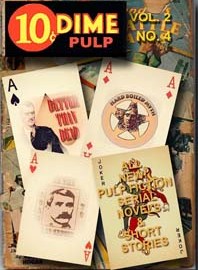
“Falk and his crowd held forth over at the Silver Maiden Saloon, and the Santa Fe gang used O’Shea’s Miner’s Club and Billiard Emporium as their headquarters. You could sit in Cobb’s barbershop and watch the gaggle of newspaper boys go from one camp to the other to get the opposing versions of how the day’s testimony had gone. The later it got, the harder it got for those shit scribblers to find their way across the street to the opposite camp for that last glass of convincing. Falk you might say had the deepest pockets and thus proved his righteousness by the number of besotted writers that were swept up at the Silver Maiden the following morning.

“I wouldn’t be saying much if I said that the prosecutor was incompetent. Falk demolished just about every witness who took the stand. And with nary an objection from the Territory’s side. I guess they reckoned that given enough rope Falk would hang himself, but they hadn’t figured that he was as clever as Houdini at getting out of a close place.

“He cross-examined me for a whole three days. He did not cow me, though. I gave it to him straight from the chest. I told him what I thought of his back room manipulating of the courts, how it was his kind that was responsible for the corruption in the Territory, that politics was determining the course of justice. And he could not demolish my testimony. My evidence was irrefutable, and he knew it. I would not be shaken. As much as he tried.

  “Falk sunk as low as bringing O’Lee mother to the stand to testify to her son’s character and innocence. Her weeping into her hanky that way, she probably did more to acquit those boys than any of Falk’s underhanded moves. Moreover, it did not help that every testimony in O’Lee’s favor was greeted with cheers and applause from the remuda of Texas jackasses Falk had packed the courtroom with. Or that the Dog Canyon pistoleros had made it plain and clear what would happen to the jury if the verdict was returned guilty.

“The closing arguments lasted all of one day. Falk took the time to denounce each and every witness and piece of evidence against O’Lee, claiming that the accusations were nothing but politics by the Republicans. He name-called the entire Rio Grande Valley establishment, said they were slime, a bunch of broken down hacks, and liars. Claimed that there wasn’t enough evidence to hang a yellow dog, let alone the defendants. It was late evening before he was done with his marathon summation. After the prosecutor presented his rebuttal, Falk’s case did not look as strong as it might have. However, Falk had one last card to play. By then it was close to midnight and the jury was just plain tuckered, but Falk insisted that they return their verdict before they bedded down for the night in their fashionable straw palace. That jury certainly knew what was important to them. They took a whole of eight minutes to declare O’Lee and his assassins not guilty.”

The rider was close enough behind that he could no longer be ignored. Adams had glanced over his shoulder in nervous anticipation. The old man smiled as he twisted the cork out of the bottle with his teeth. He had been right.

“If Gil Leland is ready to talk like I heard then I’d say O’Lee should start worrying about his chances of gaining a seat in Santa Fe. Leland’s sister even admitted in the Las Cruces paper not long ago that soon after the disappearance of Jennings, she went to slop the hogs and found them rooting among young Rudy’s remains near the edge of the pen. This was at the Dog Canyon ranch. I’ve heard tell that for the price of a bottle of whiskey that Leland will spill his guts about the whole affair. He’s as much as admitted to being the one who killed the kid.”


Next Time: The End Of The Road

Contents Vol. 2 No. 4

Welcome to Volume Two, Number Four of Dime Pulp,
A Serial Pulp Fiction Magazine

In this instalment of On The Road To Las Cruces, the name of the legendary lawman is revealed. Pat Nolan said of this novel account of the last days of the man’s life, “I had the manuscript sitting around for nearly thirty years and one day I went in with a machete and cleared out all the undergrowth until it was as spare and taciturn as the man himself. It shortened the word count considerably but it made for a better story.” What is related on the road to Las Cruces is as much a retelling of some history as it is how such a retelling might come about.

On the conclusion to All Tore Up, Helene Baron-Murdock says of her latest Hard Boiled Myth episode, “When I first created Jim Donovan of the Weston County Sheriff’s Violent Crime Unit, I just thought to use him as a mouthpiece to revisit the mayhem and murder found in Greek Myths. Yet the character in addressing how these myths can be retold cannot be conscious of the current investigation’s architypes—they are only transparent to the informed reader—and allows him to take on a life of his own. The odd development is that most of the other police officials Donovan interacts with have, like his, the names of pop music celebrities. It’s just a coincidence.” Or is it?

Better Than Dead’s author, Colin Deerwood remarked that the world of the private detective of his story, Lackland Ask, is made up entirely of language. “The language of the quotidian exchange, the patter and chatter of someone who gets ahead on guile and a few luck breaks, and which is why some episodes resemble a large shaggy dog following the scent of the imagination to wherever it may lead. The peregrinations of our everyhero are what gives pleasures to the telling of situations and predicaments only one step away from the next misstep.” But then he always says things like that.

Dime Pulp Yearbook 21 contains the novels (The Last Resort and Better Than Dead) and the short fiction (Hard Boiled Myth and Gone Missing) of Volume One’s 12 issues and are available for perusal in their entirety. If you missed a few issues or lost the thread of a serial, clicking on the link at the beginning of this paragraph or on the menu bar above is a good way to catch up.

Dime Pulp continues its crime spree with the serialization of 2 full length novels,  Better Than DeadA Detective Story and On The Road To Las Cruces  as well as the conclusion of latest installment of Hard Boiled Myth. If you’ve made it this far, go ahead and follow the links below to reading entertainment with the serial contents of Volume Two, Number Four

 —Perry O’Dickle, chief scribe
and word accountant


Ace-of-Spadesfi“Lackland Ask is the name. ‘Lack’ to my friends, ‘Don’t’ to those who think they’re funny. You might have seen my portrait on the cover of Black Mask, the crime fiction magazine. This is my story. It starts with a blonde. This kind of story always starts with a blonde.” Thus begins the seemingly non-stop, endless narrative of Better Than Dead in which women are not the only trouble although most of it, told with the wit and street savvy of Runyon and Parker.

Better Than Dead—16


Ace-of-hearts-1f1In late February of 1908, a one-time drover, buffalo hunter, saloon owner, hog farmer, peach grower, horse rancher, US Customs inspector, private investigator, county sheriff, and Deputy US Marshal set out from his adobe home on the mesa above Organ, New Mexico accompanied by a young man in a black buggy on the journey to Las Cruces. He would never arrive. This is the story of that journey, a novel account of the last day in the life of a legendary lawman.
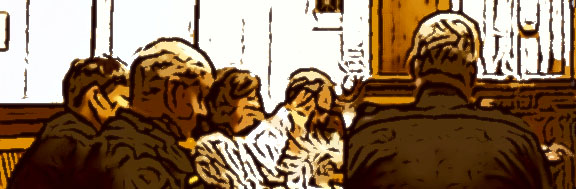
On The Road To Last Cruces ~Six~


Ace of Diamonds

Greek myth is rife with murder, mutilation, cannibalism, mayhem, and the ever popular incest.  Weston County Sheriff’s Detective Jim Donovan of the Violent Crimes Unit wouldn’t know a Greek myth from a Greek salad, but if he did he would find some troubling similarities to the cases he’s investigating.  Revisited as crime fiction are the strange death of Hippolytus, the agonizing death of Heracles, the slaughter of Penelope’s suitors, the Fall of Icarus,  the sparagamos of Orpheus, and the cursed lineage of Pelops.  Helene Baron-Murdock’s Hard Boiled Myth taps into the rich vein of classical literature to frame these ancient tales in a modern context.

All Tore Up—III


All Tore Up III

by Helene Baron-Murdock

The operations briefing was scheduled for 8 AM in Conference Room Two adjacent to the squad bay. Donovan had been in the office since 5. Now he was seated at the long table watching Lieutenant Jackson tack the mug shots of the three suspects and the reconstructed sketch of O.R. Phineas onto the white board.

Rick Nelson was there too, staring into the steam of a hot cup of coffee. He had that new-baby-no-sleep look to his bleary eyes. In answering “How’s the baby” he’d offered “I think she’s a vampire. She only sleeps during the day and stays awake all night. I could be catching a few precious winks if the Loot hadn’t called me in.”

confrenceroom

Mike Jackson looked away from what he was writing on the white board. “Boss said he wanted everyone front and center. He even had me call Bobbie back.”

Lanky Townsend stopped at the doorway about to step in. “What? Bobbie Delyn? That’s cruel and usual punishment. I thought she was still going through rehab.”

“Boss’s orders,” Mike said to the white board and drawing a line connecting what he had written to the picture of O. R. Phineas that Donovan had printed out from an array of available images online. The victim had not been camera shy.

Stubby Burdon found a place at the table and set a paper hot cup down next to his file folder. “You’ll never guess who I saw in the breakroom.”

Nelson and Townsend turned to him and said “Bobbie” in unison.

“Taking my name in vain, are you?” The older woman in the doorway glared at them with mock displeasure.

“Not me, Sarge,” Burdon held up his hands in protest, “Just surprised to see you back is all.”

Sergeant Roberta Delyn had that tough cop look that only a woman can have. She was all business. No tolerance for boy games and pranks. If you messed up, she was the one who read you the riot act. At five foot five her square shoulders balanced a not exceptionally pretty face due to the white scar that ran from beneath her left ear across her cheek to the tip of her chin. A boyish dyed blond bob tucked under a ballcap, she was dressed in her usual puffy green down vest over a checked man’s shirt, a pair of Levi’s, one leg of which was wrapped in a brace, and a three toed aluminum cane. She passed behind Donovan’s chair to get to the end of the long table and casually asked, “Why are you still here?”

Donovan and Bobbie didn’t exactly have a history. Not that kind of history anyway. She’d been in Violent Crimes longer than he had. She was the Loots right hand and sometime his left foot. “Sergeant Delyn, always a pleasure.” Donovan raised his coffee cup in salute.

Jackson faced the detectives from the white board, sleeves rolled up, folder in hand. “Ok, let’s get started. Captain Voss will be delayed so we’ll start without him. Let’s hear what forensics came up with. Pete?”

“I have a question.” Bobbie had raised her hand. “Why am I here?”

“Come on, Sarge, as I explained, it was not my call.”

“I’m on sick leave, for cry’s sake!”

“You could have said no.”

“Well,” she said glaring at the other detectives at the table, “don’t expect me to ride your asses in my usual capable and efficient manner. If anybody needs me, I’ll be in the cafeteria.” At that she pushed her chair back and lifted herself, obviously in pain, to stand, and slowly shuffled her way out of the conference room and in the direction of the elevators.

Jackson shook his head. “Pete? You were saying?”

“Uh, not much new from the lab except that some of the bits and pieces are testing positive with non-human traces. Blood from the clothing of the gals matches the deceased, but other than that nothing. Samples from under their nails show no indication that they used their hands to rip the vic apart.”

“Maybe they washed their hands after,” Burdon offered.

“Jackson shook his head. “I don’t think so, Eric. Their clothing was bloody but I’m guessing it was transient. They may have handled some of the body parts. And not one has a broken nail, chewed maybe, so I’m leaning toward the idea that maybe they were bystanders, witnesses, if you will, not actually physically participating in the rendering.” He addressed Townsend again. “What kind of non-human traces? Are we talking about foxes or big cats? Bear?”

“They ruled out most of the local critters. They’re thinking something more exotic. They’re still waiting for confirmation on the sample but something along the lines of,” Townsend checked his notes, “pan troglodytes.”

“What?”

“Chimpanzee.” Donovan offered.

“I know that!” Jackson retorted.

“Our closest animal relative.”

“Yours maybe.” Which drew guffaws around the table. “Ok, Pete, anything else?”

“Dispatch got a call from a fisherman downstream from Sharon’s Crossing. Seems like we might have found the victim’s hands. Deputy’s on the way. We should know within the hour.”

“Alright, might as well have the coroner’s guys head that way, too. If they’re his hands we can get a positive id. His prints are in the system.” He turned address the white board. “Now our terrible trio here, dumb, dumber, and dumbest.” He tapped each of their photos with his pen. “Melanie, Dora, and Laurel are not being very forthcoming about what they saw and how they were involved.”

Burdon who’d been on the interrogation team volunteered, “Here’s what we’re dealing with. The Captain is sitting in. Out of nowhere, he says “Will you admit that you tore the limbs off this man because you were high on mushrooms and you floated his head down the river on a raft made of sticks.’ This is when we were grilling dumber, there in the middle. I had no idea where the heck that came from. So Dora, dumb Dora, it fits, goes ‘I dunno about the first part, I was pretty high, but yeah, his head, it seemed like the right thing to do.’ And I about. . . .”

“Uh, good, good, looks like Captain Voss is on his way,” Jackson held up his hand glancing toward the doorway. Conference Room Two became very quiet as Voss stepped in.

The Chief of Detectives nodded at his lieutenant and briefly glanced at the others at the table. “Continue Jackson, you can fill me in on what has already transpired. How is the questioning of the women going?”

“Ah, yes sir, we were just getting to that.”

Donovan knew the Loot well enough to know that when he put on that poker face, he was seething inside. He should have seen it coming when Jackson broke a little smile.

“But first Detective Donovan was going to brief us on the narrative he has developed of our victim’s movements before his murder.”

Donovan blinked, ok, Mike, you owe me one, and gathered the folders with his notes in front of him. “Yesterday, approximately 1700 hours we receive a call from the proprietor of Sharon’s Corner, Dane Carson, who said he could identify the composite broadcast on the local evening news. Earlier, approximately 1300 hours, a facial recognition search I had initiated came up with a possible id of the victim. The names matched, and in the process of questioning Mr. Carson, I learned that the victim had presented a poetry reading at his establishment, less than a week ago, last Sunday. There were approximately twenty people in attendance that evening. I interviewed one of them so far, the organizer of the event, Faye Angeli, and plan to interview the others on the list of attendees. I learned or confirmed that the victim, O.R. Phineas, was a kind of literary celebrity, a poet. Mr. Phineas was last seen driving away from Sharon’s Corner in a silver BMW convertible accompanied it would seem by our first suspect, Melanie, who had come to the reading with May Naddy, as had the other two of our charming trio. That would indicate that she has prior knowledge of the poet perhaps leading up to the time of his death.”

may naddyAt Jackon’s nod he continued. “In my interview with Ms. Angeli, who is a real estate agent, she admitted to at one time being a part of the following of radical women around May Naddy known as The Bear Cult, but had left the group after what she termed an ‘unnerving incident.’ She wouldn’t say further what she meant by that but I’d guess that she witnessed something that still leaves her shaking. It’s her contention that May Naddy is a witch, evil, at least.”
Donovan pulled a print out of a photo from the folder and slide it across the table to the Loot. “Tack that one up next to the author’s photo of Phineas.” It was a picture of May Naddy from her last major film, Mistress of the Beasts. She wasn’t wearing a lot of clothes in that one either.

“Is this your idea of a joke, Detective, a pinup on the murder board?”

“The relevance of May Naddy in all of this is in the fact that she is well acquainted with Phineas. I did a little digging on the internet and you’d be surprised with what you can come up with. Before she moved her animal rescue operation to Weston County, May Naddy had a similar enterprise on an island off the coast of Croatia. She was also a patron the performance artist, Yuri Dicey.”

“I don’t see how any of this is relevant to our investigation, Detective.” Voss wasn’t the patient sort.

“Yuri Dicey was married to Oscar Reynaldo Phineas. She was killed when one of her stunts went wrong. He was suspected at first but was eventually cleared. But if you read the comments on stories about Dicey’s death, there are people who believe that Phineas in fact had something to do with his wife’s death.”

“That’s gossip, you’ve been wasting your time reading tabloids instead of doing police work!”

“One of those people is May Naddy. She has been quoted as saying she believes Phineas killed Yuri Dicey because he was jealous. I’ll just throw this out, Naddy and Dicey were rumored to be lovers.”

“And I’d throw that in the trash where it belongs. I don’t know where your reputation comes from, Donovan, but this certainly isn’t police work!”

“Hey, look at that!” Townsend held up his smart phone. “They found the hands and printed them! He’s our guy. O. R. Phineas, poet.”

cafeteria

Donovan sat opposite Bobbie Delyn at the table in the cafeteria with a paper cup of steaming caffeinated brown water and watched her chew the end of her pencil.

“What’s a four letter word for ‘martinet’?”

“Asshole.”

“Too many letters.”

“Voss.”

“That fits, and completes the cross word ‘retired police officer,’ ‘excop’.” Bobbie gave what passed for a smile that creased her white scar like an odd punctuation. “The investigation not going well?”

“Our new chief of detectives is intent on charging the three, I wouldn’t say undeserving but nonetheless not culpable, with murder. Unfortunately other than the bloody clothing nothing indicates that they were directly responsible for the victim dismemberment. Personally, and I’m not alone with this, I think it is physically impossible for them to do it.”

“Because they’re women.”

“Of course not. Even a very strong man would be incapable of ripping a torso to shreds like that, even with tools. This guy was practically confetti.”

“Ugh, now there’s a pretty picture.” Bobbie scribbled on the edge of the newspaper thoughtfully. “Some kind of animal, then?”

“Pan Troglodytes.”

“Chimp. I know that one from doing the crosswords. But a chimp in R.K. Turis State Park? Who would. . . ?”

“Let me finish that thought for you. May Naddy and her anxious animal ark. I got Woody Ames, the animal behavior vet out of bed early this morning.”

“The County Dog Catcher as he so often calls himself. Bet he was happy.”

“Because she operates a wild animal sanctuary one of the stipulations for the permit was that Animal Control had to regularly inspect conditions on the ranch, make sure they weren’t being mistreated and such.”

“Yeah, I think I heard Woody complaining about that.”

“There’ve been problems before. One of her cheetahs escaped and went after the neighboring ranch’s sheep. Fortunately, the cheetah was defanged. It just gummed a lamb. Unfortunately the lamp died of a heart attack.

“Gummed a lamb. I don’t think I’ll ever be able to erase that from my memory.”

“So Woody has an inventory of what kind of animals she has out there. They’re mostly arthritic big cats who have seen better days, all defanged, or blind. A black bear that is so fat it can’t walk, it can only roll, a couple of dogs pretending to be wolves, llamas who’ve lost their spit, a giraffe that can’t stand, horses one step from the glue factory. . .the usual assortment of misfit four legged, feral cats, stray dogs, and two legged runaways engaged in some kind of throwback evolution. . . .”

“His words, I’ll assume.”

chimpanzee“And a crazed chimpanzee. Said when he did the inspection, the chimp was kept in some kind of cage away from everyone, including the other animals. And believe it or not, went apeshit whenever anyone came near her. May Naddy was the only one who could calm the chimp down. Female I think he said. Probably the most dangerous animal out there. His opinion.”
“If I were to draw a conclusion from what you’ve told me, May Naddy’s chimp is the perp.”

“May is linked to Phineas through Yuri Dicey who was both their lover.”

“Sounds like someone was working all the angles hoping to get to the point.”

“Naddy blamed the poet for Yuri’s death. Either she had Faye Angeli lure Phineas to Weston County or it was by coincidence. Either way, May sees her chance at revenge.”

“And uses the chimp as her hitman? From what I’ve heard they’re strong enough. But why involve the three runaways?”

“They were bait. From what I’ve read about O.R. Phineas, he was a lady’s man, left a trail of broken hearts and promises from coast to coast. The silver BMW he was last seen driving was reported missing by some gal up in Eureka. . . .”

“Surprise!”

“And who didn’t want to press charges because she was certain O.R. had just borrowed it but changed her tune to stolen when we told her we’d found it torched in a turnout off a dirt road down here. I think May used these three kids to lure him to her place. Maybe even tortured him. The lab is putting together a composite of the body parts that might show indications of torture.”

“Adding insult to injury. But wouldn’t she worry that the three women would talk if they were involved in any of it.”

“She’s got some kind of psychic grip on them. The experience was probably so horrific they’re suffering from amnesiac shock. If we let them stew a bit longer, one of them might loosen their hold on whatever false scenario they’re clinging to.”

Bobbie penciled in an answer with a grunt of satisfaction. “Might be a little complicated for the new guy.”

“He as much said I should be writing for TV cops shows. It was the most farfetched narrative he’s ever heard.”

“He won’t last long.”

“You don’t think so? I’ll be long gone, but you guys are going to have to put up with him.”

“He doesn’t fit. Who’s ever heard of a Derrick Voss. Helen Reddie over in HR told me that they had a much better candidate, guy by the name of Hendrix. He would have been a perfect fit, she said.”

Donovan took a sip of his coffee which had gone from scald to just hot. “You’re not thinking of jumping ship soon are you?”

“Me? No way. I’ve got half a dozen years before I’m eligible.” Bobbie pointed to her knee. “Unless I go out on a medical.” Then she frowned. “Wait! How old do you think I am?”

“Hey, Sarge. No offense, you just look mature for your age.”

“Geez, like I haven’t heard that one before.” She sighed and tapped the pencil eraser on the table. “So how are you going to deal with Voss the boss?”

“Mike’s getting a search warrant for the Bear Ranch. We’ll see if we can make a match with the chimp. If so, then it goes in that direction and Voss will have to follow it.”

“He was hoping for something cut and dried, this sounds sloppy and wet. So what’s the motive besides sheer cruelty and mayhem? Revenge for the girlfriend’s death?”

Donovan shrugged. “That’s one of them.” He retrieved a slim volume from his folder and passed to Bobbie.

“What’s this? Poetry? When Sunny Get Glue by O.R. Phoneas, er Phineas?”

“Yeah, Fay Angeli had an extra copy.”

“So your saying he was killed because of his poetry?” Bobbie leafed through the pages, lingered on some passages, winced, looked disgusted, sighed, and then passed the book back. “With something like that, anyone could claim justifiable homicide.”


Ω

Better Than Dead—16

by Colin Deerwood

Ads77

There was an explosion of smoke, the rumble and roar of competing conversations, cacophonies of shouts, bursts of laughter as low belly guffaws of gents or the high whinnies of fillies, the distinct clink of bottle and glass, a shuffling and scraping of chairs, and music from a coin operated Victrola over in the corner where a few couples were rubbing their bodies against each other to the lowing moans of a crooner in what passed for dancing. The heady hoppy scent of beer and sharp tang of high octane joy juice mixed in the tobacco haze that hung in the air just about at eye level. It was a lively crowd and no one noticed as I stepped up to the bar where shoulder to shoulder the serious drinkers sat on stools or leaned against it for support.

cocktail lounge1Neither of the two bartenders treading the boards pouring drinks and ringing up the sales on the big brass cash register was the tree trunk that had served me the first time when I’d stepped in to avoid a tail. I tried to wedge myself between a couple of muscle heads who weren’t interested in letting me squeeze through until they laid eyes on Rebecca. Then they became gentlemen whose mouths had dropped open and whose eyes popped out of their sockets accompanied by an ahooga horn.

It just made her smile even prettier at the attention. She was what the old Jewish ladies in the neighborhood used to say, a real  shayna punim: a pretty face. I’d looked into that pretty face with stars in my eyes, too. But something was telling me it was too good to be true.

We’d followed Alice’s suggestion and took a breather in her friend’s loft on the top floor of the building. It was a tiny place, like Alice’s studio, but big enough to be crowded with large canvases hanging on or leaning against any spare wall space below the low ceiling and skylight. Becky sorted through them as if leafing through a sheet music bin, sounding little notes of surprise or astonishment. The ones on the walls looked like swabs of brush cleaning to me.

I’d cleaned up a bit. brushed the bin dust off the elbows, lapels, and knees. I washed my mug of the coal smudges. The bruises weren’t in any hurry to leave. And enough time now had elapsed since the hot grope in the tailor shop. She was still being coy but cool. It was like she knew she had me, she didn’t have to tug on the string.

I had other things on my mind besides. The throbbing at the base of my skull was annoying. I’d been beat on a little too much lately and it was taking its toll. A good long sleep would probably take care of that. In the meantime, getting the rocks back was the first priority, fencing them to diamond dealers Rebecca said she knew or even Max Feathers if worse came to worse. That would generate enough cash for me to light out for parts unknown, far enough that any of Mister K’s mooks might accidently bump into me. But now Becky and I were partners, business partners, so to speak, and there’s no better way to ruin a romance.

We bided our time waiting for evening to get grayer in a kind of no touch tango, dancing around what each of us might be thinking.

I thought taking the back way out of the building the safest bet and we scuttled across the trash strewn backyard to the alley behind. The less we were seen the better I was going to feel. She’d tied a scarf under her chin and I had my too large fedora down over my ears. We probably looked like an old couple out for an evening walk on the mean streets of the East Side. No cars followed us with their headlights dimmed and no mugs were tailing our footsteps. We were all but invisible. And I warned the kid. If things went south or anything happened to me or we got separated she was to amscray back to Alice’s and wait till I got word to her. When it developed that getting at the diamonds wasn’t in the immediate future, I had a backup option.

“Whatallitbe?”

I’d attracted the bartender’s attention although not in the same manner that the kid was attracting the attention of the wolf in the pinstriped suit next to her. The leer of his oily grin wouldn’t pass the Hays code.

I held up two fingers and then sideways signifying a double.

“And your little sister?”

Rebecca smiled up at me and I remember how loopy she’d got on Max’s hootch.

“A Shirley Temple,” I said which prompted her to squeak with delight, “Oh, I love Shirley Temple!”

After I laid the simoleon on the bar I told the bartender that a friend of mine had left an envelope for me. I pointed to the cash register. “My name’s on it.”

He came back with the envelope. “What’s your name?”

I told him but someone was getting loud at one of the tables and he had to ask again. So I said it louder. “Lackland Ask!”

He didn’t quite hear what I said and bent his ear toward me. “Lackland Ask!” I repeated even louder. And right about then there was a lull in the barroom din and anyone who wanted to heard my name. He handed over the envelope and I pushed the two bits from my change on the bar toward him. “Gee, thanks.” He said and grinned brightly.

I’d been keeping a side eye on the skunk in wolf’s clothing trying out his con with the kid. She may have been starry eyed but she wasn’t dumb. She wasn’t going to fall for the line that he was Shirley Temple’s long lost brother, Ramon. Or was she?

lackbec1I nudged her with my elbow. “imtay otay ogay.”
She blinked once and frowned. “But Ask, I haven’t. . . .” As she turned to glance over her shoulder she saw the look on my face.

The wolf had been nudged out of the way by a snake and I felt like I’d just stepped into a frame of an Orphan Annie strip because the narrow framed ferret eyed fella in a long overcoat was a spitting image of the Asp.

He smiled one of those smiles that wasn’t a smile and I expected a forked tongue to slither out from between his tight bloodless lips. Instead he said in a high pitched voice, “So nice of you to announce yourself, Mr. Ask. If you will please come with me. Someone would like to ask you some questions, Mr. Ask.” He thought he was being funny but I could see by the way he was holding his hand that he had a gat in his coat pocket pointed at Rebecca and that he was very serious.

I nudged the envelope into the kid’s hand and murmured “Aketay isthay.” Then I turned to the large stevedore quaffing his brew behind me unaware of the little drama going on inches from him. I patted him on the derriere and when he turn to give me the mean eyes, I made a kiss with my lips. That enraged him.

He set his beer down and prepped a roundhouse.

“Ukday!’ I yelled, ducking as his fist landed square on the side of the Asp’s head. I goosed a couple of other saps scrambling for the door and within seconds the place had erupted into the brawl it had been waiting for all night.

Ads78

Once on the bricks I twirled undecided which way to run. Just before the end of the block was a service alley. I headed there all the while scanning the opposite side of the street lined with jalopies. I wanted to stay to the shadows so I crossed over, the kid on my heels. I figured to get to the main drag where I might flag a cab or duck down to the subway. It wasn’t to be.

The asp-man was rubbing his head. “I can make him talk.” He examined the tips of his fingers, blood.

It was like they’d materialized from the bricks and shadows, the Asp’s twin, a skinny guy in a tweed cap and a red scarf around his mug, a bruiser with a taffy colored bald head, arms like elephants trunks, ten penny nails for eyes, and a short shrimpy guy with a tall hat and high heeled shoes. Only it wasn’t a guy. It was Della, Al’s redheaded sister. And I had to guess that the skinny guy with the scarf was Al.

“You have something that belongs to me!” she growled in my face.

The bruiser held me up by the scruff of my coat like I was hanging from a hook. The Asp had grabbed Rebecca by the arm as she tried to get away. She reached into her pocket and smacked him on the side of the head with the flashlight. It surprised him just enough to loosen his grip and it was all she needed.

“Unray, unry!” I shouted to her as Al started to chase after her.

Della called him back. “Letter go. This is the guy we want.” I felt the slap, the taste of blood in the mouth. “You took something from my mailbox.” There was another slap but not as hard. She may have hurt her hand the first time. “I want it back!” and a knee below the belt. That hurt, and I groaned because that was all I could do. “Wherizit!”

“I don’t know what you’re talking about?”

“You’re lying!”

The giant shook me like maybe the answer would drop from my sleeves like burgled silverware.

“You took the postal slip from my mailbox in the lobby. One of the neighbors saw you. She reported to the cops but I knew it was you from her description. That’s a federal rap you know, stealing mail.” She said it with a mean smile.

The asp-man was rubbing his head. “I can make him talk.” He examined the tips of his fingers, blood.

“Give her what she wants, Lack.” Al spoke up, “You don’t wanna get hurt. Not by Sid.”

“Al,” I said, “I thought we was pals. You said I should come to you if I needed help. Are these creeps the muscle you’re talking about, Al?”

Al shrugged. “Ya shouldna takenit, Lack. I got no choice.”

“The slip!” Della screamed in my face. Then Sid’s fist caught me between the eyes. I thought I was seeing double and hearing things, the shrill eerie cries of a banshee. But it was just Sid’s twin, and he was telling Della, “Less getoutayear! Cops erondereway!” and then I realized, “the sirens!”

1935_Chrysler1Rough hands lifted me and stuffed me into the back of the Chrysler sedan and before I knew it I had King Kong, the Asp, and my shadowy old pal, Al sitting on top of me while the other snake got behind the wheel with Della seated beside him, roaring off just as the paddy wagon pulled up. One of them was sticking something sharp into my spine and it hurt.

“It’s stupid to die over a piece of paper, Lack,” Al insisted.”

The pain increased. “Ok, ok! It’s in my office over on 10th Street.”

“That dump you call an office is over on 9th, meatball. I know, I been there,” Della barked. “Don’t think you’re smart.”

“Right, 9th Street. The slip is in my office. Hidden.”

“You’re lying! I tossed the place. I didn’t find anything except dirt, flies, and soiled underwear.” She gave a smile with her tiny bone grinding teeth. “You’re a slob, you know that?”

The pressure on my spine eased some. I had to come off sincere. “No, I hid it pretty good. You wouldn’t find it unless you knew where to look.”

Della told the driver to head back toward 9th. “If he’s lying, you and Sid know what to do with him.”

Ads79

Curtis was lurking in the foyer with a broom and a dustpan when I came through the door. He looked up surprised to see me accompanied by the Asp brothers, the muscle bound gorilla, Al, and his sister, Della. He smiled at first. Then he frowned. “Hey Mr. Ask, where you been? The cops has come around lookenferya.” He gaped at Della. “And yer udder sister. From why oming.”

“Oh yeah, well, tell the cops I ain’t here.” I said as I brushed past him.

“Hey, you know the rule about visters affer fivaclock!”

One of the Sids grabbed the handle of the broom Curtis was holding and used it to smack him between the eyes. “Mind yer own business if ya know what’s good ferya.”

stairwellA herd of elephants might have been quieter climbing up the two flights to my office. Alice must have forgotten to lock the door and I walked right in. The bruiser had an iron grip on my shoulder. “Don’t try any funny business,” Sid warned. I flicked on the light and saw what Alice and Rebecca had seen earlier that day. Messes don’t have a tendency to right themselves no matter how long they’re left alone.
“Whooo! Open a window!” And one of the Sids started over to do Della’s bidding.

“Ah, nah, bad idea. It’s broken. Open it and it’ll never close.” I should have kept my mouth shut. Sid grinned over his shoulder and yanked on the sash lifts at the bottom. It would budge. At first. And then it shot up like a rocket. I heard the top pane crack and shatter. Well, I hadn’t planned on spending another winter here.

Dempsey didn’t pay them no mind. “Shadap! Some gents downtown wanna talk to ya. Somethin’ about a dead lawyer!” He pulled the cuffs from his pocket. “Yer not gonna give me a hard time, are ya?”

“In the closet.” I said pulling myself free from the baby giant who I just noticed was wearing some kind of pajama pants. But given his size, he could wear just about anything he wanted. “In the trench coat.”

“I already looked there!” Della was trying to squeeze into the closet with me.

“In the lining.” I’d palmed the postal call slip when they were dragging me up the steps. I reached in and after some rummaging to make it look like it had really been hidden, I pulled my hand back out with the orange slip that had item too large for box written across the top.

She snapped it from my hand, glanced down at it, and then gave me a suspicious glare. “I already looked there. Is this some sort of con your pulling, pepper ?”

“That’s them, officer!” Curtis was in the doorway with the beat cop. Dempsey. He was a large cop and what they call a hard man. Della’s genie may have been bigger but he wasn’t as hard. And he had a loud cop voice. Probably because he was deaf in one ear. “What the holy hell is going on here!” He had his fists on his hips, one of them holding his billy club, and the bulge in his back pocket was his pistol. “Who’s responsible for this mess!”

Curtis pointed at me. “That’s him, officer. That’s Lackland Ask.”

Dempsey’s eyes narrowed and his mouth twisted with that particular Irish determination. He strode across the room and pulled me out of the closet. “We been looking for you! Come with me.”

That was one of the few times I went anywhere willingly with a cop. “What’s the beef, officer?” I glanced around the room. The two Sids were pretending to find something interesting with the wallpaper. My pal Al had the red scarf wrapped around his nose and staring at his shoes. And the oak doorway was trying, not very successfully, to blend in with the shadows. Della looked surprised and was about to say something.

Dempsey didn’t pay them no mind. “Shadap! Some gents downtown wanna talk to ya. Somethin’ about a dead lawyer!” He pulled the cuffs from his pocket. “Yer not gonna give me a hard time, are ya?”

When I shook my head no, he put them away. And besides he wasn’t going loosen the vice grip he had on my arm. But that wasn’t how I escaped.

Ads80

Something must have happened in the room after Dempsey hustled me out. Curtis had been bringing up the rear and lingered at the door. The next thing I knew he barreled past me on the stairs with terror in his eyes, banging into the cop and throwing him off balance. Dempsey loosened his grip to catch his balance and I wrenched free. Down to the next landing I leaped overtaking Curtis, knocking him down, and then practically skipped the entire next flight of stairs, skidding into the wall. I caught myself and jumped another half dozen steps down the next flight. Dempsey was roaring behind me, yelling at Curtis laid out across the stairs to get out of the way. I made it down to the foyer and through the front door onto the stoop and the street. I looked both ways and then dashed down toward the end of the block where a large delivery truck was parked. I skidded around behind it and ducked down.

truck101I could see Dempsey pause at the top of the stoop, look around to see if he could spot me. Out of breath, he lifted his cop cap and scratched his head realizing he’d lost me. He slapped the billy in the palm of his hand a couple of times and then strode off to the call box at the other end of the block.
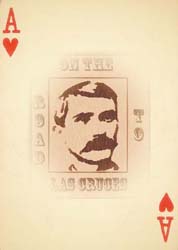
The night was filled sirens, but that seemed typical for a Saturday. I waited till Della and her misfits exited the building and drove away. She’d got what she wanted. Or so she thought. Rebecca was the one with the postal slip she wanted, and I had to get to her in a hurry. I cut through a couple of alleys and made my way over the few blocks to Alice’s. If she’d listened to me, she would be waiting for me there. With the diamonds I’d yet to retrieve and what I had a hunch Della’s package contained, I  might just be looking for a place on easy street.

I rounded the corner down from Alice’s studio, and there they were, a squad car blocking the street and a gaggle of blue uniforms. The cop car was stopped right in front Alice’s building. I didn’t like what that was telling me.

A crowd had begun to gather and some of the patrolmen were pushing them back. I wanted to get closer, make sure it wasn’t what I was thinking. There was a lump lying along the iron railing leading down to Alice’s A cop was down on one knee examining it and, looking up at his partner, shook his head. Then I spotted her, sitting on the steps, wrapped in a blanket, shivering, a cigarette between two fingers. Alice. A patrol sergeant by the chevrons was talking to her and writing her answers in his pocket notebook.

I had the urge to bust through the cordon to be by her side, put a protective arm around her when I felt a tug on my sleeve. It was Rebecca. Her eyes were red like she had been crying, her lips trembling.

“Oh, Lack, it was awful!” she sobbed.

I needed details. And she gave them to me in fits and starts. She had made her way back to Alice’s studio. When she arrived there were a few neighbors standing around the steps leading down. Then she saw something on the sidewalk. It was a body. She could see that Alice’s door was wide open. Fearing the worst she ran in. Alice, stunned and shaking was crouched down by the icebox. On the floor was another body. It had a huge bloody slash across its back. Seated on one of the kitchen chairs was a man. With a sword. It was Linkov.

“I screamed. And that brought Alice out of her daze. She told me not to be frightened. It was Linkov who had saved her. Two men had burst into her studio and demanded to know where you were, Lack! They were looking for you! They hit her a few times and threatened to do things to her.” She paused to see if I understood what those things might be.

I nodded, looking over at Alice, smoke trailing from her mouth as she answered the cop’s questions. “Where is he” jumped back into the forefront of my brain as a recent memory.

“She had just finished taking a shower she told me. And she said that she usually did a little dance before the portrait of Ted because she misses him so much. And that is when they burst in and began to slap her around, demanding she tell them where you were! And all of a sudden there was Linkov with his sword! He slashed them before they even knew what had happened. One fled out to the street but he is dead too, on the sidewalk.”

I put my arm around her shoulder. “That musta been pretty scary, kid, no wonder you screamed.”

“That is not why I scream, Lack. I scream because they are the same men who come to Rabbi Joseph’s apartment and start the shooting. They have the googles and the kerchiefs the same.”


Next Time: Coming To Grips With The Black Hand

On The Road To Las Cruces ~Six~

by Pat Nolan

new badge hd21

“Life is a narrow vale between the cold and barren peaks of two eternities.”

One-eyed Tom, the proprietor of the Coney Island Saloon in El Paso and the old man’s longtime friend and gambling associate, read from the page Apollinara had prepared from a text by the agnostic, Ingersoll.

The day had begun with a gully washer and had made a pond of the rectangular hole carved in the red dirt in a neglected corner of the Las Cruces Odd Fellows Cemetery. As the funeral procession had wound its way to the burying ground later that day, large threatening dark clouds raced across the severe blue like itinerant mourners threatening to drop more misery on the assembling dignitaries, friends and family.

“We strive in vain to look beyond the heights. We cry aloud and the only answer is the echo of our wailing cry.”

cemetaryThe old man’s children, four boys and three girls, stood at graveside, their heads bowed. Paulita, the youngest of the girls, held the three-year old boy on one hip. Apollinara stared solemnly, stoically at the long plain coffin holding her husband’s body. In her black-gloved hand, she clutched the telegram of condolence from the President, Theodore Roosevelt. At her side, a grim Governor Kerry stared intently at the red muck that encased his new boots. The old man’s brothers, long estranged, had made the trip from Louisiana, tall and gangly like their departed sibling. A young reporter from the El Paso Herald stood off to one side, unobtrusively, jotting in a narrow notebook.
“From the voiceless lips of the unreplying dead,” One-eyed Tom quavered, “there comes no word; but in the night of death hope sees a star and listening love can hear the rustling of a wing.”

A cloudburst greeted his words. With the sound of spreading wings, almost in unison, and as if in salute, the black umbrellas of the prepared rose over the heads of the dark clad mourners. Rivulets appeared in the rutted red earth, wending their way between mud spattered shoes, over the piles of crimson dirt at grave’s edge, and around the large gray mass of granite headstone upon which was carved the name, Garrett. The accumulating wet gathered in depressions made by the carriage wheels and boot heels like murky pools of blood before dribbling down the desolate hill.

new badge hd22

The old man wet his whistle and continued. “I had a plan, and if it was going to work, I had to play it out slow so as to hang all three with the same noose.

If this had been an open and shut case of some desperados on a tear, it would have been over and done with long ago, and without any help from me. As I said before, politics was involved and so I had to proceed cautiously. Too cautiously, some have said. I had to weigh the political implications for everyone I investigated. Politicians, if they ain’t long on ethics, are certainly long on memory, and I didn’t want to step on any toes that would come back years later to kick me in the rear when I wasn’t expecting it. I was caught up in the power game between the Democrats and the Republicans. The murder of Jennings was almost inconsequential, a minor irritant, and so I had to get in the swim just to stay afloat.

“I played a waiting game figuring that someone involved in the murders would either brag or break. Gil Leland was the one I would have given odds as most likely to talk. There was one of the goosiest fellows I ever came across. At times he was just one big twitch, arms, face, legs going every which a way with some kind of affliction. Don’t think they ever figured that one out. He’s one of them northern types with white blond hair that he always keeps jailbird short. Has the kind of blue eyes that are so light they’re almost colorless. The locals call him El hombre sin oyos, the man with no eyes.”

“Are you saying he’s still alive, I mean, living around here?’

“He is at that, and crazier than a loon, I hear. He’s finally cracked. And he’s talking about it now, letting on little details that only the killers would know. I also hear that when he’s had a little too much firewater that’s the only thing he’ll talk about. I’d say his conscience is getting the best of him.”

“Has he said anything that could be used to implicate him in the murders?”

wantedolee“Oh, he’s always said plenty. You see, the killing of Colonel Jennings was thought to be a feather in their cap by some, including themselves. Leland was just a boy himself when the murders were committed, and he was cocky, boastful and impulsive as most boys are. And not too bright.
“He’s the one I was most anxious to arrest in particular. He had the potential of being the prime witness. O’Lee and Falk knew this too so they kept him away from the wrong kind of people, people who might be willing to talk to me about what he was saying.”

“What was he saying?”

“Some of what I was told, and it’s been a while now, was that Rudy Jennings was nothing but a little half-breed and to kill him was nothing more than killing a dog. He said of Jennings that the old bastard got what he deserved. But it’s what he’s saying now that has O’Lee worried.”

“How’s that?”

“Well, it seems that Leland is saying that he’s ready to confess and that he wants to confess to me. I do not know why. It won’t do a whole hell of a lot of good. I’m not a lawman any more. Nevertheless, he’s saying he knows where the bodies are buried, and he’s saying that he’s the one who killed young Jennings. The way it was told to me, he grabbed the boy by the hair, pulled his head back and slit his throat with no more compunction than if he was a crippled calf.”

“Did he say how the Colonel died?”

“The way I heard it, they overtook the buckboard and just started shooting. No one knows whose bullet actually killed him. There’s even talk that the Colonel hopped between the riggings to get away but was dead before he hit the ground.”

The young man nodded his head. “I’ll bet if he could, he would tell some tales.”

“I’m counting on it. I may not be able to arrest O’Lee for what he did back in ‘96 but I can expose his villainy and finally clear up the mystery of White Sands.”

“How are you going to do that?”

“I’m going to write a book about it.”

“A book?”

new badge hd23

Any book would be a lie. Without Ash, it was only a threat, a bluff. He was willing to expose O’Lee for the criminal that he was, and he had noised it about that that was what he intended to do.

On the other hand, he was less eager to reveal his own ineptness. How could he admit to the embarrassment of Wildy Well? He had blundered and had let O’Lee get the best of him in that instance. This was when he needed Ash to help him. Ash could temper a tornado down to a dust devil. He had controlled the spin on the one book they did write together though the results were not what they had anticipated.

“You eventually captured the men indicted by the grand jury, didn’t you?”  Adams was getting downright fidgety. He had loosened his cravat, and the pigskin gloves had been stuffed into a pocket of the raw canvas duster.

The old man nipped at the bottle a couple of times before answering. He didn’t like to lie mainly because he wasn’t good at it. That was Ash’s bailiwick. “I was never one for riding all over creation looking for desperate men and exposing myself to an ambush. Patience is as important as dry powder on the hunt, especially a manhunt. So I waited. I knew O’Lee and Leland were hiding out in the mountains. I had reports that they’d grown beards in an effort to disguise themselves. Of course, I would have known them even if they were hairless. I was anxious to get my hands on Leland. If I could get him to divulge where the bodies were buried, I was positive O’Lee and his assassins would have an appointment with the hangman.”

“You must have gone after them.”

The old man wet his lips and stared ahead at the rutted road, the sage and stunted greasewood that grew up along the embankment, the shimmering crests of the sawtooth Jarilla Mountains in the distance.

“Once I tried to take them at Wildy Well, and almost had them.”

“I assume you weren’t successful as ‘almost’ only counts in horseshoes, don’t it?”

“Well, I was successful in impressing O’Lee that I was serious about bringing him to justice. But I’d also have to admit that I might have acted a bit too hastily in this case.”

“What happened?”

“It was this way. I had a deputy by the name of Jorge. He was an honest-to-god Mexican pistolero, what you might call a flashy fellow. He dressed like a vaquero at a fiesta every day of the week. You comprende? The wide embroidered sombrero, the dragoon jacket, conchos up the pant leg, spurs with huge rowels, a brace of Colts in embossed scabbards, quirt. . .in short, the whole shooting match. Hell, when the sun hit him with all his silver on, he lit up like a big piece of jewelry.”  He could almost feel Ash prompting him. “We could only travel at night because you could see him coming for miles in the daylight. He was sure a pretty shadow, but he was also a reliable man, a dead shot, and I trusted him.

“One afternoon he came by my office and informed me that he’d discovered where O’Lee and Leland were staying that night. When he told me that it was in the adobe shack at Wildy Well, the thought crossed my mind that O’Lee was getting awfully reckless by placing himself so close to my reach. Maybe, I thought, he is trying to test my resolve in capturing him or maybe he is daring me to come after him. I was inclined to let him try a little harder because if I did not act then, that might make him bolder and more careless, and I would have him. As it happened, two other deputies, Woody Eastwood and Lefty Cartwright, as well as a young school teacher by the name of Matt Hughes who often volunteered when I need an extra man were in the office when Jorge stormed in with this information. Now Jorge was of the opinion that we should ride right out there and arrest them. And Woody and Lefty, who felt that they had been chaffing at the bit long enough anyway, chimed in that they thought that it was a good idea, too. I mulled it over knowing the potshots I’d be taking from the press and citizenry if word ever got out that O’Lee had been within my grasp and I failed to act so, against my better judgment, I agreed to undertake the expedition.

“If we were going to take them, I knew that it had best be by surprise so I waited till after midnight before starting out. La madruga, as Jorge called it. We rode to within a mile of Wildy Well before dismounting. As I re-call, it wasn’t a particularly dark night, the moon was still up, and as it was mid-July, the air was notably balmy. We arrived at the line shack just before dawn. It was an adobe and wood shanty with a lean-to propped against one side. We kept watch on it for a while just to make sure no one was up and stirring so as not to spoil our surprise. Finally, we decided to make our move. Jorge was so intent on stealth that he even took his boots off and proceeded in his stocking feet. I always figured that it was the Indian in him that made him do that. We got up to the door of the adobe without being discovered and then, since it wasn’t latched, we invited ourselves in.”

Adams was plainly interested again. “What happened then?”

wildywells1The old man took another swig. The answer to that question led to the unraveling of the entire unfortunate adventure. They had not surprised O’Lee and Leland under the blankets. Instead they had rousted the Madisons, a family O’Lee had hired as caretakers. Old lady Madison had sat up stiff as a plank and started screaming when she woke to see a pistol barrel stuck in her face, and that in turn had awakened her husband and the two children. There had been another adult sleeping in the room too, but he was no one they could identify. He had ordered them to light a candle, and after a quick search of the single room and the sleeping loft where the children had been, he had found no one else.

“It looked like we had a case of mistaken identity,” he finally admitted. “The people in the adobe were just some harmless folks, the Madisons, a husband and wife who were employed by O’Lee to keep his stock watered. I questioned them but they denied having seen O’Lee or Leland. By then everyone was up and milling about so we stepped back outside to reconsider our strategy. I had Woody go over to the corral and size up the horses. O’Lee or Leland would not be riding just any nags. Jorge swore up and down that O’Lee should have been there but I was inclined to dismiss it simply as bad information. Then something occurred that made me suspicious. Out of the corner of my eye, I caught one of the Madisons trying to signal to someone on the roof.”

“They were on the roof!”

“That was my suspicion though I couldn’t be positive right then. There was a ladder over by the shed on the side of the adobe but it wasn’t tall enough to reach, and besides I was not anxious to stick my head up there just to get it blown off. Now Matt Hughes had more guts than brains and he set about moving the ladder onto the roof of the shed and that way getting a look over the wall.”

“Couldn’t you just step back a ways to get a view of the roof top?”

“Not without leaving myself open to taking a bullet and not on an adobe I couldn’t. Think about it. Most adobes are built with about two feet of wall above the roof line. Anybody up there is in a superior position because it acts as a natural fort. They had command of the entire compound, us included. Well, before I could get off a word of caution, Matt was up on the ladder pointing his Winchester over the lip of the wall. The next thing I know there’s shooting and Matt is tumbling off the ladder and crashing through the top of the shed! I did not know it then, but he was mortally wounded, gut shot by those cowards.

“I was in a mighty bad position right about then, out in the open with not a lick of cover. I managed to get myself behind the shitshed, their rounds kicking up dust at my heels. Woody had a clear shot at them from over by the corral but they managed to keep him pinned down. Lefty was over by the water tower behind a pile of gravel but he could not move one way or the other without exposing himself. A couple rounds had punctured the tank so he got himself a cold shower he had not been counting on. And Jorge was caught back at the adobe, bare footed and without a stitch of cover. I remember he clung to the side of that adobe as if it were a sheer cliff, unable to get out to a firing position, and him the most fearsome pistolero of our bunch.”  The old man offered a sardonic chuckle with this memory. It had not been humorous at the time. Matt Hughes had probably fired first though he had testified at the inquest that the men on the roof had been the first to get shots off. He was a youngster and trigger happy, and he had paid with his life. He still blamed himself for the man’s death, and the fact that O’Lee had got the upper hand rankled him yet. The humiliation that they had endured a rout at the hands of those bastards burned him now as freshly as it had ten years past.

“You were in a fix, I’d say. What did you do then?”

“I did the only thing I could do. I called for O’Lee to surrender.”

“That was rather bold of you.”

“True, I was in what you might call a close place. However, I was still the law and I had the right to demand that they put down their weapons and come out with their hands up. O’Lee was of a different opinion. He claimed that I would kill him if he gave himself up and, though that was not my intention, I knew it to be a possibility as I had heard that he had bragged that he would never be taken alive. Unfortunately for me, I was in no position to bargain.”

The exasperation even after all those years dulled him to silence. Moreover, the drink he had been spilling down his gullet made him feel a certain thickness that was at the same time a fuzzy constraint. A grim bitterness tightened the corners of his mouth and his lower lip protruded in sour contemplation. Anyone familiar with the wounded, glowering look that passed over his shaded brow would have known that it was time to politely seek other company or face the brunt of his explosive rancor. The injustices he felt he’d suffered, real or imagined, at the hands of manipulating politicians smoldered within him and were invariably fueled to flame with drink.

Adams prattled, unaware. “Seems to me you could have planned that undertaking a little more carefully. How did those men on the roof know they weren’t being set upon by robbers or Indians?”

“I called for them to surrender but they answered with their guns. I had a woman and two children in danger of being struck by stray gunfire if I decided to fight. I knew that I would get my chance at O’Lee again. I told him that we would pull back if he held his fire, and he agreed. And that’s pretty much all there is to that story.”

The discomfort and anger he felt was making him sullen. He pictured their retreat. They had been forced to abandon Matt Hughes’ body. They’d had to retreat, Leland spitting jeers and insults at their backs, hands over their heads until they dropped behind the rise. They had made a pitiful, almost comical, sight: Woody and himself glowering in silence, humiliation steaming off them; Lefty soaked to the bone, growling and mumbling; and Jorge hopping from one foot to the other at the bite of some sharp rock or mesquite thorn and uttering elaborate Spanish Indian curses and blasphemies. Empty handed as a sodbuster at a tax auction, as Ash would say.


Next Time: Pecos Politics