Tag Archives: Carriers

Contents Vol. 4 No. 3

Welcome to Volume Four, Number Three of Dime Pulp,
A Serial Pulp Fiction Magazine

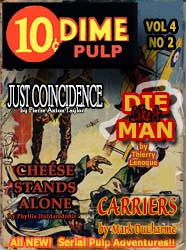
Die Like A Man, Thierry LaNoque’s debut serial novel,  is a meta noir of a man who gives a friend a ride only to be pulled in deeper and deeper into the events surrounding a brutal murder, the daughter of a prominent businessman, and attempts to cover it up and place the blame on someone else. Drugs and money are involved in this second installment featuring La Noque’s young hunky wannabe private eye, Ray Philips. As well, Mark DuCharme ties up all the loose ends to bring his dark, sometimes humorous, gothic serial, Carriers, to its finale. Lydia Cheése (pronounced “Chase”) continues her mission to fly an unauthorized dirigible to Djibouti in Phyllis Huldarsdottir’s round-the-world steampunk adventure,  Cheése Stands Alone.  Wayne Bruce survives his ordeal in the Southern Sahara and emerges as a new man with a new mission in Pierre Anton Taylor’s crimefighter drama, Just Coincidence.


carriers vanMark DuCharme’s Carriers and it’s gothic air of  shadowy creatures who might just be the living dead is a vampire novella with touches of black comedy and satirical bite, told from the perspective of its unreliable narrator and protagonist. Taking place during a “plague” that has been going on for two years in an unnamed city, dead bodies litter the streets, hallways, and homes. A corpse disposal company hires people to transport them to a facility at the edge of town with the very important stipulation that the bodies be delivered there before sundown. No one ever says why. Read the final installment of  Carriers, Episodes XIII .


chase blurbFIPhyllis Huldarsdottir’s Cheése Stands Alone, the continuing adventures of Airship Commander Lydia Cheése (pronounced “Chase”) in the search for her anti-Clockwork Commonwealth renegade father, Commodore Jack, with the help Doctor Professor Jean-Pierre Serre-Pain, proprietor the Madame Ophelia’s Ophidiarium, a traveling snake show, and his associates, former circus strongman, Vlady, and Serpina, the snake girl. On the run from IOTA (the Investigative Office of The Admiralty), she has narrowly escapes capture by her nemesis, Chief Inspector Karla Kola, in Oldest Orleans, and now with the help of a young wannabe airship pilot, Pyare, must traverse the Central Massif to rendezvous with Serre-Pain and the dirigible that will take them on a mercy mission to HOAR (the Horn Of Africa Republics), base for the anti-Commonwealth ICERS. Read more of Cheése Stands Alone in Episode XIV.


JCblurb1fiPierre Anton Taylor’s dark crimefighting serial, Just Coincidence is about a privileged young man with the unremarkable name of Wayne Bruce who returns to the site where his father once had his business, a battery manufacturing plant, and where he often spent his childhood days hanging around the factory and the neighborhood. His return is haunted by the mysterious circumstances surrounding his father’s death and the vague feeling that his uncle is somehow involved. Appalled by the poverty and crime of the place he remembers fondly, he is moved to resolve the injustice of the socially marginalized and to wreak vengeance on those he believes are responsible for the death of his father.  The backstory to his emergence as a crimefighter is revealed in Just Coincidence, Act Three, Scene I, Part 1


DLAM5

Die Like A Man, a brand new serial novel by Thierry La Noque, is a meta noir of a man who gives a friend a ride only to be pulled in deeper and deeper into the events surrounding the brutal murder of the daughter of a prominent businessman and the attempts to cover it up and place the blame on someone else. Ray Philips, a martial arts instructor, sometime event security, and bouncer working toward getting his private investigator’s license in a world where the private eye is quickly becoming an anachronism, is hired to find a missing husband, the famous crime novelist and infamous drunk, Stan Giordino by his petite pierced drug addicted wife, Stella. A stolen cache of drugs and money only complicates and implicates the wannabe detective, and puts him over his head and his life in danger. Not to mention that his girlfriend, Cissy, is dying of cancer.  Die Like A Man 3&4


FYI: Available for readers of Dime Pulp who may have missed a few issues or lost the thread of a serial,  Dime Pulp Yearbook 21, featuring the novels (The Last Resort and Better Than Dead) and the short fiction (Hard Boiled Myth and Gone Missing) of Volume One’s 12 issues, is joined by Dime Pulp Yearbook 22, featuring the complete pulp Western, On The Road To Las Cruces, continuing episodes of  a detective story, Better Than Dead, the opening chapters of new serial novels, Just Coincidence and Cheése Stands Alone, the short fiction of Hard Boiled Myth and Polka Dot Dress, as well as Dropping A Dime’s pithy pulp observations.  Volume Two’s 10 issues are available for perusal in their entirety simply by clicking on the links in this paragraph or on the menu bar above. Dime Pulp Yearbook 23 is now available featuring a full year’s worth of Just Coincidence and Cheése Stands Alone, and the complete Better Than Dead novel, as well as the early chapters of Mark Ducharme’s gothic serial, Carriers.

If you’ve made it this far, click  on the links above to read the entertaining  serial contents of Volume 4, Number3!

 —Perry O’Dickle, chief scribe
and word accountant


Carriers XIII

by Mark DuCharme

xiii

I had been rapping steadily at Mrs. Dittleboffer’s door— since she is the concierge, of course, her quarters are on the main floor, proximal to the central building’s entrance— for what seemed a quarter hour, but in reality was probably closer to three or four minutes.  I had heard no footsteps approaching, so I was surprised when the sound of the bolt turning became audible, and then the door creaked open.

Old Mrs. D’s languid, sagging face emerged from the shadows.  When I spoke, I was wary to keep my voice low, lest that busybody, Mrs. Plunket, be listening stealthily, just behind her door.

“Mrs. Dittleboffer, how are you,” I beamed, with no possible hint of insincerity.  “I’m so sorry to trouble you at this odd hour.  I wonder, though, if you can help me with something.  Is there any way to get into that door at the end of the third-floor alcove?  I wonder if you might have the key.  I’ve heard some strange noises that seem to be coming from there these last few nights.  It would sure help my peace of mind if I could just peek behind that door and assure myself that there’s no mischief there.”  I smiled.  I could be such a charming bastard, when I put my mind to it.

She looked at me as if I had just thrown sand in her face.  “No, there ain’t no key to that door.  I ain’t never seen one.  No key.  That tower deserted,” she said, in her version of English, and practically slammed the door in my face.

Well, that hadn’t gone quite as I’d expected.  But one should never give up hope.

I guessed that the only option now was Ana.  I really had not wanted to resort to that.  But what was I to do, short of abandoning Old Gruber’s plea altogether?  And if I were in danger, wouldn’t it be better to face it head-on, rather than live in passive dread of it walking through my door at some godforsaken hour?  No, I wasn’t going to live like that.  I resolved that I had to get in that tower, even if I had to resort to asking for Ana’s help.

Well, it was kind of silly.  I mean, what did I really think I would find in that dusty old tower?  I had no idea, actually.  Yet, I couldn’t shake that feeling of unease, that feeling of not knowing what was behind that old door, and whether there really was danger there.  And I really thought it might bring me some relief, if only I might just peer inside and assuage my darkest anxieties.

The phone rang three times, then went to voicemail.  “This is Ana.  Leave a message.”  Beep.

“Hi, Ana.  It’s Johnny.  Hey, listen— you said you might be able to help me get into that tower, so I thought—”  Suddenly, I couldn’t find the words to complete that sentence.  Suddenly, a cold fear overtook me.  This wasn’t like me.  I’m always calm, aloof and rational.  Suddenly, I felt overwhelmed.  I hung up the phone, to my own surprise.  I was even more surprised at what happened next.

“Johnny.”  It was Ana’s voice, just outside my apartment door.  The phone hadn’t even been down for a cold minute.

“What is it?”  I was tired, disappointed, cold, and scared.

“May I come in?”

“Sure.  I’ll unlock it for ya in just a—”

The door moved, seemingly of its own will.  The odd thing was that I was certain I had locked it.  All that thinking about picking locks and calling cards on my pillow had somehow reinforced my resolve to keep locked my own entrance.

It moved, I say, seemingly of its own will, and behind it Ana stood, stark upright and pale— as pale as moonlight.

She didn’t ask, this time— for I guess she had already.  Her heels clicked across the threshold.

“What can I help you with, Johnny?”  Her uncharacteristic demureness belied my growing dread.

“Ana— Analeise— you said you could get me into that tower.”  I was almost stuttering, for in truth, now I was truly afraid.

“Sure, I can, Johnny,” she replied, smiling a warm smile and stepping closer, as if we were intimates, or might soon become such.

Already, I was having second thoughts.  “What’s beyond that door?”

“You don’t have to worry about that, Johnny.  You just leave that to me.”  She smiled again.  I knew she was lying.  Oh hell, why hadn’t I ignored crazy Old Gruber’s dying testament?  Yet why had I ignored his admonition that his own daughter was dangerous?  I could feel it now— and now I was truly scared.  For her part, Ana just smiled that sweet, voluptuous smile that lets you know all bets are off.

“Come.  I’ll get you into the tower.”  She took my hand.  Her flesh was surprisingly cold.  We walked, and as we did, I could feel my own resistance to her grow suddenly numb, as if I had no will of my own left to take my hand away and back out of the bargain.

When we got to that ancient doorway, to my shock and growing dread, it yielded to her, and flung itself open at her approach, though gently and with malicious ease.  There is no other way to describe it.  She held my warm hand in her cold, clammy one the whole time.  I don’t even think she looked at the door.  She just knew that it would yield to her.

Behind it, from what I could see in the dimness, was a dusty corridor that led several feet to a lengthy spiral stairwell leading up to god-knows-what.  She didn’t pause; she was evidently quite familiar with the passage.  My hand was held in hers the whole time.  Her heel clicked on the first step, and the thud of my own shoe followed.  The door, as if by some preternatural force, swung closed behind us, as easily as it had yielded to her approach.  She never looked at me the whole time.

Up that winding staircase we walked.  Can I tell you what growing dread I felt?

Oh, why had I even for a moment trusted her?

We reached the floor she wanted, and made our way toward dim candlelight.  Though the illumination was welcome, I quickly realized it was evidence that someone did live inside this odd, post-medieval, circular structure.  My terror quickened.

At last, we arrived at a chamber from which I saw further candles’ illumination.  Once more, it was clear that she knew where she was going, and she led me— I knew not for what purpose.

I followed her lead— for at this point, what else could I have done?  I could not have broken free of her if I’d tried.  As she drew open the chamber door, it creaked a little.  Behind it was a windowless room brightly lit by candles.  There must have been at least a half dozen.  And in all that relative warmth, we encountered there a man— close to six feet tall, I’d wager, and middle-aged, from the looks of him, slender though not slight of build.  He looked as if he were well off.  Dressed in black from head to foot, his clothes were not just fashionable, but all the rage.

His gaze met mine, and then he smiled.  Though his complexion was most pallid, his lips were red– almost as red as Ana’s lipstick.

“Mr. Pinklund, I gather,” he said in a deep voice that tried to seem cordial.

“Yeah, that’s me.”

“So good to meet you at last.”

“Why do you want to meet me?”

“I might ask the same question of you.”

He looked at me knowingly, smiling an indulgent but faintly mocking smile.  “But let me introduce myself.  I am Artemas Thorne.”

“I hear you own this building.”

“I own a lot of properties.  It has proven—” he paused— “useful for my purposes.”

“Which are?”

“Always trying to get to the point, you vivants.  As if a wasted moment could cost you an eternity.”  He had been speaking almost to himself, yet suddenly regained his politesse.  “Won’t you sit down, young gentleman,” the host purred suavely.

In addition to the candles, there was an antique-looking couch and two antique-looking chairs, plus some minimal bric-a-brac, which also didn’t look like it had been brought home from the store any time recently.  I reclined on one of the chairs, he on the couch, while Ana, who hadn’t really joined our party, stood to the side, looking away, near the door that she had led me through.  Although there was a seat for her, she didn’t take it, nor did Thorne invite her.

“You no doubt have heard tall tales from my departed tenant.”

“Yeah, but I don’t know what to believe.”

“Your own eyes and senses will lead you to the truth.”

“Which is?”

He laughed to himself.  “You are remarkably impatient, even for one of your kind.”  I had started to notice his accent; he sounded kind of British and kind of American at the same time, but in a funny way, for he talked like no Brit or native of these shores that I had ever encountered.  It was— quaint, as if he came from a different time altogether.

“Then indulge my impatience just one more moment, sir.”

He paused.  “It’s not just the properties, so much, though there have been times when having a variety of potential”— he paused again— “residences has been most helpful.  But more helpful still has been the money, and the power it accords one.  The earthly power, of course.”

I wasn’t sure where I wanted to go with this— or how I was going to manage to get out of this tower (for it had begun to dawn on me that this whole affair had been a very bad idea, and that, even if I wanted to kill this suave but, I sensed, dangerous host, I was quite unprepared to do so at that moment).  So I decided to keep up the open-ended questions, so long as he was responding cordially, and to bide my time until I could find an excuse to depart.

“Why is that?”

“Surely you understand, Mr. Pinklund, that those who hold wealth hold the ability to control their destinies.  And I now possess a very great deal of wealth, indeed.”  He resisted smirking, but couldn’t resist the triumphant glare his eyes exuded. “It has taken me quite a long time to accumulate— more time than you can even imagine; but I have succeeded, and so now I am welcomed (with certain precautions) in the gatherings of the elite, whether they be boardrooms or private meetings with government officials or even social fêtes— though, again, my welcome is always conditioned upon the usual superstitions.”

“And what exactly are those?”

“Oh, Mr. Pinklund, surely you are not such a naïf.  What can fate possibly do to cure you?”

“Tell the truth, possibly.”

“What more is there to say?  I am sure that annoying old gossip told you all the tall tales of yore.  Tales of crucifixes and holy water, of graves unearthed at dawn most dramatically, of stakes and consecrated hosts and whatnot.  Such legends!  We are both modern men, Mr. Pinklund.  Surely, neither of us will be deceived by lurid, second-hand folklore.”

“I’m not sure what I believe yet, Mr. Thorne.”

“That is a pity.  For I’d hoped we could do business.  You see, since I arrived here long ago, and that old native shaman put this curse upon me (and yes, I made sure that he was the first to suffer from my new life— a new life in a New World, or so I called it then), I have learned that doing business is a great way to forge bonds with those whose source of sustenance, for want of a better term, may be very different from my own.  Indeed, I have forged many of what I consider real friendships with mortals, in this way.”

“But aren’t you, too, a mortal?”

He smiled with an almost sneering amusement.  “Oh, my dear Mr. Pinklund, haven’t you already guessed?”

“But why should they welcome you if they also fear you?”

“Because I am one of them, Mr. Pinklund!  No, they do not drink mortal blood, exactly; nor do they sleep in coffins by daylight.  But nevertheless, we understand each other.  We have much in common, actually.  That is the best way to put it.”

It was clear his patience was thinning.  “I will put it to you, sir, that I am offering the opportunity to join my organization— if you would call it that.  To be of service to me from time to time, mostly in trivial matters.  To assist in my enterprise.  But if we cannot do the business I would prefer, sir, we shall engage in another sort of— transaction.  Well, what will it be?”  His eyes were most serious and menacing, yet it was entirely impossible— by what ungodly force, I could not guess— to retract my gaze from his.  I was dumbfounded, and had no idea what to say, a silence he must have interpreted as a rebuff.  “Ana,” he summoned sternly.

She turned, finally, and approached with eyes downcast.  She truly seemed sad and remorseful, and this shocked me momentarily, for I hadn’t imagined her character contained that potential.

“It’s not often,” she explained, “that youthful rebellion marks you for life, and even after death.”  Our eyes met, and I detected regret there too.

“Ana, don’t you understand?  You’ll be undoing everything your father worked and struggled for!”  I was surprised at my sudden interjection.  It was a desperate plea, but I felt desperate.

She met my gaze again.  “I’d like to help you, Johnny.  And I would have liked to help my father more.  But I’m not one of the living now.  And his power”— she glanced toward Thorne contemptuously— “is so much greater than my own.”  With that, she turned her head and walked away, slow heels clicking.

Thorne laughed his cold laugh that came too easily.  “Excellent work, Analeise, excellent!  For this, you shall be rewarded.”

“Fuck you and your rewards,” she snapped back coldly, still looking away.

“Then only I shall indulge in this feast?”  His grin widened, and I could smell his rank breath unforgettably.  She did not answer, and he didn’t seem to want her to.

He moved toward me instead, and the very air seemed to bear him forward.  All his politesse was gone now; the look in his eyes and his whole demeanor was suddenly a mountain lion’s, at the end of the chase, when the prey has lost all energy to flee.  That look of triumph.

I heard gibberish and rustling when the cold snapped at her feet.  An evil leer overtook his reddened eyes.

That is the last thing on earth I remember.

O help me, Lord!

101

But what am I saying?  I am still on earth!  I have never left!  It’s never been better here!  I walk every night, after the sun dies, as we all must, once, before tasting reality.

Things look more beautiful before dawn.  It’s hard to explain.  There’s just something about the absence of sunlight.  I mean the blues are too vivid; I mean that there are colors one only fully sees in the absence of direct light.

Thorne still lives and rules this land, an immortal baron over a helpless fiefdom.

As for Ana, she chose shortly after that night to take her own life, walking directly into streaming, mid-morning sunlight.  It is said that she vomited blood, but I didn’t witness.  I couldn’t have, you see.

The events described here occurred roughly 139 years ago this month, if I count the phases of the moon correctly.  That was the night of my awakening.  Since then, I haven’t been a transporter at all, but have been sort of promoted, in a funny way.  You see, I’m now one of those, like sharks, who saunter down uneasy thoroughfares at night.  You might even say, if you wanted to make a bad joke, that it is I who have now been transported.

But in truth, if you see me walking about the avenues at night, there’s an excellent chance it will be you who joins the ranks the transported.  I guess I’m still working for the Company, after all.   But aren’t all of us, in our own strange ways?


das Ende

Contents Vol. 4 No. 2

Welcome to Volume Four, Number Two of Dime Pulp,
A Serial Pulp Fiction Magazine

Dime Pulp debuts a new serial novel, Die Like A Man, by Thierry La Noque, in Volume 4, Number 2. It is a meta noir story of a man who gives a friend a ride only to be pulled in deeper and deeper into the events surrounding a brutal murder of the daughter of a prominent businessman and the attempts to cover it up and place the blame on someone else. Drugs and money are involved in this initial outing of La Noque’s wannabe private eye, Ray Philips. As well, Mark DuCharme’s gothic Carriers is quickly approaching its denouement. Lydia Cheése (pronounced “Chase”) continues her mission to fly an unauthorized dirigible to Djibouti in Phyllis round the world steampunk adventure,  Cheése Stands Alone. And in Just Coincidence, Wayne Bruce survives his ordeal in the Southern Sahara and emerges as a new man in Pierre Anton Taylor’s crimefighter drama. 

carriers vanMark DuCharme’s Carriers and it’s gothic air of  shadowy creatures who might just be the living dead is a vampire novella with touches of black comedy and satirical bite,  told from the perspective of its unreliable narrator and protagonist. Taking place during a “plague” that has been going on for two years in an unnamed city, dead bodies litter the streets, hallways, and homes. A corpse disposal company hires people to transport them to a facility at the edge of town with the very important stipulation that the bodies be delivered there before sundown. No one ever says why. Read more in the latest installment of  Carriers, Episodes X-XII .

chase blurbFIPhyllis Huldarsdottir’s Cheése Stands Alone, the continuing adventures of Airship Commander Lydia Cheése (pronounced “Chase”) in the search for her anti-Clockwork Commonwealth renegade father, Commodore Jack, with the help Doctor Professor Jean-Pierre Serre-Pain, proprietor the Madame Ophelia’s Ophidiarium, a traveling snake show, and his associates, former circus strongman, Vlady, and Serpina, the snake girl. On the run from IOTA (the Investigative Office of The Admiralty), she has narrowly escapes capture by her nemesis, Chief Inspector Karla Kola, in Oldest Orleans, and now with the help of a young wannabe airship pilot, Pyare, must traverse the Central Massif to rendezvous with Serre-Pain and the dirigible that will take them on a mercy mission to HOAR (the Horn Of Africa Republics), base for the anti-Commonwealth ICERS. Read more of Cheése Stands Alone in Episode XIII.
JCblurb1fiPierre Anton Taylor’s dark crimefighting serial, Just Coincidence is about a privileged young man with the unremarkable name of Wayne Bruce who returns to the site where his father once had his business, a battery manufacturing plant, and where he often spent his childhood days hanging around the factory and the neighborhood. His return is haunted by the mysterious circumstances surrounding his father’s death and the vague feeling that his uncle is somehow involved. Appalled by the poverty and crime of the place he remembers fondly, he is moved to resolve the injustice of the socially marginalized and to wreak vengeance on those he believes are responsible for the death of his father.  The backstory to his emergence as a crimefighter is revealed in Just Coincidence, Interlude II
dlamfi1

Die Like A Man, a brand new serial novel by Thierry La Noque, is a meta noir story of a man who gives a friend a ride only to be pulled in deeper and deeper into the events surrounding the brutal murder of the daughter of a prominent businessman and the attempts to cover it up and place the blame on someone else. Ray Philips, a martial arts instructor, sometime event security, and bouncer working toward getting his private investigator’s license in a world where the private eye is quickly becoming an anachronism, is hired to find a missing husband, the famous crime novelist and infamous drunk, Stan Giordino by his petite pierced drug addicted wife, Stella. A stolen cache of drugs and money only complicates and implicates the wannabe detectives, and puts him over his head and his life in danger. Not to mention that his girlfriend, Cissy, is dying of cancer. The beginning to this meta noir begins here: Die Like A Man 1&2

FYI: Available for readers of Dime Pulp who may have missed a few issues or lost the thread of a serial,  Dime Pulp Yearbook 21, featuring the novels (The Last Resort and Better Than Dead) and the short fiction (Hard Boiled Myth and Gone Missing) of Volume One’s 12 issues,  is joined by Dime Pulp Yearbook 22, featuring the complete pulp Western, On The Road To Las Cruces, continuing episodes of  a detective story, Better Than Dead, the opening chapters of new serial novels, Just Coincidence and Cheése Stands Alone, the short fiction of Hard Boiled Myth and Polka Dot Dress, as well as Dropping A Dime’s pithy pulp observations.  Volume Two’s 10 issues are available for perusal in their entirety by simply clicking on the links in this paragraph or on the menu bar above. Dime Pulp Yearbook 23 will be available in early February ’24 as part of the annual archival review.

If you’ve made it this far, click  on the links above to read the entertaining  serial contents of Volume 4, Number 2!

 —Perry O’Dickle, chief scribe
and word accountant


Carriers X-XII

by Mark DuCharme

x

Needless to say, I did not sleep at all well the rest of that night.

I went through the duties of my job as best I could the next day. The handling of carriers, I must admit, now struck a definite note of trepidation in my blood. I could feel, or imagined I could feel, my cargo’s eyes on the back of my neck as I raced with waning caution toward the facility. It was unnerving, but I tried to steel myself to the horror. After all, breaking down wouldn’t have made things any better.

I couldn’t get Old Gruber’s letter— or the strange vision I had encountered— off my mind all that day. I honestly can’t say whether I believed him or not, but I sure didn’t think he was crazy anymore. Hell, maybe I was the crazy one! It was I, wasn’t it, who had had that vision— that hallucination! Who would believe me, if I tried to tell anyone? And what I saw was no less crazy than anything Gruber ever wrote or said. No, it wasn’t him. Maybe craziness was in the air, encompassing this whole city. Some days, it sure felt that way.

I decided that I had to know what was in that other packet. And I realized I hadn’t taken the same precaution with Gruber’s letter as on the previous day. In my sleepless grogginess, I had left it at home, sitting right on the table. That, I realized, had been a foolish mistake.

When I finally made it home, my cargo dropped off at last and the sun finally retreated, I immediately saw that the letter was still there, just as I’d left it, and the second packet remained unopened too. Suddenly, a new fear came over me: what did Gruber think that I could do about this Artemas Thorne— and would I be able to carry it out? Once again, I wished that I had told Ana that night to just go away.

Just as I was about to heat up some food and sit down to read the yet-unopened missive, I heard a rude knocking. I hastily gathered up all the papers and shoved them in the drawer of my nightstand. When I opened the door, it was Ana. A sheepish smile crossed her lips, again lipsticked deep red. Her eyes were wide and playful.

“May I come in?”

I remembered that she had asked that question the last time. It seemed innocent enough— but she didn’t. Nevertheless, despite my wish and her own father’s admonition, I found it hard to say no. If the admonition were true, her charm was certainly part of the danger.

“I guess,” I shrugged. “But I didn’t sleep well last night and plan to go to bed early, and I just got home and haven’t had dinner yet, so please make it quick.”  I was rather proud that I’d found the strength to qualify the acquiescence. She smiled less sheepishly and stepped across the threshold with a click of the heel.  Then she turned and announced, “I won’t be a minute.”

“What’s on your mind?”

“I wanted to thank you again for all your help. And I wanted to apologize, because I was kind of in shock at the time, and I’m sure I was rather rude.”

“No worries. It’s kind of hard finding a dead parent, and none of us gets much practice at it.”

“Has he been—?”

“Yes. His remains have been disposed of. I’m sure that’s what he would have wanted.”

She looked down. “Certainly.”  Then she looked up suddenly, and when she spoke her tone was frank. “Look, I don’t know what he told you in that letter, but I can make some educated guesses. It’s true that we had a falling out. I guess I’m not the daughter he hoped I’d be. But I can only be myself. That was his problem with me, if you want to know my side of the story. But I loved him”— she paused— “in my way. I’ll always love him.”

“Whatever there was between the two of you is none of my business,” I interjected, feeling too exhausted to get caught up in their family drama. “And you have nothing to apologize to me for,” I added, hoping to cut her visit short.

“Look, Johnny, the other reason I wanted to see you is about my father’s letter. Not about whatever he said about me, but about the other things he may have told you. I’m not quite as bad a girl as he thought I was. I know what he wants you to do. And I can help you get in the tower. You have my number. Call me if you want my help.”  She was making eye contact, and she looked more sincere than I could  have imagined her capable of being. I felt mortified.

Then she veered and sauntered toward the door, but before exiting, she turned back to face me. “I’m easiest to reach after dark,” was all she uttered. Swerving back round, she disappeared into the stairwell’s dim luminance.

carriers room

xi

“Dear Johnny,

“If you are reading this, something (and I don’t flatter myself that it was my first letter) has jolted you and made you less doubtful— or more fearful. I hope that you are reading this, and haven’t instead burned my writing, for in truth, what follows is the most important part of what I fear I must posthumously tell you.

“These undead persons maintain their lives by feasting on the blood of living beings— people like you and me, Johnny. The blood of the freshly dead will not do; it has to be a living person’s blood they drink. In this way, they both sustain themselves & add to their number— for any mortal person who is bitten by one of them is very likely to either perish or (unless properly disposed of) become like those who administered the wounds. In this way, the cult of the undead reproduces itself and, at least in our city, flourishes & reigns. You no doubt have seen the undead walking city streets at night. They never move in haste, but purposefully, watching the night for potential victims.  Just the sight of them sends chills through my blood. And to think that these creatures now essentially own at least our main city streets after the sun goes down!

“Ah yes, the sun. I should tell you more about the peculiarities of these beings. They are not people anymore, although, as I say, they once were. They are creatures now, predators with a predator’s instinct to take its prey. That is largely all they do, at least the newer ones. Those who have lived as long as Thorne and his unholy company— for I suspect that there are others in our city who may be closer in age to Thorne himself, and who have been working with him, though I have not yet proved this point with the certainty that I believe I have proved Thorne’s true identity— are more powerful. The older ones, generally, can tolerate a little sun, especially on overcast days, and ultimately can go a long while between victims. The newly undead, by contrast, must have fresh victims every two or three nights, at minimum, and are destroyed by direct exposure to sunlight. They are the ones with the gray complexion and yellowish eyes; after a time, that goes away– if they survive the first few months (and many do not). Then they begin to look more human, and that is when they start becoming really dangerous. All of them, even Thorne, must sleep while the sun shines. It is said that they must sleep in a coffin containing some soil from their native land, but I have not proven that point, nor indeed found much evidence for it. Thorne, for example, based on all contemporary accounts that I have found, probably wasn’t an undead when he took ship across the Atlantic, so it is beyond unlikely that he would have transported a casket of London soil on that voyage, and indeed there is no record of it. Therefore, I have come to believe that this folktale is pure fantasy. However, it is true that such an unnatural being must seek sleep outside the reaches of the sun, and for practical necessity, I think most prefer their coffins, as they allow more absolute protection from deadly sunlight than, say, a chamber with the blinds drawn.

“Another myth about these creatures is that they fear (or are destroyed by) religious icons, particularly the cross, Catholic holy water, or the host. There is no objective evidence for this fanciful belief.

“Certain other characteristics of these creatures sound like wild fancies, yet turn out to be empirically true. One example is the folktale that the undead cannot cross a threshold unless invited in. It turns out that there is some basis for that. I do not know why this would be, but nevertheless I have found enough evidence that I am convinced of it. This is Thorne’s advantage in being a landlord, you see, and why you and I are in such danger: he need not be invited into our quarters! He owns the building. It is we who are his guests!

“What I do believe is incontestably true about these creatures is that there are only two certain ways to destroy them (that we know of as I write, based on my and very few other scholars’ research): decapitating the bodies (some legends say that the mouth must first be stuffed with garlic or silver coins or the blood of a virgin dove, others that the sword itself must be silver, but again, I find little evidence for these fanciful folktales) or driving a wooden stake directly through the heart and clear through the body, into the very earth it rests in.  As to why these two methods are effective, sadly, not enough research has been done. Although the phenomenon of the unliving may go back centuries, so far much of the evidence is still only anecdotal. Unfortunately, it’s very hard to get funding for this sort of work and to get colleagues in disciplines like medicine, biology, history, anthropology, or religious studies to take it very seriously. But I’m digressing.

“Johnny, Thorne must be destroyed. It is our city’s only hope. The newly undead, as you know, can be disposed of with relative ease and at least reasonable safety for those doing that work. But Thorne is much more dangerous than they, not only because his unnatural powers are much greater, but because his property and wealth lend him a kind of prominence that puts him, in many respects, beyond reach. For example, did you know that he is on the board of directors of the company that employs you? And that’s not the only one! It is hard to fathom, when you fully realize what he is, but Thorne is extremely well connected among the rich and powerful in this city. As to whether they realize his true nature or are unaware of it, it is very hard to say. I suspect they do not want to know or are in denial of the truth. It is also possible that they are aware, but have decided that consorting with that Evil (for that is what Thorne is!) is good for “business.”  It is further possible that some, at least, are entirely ignorant of the truth. Whatever the reason or combination of reasons, it does not matter; the effect is the same. Thorne is not only supernaturally powerful, but has gained worldly power through his wealth and connections. This makes him all the more dangerous.

“You have one advantage Johnny (I write this hopeful that you will accept the undertaking upon which rests the only hope for our city and our very souls): you see, Thorne lives in this building, in that strange old tower, in fact. Have you ever noticed that there are no doors on its outside? That is by design, so that outsiders cannot gain entrance to his profane resting place. But you can gain entrance, Johnny— that is, if you can find the key to that old door in the darkened alcove on the opposite side of your flat from mine. The corridor on the other side of that door leads into the tower itself. If you can get past that door somehow— for it is always kept locked— you can destroy Thorne and his reign of terror in this city. I am convinced that you are the only one who can do this; not only are you young and strong, as I said, and not only are you used to dealing with these creatures, to some extent at least, but you live in proximity to his very resting place! If you cannot do it, all hope is lost!

“But I am trying not to despair, Johnny. I am hopeful and in fact resolute in my purpose— as you must be, dear friend!

“May God protect you!—

“Jim”

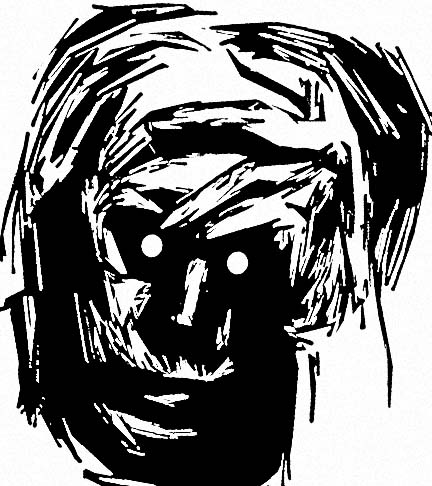
Self-portrait

xii

Gruber’s logic was inescapable, even if I still didn’t know how much of his tale I really believed. For if Thorne were even half as dangerous as Old Dead Gruber claimed, and if Ana were in the least bit dangerous herself, then how could I not be in any danger? And in that case, the only way to save myself must be to gain entry to that tower and do as he pleaded (though preferably without Ana’s help— for, though I was still undecided about how much I believed Gruber, and indeed I found it hard to consider Ana very dangerous, nevertheless, I was still certain that there was something untrustworthy about her). On the other hand, if I did gain entrance to the tower, perhaps I could disprove Gruber’s mad rantings as just that, and so regain my peace. Either way, I had to try. So I decided that the thing I had to do was find that key, without soliciting Ana’s help (if at all possible)— for I sensed a trap might be waiting.

The first thing to do was examine the door itself and its lock. Perhaps I would be able to pick that ancient mechanism or use my good strength (or that is to say, the strength Old Gruber thought I possessed— for in truth, I don’t see myself as particularly either youthful or strong) to somehow break through that dark barrier.

The door was situated at the dead end of the L-shaped hallway (mirroring the L-shape of Gruber’s former apartment) that, along with mine, constitutes the third floor of my building, or that is, the older, main part of it. That few feet of hallway is entirely unlit, in day or night, either by natural lighting or man-made. It is a dark corner one forgets is there. I have never seen anyone walk into it. (The small, dead-end alcove we are talking about consists, at most, of about four feet of space, culminating in the locked door.)

Although I was afraid of rousing the concierge’s suspicions, I could see no way other than to risk it. I hoped that her overall infirmity would lead her not to investigate any noise that I might make, if no guests complained. And since Gruber’s apartment was still empty— dealing with his papers and estate would be a rather daunting process, I gathered, and one that Ana seemed uniquely unsuited for— I had nothing to fear from the third-floor tenants, at least for the time being, because for now I was the only one.

I could see no sense in putting it off. Indeed, the sooner this whole matter was resolved, the better. Yet though I held no great hope of being able to either pick the lock or break through the portal, it was necessary to try, before I resorted to more desperate measures.

Out my door I walked, looking furtively down the stairwell at the angle by which I could see a part of the lobby below. No one was in sight. This was as good a chance as I was likely to get.

I had come prepared with a jumbo paperclip, which I promptly uncoiled. Surely, this was all I would need.

The lock was at least decades old, but perhaps as old as the main part of the building itself. I had no reason to think it had been used recently. Because of that, I wondered whether the lock as such was still functional— even if I’d possessed a key. I felt a little relief when I was able to easily insert the paperclip and, jiggling it about within, feel the pins inside clicking in response to the instrument’s thrusts. Nevertheless, within a few minutes, it became clear to me that, though I could indeed move the pins without trouble, I had no way of actually turning the lock simultaneously, and thus of gaining entrance. I tried inserting the tip of my own apartment key— not because I thought it would turn the lock by itself, but because I hoped that, alongside the paperclip, I might be able to insert it just enough to rotate the inner mechanism and thus unbolt the door, while simultaneously teasing the pins with the uncoiled clip. Sadly, the paperclip took up just enough room that even the tip of my key could not gain entrance. And the clip itself, as several minutes’ fumbling soon proved, was quite impotent alone to unbolt the portal. Finally, in frustration, I heaved my shoulder at the barrier. I know not what wood that door was carved of, but it was an impressively sturdy variety. Further, and most grimly, I noticed that the door was not latched to a plaster or drywall frame at all, but to a wooden one, evidently of the same quality as the door itself. As my shoulder started to grow more sore, with no evidence of gain for my labor, I began to suspect that the mortise was reinforced with some sort of metal at the point the bolt enters the frame.

“Hey! What’s all that racket up there?”

The voice wasn’t that of our frail concierge, but of Mrs. Plunkett, who occupied the largest quarters on the first floor, and indeed in the whole building and its appendages, at least those I had managed so far to investigate.

Turning from my struggle, I looked down and smiled, feigning nonchalance. “I’m so sorry, Mrs. Plunket. I seem to have locked myself out of my apartment, and I was just trying to get back in.”  My manner was so friendly and sweet that she could have hardly suspected a thing.

“Well, call a locksmith or something. This noise at night that you’re making has got to stop,” she retorted curtly, abruptly retreating back behind her door and swiftly slamming it shut.

Well, that was that. Breaking in to the tower had been an outright failure. Furthermore, I could not risk such an episode again, it was clear, or complaints might be made. And that would not do. You never know where such a thing might lead, the way people talk. No. Attempting to break in would not work at all. I must secure the key.

I had one other option, before my last and most desperate one.


Next Time: The Last Haul

Contents Vol. 4 No. 1

Welcome to Volume Four, Number One of Dime Pulp,
A Serial Pulp Fiction Magazine

van3The new year at Dime Pulp begins with the return of Carriers by Mark DuCharme and it’s gothic air of  shadowy creatures who might just be the living dead. Carriers is a vampire novella with touches of black comedy and satirical bite, and is told from the perspective of its unreliable narrator and protagonist, Johnny. It takes place during a “plague” that has been going on for two years in an unnamed city. Dead bodies litter the streets, hallways, and homes. A corpse disposal company hires people like Johnny to transport them to a facility at the edge of town with the very important stipulation that the bodies be delivered there before sundown. No one ever says why. Read more in the latest installment of  Carriers, Episodes VIII-IX .

Also returning to the start Volume 4 off on the right foot are Dime Pulp regular authors Pierre Anton Taylor and Phyllis Huldarsdottir  with Phyllis’s steampunk adventure,  and Perre’s crimefighter fiction, Just Coincidence.

lcnew2Phyllis Huldarsdottir returns  with Cheése Stands Alone, the continuing adventures of Airship Commander Lydia Cheése (pronounced “Chase”) in the search for her anti-Clockwork Commonwealth renegade father, Commodore Jack, with the help Doctor Professor Jean-Pierre Serre-Pain, proprietor the Madame Ophelia’s Ophidiarium, a traveling snake show, and his associates, former circus strongman, Vlady, and Serpina, the snake girl. On the run from IOTA (the Investigative Office of The Admiralty), she has narrowly escapes capture by her nemesis, Chief Inspector Karla Kola, in Oldest Orleans, and now with the help of a young wannabe airship pilot, Pyare, must traverse the Central Massif to rendezvous with Serre-Pain and the dirigible that will take them on a mercy mission to HOAR (the Horn Of Africa Republics), base for the anti-Commonwealth ICERS. Read more of Cheése Stands Alone in Episode XII.

Batman-Logo-121Pierre Anton Taylor’s dark crimefighting serial, Just Coincidence is about a privileged young man with the unremarkable name of Wayne Bruce who returns to the site where his father once had his business, a battery manufacturing plant, and where he often spent his childhood days hanging around the factory and the neighborhood. His return is haunted by the mysterious circumstances surrounding his father’s death and the vague feeling that his uncle is somehow involved. Appalled by the poverty and crime of the place he remembers fondly, he is moved to resolve the injustice of the socially marginalized and to wreak vengeance on those he believes are responsible for the death of his father.  The backstory to his emergence as a crimefighter is revealed in Just Coincidence, Interlude I

dime dropFIAlso returning for the 2024 inaugural issue is Dropping A Dime, the editor’s pithy commentary on pulp fiction, this time asking the vital question What Is It About Poets and Pulp? 

FYI: Available for readers of Dime Pulp who may have missed a few issues or lost the thread of a serial,  Dime Pulp Yearbook 21, featuring the novels (The Last Resort and Better Than Dead) and the short fiction (Hard Boiled Myth and Gone Missing) of Volume One’s 12 issues,  is joined by Dime Pulp Yearbook 22, featuring the complete pulp Western, On The Road To Las Cruces, continuing episodes of  a detective story, Better Than Dead, the opening chapters of new serial novels, Just Coincidence and Cheése Stands Alone, the short fiction of Hard Boiled Myth and Polka Dot Dress, as well as Dropping A Dime’s pithy pulp observations.  Volume Two’s 10 issues are available for perusal in their entirety by simply clicking on the links in this paragraph or on the menu bar above. Dime Pulp Yearbook 23 will be available in early February ’24 as part of the annual archival review.

If you’ve made it this far, click  on the links above to read the entertaining  serial contents of Volume 4, Number 1!

 —Perry O’Dickle, chief scribe
and word accountant


Carriers VIII-IX

by Mark DuCharme

-VIII-

“You’re late,” Waycross blurted, testily. He was the Interim Assistant Deputy Director of Transportation— that is, of transporters like me. I never met anyone higher up than Waycross. He felt it, too. He was like a petulant king.

I looked at my watch. I was about a quarter-hour late or so, I was surprised to learn.

“I’m sorry, sir, but I had a carrier incident while off-duty in the middle of the night, and I thought I should try to get the cargo to the facility directly, and thought I could do that and still make it back here on time, but I misjudged the time terribly. I’m so horribly sorry, sir.”

“Well,” he paused, “don’t let it happen again.”  Then he huffed away, just as testily as before, but perhaps a bit incensed at his own uncharacteristic show of relative mercy.

I noticed the New Man several feet away, looking stealthily toward me and observing— observing the whole time, with a most curious and furtive glee.

The New Man was sinister. I felt uneasy in his presence, and so tried to avoid him. There was something odd about him, the way he’d so suddenly replaced Hank, and the silence about it, the whispers, as if nothing had happened at all, as if Hank had never been. And the New Man always seemed to be turning up suddenly at the wrong time, looking about stealthily, behind one’s back, over one’s shoulder, as if he were studying you, as if he wanted to learn your private business, as if he wanted to learn to be you. I half suspected him of being a spy for management. Maybe, it now occurred to me, he was a spy for this Thorne.

I didn’t intend to let myself be late again, but neither could I make much sense of all that had recently occurred. Then I remembered the packet Gruber had left me. I reached into my coat and felt that it was still in my breast pocket. I suddenly became more curious about it. I mean, here was I, who had been fearing that old man— or rather, his remains— and I’d been carrying his final testament, of sorts, the whole time. And why me? I was just a neighbor. Sure, I’d drunk his brandy and listened to his ravings on occasion, but we weren’t close, or so I judged. Why would he have made a point of leaving this for my eyes alone? Why would he have told Ana about it, and why did she feel it was important (if she felt anything at all) that I should get it— especially in that very strange moment when we’d just burst in upon her old daddy’s death scene? What strange jumble of thoughts rambled through her mind at that time, out of which she determined that this was the one thing she wanted to be sure not to forget? It’s not like she remembered it a week later and slipped it under my apartment door; no, she made a point of giving it to me then. Something was mysterious about it, alright. Yet I had no time to look into it now; a full day’s work lay ahead of me.

Must I confess how my curiosity began to grow and fester over the course of that day’s labors, and how my lack of a full night’s sleep only seemed to compound my general state of confusion?

Finally, after endless hours, the sun began its slow descent, and I, after having deposited my cargo, began to make my way home also. I knew as soon as I got there that I would want to read Gruber’s packet. And so I hurried.

When I finally entered my apartment, the night now having fully descended upon the city, I tossed Gruber’s envelope upon the table and removed my coat. I was hungry, but even more so was I curious, so I grabbed a beer out of the refrigerator, stuck a frozen dinner in the microwave, and sat down with the packet that had captivated my thoughts for the better part of that strange day.

I ripped open the yellowed envelope and removed the sheets of folded paper and another sealed packet that had been inside the first. When I read the contents, it became clear to me that Gruber had thought more highly of our “friendship” than I myself.

Dear Johnny,
By the time you read this, I may be dead. That’s how things go in times like these. I’ll try to explain more about that later. Forgive me if I can’t explain it all. There are some things I am about to tell you that defy reason or virtue.
On the last night you came to visit, Johnny, I could sense your skepticism, so I didn’t want to go on about all this.  But nevertheless, I feel it’s important to tell you, because if I’m right, my life is in real danger, and yours is too.
I mentioned one Artemas Thorne that night. It didn’t seem like you’d heard of him. Nevertheless, he’s a very important man in this town. Some say, the most important. But I told you, or I tried to tell, that he is very, very dangerous. You must be on your guard!
Why he’s so dangerous will take some explaining. You probably already think me a little crazy, Johnny, but if you don’t, you surely will after you have finished reading what follows. I can assure you, though, that I am in full possession of my mental faculties, despite my age, even as I imagine that my assurance will not matter much to you, my dear friend. Nevertheless, because your own soul is at stake, as well as mine, I must try at least to convince you, however quixotic that labor may prove.

Johnny, strange things are going on in this city— strange and wicked things. Why do you think that all those bodies have to be brought to the abandoned warehouse before dusk?  What is it your employers are afraid of? Have you ever thought about that?
Johnny— you’re smarter than you pretend to be, but if I can speak frankly, my friend, your problem is that you’re incurious.
Johnny, have you ever heard about the dead returning to life? I don’t mean to life exactly, but to some pale semblance of it. When this happens, some call those returned— those whom I believe you call “carriers”— the undead.
Johnny, please bear with me. I am not as feeble-minded as I think you think I am. I am not feeble-minded at all, in fact. But when I say this, I know you will not believe me.
Nevertheless, I persist, because you are my last hope. My daughter is lost to me. I know few people young enough, strong enough, to carry on this fight. You are both young and strong, Johnny, and if you will but believe, I know that you can see this through— and do what must be done.
You have received the calling card, by now, of Artemas Thorne, I trust. No, it’s not I who put it there! I understand your skeptical nature, Johnny— in many ways, I am a skeptic myself, as I’ve tried to stress to you, though it seems to have fallen on deaf ears.  In any case, perhaps by the time you read this, you might be a bit more curious about him than when we last spoke.
I am a historian by training, if not by profession, as you well know. I have done a fair amount of historical research in my time. I have looked into this Artemas Thorne— for reasons that may become clear to you, but which for now it is difficult to fully explain. In any event, there is no record of a person of that name, man or woman (for in fact, it could be either) ever being born on this continent. And I’ve scoured all the data. I find that rather curious.
The other curious thing is that the only record— again, on this continent— of a person by that name, in any variant spelling, is of a colonist who arrived here on one of the early ships. A birth record has been found for that Artemas Thorne near London, but no death record for that person, born in 1596, has been located. Very strange.
Johnny, I am convinced that the Artemas Thorne who lives here and now and the Artemas Thorne born in 1596 are one and the same! He is one of the undead, Johnny— in fact, he is their leader, of sorts. If I am right about this— and I am almost certain that I am— then it is he who brought this plague upon our city. He is a very wicked man— or should I say, creature?
You’ll want proof. I can offer none, at least until catastrophe strikes. But if you ever wake up in the middle of the night, full of restless dreams, do not look out your south-facing window if you lack courage.
My hope and purpose in writing posthumously (should my guess prove correct, and my daughter, in that event, keep her word) is that you be awakened to this danger and act swiftly, as one should.

Most sincerely,
Augustus Aloysius Gustave “Jim” Gruber

PS: I am enclosing a second sealed letter in this first. I ask that you not read it unless and until you become convinced that I am right. This second letter will instruct you on what to do to rid this city of its plague and of the demon who brought it upon us.
PPS: One more thing, Johnny. My daughter Analeise may call upon you some evening, if she already hasn’t. Don’t let her see this letter or the enclosed one! If I’m right about all of these things, Johnny, she is dangerous too.

I was most perplexed by this strange missive. On the one hand, Gruber here sounds madder than ever before; on the other, he makes a strange sort of sense.

I grew upset. The events of the last few days had cast an unmistakable pall over things. It seemed as if I’d been drawn into some chain of circumstance that led I knew not where, and over which I had no control. I didn’t know what to do or think. I began to wish that I’d told Ana to go the hell away and gone back to sleep. I began to wish that I hadn’t knocked on Gruber’s door that night. O, what to believe?

I finished my meal, then drank another beer, then another. I went to bed at the usual time, but slept fitfully. I would have gladly settled for troubled dreams.

Bild 138

-IV-

I couldn’t very easily get to sleep, and when I did it was only a feeble approximation of rejuvenating repose. I did wake fully, though, around midnight. Old Gruber’s letter had haunted me, chasing back innocence’s rest. But when I glanced up at the clock and saw that it was only 11:58 P.M., I felt despair. And then, those words of Gruber’s came back to me: if you ever wake up in the middle of the night, full of restless dreams, do not look out your south-facing window if you lack courage. Gruber had been crazy, but he could be right about some things. My apartment does have a south-facing window, for example. But what could I see from there, and why would it require courage? The main thing visible from there is that old tower.

I have remarked earlier in my tale upon the unusual construction of the building in which my quarters are located— how the edifice is essentially an old Victorian house that has been added on to over the many decades hence. This is so, and the newer appendages are sometimes odd and ill-suited to the original components of the structure.

Nowhere is this more evident than in the tower. It is probably at least five or six stories in height— easily the tallest edifice for blocks around. It is constructed of mortared stones. It looks rather more like a European structure than one erected on this continent. In truth, it resembles a medieval tower more than anything post-Victorian, and so it fits right in with the odd hodgepodge of architectural styles that is the hallmark of the assemblage I call home. There are windows in that tower (fairly narrow), but there is no door at all outside its circular structure. It is said that an old door that no one ever uses— one that, coincidentally, is to be found just to the left as I exit my quarters and approach the main stairwell— actually leads to a hallway which, in turn, leads into that tower. But as I’ve said, that doorway is never used. It doesn’t seem that anyone has the key. And I have never seen lights in the tower’s somewhat narrow rectangular windows. In truth, I think that no one lives there, nor has anyone for at least as long as I have occupied my quarters.

The more I thought about it, the less sense Gruber’s statement made. You see, if I look out that window at night— or in day, for that matter— just about the only thing I can see is that tower. Now why should that be so frightening?

Here, I suddenly thought to myself, here was a chance to prove Old Gruber the benign lunatic I always took him to be. I got out of bed at once and went to that window. Surely, I would need no courage, because surely all that would be visible would be that old, abandoned tower, the darkness that engulfed it, and perhaps some faint lights down the street. This was brilliant, I thought. Surely all this vague, uneasy feeling would be resolved at once, and I would turn and go right back to bed, and sleep there like a babe in comfort.

I should not need to tell you with what chagrin I had to admit to myself that Old Gruber knew exactly what he had been talking about. For there it was, out my window facing south, that stone phallic structure. And out of one of its narrow, rectangular windows, I saw emerge to my growing horror the figure of a man. Yes, it was unmistakable. But this man did not leap to his doom, nor make some plea to the unheeding night; no. This man, instead, emerged from that window and crawled— yes, that is the right word— he crawled down the side of that building, quite like a spider. He had dark hair and was slender, but not slight, of build. He was clad all in black or dark gray— I could not tell the difference by cloudy moonlight— and his long overcoat paid no more respect to the law of gravity than his body did. When this downward-crawling human arachnid arrived at the narrow window directly below the one he had emerged from, he entered abruptly, and with an insect-like and most inhuman agility. Then— and this is the strangest part— I could see him stand up in the lower chamber he had so unnaturally entered, and turn and face me suddenly— yes, me! He was clearly aware that I had been watching him, and even in the dim moonlight, I could yet detect a malevolent smile curl his lips.

I rushed from my window in horror. Had this all been a dream? No, it couldn’t have been! I was nowhere near a state of sleep conducive to dreams, much less any state of sleep. I was wide awake, yet what I saw struck mortal terror in me in a way no nightmare ever had, even as a little boy. No, this was all too real! And this thing— this spider-creature— was now aware of me, if he hadn’t been before. My blood chilled as I reflected on this new and dreadful development.


Next Time: The Letter Inside The Letter

Contents Vol. 3 No. 8

Welcome to Volume Three, Number Eight of Dime Pulp,
A Serial Pulp Fiction Magazine

CARRIERSfi2Carriers by Mark DuCharme returns with it’s gothic air of  shadowy creatures who might just be the living dead. Carriers is a vampire novella with touches of black comedy and satirical bite, and is told from the perspective of its unreliable narrator and protagonist, Johnny. It takes place during a “plague” that has been going on for two years in an unnamed city. Dead bodies litter the streets, hallways, and homes. A corpse disposal company hires people like Johnny to transport them to a facility at the edge of town with the very important stipulation that the bodies be delivered there before sundown. No one ever says why. Read more in the latest installment of  Carriers, Episodes V-VII .
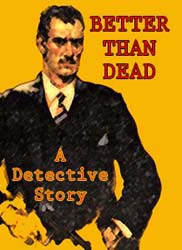
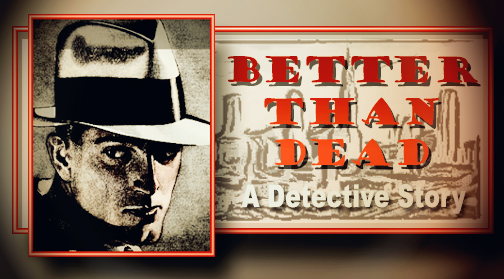
btdv2n10fiIssue 8 brings to a close Colin Deerwood’s long running serial, Better Than Dead, A Detective Story, featuring the unpredictable peregrinations of private investigator Lackland Ask, aka Stan Gardner, aka Sam Carter, and now Dr. Jerome Paulsen, O.D. leaving on a freighter for Cuba one step ahead of the law, the mob, and the draft board. All the loose ends (and there were many) are tied up or disposed of (are they?), and now the fugitive confidential agent can exit stage left. Find out how the story ends in Better Than Dead, Episode 30.  (A note from the author reminds us that the cover of this issue is from an original Black Mask magazine, c. 1940, and as such was the catalyst and inspiration for the more than 150 pages of serial crime fiction that followed. )

doncoyoteThis issue also introduces a new private eye, Don Coyote,  brain child of Mike Servante, a newbie to the musty (and labyrinthine) halls of serial crime fiction although an aficionado of the genre, in a metatextual story that promises to be a lot of fun, titled The Man From La Mirada Perdida, A Don Coyote & Saundra Pansy Adventure. Read  inaugural episodes i & ii in this latest offering of imaginative crime fiction from Dime Pulp.

Dime Pulp regular authors Pierre Anton Taylor and Phyllis Huldarsdottir were unfortunately caught up in the  seasonal vortices that often cause time displacement, especially as the days get shorter,  and the imprudent certainty that there is still plenty of time to get everything done.  Phyllis’s steampunk adventure, Cheése Stands Alone, will return in Vol. 4, Number 1 in early 2024, as will Pierre’s crimefighter fiction, Just Coincidence.

FYI: Available for readers of Dime Pulp who may have missed a few issues or lost the thread of a serial,  Dime Pulp Yearbook 21, featuring the novels (The Last Resort and Better Than Dead) and the short fiction (Hard Boiled Myth and Gone Missing) of Volume One’s 12 issues,  is joined by Dime Pulp Yearbook 22, featuring the complete pulp Western, On The Road To Las Cruces, continuing episodes of  a detective story, Better Than Dead, the opening chapters of new serial novels, Just Coincidence and Cheése Stands Alone, the short fiction of Hard Boiled Myth and Polka Dot Dress, as well as Dropping A Dime’s pithy pulp observations.  Volume Two’s 10 issues are available for perusal in their entirety by simply clicking on the links in this paragraph or on the menu bar above. Dime Pulp Yearbook 23 will be available in late January ’24 as part of the annual archival review.

If you’ve made it this far, click  on the links above to read the entertaining  serial contents of Volume Three, Number 8

Special Note: Dime Pulp, A Serial Pulp Fiction Magazine has changed its posting schedule from  monthly issues to once every forty-five days (more or less—mostly more). Thus Volume Three will (hopefully) consist of eight issues (much to the relief of the overworked writers and production staff). Thank you for your understanding.

 —Perry O’Dickle, chief scribe
and word accountant


Carriers V-VII

by Mark DuCharme

-v-

In truth it wasn’t the door I finally broke through, but the plastered drywall frame it had been latched to. When I managed to accomplish that feat— and not without some terrible cost to my bones— I remember her laughing. This struck me as odd, for the sight we found within those L-shaped quarters was hardly amusing. Her own father— for that is what she called him— Gruber, that crazy old goat— lay there with a great red stream trickling from his neck. He was obviously, incontestably dead— had died by most horrid means— yet it was quite unimaginable what beast, either human or animal, might have entered his chamber and delivered the wound. (Still more unimaginable, I had heard nothing of what must have been a terrible struggle, given the condition of the scene, with books and papers strewn about, though our adjoining apartments were only separated by a thin layer of drywall, through which I used to routinely hear even Gruber’s faintest mumblings.)

I remembered what Dr. Greenway had said. I looked closer at the departed— and yes, there were two wounds indeed, two small wounds, somewhat close, and exactly at the site of the jugular, just as the good doctor had described. In addition, I now noticed, from that closer vantage, the somewhat gray complexion of the skin and the increasingly jaundiced look in the eyes. No, this was no work of a beast as we know it, nor an intruder; Gruber, that strange, crazy old man, had clearly fallen victim to the plague. Well, that, at least, explained why I had heard no struggle: presumably, there had been none. And then it hit me: he had to be taken to the facility, and sooner than later! Gruber was now what my bosses would call a carrier. And even if I were off-duty, you see, I simply couldn’t let a carrier sleep— to go on sleeping. I had to get him to the facility as fast as I could.

His daughter— or the creature claiming to be such— seemed to feel less urgently or sadly about all of this than me. It’s not that she exulted; rather, a blankness overtook her affect, out of which she seemed lost to herself, benumbed. Perhaps the shock of loss had overwhelmed her; I suspected as much, but could not judge with certainty, having only just met her— yet she suddenly seemed not in this world at all, but in another.

“Can you help me get him down to my truck?”  My question seemed to jar her. She stared into space a moment, then regained herself.

“Sure,” she nodded, half smiling. I had him by the armpits. She was about to grab his feet, but then blinked in awareness, veered, and made her way to the great, old, wooden desk where Gruber kept his ravings— the ones in written form, at least.

“Here, this is for you,” she said, handing me an envelope on which “Johnny” had been scrawled in idiotic hand. “He told me he wanted you to have it.”

I attempted to stuff it in my back pocket, but suddenly realized I was still attired in plaid, woolen pajamas. “Excuse me,” I said, looking down in embarrassment, then set the body back down and went straight back to my quarters. Once there, I hastily threw on yesterday’s pants, shirt and socks, in addition to my winter coat, a trench resembling military wear of several bygone eras ago. I tossed the envelope upon the small table that serves all my nutritional, social (when I have visitors) and business needs, but then thought better of it: this Mr. Thorne, or one of his agents, might well intrude again while I’m away, and though I doubted the envelope contained more than ravings, if only out of respect for the dead, I thought it best to keep it out of that Thorne’s reach. I stuffed it hastily into the inside pocket of my overcoat.

“What’s your name,” I inquired, on returning. I thought it best to have a way to contact her— just in case.

“Analeise. Analeise Gruber. You can call me Ana.”  A smile broke upon her pallid face, and her brown eyes suddenly, briefly, regained their luster.

“That doesn’t matter now,” I retorted, striving to keep this all on strictly business terms.  “Give me your card.”

I had no reason to expect that she would have one, but she produced a rectangular, off-white piece of stiff cardstock from her small, decorative, gold lamé handbag. It wasn’t until the next day that I noticed it was the same thick, off-white stock with the same dark, almost blood-red font as the card that Thorne, or someone in his employment, had deposited on my pillow.

We carried the body down the dilapidated, crooked flights of stairs. She was surprisingly much stronger than she looked.

forrest_german_expressionism

-vi-

Although I did briefly consider taking Old Gruber straight to the arena, I judged that there would be enough time to take him directly to the facility before going to pick up my cargo. And besides, what else was there to do now? I wasn’t going to be able to get back to sleep, and even if I could, I wouldn’t be able to sleep for long. Besides, it was still dark. Sunup wouldn’t happen for a good hour. I considered waiting till the sun’s first rays, but the problem with that idea was twofold: if I did that, I’d never be able to get to the arena in time, and I was afraid of what might happen if I left Gruber alone before dawn. Oh, I’ve heard stories! You see, it seems that carriers sometimes can wake up. I don’t know much about it (or I didn’t then), but I knew enough to know that I didn’t want him left unattended in the event that did happen. Uneasy as I felt about the idea of driving him in the dark to the facility, I was more afraid of the alternative. So I went back upstairs, grabbed some food to eat in my cab, and I was off, down crooked streets.

Yet all that time, I felt that strange old fool’s dead, yellow eyes staring at me, hauntingly, in the rearview, neither quite alive nor entirely dead. Must I tell you how I feared him?

His eyes were cold, dead, now fully yellow— most devoid of expression. That blank, almost idiotic twist  of his mouth— one achieved only through his death throes— threatened to break suddenly into a smile, a most wicked and evil grin. I watched for it, almost as carefully as I watched the twisted roads ahead of my careening vehicle— but I swear it never occurred.

I was racing down Pico Avenue— I mean really racing! Dawn was fast approaching. I could see better now, in the new, bluish half-light. I put my boot to the pedal and zoomed past trouble— for what had I, exactly, to fear? Wasn’t I a Transporter, an official agent of the Company? Who was anyone to interrupt my racing? Even the police didn’t care!

I was delirious with excitement and relief. The slowly awakening sun seemed to mark the end of my fears about Old Gruber, at least for the time being. I was getting close to the facility, when suddenly I turned a corner and caught a flash of rosy, post-dawn light in the rearview as I passed the towering hulk of an abandoned, formerly auspicious office structure. For all I knew, carriers were having their way in there at that very moment.

I turned another corner and at last could see the facility looming ahead in the distance.

10

-vii-

When I arrived, there was no one there, no dockworkers, no flatbeds on which to dump the remains. Now that the sun was almost fully up, I felt a little safer— and that was good, for it suddenly occurred to me that I would have to carry the old man in— and I had no idea whether the building would be open or not! Suddenly, the colossal mistake of my hasty decision fully dawned on me. For all I knew, I wouldn’t be able to leave him there at all— would have to transport him, in fact, back to the arena, to pick up my other cargo, only to race back here again before the pink sun sank.

I looked back through the tiny window separating the driver’s cab from the carriage proper. I could see no change in Gruber: same yellow eyes, same gray complexion (perhaps just a shade grayer now), same twisted half-smile. Perhaps my fears had been unfounded after all, I exulted to myself, in the eerie, bright light of new-day.

I steeled myself and exited the cab, swerved round, and unlocked the rear door of the transport. He didn’t move at all. Whatever had I been thinking?

I entered, situated my arms about his (I could tell) stiffening corpse, and lifted him up, as one would lift a new bride, and carried him out of the carriage, making my way toward the narrow flight of stairs leading up to the platform.  I reached the top and headed to the door next to the warehouse gates. If anyone was there— if I had any hope of dropping off Old Gruber at this hour— that was where I might find him. I set down the stiff assortment of limbs and knocked hard— knocked and knocked with all my might, upon the heavy, unrelenting steel door. I knocked for what felt like nearly a quarter hour, and I was just about ready to give up, when I heard faint, approaching footsteps, some rustling keys, and a sharp metallic click. The door swung slowly open, and I could see Carlos behind it. He looked like he was still half asleep. I had no idea he would be here this early.

“Sorry, Carlos, but I got one for ya. I’ll be back at the usual.”  He nodded mutely, then I turned and scooped up the cadaver— for what else was he now?— and brought it through the doorframe. I had never been through that door, but there was a pallet on the other side, and I decided that would be as good a place to leave Old Gruber as any. I laid him there, and Carlos kind of nodded, while making vacant eye contact. I veered back and walked out without saying goodbye. He hadn’t said a word the whole time.

Contents Vol. 3 No. 7

Welcome to Volume Three, Number Seven of Dime Pulp,
A Serial Pulp Fiction Magazine

CARRIERSfi2 Carriers by Mark DuCharme returns with it’s gothic air of  shadowy creatures who might just be the living dead. Carriers is a vampire novella with touches of black comedy and satirical bite, and is told from the perspective of its unreliable narrator and protagonist, Johnny. It takes place during a “plague” that has been going on for two years in an unnamed city. Dead bodies litter the streets, hallways, and homes. A corpse disposal company hires people like Johnny to transport them to a facility at the edge of town with the very important stipulation that the bodies be delivered there before sundown. No one ever says why. Read more in the latest installment of  Carriers, Episodes III & IV .

LCinset21Phyllis Huldarsdottir returns  with the continuing adventures of Airship Commander Lydia Cheése (pronounced “Chase”) searching for her anti-Commonwealth renegade father, Commodore Jack, with the help Doctor Professor Jean-Pierre Serre-Pain, proprietor the Madame Ophelia’s Ophidiarium, a traveling snake show, and his associates, former circus strongman, Vlady, and Serpina, the snake girl. On the run from IOTA (the Investigative Office of The Admiralty), she has narrowly escapes capture by her nemesis, Chief Inspector Karla Kola, in Oldest Orleans, and now with the help of a young wannabe airship pilot, Pyare, must traverse the Central Massif to rendezvous with Serre-Pain and the dirigible that will take them on a mercy mission to HOAR (the Horn Of Africa Republics), base for the anti-Commonwealth ICERS. Read more in Episode XI of Cheése Stands Alone!
Batman-Logo-121Pierre Anton Taylor’s dark crimefighting serial, Just Coincidence is about a privileged young man with the unremarkable name of Wayne Bruce who returns to the site where his father once had his business, a battery manufacturing plant, and where he often spent his childhood days hanging around the factory and the neighborhood. His return is haunted by the mysterious circumstances surrounding his father’s death and the vague feeling that his uncle is somehow involved. Appalled by the poverty and crime of the place he remembers fondly, he is moved to resolve the injustice of the socially marginalized and to wreak vengeance on those he believes are responsible for the death of his father. In this new episode, the young crimefighter continues to investigate the unexplained death of his father, and the robbery murder of old Rick, the candy store owner, as well as the strange new street drug, Wacky Waxx. Read more in Act 2, Scene 2, Part 3

BTD headLast but certainly not least, Colin Deerwood’s long running serial, Better Than Dead, A Detective Story, continues its unpredictable peregrinations featuring private detective Lackland Ask, aka Stan Gardner, aka Sam Carter, on the run again when he learns that his bucolic hideaway in the Three Lakes area is also where his nemesis, mob boss Yan Kovic, aka Mr. K, is ducking the feds. Now it is even more imperative that he make himself scarce, especially after a crooked local constable in league with Mr. K’s hoods try to finish him off. In the meantime, thanks to the moonshiner’s daughter and a lusty cousin, he learns a surprising revelation about his paternity. On his return to the big city from the country, still on the lam, Lackland Ask has to scare up some cash and make plans to flee the country under an assumed name with one minor hitch: he has to be blind. Read more in Better Than Dead, Episode 29.

FYI: Available for readers of Dime Pulp who may have missed a few issues or lost the thread of a serial,  Dime Pulp Yearbook 21, featuring the novels (The Last Resort and Better Than Dead) and the short fiction (Hard Boiled Myth and Gone Missing) of Volume One’s 12 issues,  is joined by Dime Pulp Yearbook 22, featuring the complete pulp Western, On The Road To Las Cruces, continuing episodes of  a detective story, Better Than Dead, the opening chapters of new serial novels, Just Coincidence and Cheése Stands Alone, the short fiction of Hard Boiled Myth and Polka Dot Dress, as well as Dropping A Dime’s pithy pulp observations.  Volume Two’s 10 issues are available for perusal in their entirety by simply clicking on the links in this paragraph or on the menu bar above.

If you’ve made it this far, click  on the links above to read the entertaining  serial contents of Volume Three, Number 6

Special Note: Dime Pulp, A Serial Pulp Fiction Magazine has changed its posting schedule from  monthly issues to once every forty-five days (more or less—mostly more). Thus Volume Three will (hopefully) consist of eight issues (much to the relief of the overworked writers and production staff). Thank you for your understanding.

 —Perry O’Dickle, chief scribe
and word accountant


Carriers III-IV

by Mark DuCharme

-III-

The sign outside the office read “LAMAR GREENWAY, M.D.”  For a man of that distinction, my doctor friend was quite the character. I knocked but didn’t wait for a distracted “come in” from behind the door’s frosted pane. There was no secretary or nurse, just a one-room office with some cabinets and a door on the opposite leading to the adjoining “clinic.”  Dr. Greenway slouched behind a desk in between, a cigarette dangling from fleshy lips, and a steak sandwich in one of his large hands while the other jotted notes on some stained medical record.

He looked up but didn’t smile, then looked back down to finish his note, put down his cigarette in the ashtray (overfull, as always) and— using both hands now— took a large bite from the steak sandwich, letting horseradish and a little juice dribble out the other end. The steak was rare: just the way he liked it. After hasty mastication, he swallowed, set down the repast, wiped his fingers on his trouser fronts, stood up and, leaning forward, extended his big, greasy hand, never smiling the whole time.

“Pinky! Good to see you!”  I shook that hand, which was somewhat clammy, and had a looser grip than you’d expect from such an imposing figure.

Dr. Lamar Greenway was a fairly corpulent man— obese, if you want to know the truth— tall and big-boned. He carried his weight as most heavy people do, strategically, and with a kind of grace that might at times be compared to a dancer’s. It would have been hard to guess his age, but for hints of gray in the carefully groomed circular beard that ringed his surprisingly small mouth. Curly hair was abundant on his scalp and cut stylishly. A suit jacket hung off the back of his chair, threatening to pull it to the floor when he stood. His vest and pants matched that jacket’s color, but his collar was open to his loosened tie, and his sleeves were rolled up, revealing strong forearms.

“Sit down— sit down,” he beckoned, and did so himself. “What brings you in?”

I eyed him warily before I spoke. When I did, it was strategic. “Doc, I know you’re busy, and I don’t want to take up more time than I need. But I’m a little worried, and it would do me good to have a talk with you about— well, you know— some things.”

I tried to look at him with that blank expression, that unknowingness, that seemed the raw currency of the day.

He was unruffled, but gathered his thoughts, as if to appear polite. When he spoke, it was purposefully, as if he’d already had this conversation before— as if the script had been played out.

“Pinky, you know, these are troubled times.”  He didn’t even look at me directly. “It’s understandable, even normal, to get a little anxious now and then.”  I swallowed, then looked toward the floor, in an effort to gather my own thoughts.

“Can you tell me, Doc, what you know about this plague,” I said when I looked up.

“What do you want to know, Pinky?”

“Well, for starters, why is it so important that I deliver my cargo before dark? It seems kind of strange that—”

He cut me off officiously. “It’s company policy, Pinky. You know that as well as I do.”

“But why is it the policy? What’s the reason?”  I met his gaze, and after a moment, he looked down, pausing.

“Pinky,” he replied, when he looked up soberly, still shunning my gaze, “there are things about this plague you don’t really want to know. Trust me. Some things are best left”— he paused, this time for emphasis— “to the professionals.”

“But look, I work with those— things— every day. For my own protection, Doc, I got to know,” I replied, rather proud of myself. I was playing my naïve-but-sincere card for all it was worth.

Doctor Lamar Greenway looked me straight in the pupils, but yet a little furtively, and took a long pause. Then he found his most recent cigarette stub in the rather disgusting, crowded depository, relit the nubbin, and took a longer drag off it than you’d have thought it could bear. His eyes were level, and did not avoid mine, but neither did they seek mine out. He looked weary, as if he hadn’t slept well lately.

Then he looked at me straight. There was some sort of force he had when he did that, which was quite rarely. But there it was, all the sudden, startling.  He took another drag, then averted his gaze just as easily as he’d thrust it upon mine, then regathered his thoughts once more. He turned back to face me.

“I don’t know much about this plague, to tell you the truth— if that’s what you want to know.”  His eyes were level, and his face would have suited a hard game of poker. It wasn’t easy to know if he was telling the truth or not, but still, I was sure he was lying. He continued.

“What I do know is mostly what we don’t. I mean the medical community.”  He took another drag, then paused. “Okay, here is what I’ve seen.”

“I’ve seen patients infected with that— thing. You’ve seen those yellow eyes; I know you have. But here’s another telltale clue: the ones who have it all have two close puncture wounds. It’s kind of peculiar. Usually, they’ve got them on the neck, pretty near the jugular. But I’ve seen ‘em, and not a few times too, in other places— mostly on the inside wrists and along the inner forearms, where veins tend to bulge. Once or twice, I’ve seen ‘em on the thighs. Once, I even saw those wounds all over  a corpse’s body.”

He seemed a little disgusted with himself, for just for a moment. I wondered why. But just then, he looked back up, and squarely at me. If you could say one thing of him, he was a confident bastard, though perhaps a less accomplished one than he let on.

“Look, Pinky,” he confided, “you ought not mess with such things. You don’t know what you’re dealing with. You’d best leave it be.”

“Okay, Lamar— may I call you that,” I said, smiling, trying another tactic. “Just one more thing: what can you tell me about Artemas Thorn?”

Anger crossed his face. “Just where did you hear that name?”

“Around.”

I could tell by his eyes that he didn’t buy my evasion. He made no attempt to conceal his anger this time. “Look, don’t ever say that name again, at least around me. And keep your nose out of things that don’t concern you!”  He was clearly pissed off; I had overplayed my hand.

I could see that I would get no further with him now. Also, his anger had made the interview suddenly uncomfortable, so I made polite but insincere apologies and left quickly. Still, as I entered the shabby elevator— too shabby for one leading up to such a tidy, if modest, doctor’s office— I wondered just who this Thorn character was, and why so few cared to talk about him, especially if he was so prominent. And I wondered, further, why Dr. Greenway feared him— for that is what I sensed. I am normally a man who keeps to his own business. Nobody says anything to me, and I don’t say anything back: that’s what I pride myself on. But Gruber’s ravings and Doc Greenway’s fierce defensiveness were all starting to become a little unsettling. Was there really something about this Thorn character that I ought to be worried about? I mean, even if he was my landlord (and I doubted it, for I clearly recalled signing a lease with Brood Properties, LLC— oh yes, I am a man who reads all the legal documents very carefully), what could it matter? The documents I most carefully read made no mention of a Mr. Thorn. So how is it that he could have owned the room— if you want to know, it was two rooms, counting the combination living and sleeping quarters and the kitchenette; the bathroom is down the hall— that I currently occupied, and with such satisfaction? And I wondered, too, if it was really worth going to the trouble to find out.

GE Woodcut1

-IV-

As it turned out, I didn’t have to wonder. When I got back to my quarters, I found a business card left too prominently on my pillow. “Artemas Thorne,” the card bearer’s name read, in very dark, red letters. I wondered now about the obvious: the Greek goddess whom the first name suggests, and the surname, thorn, something sharp. Yet it was a man’s name— the masculine variant of the spelling. I already knew Thorne was a man, whoever or whatever else he might be. And I also knew his ancient namesake was the Greek goddess of hunting. I found the name perplexing, and my reaction to it even more so. I mean, why should I care about the etymology, no doubt coincidental, of a man’s name? Yet the name itself seemed to set off all kinds of alarms that I couldn’t quite wrap my mind about.

It must have been the concierge who left that card, for how else could it have gotten there? She was an old, somewhat feeble woman, though she’d only been here maybe three years at most, and she’s most worthless at her job. I mean, it takes a good effort for her to even climb those stairs, with all that huffing and puffing. And for what? She can’t really do anything once she gets up here, to the third floor, where I live; she’s much too infirm. In fact, she rarely makes it all the way up here at all anymore. But who else could it have been? This Artemas Thorne character? But why? Even if he were the landlord— even if crazy old Gruber had been right, which I seriously doubted— why would Thorne “introduce” himself suddenly now? He can’t have known that I’d been asking about him with Doc Greenway, just a few hours before. I mean, there are rules about such things— very serious rules. Patient confidentiality and whatnot. Oh no! And further, even if he had some clue, some whiff of information, he’s still not part of the Company. The Company is very strict about the flow of information, and Doc works for the company, just like I do. We’re all employees, you see. We’re all non-carriers, dealing with carriers, and in my case, transporting them. That’s really all that any of us are: Doc diagnoses and treats; I transport. We all have our assigned roles, you see, and it’s best not to look outside too far. In any case, it’s best for me.

Yet somehow, the card both annoyed and frightened me. What right had he, for one thing— even if he were the landlord— to let himself into my chamber, or force that feeble concierge (Mrs. Dittleboffer was her name) to climb those harrowing flights, only to deposit a stiff, off-white piece of rectangular cardstock in blood-red font upon my very pillow? I vowed then and there to ignore such an impolite intrusion and to take Gruber’s advice (which in this instance, might have been rather sage after all, I now judged) and seek no further this Mr. Artemas Thorne, this remarkably mysterious but somehow prominent man, whom some at least knew and feared.

I would have lived up to my vow, I am certain, were it not for the chain of events that intervened.

Deep in the night, I was awakened by an urgent knock at my door. Although somewhat groggy from the sudden transition between dreams and waking, I am proud to report that I leapt up promptly, and as promptly (though not without some slight stumbling) made my way to the entry to my quarters, from whence I had heard the rude interruption. I unlatched the bolt, then blinked at the light which greeted my eyes, so unaccustomed was I in that moment even to the brightness of the grayly dim hallway bulb.

A figure was standing there, with the light behind its unlit face. In the few seconds it took my eyesight to adjust, and my still rather imbalanced mental state to attempt the abrupt transition from hazy consciousness and dreams, I tried to gather my wits and focus my vision. When I had done at least the latter, I noticed that the hazy figure, when seen more carefully, was, though a mysterious sight, not an altogether unpleasant one. Some might have called her comely, though after such an abrupt awakening, I confess no adjectives immediately were at my disposal. She was brunette and slender, wearing a gray suit jacket and skirt and black heels, and had an urgent expression, unlike most you see on the street these days.

“What is it,” I managed to get out.

I recall that her mood the whole time was grave and impatient.

“May I come in?”

I should have asked more questions, but my thoughts weren’t quite connected to my voice yet.

I nodded, and she crossed the threshold with a heel click and then turned to me, her large brown eyes clearly conveying a practiced note of distress. Her perfume was a sickly sweet jasmine that crowded out the air. “My father’s not answering his door,” she said, with a tone that matched her body language.

I tried to compose myself, though in fact I was just starting to realize that I needed rather badly to pee, and furthermore that I was somewhat hungry. I decided to try to cut the rude interview short.

“What does that have to do with me?”

“Well, aren’t you Johnny?”

She had called me “Johnny.”  My name’s not  Johnny. It isn’t Pinky, either. That’s when I knew she was Gruber’s daughter. No one else ever calls me Johnny.

“What happened,” I asked. The shock of seeing her had slowly started to awaken me.

She looked at me with those brown eyes again, but they seemed warmer now. She smiled. I had nothing to fear, I thought. But then, a more grave demeanor overtook her.

“My dad isn’t answering the door,” she explained, expecting me to figure out what I already had.

“What do you want from me?”  It was a reasonable question, but her answer wasn’t.

“Help me break it down.”

I was taken aback. I didn’t know this woman at all, and all the sudden she was asking me to break into someone’s apartment to find out if its occupant, her father she claimed, was alright. Furthermore, though I confess I was strangely drawn to her, I was also equally a bit distrustful of her, and even repelled by her company. Moreover, I had my position at the Company to consider. I mean, breaking through a man’s own oaken door in the dead of night just might have consequences— just might!

“Why should I risk that?”  The question was what I was thinking, though I hadn’t intended to let it blurt out so frankly.

“Why not?”  She smiled, in a way that I thought alluring but still set me on edge. And it was then that I really noticed the scarlet-red, lipsticked smile on a surprisingly death-pale face framed by shoulder-length, jet-black hair, straight and silky.

“Okay,” I said. I don’t know why I said it. She smiled some more.

Bursting through that goddamned, thick, oaken door nearly killed me.


Next Time: Gruber No More (Or The Plague Next Door)