Tag Archives: books

Contents Vol. 4 No. 4

Welcome to Volume Four, Number Four of Dime Pulp,
A Serial Pulp Fiction Magazine

Die Like A Man, Thierry La Noque’s debut serial novel,  is a story of a man who gives a friend a ride only to be pulled in deeper and deeper into the events surrounding the brutal murder of the daughter of a prominent businessman featuring  hunky young wannabe private eye, Ray Philips.  
Lydia Cheése (pronounced “Chase”) continues her mission to fly an unauthorized dirigible to Djibouti in Phyllis Huldarsdottir’s round-the-world steampunk adventure,  Cheése Stands Alone.  
Wayne Bruce survives his ordeal in the Southern Sahara and emerges as a new man with a new mission in Pierre Anton Taylor’s crimefighter drama, Just Coincidence.


chase blurbFIPhyllis Huldarsdottir’s Cheése Stands Alone, the continuing adventures of Airship Commander Lydia Cheése (pronounced “Chase”) in the search for her anti-Clockwork Commonwealth renegade father, Commodore Jack, with the help Doctor Professor Jean-Pierre Serre-Pain, proprietor the Madame Ophelia’s Ophidiarium, a traveling snake show, and his associates, former circus strongman, Vlady, and Serpina, the snake girl. On the run from IOTA (the Investigative Office of The Admiralty), she has narrowly escapes capture by her nemesis, Chief Inspector Karla Kola, in Oldest Orleans, and now with the help of a young wannabe airship pilot, Pyare, must traverse the Central Massif to rendezvous with Serre-Pain and the dirigible that will take them on a mercy mission to HOAR (the Horn Of Africa Republics), base for the anti-Commonwealth ICERS. Read more of Cheése Stands Alone in Episode XV.


JCblurb1fiPierre Anton Taylor’s dark crimefighting serial, Just Coincidence is about a privileged young man with the unremarkable name of Wayne Bruce who returns to the site where his father once had his business, a battery manufacturing plant, and where he often spent his childhood days hanging around the factory and the neighborhood. His return is haunted by the mysterious circumstances surrounding his father’s death and the vague feeling that his uncle is somehow involved. Appalled by the poverty and crime of the place he remembers fondly, he is moved to resolve the injustice of the socially marginalized and to wreak vengeance on those he believes are responsible for the death of his father.  The backstory to his emergence as a crimefighter is revealed in Just Coincidence, Act Three, Scene I, Part 2


DLAM5

Die Like A Man, a brand new serial novel by Thierry La Noque, is a meta noir of a man who gives a friend a ride only to be pulled in deeper and deeper into the events surrounding the brutal murder of the daughter of a prominent businessman and the attempts to cover it up and place the blame on someone else. Ray Philips, a martial arts instructor, sometime event security, and bouncer working toward getting his private investigator’s license in a world where the private eye is quickly becoming an anachronism, is hired to find a missing husband, the famous crime novelist and infamous drunk, Stan Giordino by his petite pierced drug addicted wife, Stella. A stolen cache of drugs and money only complicates and implicates the wannabe detective, and puts him over his head and his life in danger. Not to mention that his girlfriend, Cissy, is dying of cancer.  Die Like A Man III Die Like A Man IV


FYI: Available for readers of Dime Pulp who may have missed a few issues or lost the thread of a serial,  Dime Pulp Yearbook 21, featuring the novels (The Last Resort and Better Than Dead) and the short fiction (Hard Boiled Myth and Gone Missing) of Volume One’s 12 issues, is joined by Dime Pulp Yearbook 22, featuring the complete pulp Western, On The Road To Las Cruces, continuing episodes of  a detective story, Better Than Dead, the opening chapters of new serial novels, Just Coincidence and Cheése Stands Alone, the short fiction of Hard Boiled Myth and Polka Dot Dress, as well as Dropping A Dime’s pithy pulp observations.  Volume Two’s 10 issues are available for perusal in their entirety simply by clicking on the links in this paragraph or on the menu bar above. Dime Pulp Yearbook 23 is now available featuring a full year’s worth of Just Coincidence and Cheése Stands Alone, and the complete Better Than Dead novel, as well as the early chapters of Mark Ducharme’s gothic serial, Carriers.

If you’ve made it this far, click  on the links above to read the entertaining  serial contents of Volume 4, Number4!

 —Perry O’Dickle, chief scribe
and word accountant


Die Like A Man IV

by Thierry La Noque

CHAPTER 7

They don’t teach it to you at the Academy, but the old timers will tell you, nine out of ten, if the perp falls asleep when left by himself in interrogation, he’s guilty. Ray struggled to keep his eyes open. If only. Fucking useless mewling hairball puking three and a half legged piece of fur shedding bad tempered finicky retired rat catcher has to have special. Man, he could be sleeping now. Like a stupid ass, he had to go. Why did he even bother? At least she didn’t flip out into one of her “what I’ve done for you and what do I have to show for it” rants. “When we met you didn’t know the difference between a Picasso and a Pepsi!” Like he even cared that there was a difference. Besides, he knew who Picasso was. The guy who drew the moustache on the Mona Lisa. Like that hadn’t been done before. The throbbing from the swelling on his forehead was more annoying now than merely painful. Fucking Colin, wrapped up in one of his jams. Again. He owed. Well, he didn’t have to go there.

Kovacs had come close to losing his cool. “Ok, Ray let’s cut the crap. Sign the damn form!”  He’d leaned on the table with his knuckles and glowered down. “I asked around. Word is you’re a wannabe cop. Couldn’t cut it the right way and now you’re going wrong. If law enforcement flags your file with an arrest for accessory after the fact, do you think the State review board is going to issue you a license? I could add a note that you’re an Academy drop-out who flunked the psych evaluation.”

The door was pushed open and a voice spoke low to Carson. Carson repeated the message. “Briefing’s about to start. Leave this asshole to stew.”

Ray thought about it. If he asked for a lawyer, they’d arrest him and chain him to half a dozen spurious charges. That kind of paper he didn’t need. Sign the form. The wording above the signature line didn’t leave much wiggle room. I understand that by signing this document I acknowledge having been advised of my rights under the Miranda Act of 1966, and that a lawyer will be provided should the need arise. There was no guarantee that he wouldn’t be arrested anyway. There had to be an angle. But he wasn’t thinking angles. He could barely stay awake to think straight.

The next cop to come through the door walked like a man with a chapped asshole. He was wide in the hip, sleeves still buttoned to the wrists, freshly shaved judging by the neon nicks on one side of the jaw line, and he was left handed. The belt was cinched too tight on the high waist slacks begging for a pair of suspenders.

Ray recognized the face, but the name escaped him. Where? Pushing the mandatory retirement age, that was for sure. And he held the interrogator’s magic top hat, the manila file folder, which could be empty of anything but a blank sheet of paper or it could be full of incriminating rabbits. Lowering himself to the seat with great care, he set the folder at his elbow and gave Ray a slight pained smile when he finally settled.

Ray caught a pause, a freeze in the old cop’s demeanor. It was momentary, barely perceptible. Or maybe he imagined it, drifting a moment into micro-sleep.

“You’re Raymond Philips?” and without waiting for confirmation, “Can I call you Ray?”

The voice triggered the name just as he introduced himself. Bob Orthall.

“Ray, my name’s Bob Orthall, and I’m going to ask you some questions.”

Orthall, right, retired deputy chief of a department down on the peninsula, not San Jose, but somewhere down there. He’d given a talk on interrogation technique at the Academy. Top homicide cop once. Noted for getting confessions without breaking a sweat or using a glove. It had been a while. And the id tag clipped to the shirt pocket had Ray looked closely said he wasn’t one of the regular staff. Picking up a little on the side working as a retired annuitant on big operations.

“That’s a nasty bump on your forehead.”

“Yeah, thanks to Junior.”

The old cop’s eyes scanned him with expert appraisal. “One of our officers is responsible for that?”

Ray considered his response. Fuck it. “Junior. Carson. Ask the other guy, the city cop. He’ll tell you.”

The old man pursed his lips and nodded. “Well, that’s certainly bound to change your disposition. Do you want to file a formal complaint with the Sheriff’s Department? I can get you the forms to sign.”

Ray would have laughed if the situation weren’t so fucked up. Instead he gave a splayed you gotta be kidding stare and a twist of lip smirk.

“Sheriff Departments have a tendency to hire cowboys. That’s just the way it is. I’m not making excuses but there’s a major incident in progress and we have to develop as many leads as we can in a very short time. Bad attitudes get bad reactions, Ray. A major crime has been committed and you might have information that could help us piece the events together. All I’m looking for is a little cooperation.”

Ray stared at the mottled receding hairline, the predominance of gray or white, the sagging eye corners and the accompanying baggage beneath piercing steady blues that banished all nonsense. “Sure, I’ll cooperate. Tell me what’s going on.”

“The detectives didn’t inform you?”  Orthall shifted the folder on the table in front of him.

“I could have told the other cops what they wanted to know if they’d told me what was going on, but that punk deputy prematurely ejaculated.”  Orthall couldn’t restrain the small chuckle and Ray added. “Tell me what’s going on. I’ll help you anyway I can.”

“I’m happy to hear that, Ray. And I will tell you exactly what is going on. But first I’d like you to answer a few questions. For instance, tell me what you did, where and when, on Friday the 23rd. Yesterday. “

“You want me to tell you what I did yesterday?”

“That’s shouldn’t be too hard. What was the first thing you did yesterday? How many hours ago would you say?”

Ray blinked in recognition. It was the old math trick. Orthall wasn’t wasting any time. He wanted to see whether his eyes would move to the right or the left considering the answer. At least that class at the Academy wasn’t a total waste of time. He stared straight ahead not even focusing. “I dunno, twenty four?”

“Cooperate, Ray. The sooner you answer my questions, the sooner you can get up and walk out of here. It’s as simple as that. I’m just an old cop they brought in to help with the work load. The hotshots are working the real bad guys. My job is to gather ancillary information to fill out the big picture. Right now the picture is far from complete. Something you tell me might seem meaningless to you but it could help the investigators gain some insight. It’s a long shot, I know, but we wouldn’t be doing our job if we overlooked anything.”  Orthall had rested his wrists on the edge of the table and looked down at the folder before bringing his head up to fix Ray with the unwavering blue stare. “What was the first thing you did yesterday morning? And skip the petty details like wiping your ass and what kind of syrup you put on your pancakes.”

What the fuck. Why not. The sooner, the sooner. “Ok. First thing. On Friday mornings I teach a martial arts class at the Runway Club.”

“Martial arts? Really? You must be pretty good. Just Fridays? What time does the class start?”

Ray shrugged. “Three times a week. Mondays and Wednesdays, too. Seven to eleven.”

“Are you an employee of the Runway Club? I’ll need the name of someone I can contact. . . ?”

“I contract with the manager, Karen. I’m offering a change from the usual pump and run aerobics. Uh, the number’s on my phone. But you guys have my phone.”

“Ok, what next.”

“I usually work out for about an hour. Till about noon.”

“Knock off for lunch? Where’d you go eat?”

If I tell you what I ate I’ll have to tell you what I shit. Ray held back. “At the Goll y Geez taco truck over by the airport. They make a mean chicken burrito.” Ray caught a pause, a freeze in the old cop’s demeanor. It was momentary, barely perceptible. Or maybe he imagined it, drifting a moment into micro-sleep.

“After lunch?”

“I stopped by the office where I intern to pick up my check.”

“Where do you intern, Ray?”

“Morgan Josephson.” He could tell by the absence of reaction it was information Orthall already knew.

“Paul Morgan was my sergeant when I first started out. He was a good cop. And I have a lot of respect for Ted Josephson. Are you pursuing a career as a private investigator?”  He knew that answer as well.

“Why don’t we just cut to the chase? Tell me what’s going on and I’ll tell you what I know!”

“Ray, you know as well as I do we have to play it by the rules. About what time was it you dropped by the office to pick up your check? And that’s the office over on College, right? He’s still in the same old place?”  More questions that didn’t require an answer.

“About one thirty or so.”

“You take a long lunch.”

“Uh, I went home for quick shower.”

“So noon lunch standing up or sitting in your car. Home for a shower? I get the feeling you’re leaving something out here, Ray.”

“I dunno, I was back at my place around twelve thirty.”

“And when you say my place, where is that?”

Ray was suddenly very tired, the sugar had worn off. Tired meant irritable. “Look it up in the fucking folder in front of you. You think I’m gonna lie to you about where I fucking live?”

“I’ll give Ted Josephson a call to confirm what you’re saying. He’ll be disappointed to hear how uncooperative you’re being. What did you do after you picked up your check?”

Ray kept from scoffing. He obviously didn’t know Ted very well. “I went by County animal control.”

“Do you work there, too?”

“Uh, no. I check there occasionally to see what strays have been picked up.”

“Looking for a canine companion?”

Ray shrugged. He knew the response he’d get. “When strays are picked up, the animal control officer has to log the location. I have a friend who works at the shelter. I get access to the information and drive out to those locations and look for lost pet posters. Sometimes rewards are offered. Sometimes I get a match. You’d be surprised how grateful people are to get their pet back.”

“Why don’t they just call the pound?”

“You’d be surprised how many people don’t think of that. They’re more likely to believe that someone kidnapped their dog.”

Orthall seemed amused. “That’s very enterprising. Do you do cats?”

“Naw, not cats, once they’re gone, they’re gone, and if they come back, they’ll come back on their own.”

“So you’re a pet detective.”

CHAPTER 8

Kovacs had called Orthall to the door of the interrogation room and they’d stepped into the hallway. The old cop’s wobbly step returning to the table indicated that he was in some degree of pain. “Ok, where were we? You spend the rest of the day looking for lost owners?”

Ray shook his head. It hurt to do that. His gut spasmed. What to say now. “There weren’t any new strays so I went back to Mojo and hit the books, public safety codes, criminal law. Like that. Ted has a good library. I have to bone up for the State exam.”

“And Ted will vouch for your being there, how long, all afternoon?”

“Uh, no, Ted usually takes Friday afternoons off for his golf date.”

Orthall smiled. “The Nineteenth Hole?”

Ray nodded. Ted liked to get stewed while talking up his golf game. And even if he’d been there he wouldn’t have noticed that around three Ray left unannounced. He had to tread carefully. He’d gone to the house on Ripley that Charlene shared with her roommate, another cocktail waitress from La Bête Noir. Afterwards they’d gone to a hip little Korean restaurant in a strip mall over on Yulupa. And then back to her place.

“Ok, Ray, we’ve established you taught martial arts until eleven, worked out, had lunch, picked up your check after you went home to shower, drove to the county shelter and then drove back to Josephson’s office on College. Till what time?”

“Four thirty, five.”

“I see, hitting the books pretty hard, that’s commendable. What then?”

Ray dropped his gaze to the table. The books were the gadget and gear catalogs Ted kept around the office. Gadget porn, Ted called it. Civil and criminal codes put him to sleep. “I went back to my place and got ready for my gig at La Bête Noir.”

“Your gig.”

“Yeah, I handle the door, check IDs, that kind of thing.”

“Well, so far nothing you’ve said has been useful except that I am getting a better picture of you, Ray. Martial arts intern pet detective bouncer. What time did you go to work at the night club?”

At least he knew what it was. “I start at nine. I sometimes go in a little earlier. I’m friends with some of the staff.”

“So from four thirty, five? How long is that?”  The eye thing again and when Ray didn’t react, “That’s almost four hours. A critical amount of time. What did you do?”

“Usual stuff. Had something to eat. Went for a run. Took another shower”

“A run? Where?”

“In the neighborhood. I try to get one in every evening. Even at this time of year.”  Cissy had come back late from an estate sale in Mill Valley just as he was getting ready for work. She was exhausted and in a mood so he didn’t say much except that he’d grabbed a bite out.

“Can you verify where you were during that time? Girlfriend, domestic partner, mom?”

Ray grimaced more at the mention of his mother. Since when did she care where he’d been? “Girlfriend. She was on business down in Marin and didn’t get back till I was about to leave.”

Ray was pissed. Pissed at himself and pissed at Colin and pissed at the old cop. He’d been backed into a corner by circumstances beyond his control. He hated that.

“Ray, I have a problem here. There’s no one to verify you were where you say you were for that period of time. That happens to be the time frame investigators are focusing on.”

Ray shook his head without moving his eyes. “Yeah, well, you’re going to have to take my word that I was where I said I was.”

“That’s not good enough, Ray.”  Orthall had leaned forward to emphasize the unacceptability of his answer. “But we’ll come back to that. I’m going to assume that if someone asked the staff at the night club they would confirm that you worked the door till about when? Closing time? What time is that?”

“I’m usually out of there a little after two. Depends if I socialize after hours.”

“Did you socialize after hours this morning?”

Ray was reminded. Was it still morning? “No.”

“Alright, went home to the girlfriend. Was she waiting up? You wake her getting in bed? These are things I’m going to ask her. What’s her name, by the way?”

“Cissy. Celia Marleau.”

“How do you spell that?”

“Common spelling.”

“Ok, so M-a-r-l-o-w. With an e?” Orthall scrawled the name on the outside of the folder. “And which was it, waiting or waking?”

“She usually waits up for me.”

The old cop shook his head. “No, Ray, straight answers. Clear cut. Yes or no.”

Ray looked up at the ceiling and stretched pressing against the back of the chair. He brought his hand to his mouth to cover the yawn. “I can’t remember.”

“Cut the crap, Ray.” Orthall had opened the file and found what he was looking for. “At 2:39 AM Sebastopol Police dispatch ran a ten twenty eight on California plate GMTI00. That came back on a tan ‘94 Honda hatchback registered to a Raymond Allen Phillips. That request came in from a patrolman conducting a traffic stop on Bodega Highway just inside the Sebastopol city limits. The officer confirmed that he did make a tail light stop and that the driver was identified as Ray Phillips, someone he knew from the Academy.”  Orthall looked up from the page. “Stop me if any of this is inaccurate, Ray.”

“Yeah, so I went for a drive. What of it?”

“The officer also states that there was a second occupant in the vehicle who appeared to be sleeping or passed out. Not something unusual for early Saturday morning. Incidentally, according to the officer, Warren Kroener, you appeared sober. Who was in the car with you, Ray?”

Ok, this is where silence is golden or at least not incriminating. He stared at a spot on the table between them.

“Let me fill in the blanks for you, Ray. A resident in one of the trailers at Bottle Point Marina reported a suspicious vehicle parked near the slip when she was awakened early this morning by one of the boats starting out into the bay. There was a car with misted windows parked by the empty slip like someone was inside sleeping. There’d been break-ins at the marina so she jotted down the license. Guess what she copied down, Ray? GMTIOO! Whatever the fuck that means?”  He shot Ray a look like that might have been the worst offense. And waited. “Well, what’s it stand for? Some kind of secret society?”

“Gumshoe. It stands for gumshoe.”

Orthall stared down at the page. And then back up at Ray. “Ok, I get it. Like that weird way you can spell fish.”  He managed a taut smile. “Cute. Perfect for a pet detective.”  He closed the folder after removing a sheet and holding it up showing only the blank backside. “I’m gonna show you something, Ray, but first let me fill in more of the blanks. That party boat leaving while you were taking your nap was The Black Manta owned by Seagoing Sports Fishing. Know who is a partner in that venture, Ray? Colin Knox. Name ring a bell, Ray?”

“Yeah. So?”  This had to be a drug thing. But why a retired homicide cop?

“Just so we make sure we’re talking about the same guy. Colin Knox, the war hero. Kicked ass in Iraq, saved his patrol from ambush. Killed a bunch of people. That Colin Knox. Killer Colin, they called him.”

“I never heard him called that.”

“So you know the guy. Son of former city councilman Howard Knox. Decorated war vet.”

“Yeah, I was friends with him in school.”

“I’m gonna take a wild guess and say that Colin Knox was the passenger in the car when Sebastopol PD made that traffic stop. Am I right?”

Ray was pissed. Pissed at himself and pissed at Colin and pissed at the old cop. He’d been backed into a corner by circumstances beyond his control. He hated that.

“I’m gonna assume by your unresponsiveness that I’m right. You went to Bottle Point Marina in the early hours of the morning with Colin Knox as a passenger. I want to know what you talked about. Everything you talked about.”

“Listen, I don’t have anything to do with his drug stuff. That’s why I don’t hang with him anymore. And since he’s been back from Iraq he’s had this swelled head. All that hero bullshit. Hard to take.”

“This isn’t about drugs, Ray.” Orthall placed the sheet on the table between them. It was a color photo enlargement.

Ray stared at it and in recognition pulled his head up sharply.

“That’s not pizza.” Orthall poked an arthritic finger at the picture

Ray returned his gaze to the photo. In the middle of the tomato sauce was an eyeball.

“It’s Mandy Goll. Or what’s left of her face.”

Contents Vol. 4 No. 3

Welcome to Volume Four, Number Three of Dime Pulp,
A Serial Pulp Fiction Magazine

Die Like A Man, Thierry LaNoque’s debut serial novel,  is a meta noir of a man who gives a friend a ride only to be pulled in deeper and deeper into the events surrounding a brutal murder, the daughter of a prominent businessman, and attempts to cover it up and place the blame on someone else. Drugs and money are involved in this second installment featuring La Noque’s young hunky wannabe private eye, Ray Philips. As well, Mark DuCharme ties up all the loose ends to bring his dark, sometimes humorous, gothic serial, Carriers, to its finale. Lydia Cheése (pronounced “Chase”) continues her mission to fly an unauthorized dirigible to Djibouti in Phyllis Huldarsdottir’s round-the-world steampunk adventure,  Cheése Stands Alone.  Wayne Bruce survives his ordeal in the Southern Sahara and emerges as a new man with a new mission in Pierre Anton Taylor’s crimefighter drama, Just Coincidence.


carriers vanMark DuCharme’s Carriers and it’s gothic air of  shadowy creatures who might just be the living dead is a vampire novella with touches of black comedy and satirical bite, told from the perspective of its unreliable narrator and protagonist. Taking place during a “plague” that has been going on for two years in an unnamed city, dead bodies litter the streets, hallways, and homes. A corpse disposal company hires people to transport them to a facility at the edge of town with the very important stipulation that the bodies be delivered there before sundown. No one ever says why. Read the final installment of  Carriers, Episodes XIII .

chase blurbFIPhyllis Huldarsdottir’s Cheése Stands Alone, the continuing adventures of Airship Commander Lydia Cheése (pronounced “Chase”) in the search for her anti-Clockwork Commonwealth renegade father, Commodore Jack, with the help Doctor Professor Jean-Pierre Serre-Pain, proprietor the Madame Ophelia’s Ophidiarium, a traveling snake show, and his associates, former circus strongman, Vlady, and Serpina, the snake girl. On the run from IOTA (the Investigative Office of The Admiralty), she has narrowly escapes capture by her nemesis, Chief Inspector Karla Kola, in Oldest Orleans, and now with the help of a young wannabe airship pilot, Pyare, must traverse the Central Massif to rendezvous with Serre-Pain and the dirigible that will take them on a mercy mission to HOAR (the Horn Of Africa Republics), base for the anti-Commonwealth ICERS. Read more of Cheése Stands Alone in Episode XIV.


JCblurb1fiPierre Anton Taylor’s dark crimefighting serial, Just Coincidence is about a privileged young man with the unremarkable name of Wayne Bruce who returns to the site where his father once had his business, a battery manufacturing plant, and where he often spent his childhood days hanging around the factory and the neighborhood. His return is haunted by the mysterious circumstances surrounding his father’s death and the vague feeling that his uncle is somehow involved. Appalled by the poverty and crime of the place he remembers fondly, he is moved to resolve the injustice of the socially marginalized and to wreak vengeance on those he believes are responsible for the death of his father.  The backstory to his emergence as a crimefighter is revealed in Just Coincidence, Act Three, Scene I, Part 1


DLAM5

Die Like A Man, a brand new serial novel by Thierry La Noque, is a meta noir of a man who gives a friend a ride only to be pulled in deeper and deeper into the events surrounding the brutal murder of the daughter of a prominent businessman and the attempts to cover it up and place the blame on someone else. Ray Philips, a martial arts instructor, sometime event security, and bouncer working toward getting his private investigator’s license in a world where the private eye is quickly becoming an anachronism, is hired to find a missing husband, the famous crime novelist and infamous drunk, Stan Giordino by his petite pierced drug addicted wife, Stella. A stolen cache of drugs and money only complicates and implicates the wannabe detective, and puts him over his head and his life in danger. Not to mention that his girlfriend, Cissy, is dying of cancer.  Die Like A Man 3&4


FYI: Available for readers of Dime Pulp who may have missed a few issues or lost the thread of a serial,  Dime Pulp Yearbook 21, featuring the novels (The Last Resort and Better Than Dead) and the short fiction (Hard Boiled Myth and Gone Missing) of Volume One’s 12 issues, is joined by Dime Pulp Yearbook 22, featuring the complete pulp Western, On The Road To Las Cruces, continuing episodes of  a detective story, Better Than Dead, the opening chapters of new serial novels, Just Coincidence and Cheése Stands Alone, the short fiction of Hard Boiled Myth and Polka Dot Dress, as well as Dropping A Dime’s pithy pulp observations.  Volume Two’s 10 issues are available for perusal in their entirety simply by clicking on the links in this paragraph or on the menu bar above. Dime Pulp Yearbook 23 is now available featuring a full year’s worth of Just Coincidence and Cheése Stands Alone, and the complete Better Than Dead novel, as well as the early chapters of Mark Ducharme’s gothic serial, Carriers.

If you’ve made it this far, click  on the links above to read the entertaining  serial contents of Volume 4, Number3!

 —Perry O’Dickle, chief scribe
and word accountant


Contents Vol. 4 No. 2

Welcome to Volume Four, Number Two of Dime Pulp,
A Serial Pulp Fiction Magazine

Dime Pulp debuts a new serial novel, Die Like A Man, by Thierry La Noque, in Volume 4, Number 2. It is a meta noir story of a man who gives a friend a ride only to be pulled in deeper and deeper into the events surrounding a brutal murder of the daughter of a prominent businessman and the attempts to cover it up and place the blame on someone else. Drugs and money are involved in this initial outing of La Noque’s wannabe private eye, Ray Philips. As well, Mark DuCharme’s gothic Carriers is quickly approaching its denouement. Lydia Cheése (pronounced “Chase”) continues her mission to fly an unauthorized dirigible to Djibouti in Phyllis round the world steampunk adventure,  Cheése Stands Alone. And in Just Coincidence, Wayne Bruce survives his ordeal in the Southern Sahara and emerges as a new man in Pierre Anton Taylor’s crimefighter drama. 

carriers vanMark DuCharme’s Carriers and it’s gothic air of  shadowy creatures who might just be the living dead is a vampire novella with touches of black comedy and satirical bite,  told from the perspective of its unreliable narrator and protagonist. Taking place during a “plague” that has been going on for two years in an unnamed city, dead bodies litter the streets, hallways, and homes. A corpse disposal company hires people to transport them to a facility at the edge of town with the very important stipulation that the bodies be delivered there before sundown. No one ever says why. Read more in the latest installment of  Carriers, Episodes X-XII .

chase blurbFIPhyllis Huldarsdottir’s Cheése Stands Alone, the continuing adventures of Airship Commander Lydia Cheése (pronounced “Chase”) in the search for her anti-Clockwork Commonwealth renegade father, Commodore Jack, with the help Doctor Professor Jean-Pierre Serre-Pain, proprietor the Madame Ophelia’s Ophidiarium, a traveling snake show, and his associates, former circus strongman, Vlady, and Serpina, the snake girl. On the run from IOTA (the Investigative Office of The Admiralty), she has narrowly escapes capture by her nemesis, Chief Inspector Karla Kola, in Oldest Orleans, and now with the help of a young wannabe airship pilot, Pyare, must traverse the Central Massif to rendezvous with Serre-Pain and the dirigible that will take them on a mercy mission to HOAR (the Horn Of Africa Republics), base for the anti-Commonwealth ICERS. Read more of Cheése Stands Alone in Episode XIII.

JCblurb1fiPierre Anton Taylor’s dark crimefighting serial, Just Coincidence is about a privileged young man with the unremarkable name of Wayne Bruce who returns to the site where his father once had his business, a battery manufacturing plant, and where he often spent his childhood days hanging around the factory and the neighborhood. His return is haunted by the mysterious circumstances surrounding his father’s death and the vague feeling that his uncle is somehow involved. Appalled by the poverty and crime of the place he remembers fondly, he is moved to resolve the injustice of the socially marginalized and to wreak vengeance on those he believes are responsible for the death of his father.  The backstory to his emergence as a crimefighter is revealed in Just Coincidence, Interlude II
dlamfi1

Die Like A Man, a brand new serial novel by Thierry La Noque, is a meta noir story of a man who gives a friend a ride only to be pulled in deeper and deeper into the events surrounding the brutal murder of the daughter of a prominent businessman and the attempts to cover it up and place the blame on someone else. Ray Philips, a martial arts instructor, sometime event security, and bouncer working toward getting his private investigator’s license in a world where the private eye is quickly becoming an anachronism, is hired to find a missing husband, the famous crime novelist and infamous drunk, Stan Giordino by his petite pierced drug addicted wife, Stella. A stolen cache of drugs and money only complicates and implicates the wannabe detectives, and puts him over his head and his life in danger. Not to mention that his girlfriend, Cissy, is dying of cancer. The beginning to this meta noir begins here: Die Like A Man 1&2

FYI: Available for readers of Dime Pulp who may have missed a few issues or lost the thread of a serial,  Dime Pulp Yearbook 21, featuring the novels (The Last Resort and Better Than Dead) and the short fiction (Hard Boiled Myth and Gone Missing) of Volume One’s 12 issues,  is joined by Dime Pulp Yearbook 22, featuring the complete pulp Western, On The Road To Las Cruces, continuing episodes of  a detective story, Better Than Dead, the opening chapters of new serial novels, Just Coincidence and Cheése Stands Alone, the short fiction of Hard Boiled Myth and Polka Dot Dress, as well as Dropping A Dime’s pithy pulp observations.  Volume Two’s 10 issues are available for perusal in their entirety by simply clicking on the links in this paragraph or on the menu bar above. Dime Pulp Yearbook 23 will be available in early February ’24 as part of the annual archival review.

If you’ve made it this far, click  on the links above to read the entertaining  serial contents of Volume 4, Number 2!

 —Perry O’Dickle, chief scribe
and word accountant


Contents Vol. 4 No. 1

Welcome to Volume Four, Number One of Dime Pulp,
A Serial Pulp Fiction Magazine

van3The new year at Dime Pulp begins with the return of Carriers by Mark DuCharme and it’s gothic air of  shadowy creatures who might just be the living dead. Carriers is a vampire novella with touches of black comedy and satirical bite, and is told from the perspective of its unreliable narrator and protagonist, Johnny. It takes place during a “plague” that has been going on for two years in an unnamed city. Dead bodies litter the streets, hallways, and homes. A corpse disposal company hires people like Johnny to transport them to a facility at the edge of town with the very important stipulation that the bodies be delivered there before sundown. No one ever says why. Read more in the latest installment of  Carriers, Episodes VIII-IX .

Also returning to the start Volume 4 off on the right foot are Dime Pulp regular authors Pierre Anton Taylor and Phyllis Huldarsdottir  with Phyllis’s steampunk adventure,  and Perre’s crimefighter fiction, Just Coincidence.

lcnew2Phyllis Huldarsdottir returns  with Cheése Stands Alone, the continuing adventures of Airship Commander Lydia Cheése (pronounced “Chase”) in the search for her anti-Clockwork Commonwealth renegade father, Commodore Jack, with the help Doctor Professor Jean-Pierre Serre-Pain, proprietor the Madame Ophelia’s Ophidiarium, a traveling snake show, and his associates, former circus strongman, Vlady, and Serpina, the snake girl. On the run from IOTA (the Investigative Office of The Admiralty), she has narrowly escapes capture by her nemesis, Chief Inspector Karla Kola, in Oldest Orleans, and now with the help of a young wannabe airship pilot, Pyare, must traverse the Central Massif to rendezvous with Serre-Pain and the dirigible that will take them on a mercy mission to HOAR (the Horn Of Africa Republics), base for the anti-Commonwealth ICERS. Read more of Cheése Stands Alone in Episode XII.

Batman-Logo-121Pierre Anton Taylor’s dark crimefighting serial, Just Coincidence is about a privileged young man with the unremarkable name of Wayne Bruce who returns to the site where his father once had his business, a battery manufacturing plant, and where he often spent his childhood days hanging around the factory and the neighborhood. His return is haunted by the mysterious circumstances surrounding his father’s death and the vague feeling that his uncle is somehow involved. Appalled by the poverty and crime of the place he remembers fondly, he is moved to resolve the injustice of the socially marginalized and to wreak vengeance on those he believes are responsible for the death of his father.  The backstory to his emergence as a crimefighter is revealed in Just Coincidence, Interlude I

dime dropFIAlso returning for the 2024 inaugural issue is Dropping A Dime, the editor’s pithy commentary on pulp fiction, this time asking the vital question What Is It About Poets and Pulp? 

FYI: Available for readers of Dime Pulp who may have missed a few issues or lost the thread of a serial,  Dime Pulp Yearbook 21, featuring the novels (The Last Resort and Better Than Dead) and the short fiction (Hard Boiled Myth and Gone Missing) of Volume One’s 12 issues,  is joined by Dime Pulp Yearbook 22, featuring the complete pulp Western, On The Road To Las Cruces, continuing episodes of  a detective story, Better Than Dead, the opening chapters of new serial novels, Just Coincidence and Cheése Stands Alone, the short fiction of Hard Boiled Myth and Polka Dot Dress, as well as Dropping A Dime’s pithy pulp observations.  Volume Two’s 10 issues are available for perusal in their entirety by simply clicking on the links in this paragraph or on the menu bar above. Dime Pulp Yearbook 23 will be available in early February ’24 as part of the annual archival review.

If you’ve made it this far, click  on the links above to read the entertaining  serial contents of Volume 4, Number 1!

 —Perry O’Dickle, chief scribe
and word accountant


Dropping A Dime: What Is It About Poets and Pulps?

What is it about poets and pulps? The easy answer is imagination and vernacular. One might throw in a dash of ubi sunt just because it is truly about nostalgia, a nostalgia for a certain kind of storytelling that dispenses with the metaphysical and is driven by narrative inspiration and colloquial dialogue. The storyteller was not always defined by paragraphs and pagination. And poets are the ur-storytellers, singing of valorous and miraculous interludes in the myths of yore—it’s something poets, even contemporary poets, feel at their roots. Of course a lot has changed since, as Aram Saroyan once remarked, campfires were the first TV. In the post industrial world, the wood pulp paper used in the publication of disposable literature from newspapers to magazines to novels for most of the 20th century became the designation of a genre.

Pulp can also be an acronym for Popular Undervalued Literature Publications. There is something common, déclassé about pulps. That’s why that kind of reading is called “guilty pleasures.” All popular literature delights in the sordid and the vulgar in which the reader can catch a glimpse of themselves in de facto complicity.

Noir is often conflated with pulp, but there is a distinction. Penzler suggests that noir began with Hammett in the American canon. Police procedurals depict an unromanticized look at our venial selves, and thus the abysmal pessimism of “noir.” Noir can be characterized by irony and cynicism, the modern malaise.

Pulp writing, on the other hand, represents a certain naivety, a suspension of belief that speaks to a kind of anti-existentialism, an escape to the realm of fantasy and fanciful storytelling. With a few notable exceptions, the popular men’s magazines in the 1920s and 30s featuring lurid stories of crime, the unusual, and the future, “true” or otherwise, can be considered “pulp.”

Postwar, the pulp heroes and villains grew capes and fled to the comic books, leaving the field open to an angst driven sardonic despairing self-righteousness of the survivors of a world cataclysm, winners and losers, but mostly losers, now defined as noir.

It is not unusual to find poets engaged in writing or reading pulp or noir, or for a novelist to pen a collection of poems. As writers write, one or the other becomes their maître and is recognized as such. Almost a hundred years ago, the poet Kenneth Fearing published acclaimed crime fiction in the pulps. James Sallis, author of the Lew Griffin PI series, is an accomplished poet, yet it is for his skillful novellas that he is known. Jim Harrison, author of Legends Of The Fall and the Detective Sunderson novels, was also known for his poetry. Poet Alice Notley, an admitted fan of the genre, published an epic “noir” poem titled Negativity’s Kiss in France (where the word originated), managing to synthesize the bleakness of crime fiction with the abstraction of the avantgarde. Kerouac and Burroughs (Williams S.) wrote Hippos Were Boiled In Their Tanks, as a paean to the hardboiled pulps. Roberto Bolaño, a poet whose novels are more well known than his poetry, cashes in on the cachet of pulp and noir with the title of his remarkably dark narrative, The Savage Detectives. James Ellroy might fancy himself a poet, pushing the stylistic envelope as poets do. And for countless other writers, known and unknown, poets or novelists, the genre of imagination and vernacular holds a peculiar fascination. It is, in a sense, a return to the source. Just sayin’: scratch a poet and find a storyteller, and vice versa.

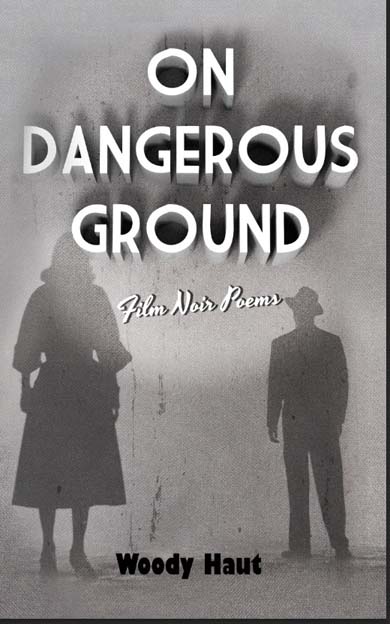
Two recent books, Woody Haut’s On Dangerous Ground and Jim Nisbet’s Pandemic Ditties, offer a case in point.

woody dgcvrWoody Haut’s On Dangerous Ground, Film Noir Poems takes its title from the Nicholas Ray movie of the same name. As the 50 “film noir poems” illustrate, the poet is well informed in the both genres. The author of numerous critical studies of the noir genre including Pulp Culture: Hard Boiled Fiction and The Cold War and Neon Noir: Contemporary American Crime Fiction as well as a couple of noir pot boilers, Cry For a Nickel, Die For a Dime and Days of Smoke, Haut’s poems take their titles from such classics as The Big Sleep, Nightmare Alley, and Touch Of Evil as well as the lesser known films like Where The Sidewalk Ends and I Wake Up Screaming. The poems themselves are prompted by dialogue, interesting camera work, the plot, a particular scene, the acting by the actor/actress, or their depiction of a time, place and social relevance which reveals the author’s knowledgeable immersion in a distinct American genre with a French name.

Woody Haut started out on poetry but soon hit the hardboiled stuff. And he even admits it! “Poetry had been my first port of call, though over the years my relationship had succumbed to disgruntlements and separations.” And yes, the poetry world is not an easy safe to crack, and even if you do, sometimes, although the safe may seem full, the rewards can be empty. Still carrying some of the baggage from that time, he confesses, “stretching back to the mid-1960s, in Los Angeles, then San Francisco, with various publications and a range of mentors, from the academic — Henri Coulette, Philip Levine, Jack Gilbert — to the peripatetic—Michael McClure, Charles Olson, Amiri Baraka and Ed Dorn. More recently, my interest veered towards the more linguistically-oriented, such as Clark Coolidge, Michael Gizzi, and Tom Raworth, and political screeds by the likes of Sean Bonney and Keston Sutherland.” And he is not above spilling the beans and implicating other writers in this amour fou: “Alice Notley, Robert Polito, Geoffrey O’Brien, Nicholas Christopher, and earlier, Weldon Keyes and Kenneth Fearing. Even Raymond Chandler began his writing career composing doggerel for the Westminster Gazette, while the great Dorothy B. Hughes garnered the Yale Younger Poets Prize long before she wrote such classics as In a Lonely Place or Ride the Pink Horse.” And of course the most damning testimony, besides his own words, are the poems themselves.

On Dangerous Ground
(Nicholas Ray, 1952)
Why do you punks make me do it?
growls the cop as he beats the shit
out of a pathetic street hood. As if
the same old same old, aggressor
blaming victim, perking watch and
wonder. Law and order cracking as
inevitable as the saturated light, an
apartment filled with testosteronised
artifacts: what once was, will never
be. Violence, as always, feeding the
conundrum. If only it wasn’t so addictive,
or family of last resort. A jones exiling
him to a sparsely populated snow-
ridden town, viewed-a movie within
a movie-through a windscreen, the
schtumed backseat viewer cachéd
in their own private critique, bleached
out by the death of a young girl at the
hands of a teenager barely knowing
better. With darkness bleeding into
domesticity, a match is lit for unblinking
eyes, and a wounded plea to locate her
brother before revenge can freeze his
tracks. Frightened, the kid invariably
slips from higher ground, recycling a
geology of clichés, footnotes in an
expurgated history of crime and
punishment. Fifty years on, the screen-
writer, blagging in his local coffee shop,
tells a redacted story: how he’d simply
wanted the cop to return to the city a
different person. But the studio’s arc was
non-negotiable. After all, the politics of
money dictates that only a miracle can
suffice. A capitulation, however generous,
not quite more than barely nothing at all

As Haut explains, “the poems in On Dangerous Ground could be thought as distortions, often humorous, of the films under consideration, like scrambled film reviews that exist at a particular moment, distilled through time, whose shelf life will last until the next viewing, by which time another set of linguistic prompts or images might attract my attention.”

Woody Haut’s On Dangerous Ground is available from Close To The Bone Publishing

A longtime member of the Bay Area lit scene who passed away in 2022, Jim Nisbet was an internationally recognized novelist and poet, and a seminal figure in the West Coast Noir Renaissance. His many novels which include Lethal Injection, Windward Passage, Snitch World, and The Syracuse Codex (to name only a few) have been described as “Jack Kerouac meets Tarantino meets David Forster Wallace” which is some kind of hyperbole but fitting of the genre and the author.

PLAGUE+DITTIESNisbet returned to his poetry roots (not that he was ever very far from them) to put the pandemic in pentameters in a selections of poems titled Pandemic Ditties. Jim, in the late 70s was a young poet in San Francisco who wrote and declaimed his poetry in coffee houses and bookstores. He even read at the historic San Francisco Punk Poetry Festival at Terminal Concepts Gallery with such luminaries as Andrei Codrescu, Gloria Frym, Darrell Gray, and the ravishing redhead femme fatale, Victoria Rathbun, straight out of a noir drama. Obviously, as it turns out, poetry wasn’t the only thing he was writing.

The poems, fifty five in all, collected in this slim volume from Molotov Editions, were written over a two year period (March 2020 through June of ’22) and distributed to his email contacts. Informed both by classical tradition and the immediate circumstances of the pandemic, these poems deal in matters political, spiritual, and cultural — but ultimately take the shape of an increasingly personal encounter with the phantasms of the pandemic.
Nisbet has a fine discerning ear and the Oxfordian vocabulary to go with it. The raucous ditties romp and roam, the pace hyperactive, reminiscent of the high wire antics of Nisbet’s prose, walking the line between doggerel and limerick, all the while juggling a ham on wry sense of humor. And like those internationally acclaimed novels, the poems are nothing but lively and thought provoking. An excerpt from “No. 19” written in July of 2020 gives an idea of the gyroscopic wit of the novelist as poet

Safe at home in 1958
We had Doctor Zorba
Who, his eyes turned away at last
From the jitterbugging babe

In The Asphalt Jungle, weekly chalked
On a dusty slate
“Man. Woman. Birth.
Death. Infinity.”

Today, not safe anywhere,
We have Subdoctor Schnorba
Sketching in thin air
“Person. Woman. Man.

Camera. TV.” Repeat ad
     nauseum. Never mind
The incredulity. Expect
Rezids, directly deposited.

The poems in Pandemic Ditties (pace Defoe) demonstrate Nisbet’s great range, from highbrow to lowbrow at the flick of the tongue, resulting in fascinating frenetic high octane linguistic kaleidoscopic versifying. A seat belt, nay, a harness is recommended if you’re going along for the ride: whiplash may occur as the result of sudden sharp turns, changes in direction and orientation, and abrupt stops, all of it like an amusement park ride, entertaining as well as exhilarating. Anyone who has enjoyed Nisbet’s novels will appreciate this selection.

Jim’s Pandemic Ditties is available from Molotov Editions

There is no doubt, as it is quite obvious to the most casual of observers, the genre is infested with poets. Should the reader of pulp be concerned, put in a call to the exterminators? Probably not. Poets and pulps are in a symbiotic relationship, like Louis and Rick in Casablanca, it is a “beautiful friendship.”

That’s my story and I’m sticking to it,
Perry O’Dickle
for Dime Pulp,

The Man From La Mirada Perdida—i & ii

A Don Coyote & Saundra Pansy Mystery

by Mike Servante

i


—Ever work for a private investigator before?

—I can’t honestly say that I have.

—But you’ve had experience working in an office, answering phones, typing?

—It’s all there in the resume.

—Yes, of course. So why don’t you tell me in your own words.

—I was a receptionist for a law firm, Stag, Stagger,& Staggered. I answered phones, took messages, routed calls, sorted mail and put it in the appropriate mailboxes. And did some light typing. The legal secs did the important stuff.

—Just a minute, did you just say legal sex?

—No, no, legal secretaries, that’s what they were called, legal secs, legal secretaries.

—Alright, go on.

—The firm had an investigator on retainer, but I never saw him. Only his mail.

—Only his mail what?

     “His mail, envelopes, packages, legal briefs, that sort of thing.”

—I see, mail, briefs, packages.

—But that was a while back. I haven’t been in an office environment since I got married.

—You’re married?

—Was. Widow.

—Oh, I’m sorry. My condol. . . .

—It was several years ago.

—Yes.

—And I’ve had to rejoin the workforce.

—Your husband, uh, Mr. Pansy?

—Corrigan, Jake Corrigan. Pansy is my maiden name.

—Ok. Mind if I call you Saundra? Or Sandy?

—If it comes with a pay check, I’m ok with that, though I’m not particularly fond of Sandy.

—Pay check, right, good you brought that up. If you were to accept this assignment I can only use you parttime, three days a week. Monday, Wednesday, and Friday, eight till noon, I will pay you for your time each week on Friday. I hope those are enough hours for you. Maybe once business picks up we can add more time.

—That’s fine. Like I said I’m rejoining the workforce after years of being a housewife. I’d like to take it slow. Plus I get Jake’s pension.

—Oh, yes, pension, that’s good. What did your husband do?

—He was a cop.

—Really? That’s very interesting, a cop?

—He never talked to me about the job. Said he didn’t want to depress me.

—I see. That was thoughtful.

—I have a question. Do I call you Don or Mr. Coyote?

—Boss is fine.


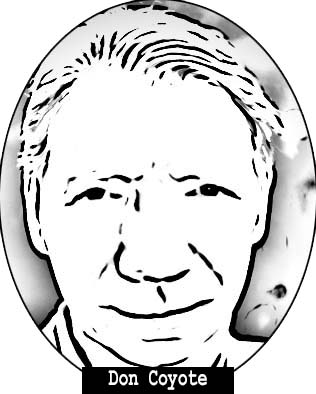
dcovaltxtI’m a good judge of character. She was in her late forties, going gray pixie cut that went with the pixie face, dangling silver earrings, intense blue eyes, mascara thick eyelashes, not so subtle green shadowed and precisely drawn eyebrows. Her lipstick was a synthetic shade of orange and probably applied with a palette knife.     

 What choice did I have? The only other applicant was a high school girl who had arrived with her mother who wisely stayed in the car. She’d snapped her gum while looking around the small office, bewildered, pointed to the typewriter, and asked, “What’s that?”

This woman in the colorful summer dress and gold brocade shrug appeared evasive and reluctant when I asked about her experience. Anyone can write a resume, I wanted to get the depth of her understanding by how she used her words and if she was familiar with the nomenclature.

She brought up sex almost immediately. I don’t want to say that I have that effect on women, but I am not uninitiated in the ways of the world. When I questioned her bringing it up, she covered skillfully and made it out to be a misunderstanding on my part. I don’t make those kinds of mistakes. And as if to further tease, she brought up male briefs and packages. I wasn’t born yesterday. Packages, that was just blatant.

Next she tried the pity angle. Widow. What was I supposed to say? How did he die? And she coldly brushed off my expression of sympathy. I could tell she was desperate to get the job, her repeated emphasis on the need to return to the workforce, but maybe at her age it’s a challenge, and she’s desperate.

I guess that’s something I’ve never known, I come from money. My grandfather was a jeweler, from the Ukraine, one of three Koyoskozko brothers who were headed to Alaska during the gold rush to claim their fortune. Grandpa jumped ship in San Francisco, tired of puking his guts at every swell of a wave. He apprenticed to a jeweler, a fellow countryman, and learned the business. With the ’06 quake, the business was destroyed. Like many made homeless by the catastrophe, he headed north, following the circumference of San Pablo Bay until he reached the wet lands on the northwest side of the bay once owned by General Vallejo. There on a river that drained into the bay sat a relatively untouched settlement known as Petaluma. He took it to be an Indian name. He was successful, changed his own name to something easier to pronounce, Coyote, though at the time he didn’t realize its import as a mythical figure in the lore of his adopted country. Eventually he had jewelry outlets in every major burg in the valley. My father inherited the business and became even more prosperous by investing in real estate. When he died I inherited millions. He’d eased out of the jewelry business a while ago although I had worked for him as a courier when I was going to the University in San Francisco. I often carried satchels of very valuable jewels in the trunk of my Impala as if they were nothing more than a bag full of old tennis togs. I had a permit to carry, then, and still do.

That woman is wily, I’ll give her that. When I politely asked if I could address her by her first name she immediately turned it into an offer of a job.


sandy2ovaltxtI don’t know who he thought he was, thinning red hair, tall and gangly with quite a beak, too. He dressed conservatively for this neck of the woods, slacks, open collar shirt. I’ll admit I was desperate. After Jake’s passing, I had to keep up the house payments and that meant cutting corners on other necessities. Besides, being housebound as a homemaker for a couple dozen years, I was ready to re-experience life as a single woman.

My husband used to say I was a ditz, but what did he know, he was a lummox. Jake worked as a Napa PD patrol officer till he dropped dead at Swank’s Steakhouse in Santa Rosa. The red meat in his gut didn’t agree with the red meat of his heart. As someone from his family said at the wake, “He larded up.” Certainly no one on my side of the family would have said it, out loud, at any rate. And it was true that the slim handsome police cadet I married turned into a wide load, pot-bellied, booze swilling porker right before my eyes. The sorrier he felt for himself, the more pounds he put on, and the meaner he got. He was an accident that didn’t wait long to happen.

I’m from around here, born, bred, and schooled. My folks and their folks and their folks before them were pioneers in these parts, chicken ranching, sheep and cattle, apples and prunes, they did just about anything that had to do with growing or grazing. Of course Coyote Jewelers was known far and wide. My wedding ring came from their showroom in Sonoma, or as my dad used to call it, Sonombula because it was a sleepy little town back then, before it got overrun by grapevines and all the snobby money, snooty attitude, and high prices that followed. Growing grapes was suddenly an art when all it was really was just good farming. That’s my stock. I’m not afraid of honest work and I expect to be respected for doing it.

I knew enough to be on my guard, having worked as a waitress while I was taking secretarial courses at the local business school. Guys always bring sex up and then when you call them on it, they act all offended like and pretend that’s not what they meant. Happened at the office, too. And though I hadn’t expected it to come up in the job interview, there it was. Everyone knows a legal sec is short for legal secretary just as a para is short for paralegal. If I hadn’t got married I think I would have tried for paralegal, get the training and all.

In the meantime, I needed to get work and his acting like a jerk wasn’t making it easy. I wasn’t going to catch the drift? Mail, package, briefs. I come from a big family, brothers, cousins, uncles, all of them brain in the gutter. I’ve heard it all. And I wasn’t going to fall for it. If that’s what he thought, he had another think coming. Saundra Pansy was never a pushover whatever you thought of the name.

Guess he got the drift. Boss said I was to start Monday, eight sharp.


ii

—It’s not electric?

—Um no, but it’s authentic.

—It looks like it weighs a ton.

—It’s a 1939 Royal KMM with the patented Magic Margin system. See, if you hold down the right or left margin lever and slide the carriage to the desired location you ‘magically’ set the margin. It still has the original round glass-topped keys. I paid $5 for it at a flea market, and it still works as well as when it was new. I even ordered extra ribbons.

—Right. . . ribbons. That’s quite a museum piece.

—Oh, it is perfectly functional.

—And this lever?

—That’s the carriage return.”

—Ok, now I remember seeing a video of one being used when I was in business school. We practiced typing on electric typewriters.

—But you assured me you could type!

—Oh yeah, no problem, if it’s qwerty, I let my fingers do the walking, and I can do it blindfolded. I can also do Gregg but it’s been a while so I might be a little rusty.

—Greg?

—Yeah, you know, the shorthand guy.

—Shorthand?

—Transcription. Like I said, it’s been a while.

—Good, good, for now typing will be enough. And this is an elegant machine. You shouldn’t have any problem with it, freshly oiled and cleaned.

—You don’t have a computer?

—No I don’t believe in computers. But look, I even had some stationary printed.

—Stationary?

—I hired a graphics firm to design the letterhead and the logo. Don Coyote & Associates, Private Investigations. I think the howling coyote in the oval frame like that is quite well done.

—That looks like a wolf.

—No, no. I’ve been assured that it is, in fact, a coyote.

—Have you ever seen a coyote in the fur?

—I’ve seen pictures. Many pictures.

—Well, alrighty then, if that’s the case.

—Oh, no, no case yet, but I’m hoping in the near future to develop some leads, lure clients in need of investigative services.

—And in the meantime is there any correspondence you’d like me to write, calls you’d like me to make, appointments you want me to schedule, dictation? I’m ready to get down to business.

—Good, and I don’t know if I have to point this out, but that is what is called a rotary dial on the telephone. It’s a 1937 Stromberg Carlson, very rare.

—It works? I thought it was just part of the décor. Like the typewriter.

—It is in perfect working order, as functional as the day it rolled off the assembly line. It has the original bell. Wait till you hear it!

—I’ll assume it doesn’t take pictures.

—Of course not. The telephone is for the ear, not the eyes. This is not some Dick Tracy outfit with wrist radios and video phones. Don Coyote, Private Eye, is nothing if not authentic!

—Ok, you’re the boss. I’m ready to get to work. I just don’t want to waste your time and money sitting around not doing anything.

—Well, first of all you need to get familiar with the type of job you’ll be doing and probably the best way to do that is to begin by creating a catalog of the files and reference books in my office.

—Like a librarian?

—I have a collection of rare pulp fiction magazines and obscure post war crime fiction paperbacks. Oh, and my film noir library, private eye memorabilia, crime scene photos. I would recommend that you read a few of those novels to get a feel for the business. I’m thinking along the lines of Mike Hamm. . . .

—You’re going to pay me to read?

—Well, no, I see it as something you could take home and do. To bring you up to speed. A private eye’s secretary requires specialized knowledge.

—So I would be doing more than just typing and filing? That sound like I’d need specialized training. On company time.

—Are you going to answer that?

—Don Coyote & Associates, Private Investigations, how can I direct your call? One moment please. It’s for you.


dcovaltxtI don’t know how to say this. My expectations might have been too unrealistic. She chews gum. Maybe she was nervous. I suspect that she is rather unqualified and I will eventually have to let her go. As my father used to quote my grandfather as saying, “The biggest problem in running a business is employees.” She is rather plain in a well-scrubbed sort of way. And maybe someone should have told her that colorful plastic jewelry was no longer as popular as it might have been, if ever, in the fifties, say. And even though she was made up to match the bangles and bracelets, she couldn’t hide her lack of refinement when I showed her to her desk.

That typewriter is a classic machine, indestructible, a workhorse. I couldn’t believe my luck. It was from an estate sale, everything had pretty much sold at auction except for a few odd items, like gooseneck lamps, and the old typewriter. One of the heirs was selling them at a flea market where, on occasion, I browse, looking for old magazines and paperbacks. A hand printed sign propped on the machine read BOAT ANCHOR? $5 or B/O. Finding a typewriter repair shop and restoring it was probably the hardest and most expensive part. Even the repairman had never encountered this old of a model, a 1939 Royal. His experience had been mainly on lightweight plastic chassis portables and dreadnaught electric office machines. He also repaired watches, something else experiencing technological displacement.

As soon as I questioned her competence she immediately brought the conversation around to sex. She said she was alright with quirky, and then something that she had done blindfolded with someone named Greg involving shorthand, whatever kinky fetish that was, but I could just imagine. I can only assume she was desperate. She kept saying that it had been a while. Then she brought up computers. And that’s a sore spot with me. I find them dehumanizing. Unfortunately I can become quite irrational when confronted with the issue. I deflected by showing the stationary I had printed but she wanted to make an argument about whether it was a wolf or a coyote depicted in the oval of the logo. I can see that she has a petty side.

I definitely got the feeling that she was in over her head. She was undoubtedly confused by the rotary dial on the telephone. She tried to laugh it off by making a joke. I have very little patience with mockery especially when it pertains to the degradation of values under assault from the techno sphere. I’ll admit it, I’m a technophobe.

And when I suggested that she educate herself for the role she would play as a secretary to a private investigation firm, she turned it into a labor negotiation. I was about to assert my prerogative as the employer when the phone rang. I’ll admit, she did answer the call quite professionally.


sandy2ovaltxtHoo boy! I didn’t think I realized what I was getting into. That machine, a manual typewriter, was carpel tunnel syndrome waiting to happen. I thought he was kidding. Maybe a monitor would cleverly pop up from a hidden compartment on the mahogany desk. No such luck.

I had to remind him again that I was qualified as a secretary, I’d even included a copy of my diploma from Empire Business College with my resume. I found a clean copy that my crazy friend Lola Lamont hadn’t altered the heading of the certificate to Vampire Business College though in truth that’s what we all called it—they didn’t suck you blood, just your money. But from the look on his face, it might have been TMI, too much information.

Then he trots out this stationary with a heading like it was from a comic book. A picture of a coyote, he says, in a clunky oval frame. It was a wolf. I’ve seen coyotes numerous times. Even shot one on my uncle Brad’s sheep ranch over by Two Rock. I know what a coyote looks like. They’re vermin. But he’d seen pictures.

And speaking of pictures, he had to point out the antique telephone like I haven’t ever seen pictures on ones almost exactly like this one. My gran even had one on her bookshelf, used it as a bookend to hold up her collection of picture albums. He got a little touchy at my joke about taking pictures so I’m going to guess he had his funny bone surgically removed.

But I gotta hand it to the guy, his setup is right out of an old black and white movie which I can’t watch because without the color, there’s no meaning, and I lose interest real fast. The place is on Western just off the main drag in what used to be the original family jewelry store, a three story brick walk-up. The downstairs showroom is now an antique store so he doesn’t have to go far for his décor. His office is on the second floor, the door at the end of the hallway at the top of the stairs. It’s one of those old wooden doors with a frosted glass panel on the upper half and in gold lettering it says Don Coyote & Associates. I haven’t a clue who the associates are but I figure I’ll find out soon enough. Inside is a small reception area with a couple of old chairs up against the wall and across from the big mahogany desk where I’m supposed to work. There’s another door on which is written in the same gold lettering, Don Coyote, Private Investigator, and call me crazy, but I’m guessing that’s where the files and reference books are that he wants me to catalog. And read.

He has another think coming if he thought I was going to take work home. If I learned one thing from Jake Corrigan, it’s don’t take the job home. And the only thing I’m going to flip when I get there is the channels. Even McDonald’s pays you when they train you to flip burgers. I could see that that was going to be a bone of contention. If you want me to do a special job, train me. I’m a fast learner. I was about to let him know where I was coming from when the phone rang. It startled me at first. It was loud. And it was a real bell, not an electronic facsimile. I picked up the handset and immediately went into receptionist mode. It was a woman’s voice. She was sobbing, “Help me, oh please, Don Coyote.”


Next time: la bola desnuda or don’t go bowling naked

Carriers V-VII

by Mark DuCharme

-v-

In truth it wasn’t the door I finally broke through, but the plastered drywall frame it had been latched to. When I managed to accomplish that feat— and not without some terrible cost to my bones— I remember her laughing. This struck me as odd, for the sight we found within those L-shaped quarters was hardly amusing. Her own father— for that is what she called him— Gruber, that crazy old goat— lay there with a great red stream trickling from his neck. He was obviously, incontestably dead— had died by most horrid means— yet it was quite unimaginable what beast, either human or animal, might have entered his chamber and delivered the wound. (Still more unimaginable, I had heard nothing of what must have been a terrible struggle, given the condition of the scene, with books and papers strewn about, though our adjoining apartments were only separated by a thin layer of drywall, through which I used to routinely hear even Gruber’s faintest mumblings.)

I remembered what Dr. Greenway had said. I looked closer at the departed— and yes, there were two wounds indeed, two small wounds, somewhat close, and exactly at the site of the jugular, just as the good doctor had described. In addition, I now noticed, from that closer vantage, the somewhat gray complexion of the skin and the increasingly jaundiced look in the eyes. No, this was no work of a beast as we know it, nor an intruder; Gruber, that strange, crazy old man, had clearly fallen victim to the plague. Well, that, at least, explained why I had heard no struggle: presumably, there had been none. And then it hit me: he had to be taken to the facility, and sooner than later! Gruber was now what my bosses would call a carrier. And even if I were off-duty, you see, I simply couldn’t let a carrier sleep— to go on sleeping. I had to get him to the facility as fast as I could.

His daughter— or the creature claiming to be such— seemed to feel less urgently or sadly about all of this than me. It’s not that she exulted; rather, a blankness overtook her affect, out of which she seemed lost to herself, benumbed. Perhaps the shock of loss had overwhelmed her; I suspected as much, but could not judge with certainty, having only just met her— yet she suddenly seemed not in this world at all, but in another.

“Can you help me get him down to my truck?”  My question seemed to jar her. She stared into space a moment, then regained herself.

“Sure,” she nodded, half smiling. I had him by the armpits. She was about to grab his feet, but then blinked in awareness, veered, and made her way to the great, old, wooden desk where Gruber kept his ravings— the ones in written form, at least.

“Here, this is for you,” she said, handing me an envelope on which “Johnny” had been scrawled in idiotic hand. “He told me he wanted you to have it.”

I attempted to stuff it in my back pocket, but suddenly realized I was still attired in plaid, woolen pajamas. “Excuse me,” I said, looking down in embarrassment, then set the body back down and went straight back to my quarters. Once there, I hastily threw on yesterday’s pants, shirt and socks, in addition to my winter coat, a trench resembling military wear of several bygone eras ago. I tossed the envelope upon the small table that serves all my nutritional, social (when I have visitors) and business needs, but then thought better of it: this Mr. Thorne, or one of his agents, might well intrude again while I’m away, and though I doubted the envelope contained more than ravings, if only out of respect for the dead, I thought it best to keep it out of that Thorne’s reach. I stuffed it hastily into the inside pocket of my overcoat.

“What’s your name,” I inquired, on returning. I thought it best to have a way to contact her— just in case.

“Analeise. Analeise Gruber. You can call me Ana.”  A smile broke upon her pallid face, and her brown eyes suddenly, briefly, regained their luster.

“That doesn’t matter now,” I retorted, striving to keep this all on strictly business terms.  “Give me your card.”

I had no reason to expect that she would have one, but she produced a rectangular, off-white piece of stiff cardstock from her small, decorative, gold lamé handbag. It wasn’t until the next day that I noticed it was the same thick, off-white stock with the same dark, almost blood-red font as the card that Thorne, or someone in his employment, had deposited on my pillow.

We carried the body down the dilapidated, crooked flights of stairs. She was surprisingly much stronger than she looked.

forrest_german_expressionism

-vi-

Although I did briefly consider taking Old Gruber straight to the arena, I judged that there would be enough time to take him directly to the facility before going to pick up my cargo. And besides, what else was there to do now? I wasn’t going to be able to get back to sleep, and even if I could, I wouldn’t be able to sleep for long. Besides, it was still dark. Sunup wouldn’t happen for a good hour. I considered waiting till the sun’s first rays, but the problem with that idea was twofold: if I did that, I’d never be able to get to the arena in time, and I was afraid of what might happen if I left Gruber alone before dawn. Oh, I’ve heard stories! You see, it seems that carriers sometimes can wake up. I don’t know much about it (or I didn’t then), but I knew enough to know that I didn’t want him left unattended in the event that did happen. Uneasy as I felt about the idea of driving him in the dark to the facility, I was more afraid of the alternative. So I went back upstairs, grabbed some food to eat in my cab, and I was off, down crooked streets.

Yet all that time, I felt that strange old fool’s dead, yellow eyes staring at me, hauntingly, in the rearview, neither quite alive nor entirely dead. Must I tell you how I feared him?

His eyes were cold, dead, now fully yellow— most devoid of expression. That blank, almost idiotic twist  of his mouth— one achieved only through his death throes— threatened to break suddenly into a smile, a most wicked and evil grin. I watched for it, almost as carefully as I watched the twisted roads ahead of my careening vehicle— but I swear it never occurred.

I was racing down Pico Avenue— I mean really racing! Dawn was fast approaching. I could see better now, in the new, bluish half-light. I put my boot to the pedal and zoomed past trouble— for what had I, exactly, to fear? Wasn’t I a Transporter, an official agent of the Company? Who was anyone to interrupt my racing? Even the police didn’t care!

I was delirious with excitement and relief. The slowly awakening sun seemed to mark the end of my fears about Old Gruber, at least for the time being. I was getting close to the facility, when suddenly I turned a corner and caught a flash of rosy, post-dawn light in the rearview as I passed the towering hulk of an abandoned, formerly auspicious office structure. For all I knew, carriers were having their way in there at that very moment.

I turned another corner and at last could see the facility looming ahead in the distance.

10

-vii-

When I arrived, there was no one there, no dockworkers, no flatbeds on which to dump the remains. Now that the sun was almost fully up, I felt a little safer— and that was good, for it suddenly occurred to me that I would have to carry the old man in— and I had no idea whether the building would be open or not! Suddenly, the colossal mistake of my hasty decision fully dawned on me. For all I knew, I wouldn’t be able to leave him there at all— would have to transport him, in fact, back to the arena, to pick up my other cargo, only to race back here again before the pink sun sank.

I looked back through the tiny window separating the driver’s cab from the carriage proper. I could see no change in Gruber: same yellow eyes, same gray complexion (perhaps just a shade grayer now), same twisted half-smile. Perhaps my fears had been unfounded after all, I exulted to myself, in the eerie, bright light of new-day.

I steeled myself and exited the cab, swerved round, and unlocked the rear door of the transport. He didn’t move at all. Whatever had I been thinking?

I entered, situated my arms about his (I could tell) stiffening corpse, and lifted him up, as one would lift a new bride, and carried him out of the carriage, making my way toward the narrow flight of stairs leading up to the platform.  I reached the top and headed to the door next to the warehouse gates. If anyone was there— if I had any hope of dropping off Old Gruber at this hour— that was where I might find him. I set down the stiff assortment of limbs and knocked hard— knocked and knocked with all my might, upon the heavy, unrelenting steel door. I knocked for what felt like nearly a quarter hour, and I was just about ready to give up, when I heard faint, approaching footsteps, some rustling keys, and a sharp metallic click. The door swung slowly open, and I could see Carlos behind it. He looked like he was still half asleep. I had no idea he would be here this early.

“Sorry, Carlos, but I got one for ya. I’ll be back at the usual.”  He nodded mutely, then I turned and scooped up the cadaver— for what else was he now?— and brought it through the doorframe. I had never been through that door, but there was a pallet on the other side, and I decided that would be as good a place to leave Old Gruber as any. I laid him there, and Carlos kind of nodded, while making vacant eye contact. I veered back and walked out without saying goodbye. He hadn’t said a word the whole time.