
Apollinara gnawed her lower lip, hands clasped over the small Bible resting on top of the yarn basket in her lap. She stopped rocking and went over the scene of her husband’s departure again.
Adams, a ruddy-faced young gringo, had arrived on the mesa before dawn. He had waited in the black one-horse buggy, wind whipping at the flaps of his long gray duster, one hand on the reins, the other holding down the bright green bowler on his head. Her husband had slowly crossed the yard, shotgun in hand, shoulder to the blowing sand, and climbed up onto the bench beside the young man. He had waved once as the buggy wheeled and headed away.
A slight breeze stirred in the doorway of the adobe, a chunk of firewood propping open the slat door to let some of the heat from the dark stuffy kitchen out onto the late afternoon mesa. She stared out at the dry, beige landscape. There had been a time, when they lived in Roswell, she had been able to look out of windows, real glass windows, at rows of peach trees. Maybe it was all a dream, the luxury, the finery of days gone by. Now her hope for a comfortable life rested with the young man who had come to fetch her husband to Las Cruces. Adams wanted to lease their land to graze cattle, and that was being used by a young drover named Billy Brazil. But Brazil had an agreement with their oldest son, Pepe, for the rights to graze goats on the land, and would only vacate if they agreed to buy the herd outright. Her husband had refused to honor the agreement and had taken Brazil to court. The Justice of the Peace had ruled in the young man’s favor. That had made matters worse. The bad blood between them had turned to poison. All the same, Adams seemed intent on getting his way and had arranged for a meeting with Brazil in Las Cruces. She could not help but feel apprehensive. She knew how much her husband despised Brazil. There would be violence if he were pushed too far, especially if he’d been drinking.
She almost jumped out of her skin as the door slammed shut. She screamed in the sudden darkness in spite of herself. The door creaked, opening wide, and was again buffeted by the wind, slamming shut with explosive violence. The awful realization of her worst fears crept over her. She screamed, screamed again.
Her youngest daughter, Paulita, hurried to her side. “What is it, mamma? Why are you doing this?” She tried to pry her mother’s hands away from her face. “Why, mamma, why. . .why are you crying?”
Between sobs, Apollinara spoke her fears. “He is dead.”
Paulita tried her best to comfort, but Apollinara continued to weep, falling to her knees and praying for the repose of her husband’s soul. Paulita, caught up by the hysterical crying and praying, joined in.
After some time and a long, solemn silence, Apollinara addressed her daughter. “You saw him last. What was he doing?”
The young girl, still bewildered, recounted how she had followed her father after he had left in the buggy. She had caught up with them, riding as far as the first gate just before the trail dipped down into the canyon. “I opened the gate for them. . . .”
“What were they talking about, your father and the young gringo? Were they arguing, were they fighting?”
“No, mamma, I think they were talking about Indians. I kissed papa on the cheek. I said, ‘Cuidado, papa’ and got back on my pony and came home.”
Apollinara whispered to herself. “Indians?”
The old man watched the smoke rise from his cigar. Whenever he thought of Indians, the pile of moccasins he had dumped at Pete Maxwell’s feet came to mind.
That, and the look on Pedro’s face. He almost smiled. A small party of Comanche had raided a homestead just outside of Lincoln, run off a half a dozen head of cattle, killed a dog, burned a milking shed, and scared the bejeezus out of the folks in town who were certain that this was the beginning of new hostility. He had joined the posse because he’d had experience tracking from his buffalo hunting days. That and he was a dead shot. It was a break from the boredom of herding cattle for Maxwell. And this raiding party was careless. They had come upon their camp in less than two days, no guard posted, mostly youngsters armed with bows and a few antique rifles. They did not have a chance.
“You hunted buffalo?” the young man asked, “You must have some wild and wooly tales to tell.”
It could have been a growl as the old man sucked smoke from the black root. He was not a teller of tales. That was something Ash excelled at, but not him, no sir, he was always glad to leave the chin music to someone else. Ash was dead now though his voice was still very clear in his ears, exaggerating every little detail, going on and on, splashing another shot of whiskey in his glass, flapping his gums till the rooster crowed. How would Ash tell the story? Buffalo hunting. He shivered. What he remembered most was the harsh winter and stacking the rigid hides, frozen stiff like sheets of furry slate.
“It was hard work, son, I’ll tell you that. You bedded down every night with the sound of gunfire ringing in your ears. The money was good, though. A prime hide could fetch you two dollars, and on a good day I was bringing down a hundred, a hundred and fifty head.” That was Ash talking there. A hundred maybe, if you got a stand going and the wind was in your favor. A lot of the time was spent chasing little herds of no more than half a dozen buffalo and then helping the skinner peel hides.
“Did you ever have a run in with hostile Indians?” Indians again. This boy has been reading too many yellow backs. Almost a chuckle. If he only knew. He would be pestering for the details of that, too. Well, it was going to be a long ride to Las Cruces.
“Most of the Indians on the Staked Plains out by the Brazos River were Kiowa and Comanche, maybe a few Cheyenne. Anytime they went some place they had to have an escort from the 10th Cavalry with them. Anyway, that’s the way it was supposed to work, but a lot of the time the young bucks would sneak out of their camps and raid a hunting party, burn the skins if they could, slash them. You see, they did not take too kindly to the fact that the white man was out there slaughtering their source of food. Buffalo did not belong to them. And they were worth a powerful lot more to the white man than the Indian. Used to call it ‘wooly gold’ or ‘brownbacks’.” There was Ash again. He never called them anything but hides, if that. And he never got his money from that hunt. He could use it now. If only he had listened to Shelton in the first place.
Whenever Shelton would take his hat off, his thin red hair stood straight up like the flame on the tip of a Lucifer.
Adams had red hair too, what you’d call a copperhead, poking out from under that damn green hat. Shelton had always worn a gray, wide brimmed, rebel cavalry officer’s “Jeff Davis” sombrero. He had been right proud of being a Johnny Reb from Georgia. He would foam at the mouth whenever he encountered what he called “carpetbaggers” or “just plain Yankees.” If you weren’t from the South, you weren’t fit human company. Niggers and Indians were animals. Foreigners smelled bad and were not to be trusted.
“This was in ‘76. In Fort Worth. Just back from Dodge City on a cattle drive where I ran into a man named Shelton from Georgia and a man named Duke from Kentucky. They were looking for a partner to join their hunting party. I threw in my pay from the drive and two days later the four of us headed out to the Rio Brazos and Fort Griffith.”
“Wait, you said, the four of you. . . .”
“The sheeny kid, Joe, I picked him up as a skinner to save money.
“Sheeny? I’m not. . . ?”
“Irish. He was young but he looked strong and I figured once he got experience, he’d be as good a skinner as any.”
Shelton had thrown a fit. He hadn’t wanted to nursemaid no goddamn paddy whelp. He’d spit, he’d howled, he’d kicked. There was a picture to smile about. Shelton not getting his way, taking off his hat and throwing it in the dirt and kicking it. Still, the kid had joined the hunt as a skinner despite all the fuss.
Skinner was a dirty job by any standards. Thinking back, the kid didn’t know what he was getting himself into. Or had he got the kid into it?
Joe’s pale and very young face pleaded with him, pleaded to be hired on as a skinner, large shiny tears rolling down his face. The patrons at Beadle’s Saloon down by the hide yards were beginning to wonder what exactly was transpiring between the two of them. To shut the kid up and save himself from the embarrassing public display, he agreed to hire the kid on.
Even after twenty-five years, he could still feel the heat of his regrets. Unless you had raised livestock or worked in a slaughter-house, there was no easy way of breaking into the skinning 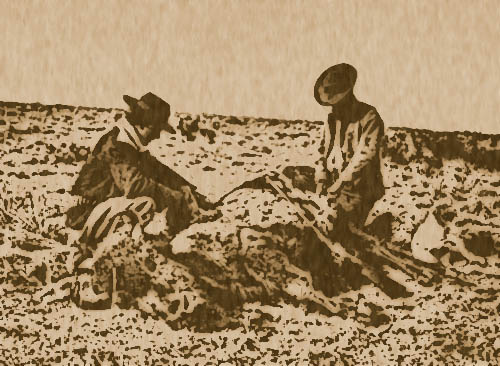 business. Out on the range it was just you, your knife, and the carcass. The hunters would be scouting the river bottoms and the only way you could keep track of them was to remember the direction of the sound of their rifle fire. The kid hadn’t picked up the skills as quickly as he had anticipated and often times someone from the party would have to go out and find him, lost among the bluffs, wandering in circles. Shelton said he prayed for some Comanche to lift his scalp and put the poor bastard out of his misery.
“We were out on the range when Nigger Horse and his renegades bolted from their encampment. The Army was right on their trail but a white man wasn’t safe out on the Plains by himself, especially if he was hunting buffalo.”
“What did you do?”
“Well, we had over two thousand hides stacked up at our camp. We loaded as many as we could on our wagons and dug caches for the rest of them. We had a couple hundred pegged out to dry that we had to leave and hope nobody, Indians or hide thieves, would run across them. There’s safety in numbers as I’m sure you’ve heard so we broke camp and headed for Charlie Rath’s outpost near Double Mountain.”
“Were you ever attacked?”
The old man shook his head. He had a live one here. Ash would have played him like an old tune. You had to have the knack to lead someone on, have them follow you down every backwater, gully, and blind alley you could imagine and still have them come out believing every word you said. He did not have it.
“No, we were pretty safe as long as we stuck close to the outpost. Nigger Horse and his bunch might have outnumbered us, but we out gunned them easily. Hell, with the Sharps most of the hunters were using, a hostile attack wouldn’t have even got close enough to get in range.”
“You favored a Sharps, did you?”
“No, can’t say that I did. The .50 caliber Sharps was like a hand cannon, it did the job on the buffalo, but it was slow and heavy. I was partial to the repeating Winchester. Lighter than the Sharps. It didn’t pack the power, but if you knew how to shoot, it did just as well.”
“Did the Army ever catch up with Nigger Horse?”
“That they did but not before a bunch of hunters decided to out-army the Army and go after the renegades themselves. The way they figured it, each day they spent off the range they were losing money, so the sooner they killed or rounded up all the Indians, the sooner they could get back to the hunt.”
He stopped to relight the black stub clenched in his teeth. He had to hold up a side of his thin cloth coat to shield the flame. He struck the match on the barrel of the shotgun draped over his lap. This time with the help of the coat and the cooperation of the wind, he got it lit.
“You get a bunch of howling drunk, blood-in-the-eye range rats riding out to murder, it’s hard to creep up on anybody.” Ash would have liked that. “By the time the hunters came up on the Indian camp they were riding straight into an ambush.” Maybe he could weave a tale like old Ash. But he’d need a drink first. To tell it right. “Lucky as many as did made it back.”
“But you didn’t go looking for the Indians.”
“No sir. Hadn’t lost any.”
He had lost just about everything he had ever had. He was tired of losing. This snoozer, this goat-boy, would not prevail, no matter what the court had decided. He would not lose this one.
The whippersnapper at the reins had no idea. Even those slight victories had been defeats. Just when he thought he had his hands on the goods, they had the habit of turning to dirt. The buffalo hunt had been the beginning of it all. He had lost everything then. There was no real profit in running a little ranch, and the saloon deal had ended in bitterness. Only his election as sheriff had proved fruitful, providing respectability, and the prospect of settling down and raising a family. Even that had led to his ultimate undoing.
The old man drew on the cigar, holding a mouthful of acrid smoke then letting it blow. He examined his companion’s outfit; the barely soiled gray canvas duster, snakeskin riding boots, heavy blue denim trousers. The bright green bowler. He could not for the life of him figure what irked him so much about that hat.
Even when he had had the money, he would never have dressed as outlandishly. The threadbare black broadcloth he was wearing had been his habit ever since he could remember. He had bought his first black suit for his swearing in as Sheriff. He had worn it to his wedding. He wore it to funerals, and to court. He had picked up a couple more over the years, always the same cut. It was not the sturdiest cloth and it did show wear when there was some. And there was always some, around the elbows, around the knees, around the back pockets.
He had been partial to brocade vests, however. And Polly, who thought he should show more imagination than an undertaker in his dress, gladly made a few of them for him, with mother of pearl buttons and silk backing. He had worn a glossy white one to Santa Fe once. Then he had foolishly lost it in a poker game.
He could add that to the things he’d lost along with the peach orchard, the irrigation company and his dream of watering the Pecos Valley, the thoroughbred horse ranch outside of Uvalde, Texas, his job as Customs Inspector in El Paso, and slowly but surely, the little property he owned in the Organ Mountains.
He had been blessed with eight children, it was true. And his wife had stuck by him through all his trials and tribulations. He could be thankful for that. His present troubles, however, did stem from his oldest boy’s rashness. He would set it right, if it was the last thing he did.
 He coughed a dry cough and it reminded him of Ash. Ash was perhaps his greatest loss. He had grown to depend on Ash’s humor and irascibility to balance the grimness of his own turn of mind. He valued his old friend’s rather exaggerated view of life, how the boring and dull events of every day were the foundations of what he liked to call ‘myth.” He could remember how all his petty little worries would disappear after he and Ash had spent time jawing and sipping, sipping and jawing. He was also reminded of how dimly Polly viewed this pastime, and how Ash, a regular Sunday dinner guest when they lived in Roswell, had to endure her steely glares. “Ash and his ideas,” she would mutter after his friend had fallen asleep in the old wing-backed chair in front of the fireplace. When Ash was dying, though, she had prepared the extra room at the Uvalde ranch for him, and had seen to his every comfort. Ash’s death was a slow one. His liver was going, but despite the pain, he still liked to spin a good yarn.

