
by Helene Baron-Murdock
Donovan found the time in the radio log where Sheriff Collins had contacted him and noted it. That was when they shut the investigation down or were shut down by the Feds.
“Go to channel 12!” Collins wanted to talk to him on his cell phone, but the reception was minimal this far out on the lands. “Channel 12” was code for channel 6, the scrambled channel, meant to confuse the scanner heads who hung on every word transmitted over various law enforcement frequencies. Of course any self-respecting scanner head had a descrambler and going to channel 12 would only fake them out for so long. “Shut it down! I want you to put everything back where you found it, every hair, every shell casing, every fingerprint, all of it, every bit of forensic evidence. I don’t want a trace that would show we’d ever been there.” At his protest, Collins replied, “Just do as I said. The Feds will be out there shortly, hand it over to them and leave. I’ll explain when you get back to the office.”
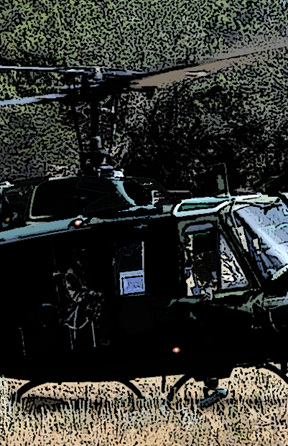 He heard it first, and the black chattering shape grew larger coming in from the southwest. The chopper swept low over the farmhouse and then back toward the access road where he’d been waiting by his sedan. There was a wide spot in the stubble field beyond the gnarly giant live oak near the entrance to the front yard. A tornado of fine beige dust and sand engulfed the chopper as it set down. The rear passenger door opened once the dust settled and two figures stepped out.
He could tell by the bouncing confident stride that the taller one was a woman. The man was wide shouldered built close to the ground and moved like a perfectly oiled killing machine.
Not your likely Fed duo.
She held out her hand and introduced herself. “Special Agent Sharon Eckes. You must be Donovan.”
He shook her hand, a firm grip, not a perfunctory formality. She was dressed for the field, dark work slacks and the standard issue FBI windbreaker, black lanyard with badge ID, and a standard issue ballcap gathering her sandy blonde hair. Her partner was a little more fastidious in a brown leather jacket over a cranberry polo shirt that detailed a well-defined six-pack. His slacks were knife edge creased and a few shades lighter than his brown desert boots. On closer appraisal, he was an older man by the leathery bulldog jowls of his sun darkened features. The close cropped pate said ex-military, a squared off hand grenade with an aggressive hard stare.
“This is Wayne Tanner, DOD consultant with DHS. We’ll be taking over the investigation from here on out. Thanks for securing the scene for us.”
Tanner deigned to speak, and at almost an octave higher than he’d expected. “Is this all exactly how you found it?” He motioned toward the farmhouse.
Donovan nodded, taking an instant dislike to the man. “Yep, exactly as it was found by the first officers on scene. So except for their footprints in the sand, it’s a pristine crime scene.” He said the last with a hint of a smile.
“We heard you had a crime scene van out here. And animal control?”
Of course they would have monitored the local LE radio traffic. “Standard Operating Procedure on multi-casualty incidents. Out here, we thought we might need a tracking dog, and the Animal Control vet is also the head of Search and Rescue Team. They were canceled before they could deploy.”
“What agencies and personnel were at the scene? I’ll need names, ranks, of anyone who was here.”
Donovan shrugged. Now he was certain that he detested the short stack of muscle and spleen. “County Sheriff’s dispatch can probably fill you in on who the responding officers were. You’ll have to contact HQ at High Point on what Florist Service personnel were out here.” He’d used a common nickname for the men in the green trucks out on the lands, known also as “greenies”, but it failed to get a reaction. He didn’t mention that by the time the forensics van had packed up he saw Grandma Spider hightail it on her ATV over the rise in back of the ranch house.
On his way out to the main road just passed the fork in the rutted dirt track he met up with a black Mercedes mini motor home with a couple of bewildered techs in FBI ballcaps. He’d pulled off as far as possible to one side without getting wedged in the drainage ditch to let them pass.
The driver’s side window floated down. “We on the right track to the scene?”
“Right you are. Keep following the ruts and bear left when you come to the fork.” How he loved the Feds. The driver didn’t even give a thank you. And if they followed directions they would soon find themselves down pasture where the road played out amidst nothing but cattle.
With the time he’d vacated the scene and turned the incident over to the Feds so noted, and with a few, very few, comments appended, the report was done. The Sherriff could embellish his timeline however he wanted to frame the narrative he would spin to the Board of Supervisors and exculpate himself. Except that wasn’t the end of the story.
Donovan knew enough to avoid swinging by the office to report in just yet, given the state of mind the Sheriff would be in, best to let the man have a chance to count to ten a few million times. At Santa Lena General, he was informed by the nurse at emergency receiving that the Apes social worker had left a number for him to call. The old gal, who might have pushed her husband down the stairs on Valentine’s Day, a love story yet to be told, appeared to be sleeping in her wheelchair in the holding room, a sure sign of guilt according to the experts. Let sleeping dogs lie, he thought to himself.
Patients might gripe about hospital food, but the cafeteria always had a great entrée. He’d learned that as a young deputy. The servings were ample and the coffee always hot. And it was cheap. He’d skipped breakfast and hadn’t even had a chance for his mid-morning power ring, cop talk for “doughnut”. The rigatoni was tempting, and he pointed to it when the server questioned with her dark eyes. The phone to his ear rang twice before it was answered. “Shirley Holmes,” a husky professional voice spoke.
“Detective Jim Donovan here, I’m at the hospital.” He slid the tray with the heaping plate of rigatoni toward the register, pausing to lift a large paper coffee cup from the stack.
“She’s as much as admitted that she pushed her husband down the stairs.”
He grunted an acknowledgement as he fished a twenty from his billfold and handed it to the woman behind the register. “I’m in the cafeteria. If you meet me here I’ll buy you lunch, and we can talk about it. Unless you recorded what she said, it’s really your word against hers. And they’ve got a terrific rigatoni on the menu today.”
“I’m Vegan.”
As always when he encountered that assertion he wanted to ask, “Is that a planet in this solar system?” But he didn’t.
“And I’m slammed with clients, plus my boss wants a prelim report on the quote unquote accident. I could maybe make some time around three-ish?”
“Ok, here’s what we’re going to do. I’ll set you up with Detective Nelson. He’ll give you a call seeing as how his last case just mysteriously vanished and arrange a meet up to take your statement and the Valentine Day killer’s.”
“What’s his name again?”
“Nelson.”
“Does he have a first name or is it just ‘detective’?”
“Uh,” Donovan paused at the coffee carafe and gave it a few hearty pumps, “You know, I’m not quite sure. Robert? Richard? I’m guessing. He’s Nelly to everyone in the squad room.”
“I’ll remember that.”
Donovan parked the sedan on the concrete apron taking up most of his backyard. There was an unwritten rule in law enforcement that a work vehicle should never be parked at the curb of one’s domicile, official language designating place of residence. Too easy and too tempting to break in and or vandalize. The previous owner had poured the slab that covered ninety percent 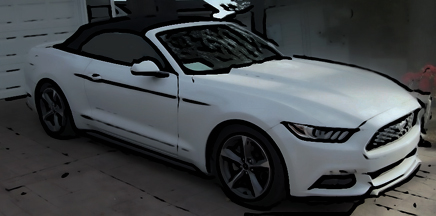 of the small backyard crowded with a detached garage probably built in the early fifties. It was a sturdy two hundred plus square feet that housed his personal vehicle, a Mustang convertible boy toy, a midlife crisis gift to himself. Maybe the original owner didn’t like mowing the lawn although the piebald patch of turf in the front yard had been well maintained when he bought the place almost twelve years ago. He was the one responsible for its current shabby overgrown neglect. So what was he hiding under the slab? Bodies? Something that had occurred to him more than once. Cop thinking, he called it.
The neighbor’s cat came loping into the yard from a hole in the fence and rubbed against his pant leg as he unlocked the door to the covered porch that housed the washer dryer. The cat raced ahead as the door opened and stood next to the bowl by the washer and gave an imploring mew. Donovan reached into the box of kitten treats on the shelf with the laundry detergent and dribbled a handful into the bowl. It had been more than a few years, he’d lost track, since he’d announced “Honey, I’m home,” to give the bride a chance to stash her stash and straighten herself up, tuck a stray lock behind an ear, pretend she’d fallen asleep while reading the same book she’d been reading for the last couple of months. It was a familiar cop story. So was the divorce.
The house was cold, and he set the thermostat up a notch as he headed for the front door and the few items of mail scattered on the rubber welcome mat under the mail slot. He stooped to pick them up and the way he grunted they were apparently heavier than they looked. Nothing, nothing, nothing, bill, and more nothing. He set the bill on the table in the entrance way with the other bills and tossed the rest into the circular file that had once been an umbrella stand.
The day caught up with him as he climbed the stairs to the bedroom, a weariness that had been building over his last shift and the one before that. He was old, no “getting” about it, and retirement, once playfully lobbed around the squad room when the job got too demented or absurd and the endless hoop filled bureaucracy just making it worse, was a serious consideration, especially after the reprimand.
He tossed his jacket on the bed, placed the hip holster and firearm in the top drawer of the dresser, whipped off the tie, unbuttoned his shirt, dropped his trousers, slipped off his sock, and stepped out of his briefs. The tile floor in the bathroom was cool against his wearied dogs. He didn’t hesitate stepping into the shower and turning it on full blast. First there was the shriveling cold water pelting his bare back and then slowly as the warm water worked its way up the plumbing a warm soothing wash before the scald of hot that made him jump back and adjust the mix. By then he was wet and the tension, the dust from the lands, the weary knotted road muscles were just washed away.
He replayed his conversation with the boss as the stinging spray washed across his face. Actually it was less of a conversation, more like a reluctant audience to Tim’s rant against the Feds. “Can you believe it, they want to cover this up, like it never happened!” Homeland Security had declared the murder scene a classified black site because the killings were obviously a terrorist act. Everyone present at the scene was advised that any disclosure of classified information regarding the terrorist incident would result in hefty fines and or prison time. “Bullshit!” Tim shouted in frustration, and there was no arguing with that.
Drying himself off he turned on the TV and sat on the edge of the bed to catch the early news. He could have predicted it. A throng of reporters swarmed Sheriff Tim Collins in his gold starred uniform finery as he was leaving Headquarters. The questions were of the “is there any truth” variety and specifically referenced the multiple shooting out on the lands. So much for secrecy. He felt like saying “Houston, we have a problem” but he didn’t talk to the TV. That was his ex-wife’s routine.
He dressed checking the time and messages on his phone. Royanne from the coroner’s office wished him a Happy Valentine’s Day, and Judy from the DA’s office sent him a picture of candy hearts that said things like “You Rock”, “Got Luv?”, and “Hanky Panky”.
He urged the cat out the back door with a light nudge of the toe of a dress loafer. Latching it shut he strode across the yard in the encroaching twilight in a pair of stone washed jeans, a pale blue collared shirt under a sturdy beige canvas windbreaker. He backed the Mustang out of the garage and let it idle a while to warm up the interior, the winter evenings still a little brisk in February. He tuned out the radio news and slipped a favorite Etta James CD into the dashboard slot. Once on the street, he steered east toward Old Town Santa Lena.
Only two hotels in Santa Lena guaranteed government rates. One was a dive with a big heated pool. The other was almost a dive with a big heated pool and a cocktail lounge. He parked in the lot, no valet service, and walked up the steps into the lobby. He’d been to the Santa Lena Hilton a number of times, probably as many times as the establishment had changed hands so it might not have been part of the Hilton chain anymore, but that’s what everyone called it. The entrance to the lounge was to the left of the reception desk. He stood in the doorway letting his eyes adjust to the dusky light.
She was sitting by herself at the end of the bar poking at the ice in her tall cocktail with a slender crimson straw. She sensed his approach and turned as he asked, “Buy you a drink?” Special Agent Eckes gave him a weary smile. “Sunshine Superman. I was wondering if you’d show up.”
No one had called him Sunshine Superman since his rookie patrol days so that made him feel young as well as in love.
“Chief Warrant Officer Dessy was on an operation in Northern Afghanistan and got caught in an ambush. He is presumed missing in action.”
Donovan made a mental note to renew his health club membership. He stared at the ceiling, one of the myriad shades of gray in the darkened hotel room. His heart rate was dropping back to normal and he was no longer breathing as heavily. All in all, he felt like a wrung out dishrag. She wasn’t a big woman, but she was fit, a runner. That would account for the stamina. She’d held him tight and forced her tongue down his throat. One thing led to another.
He heard water running through the half open bathroom door. He thought back to their preliminary banter in the lounge over drinks. She’d said, “I know you think we’re just a bunch of overeducated desk bound dummies.”
“With guns.”
“What is it with cops? Can’t they accept anyone outside their exclusive blue fraternity to be an armed sworn officer?”
“Too many guns as it is. It’s a safety issue.”
And then they got into a back and forth about the classification of the murder scene. He called it a cover-up.
“You mean a broom and rug operation?”
“Exactly.”
“You’ll never hear me admitting that.”
“And your partner, the DOD DHS universal soldier. . . .”
“He’s not my partner.”
“Who is he then?”
“I’d tell you but I’d. . . .”
“Yeah I know, ‘have to shoot me’. I think I know the backstory, and if I figured it out, you can bet some investigative snoop will tumble to it.”
“No comment.”
“Ok, I’m going to tell you what I think the scenario is and you’re going to blink your big beautiful eyes, one blink is yes, and two is no.”
“Who am I, Paula Revere? But alright, try me.”
“Major Jowls is a military gunslinger bounty hunter cleanup man and he had a very specific target. Someone he’s been tracking for quite some time.”
“What’s the code again? Sorry, that third cocktail went to my head. One yes, two no?”
“Was that a yes?”
“No, I think my contact lens is slipping.”
“I’ll take that as a yes. The person he is hunting, to likely kill, with the help of the FBI I might add, is the mysterious and legendary Oliver Dessy, US Army.”
“Chief Warrant Officer Dessy was on an operation in Northern Afghanistan and got caught in an ambush. He is presumed missing in action.”
He knew that. Mary Fisher had brought him up to speed on the Dessys as they were packing up to leave. The Army had notified Penny Dessy that her husband was missing in action almost two years previous. That’s when the protectors showed up, men distantly related to the family to provide security for the widow of their hero out in the middle of nowhere all by herself. She’d said it with a hint of ridicule in her voice and he’d wondered how Mrs. Dessy had held off those thugs. The answer was Grandmother Spider, the men were afraid of her power, something she was well known for among all the families. As long as they behaved themselves, they had nothing to fear. And Penny Dessy, always a gracious woman, kept to herself, and her blanket loom, away from the men who were taking advantage of her hospitality by claiming kinship to her late husband. He wasn’t going to attribute the efficiency of the killing to either Penelope Dessy or Grandmother Spider. The men had obviously been caught by surprise. No warning. If it had been a stranger or strangers, old Gus would have raised the alarm. And he hadn’t. Poor old Gus. According to the FBI, old Gus had come out of his stupor just as the bounty hunter was rooting around in the shed. He’d managed maul the man’s thigh before Tanner shot him defending himself.
The FBI stood at the foot of the bed wearing the complimentary white bathrobe but open in front and leaving nothing to the imagination. She smiled at his smile. “A penny for your thoughts.”
“I was just thinking about old Gus.”
“You’re such a romantic. And you never said anything about a dog.”
“It slipped my mind. I think I was distracted.”
“If it makes you feel any better, Tanner needed a hundred stitches.” She crawled toward him across the rumpled sheets and put her chin on his chest so she could look into his eyes. “Were you thinking about anything else?”
“As a matter of fact,” he said snagging the lanyard with her government identification hanging from the back of the chair next to the bed, “I was just looking at your ID here. . . .”
“I hate that picture,” she said turning her head to look at it.
“Did you know that if you used just your first initial with your name it would say ‘sex’?”
Special Agent Sharon Eckes’ elbows dug into his chest as she got squarely in his face. “Did you know that if I had a dollar for every time some horndog told me that, I could pay off my student loan and still buy a condo on Miami Beach?”
Donovan stared at the blinking cursor at the bottom of the page. He saved the document, attached it to the email addressed to Sheriff Tim Collins and was about to hit send when he looked up to see Nelly standing in front of his desk with a big friendly grin on his face.
“How’s it going, old man?”
“I could complain but why be predictable. How’s the love life on planet of the Apes?”
“You know she calls you ‘Cupid’ now.”
“That’s gonna be a hard one to live down. I might have to retire.”
Donovan hit send and watched the document disappear from his screen. Nothing in it said anything about his hunch as to who the killer might be. He’d done a little off the books research on his own. A few months before Dessy was reported missing in action, a drone strike in Northern Afghanistan had targeted and killed a wedding party of non-combatants. It was in an area that Chief Dessy was operating, training a local militia fighting the Taliban. Then there was the report of a top ISS official being assassinated in Karachi. Not long afterward at a clandestine CIA airfield in Pakistan numerous explosions had destroyed or disabled the drone fleet housed there. An attaché to the US Embassy was gunned down in the streets of Lahore. More recently a top Special Operations Command Colonel was found strangled in his home in North Carolina. And around the holidays, the CEO of a government contractor providing mercenaries in Afghanistan was found with his throat cut in a Denver hotel room. Although it was just a guess, the sequence of actions reeked of payback. He’d received a cryptic text from sexy Sharon a week or so past that said, “Picked up the trail in Ithaca.” He assumed upstate New York as he wasn’t aware of any other place with that name. He also assumed that Chief Warrant Officer Oliver Dessy was armed, extremely dangerous, out for revenge, and so far had managed to elude the government gunslinger.

 —Perry O’Dickle, chief scribe
  Deep in the redwood wilds along the Corkscrew River, someone is shooting neighborhood dogs. The year is 1985 and Lee Malone, former fashion model, queen of the runways from Paris to Milan, once dubbed the most beautiful woman in the world, now a part-time reporter for The Corkscrew County Grapevine, is looking for a story to sink her teeth into. When Lee finds the owner of Kelly’s Seaside Resort brutally murdered, it leads her on an adventure that includes a mysterious gray van, another murder, extortion, pornography, sex slavery, and a shadowy organization of militant feminists known as SAPHO. In the process, Lee Malone’s notorious past catches up with her.




 Just as I choked and coughed up the last of the East River, the rain began. It was a hard rain and it hit the scrubbed wood planks of the deck with explosive force, as if each drop were a spark launched upward in the dim amber of the demon lanterns. I was peppered by its force, wetting me more thoroughly than my baptism in the river. I resigned myself to the fact that my hell would be a soggy one. Then the demons rolled me over on my back and teased me with the vision of an angel, a beautiful, blue-eyed angel with red gold wings protruding from her temples. Her luscious full red lips parted ever so slightly to reveal the pearls of paradise. I felt her sweet breath on my face and heard her melodious voice.
 The dwarf said something else, stepping from the shadows, half addressing me. I saw that he wasn’t really a dwarf but a truly short stocky man with a thick mass of graying curly dark hair under a well-worn stocking cap. He was dark enough to be African but his features said maybe Arab or Portuguese. The dim light of the bulkhead lamp glanced off the small gold loop in the lobe of his right ear.
 Annie nodded. “Yeah, I thought it was a body too, but turned out it was just a waterlogged tree trunk floated down from upstate. What are the chances, huh? You see people in the water and you go to save one of them and it turns out to be just a hunk of wood.”
 under the bed frame as well as my private library of French Art magazines. I stared down at the big red bouche of the brunette on the cover of L’Etoile. Amazingly someone hadn’t disturbed any of the magazines. I reached down and pulled out a buried copy of Seins Marveilleux. The pink postal slip still marked the page where Yvette displayed her substantial endowment. Maybe that’s what someone was looking for. I folded it into my wallet. Then I went downstairs and banged on the super’s door with the edge of my fist.
 He remembered the day well, Valentine’s Day. He was on a domestic violence call on the west side of Santa Lena, in an unincorporated neighborhood on High Creek Rd. A rundown two story Queen Anne knockoff in need of some TLC fronted the High Creek address. Just inside the door a shaggy white haired unshaven older gent lay in a heap at the bottom of a flight of stairs. Accident, at first glance, yet the man was naked below the waist, his pants and briefs wrapped around his ankles. That appeared to have been the cause of his fall. At the top of the stairs sat a woman in a wheelchair, close in age to the dead man. With her was a social worker from Adult Protective Services or Apes, as they were sometimes called, a young woman in her thirties with shiny caramel colored hair and a bright green overcoat. She had a pretty face, but it was marred by a frown and severe expression. She was the one who had found the body and called it in. First responders had arrived about the same time as the deputy. They’d both agreed, a coroner’s case. Something the Ape said to the deputy had made him request a detective from Violent Crimes.
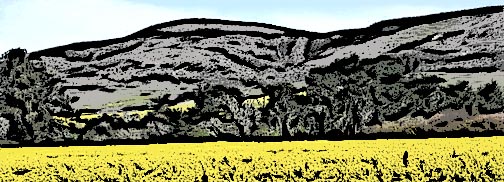 Weston County in February was awash in yellow mustard and acacia blooms. A political compromise in the early 20th Century had created Weston County as a trapezoidal wedge between the conservatives of the Anderson County timberlands to the north, and the well to-do liberals in the agri-burbs of Tolay County to the south. Weston was a sampler of both of those ideologies and equally representative in its topography. To the West, Weston was bound by the rugged coast and the wide blue yonder of the Pacific. Consisting mostly of sparsely inhabited timberland vacation destinations and upscale enclaves notched into and around sheer granite oceanside cliffs, it stretched north to the county line as a continuation of the coastal range. The south and east of the county were taken up by arable lands, home to vineyards, orchards, and truck farms encroached on, steadily and year after year, by housing developments and the attendant paving.
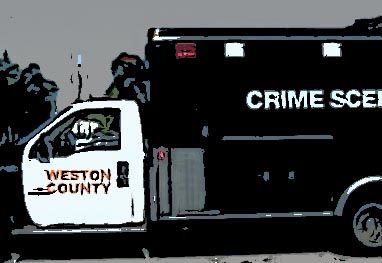 Nelson indicated the Crime Scene van and the elderly woman seated on the passenger’s side with the door open. “Mrs. Elma Snyder. Lives in the granny unit out back. Didn’t hear a thing. She found the bodies.” And as an afterthought, “The tech, Fisher, knows her.”
 The sitting room immediately inside the front door was just as immaculate and well cared for as the verandah. Had it not been for the bodies. The tech had placed yellow A-frame number placards by each of the corpses. Donovan stood in the middle of the room and observed the position of each of the dead men. Number one and two, caught sitting, right between the eyes, mouths still open in surprise. Number three, not quite a center shot and may have been standing by the way he had fallen over the arm of the chair. Four looked like he had a defensive wound on his right hand, but the bullet tore right through it and entered just below the right eye. Number five caught a slug just below the laryngeal prominence and then another at the hairline. The efficiency of the killing was chilling.
 Woodrow Ames, also known as Woody, was an animal behavior vet who deprecatingly called himself a glorified dog-catcher. A green County issue mesh ballcap held down the explosion of curly red hair that topped his skinny frame. And anyone one who knew Woody would agree with the assessment that he was fastidious about his uniform attire. A neat freak as the not-so polite would say. His new assistant, a young woman, retrieved the wire lasso at the end of a length of pole and he directed her to walk parallel to the fence in plain view of the large mastiff, attracting its attention. In the meantime, he retrieved a long dark case, the kind a pool shark might carry his professional cue in and extracted two long hollow tubes that he fit together to form an even longer tube. One end was fitted with a round rubber mouthpiece. He propped the blowgun on the open window of the driver’s side door of his truck, inserted the dart in the opening of the tube, and positioned himself to aim. His assistant, glancing back over her shoulder once, moved closer to the fence and the dog on the other side that had by then worked itself into a froth of rage.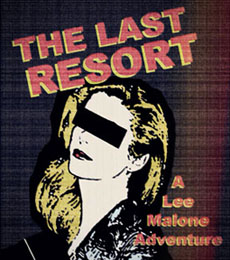
 There was a smiling Blackie leaning on a big motorcycle with his arm around a beautiful blonde betty. Why he was known as Blackie was evident from the commanding jet-black pompadour. Among the assortment of snapshots were a few professional photos of a beautiful woman in a postwar coif smiling confidently at the camera. There were group pictures: Blackie and his pals with their motorcycles sporting tight sleeveless white t-shirts, sunglasses, cigarettes dangling from their mouths. In one, a young man in an Army uniform looked out of place. Another large group photo depicted a line of young men posing with their machines and attendant women in front of a flat roofed industrial building with a sign that read Blackie’s Hole over the doorway. Blackie’s arm was around the woman in the studio photo. There was something radiant about her smile, one that instantly beguiled. I knew that smile. Intimately. Most of the women were attired in short denim jackets or peasant blouses, pedal pushers and sandals, with their big hair wrapped in decorative scarves. From her broad smile, one of the girls appeared quite proud of the way she filled out a knit tube top. She looked very familiar. Perplexed, I realized I was looking at a young Rhonda. Blackie had come to look over my shoulder.
 JJ had told me a little about Blackie when I had once asked about the good-looking old guy hosing down the sidewalk in front of the office. She had made some lame joke like ‘Blackie Widower’ but I also learned that his wife, Arlene, had run the antique store while Blackie puttered around in the workshop. After his wife died, he had kept the business open in her memory. It had always been called Blackie’s Antiques and Motorcycle Repair Shop. That had been Arlene’s idea. She thought that the unusual name would bring in the curious. It did, but, according to JJ, the curious just like to look, they rarely buy anything.
 By sheer accident, Blackie and his gang of Road Devils, on a road trip up the coast, had turned inland onto Highway 8 at Feather and stopped in Timberton. Arlene had taken one look around and claimed to have found paradise. The pines, the firs, the redwoods, the river all spoke to her spiritual inner self. Blackie couldn’t argue with that. When they got back to LA, they packed a few suitcases, sold everything they couldn’t carry and moved up to the Corkscrew River.
 A dog lunged from behind a shopping cart piled high with empty cans and bottles. It looked just like Hitler, Goldstein’s old Airedale. Maybe he hadn’t been shot after all. Maybe he’d just been kidnapped. The mud-spattered urchin, now a young girl with a wreath of dead flowers braided into her hair, followed me with the artificial birds. They were supposed to be finches but the sounds she gave them were like cats in heat.
 I hate Chicago. I hate Chicago in the winter. I hate that the snow is not white but a sooty gray. I hate that the chill winds swirl through the high-rise canyons, around your legs and up your skirt, so cold and impersonal. I love the view of Lake Michigan from my mother’s townhouse, sheeted over with ice and snow. I hate my mother’s townhouse. It’s a museum. Not a museum of Louis the XIV furniture or art deco lamps or Japanese prints. It’s a museum of me.
 On the walls of my mother’s townhouse were the constant reminders of how gorgeous I was. There were poster sized photo portraits of me by the cream of world famous photographers in the foyer. Discreetly off to one side before entering the glass walled living room was an Oglethorpe nude of me, all white flesh and black background. I was naked but none of my private parts showed. Not that any of my parts were ever private once I became a professional beauty. Still it was pronounced the most seductive image of the century. The oil baron who had privately commissioned the portrait had made that pronouncement. In the formal dining room, taking up a good part of the wall above the chrome and glass table was the most scandalous portrait of all. It was the canvas that the controversial painter, René de Ricane, had done of me, a thicket of violent brushstrokes whose suggestiveness left little to the imagination. My face, as they say, may have launched a thousand ships, but according to the painting, my body was responsible for as many shipwrecks. It was titled la Siréne, The Siren.
 I held mother’s soft mottled hands and couldn’t help noticing how much mine were beginning to resemble hers. Sometimes she was there, sometimes she wasn’t. I would get that glowing look of recognition when she woke to see me or a vague troubled frown when she didn’t recognize her surroundings. She had been a strong woman once, a gorgeous, vivacious woman, born in the Ukraine. I was a lucky combination of my father’s cocky Irish manner and her classic good looks. The way I looked was money in the bank to her, the epitome of the American dream. I had been packaged and sold. I’d come to terms with that long ago.


 Donovan shrugged. “It’s a CYA operation. Considering the identity of the road burger, everyone who’s politically connected is going to want to be in on it, if for no other reason than to cover their asses.” He stopped a short distance from the carnage, a crumpled upended vintage sports car. “That an old Porsche?”
 “Yes, when a large wave breaks close to shore it makes a thunderous noise hitting the sand. The ancients called it the ‘bull of the sea.’ They meant Poseidon, of course.” She pointed to the slide show on a flat screen TV mounted on the wall. “Here are some photos of the recent sculptures we assembled. And the artists. And their friends.” She froze a frame with the remote. “And this is Pol.” The photo was of a young, very handsome man with a long dark mane and a captivating demeanor.
 Donovan closed his notebook and turned to leave. “Thanks for your time. Sorry if I inconvenienced you.” He stopped at a small shelf near the entrance to the gallery to look at a bronze statue of a nude woman with a stag’s head that would make a nice base for a table lamp. Inscribed on the pedestal was the artist’s signature, R. Temis.
 Unprepared downspouts spit like spavined lunatics. Roiling creeks swirled gray with stirred sediment. Soggy downpour days took the heart out of jogging for me. I didn’t fight the urge to curl up on the divan with a fashion magazine or a mindless novel, the gas hearth exuding comfort like a purring cat. The horrible events of the previous week hadn’t been washed away by the dramatic change in the weather, however.
 I had to admire Rhonda’s candidness. After Wallace and Rikki had gone over to reacquaint themselves, more out of morbid curiosity than auld lang syne, I invited them all in for a drink. Anna and Ward had demurred, but Rhonda was game, and held us spellbound with her anecdotes of life as a porn actress. She was still very sassy and loved to shock as her racy stories demonstrated. I’m not one to blush, but there were a few times my cheeks burned accompanying my hearty laughter. I respected and perhaps even envied her tenacity, her toughness. Eventually Wallace and Rikki, having been drunk under the table by the old gal, passed out on the pullout couch and snored away like babies with apnea. It was then that she spoke those words. It was a truth I wasn’t going to deny.
 When I explained who I was and it suddenly dawned on him that I was the one who had been in the news, he took on a tone of fatherly authority. That’s the way it usually works with older guys. They figure if they can’t be my lover they might as well be my daddy. Apparently there were, as he put it, crispy critters in the vehicle, bodies, so they had to wait for the coroner. I focused in the direction of the hulk of smoldering metal half hidden by the undergrowth. It was a long rectangle, like a van. I stepped a few paces forward to the edge of the bramble bank and strained for a closer look. There was a round hole in the upper rear panel. Below it, a tear of melted plastic adhered to the scorched and mottled gray paint. It was the van. My van!
 The anger on the driver’s face seemed directed at me, like it was all my fault, the freezing temperatures, the ice. My thoughts turned on that odd reflection. I had been called an ice queen, aloof, unsympathetic, freezing people out. Personally I thought of my demeanor as radiant, more often too bright for mere mortals. I believed in the power of my beauty and the access that it allowed. And I used it. The downside was that everyone thought I was unapproachable. And manipulative. That wasn’t the real me, though at this point I was still a little fuzzy as to who the real me might be. Still, I could have been cashing in on any number of aging model endorsements, all legit. Instead I was writing flack for a two bit rag out in the middle of nowhere for a woman with a serious sugar habit.
 Contemplating suicide, I thought to myself as I crossed Main Street. I was accompanied by an irksome suspicion. JJ was having lunch with Detective Santos. She knew I had been after him for an interview as a follow-up on my theory that there was a connection between Fashwalla’s murder and the dog shootings. And she had brushed off any suggestion that there had ever been anything between her and Santos while he was a deputy assigned to the Timberton substation. I wasn’t convinced. I had called his office on numerous occasions and thought that I had finally secured an appointment. He said that he’d get back to me to confirm it. And now she was sending me off on a fool’s errand? If I didn’t know better I might think she was trying to steal my story. Maybe I didn’t know better.
 He caught the intent and grinned sadistically as if he had snared me in his trap. The use of force was his turf. He stepped with me as I backed to the door. He was telegraphing his moves and I calculated the arc of my swing. Then he stopped, the sneer on his face replaced by a look of puzzlement. I too stopped, having bumped against a presence behind me. I turned. He was a tall man with a full head of silver hair. He held an aluminum baseball bat against his shoulder as if he were readying to step up to the plate.
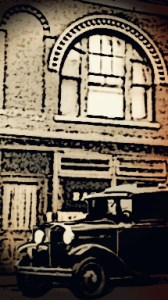 It wasn’t long before Kovic’s limo swung into view followed by a big blocky sedan carrying the troops. They all hurried inside except for one guy who stayed in the car as a lookout. He wasn’t the one I wanted.


 I pulled on a heavy peacoat and fit a stocking cap on my head. A pair of my rattier shoes and I looked like any mug that’d likely be drifting around the riverfront docks and warehouses.
 Alice gave one of her sighs and lapsed into more silence. Sipped from her cup, pensive. Her bobbed hairdo fell around her ears like the puff of pantaloons and she was gazing out the window when she said, “I was more alone than I could have ever imagined when Ted died.”
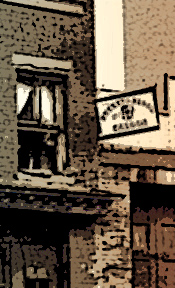 corner in the shadows where I could keep an eye on the door at the top of the stairs where Kovic had his office. I’d been there before. I knew if I went in I’d recognize the red shag carpet. I didn’t have a plan. I just wanted to get even. I’d play the rest by ear.
 In the first issue Dime Pulp presented the initial installments in the serialization of two full length novels, The Last Resort and A Detective Story, as well as a short story from the series of tales under the rubric of Hard Boiled Myths. As was often done in the days of yore, the writers appear under pseudonyms. “Colin Deerwood,” the author of A Detective Story, is an amateur historian who claims to have been inspired to write his period piece after contemplating the cover of an issue of Black Mask Magazine. “Helena Baron-Murdock,” under her own name is a scholar of comparative religions and myth and is the creator of Sheriff’s Detective Jim Donovan of the Hard Boiled Myths short story series. The Last Resort, A Lee Malone Adventure, by poet and publisher Pat Nolan (not a pseudonym but in Nolan’s estimation, he is obscure enough not to need one) was written to upend the stereotypical image of the hard boiled crime sleuth. The Last Resort was originally published by Nualláin House, Publishers, in 2012—it is serialized here for the first time.
 Dime Pulp