
by Mark DuCharme
-VIII-
“You’re late,” Waycross blurted, testily. He was the Interim Assistant Deputy Director of Transportation— that is, of transporters like me. I never met anyone higher up than Waycross. He felt it, too. He was like a petulant king.
I looked at my watch. I was about a quarter-hour late or so, I was surprised to learn.
“I’m sorry, sir, but I had a carrier incident while off-duty in the middle of the night, and I thought I should try to get the cargo to the facility directly, and thought I could do that and still make it back here on time, but I misjudged the time terribly. I’m so horribly sorry, sir.”
“Well,” he paused, “don’t let it happen again.” Then he huffed away, just as testily as before, but perhaps a bit incensed at his own uncharacteristic show of relative mercy.
I noticed the New Man several feet away, looking stealthily toward me and observing— observing the whole time, with a most curious and furtive glee.
The New Man was sinister. I felt uneasy in his presence, and so tried to avoid him. There was something odd about him, the way he’d so suddenly replaced Hank, and the silence about it, the whispers, as if nothing had happened at all, as if Hank had never been. And the New Man always seemed to be turning up suddenly at the wrong time, looking about stealthily, behind one’s back, over one’s shoulder, as if he were studying you, as if he wanted to learn your private business, as if he wanted to learn to be you. I half suspected him of being a spy for management. Maybe, it now occurred to me, he was a spy for this Thorne.
I didn’t intend to let myself be late again, but neither could I make much sense of all that had recently occurred. Then I remembered the packet Gruber had left me. I reached into my coat and felt that it was still in my breast pocket. I suddenly became more curious about it. I mean, here was I, who had been fearing that old man— or rather, his remains— and I’d been carrying his final testament, of sorts, the whole time. And why me? I was just a neighbor. Sure, I’d drunk his brandy and listened to his ravings on occasion, but we weren’t close, or so I judged. Why would he have made a point of leaving this for my eyes alone? Why would he have told Ana about it, and why did she feel it was important (if she felt anything at all) that I should get it— especially in that very strange moment when we’d just burst in upon her old daddy’s death scene? What strange jumble of thoughts rambled through her mind at that time, out of which she determined that this was the one thing she wanted to be sure not to forget? It’s not like she remembered it a week later and slipped it under my apartment door; no, she made a point of giving it to me then. Something was mysterious about it, alright. Yet I had no time to look into it now; a full day’s work lay ahead of me.
Must I confess how my curiosity began to grow and fester over the course of that day’s labors, and how my lack of a full night’s sleep only seemed to compound my general state of confusion?
Finally, after endless hours, the sun began its slow descent, and I, after having deposited my cargo, began to make my way home also. I knew as soon as I got there that I would want to read Gruber’s packet. And so I hurried.
When I finally entered my apartment, the night now having fully descended upon the city, I tossed Gruber’s envelope upon the table and removed my coat. I was hungry, but even more so was I curious, so I grabbed a beer out of the refrigerator, stuck a frozen dinner in the microwave, and sat down with the packet that had captivated my thoughts for the better part of that strange day.
I ripped open the yellowed envelope and removed the sheets of folded paper and another sealed packet that had been inside the first. When I read the contents, it became clear to me that Gruber had thought more highly of our “friendship” than I myself.
Dear Johnny,
By the time you read this, I may be dead. That’s how things go in times like these. I’ll try to explain more about that later. Forgive me if I can’t explain it all. There are some things I am about to tell you that defy reason or virtue.
On the last night you came to visit, Johnny, I could sense your skepticism, so I didn’t want to go on about all this. But nevertheless, I feel it’s important to tell you, because if I’m right, my life is in real danger, and yours is too.
I mentioned one Artemas Thorne that night. It didn’t seem like you’d heard of him. Nevertheless, he’s a very important man in this town. Some say, the most important. But I told you, or I tried to tell, that he is very, very dangerous. You must be on your guard!
Why he’s so dangerous will take some explaining. You probably already think me a little crazy, Johnny, but if you don’t, you surely will after you have finished reading what follows. I can assure you, though, that I am in full possession of my mental faculties, despite my age, even as I imagine that my assurance will not matter much to you, my dear friend. Nevertheless, because your own soul is at stake, as well as mine, I must try at least to convince you, however quixotic that labor may prove.
Johnny, strange things are going on in this city— strange and wicked things. Why do you think that all those bodies have to be brought to the abandoned warehouse before dusk? What is it your employers are afraid of? Have you ever thought about that?
Johnny— you’re smarter than you pretend to be, but if I can speak frankly, my friend, your problem is that you’re incurious.
Johnny, have you ever heard about the dead returning to life? I don’t mean to life exactly, but to some pale semblance of it. When this happens, some call those returned— those whom I believe you call “carriers”— the undead.
Johnny, please bear with me. I am not as feeble-minded as I think you think I am. I am not feeble-minded at all, in fact. But when I say this, I know you will not believe me.
Nevertheless, I persist, because you are my last hope. My daughter is lost to me. I know few people young enough, strong enough, to carry on this fight. You are both young and strong, Johnny, and if you will but believe, I know that you can see this through— and do what must be done.
You have received the calling card, by now, of Artemas Thorne, I trust. No, it’s not I who put it there! I understand your skeptical nature, Johnny— in many ways, I am a skeptic myself, as I’ve tried to stress to you, though it seems to have fallen on deaf ears. In any case, perhaps by the time you read this, you might be a bit more curious about him than when we last spoke.
I am a historian by training, if not by profession, as you well know. I have done a fair amount of historical research in my time. I have looked into this Artemas Thorne— for reasons that may become clear to you, but which for now it is difficult to fully explain. In any event, there is no record of a person of that name, man or woman (for in fact, it could be either) ever being born on this continent. And I’ve scoured all the data. I find that rather curious.
The other curious thing is that the only record— again, on this continent— of a person by that name, in any variant spelling, is of a colonist who arrived here on one of the early ships. A birth record has been found for that Artemas Thorne near London, but no death record for that person, born in 1596, has been located. Very strange.
Johnny, I am convinced that the Artemas Thorne who lives here and now and the Artemas Thorne born in 1596 are one and the same! He is one of the undead, Johnny— in fact, he is their leader, of sorts. If I am right about this— and I am almost certain that I am— then it is he who brought this plague upon our city. He is a very wicked man— or should I say, creature?
You’ll want proof. I can offer none, at least until catastrophe strikes. But if you ever wake up in the middle of the night, full of restless dreams, do not look out your south-facing window if you lack courage.
My hope and purpose in writing posthumously (should my guess prove correct, and my daughter, in that event, keep her word) is that you be awakened to this danger and act swiftly, as one should.
Most sincerely,
Augustus Aloysius Gustave “Jim” Gruber
PS: I am enclosing a second sealed letter in this first. I ask that you not read it unless and until you become convinced that I am right. This second letter will instruct you on what to do to rid this city of its plague and of the demon who brought it upon us.
PPS: One more thing, Johnny. My daughter Analeise may call upon you some evening, if she already hasn’t. Don’t let her see this letter or the enclosed one! If I’m right about all of these things, Johnny, she is dangerous too.
I was most perplexed by this strange missive. On the one hand, Gruber here sounds madder than ever before; on the other, he makes a strange sort of sense.
I grew upset. The events of the last few days had cast an unmistakable pall over things. It seemed as if I’d been drawn into some chain of circumstance that led I knew not where, and over which I had no control. I didn’t know what to do or think. I began to wish that I’d told Ana to go the hell away and gone back to sleep. I began to wish that I hadn’t knocked on Gruber’s door that night. O, what to believe?
I finished my meal, then drank another beer, then another. I went to bed at the usual time, but slept fitfully. I would have gladly settled for troubled dreams.
-IV-
I couldn’t very easily get to sleep, and when I did it was only a feeble approximation of rejuvenating repose. I did wake fully, though, around midnight. Old Gruber’s letter had haunted me, chasing back innocence’s rest. But when I glanced up at the clock and saw that it was only 11:58 P.M., I felt despair. And then, those words of Gruber’s came back to me: if you ever wake up in the middle of the night, full of restless dreams, do not look out your south-facing window if you lack courage. Gruber had been crazy, but he could be right about some things. My apartment does have a south-facing window, for example. But what could I see from there, and why would it require courage? The main thing visible from there is that old tower.
I have remarked earlier in my tale upon the unusual construction of the building in which my quarters are located— how the edifice is essentially an old Victorian house that has been added on to over the many decades hence. This is so, and the newer appendages are sometimes odd and ill-suited to the original components of the structure.
Nowhere is this more evident than in the tower. It is probably at least five or six stories in height— easily the tallest edifice for blocks around. It is constructed of mortared stones. It looks rather more like a European structure than one erected on this continent. In truth, it resembles a medieval tower more than anything post-Victorian, and so it fits right in with the odd hodgepodge of architectural styles that is the hallmark of the assemblage I call home. There are windows in that tower (fairly narrow), but there is no door at all outside its circular structure. It is said that an old door that no one ever uses— one that, coincidentally, is to be found just to the left as I exit my quarters and approach the main stairwell— actually leads to a hallway which, in turn, leads into that tower. But as I’ve said, that doorway is never used. It doesn’t seem that anyone has the key. And I have never seen lights in the tower’s somewhat narrow rectangular windows. In truth, I think that no one lives there, nor has anyone for at least as long as I have occupied my quarters.
The more I thought about it, the less sense Gruber’s statement made. You see, if I look out that window at night— or in day, for that matter— just about the only thing I can see is that tower. Now why should that be so frightening?
Here, I suddenly thought to myself, here was a chance to prove Old Gruber the benign lunatic I always took him to be. I got out of bed at once and went to that window. Surely, I would need no courage, because surely all that would be visible would be that old, abandoned tower, the darkness that engulfed it, and perhaps some faint lights down the street. This was brilliant, I thought. Surely all this vague, uneasy feeling would be resolved at once, and I would turn and go right back to bed, and sleep there like a babe in comfort.
I should not need to tell you with what chagrin I had to admit to myself that Old Gruber knew exactly what he had been talking about. For there it was, out my window facing south, that stone phallic structure. And out of one of its narrow, rectangular windows, I saw emerge to my growing horror the figure of a man. Yes, it was unmistakable. But this man did not leap to his doom, nor make some plea to the unheeding night; no. This man, instead, emerged from that window and crawled— yes, that is the right word— he crawled down the side of that building, quite like a spider. He had dark hair and was slender, but not slight, of build. He was clad all in black or dark gray— I could not tell the difference by cloudy moonlight— and his long overcoat paid no more respect to the law of gravity than his body did. When this downward-crawling human arachnid arrived at the narrow window directly below the one he had emerged from, he entered abruptly, and with an insect-like and most inhuman agility. Then— and this is the strangest part— I could see him stand up in the lower chamber he had so unnaturally entered, and turn and face me suddenly— yes, me! He was clearly aware that I had been watching him, and even in the dim moonlight, I could yet detect a malevolent smile curl his lips.
I rushed from my window in horror. Had this all been a dream? No, it couldn’t have been! I was nowhere near a state of sleep conducive to dreams, much less any state of sleep. I was wide awake, yet what I saw struck mortal terror in me in a way no nightmare ever had, even as a little boy. No, this was all too real! And this thing— this spider-creature— was now aware of me, if he hadn’t been before. My blood chilled as I reflected on this new and dreadful development.

 Captain Lydia Cheése (pronounced “Chase”), Airship Commander for Aerosud, a luxury liner airship company based out of São Paulo in the Empire of Brazil, who is searching for her father, Commodore Jack Cheése, an outlaw and antigovernmental rabble rouser.
 Professor Doctor Jean-Pierre Serre-Pain, proprietor of Madame Ophelia’s Ophidiarium, a traveling snake show, who has abducted Lydia to get her to pilot an illegal unregistered airship to HOAR (the Horn Of Africa Republic) on a mission of mercy in exchange for helping her find her father.
 Serpina, a young girl who serves as Serre-Pain’s assistant and snake handler and who is also a psychic Vessel.
 Vlady, an older bearlike man also in the employ of Madame Ophelia’s Ophidiarium and a traveling circus strongman Lydia recognizes from her past.
 Pyare, a young man with dreams of being an airship pilot, and member of LBFDS (the League Bousculier Francaise Du Sud) helping Lydia and Serpina rendezvous with Serre-Pain and Vlady at an illegal airship.
 Pax Victoriana, a period of peace imposed by the Clockwork Commonwealth and its enforcement arm, The Admiralty, dating from the beginning of Queen Victoria’s reign to the present for a total of 180 years which includes the TSR (Temporal Shift Realignment) of 56 PV (1893 AD) after which Commonwealth calendars where recalibrated to reflect Her Royal Majesty’s peaceful rule (following the devastation of the first Pandem and its resurgence 30 years later as Pandem II).
 Chief Inspector Karla Kola, head of the IOTA squad charged with capturing Commodore Jack Cheése and Lydia’s nemesis and pursuer.
 Carriers by Mark DuCharme returns with it’s gothic air of shadowy creatures who might just be the living dead. Carriers is a vampire novella with touches of black comedy and satirical bite, and is told from the perspective of its unreliable narrator and protagonist, Johnny. It takes place during a “plague” that has been going on for two years in an unnamed city. Dead bodies litter the streets, hallways, and homes. A corpse disposal company hires people like Johnny to transport them to a facility at the edge of town with the very important stipulation that the bodies be delivered there before sundown. No one ever says why. Read more in the latest installment of
  Issue 8 brings to a close Colin Deerwood’s long running serial, Better Than Dead, A Detective Story, featuring the unpredictable peregrinations of private investigator Lackland Ask, aka Stan Gardner, aka Sam Carter, and now Dr. Jerome Paulsen, O.D. leaving on a freighter for Cuba one step ahead of the law, the mob, and the draft board. All the loose ends (and there were many) are tied up or disposed of (are they?), and now the fugitive confidential agent can exit stage left. Find out how the story ends in
  This issue also introduces a new private eye, Don Coyote, brain child of Mike Servante, a newbie to the musty (and labyrinthine) halls of serial crime fiction although an aficionado of the genre, in a metatextual story that promises to be a lot of fun, titled The Man From La Mirada Perdida, A Don Coyote & Saundra Pansy Adventure. Read inaugural episodes
 I’m a good judge of character. She was in her late forties, going gray pixie cut that went with the pixie face, dangling silver earrings, intense blue eyes, mascara thick eyelashes, not so subtle green shadowed and precisely drawn eyebrows. Her lipstick was a synthetic shade of orange and probably applied with a palette knife.
  I don’t know who he thought he was, thinning red hair, tall and gangly with quite a beak, too. He dressed conservatively for this neck of the woods, slacks, open collar shirt. I’ll admit I was desperate. After Jake’s passing, I had to keep up the house payments and that meant cutting corners on other necessities. Besides, being housebound as a homemaker for a couple dozen years, I was ready to re-experience life as a single woman.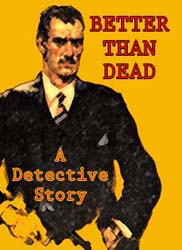


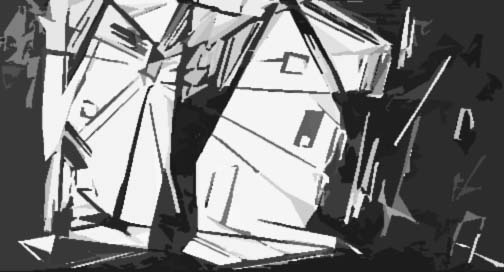

 Phyllis Huldarsdottir returns with the continuing adventures of Airship Commander Lydia Cheése (pronounced “Chase”) searching for her anti-Commonwealth renegade father, Commodore Jack, with the help Doctor Professor Jean-Pierre Serre-Pain, proprietor the Madame Ophelia’s Ophidiarium, a traveling snake show, and his associates, former circus strongman, Vlady, and Serpina, the snake girl. On the run from IOTA (the Investigative Office of The Admiralty), she has narrowly escapes capture by her nemesis, Chief Inspector Karla Kola, in Oldest Orleans, and now with the help of a young wannabe airship pilot, Pyare, must traverse the Central Massif to rendezvous with Serre-Pain and the dirigible that will take them on a mercy mission to HOAR (the Horn Of Africa Republics), base for the anti-Commonwealth ICERS. Read more in
 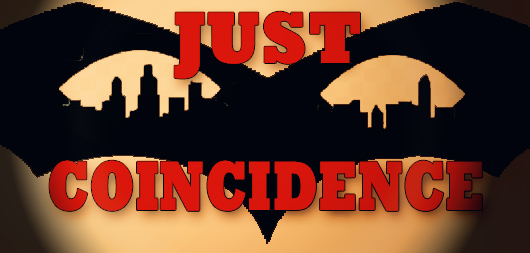 Pierre Anton Taylor’s dark crimefighting serial, Just Coincidence is about a privileged young man with the unremarkable name of Wayne Bruce who returns to the site where his father once had his business, a battery manufacturing plant, and where he often spent his childhood days hanging around the factory and the neighborhood. His return is haunted by the mysterious circumstances surrounding his father’s death and the vague feeling that his uncle is somehow involved. Appalled by the poverty and crime of the place he remembers fondly, he is moved to resolve the injustice of the socially marginalized and to wreak vengeance on those he believes are responsible for the death of his father. In this new episode, the young crimefighter continues to investigate the unexplained death of his father, and the robbery murder of old Rick, the candy store owner, as well as the strange new street drug, Wacky Waxx. Read more in
 Last but certainly not least, Colin Deerwood’s long running serial, Better Than Dead, A Detective Story, continues its unpredictable peregrinations featuring private detective Lackland Ask, aka Stan Gardner, aka Sam Carter, on the run again when he learns that his bucolic hideaway in the Three Lakes area is also where his nemesis, mob boss Yan Kovic, aka Mr. K, is ducking the feds. Now it is even more imperative that he make himself scarce, especially after a crooked local constable in league with Mr. K’s hoods try to finish him off. In the meantime, thanks to the moonshiner’s daughter and a lusty cousin, he learns a surprising revelation about his paternity. On his return to the big city from the country, still on the lam, Lackland Ask has to scare up some cash and make plans to flee the country under an assumed name with one minor hitch: he has to be blind. Read more in

 Captain Lydia Cheése (pronounced “Chase”), Airship Commander for Aerosud, a luxury liner airship company based out of São Paulo in the Empire of Brazil, who is searching for her father, Commodore Jack Cheése, an outlaw and antigovernmental rabble rouser.
 Professor Doctor Jean-Pierre Serre-Pain, proprietor of Madame Ophelia’s Ophidiarium, a traveling snake show, who has abducted Lydia to get her to pilot an illegal unregistered airship to HOAR (the Horn Of Africa Republic) on a mission of mercy in exchange for helping her find her father.
 The reasoning behind the stealth of his action, the risky wingsuit flight from the penthouse, other than another opportunity to recharge the adrenaline, was that he was certain he was being watch, followed. Even as he made his way to the Battery Work along the deserted streets, the sirens wailing in the distance, fire and police, he stayed out of sight, reversing his path, scaling walls, cutting through alleys. He saw no one, but then the temperatures were freezing in the dark AM.
 Dime Pulp