
by Pat Nolan

“Let’s begin the proceedings. How does the defendant plead?”
Billy Brazil stared blankly at the magistrate. Then, as if startled, answered, “What’s that?”
His lawyer, Abe Falk, leaned over and whispered into his client’s ear.
“How does the defendant plead?” the judge repeated.
“Not guilty, your Honor,” Brazil replied quietly.
“Very well, Mr. Prosecutor, call your witness.
“I call Mr. Adams to the stand.”
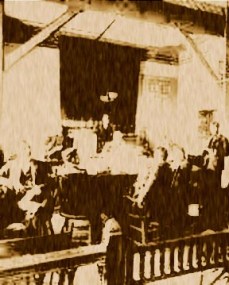 Adams, his green bowler clutched to his chest, took his seat in the chair next to the magistrate’s table.
“Do you swear to tell the truth and nothing but the truth so help you God?”
“I do.”
“State your full name for the record.”
“Charles Adams.”
“To the best of your recollection, what took place on the road to Las Cruces?”
“I stopped the buggy to urinate, and while I was standing there, I heard the old man say ‘Well, damn you, if I don’t get you off one way, I will another,’ or something like that.”
“Where were these people in relation to you?”
“The old man was in the buggy and Brazil was on his horse. They were at my back.”
“So you did not see the deceased standing upright at all?”
“I think when I seen him, the first shot had been fired and he was staggering.”
“Did he fall to the side, to the front, or to the rear of the buggy?”
“About two feet to the side.”
“Where was the defendant at the time?”
“He was on horseback, about even with the buggy. He had a six-shooter in his hand.”
“Who fired the second shot?”
“My horse bolted and I had to grab the lines and wrap them around the hub of the wheel to stop him from running. Then I went over to where the old man lay.”
“What about the defendant?”
“He was still on his horse and about in the same place.”
“Did the deceased speak?”
“When I got to him he was just stretching out. He did groan a little, and he might have said something. It sounded Mexican.”
“And what was that?”
“I can’t be sure.”
“Could you venture a guess?”
“It sounded like he might have said quien es?”
“What about the defendant, what did he say after all this had transpired?”
“He did not say much. He said, ‘This is hell.’ and he handed me his six-shooter.”
“Your Honor, I have no further questions.”
“Very well, Mr. Adams, you may step down. Mr. Prosecutor, call your next witness.”
“I call the Dona Ana County medical examiner, Doctor Fields, to the stand.”
A large man with a wide intelligent brow and graying muttonchops removed himself from the chair behind the prosecuting attorney’s table and strode to the witness stand.
“Do you swear to tell the truth and nothing but the truth so help you God?”
“I do.”
“State your full name for the record.”
“Walter Charles Fields.”
“You are the medical examiner for the County, is that correct?”
“Yes, it is.”
“Can you describe what you found when you arrived at the scene of the crime?”
“I found the deceased in a six-inch sand drift about four miles from town on the road to Las Cruces in an area known as Alameda Arroyo.”
“And what was the disposition of the body?”
“The deceased had been shot twice, once in the head and once in the body. He was lying flat on his back, one knee was drawn up. His trousers were unbuttoned and his male organ was visible which would indicate that he had been urinating at the time he was killed.”
“Was there a weapon at the scene?”
“Yes, there was. A shotgun identified as belonging to the deceased lay parallel to his body about three feet away. It lay on top of the ground without any sand kicked around it.”
“And what were the findings of your autopsy?”
“The deceased had been shot twice, one shot hitting him in the back of the head and emerging just over the right eye. The second shot was fired when the deceased was on the ground, the bullet striking the region of the stomach and ranging upward.”
“Thank you, Doctor Fields.”
“When a man is shot in the back of the head, he does one of two things with what he has in his hand. Either he clutches it convulsively tight or he throws it wide. There were no signs in the sand that the gun had been violently thrown. I would therefore conclude that this could not possibly be a case of self-defense as claimed by the defendant, but murder in the first degree.”
Abe Falk leaped to his feet. “I object! The witness offered conclusions that go beyond the scope of the original question!”
“Mr. Falk, this is not a trial, merely a hearing to determine the circumstances. . . .”
“All the same, your Honor, I respectfully request that the last comment by the witness be struck from the record.”
“Very well. Objection sustained. Doctor Fields please restrict your answers to questions asked by the prosecutor. Mr. Prosecutor, you may continue.”
“No further questions, your Honor.”

“Quien es?”
“That’s all he said?”
“Near as I can recollect, yes.”
“Could you see his expression?”
“No, he was pretty much just a shadow.”
“So you couldn’t tell if he saw you.”
“No, I don’t think he saw me.”
“Then why did he ask, ‘Who is it?’”
“He was asking Pete who the boys on the front porch were.”
 “And Pete was in his bed.”
“That’s right, and I was crouched down in the dark next to him.”
“How did you know it was him?”
“Pete said, ‘That’s him!’”
“Then what happened?”
“I shot him.”
“How many shots were fired?”
“Two.”
“He fired back then.”
“No, both shots were mine.”
“What did you do after you shot him?”
“I got the hell out of there. I didn’t know if I’d killed him or just wounded him.”
“He was armed, though.”
“I couldn’t tell at the time that I shot him. Later, after I was sure that he was dead, I saw that he had a butcher knife in his hand.”
“I find it hard to believe that a desperado of his reputation would be walking about without a firearm.”
“He did favor that self-cocking revolver.”
“He didn’t have it on him?”
“I didn’t see it if he did.”
“Did you look for it?”
“No, once he was dead, I figured that no amount of pistols were going to make him any more dangerous.”
“Pat, I’d hate to think that you shot an unarmed man.”
“I had no way of knowing if he was armed or not, Ash. I wasn’t going to take the chance that he was and ask him.”

“You had a chance to see how cool and calculating he could be, when you were operating Beaver Smith’s saloon over in Fort Sumner, didn’t you?”
“He had come in with some of his compadres. That lot had been in there a few times before. They generally behaved, hoisted a few and played cards like most of the regulars.”
“I’ll wager he did like to belly up to the bar.”
“Can’t say that I ever saw him take a drink of liquor. He was partial to the paste boards, though.”
“Yes sir, he was adept at cards from a very early age. I should know, I boarded at his mother’s establishment in Silver City. He was quite a handful even in those days.”
“As I was saying, I was engaged in a game of chance at a nearby table and I had a good view of the goings-on.”
“Some hold that poker is more of a game of skill than chance, Pat.”
“Ash, you know as well as I do that when I play poker, it’s a game of chance. . .there’s always a chance I might win!”
 “Sir, your wit is like prairie lightning, bright and dry. Allow me to top your glass off with another jolt. But, please, please, continue. . .I apologize for my interjections.”
“One of their bunch, an hombre with the go-by of Grant looked to be getting pretty damn drunk pretty damn fast. He yanked a six-shooter out from an old saddle tramp’s scabbard at the bar. He waved it around, keeping it away from the old man, teasing him. He was an accident waiting to happen.”
“Certainly, that gun could have easily gone off and pelted somebody with a lead plum.”
“The boy came over to Grant, laid his hand on the pistol, said a few quiet words to him, and got Grant to let go of it.”
“That should have been the end of it.”
“Well yes, but no sooner had he gone back to his game, Grant snatched up the revolver again, walked be-hind the bar, and began breaking bottles and smashing glasses. I’d about had it with him by then.”
“I’ll say. He’d made himself pretty unwelcome.”
“But before I could get to him, little Jimmy Chisum collared Grant and was about to do my job for me.”
“Jimmy Chisum, now there’s a rooster.”
“Grant turned on him like a snake caught by the tail. He threw down on him with that old tramp’s six-shooter and cocked the hammer back.”
“That sounds like a mighty close situation.”
“Things got very quiet right about then. But as I said, the boy was a cool customer. He walked right over to Grant and said to him ‘why don’t he put that gun down and get the hell out of here before someone gets hurt.’”
“Now Grant was not a greenhorn desperado, was he?”
“That’s right, and he was on the prod!”
“But the kid was cool as the shade.”
“He didn’t take his eyes off Grant. And Grant, who had the look of a man gone too long to the bottle, was suddenly as sober as a country Baptist. What’s more, he had the drop on him. Then he said something like ‘now, you little bucktoothed sonofabitch, I got you!’ and he pulled the trigger.”
“What happened?”
“Nothing. The gun misfired.”
“You don’t say.”
“And they weren’t any further apart than you and me.”
“What did he do?”
“He blew the man’s head off. I was finding bits of brain behind the bar for weeks!”
“Last week you talked about how you couldn’t scare up a posse to go out after him and his gang. How did you manage to secure the assistance of the Canadian River boys?”
“The Panhandle Cattlemen’s Association had charged them with locating and bringing back stock that had supposedly been rustled by the men we were after.”
“So just who were those Canadian River boys?”
“Damn it, you know as well as I do who they were, Ash!”
“Refresh my memory, Pat. For the purposes of our narrative and the eventual readers of this book, it’s important that we get the details right.”
“Let’s see. Frank Stewart, of course, Lee Halls, Jim East, Lon Chambers, a character they called ‘The Animal,’ Poker Tom, and Tenderfoot Bob. Charlie Siringo was among that bunch, but he and a couple of others declined to take up the manhunt. I didn’t blame them, they were mostly cowhands. That was not what they had hired on to do.”
“Stewart must have understood that if you captured those boys, the stock depredations would most likely stop.”
“I had developed information that the men we were after had been seen in the vicinity of Fort Sumner.”
“Yes, you might say that Sumner had a fatal attraction for him, like a moth for a flame.”
“Once there, I had the men lie low and keep their presence concealed. I took a turn around the Plaza. There I ran into old man Wilcox’s son-in-law, Juan. I had suspicions that he might have information I was after. I was right. He had been sent to town by the gang with instructions to return and report on the lay of the land.”
“All right. Hold up while I get all this down. This was in December of ’80, am I correct?”
“That’s right. The weather had been particularly bad. A blizzard had blown through just the day before. There was a foot of snow on the ground if there was an inch. ”
“Good, good, weather conditions are important. They set the scene for the events about to transpire.”
“Juan confirmed that the men I wanted were at his father-in-law’s place. I knew Wilcox was a law-abiding citizen, but had he betrayed them, they would have killed him without second thoughts.”
“They were nothing if not cold blooded and ruth-less.”
“It seems that they had planned to come into town the following day with a load of beef. They learned that I was on my way to Sumner and so Juan had been sent in to size up the number of my force.
“I asked Juan if he would work with me to set a trap. He agreed immediately. I hunted up someone I knew to be sympathetic to these men and forced him to write a note saying that my party and I had left for Roswell and there was no danger. I also wrote a note to Wilcox stating that I was in Fort Sumner with my men, that I was on the trail of the gang, and that I would not let up until I got them. I gave the two notes to Juan. I warned him not to mix them up as his father-in-law’s safety depended on it.”
“You were confident that if those boys took the bait that they would ride for Fort Sumner that night.”
“That is so. I also knew he would be leading his gang. . .”
“Consisting of. . .”
 “Dirty Dave Rudabaugh, Billy Wilson. . .”
“A wanted murderer and a counterfeiter.”
“Tom Pickett, Tom Folliard, and Charlie Bowdre.”
“Guilty by association.”
“The old military hospital building was on the east side of the Plaza, the direction I expected them to come in from. Bowdre’s wife also occupied a room in that building. I figured that they would pay her a visit first. I took my posse there, placed a guard about the house, and awaited the game.”
“The boys got the cards out and engaged in a little prairie pastime while we waited. It was getting on dark and we had secured a room in another part of the old hospital to keep out of the cold. Snow was lying on the ground increasing the light from the full moon outside.
“Around eight o’clock, one of the guards called from the door, ‘Someone is coming!’ They were two hours earlier than I had expected them. ‘Get your guns, boys,’ I said, ‘None but the men we want are riding tonight!’
“Lon Chambers and I stepped out onto the verandah. The rest of the men went round the building to intercept them should they aim to pass on into the Plaza. The gang was in full sight approaching. Folliard and Pickett rode in front. I was close against the adobe wall hidden by the harnesses hanging there. Chambers was next to me. They rode up until Folliard’s horse poked its head under the porch. I called out ‘Halt!’
“Folliard reached for his pistol. Lon and I both fired. His horse wheeled and ran. I fired at Pickett but the muzzle flash from Lon’s rifle had blinded me and so I missed him.”
“I’ll bet he was taken aback.”
“You would have thought by the way he ran and yelped that he had a dozen balls in him.”
“What about Tom?”
 “Folliard was crying and moaning. He had received his death. He managed to wheel his horse and ride back toward me. He called out, ‘Don’t shoot me, Garrett, I’m killed!’ One of my men ran out toward him, yelling, ‘Take your medicine, old boy, take your medicine.’ I warned him off. ‘He may be killed but he’s still heeled and liable to spit lead!’ I stuck to the shadows. ‘Throw up your hands, Tom, I’m not going to give you the chance to shoot me,’ I said. His horse stopped right in front of where I was standing.”
“Did he say something like ‘I’m dying, goddamn it’?”
“He moaned some. He was doubled up in the saddle.”
“I’ll wager he said something like, ‘I can’t even lift my head!’ and ‘It hurts, it hurts.’ And finally ‘help me down, let me die as easy as possible, boys.’”
“I don’t recall his exact words if he even spoke any. He was in a world of pain.”
“What happened to the rest of the gang? How did they fare under the onslaught?”
“During the encounter with Folliard and Pickett, the party on the other side had engaged the rest of the gang, had fired on them, and killed Rudabaugh’s horse. I learned later that it ran twelve miles under him, to Wilcox’s ranch, before it died. Soon as my men fired, the remaining outlaws ran off like a bunch of wild cattle. They were completely surprised and demoralized.”
“But Tom Folliard’s luck had run out.”
“That it had. We unhorsed him and disarmed him and laid him out on a blanket on the floor of the hospital. He begged me to end his misery. ‘Kill me,’ he said, ‘if you was ever a friend of mine, Garrett, you’ll kill me and end this torture.’
“‘I have no sympathy for you, Tom,’ I replied, ‘I called for you to halt and you went for your sidearm instead. I’m no friend of a man who would shoot me simply because I was doing my duty. Besides,’ I said, ‘I would never shoot a friend as bad as you have been shot.’
“Now when one of my men came up to where we were, he changed his tune. ‘Don’t shoot anymore, for God’s sake, I’m already killed.’”
“Who would that be?”
“It was Barney Mason who, along with Tip McKinney, was part of my original posse.”
“Married to Polly’s sister.”
“That’s correct.”
“And a notorious horse thief.”
“So some claim, but he proved invaluable in tracking down these desperados.”
“What did he say to Folliard?”
“Oh, he said something like ‘take your medicine like a man, you ain’t got much of a choice.’ And Tom answered, ‘It’s the best medicine I ever took, pard, but it hurts like Hell.’ He asked, ‘Could you have McKinney write my old grandma in Fort Worth and tell her that I died, can you do that, old chum?’ Barney answered him, ‘Hell, you’d kill your old grandma if she found out that you died with your boots on, Tom, it’s best that she didn’t know.’
“At one point he exclaimed, ‘Oh my God, is it possible that I must die?’ I said to him ‘Tom, your time is short.’ and he replied, ‘the sooner the better. I will be out of pain.’ He expired soon after that.”

 In late February of 1908, a one-time drover, buffalo hunter, saloon owner, hog farmer, peach grower, horse rancher, US Customs inspector, private investigator, county sheriff, and Deputy US Marshal set out from his adobe home on the mesa above Organ, New Mexico accompanied by a young man in a black buggy on the journey to Las Cruces. He would never arrive. This is the story of that journey, a novel account of the last day in the life of a legendary lawman.
 In March of 1892, a Scotsman by the name of Arthur C. “Artie” Doyle was hanged by the neck until dead after being found guilty of a string of grisly murders of prostitutes in Whitechapel. At that moment, history veered off its presumed course and headed in a direction all its own in which the Great War never happened because the Kaiser was afraid of offending his grandmother, Queen Victoria, whose life has been prolonged by the wonders of biology. The peace of her reign, known as the Pax Victoriana, despite some major environmental disasters, has lasted 180 years keeping as many Victorian airs as possible while making accommodations to bio technology. Cheése Stands Alone poses a steampunk question, can Captain Lydia Cheése find her father, the antigovernment turncoat and radical, Commodore Jack “Wild Goose” Cheése. And furthermore, will her quest take her around the globe and through alternate world histories in the requisite 80 days or is it the beginning of a lifelong journey?
 In Just Coincidence, a privileged young man with the unremarkable name of Wayne Bruce returns to the site where his father once had his business, a battery manufacturing plant, and where he often spent his childhood days hanging around the factory and the neighborhood. His return is haunted by the mysterious circumstances surrounding his father’s death and the vague feeling that his uncle is somehow involved. Appalled by the poverty and crime of the place he remembers fondly, he is moved to resolve the injustice of the socially marginalized and to wreak vengeance on those he believes are responsible for the death of his father. A personal coincidence brings together dark prince and a dark knight joined together in a fateful and tragic quest for justice
 “That’s quite an antique.” A square shouldered black man on the step leading up into the store spoke the words. He was referring to the black sedan parked at the curb.
 “The Battery Man. I remember the billboards. Nobody Beats A Bruce! You that kid? I heard about you. Come on, come on in.” He pushed the door open and the hinge squeaked like a cry for help. “He’s in the back, come on.”
 Wayne paused to recall. “A quarter.” And then, “But I remember when they went up to fifty cents because I came in one day and all I had was twenty five cents, two dimes and a nickel, and you told me that the price had gone up. But you sold it to me anyway, that I could pay the rest next time.”
 Wet occupied the air and chilled it. In the yellow-brown light of the doorway to Quinn’s Tavern, the rain striking the concrete jumped like sparks off a hot griddle. The door opened quietly, disturbing neither the wide shouldered man with the bar towel over his shoulder, gaze intent on the square of color TV mounted above the bar, who laughed along with the track, a rheumy asthmatic rasp, or the other two hunched over in the shadows of a back booth, laughing, giggling, but not at the TV, a sitcom about people who frequent a bar similar to this one although certainly less sinister.
 What she saw did not please her, a fringe of auburn hair, brow knit into a frown, grey eyes staring back in anger. Not again, she thought. Two groundings in as many weeks, and her suspension only just overturned. Tossing her tunic onto her grandfather’s vraisther smoking chair, she glanced at the stack of documents on the side table. In particular, she eyed the communication she had set aside the day before when she had been too preoccupied with preparing for her flight out of Lesser London to give it much more than a cursory glance. Addressed to her, handwritten in green ink, that in itself unusual, on what felt like a slip of parchment. “Parchment, really?” she said aloud. It was just one of the many come-ons and false leads she had received since she advertised a reward for information as to proof of life of Commander Jack Cheése, her father and the brilliant airship engineer who had disappeared many years ago, around the time she had entered the Air Academy for the freshman term.
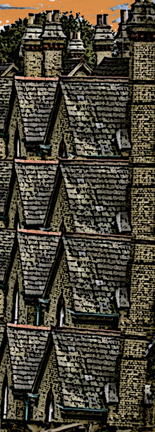 Baker’s Square was hemmed in by blocks of apartment dwellings designed to look like rowhouses, stacked one atop the other. They were all the same whichever way you looked. Their sameness caused her a momentary claustrophobia.
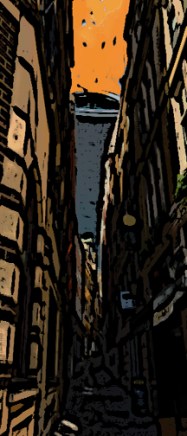 The pickpocket veered into the alley between two buildings with Lydia still in the tangle of panicked underdwellers. She kept her gaze fixed on the hobbling figure and once free of the mob ran swiftly to the entrance of the alleyway. The already inefficient bacso street lamps hardly penetrated the deep darkness of the cleft between buildings. Indignation overrode her sense of caution and she strode into the shadows. Slowly her eyes gathered the available light and sharpened to the dark. An oversplash of orange from the city above allowed her to discern edges and contours. The young purse snatch bobbed hurriedly toward the light of a parallel street at the other end.
 Perhaps it was the black and white cowhide vest trimmed with red piping that seemed so outlandish. The Montana peak of the Stetson’s crown was all the latest rage among the younger range hands and it did not surprise him that Brazil sported his in the same manner. The red flannel shirt was a little hard on the eyes and the stiff Levi’s pants looked brand new blue stuffed into the tops of his boots, a pointy toed, riding heel variety. And the big blood bay was enough horse for any man. Troubling too might have been the revolver the young man had strapped to his waist, but that also appeared part of a preposterous affectation. In his slightly inebriated state, the old man had the feeling that he was watching the final hand of a card game, but from a distance, a fuzzy distance.
 “I don’t care for them. They’re just a passing fancy. They will never catch on. The rich folk will use them to parade around. You can’t go any distance in the damn things without them breaking down or getting stuck and needing a horse or mule to haul them out or needing to feed on that stink water!”


 He and Black had gone out to the Cott Ranch in Black’s buckboard. Jorge had followed on horseback. Not far from the ranch house, he had left the buckboard and horse with Black and he and Jorge had gone on foot down around the bluff, following the path to the rear of the garden. They had quietly tripped the latch to the gate and quickly crossed the red tile patio to the open kitchen door. Billy Reed, a tall, burly young man with a crop of dirty blonde hair, had his back to them. He had been helping Shirley Cott in the kitchen. He had leveled his Colt at the large young man, asking, “Are you Billy Reed?” The young man had turned slowly and nodded yes. Informed of the warrant for his arrest, he had nodded his assent and extended his wrists giving the indication that he would go quietly.
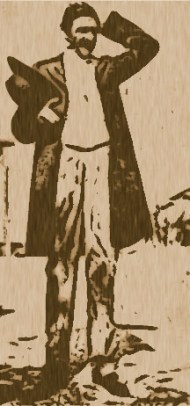 The old man would not show his profound disappointment. He managed a laugh though it was an empty one. “It makes no difference if you do or not.” He stood up, a little unsteadily, and dismounted from the buggy, leaning his shotgun against the bench. “I’ll get you off that land one way or another.” He turned his back to the two men, saying, “Think I’ll water a little mesquite myself,” and walked to the opposite side of the road. He was livid, the very notion that the deal he had counted on to reverse his fortunes had gone sour was almost more than he could stand. His legs felt weak, his gut churned, and it was not just from the aguadiente. His ears were ringing, his breathing labored. Again, Ash’s voice insinuated itself. It was as if he were calling his name, but from a far distance. He let himself go at the side of the road. The stub of cigar in his other hand had gone out. It was not worth firing up again. It was done. He tossed it aside. He was done.
 At the end of the line the late afternoon sun passing behind a cloud defined a horizon of ship yard cranes and a thicket of masts. Fenced lots echoed with the barks of loud vigilant dogs and the brick warehouses, some seeming abandoned, maintained a grim silence. The rail yard was nearby, and a block of shabby businesses: a café and bakery, a corner grocer’s, a laundry, a hotel, a snooker parlor, and the address I was looking for.
 “No, no you’re doing it all wrong! Didn’t they teach you anything in that fancy Swiss boarding school of yours?” And I showed her how, breaking off a piece and dipping it in the coffee just enough to wet it but not get it soggy. “That’s the way it’s done, kid.”
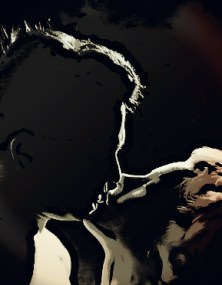 I was tempted, pulling her up against me, her head tilted back at my response. My judgement when it comes to women hasn’t always been the best, and maybe I could even blame my lapses on my inability to figure them out even when I gave it a try. The hardest part of this jobs was resisting that urge. How many unfaithful wives of unfaithful husbands had offered themselves as partial payment or as a bonus for my peeping, and every time I gave in I was reminded soon after of what a mistake that had been. I couldn’t afford to be swayed.
 The lid of one of the crates had been pried up and I lifted it off. All of a sudden I felt like Ali Baba minus the forty thieves, and I didn’t have to say Open Sesame. Nestled in among the packing straw were five Thompson machine guns, gleaming with oil as if they’d just been foaled. This was my ticket out. Any one got in our way they’d get the business end of old Tommy.


 Ron Goulart may be viewed as a lightweight by the toting crowd but the sheer volume of his engagement in the pulp/comic genre allows him to claim the turf he helped established. He was the author of over two dozen compendiums on comics and golden age pulp fiction illustrating the comic book’s emergence from the fantastic pulp genre and the Sunday Funnies. He wrote numerous futuristic novels that played off the unintended Schumpeterian and most often hilarious consequences of mechano-tech—he was the gleeful saboteur of a Popular Science future. Of the over two dozen nonseries novels, including Clockwork Pirates (1971), The Robot in the Closet (1981), and Now He Thinks He’s Dead (1992), most are of a whacky dysfunctional Murphey’s Law universe. His Barnum System series of novels is a planetary circus of its own with such titles as Spacehawk, Inc. (1974) and Galaxy Jane (1986) among numerous other linked and obtuse permutations his agile mind could hatch: Hail Hibbler (1980), After Things Fell Apart (1970). Goulart’s era was the twenty years span from the mid-70s to the early 90s in which he wrote under many pen names (Chad Calhoun, Zeke Masters, Jillian Kearny) as well as his own, collaborating on a range of projects in the pulp comic book genres which included penning Flash Gordon stories, Vampirella, and Avenger. In the 1970s, he wrote several novels based on Lee Falk’s The Phantom (“the ghost who walks”), a character incorporating proto-super heroes, essentially Tarzan as Batman with a brace of 45’s, for Avon Books under the pseudonym “Frank Shawn”.
 Both PIs, Sughrue and Milodragovitch are hard drinkers, and hail from the cowboy states, Texas and Montana, the author’s home turf. They are the giants from the north exacting their version of justice in a particularly cockeyed world. A natural born storyteller, Crumley spins tales of mishaps and bad luck death defying scrapes that are often hilarious in their telling but also tragic in their own right as a history of bad choices. His characters inhabit a world of regret and wounded psyches. Often times the graphic violence seems gratuitous, yet no one would doubt the authenticity of the pictures Crumley paints. Crumley’s is a world of right and wrong with a lot of leeway gray viewed from the other side of the tracks where there is honor of a kind among outlaws and where some situations can only be resolved by violence. The plotting of the novels allows Crumley’s penchant for the shaggy dog tale and wide ranging hair of the dog that follows.
 Lew Griffin, Sallis’s PI, is portrayed realistically, not as a knight in shining armor, but as gritty, a survivor in spite of himself, haunted, flawed. Griffin is featured in six novellas, all titled after insects (companions of the loner or lonely man) beginning with The Long Legged Fly in 1992 and including Bluebottle in 1999, and Ghost Of A Flea in 2001.The action is often muted, viewed in the aftermath or off camera, the consequences telling the story that led to them. Lew Griffin is a black man, obviously self-educated and fond of quoting French authors, living in or on the edge of poverty in and around New Orleans. He finds people or saves them or kills them but always with lengthy soul searching consideration. He’s a tough guy because he is forced to be not because he wants to be. He has no illusions, thus the basis of his sustained noir ennui.. The tang of adrenaline is rare in Sallis’s crime fiction yet the depictions and progressions of the stories are always satisfying, literate contemplative ruminations on the human condition.

 He was going on about other things, Commies, getting loud, angry, until the cook waved a big metal spatula at him and told him to turn it down. I was looking at my hands trying to be invisible, hat pulled down over my ears, dark glasses no matter that they looked like beach wear. A problem had developed. Because of Sid’s frap between the eyes, the bruise around both of them had turned the color of a ripe eggplant. I didn’t think my nose was broken but it was still throbbing the next morning.
 As if no one would take a gander at my beat up mug wearing a pair that belonged on a Hollywood dame. I held them in my hand as I had then to compare. There wasn’t too much of a selection in the box, mostly a tangle of round wire frames and cracked lenses. At the bottom was a square set of black lenses, the kind you might see on a blind man. I tried them on and they fit with a certain weight that felt comfortable. I turned on the stool and looked at my reflection in the diner’s front window. I was unrecognizable. I slipped Lee’s pair into my jacket pocket and smiled even though it hurt. “Whadyeoweya?”
 I had a card in my wallet. It was Yamatski’s card, the one that promised a reward if his address book got lost and found and gave a phone number and an address to return it to. My original idea of taking a look at his setup and maybe taking something that might be worth my trouble came back into play. It would be dangerous and I didn’t think I should drag Becky into the scheme which was essentially a burglary. But when I told her I had to be someplace, she gave me such a sorrowful look and pleaded, “What will I do while you are gone? Alice is still very angry with you, with me. I have no place to wait.”
 Fourteen years had passed since the old buzzard died. Lately his memories of Ash had been frequent.
  “Well, Abe Falk didn’t get to be one of the most powerful men in the Southwest by being a pussycat. He tore into Welkin like an auger into rotten wood. By the time Falk was done with him, he was lucky if he knew who he was. It even looked to me that he had made him into a witness for the defense!
 “I supposed you eventually apprehended O’Lee and Leland. They did stand trial, if I recollect.”
 “I knew that an arrangement had been made for O’Lee and Leland to surrender themselves to George Kerry in Las Cruces but no date had been determined. I was up in Santa Fe collecting a prisoner for extradition to Texas when an acquaintance who worked in the Governor’s office informed me that O’Lee and Leland would be boarding the train somewhere along the line between Santa Fe and Las Cruces in the custody of Kerry’s deputy. As luck would have it that was the very train I would be taking to El Paso with my prisoner. Accompanying me was John Hume, a Texas Ranger.
 “I explained my plan to Captain Hume. We chained our prisoner to his seat and then we walked back to the smoking car. Those boys must have seen us coming as it was mighty quiet when we stepped into that car. Right away, I recognized the men I had been chasing. Both had full beards. Leland wore dark glasses and pretended to be asleep. The deputy had his face buried in some French blue book. The man I wanted, O’Lee, was hiding under a railroad cap. We had worked it out beforehand that Hume would cover Leland and the deputy, and I would have a go at O’Lee. I went over to where O’Lee was sitting, stiff as a raw hide in a snowdrift. I planted my foot on the armrest of the seat next to his and made like I was looking for some reading material in the newspapers and magazines stacked there. Then I leaned against the back of his seat and looked out the window, casual-like, as if I was enjoying the scenery. I was close enough to see the sweat rolling down the back of his neck. Those boys didn’t know whether to shit or go blind.” The old man chuckled, replacing the cork. “I’d say that’s a memory I’ll always savor.”
 “Falk had the venue of the trial changed because he claimed that his clients would not receive a fair trial in either Dona Ana County or Ortega Country.
  “You would have thought it was fiesta week in Hillsboro. Why, Western Union even ran a wire up there just for the trial! They had reporters come from as far away as New York and London. Folks were arriving by the wagonload everyday just to get a seat in the courtroom as if it was some kind of opera or musical concert. The hotel was packed four to a room in no time, mostly with O’Lee partisans. Tent camps were set up all over the hillside on the outskirts of town. The truth is, the jury had to sleep in the hayloft at Hank’s livery!
 Dime Pulp