Category Archives: Crime Fiction

Better Than Dead—28

by Colin Deerwood

Ads121

Thorny was a problem. He wasn’t where I left him after I’d clobbered him with the can of beans. I froze in front of the cabin’s porch. The Scout was still there. But the shadows were deeper and longer as the sun settled behind the trees at the other end of Little Lake. My ears piqued, I listened for any sound that he was nearby. I crouched lower, head cocked. I examined the dark shadowed undergrowth among the trees, ahead and behind me. If I was lucky, Thorny ran off when the shooting started. A snap of shrub or stick turned my attention to the path leading over into the berry bramble. If he still had his shooter, I was fish in a barrel. I ducked around the fireplace where the cook’s earlier fire smoldered and sent up puffs of smoke. I was looking for something to defend myself with. I picked up the skillet. It was heavy but too small and I didn’t think I’d have much luck batting bullets away with it. There was an assortment of forks but no knives. I knew where the knives were. In the kitchen. But I’d have to get into the cabin through the front door. A wide open target. I grabbed a length of firewood from the kindling pile. It was too short. Now I was sure something was coming from the direction of the brambles by the rustling and commotion. The loud grunts. Maybe I’d broke his skull when I walloped him with the gunny sack weighted with a can of beans and a jar of white lightning. And he was writhing in a death agony in the berry bushes. I grabbed a stout faggot from the smoldering coals in the fireplace and poked my head around the corner of the cabin. Even in the encroaching dark it was obvious something was shaking the bushes. It had to be Thorny.

“He was dripping blood from his jaw!”

I looked at the stick in my hand. It was smoking. The tip was a red hot coal. If I got close enough, I could poke him in the eye. I dashed across the yard to the shadows of a large lilac bush that Granny had planted there many years ago. I realize that the glowing end of the stick was a dead giveaway and was about to toss it when I heard a sound I was sure Thorny could never make. And I was right.

A large bear stepped into the clearing and poked its nose in the air. I knew enough to bury my leavings when I was done eating for the day. But I figure that Ruthie had left in a huff and didn’t bother to clean up. The bear stretched its neck toward the outdoor kitchen and then stopped because it heard it too. Someone was coming up the trail from next door, and I knew it was Marie. And she wouldn’t see the bear until she was right up on top of it.  I had to do something quick, no matter how foolish.

I jumped out of the shadows and brandished my brand while giving as loud and terrible shouts as I could manage. The bear was not impressed. Standing on its hind legs reminded me why it is not wise to confront a bear with a stub of smoldering wood. Even in the dim light I was pretty certain that the red drool dripping from its muzzle was not berry juice.

I waved the stick in front of me anyway. In the process, like a magic wand, the tip of the stick flared up with an angry flame, all that smoldering energy suddenly released. I was surprised, but the bear even more so. It settled back on its haunches and then turned and trotted off like it had never been there. No one would believe it if I’d have told them. Nobody but Marie who had seen the whole thing.

“You sure scared off old Abe,” she said, “He don’t like fire.”

“You know the bear?”

“Oh, sure. He’s been rooting around here for years. He won’t bother you if you don’t bother him.”

“He was dripping blood from his jaw!”

“You sure?” I could see that worried her. She shifted the rifle in her hand and stared in the direction the bear had fled. “What about Thorny?”

“Right over there by the Indian is where he came up on me. He had brought Kovic’s hoods along. Those are the two dead mugs over by your pa’s still. I figure Thorny came to and hearing the gunshots coming from your place made a run for it. Maybe I didn’t hit him as hard as I thought I had.”

“Well, it’s getting dark and we need to take care of other business.”

“The only business I can think of is me leaving here, and in a hurry.”

“No. I got to run my pa over to Doc Gallup to see after his wound. And there are two bodies that need taking care of.”

“What are you talking about?”

“You brought the mess. You have to help clean it up.”

“What, you want me to bury them?”

“No. We’ll take ‘em over to Middle Lake and dump them there.”

“Middle Lake?”

“Nobody’ll ever find them.”

It was like she’d done it before. She had it all worked out. I would cart the bodies down to their dock and load them in her pa’s skiff while she took him to see the local sawbones.

“That could take all night. What if Thorny comes back with reinforcements?”

She handed me the rifle. “You know how to use this, don’t you?”

Ads122

I could have just as well taken off. Why should I care about the bodies? I planned to be long gone. I should have never listened to Ralphie Silver and agreed to take the job of looking for Kovic’s hophead daughter. I had to get my revenge after what he did to me. But that led me to Rebecca and the diamonds. And Al’s sister, the Empress’s Cucumber, the Thieves Of Bombay. My life was beginning to sound like one of Max’s crazy adventures. But Max, why hadn’t I thought of Max? All of a sudden it was all beginning to make sense.

Kovic’s mugs were dead weight. There was no way I was going to carry the bodies over my shoulders. I rummaged around the moonshiner’s shed by the light of a kerosene lamp, on the lookout for any booby traps, until I found a canvas tarp covering an old flatbed heap. I rolled the first body into the folds and dragged it down to the boat dock. The lake was calm and quiet and  the sound of the body bouncing against the gunnels echoed across the expanse. I had a bit of a struggle getting the bear trap off the other one’s leg, but he was a smaller guy and he dragged real easy.

Once I got both the corpses settled, I took time for a cigarette from the pack I liberated from  one of the thugs. “I Smoked A Dead Man’s Smokes” I thought sounded like a good story that might appear in one of those men’s magazine, depending on what you thought “smoke” stood for. He wouldn’t have any use for them anymore. For a couple of gunsels on Kovic’s payroll, they were surprisingly light in the money clip. Maybe they were hoping to replenish the dosh by icing me. Whatever the reason, it was mine now. If they weren’t going to be found, what difference did it make.

I’d finished two cigarettes and I might have closed my eyes a bit because Marie startled me when she called my name. “Stan?” I had been thinking about Thorny. He was a loose end, and still a danger if he got his wits about him. But first things first.

Besides I was the spitting image of Uncle Ned who I had just learned was probably my father and with whom she had been madly in love.

Marie fired up the outboard motor and steered out across the calm night lake waters, the bodies slumped at our feet. It had been a while since I thought of the size of Little Lake, a long narrow stretch of water that ended three quarters of a mile at the far end at a dam and spillway into Middle Lake. The last few rains had brought the lake levels up and the spillway roared even over the puttering of the outboard.

The moonshiner’s daughter angled the boat out of the strong current and touched the deserted finger of beach above the dam. The swarm of mosquitos weren’t as bad as during the late summer evenings she claimed, but it didn’t mean they were absent. I could hear them divebombing, looking for any patch of exposed flesh which on Marie was plentiful. It didn’t seem to faze her. And when I slapped the back of my neck where it felt like a squadron of them had landed, she laughed. “Penny Royal, that’s what keeps ‘em away.” And she slapped at a bare arm, “Most of ‘em, anyway.” She help me drag the bodies to the overlook and drop them down the chute. They were swallowed by the dark and the churning froth at the bottom. We didn’t say much to each other as we looked out over the dark distance of the swamp that was Middle Lake. It wasn’t until we were half way across the lake that she thought to say something. “When I said pa never did shoot nobody, I lied a little. But the ones he did was before my time, mostly city bootleggers. His first wife. Her boyfriend. All swamp meat for the skeeters.”

Ads123

I was exhausted so I didn’t resist when Marie invited me into her bed. I’d once teased her about the boys at her school. “They’re only after one thing.” But she did admit to kissing one or two. “Just a peck, never a bushel” she says mischievously. Then on second thought, “Well, almost never.” I was her first man, the others were just boys. Besides I was the spitting image of Uncle Ned who I had just learned was probably my father and with whom she had been madly in love. I was road tested and put through my paces. After all that, I had no problem dropping off to sleep. And she woke me at first light to say she was going to retrieve her pa who’d spent the night in Doc Gallup’s surgery.

I figure I’d be making tracks as well, and she walked with me to where I’d left Ned’s motorcycle in front of Granny’s cabin. I knew what she was thinking and I was going to have to say no. A wisp of mist rose over the lake’s waters and the cool air was little respite from what promised to be another scorcher. Morning light seeped through the branches of the trees and illuminated the wooded glade the cabin occupied. The Indian was still standing and the gunny sack I had walloped Thorny with, both the can of beans and the jar of shine, no worse for the wear. I didn’t detect any brains on it. The clout had just knocked him out. From the corner of my eye I caught the gleam of metal at the edge of the path to the berry patch. It was Thorny’s pistol.

“Did you lose a shoe?”

I could see what Marie was pointing to, a man’s scruffy  half boot, and just up from it I made out a shape that didn’t belong to the bramble. Two and two were coming together to make sense. This was exactly the spot where the bear was fussing about when I’d come back looking for Thorny. I thought he’d run off when his pals hadn’t come back after all that gunfire. I was wrong.

I hunched down next to the body to get a closer look, Thorny was obviously better than dead, he was, in fact, the deadest of all.

A thin gold chain with a charm depicting a candleholder, what Granny used to call a chamberstick, was wrapped up with the hundred dollar bill.

Marie crouched beside me. She had come to a similar conclusion. “I can’t believe old Abe did this. He must be getting senile.”

“That’s what it looks like.” His jugular had been severed and he’d bled out. I stepped away from the body and back into the clearing near where Thorny and I had had our last encounter. Splotches of blood were visible in the dirt and weeds leading up to the bramble where the body lay.

I pointed to where the trail of blood began. “He must have run into the bear here. The question is, how long was the bear in the brambles? Was it before Thorny highjacked me? Not that much time passed between when I knocked him out and Kovic’s thugs started shooting and chased me and then ran into you and your pa. If I had to guess, I’d have to say that the bear was there at the time of the first shots fired. It probably scared him and he attacked the first thing he came upon. Thorny.”

Marie gave a little squeal. “Oh, this is just like in one of those William Powell movies!”

“But here’s the problem. The amount of blood at the beginning of the trail is just a few smears and globs.” I didn’t want to get too technical with her. “So I’d say his throat was slashed after he started bleeding. Because where he fell the ground is soaked with blood.”

“What does that mean?”

I crouched down next to the body again. “We’re assuming that the bear did this. One swipe with his big claws slices the artery in his neck. But if you look closer at the wound, it’s not as big as you’d expect, not bear claw big anyway. And besides he’s been shot.”

“Shot. How can you tell?”

I pointed to his chest. “That is a bullet wound. And for all I know, so is the one in his neck, the one that made sure he was dead.” I reached into the breast pocket of his shirt and fished around. “Those fools were firing blind in the dark. They missed me and got him. That, or it was the bear.” I pulled out a folded bill. It was a C note. The C note Kovic owed me. It took the long way around and it finally got to me.

“What’s that?”

A thin gold chain with a charm depicting a candleholder, what Granny used to call a chamberstick, was wrapped up with the hundred dollar bill.

“A necklace. You want it?”

She jerked away, repulsed, and then just as quickly brought it closer for a better look.

“That’s her charm necklace, the candleholder!”

“Whose?”

“Judge Chandler’s daughter, my friend, Sissy!”

Ads124

Finding Sissy’s necklace opened a can of worms. First, Marie was dumbstruck and began tearing up.

“How could I have been so stupid!”

I tried to console. “It’s not your fault.”

“It’s as plain as the nose on your face.”

It had been a while since anyone thought my nose was plain. It has been bumped, tweaked, bent, target of not a few fists, and, as a result, broken. It probably stopped being plain around the time I turned thirteen.

“All those girls. The ones that went missing. Year after year. Some were thought drowned, some just were missing, runaways to the big city. I knew a lot of them. Or knew of them because they had, well, you know, a reputation. And I’ll bet they’d all gone on a ride with Thorny!”

I could have said that the evidence was circumstantial, but she didn’t want to hear that. I let her rage. She jumped to her feet, using words that I didn’t think she knew, spit at the corpse, and then kicked it before running off sobbing. Her parting words were, “I’ve got to go get pa.”

Who am I to step on a man’s dream?

I was left with another body to dispose of. I didn’t think it would be wise to ferry it over to the Middle Lake dam in broad daylight. And I was itching to be gone. I hiked up to the road and down to where Thorny’s heap was parked. I figured the gray coupe behind it belonged to Kovic’s men. I started up the constable’s green ragtop and drove it on the overgrown track to Granny’s and eased it down the hill till I was even with the berry bushes. Thorny was dead weight but I was inspired to get what I had in mind done. I tied him to the steering wheel with an old rope I found in the backseat and released the handbrake. The wheels rolled about half a turn before stopping. I put my shoulder to the rear bumper. That did the trick. The green Ford started slowly down the hill toward the lake. Then it picked up speed, hurtling toward the dilapidated dock. It was going to be a tight squeeze between the dock and the big boulder at the bottom and I worried it might get trapped before the jalopy hit the water. Gravity took its course and sent the motor carriage up the side of the boulder, somersaulting into the lake with an impressive splash. I didn’t waste any time watching Thorny begin his descent to the bottom of Little Lake, a little lake but a deep one.

I buzzed into Ridley in no time and met no one on the road with the exception of a few farmers and their horse carts. I recognized one as Three Fingers McGee headed over to open his farm stand who craned his head slowly in disbelief as I sped past. I was in a hurry to get away from the lakes. If the city was hell, this place was worse.

The grease monkey at the Livery Stables wasn’t too sure what I meant when I said I was leaving the Indian Scout with him, and he should talk to Ruthie about buying it. I didn’t mention that by rights I was the rightful heir to old Ned’s property. And I told him he didn’t have to worry about getting any grief from Thorny. Ever. I bided my time by the soda machine and listened to him tell me the story of his life and what it was like growing up hereabouts, telling me how he’d always had a crush on Ruthie even though she was older and married with kids. I didn’t say anything. Who am I to step on a man’s dream?

Finally the bus from Big Lake made a stop and I got on. I might have looked a little rough but the bus was near empty and I dragged my satchel to the rear and stretched out across two seats. The can of beans weren’t going to  do me any good, but the jar of clearlight would ease my traveler’s bones. I had a half pack of expensive foreign cigarettes and an unexpected hundred dollar bill. I thought of Marie. I thought of Rebecca. I thought of Grace. I didn’t have much luck with women. Maybe I wasn’t trying enough. But I didn’t have time for any entanglements. I had to concentrate on my plan to flee the country and leave the cops, the feds, the mob, the diamond syndicate, the Thieves of Bombay far behind. Getting a passport and a new identity was next on the list.

The driver honked his horn a couple of times and then slowed down and pulled to a stop at the edge of the highway. I wouldn’t have thought anything of it if he hadn’t shouted, “You’re going to get yourself killed standing in the middle of the road like that, young lady!”

I knew the sound of the voice that was going to answer.


Next Time: Back Into The Frying Pan

Carriers I-II

by Mark DuCharme

—I—

It had been just two years since the plague befell us. I say fell, like a curtain, like a storm, like the sun itself, for it seemed a descent that had come swiftly and cast everything in a kind of haze from which daily life never quite recovered the vitality it had once possessed. At least, that’s how it was in the city. I myself hadn’t traveled beyond since some months prior, so I cannot say for sure how it was in other locales. But here, life had taken on a grim, stoic character. Everyone was cheerlessly preoccupied with mere survival, and no one seemed to take any particular joy in those fortunes survival accorded him.

The impact upon commerce, of course, had been devastating. Many lost their livelihoods, and new means of getting by were fewer and fewer. I was one of the lucky ones, I guess. I’d gotten hired early on as a transporter— that was the title: transporter. A lot of them needed it. Not the living, but the others.

I was lucky, too, to have a home within my means. Hundreds— no, thousands were homeless. They littered the streets like vermin; some thought they were vermin. But I had my little room, where I was safe. It wouldn’t have been thought much, in the old days, the days before. The building was a huge, run-down, shabby Victorian house— no doubt a mansion in some faded, bygone era. It had been subdivided long ago, however— built on to, and then subdivided— into how many units, I didn’t even know. Some said dozens; some, still more. Still, it was an unusual building. It’s not just that sounds travel in funny ways around its sharp corners, crooked halls and winding stairwells. All old buildings, and not a few newer ones, have something of that curious nature. No; it’s that, for a former mansion (if that’s what it even was), it was put together— oddly. The window of my own cozy (though admittedly small, and sparsely furnished) chamber, to give one example, was at a most eccentric angle, like in some blanched old silent film, a strange film I remember seeing as a small child, a child too young to comprehend the skewed images he watched in wonder. I never learned the name of that film, but never forgot the feeling it gave me: like I was in a dream. Strange what emerges from the memory, like fish washed up from the sea: oddments of a song you heard in a shop weeks ago; a forgotten lover’s face, just as it was when you last knew her; or this odd, perplexing film I half remember— or maybe only dreamed. What are dreams anyway but restructured memories— memories, and portents?

It was winter, and in the city, snows linger, becoming gradually begrimed with soot and dirt and the exhaust of buses, cars and trucks. And of ambulances, like the one I drive.

They aren’t really ambulances, though, because ambulances take the sick and the injured to get treated and made well. They’re more converted ambulances, I think— not white, like those conveyances of hope, but always a metallic gray, like the streets, like the skies.

I pick up my cargo at the arena; that’s what they use as a holding area. You can smell it for blocks around— the newly dead. Or at least that’s what they call them.

I pull round behind. There are usually other transport vehicles, metal-gray like mine, parked there, waiting or loading up. Sometimes, there are a dozen or more.

The orderlies help, but it’s the transporters who have to do most of the work, lifting the bodies in. They’re kind of gray too: lifeless, pale, sometimes emaciated. They look like death. Sometimes their eyes are open— always a jaundiced yellow in the eyeballs, one of the sure signs of the plague. That, and their foul breath. Did I say breath? Well, yes, a smell does definitely emanate from them, from their mouths, almost like breath. But I wouldn’t call it breathing. Their chests never rise or fall. They are quite, quite still. And the eyes never move, nor register any hint of cognizance. (Of this, I am terribly grateful.)  And they are cold, like the dead. I mean, they are the dead.  What else could they be?

We stack them— well, to tell the truth, it’s mostly I who stacks them— pretty much like logs in the back compartment of my vehicle. There are no beds, no equipment, no shrouds, nor caskets even. We are spared the grim irony of bereavement, of wishing peace to the lost. Once they’re loaded, my job is to get them where they’re going as fast as possible.  Faster, even. There is no time for formalities, for dignity. I turn on my siren (my gray coach has that, like a proper ambulance, like a ferry for the fallen) and speed off. Speed, I say, is what I do; no one’s very concerned any more about such matters. It’s not that there are no police— Jesus knows there are always more and more of them!— but they don’t care. They expect us to rush our grim cargo off, in fact. Why, I’d stand greater chance of being detained if I went at a polite 35 per hour! No, speeding’s expected, when my compartment’s full, when that smell is following me like Death itself, as I fly down twisted avenues. Some transporters have even killed pedestrians in their haste— children and the homeless, mostly— not quite meaning to, naturally— and the police don’t even bat an eye. They don’t bat an eye at all.

The one thing I’d get in trouble for— and the thing I must be careful of in winter, with its soot-fouled snow and, sometimes, black ice— is crashing the transport, crashing and letting my cargo slip out the rear doors, desecrating the street with those gray corpses, those jaundiced eyes. That happened to Hank, last year. It was a terrible scene. I wasn’t there, but I heard about it. Not that anybody talked— no, they whispered! People screamed and fainted, ran crying off to church, or to mother, or whatever comfort the cold streets had left for them. It was truly horrible. And that was the end of Hank. I mean, nobody knows what happened to him. He was injured, of course, and had to be taken. He must have been taken to the hospital— I mean, where else would he have gone? But no one ever saw him again. It’s not just that he never returned to work; it was as if he’d never been there. His locker was gone from the garage the next morning. His transport was mended back together and given to a new man. (I guess he’s not new anymore, but I still don’t know his name.)  Management never acknowledged the incident. It was something very strange and disconcerting. I try not to think about it, to be honest.

Our cargo always had to be delivered to the facility before dark. Our bosses were very particular about that. You see, they were trying to manage this plague— someone had to— and so certain measures had to be taken to make sure it wasn’t spreading. That’s also why I had to visit Dr. Greenway so often. They had to make sure you weren’t a carrier.

The facility was located at the city’s Far West End. It was a rundown quarter, even more so than the rest of our metropolis, and quite far from any commercial or residential districts. Abandoned factories littered the landscape nearby: huge, hulking industrial wreckage that blighted the skyline and cast the narrow streets in shadow. The light was usually starting to fade when I pulled near; in fact, I’ve rarely seen the facility with the sun properly upon it. It was a dark, imposing edifice, even for this part of town. It fully occupied an entire block, if you want to call it that, for in truth it extended over a much greater area than a normal city block. I’ve never been around it, so don’t know just how far back it went, but it seemed to go on for miles. And with the sun always behind it when I pulled near with my cargo, the facility loomed dark and bulky against the horizon: an imposing structure whose original purpose (for there must have been one) seemed long ago forgotten.

It had a purpose now, though. Although it seemed in rather squalid condition, based on its exterior (for I have never been inside), it was in fact a vital hub of the city’s operations.  It was here, you see, where the bodies were disposed of. And there were so many, the poor souls lost to this dreadful epidemic, that they must be disposed of rather quickly and en masse. There was no time for pity. There was no time for sorrow. There was no time to comfort the bereaved, or to send for priest or preacher, rabbi or imam, to say kinder words of the doomed than would be said were they alive to hear. No; that kind of sentimentality had no place in modern disease management. For they could be carriers, you see, even in their present state. So the dead were simply shunted to the facility in due haste, and without any last respects, and loaded onto the dock from whence they would be disposed. Unlike the orderlies at the start of my daily journey, here the dockworkers helped me. They had a sense of urgency about the matter, in fact, no doubt due to it getting late and their desire to go home. They had cargo lifts unto which we piled the remains, which were then hoisted up to the dock proper, whereupon they were loaded onto flatbeds that were duly hauled into the depths of the facility to be unceremoniously cremated. Dark plumes from this activity poured from smokestacks that generously populated the roofs of that great ruin, sullying the dusk.

In truth, I was glad my work must be completed before night entirely enveloped the metropolis— for it always made me uneasy. The homeless, for one thing, would now be out. But I suppose that’s not quite accurate: they were always out, of course: mendicants seeking coins and pity, or maybe bread or liquor, on street corners, or loitering in the sunken entrances to decrepit buildings, or asleep in alleys or on any abandoned plot of earth with room enough to hold their outstretched frames. But it was the others who  came out when the sun dipped down behind horizon’s clutter.  These never seemed to sleep, and never stood in one place long, but instead wandered restlessly about the boulevards and plazas, always slowly, always purposefully, never stopping unless an encounter with some hapless stranger roused their interest. These creatures without home, perhaps without country, ever moving, reminded me of sharks a little, and they had the most intense eyes. Eyes that seemed almost to burn into you. Or was I imagining things again? But anyway, I tried not to look into those eyes, and I always hurried home once my day’s duties were done.

carriershaus1

—II—

Gruber was at it again. I could hear him muttering through the shoddy drywall that separated our adjoining apartments. He was always muttering about something, always to himself.

This time, he was going on about thorns again— or thorn. I couldn’t make out much of what he was saying: just the word “thorn” and “he doesn’t need to be invited!”

“He doesn’t need you to invite him in,” the old man repeated wildly.

He was a little crazy. He’d lived here longer than I— longer than anybody, probably. They say he was a widower and raised a child here, now grown— all that time in that same apartment, now apportioned off to create my unit. Still, his memory was keen. Old folks sometimes lose that faculty, along with those of the body, when the time comes. Not Gruber, though. I’ll say that for him. In some ways, he was really sharp. For a crazy man, that is.

“Thorn doesn’t need inviting!”

He was getting louder, and I was getting tired. I had figured out long ago that the thing to do in these situations was distract him, keep him a little company. He’d soon forget his rantings and grow tired himself.

I grabbed a small measuring cup and knocked on the sturdy oak door that probably hadn’t been polished since the war before the last one. After a minute, it swung open.

“Can I borrow a little sugar, Mr. Gruber,” I inquired. “For my coffee in the morning.”

Gruber motioned me in and closed the door behind me. He was about 70, I’d guess, at least, balding, with white hair and beard, never combed. He was clothed in that same light blue, musty bathrobe and pajamas— I’d seldom seen him dressed otherwise— and he led me toward a centrally located sofa and bade me sit.

His apartment was larger than mine and L-shaped, as opposed to my own rectangular one. It betrayed the dust and clutter of decades lived in one small space. Shelves lined every available wall, crammed with books, and often books on top of books. His special interests were history and the occult. He would speak of them sometimes, when inclined to share his brandy, and I would nod and smile and politely listen and drink. He was a real character, and his yarns could be entertaining, if one were in the mood.

I wasn’t particularly this evening— hauling dead bodies sure tires you out— but I knew it was either this or listen to his mutterings through the wall. At least this way I could distract him from whatever made him so upset, and he would relax and quiet down.

Gruber didn’t go to the cupboard for the sugar, but instead plopped down in an overstuffed armchair across from me. Perhaps I’d used this pretense one too many times for him to be fooled. Perhaps he was distracted by other things.

“How have you been, Johnny? I haven’t seen you in a while.”  He eyed me, sizing up my current state.

“I’ve been busy with my job. I’m a transporter. I take the bodies—”

“I know what you do,” he cut me off, disinterestedly. “Tell me, do your superiors ever talk about how long they think this is going to last?”

“No one says anything to me. And I don’t say anything back. But I get the feeling they expect it to last a good long while. It’s like an industry now— a real industry. I suppose we need something like that, now the other jobs’ve gone.”

“Yes, yes,” he shook his head. “And do you see these victims you drive around all day? What do they look like?”

“Their eyes’re a funny yellow, sir. I never seen anything like it.”

“No, I don’t suppose you have.”  He looked down, then back up into my own eyes. “Johnny, what do they tell you about the bodies?”

“We got to get them to the facility before dark, is all. It’s real important to my bosses.  You’d think they were afraid of the dark, the way they talk about it.”

“Do they say why it’s so important?”

“Because they can be carriers, even though they’re dead. I don’t know much about infections, but that’s a scary thought, that you could catch a thing like that from one already gone.”

He looked down again. “Well, there are scarier things,” he observed, getting up and crossing over to the cupboard: not the one with the sugar, but the one with the brandy. He retrieved two cups from the adjoining cabinet, and brought it all back over and set it down on the coffee table. “Can I offer you some?”

“Sure. Thanks, Jim.”  He poured two glasses.

“Now listen, Johnny. This is going to be hard to believe, but you’ve already seen things you wouldn’t have believed, I’d guess, if I’d told you about them even three years ago. Am I right?”

“Sure,” I said politely, suddenly unsure of where he was leading.

He paused, as if to try to think about what to say next. “Johnny, those dead bodies that you drive around are dangerous, alright. I suppose you could call them contagious, too— just not in the way we’re used to thinking about it.”

“Well, they sure don’t smell good, is all I know,” I interjected.

He looked down again— “No, I’m sure they don’t”— then back up at me. “Johnny, there’s a reason that you have to dispose of them by dark. It wouldn’t be safe to be around—”

“That’s just what my bosses say,” I interrupted.

“And do they say why?”

“No, not really.”

He took a good gulp of brandy and continued. “Johnny, those bodies— they aren’t really dead.”

I froze up for a moment. I’d heard Gruber say some crazy things, but never anything like that.

“But I see them every day,” I insisted. “They don’t move. They don’t breathe.”

“But they would if you were with them after dark,” he replied soberly, looking me straight in the eyes.

“I don’t believe it!”

He paused again to gather his wits. When he spoke, he tried a different tactic. “Johnny, have you ever heard of a man named Thorn? Artemas Thorn?”

There was that word again. Only apparently it was someone’s name. I shook my head.

“Well, you should have. He owns this building, you know. And he has for a very long time. He owns a lot of property in this city. Very wealthy and mysterious— that is, if you can’t see what’s right under your nose.”  He paused again. “If you ever cross paths with him— and you may— be very careful. He’s even more dangerous than they are.”

The old man just wasn’t making any sense, but I was too polite to sit on his couch and sip his brandy and tell him so to his face. So I nodded in agreement and smiled insincerely— a gesture he in no way was assuaged by, judging by his grave expression.

For his part, Gruber was too polite to push the matter further, so we sat and chatted about our usual trifles for another half hour or so, at which point I thanked him for his brandy and excused myself, citing tiredness, which in no way was a courteous white lie, and I retired thus to my own small chamber.

The conversation had been nonsense, of course, but it left me with an uneasy feeling. Maybe it was because I’d sensed that my employers were afraid of those things too. Maybe it was the gravity of Gruber’s manner in telling me all this. I grabbed a beer from my mini-refrigerator and had it as a nightcap. Then I slunk into my bed and a night of troubled dreams.


Next Time: Enter Artemas Thorn

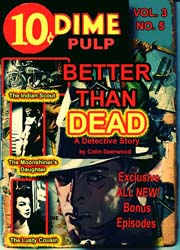
Contents Vol. 3 No. 5

Welcome to Volume Three, Number Five of Dime Pulp,
A Serial Pulp Fiction Magazine

This issue of Dime Pulp, the Serial Pulp Fiction Magazine is exclusively devoted to Better Than Dead, A Detective Story, featuring private detective Lackland Ask, aka Stan Gardner, aka Sam Carter, on the run again when he learns that his bucolic hideaway in the Three Lakes area is also where his nemesis, mob boss Yan Kovic, aka Mr. K, is ducking the feds. Now it is even more imperative that he make himself scarce, especially after a crooked local constable in league with Mr. K’s hoods try to finish him off. In the meantime, thanks to the moonshiner’s daughter and a lusty cousin, he learns a surprising revelation about his paternity. And what about those dead girls that keep washing up on the shores of Big Lake? Read more in the extended bonus episodes of Better Than Dead, Dime Pulp’s longest running serial fiction.

Phyllis Huldarsdottir’s steampunk Cheése Stands Alone, and Pierre Anton Taylor’s crime fighting Just Coincidence, will return in the next issue of Dime Pulp.

FYI: Available for readers of Dime Pulp who may have missed a few issues or lost the thread of a serial,  Dime Pulp Yearbook 21, featuring the novels (The Last Resort and Better Than Dead) and the short fiction (Hard Boiled Myth and Gone Missing) of Volume One’s 12 issues,  is joined by Dime Pulp Yearbook 22, featuring the complete pulp Western, On The Road To Las Cruces, continuing episodes of  a detective story, Better Than Dead, the opening chapters of new serial novels, Just Coincidence and Cheése Stands Alone, the short fiction of Hard Boiled Myth and Polka Dot Dress, as well as Dropping A Dime’s pithy pulp observations.  Volume Two’s 10 issues are available for perusal in their entirety by simply clicking on the links in this paragraph or on the menu bar above.

If you’ve made it this far, go ahead and follow the link below to reading entertainment with the serial contents of Volume Three, Number 5

Special Note: Dime Pulp, A Serial Pulp Fiction Magazine has changed its posting schedule from  monthly issues to once every forty-five days. Thus Volume Three will consist of eight issues (much to the relief of the overworked writers and production staff). Thank you for your understanding.

 —Perry O’Dickle, chief scribe
and word accountant


DPARCBTD“Lackland Ask is the name. ‘Lack’ to my friends, ‘Don’t’ to those who think they’re funny. You might have seen my portrait on the cover of Black Mask, the crime fiction magazine. This is my story. It starts with a blonde. This kind of story always starts with a blonde.” Thus begins the seemingly non-stop, endless narrative of Better Than Dead in which women are not the only trouble although most of it, told with the wit and street savvy of Runyon and Parker.

Better Than Dead—27


LCinset21In March of 1892, a Scotsman by the name of Arthur C. “Artie” Doyle was hanged by the neck until dead after being found guilty of a string of grisly murders of prostitutes in Whitechapel. At that moment, history veered off its presumed course and headed in a direction all its own in which the Great War never happened because the Kaiser was afraid of offending his grandmother, Queen Victoria, whose life has been prolonged by the wonders of biology. Her reign, known as the Pax Victoriana has lasted 180  years maintaining as many Victorian airs as possible while making accommodations to rapid advances in bio technology. Cheése Stands Alone poses a steampunk question, can Captain Lydia Cheése  (pronounced “Chase”) find her father, the antigovernment turncoat and radical, Commodore Jack “Wild Goose” Cheése. And furthermore, will her quest take her around the globe and through alternate world histories in the requisite 80 days or is it the beginning of a lifelong journey?

Cheése Stands Alone IX


JCA1S3In Just Coincidence, a privileged young man with the unremarkable name of Wayne Bruce returns to the site where his father once had his business, a battery manufacturing plant, and where he often spent his childhood days hanging around the factory and the neighborhood. His return is haunted by the mysterious circumstances surrounding his father’s death and the vague feeling that his uncle is somehow involved.  Appalled by the poverty and crime of the place he remembers fondly, he is moved to resolve the injustice of the socially marginalized and to wreak vengeance on those he believes are responsible for the death of his father. A personal coincidence brings together dark prince and dark knight joined in a fateful and tragic quest for justice.

Act Two, Scene 2, Part 1


Better Than Dead—27

by Colin Deerwood

Ads112

I stood in the doorway to Granny’s room. Ruthie was sitting on the edge of the bed, a bare gam poking out from under her robe.

“Look what I found!” She held open the large square black pages of a photo album. “There’s pictures of all of us up here for the summer. Cousin Dell used to take pictures of us kids with his Brownie, remember?”

I was surprised I hadn’t come across the photo album in my rummaging through the clutter of junk and cast off clothing. But her mention of Cousin Dell brought back a vivid memory of him wandering around with his little black box and pointing it at anything and everyone. We were all intent with swimming and wrestling and just generally acting like wild Indians, and Dell, who was older than the rest of us, wanted us to stand still. My old man said he was a pervert which at the time I didn’t know what that meant and then some years later I heard the story of how Uncle Ned had beat him up and banished him from Little Lake.

“Where’d you find that?” The pictures weren’t any bigger than a pack of smokes and I had to lean over Ruthie to take a good look.

“Under the bed, behind some old shoes.”

I remembered the ratty old shoes from my rummaging. Maybe Ruthie had a better idea of where to find it.

The robe had fallen open and a hirsute abyss stared back at me.

“Here’s a picture of Granny and the family in front of the cabin. Ned had just finished building the porch. Cousin Dell took the same picture every summer. And she has them arranged by year.”

I peered over her shoulder. “My first summer up here was 1920.”

She leafed a few pages over and pointed. “There you are! And that’s me on the other side with my mom and stepdad.”

I heard her catch her breath. The picture brought back a rush of memories. My mother, Mel, and my old man, Nate. And me standing in front of them, a skinny bean pole making what I thought was a funny face. Standing behind Granny was Ned, probably about my age now. Ned didn’t look anything like the rest of Granny’s children. They all looked like a combination of Gramps, who died before I was born, and Granny, but mostly knobby heads and big boned. Ned was slim and tall and looked mostly like Granny. And if the picture had been any bigger I might have been looking in the mirror.

There was something else. Maybe the lotion Ruthie had slathered on or some seductive scent or the combination of both. The way she was holding the photo album up I could see down the front of her loosely closed robe. I came alive in a manner of speaking. And I might have had one sip too many of moonshine because it struck me as funny. I had the rigid grin of a man whose fate is sealed.

Ruthie couldn’t help but notice either. She reached out. “I think I’ve found the missing tent pole.” Now she was sitting up, picture album tossed aside, intent on the buttons with her nimble fingers. The robe had fallen open and a hirsute abyss stared back at me. I didn’t resist knowing what was coming, and knowing that I knew it was coming the second she showed up with her kids wasn’t any consolation. I had to enjoy the inevitable even as I calculated that the cost in the long run would far exceed a reckless momentary pleasure. She pulled me toward her, a particular smolder to her gaze.

I heard a voice. It wasn’t hers.

“Knock, knock!” was accompanied by a rapping on the front door frame to the cabin. “Hello? Stan? Hello?” That such innocence could bring a momentary world crashing down or offer up other possibilities.

Ruthie stood up so fast she almost knocked me over cinching her robe closed. He eyes narrowed. “Who’s that?”

For a moment I drew a blank. Then it came to me like a long lost memory. “Marie.” And at her confused look, “The moonshiner’s daughter.”

Her mouth dropped open as she stepped from Granny’s bedroom and caught sight of the young girl filling out the bathing suit. I imagine mine dropped open too because standing in the cabin doorway was a pinup of the kind you’d find on any grease monkey’s wall.

“Well, Marie! How you’ve grown!” Ruthie exclaimed as she fixed me with a stare that should have turned me into a block of stone. I was just as dumb.

Marie was all smiles even though the glint in her eyes could have chiseled me to dust. Damned if I did, damned if I didn’t.

The kids had followed Marie into the cabin. They had come up to ask permission to take a ride around the lake in her rowboat. That had the effect of defusing the tension and I was for once thankful for children. Ruthie suggested that they all go for a row but making a point of excluding me as being one too many. I breathed a sigh of relief. The look that she threw me as they trudged down to the dock and the bobbing dingy was that of a woman scorned and I knew what that meant. The cook had got a fire going and was hacking at a dead chicken, water boiling in a big pot. She just shook her head in mock dismay.

I dressed in a hurry.
Ads113

I was desperate. I was running low on cash. I couldn’t hesitate any longer. The haircut and shave was going to cost me. What I would normally pay two bits for was going to be twice that much. The only barber was over in Big Lake and he catered to the vacation crowd which is why his price was so steep. I’d become considerably more sober at the realization of my predicament.

I sat in the chair anyway. The shop was next to Big Lake Hotel Resort and Cabins, the ritziest of all the motor courts and hideaways ringing a good part of the shore. A wide display window looked out over the street outside and the entrance to the resort. The motor traffic was noticeable and raised hazy dust in the heat of a midday. A truck carting inner tubes rattled by headed for the beach.

The barber was a talker. He must have thought he was on radio. He knew all the latest news as well as the word about town, who was who, and where who was staying. He had a sidekick, a toothless old geezer missing his left arm, who ran the tobacco newsstand inside the shop, and who snorted and chortled and amen’d the big man with the scissors in his hand.

The headlines displayed in the newspaper rack screamed Britain Attacks France!

“Now ain’t that something. I knew something like this was gonna happen. Once you get to warring, everybody else has to join in. And I see what they’re up to. Using the war as a distraction.”

“Who you talking about?” the old vet gummed.

“Why John Bull, that’s who! They’ve always had a grudge against France. You’ve been to France, aincha, Bill?”

The old man smiled. “Hinky-dinky parlay vous.”

“Now here is the way I see it. The British attack the French and draws everybody’s attention away from what the Germans are doing. Meanwhile they’ve got armies massed along the border with the good old USA!”

“Mexico?”

“No, not Mexico. That’s what’s so insidious! The threat is to the north!”

“Eskimos?”

The barber nudged me with an elbow and a wink. “No, Bill, not Eskimos, but something almost as bad. Canadians. And I hear that some of them can’t even speak a word of English. You know what they speak? French, same as they talk in France. Now you can see that if they’re attacking the French in one place they’re going to attack them wherever else they’re speaking it. That’s their plan. And then they’ll be coming after us, try to reclaim their lost colonies. That’s been passed on from king to king ever since we whopped ‘em. Twice!”

“But don’t we speak English?”

“No, you’re wrong there, Bill, what we talk is one hundred percent American.”

Her I wouldn’t know from Eve, but him I knew. Paul E. Bello, aka Pretty Paulie, a well-known pimp smut peddler blackmailer from the big city, and if memory served me right, someone regularly seen in the company of Mr. K.

The barber heehawed and went on to something else. My mind was elsewhere. The picture that Ruthie had shown me. Anyone who didn’t know who was who in that picture might have mistaken me for Ned’s son. Maybe that explained a lot about what went on between mother and the old man. But he was a sailor, a girl in every port and a port in every girl. And she drank and swore like a sailor.

“Well, there you are!” the barber greeted accusingly as I noticed a shadow cross in front of the window and enter the shop. A black man in a light beige shirt and pressed brown slacks sauntered in. He gave the barber the stink eye and then nodded in my direction. “Shine today, sir?”

I looked down at my dogs and they looked beat. “Yeah, maybe spruce them up a bit.”

“Give ‘em the old Big Lake special, Rodney!”

Once the man had caught a better look at the condition of what I had on my feet, he shook his head in consternation. “Gonna take some work. Ten sense worth.”

“Why that’s highway robbery, Rodney! You’re gonna drive my customers away with prices like that!”

They both looked at me waiting for my reaction. I shrugged, “In for a nickel, in for a dime.” And to be honest, bringing those shoes back to some semblance of footwear would be worth a dime.

“What was the hubbub I heard earlier?” the barber asked the man as he retrieved brushes, rags, and cans from behind a cabinet and was lathering up the leather. “I heard sirens.”

“Found another one.”

“Another one? In the lake? Drowned?”

“They ain’t saying.”

“How many’s that so far this year?”

“This one makes three. All girls.”

The barber shook his head solemnly. “The Lake averages about half a dozen a year. Not only girls, but as you know, boys are stronger swimmers.”

“Weren’t no swimmer.” The rag snapped across my toe effecting a transformation. “Heard it was Judge Chandler’s daughter.”

Even old Bill gasped. “Oh, she was a wild one,” the barber opined. “I remember once. . . .” he went on but I had stopped listen. A sleek coupe had pulled up to the front of Big Lake Hotel and I recognized the man getting out on the driver’s side. A woman, and not just any dame, but one that had been buffed up to a shine, was waving at him with a big smile on her bright red smoocher. Her I wouldn’t know from Eve, but him I knew. Paul E. Bello, aka Pretty Paulie, a well-known pimp smut peddler blackmailer from the big city, and if memory served me right, someone regularly seen in the company of Mr. K. I didn’t get what he was doing in Big Lake but then I remembered the waitress at the café had mistaken me for one of the actors in the hush hush movie production at the Lodge. And if Pretty Paulie was involved, there was a good reason why it was hush hush.

I wasn’t the only one who had noticed Paulie the Pimp. The black man had followed my gaze. He too apparently knew who Paulie was and seeing my reaction, he took a closer look at me. And the fact that he was taking a closer look at me made me take a closer look at him. I knew him. He knew me. He was the shoe shiner in the building where my lawyer’s office was located, the lawyer I had found covered in a layer of flies and whose killers had been lying in wait for me on Kovic’s orders. This was the guy who was supposed to stop me if they missed me. Maybe he’d been sent to the minor leagues for his screw up. More than likely he was part of the Kovic mob fringe. And if that was the case then the mobster was too close for comfort.

There was a glint of recognition in his eyes but also uncertainty. Maybe it was the dark glasses and the beard that threw him off. But I had no doubt that it would come to him and I wanted to be as far away from Big Lake as possible by then.

The barber held up the hand mirror for approval of his handy work. Beard nicely shaped, my dirty blond locks clipped and held in place with pomade,  I looked almost respectable.

Ads114

The trolley line ran down the center of Main Street from one end of Grover City to the other. As a sign of the times, a filling station had set up a pump almost directly across the street from the roundhouse. The attendant, an eager young guy in a collared shirt, let me stow the Indian inside the fenced yard behind the garage for a consideration when I got back from the County Courthouse.

I hopped an inbound trolley just as it was pulling out of the station. The conductor was big guy with a square head. He eyed me like he’d seen my sort before and flicked the lever of the chrome change maker on his belt. I remembered when the trolleys were horse drawn in this burg. And they were cheaper. It was the price of doing business and I paid it. And I’d picked up a copy of the daily blat when I left the barbershop that I could also charge to my nonexistent business account.

I was looking for nothing in particular until I found it. Behind the war scare headlines, Grover City’s only newspaper covered local news and politics of the Tri-Lake area. A public safety announcement in bold print urging swimming and boating safety during the summer months took up half a page. A sidebar noted that there had been two tragic drownings in Big Lake so far this summer. The edition had hit the stands before the discovery from earlier in the morning if the shoeshine man was to be believed.  Another column reported that the search for Judge Chandler’s daughter was ongoing and that the State Troopers were now helping in the effort. I had news for them.

He slid the chair back, rose slowly, and just as slowly made his way to the counter as if I had interrupted him from his important duty and he was doing me a favor.

But what caught my eye was the item on the investigation behind the attempt to dynamite the Federal grand jury looking into the activities of fugitive mobster Yan Kovic as well as the foiled heist at the US Customs warehouse. Witnesses were being sought, it said, and I knew they were talking about me. I didn’t think I’d see anything about Becky’s body being found. The obits were all local, anyway.

Two of the names in the obituaries caught my attention, not because I recognized them but because of their ages. One was sixteen and one was thirteen. That one claimed the young girl “loved to swim” was the kind of unintentional irony that often showed up when talking of the departed, and I wondered if the other girl had drowned, too. But by then a few more riders had crowded onto the sidesaddle bench and I was running out of elbow room. Not that it mattered. The stone colonnades of the Courthouse hove into view and I stepped off as the trolley rolled to a stop.

Once I’d trudged up the wide granite steps and passed through the multi doored portal to the halls of justice, I followed the arrow and the sign that read Records to a stairway leading down to the basement. A corridor branched off in two directions at the bottom and another helpful sign pointed the direction. I came to a solid mahogany door framing a pebble glass panel upon which was written in bold black letters VITAL STATISTICS and turned the brass knob and went in.

At a desk beyond the counter stacked with an assortment of ledgers was a rail thin clerk in an eye shade and sleeve garters. I rang the desk bell to catch his attention otherwise I would have remained invisible. He slid the chair back, rose slowly, and just as slowly made his way to the counter as if I had interrupted him from his important duty and he was doing me a favor.

He looked me over and was not particularly impressed. “Marriage, Birth, or Property?”

“Birth.

“County or Municipal District?”

“County, I think.”

“I don’t take orders on speculation. You either know or you don’t.” He had that sour attitude of a minor bureaucrat.

“County.”

“Can’t help you here.” He jerk a thumb, “Next door.”

I thanked him with a nod of my head, did an about face, exited the door I had entered,  turned right and opened the door that had County Records in bold black letters on a similar pebble glass pane. I could have stepped into the very same office because the very same clerk greeted me with the hint of a superior smile.

“Marriage, Birth, or Property?”

“Birth.”

He handed me a form. “Fill this out and put it in the basket.” He pointed at the stub of pencil wound with a string and then at the empty wire basket off to one side of the counter. “That’ll be three dollars.”

I was about to protest but since what I was planning was illegal I thought better of it. “How soon can I expect the document?”

“Depends on how busy I am and if I’m on the county payroll or the municipal payroll.”

I knew a grift when I heard one and decided to play along. “Of course, of course, I realize how busy you public servants are , especially at this time of year. I was hoping to expedite the acquisition by this afternoon as the document is germane to a probate matter in the city.” I’d heard lawyers speak that way and thought I’d give it a try.

He licked his thin lips, shifted his eyes to the left as if making a calculation, and asked in a lowered tone, “You on an expense account?”

I made a grimace. “No, unfortunately, I’m paid by the job, a flat fee.” I waited a beat before I made the offer. “I’m heading over to the diner I saw on my way in, grab a bite to eat, cuppa java. Do you recommend the place?”

“Oh sure, I go there practically every day.”

“That’s good to know. Maybe I can have them send you over a sandwich. A piece of pie?”

He looked over his shoulder like maybe someone might be watching. “County Registrar frowns on bringing food into the office.” He paused, “But I sure do like their pies.”

I’d hooked him and slowly reeled him in. “I’m partial to berry pie. What kind do you like?”

He didn’t hesitate. “Coconut Cream.” Then he got confidential. “Tell them Orvil sent you. They’ll set a piece aside for me.”

I returned a conspiratorial smile and quickly filled out the simple form and peeled off three dollars from my money clip.

“Check back around three o’clock for that birth certificate.” And as a reminder “Coconut Cream.”
Ads115

Grover City was easily forgettable, a wider spot in the road on the way to the widest spot. The red, white, and blue bunting was still up from the Fourth of July Parade. They probably still had a street sweeper on payroll judging by the number of horse drawn conveyances. One such specimen in blinders drew a large drayage wagon past me as I stepped to the curb. The Downtown Diner was catty corner to the park fronting the Courthouse in a square brick building with large windows flanking the step up double door entrance and overlooking Central Avenue. The airiness at the front tables were taken up with matrons and tea biscuits. I found a booth in the hazy amber light back by the swinging double door to the kitchen.

I looked over the menu the young girl made up to look older than she was had handed me. I didn’t look at the items, I was looking at the prices. The java was a must but the sandwiches were more than I wanted to pay.

It must have been the pained look, but she asked, “You want me to read that for you?”

I laughed and shed the shades. “No, I can see just fine. My eyes are sensitive to the light.”

She peered at me as I removed the fedora and set it on the bench next to me. “Oh, that’s an excuse I haven’t heard before. Tied one on, did ya?”

Her smile was bright but not hard on the eyes. “That bad, huh?”

“Any worse and I’d be calling a doctor. Are you ready to order?”

For twelve cents I could get four pieces of toast and jam, the coffee was on the house with any food order. “I’ll have the toast and coffee.”

“Sorry, that’s a breakfast order. We stopped serving breakfast half an hour ago.”

Despite being a looker, she was beginning to be annoying. “You on a budget?”

I tried to look offended but she just shrugged and pointed at the menu in my hand with her pencil. “This lunch special here, the sandwich, at two bits, it’s a pretty good deal. Comes with clam chowder, a side of grits, and generous slice of ham with pickled onions and the cook’s own homemade mustard.” When I hesitated, “Unlimited refills on the coffee.”

I nodded, “Alright.” And as she was about to walk away, I remembered. “Hey, Orvil, over at the courthouse, recommended this diner. I said I’d treat him to a slice of pie, coconut cream.”

She turned and gave me a grim look. “Coconut Cream?” She flipped the menu over and pointed at the list of very pricey desserts. The Kountry Kokonut Kream was listed at one whole dollar. “A slice?” I almost squawked.

She shook her head. “Don’t sell them by the slice. You’re buying the whole pie.”

It was still an expensive proposition and I hesitated. “Why don’t we just forget it, then.”

“Are you doing business with the county clerk?”

“I am. How did you know?”

“Would you like this business to get done soon?”

“Yes, this afternoon at the latest.” And then I got the drift. “What if I didn’t want any pie for me or anyone else?”

She shrugged. “The boss rents out rooms upstairs. At a weekly rate. They ain’t cheap.”

Not that I should have been surprised, grift greases the wheels of any bureaucracy.

I folded and the waitress quipped, “Be thankful he didn’t ask for Banana Cream pie, that’d set you back three clams.”
Ads116

It was a day for coincidences. Just as I was coming out of the Courthouse with a birth certificate in the name of Jerome Paulson, striding up the wide granite steps toward me was none other than John “Johnny Tomato” Damato, the king of the mob mouthpieces, accompanied by a couple of hard faced bruisers. I turned away as they passed briskly behind me, uninterested in anything except where they were going. That alone convinced me that Kovic was operating upstate while lying low from the feds. If I’d been more paranoid I would have thought they were following me.

The trolley had a stop conveniently in front of the Odeon. The marquee read “Back By Popular Demand! Gone With The Wind!” The afternoon matinee had just let out and there were clots of young movie goers adjusting to the heat and brightness of afternoon daylight, some queueing up for the tram. A gaggle of young girls practiced their Southern drawls on each other. “Did you hear what he said?” one asked affecting the accent, and she lowered her voice, “Damn.” Her friends giggled nervously, pleasantly scandalized.

I turned my attention to the queue as the rumble of tracks and a distant bell announced the trolley’s arrival. I don’t know how I missed it but there parked by the curb was Pretty Paulie’s snazzy coupe with Paulie leaning against a fender smoking a cigarette and looking very suave in his expensive sporting togs and Panama hat. Something that was not lost on the young and impressionable female types whose urges had just been mix-mastered by the drama of larger than life images on the theater screen. The hook was Paulie’s alluring companion, a looker who could have just stepped out of the picture herself and attracting as much attention as Paulie.

I glanced over my shoulder as the tram pulled away. If I was the suspicious type, I’d think that Paulie was trolling for local talent. But it wasn’t any of my beeswax. Then I thought about Marie and knew she was just the type to fall for a con like Paulie’s. And that made me think of Rebecca. It was still difficult to admit that she was dead. It was my fault. I let her ride along on my mission of revenge.

I throttled up and tore after the coupe and soon was eating its dust. I gave the Scout more gas closing up behind and angling to pass.

But it all had started with the diamonds in exchange for the code book, and then the double cross, and the shootout. Only to get away with the sachet of diamonds she had stolen from Herr Doktor Soloman’s safe and then to lose them dodging the G-Men. And ended on the terrace of the Serbian Social Club with the bomb built by her father exploding in an assassination attempt on Mr. K and the Black Hand, knocking her off the ledge she had been perched on, and sending her to her death four floors below.

I thought of the diamonds for a while and the lost opportunity they represented. They were a fluke when I was in need of just such a fluke. Too good to be true as they’ll always tell you. And that’s what it was, a pipe dream. After Grace left for the Hollywood, my I-don’t-give-a-damn attitude put on weight. Mad at the world, I was ready for a fight. I’d knocked around as a private hood for a while when I was younger. That’s why I knew a lot of the players. Then I help someone out of a jam, just because they looked like nice people, and it paid off. Best of all, I liked the way it made me feel. Like maybe I was worth something, a hero, in their eyes at least. Still it was a hustle and making ends meet wasn’t something I knew much about. And I wasn’t dealing with the best or the nicest of people. So when I did meet someone who wasn’t like the others, it made me think. And I thought about someone who was innocent and trusted me, someone I’d failed. Rebecca.
Ads117

I was still thinking about the diamonds after I’d tipped the kid two bits for keeping an eye on the Indian while I was conducting business. I’d rolled up to the highway getting ready to head back to Little Lake when I recognized the sporty coupe breezing by. That was my third sighting of the day. If I’d managed to turn those diamonds around, I would have had  my own roadster to visit all the resorts and spas. What bothered me wasn’t that a crumb like Paulie had all the goods and the breaks, but the face that peered out the rear side window as it passed. It was a young face, a frightened face. I could have sworn it was Rebecca, but I didn’t want to believe my eyes.

I throttled up and tore after the coupe and soon was eating its dust. I gave the Scout more gas closing up behind and angling to pass. I let up as a farm wagon puttered into view from the opposite direction. At Paulie’s speed the road opened up again in no time. I gunned it and slowly pulled up alongside. He had his head turned, yakking at the dame, and she facing him caught the movement of my shadow out of the corner of her eye. That made Paulie jerk his head around and look over his shoulder. I had just enough time to glance into the rear window where I’d seen the apparition of Rebecca’s face. A suitcase blocked part of the window and beyond that was what appeared to be a pile of overcoats.

I got the mean eyes as I pulled up even with the driver. If looks could kill. I don’t think he recognized me. He wouldn’t know me from Adam. But I did recognize the bird sitting on the bench next to him now that I had a closer look, someone from way back, when I worked as muscle at a gin joint. And as if she’d seen a ghost, she recognized me, too. Paulie may have had more engine but I was pulling less weight. I gave him the secret Boy Scout salute as I roared ahead.

A large man in a sweat stained hat stepped out from where he’d been stationed and held up his hand, a shotgun cradled over his left arm. “Private property, pal. Turn around.”

The road taking me back into Big Lake was lined motor courts and claptrap cabins. I’d left Paulie far behind when I turned off and stopped behind the large sign that said Lake Shore View Cabins & Spa and waited for the perfumed chump to buzz by. I was suddenly curious about what Pretty Paulie was doing in Big Lake and with whom. I didn’t have to wait long. Summer light dripping a slow orange onto the skyline glanced off the windshield as a bright glare. He wasn’t moving slow like maybe he thought he’d catch up with me.

I let him get ahead of me slowed down by the crowds of vacationers, many in straw hats and light dresses wandering in and out of the shops along the main drag. The latest model roadsters and coupes shared the curb with farm wagons and Model-Ts. I’d expected him to turn into the entrance to Big Lake Resort as it was the classiest spa on the lake with a large hotel dining room and nightclub. I was wrong. He kept going on Main St to the outskirts where it becomes the road to Ridley and to Little Lake.

I kept sight of the coupe far enough off his rear horizon that he might not catch me tailing him in the mirror. The coupe broke a rise in the road and dropped out of sight down the other side. By the time I crested the hill I had a clear view of the road ahead into a valley of farmland and wooded tracts. The coupe was nowhere to be seen. Even at top speed that machine could not have covered that much roadway.

I pulled to the shoulder and scanned the distance. They couldn’t have disappeared into thin air. Then I glimpsed the dust churned by wheels on a dirt road lifting up behind a stand of trees. At the bottom of the hill the tumbled down remnants of an old stone wall marked the wagon track. I had seen the outline of the bulky stone manor between the trees from the top of the rise and I figured that was where the coupe was heading. It was part of Big Lake Resort. I remembered hearing about it when I was a kid, an elite hunting lodge, although everyone referred to it as The Lodge along with the assumption that not just anyone could stay there. I figured this was the back road in.

I waited till the dust settled before I nosed the Scout onto the dirt track. I followed it slowly a ways up over a gulley and around a turn as it climbed the hill toward the lodge.

A large man in a sweat stained hat stepped out from where he’d been stationed and held up his hand, a shotgun cradled over his left arm. “Private property, pal. Turn around.”

He was a lot bigger than I was and didn’t seem the least bit concerned that I knew it. “This ain’t the road to Little Lake?” I ventured innocently.

He shook his head unhurriedly and gave a gapped toothed smile. “Not by a long shot, mac. Now turn back around. At the pavement take a right. If you pass through Ridley, you’ve gone too far.”

I thanked him and turned back the way I’d come. Both sides of the  track were densely wooded with sycamore and oak, some maple, and a smattering of spindly pine. I bounced back to the pavement and let my eye follow the contours of the boulder strewn hillside and the brush cluttered ravine that creased the hill directly below the lodge. If I was going to take a look at what Pretty Paulie was up to, it was going to take a hike to find out.

Ads118

I found myself up a tree, a leafy ancient chestnut, overlooking a courtyard at the rear of the swank hunting lodge. I also had a clear view of the two gleaming machines at the front entrance to the large stone manor. The one I recognized as Paulie’s coupe and the other was  a large Chrysler New Yorker with a white hood and a ruby red finish.

I’d made my way to my perch with less effort than I’d imagined. I’d found a deer track through the thicket that eventually widened to a faint overgrown foot path that ran along the side of the ravine and continued up the hill and alongside a six foot stone wall, tall enough to boost me up into the lower branches of grandfather chestnut and provide me with a catbird seat of the entire layout.

And there I sat considering my next move. There were large windows set into the stone edifice and I thought that I could creep up to the shrubs that bordered the lodge. I heard a shriek. It was a laugh and it was followed by a long legged beauty in tennis togs with a drink in her hand. She was followed by Paulie Bello and the woman from my past, Jean or June, who was leading a young blonde girl that was not Rebecca and not more than sixteen toward the table and umbrella next to the elaborate spouting nymph fountain at the center of the courtyard.

“Oh, Stan, I’ve just learned the most horrible news. My friend, Sissy, is dead. They found her in Big Lake this morning. They say she drowned.”

I didn’t have to be a genius to know that something was wrong with that picture and I would have followed my hunch to the logical conclusion except for the fact that it was put completely from my mind by the figure who emerged from the shadow of the umbrella. I’d recognize that stubby pink bullet head anywhere. It was none other than Mr. K!

It was obvious that Paulie had brought him something that pleased him by the wide leer on his mug and how he kissed the young girl’s hand continental style.

I’d see enough. I realized that I really wasn’t that interested in Paulie’s business after all. And Kovic was a powerful enough reason to relocate. I abandoned my leafy bower and started back down to the trunk which was considerably harder than going out on the limb. I was about to swing down to the rock wall when another motorcar drove up to the front of the lodge. I froze. I recognized that car and I knew the driver. It was Thorny!
Ads119

I made like a bat and got the hell away from there. As I raced back to Little Lake I was still shaken by what I’d seen in the courtyard. I’d watch as Ridley’s Constable Thorndyke strode into the hunting lodge like he’d been there before. And next thing I know he made an entrance into the courtyard and Paulie got up and shook his hand and introduced him to Kovic who got to his feet like Thorny just said something interesting, nodding his head, and the woman, June, joined them too, and added a few words that astonished both Paulie and Mr. K and seemed to make a case for what he was saying.

I didn’t waste any time getting off that hill. I had a bad feeling about what I’d seen. I wasn’t going to take any chances. I had to go on the lam again, pack up a few things at the cabin and I was history. I had to count that Alice would find a buyer for Ted’s art piece. The way I was feeling, I’d let it go cheap. The birth certificate in my jacket pocket was my ticket out if I was going to have an identity as a world traveler.

To my relief there was no sign of Ruthie and her kids at the cabin. The porch had been swept clean and a pan with pieces of chicken back and some grits had been left on the table. They were cold and greasy. My other choice was a can of baked beans at the bottom of a gunny sack. The jar of moonshine looked untouched and it called to me. One sip was enough to bring me back. I found my satchel and stuffed my other shirt in it and looked around for the few things I might have brought with me. And I wanted to be long gone by the time anyone came looking.

I had to tell her the truth. “Thorny is the reason I have to get out of here. I’m leaving right now. Somehow he learned who I was so I have to go. Now!”

I walked down to the lake shore and caught the last of a cloud streaked sky as the sun dipped below the tree line for one last time because I didn’t plan on coming back.

I heard her sobbing before I noticed her. Marie was sitting at the end of the dock. She looked up wiping away her tears as I stepped down the path.

“Are you alright?” I heard myself say instead of “I’m leaving, it’s been nice to know you. Goodbye.”

“Oh, Stan, I’ve just learned the most horrible news. My friend, Sissy, is dead. They found her in Big Lake this morning. They say she drowned.”

I put my arm around her shaking shoulders and tried to think of something to say. I drew a blank until I remembered the barbershop. “Was she the girl that went missing, the judge’s daughter?”

“Yes,” she sobbed, “Sissy Chandler, that’s her name. But I can’t believe she drowned. She was a champion swimmer at summer camp! It doesn’t seem possible!” And she sobbed some more.

I wanted to comfort her but was impatient to be on my way. “I read in the paper that there’ve been a number of drownings in Big Lake. It’s more dangerous than it might seem.”

“That’s true. Hardly anyone ever drowns here at Little Lake. I wonder why that is?”

“I don’t know. Maybe because Little Lake is deeper and considered dangerous so people are more careful out here. Big Lake’s just a big flat meandering pond and it’s not very deep or very clean. Too many motorboats and cruisers and carelessness.” And for a minute there I almost sounded like my father.

“You know what else is sad?” holding back tears, “I knew two of the girls who drowned this year. And now Sissy.”

I wanted to tell her I was leaving because it was none of my business. My business was to disappear. “That’s tough, kid,” as I looked over my shoulder.

“They were a little older than me but I’d run into them at the movies in Grover City and we’d go to Woolworth’s for sodas after the show. And I knew Sissy from girl’s camp where she worked as a junior life guard after she graduated from high school. She was so much fun to be around!” And that made her cry.

“Listen, kid,” I said trying break in to tell her I was leaving.

“Oh, that’s eerie. I just realized something. Two of those girls, the one I knew and the one I didn’t, had gone on the “ride” with Thorny. Do you remember I told you about that?”

“Thorny?” Again.

“And you know who told me that they had? Sissy. And she named others that I didn’t know. She said he’d tried to get her to go with him, threatened to tell her pa that she’d been out with some boys.”

“The judge?”

“Oh, he’s just a regular old JP in Ridley, everyone just calls him Judge. And she told him go ahead and tell him and see what happens to his job.”

“Thorny.”

“Oh, his whole family is nothing but crooks and cheats. His cousin is in prison for embezzling from the town council. And Thorny, he’s never around when you need him and always around when you don’t. And always up into someone’s business. Pa had to show him the bore of his shotgun to convince him that he didn’t have any business out here.”

I had to tell her the truth. “Thorny is the reason I have to get out of here. I’m leaving right now. Somehow he learned who I was so I have to go. Now!”

“About who you really are? Stan?” She’d grabbed my sleeve. “Ruthie told me all about who you are and all of a sudden it makes so much sense. She was really mad, by the way. She accused me. You know, you and me. And I swore that I hadn’t, we hadn’t, and maybe she believed me. And she told me you were running from the police. And that your real name was Lucky, and that you had made improper advances. But I didn’t believe her.”

Here it was sunset but something just dawned on me. “You say she was mad. You think she was mad enough to tell Thorny?” My wheels were spinning, I just had to let out the clutch.

“I don’t know, why? She might have. The kids heard what she was telling me. They might have told him.”

“I don’t want to scare you, but you need to get away from here. Thorny is likely to come here real soon and you could be in danger. And I don’t want you here when he does.”

She clung to me. “Take me with you!”

“I can’t, kid. Where I’m going, there’s only room for one. You’ll be safe with your old man.” I bent my head down and tilted her chin up and lightly kissed her lips. “I’m counting on you to be smart about this. Forget I was even here.”
Ads120

I made two mistakes. One was listening to Marie plead with me to take her along. She didn’t care that bad people were intent on cutting my life short. She’d only be in harm’s way I insisted. She didn’t like that one bit, but she finally calmed down and accepted that I wasn’t going to budge. I told her I didn’t want another young woman’s death on my conscience. I watched her as she ducked through the thicket and back to her chickens and bootlegger father.

Mistake number two was that I had acquired a taste for Uncle Ned’s moonshine. I went back to the cabin with the idea of adding a jar of everclear to the burlap bag along with the can of beans. I was about to tuck the goods into the saddle bag when I looked up. Thorny was standing there with his gun on me.

“Hold up, you bastard, don’t make a move.”

I wasn’t all that surprised that it would come to this, but things were moving faster than I’d anticipated. Thorny thought he was shrewd but his weakness was his self-importance.

“Thorny, old fellow, what’s the meaning of this?”

“Don’t play dumb, buster. I know who you are. Miz Walker spilled the beans. You’re an Ask! And that explains everything! You’re old Ned’s bastard!”

The cat had been let out of the bag and I considered what the constable had said. “Alright, I guess I should have figured as much seeing as how everybody was remarking on the resemblance. That doesn’t explain why you’re pointing your six shooter at me.”

“You’re wanted for questioning by the police down in the city. When Miz Walker told me that, I made some telephone calls. The feds are looking for you, too.” He gave a wicked grin. “It’s my sworn civic duty to turn you over to the authorities. Thing is, there’s someone else who is interested in your whereabouts and they’re willing to pay cash for that information.”

“Mr. K,” I nodded, and sighed like I was resigned that I’d been caught. “You got me, Thorny. It must be your lucky day. It certainly is not mine. I hope you got a good price. Especially when you have to apprehend a dangerous desperado like me.” I mirrored his grin.

“Shut your yammering. No business of yours what I got paid.” He patted his hip pocket for reassurance. “You’ll lose that sappy grin once the boys get done with you.” He fit two fingers to his lips and gave a shrill whistle.

“The boys?” I had figured I could overpower Thorny as long as I kept him talking and got him to let down his guard, but the boys changed the odds.

He gave a sadistic chuckle. “Mr. Kovic’s associates are gonna have a word, but if I was you, I wouldn’t expect a conversation.”

A voice from the top of the path down to the cabin called out, “Hey Thorndyke! You got him? Good job!”

The muzzle flashes lit up the underbrush like giant fireflies.

I caught a glimpse of two square shouldered silhouettes appearing from the shadows as a puffed up Thorny turned to acknowledge the compliment. I swung the sack with the can of beans and the joy juice in a full roundhouse and hit him square in the mug just as he turned back. He didn’t know what hit him and dropped like a poleaxed steer.

I bolted, ducking low as Kovic’s thugs took up the cry. “Shoot him,” I heard one of them shout. I crawled through the gap in the bank of brambles separating Granny’s patch from the moonshiner’s property. A shot rang out and I heard it snap through the branches overhead. I had a general idea of the lay of the land. I’d taken the path to the chicken coop before and I knew enough not to take the boobytrapped one that led to the still. Then there was the path to the main house and the one in the opposite direction that would take me down to their landing and the lake.

I saw my best bet was to head for the lake and take my chances in the lengthening shadows along the shore. If I had to, I could swim for it. They were close behind. I could hear them grunting and swearing and shouting what they would do with me when they caught me.

I dove behind an old horse wagon that had been left to rot among the underbrush and saplings. They stumbled past me and took the path toward the still. There was a rattle of empty tin cans and what sounded like a cow bell. Then came the scream. One of them had stepped in the bear trap Marie had warned me to step wide of. Another yell at the sound of something heavy hitting the ground.

I thought I’d add to the chaos. “Federal agents! Throw down your guns and surrender!”

More shots erupted in the direction of the still. Louder, not just the pistols the mugs were packing. The muzzle flashes lit up the underbrush like giant fireflies. And then “Behind you!” It was Marie. And another shot. And then nothing except the stillness of encroaching twilight.

I waited holding, my breath. I heard a groan and Marie’s voice asking, “Where you hit?” I figure I should see if I could help.

She heard me coming and had the rifle pointed in my face when I broke into the clearing.

“It’s me, Stan.” I held up my empty hands.

She was standing over her father who was seated, back against the distilling shed, protecting him. He was threw me a mean glare like it was all my fault. And he wasn’t far from wrong.

“How bad is he hurt?” I moved in for a closer look and the old moonshiner scowled like a growl.

“It’s just a scratch.” He grimaced and produced a flask from his overalls and took a snap.

I could see from the blot of blood seeping from the shoulder that it was more than a flesh wound, “He’s losing a lot of blood. He needs to get to a doctor.” I said to Marie.

A worried frown creased her forehead. “I can take him over to Doc Gallup in the flivver.” And when her father protested, “He’ll patch you up like he did last time when you shot yourself in the foot.”

The old man grimaced from the pain as he tried to stand up. “I’ll be all right. Better than these fellas at any rate. Who are they? Don’t look like revenuers.”

One of Kovic’s men had caught the shotgun blast just below his collar bone and had fallen backwards, one leg at an odd angle held in place by the large claw trap. The other one was laid out neatly, arms on either side, pistol on the ground just out of reach of his right hand, with a slaphappy expression on his face except for the bullet hole between his eyebrows.

I was about to explain when I realized I still had a problem. Thorny.


Next Time: Getaway From The Hideaway

Contents Vol. 3 No. 4

Welcome to Volume Three, Number Four of Dime Pulp,
A Serial Pulp Fiction Magazine

In this issue of  Dime Pulp, A Serial Pulp Fiction Magazine,  Colin Deerwood’s long running 40’s pulp detective serial, Better Than Dead,  Phyllis Huldarsdottir’s steampunk Cheése Stands Alone, and Pierre Anton Taylor’s crime fighting Just Coincidence, combine to give the reader their dime’s worth of Serial Pulp Fiction!

FYI: Available for readers of Dime Pulp who may have missed a few issues or lost the thread of a serial,  Dime Pulp Yearbook 21, featuring the novels (The Last Resort and Better Than Dead) and the short fiction (Hard Boiled Myth and Gone Missing) of Volume One’s 12 issues,  is joined by Dime Pulp Yearbook 22, featuring the complete pulp Western, On The Road To Las Cruces, continuing episodes of  a detective story, Better Than Dead, the opening chapters of new serial novels, Just Coincidence and Cheése Stands Alone, the short fiction of Hard Boiled Myth and Polka Dot Dress, as well as Dropping A Dime’s pithy pulp observations.  Volume Two’s 10 issues are available for perusal in their entirety by simply clicking on the links in this paragraph or on the menu bar above.

If you’ve made it this far, go ahead and follow the links below to reading entertainment with the serial contents of Volume Three, Number 4

Special Note: Dime Pulp, A Serial Pulp Fiction Magazine has changed its posting schedule from  monthly issues to once every forty-five days. Thus Volume Three will consist of eight issues (much to the relief of the overworked writers and production staff). Thank you for your understanding.

 —Perry O’Dickle, chief scribe
and word accountant


dparcbtd

“Lackland Ask is the name. ‘Lack’ to my friends, ‘Don’t’ to those who think they’re funny. You might have seen my portrait on the cover of Black Mask, the crime fiction magazine. This is my story. It starts with a blonde. This kind of story always starts with a blonde.” Thus begins the seemingly non-stop, endless narrative of Better Than Dead in which women are not the only trouble although most of it, told with the wit and street savvy of Runyon and Parker.

Better Than Dead—26


LCinset21In March of 1892, a Scotsman by the name of Arthur C. “Artie” Doyle was hanged by the neck until dead after being found guilty of a string of grisly murders of prostitutes in Whitechapel. At that moment, history veered off its presumed course and headed in a direction all its own in which the Great War never happened because the Kaiser was afraid of offending his grandmother, Queen Victoria, whose life has been prolonged by the wonders of biology. Her reign, known as the Pax Victoriana has lasted 180  years maintaining as many Victorian airs as possible while making accommodations to rapid advances in bio technology. Cheése Stands Alone poses a steampunk question, can Captain Lydia Cheése  (pronounced “Chase”) find her father, the antigovernment turncoat and radical, Commodore Jack “Wild Goose” Cheése. And furthermore, will her quest take her around the globe and through alternate world histories in the requisite 80 days or is it the beginning of a lifelong journey?

Cheése Stands Alone IX


JCA1S3In Just Coincidence, a privileged young man with the unremarkable name of Wayne Bruce returns to the site where his father once had his business, a battery manufacturing plant, and where he often spent his childhood days hanging around the factory and the neighborhood. His return is haunted by the mysterious circumstances surrounding his father’s death and the vague feeling that his uncle is somehow involved.  Appalled by the poverty and crime of the place he remembers fondly, he is moved to resolve the injustice of the socially marginalized and to wreak vengeance on those he believes are responsible for the death of his father. A personal coincidence brings together dark prince and dark knight joined in a fateful and tragic quest for justice.

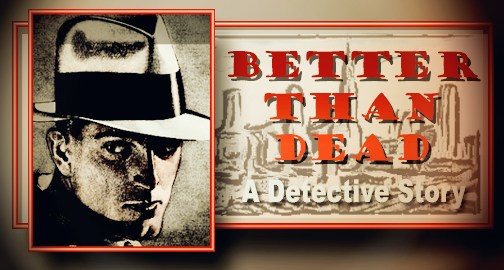
Act Two, Scene 2, Part 1


Better Than Dead—26

by Colin Deerwood

Ads108

The phone was ringing in the hall. Ringing. I could hear it. Ringing. I could see it. Ringing. In my mind’s eye. Ringing. In a smokey pool hall. Ringing. Why wasn’t anyone answering the ringing? I would have answered but the room I was in had no doors, just four walls of cheap wallpaper and scratched up wainscotting. The ringing wouldn’t let up. The smoke was making my eyes weep blood. I had to force them open to the faintest slits. That’s when it hit me like a bucket of cold water. The bucket of cold water.

Standing over me with an empty bucket and an impish grin was the moonshiner’s daughter. “You set yourself on fire!” She said it like it was a joke.

I felt like a joke. The slant rays of light through the window of the cabin sparked the dust motes and the smoke and filled the empty jar on the table like the ghost of what it once contained. I looked down at myself covered in wet, the blanket as well, and the ragged smoking black hole the now soggy cigarette had burned through it.

The light was hurting my eyes worse than before and now I had a brutal headache to go along with it. I glanced up at Marie out of the side of my eye. She seemed to be gloating.

“Where were you yesterday when I needed you?”

She desperately wanted to be needed. “No! What are you talking about?”

“You were supposed to keep a lookout so nobody’d sneak up on me.”

“What?”

“Yesterday I got a visit from Constable Thorndyke. You coulda warned me.”

She shook her shoulders with a shiver. “Oh, Thorny. He’s a snake.” And she made a face like she’d tasted something unpleasant. “”He likes to make like he’s your uncle or some other relative and tell you what to do, especially with girls. The boys he just puts them in jail if he catches them, but the girls, he takes out for long drives on deserted back roads in his jalopy and talks about the Lord and how we’re supposed to all act like young ladies.”

I pulled myself upright and wiped some water off my scraggly beard. “You’ve gone on a ride with Thorny?” I didn’t want to sound too paternal.

She shook her head. “No, Thorny wouldn’t dare cause he knows what pa would do to him. But some girls I know, older girls, they told me. Said they’d rather go to jail than go on ‘the ride’ with Thorny. He made their skin crawl.”

I grunted in acknowledgement that I understood. “Where were you, anyway?”

“I was at the Odeon in Grover City with my friend, Irma. We spent the day there. First for lunch at the Downtown Diner, and then a double feature. Two Clark Gable movies. I’d seen one of them before, but that Gable, he’s so dashing, Though I don’t think he’s that good of a singer. And Claudette Colbert is just too brassy. I don’t know what he sees in her,” she said wistfully. “There’s a change of feature tomorrow with a new William Powell movie. I like him too, especially when he’s acting with Myrna Loy. He seems very charming. Even as a private eye.”

I nodded and groaned as any movement of my head made it throb. I could have said that’s what I am, a private eye, but then she might have got the wrong idea from the movies. Hollywood never gets it right. They always give the shamus a conscience, noble principle. You can’t have any of that if you’re going to be a private investigator and expect to survive. When you’re a bottom feeder, high falutin ideals just get in the way of doing the job. I knew that. I had gone soft on Rebecca and that got me nothing but grief.

I staggered to my feet and she reached out to help me. I pushed her away. I was a little unsteady but I managed. I knew what I had to do and soon. I lurched for the door and mumbled “gotta see a troll about a hole” and stumbled off the porch and in the direction of the lopsided closet off to the side of the cabin.

“”Don’t fall in!” she called after me brightly.

Ads109

I hadn’t really wanted to think about it. What Thorny had said on the way back from the graveyard. We’d been stopped by the roadblock. Thorny knew the deputy, a young lug with a square head and eyes that wouldn’t stay still. A girl had gone missing, the daughter of Judge Chandler. She didn’t return home after a shopping trip to Grover City. It had been two days now. They had the dogs out searching the lower shore of Middle Lake near the dump.

The deputy had eyed me suspiciously. Maybe it was the dark glasses, or the beard that was growing unevenly along the ridge of my jaw. Thorny had laughed when he caught the drift of the deputy’s gaze. “This here’s one of the Ask cousins from out in the Midwest. If you know the Asks you’d say they all had that same family resemblance. This one here is the near spitting image of old Ned Ask who didn’t look like any of them either. You might remember him from when you was a young hellion.”

The young deputy had nodded his head, grinning. “The fisherman! With the old Indian motor bike!”

Right about then a rickety Model T sputtered up behind Thorny’s Ford and the deputy waved us through after saying he was pleased to meet me.

I didn’t think too much about being mistaken for old Ned but Thorny’s remark struck a nerve. And it bothered me all the way back to Little Lake.

The grease monkey who pumped my gas at the livery in Ridley had thought I looked like my old man’s younger brother. Marie and her father had remarked on the closeness. And now Thorny. Only Ruthie hadn’t said anything, maybe because she’d known all along and wasn’t surprised that I looked like Ned.

It got me to thinking and when I’m thinking I like to do it with a drink for company as it helps provide a different point of view on what I might be thinking about. I dipped into old Ned’s cache of everclear and settled in to a bit of hard thinking and hard drinking which maybe I shouldn’t have been doing especially when I was thinking about things that maybe I shouldn’t have been thinking about. But those thoughts just kept crawling back into my head and I had to drink more to blot them out. The more I drank, the tighter the circles my thinking made until I got so dizzy I passed out.

All of that thinking drink gushed out of me like a fire hydrant into the hole at my feet.

Ads110

If I was any good at math I might have put two and two together. I’d soaked my head in the lake trying to wash out the ache. I’d changed into an old pair of trousers I’d cut off at the knees as a swimsuit from the pile of musty old clothes in Granny’s bedroom. I ran my shirt under the pump and wrung it out. I spot cleaned my jacket and trousers and set them and the shirt out to dry on a big boulder by the lake.

Then I crept over to the chicken coop on Crazy Wilson’s property and swiped a couple of fresh eggs Marie had left out with the idea that I could collect them. She’d offered them when she heard me complain about how I was getting tired of canned beans, burnt rice, and lake trout. She also showed me how to avoid the booby traps her pa had set up around the property. If any one of them were triggered, he was sure to shoot, she’d warned.

I lit a fire in the outdoor stone fireplace and greased up a flat skillet and fried up the eggs. They hit the spot and satisfied my empty belly but my throbbing head was making me wobbly and I knew that there was but one solution. Hair of the dog. Unfortunately, using hair of the dog to cure the hangover has a lot in common with being in debt to a loan shark: you’ll never pay it off.

The first sip went down hard and I felt my gut riding the elevator up to the top floor. The second taste wet my whistle with only a slight shudder. By the third lip smacking swallow, my headache and I were on more friendly terms.

My eyes still burned but I could see clearly what my next step was going to be. I had to get over to the courthouse in Grover City where the birth records were kept at the County Recorder’s Office. Once I got the certificate I was going to use it to apply for a passport under the name of Jerome Paulsen and take myself  some place south of the border where Kovic, the cops, the feds, the diamond dealers, the draft board, or the Thieves Of Bombay would never find me. I figured that if I went in asking for the document looking like a mug, the clerk might be a little suspicious. I had to look legit, like that was my job, that I did it all the time. I worked for a law firm in the city if they thought to ask. But if they’re like most government clerks, they almost never do. Unless they stepped on the cat’s tail that morning and spilled their entire cup of hot coffee over themselves.

I had just stretched out in the shade of the porch, counting my chickens before they hatched, mainly about how much money I could get for Ted’s art piece if Alice found a buyer, when I heard a high whistle pretending to be a bird. That was Marie’s warning signal. I looked up to see her at the edge of the thicket between the properties pointing to the path leading up to Little Road. And then I heard the voices. I spun around just in time to see a slim young boy in a pair of swimming trunks, towel draped around his neck, and lugging a large wicker picnic basket. Right behind, a little girl in a summer dress and bare feet came running after him. And behind her, the other twin with their mother, Ruthie. I should have known. She’d probably sent Thorny out to reconnoiter the lay of the land as it were. Bringing up the rear, a large gunny sack over one shoulder and murder in her eyes, was the cook.

Ads111

Ruthie was wearing a long sleeved robe, a large woven purse slung over one arm, open toe sandals, a floppy straw hat, and white frame sunglasses. She stopped in her tracks and placed a hand on her hip when she saw me. I felt like a bug under a magnifying glass or maybe a mouse who had just wandered into the cat’s path. Either way, the only word I could think of was “uh-oh.”

She smiled to show me she was pleased with what she saw or was it just to show me her teeth, a row of tiny uniform bone grinders.

“Surprise! We thought we’d come and use the lake. Hope you don’t mind.”

They’d all gathered around the front porch looking at me expectantly. Ruthie cocked an appraising eyebrow. “Who do you think you are, Tarzan?”

“Yeah, that’s me, Tarzan. I got tired of the jungle and thought I’d try out the pines and the lake.”

“Tarzan doesn’t have a beard,” Ruthie’s boy chimed in.

“Have you ever seen Tarzan shave? Maybe he has a barber. Runs down to the local village and has the witch doctor scrape a machete across his chin.”

“I don’t think he wears dark glasses.” This was the older girl, well on her way to being just like her mother.”

I had to shrug. “I don’t understand why. As lord of the jungle he’s certainly entitled to.”

“That’s quite a swim suit. Make it yourself?” Ruthie said with a mocking grin.

I laughed because I probably did look a sight, a ragged fringe of threads dangling around my knees. “I found an old pair of trousers in Granny’s room. I had to use the axe to chop them off at the knees.”

“Granny’s room,” Ruthie looked past me at the doorway. “That was the forbidden inner sanctum. If you got caught in there you’d get the switch.”

“Telling us we weren’t allowed to go in there was like telling us we had no choice but to try.”

“I snuck in there one time with Cole Turner, my older cousin. He said he wanted to show me something. Everybody talked on how Granny must have had jewels or gold hidden in there that she kept so secret.”

I’d heard that rumor and once asked my mother about it. She assured me that there was no truth to it. Granny was just guarding her privacy. “Are you sure it was him going to show you something?”

Ruthie caught what I was hinting and narrowed her eyes at me, and then glanced over at her kids. “What are you standing around for? Go jump in the lake!” And as an afterthought, asked me, “How’s the water?”

“Wet.” The kids hadn’t waited for my answer and were already running down to the boat dock.

“Very funny. You should be on the radio. Like Jack Benny.”

“Maybe I should have my own show. A quiz show. I’d call it Ask Me Anything. With your host, Lackland ‘Lucky’ Ask!” I gave a dim smile.

“People still call you Lucky? That was Granny’s nickname for you.”

“No one in recent memory. And for obvious reasons. Granny hated the name Lackland which is a family name on my mother’s side. She couldn’t understand why anyone would be named ‘no land.’”

“Well, she was right, it is an odd name.” And peering into the dimness beyond the door. “You sleeping in her room?” she asked with a wicked smile.

I don’t know why I blushed but I did. And I almost never stutter. “No, no. I sleep on the, the cot by the door.”

“Why, Lack, are you still afraid to get caught in Granny’s room? By her ghost?”

Of course I wasn’t, but that was Ruthie, always looking for a way to make fun of someone. “I go in there all the time!” I insisted a little too vehemently. “That’s where I got these trousers. Not much in there but an old musty rat eaten mattress and boxes and drawers full of old clothes.”

Ruthie brushed past me and stepped into the cabin. “You know, Tarzan doesn’t wear pants, just some little old leather mud flap.”

The cooked dropped one of the pans she had hauled in the gunny sack and the clatter distracted me. Much about Ruthie the few summers I’d spent at Little Lake was coming back to me. Besides being a bully to the younger kids, she liked to dare you to do something stupid and then fink on you when you did. “Ruthie made me do it” was the common excuse although it didn’t save you from getting the switch or the belt.

“Well, if you don’t mind I’ll just go into Granny’s room and change into my bathing suit.” And she stalked to the back of the cabin.

The cook was struggling with the pump handle and I walked over to help her. “The handle’s stiff at first. It just needs a few good pumps.”

“I’ve heard that said.” She gave me a leery side glance.

“Let me help you with that.”

She shook her head. “I don’t need you interfering with my business.” And with the tilt of her round chin. “You gonna be busy yourself here before too long.”

I was wondering what she meant by that when I heard my name called.

“Like I said, I can do that myself. You got other things to tend to.”

Ruthie called out my name again, this time adding, “I want to show you something!”

I glanced at the jar of clear liquid sitting on the edge of the porch and decided that if I was going to responded to Ruthie’s summons, I was going to need another pull.

“I found something you might want to see!” was the siren’s call beckoning me to my doom.


Next Time: Lady In The Lake

Act Two, Scene 2, pt.1

by Pierre Anton Taylor

Harold had called an emergency board meeting, It almost turned into an intervention with Wayne as the focus. Present were his mother, Trish, and Dr. Linus Pall. Two other members of the board were out of reach and two others were connected via conference call. Harold had returned from DC and the news was not positive. The contract was officially under review. He assured them that it was just a technicality but Wallace Bruce’s sudden death had sent up flags and because the agency was itself under congressional review, they were going to proceed according to the letter of the law and order a full audit of Bruce Enterprise. An outside accounting firm would have to be engaged and it would be costly. “The PR office will be on the alert for any adverse publicity that could affect the company’s place in the standings and putting a positive spin on anything that might reflect badly on the brand.

“Wall had been pushing hard on expansion and acquisitions and took some risks. But he fought hard to be in the running with fierce competition from companies with offshore manufacturing in Indonesia. He was very proud that he could stamp American Made on our products.”

Harold went on to explain that negotiations were ongoing so no need to panic although Wallace’s death could not have come at a more critical time. And that, more than ever, the company’s future depended on research and development represented by the work being done at Bruce Advanced Technical Solutions.

Eyes rested briefly on Wayne. He set his jaw and met their gazes. He had been briefed on most of what Harold was saying when his uncle had returned from DC. The mention of BATS replayed a conversation he’d had with the lab supervisor regarding the sample taken from the carpeting in the penthouse where old dad had died. The high concentration of acetate was still unexplainable and inconclusive.

It had occurred to Wayne during the repeated viewings of the footage of the elevator to the penthouse and his father entering it alone the night of his death, that if there was any foul play it would have occurred in that box. But how? Unless the elevator was the killer.

He steeled a glare at Dr. Pall. He may have been the last one to see his father alive if what Charlotte had said was true. His attempts to meet with the good doctor face to face had been canceled or rescheduled as if he were being avoided. He was sure it had to do with his breaking off the engagement with Charlotte. Pall had been outraged by it.

“I’ve put on retainer a security consultant, Smith Brothers Security, to investigate the circumstances surrounding the designation of the old battery works as a toxic site and look for signs of impropriety. Any hint of culpability must be minimized to zero. If you understand what I mean. That we are taking the initiative on this matter will be further evidence that there was no attempt or intent to defraud the Toxic Cleanup Fund.” Harold paused to look at the notes in front of him.

“They were represented to me as an entirely reputable and reliable investment in the specialty toxic cleanup business.” Linus Pall adjusted the water glass in front of him to line up with the top right corner of the blank notepad in front of him at a forty-five degree angle. “I tendered my resignation as soon as I learned of the allegations. I’m on a number of boards, charitable organizations as well, and for the most part I’m just another hand at the table.” He smiled as if to himself secretly. “I’m in the business of business. That’s what I do. I’m a physician, and attorney, and I’m also the director of a world renowned rehabilitation clinic catering to an exclusive international clientele. Membership on various boards allows me access to potential clients that we can best serve.”

Pall lifted his gaze from his hands folded in front of him and addressed Wayne. “I was your father’s physician so you can imagine my shock at his heart attack. I knew him to be in good health for a man of his age although he did disregard my advice on his eating and drinking habits, not enough of the former and too much of the latter. And as his personal attorney I was his close confidant and advisor. I am positive that Wallace Bruce had no foreknowledge that there might be anything improper about the toxic site designation at the abandoned battery factory. He was in fact appalled by the report of toxic chemicals after all this time. He was diligent about ensuring a safe environment for his workers and abiding by the disposal regulations. He did admit that some contamination could have occurred and might have been missed when they closed the old plant down. ‘There’s no clean way to make a battery’ I’ve no doubt you’ve heard him say many times before. Yet he believed that the future was in portable energy, that it would power the technology of the future. He was nostalgic about the old battery factory even as it became a liability. Again, being an astute businessman, he resigned himself to having the cleanup done, razing the old brickworks, and selling the land to developers to recoup the cost.

“Walace is the reason Bruce Enterprise exists today. It is his legacy and that is what is at stake, as is the fate of the company. We must move on and not waste any more time or resources on the trivial matter of the Battery Works. It may have been his humble beginnings but it is dwarfed by the stellar accomplishments of his later years. He was a force of nature, but his wind has died down.” Pall wet his lips with the water in the glass and returned it to the exact same spot.

“Fortunately Harold is at the helm now. This has always been a family enterprise. Your mother understands the need for a united front if the BE brand is to have a future and continue as an innovator in portable energy devices. You have an opportunity to contribute by presenting yourself as a corporate leader, a responsible businessman following in your father’s footsteps, not a mountain climbing sky diving martial arts playboy with nothing better to do than dabble in philanthropy with a valuable piece of property in a misguided attempt to appease his guilt. Going through with the marriage to Charlotte Taste would have been more of a level headed decision for a captain of industry and an indication that you voted for the future of Bruce Enterprise. Yet you insist on wallowing in the past. Tell me what will this memorial do other than inflate your ego. What good will your defiance of common sense do? Forget this obsession and get your life back on track! Otherwise, it is madness!”

“And why does it have to be in the most crime infested part of the city?” Trish added. “Drive by shootings, muggings, drug dealing. I can’t imagine a more unsavory location. And the police still haven’t caught that vigilante terrorizing innocent people.”

Wayne had heard his mother’s complaint before. And his argument was that the kind of crime that was committed in East Central was due to poverty. And he’d wanted to add that it was the kind of crime that occurred in corporate boardrooms that was responsible for that poverty and was rarely if ever prosecuted.

Celia Grove, one of the longest serving board members and someone he had grown up knowing as Aunt Celia, chimed in. “You speak of legacy, Linus, and your focus is strictly business, but Wallace Bruce’s legacy also includes charitable work, philanthropy, the repaying the service and work of his employees. That legacy of giving back to the community makes him an honorable man. And what Wayne proposes honors his father and does it by bringing jobs back to the depressed area. And I might add that as his father’s heir he has the latitude to pursue that aspect of the corporation’s mission.”

Dr. Pall fidgeted, staring at the black box in the center of the table from which the voice emanated. “We already know that, Celia!” Linus and Celia were rivals, hardly friends, perhaps because it was believed that at one time Celia had been old dad’s paramour and that both she and Linus could claim exclusive rights to a certain intimacy with the deceased.

Trish spoke up. She disliked Celia for obvious reasons as well as what she deemed was the woman’s holier than thou attitude. “Celia has a point. Wallace particularly enjoyed that aspect of his wealth. He reveled in the ritual of giving his money away not so much for the good that it might do but because it made him feel god-like, that his generosity could affect so many people and that they would see him as a benefactor in their lives, name their children after him. It solidified his moral ground. He was on his way to being a bronze statue of himself, anyway. That said, I agree with Linus. The renovations at the old battery factory is a distraction. Wayne, dear, you must understand that our focus must be solely on weathering this awful audit.”

“That brings up another issue,” Celia interrupted from the box at the center of the conference table. “We just did a full audit not more than two years ago, I believe. Couldn’t we just amend that audit, bring it up to date?”

There was a pause as Harold took a deep breath and rolled his eyes.

“I mean, it would get it done quicker,” Celia added, “and it wouldn’t be as costly.”

Harold nodded his head impatiently as if she could see him. As he was about to answer, the low whistle of snoring was audible as the remaining board member indicated his presence.

“Celia, yes, we’ve already said that. I don’t know why you brought it up again when we had already discussed it earlier and I explained to you why what you suggested will not satisfy the review committee.” Harold signaled to his secretary who was hovering outside the glass door to the conference room. She opened the door partway to announce, “The Smith Brothers are here.”

Wayne had known the Smith Brothers, Trey and Mark, when they attended the same elite prep school. Back then they were known to everyone as “Rosy” and “Goldy.” Trey’s ruddy complexion resulted in that moniker. Mark’s almost platinum locks named him. Wayne had run into them socially a few times since their school days. Trey, William Smith III, was still ruddy complected but had lost the baby fat and had acquired the broad shoulders of an athlete. Mark sported a buzz cut, gone was the disco look of an earlier time. That they had matured might have been an overstatement. They had certainly settled into adulthood, hardened by a cynicism that comes from dealing with others they considered inferior to them. The schools they attended had made clear the dividing line between them and the others. And Smith Brothers had made it a business in keeping the others at a distance from those like them who could afford their security services.

Smith Brothers Security had been founded by their father, a former police detective with ambition, and his brother, a well-known defense attorney. In that way Wayne and the Smith Brothers were alike—they both toiled in their fathers’ figurative vineyard. Otherwise, he  had nothing in common with them.

After they had been introduced to the board and pleasantries exchanged, Harold had adjourned the meeting. He was confident that Wayne would brief the brothers on the details of the matter. Trish and Linus left deep in conversation, with Linus offering a parting shot, “Keep in mind what I said, Wayne.”

There was an espresso bar in the anteroom of the executive office which the executive secretary had served them in the inner sanctum. The brothers and Wayne sipped from their demitasses, Wayne seated in the large leather armchair usually occupied by his father and opposite the glass topped low table where Trey sat in the adequate leather couch. Mark leaned against the edge of the large desk commanding easily a quarter of the space.

Trey set his demitasse on the table and made a show of taking in the grandeur of the large windowed office. “Nice digs, Way. Is this where you hang out?” “Way” was a nickname he had acquired in prep school where it was usually paired with “out” or “no.” And as a privileged class no one used the word “work.” In their world one created a presence, like the gods of myth, by hanging out and making things happen.

“No, this is the old man’s. I have an office at the BATS Lab. And I’m renovating the old office at the Battery Works so I can hang out there while I supervise the conversion of the property into a showplace for my antique car collection.”

Mark had wandered over to the wide windows overlooking the surrounding high-rises and rooftops of the downtown business district. “Nice view,” he remarked, mostly to himself. Then turning to them, “Hard to believe you’d trade this in for that rundown ghetto around the old factory.”

“Was that when you discovered the toxic waste problem? What led to your suspicion that the report was falsified?” Trey asked after glaring at his brother for being so undiplomatic.

Wayne considered his answer. He didn’t trust the Smith Brothers. He wondered how much Harold had told them. He understood that they were merely window dressing, a cover designed to give the impression that the company was being proactive. He was certain nothing would come of it.

“Two things. One was that I was surprised that there was any toxic material at the site. My father prided himself on a clean operation. One of the reasons he shut down manufacturing at the old plant was that he could no longer guarantee that the safety guidelines were met. The other reason is that the old battery works has an historical value in the growth of this city and the neighborhood it supported.”

“Ah, nostalgia,” Trey nodded, “Nice when you can afford it.”

Mark had wandered over to stand in front of the wide set of bookshelves and their leather bound volumes, nodding in appreciation. “Your old man had good taste in literature. This is quite an investment in intellectual capital. All the great minds gathered in one place. Right at your fingertips.” He turned and smiled at Wayne and his brother. “And it looks like he invested in a state of the art surveillance system as well.”

To Wayne’s surprise Mark ran a hand along one edge of the bookshelves until he found what he wanted. With a faint hum a panel of books slid forward and dropped down to reveal electronics, a flat narrow box with a tiny green light glimmering in one corner.

“There’s a camera there,” Mark said pointing to a spot in the ceiling overlooking the desk. “I’ll bet I can find a mic in the desk. And probably one in the light fixture where you’re sitting. I wouldn’t be surprised if there’s a camera too.” He laughed. “Your old man had this place bugged!”


Next Time: What The Discs Reveal

Cheése Stands Alone IX

by Phyllis Huldarsdottir

Cast of Characters (Partial):

Captain Lydia Cheése (pronounced “Chase”), Airship Commander for Aerosud, a luxury liner airship company based out of Sao Paulo in the Empire of Brazil, who is searching for her father, Commodore Jack Cheése, an outlaw and anti-government rabble rouser.
Professor Doctor Jean-Pierre Serre-Pain, proprietor of Madame Ophelia’s Ophidiarium, a traveling snake show, who has abducted Lydia to get her to pilot an illegal unregistered airship to HOAR (the Horn Of Africa Republic) on a mission of mercy in exchange for helping her find her father.
Serpina, a young girl who serves as Serre-Pain’s assistant and snake handler who is also a psychic Vessel.
Vlady, an older bearlike man also in the employ of Madame Ophelia’s Ophidiarium and some one that Lydia recognizes from her past.
Commodore Jack Cheése, Lydia’s father, a former officer in the Admiralty’s Medical Corp and outspoken critic of the Clockwork Commonwealth, hunted by agents of IOTA (Investigative Office of The Admiralty).
Chief Inspector Karla Kola, head of the IOTA team charged with capturing Commodore Jack Cheése and Lydia’s nemesis and pursuer.
Pyare, a young man with dreams of being an airship pilot, and member of LBFDS (the League Bousculier Francaise Du Sud) helping Lydia and Serpina rendezvous with Serre-Pain and Vlady at an illegal airship.
Pax Victoriana, a period of peace imposed by the Clockwork Commonwealth and its enforcement arm, The Admiralty, dating from the beginning of Queen Victoria’s reign to the present for a total of 180 years which includes the TSR (Temporal Shift Realignment) of 56 PV (1893 AD) after which Commonwealth calendars where recalibrated to reflect Her Royal Majesty’s peaceful rule (following the devastation of the first Pandem and its resurgence 30 years later as Pandem II).

Chapter XX

Impatient, the phony Pyare urged them to hurry. “Why are you taking so long?”

Lydia handed Serpina her trousers ripped at the seam with a shrug. “Maybe we can repair them when they’re dry. In the meantime, I’ll wear your burnoose.”

Serpina gladly shed the bulky cloak. There was a gleam in her eye as she passed the sopping clothes to the man waiting outside the door. It was fear or desperation or both. Her lithe body still garbed in wide pleated trousers and a rough pullover blocked Pyare from closing the door completely.

“Someone might see you,” he protested, “think that you are burglars. Or worse, refugees!”

“We’ll stay out of sight,” Lydia spoke over Serpina’s shoulder.

Faux Pyare stepped back to gain a new appraisal of the two women he was aiding. A smile seemed to dissipate his sullen mood. ”Yes, yes. Remain inside. I will return shortly.”

Lydia watched imposter Pyare leg it across the overgrown courtyard toward the main house. She didn’t have to say it, the look Serpina gave her said she didn’t trust him either. Something had to be done. “Can you remember anything that he said that would give us an idea of what his plans were? He had a friend. He would take us overland. Something about the clans. What else did he say?”

“He likes to talk about himself. He feels he has to prove himself. An idealist besides. And handsome. Handsome idealists are rare in real life. I remember when he spoke of his friend and I pictured them sitting at a table plotting a revolution.” Serpina gave a bemused smile. “They were in a café. The Clumsy Rabbit on rue Gilles Lapin.”

“I don’t remember any of that.”

Serpina hesitated. “I don’t think it’s a memory.”

Lydia stared at the young woman. “Pyare?”

“I think so. . . .”

“How did. . . ? Did you two entangle?”

“He is very receptive for the brave front he puts up.” She smiled to herself.

“You’re communicating with him?”

“I sense an impression.”

“In real time?”

“That’s entanglement.”

“I know that! Are you entangled with me?” Lydia asked suspiciously.

“No. You’re not receptive. Your guard is up. Like someone with something to hide or repressing a terrible emotion.”

Lydia glanced around, desperate. She and Serpina were synced in their anxiety, it was written in their expressions. “We can’t stay here.” Lydia paced the small room examining the corners, the one window from which the red door of the outbuilding could be seen.

Serpina had pulled open the top drawer to the dresser. “Nothing.”

“It doesn’t look like anyone has lived here in a while. Otherwise we would have noticed their scent.” Lydia stood in front of the  wardrobe. A small waistcoat with a hole in the elbow and white padding extruded. A frock hanging limply from a peg.

“I don’t think our new friend lived here. These are woman’s things, scarves, stockings.” Serpina said looking up from the second drawer.

Lydia had moved aside the frock. “What’s this?” Hidden behind the garment was a wide belt with a large ornate buckle. “It’s real leather.” She examined it taking it down from the peg. “What do think this represents?”

Serpina looked closely at the heavy round metal clasp depicting in profile a woman with flowing curls underneath a Phrygian cap and a bird’s wing at the temple.

“This could be precious metal,” Lydia suggested.

Serpina shook her head. “No, it’s cheap cast ore. They’re very popular at fairs and markets. That’s Frida the Fearless. That’s why the buckle has an ‘F’ on either side of the figure. Surely you know of her, the popular storybox heroine from the early years of the first Pandem. I’ve even seen old pulps of her adventures in some antiquarian stalls. People collect them.”

“I don’t pay any attention to any of that trash.” Lydia kept the belt in her hand as she cast her glance back to the small room and its furnishings. At the foot of the narrow cot was a gray overstuffed chair that was coming apart at the seams. A colorful banded blanket was folded over its back. She lifted an edge to her nose and it made her sneeze. Unfolded she held it out at arm’s length. “This will have to do,” speaking to no one in particular and wrapped it around her waist so that the hem fell just above her tall boots. She cinched the belt tight around the top of the blanket to hold it in place. “Let’s get out of here.”

Chapter XXI

Lydia led Serpina briskly down the cobbled lane of the old neighborhood in the opposite direction from where they had come with the false Pyare. They had to locate the real Pyare. Lydia kept the hood of her cloak close around her face. They’d met an elderly man pushing a velo and Serpina had asked directions to the café, The Clumsy Rabbit. He’d frowned at them suspiciously, especially at the taller Lydia and her unusual outfit. It was in a bad part of town he’d advised as he pointed the way.

The district they found themselves in was one of small tradesmen and yeoman mechanics. The streets were not paved but graded earth and gravel. The clangor of building and construction echoed in the square white washed walls of the warehouses and wide doored stalls. The scent of grime and smoke emanated from them and filled the air.

They were overtaken and passed by a few young men and boys hurrying in the direction they were headed. Soon they were joined by others hurrying toward some kind of excitement.

Where the crowd of mostly men, workers from the nearby business and factories, had congregated was a small nondescript two story building with a wide wood awning over the entrance and a handful of simple mis-matched chairs and tables announced by a sign depicting a rabbit with a crutch and a bandaged head hanging from the eaves, They had found the Clumsy Rabbit. So had the gendarmes.

Lydia kept to the fringe and peered in the direction of the activity. The police had detained four men lined up facing the side wall of the café. They were guarded by two officers while a third was shouting commands at the gathering crowd to stay back.

Serpina snaked her way through the jostling bodies and murmurs of speculation taking her to the front of the raucous crowd.

The men being detained were partially obscured in the shadow of the overhang as lengthening day worked to erase them. None of the men were Pyare. In the ever growing assembly Lydia was beginning to feel conspicuous. She and Serpina were the only women apart for an older matron talking loudly, gesticulating wildly, pointing agitatedly at the café where apparently she was the proprietress. Another officer, chevrons on his sleeves, stepped to the doorway of The Clumsy Rabbit and frowning, gazed out over the growing throng of onlookers. She noticed the two official magnovels parked to one side and a squat six seater squad halftrack blocking the roadway past the cafe into the warren of neighborhood homes and shops. The policeman at the door stepped aside as another officer pushed a man out into the light of late morning. It was Pyare.

Serpina returned with what she’s overheard. “They’re waiting for some higher official to arrive. They’re rounding up members of the League. This is one of their suspected meeting places.”

“And there is Pyare. From the frying pan into the fire.”

“That’s an odd thing to say,” Serpina commented.

“It’s an old folk saying where I come from. It makes more sense in Esporto.”

Pyare had joined the men in the shadows facing the wall. And another man was taken into the dark doorway of the café by the chevroned official.

“A prisoner transport has been dispatched to take them to the main prison in Oldest Orleans I heard someone else say. You can tell by the grumbling that these workmen are angry. They don’t like the police because it is an enforcement arm of IOTA, that the local officials do its bidding.”

“Pyare said that Leon had been arrested,” Lydia remembered. “But what is he doing here? He was supposed to take us to his friend who would help us get to Autre Lyon and Dr. Serre-Pain and Vlady.” At the mention of the man bear Serpina’s expression clouded and Lydia felt a pang of regret. Her actions had caused the change of plans for their journey to rendezvous with the illegal airship she was to pilot to the Horn of Africa. Her attempt to escape her captors had put her in danger of being apprehended by the agents of The Admiralty. If she had any doubts, the appearance of Karla Kola at the check point in Oldest Orleans earlier that morning had rendered them moot. She was now in alliance with those who had abducted her in the guise of helping her find her father, the elusive anti-Commonwealth provocateur, Commadore Jack Cheése.

Serpina spoke into the ear of a man in a welder’s hat who had come to stand in the crowd around them. The ruddy faced man looked alarmed and then nodded his head before he said something to a large coverall clad man who repeated it to the man next to him who passed it on to another  man until the message made its way through those gathered to witness the police action and caused them to surge forward in anger. The gendarme charged with holding them back raised his white baton, but it was too late. A brick was lobbed at the officers guarding the detainees. They raised their pistols and fired over the heads of the seething mass.

Lydia and Serpina were carried forward by the press of bodies and had to push against the current to extricate themselves to the fringe. But it was over quickly. No one wanted to get shot. When Lydia searched the shadows where the suspected Leaguers had been detained, there were only three and none of them was Pyare.

In that instant of confusion, Pyare had disappeared and Lydia was not the only one who had noticed. The chevroned officer barked orders and two gendarmes set off down the narrow cluttered gap between the café and the adjacent building in pursuit.

“Come,” Lydia urged and Serpina followed quickly behind. Once at a distance from the police activity, they stepped up their pace. “This street parallels the alleyway. We might be able to head them off. Hurry!”

“But the police. . . .”

“We’ll deal with them if we have to.” Lydia was tired of passively waiting for an avenue of escape. She decided that she would make happen what needed to happen. It was crucial that Pyare get them to their guide who would take them across the Massif and to the hidden airship.

They reached a corner and strolled casually across the deserted intersection. A shout and the sound of something falling or breaking alerted them to look in the direction where two gendarmes exited the alley onto the street. The policemen circled each other confused as if they had had their expectations deflated.

Lydia and Serpina continued their casual stroll as if they hadn’t noticed them hoping for reciprocal invisibility.

“Stop! You Two!” The gendarmes trotted over to confront the two women. “Did you see anyone run past here in the last minute or so? A man, shaggy hair, a maroon topcoat?”

Lydia shook her head mutely and Serpina answered in the local dialect, “No, we have seen no one.”

“Your papers,” the one who was doing the talking demanded.

Lydia glanced at Serpina and gave a slight nod. Serpina reached into her shoulder satchel as Lydia considered how she would overpower them. They were suspicious but because they were dealing with women their guard was relaxed. Two moves, maybe three, and she would incapacitate the one demanding their papers. The element of surprise would give her the advantage for the other one as well.

“No, no, this can wait till later,” the second officer insisted. “We have to find the runner. The sergeant will skin us alive if we don’t bring him back!”

The officer who had demanded their papers looked annoyed but relented, taking in Lydia’s unconventional gear, pointing a finger at her, a broken finger if she’d have her way, and commanded, “Do not leave the area. I will return to confirm you identification!”

Lydia watched them scurry into the alley across from the one they had just exited. She held up her hand and motioned to Serpina. “Wait till they’ve committed themselves to the chase.” She hurried to the entrance of the narrow alley. “Since they didn’t find him when they came through here  and we didn’t see him exit, Pyare must still be in there.”

Serpina picked her way through the clutter behind Lydia. “Yes, he is here, I can sense him.”

Lydia tried a door on one side and it was locked. She glanced around a rank of blue bio barrels. Pyare had eluded the police but where had he gone? Lydia and Serpina looked at each other and then up into the rafters of the roof overhang.

Pyare dropped to the ground between them. “How did you find me? I thought I had lost you for good.”

“No time for that now. We need to leave immediately!” Lydia pointed in the direction they had come, herding Pyare and Serpina ahead of her.

As they turned the corner out of the alley, the gendarmes were waiting for them, pistols trained on them.

“Well, well,” said the one as he moved to secure Pyare, “You were. . . .” He didn’t finish what he was going to say. Lydia sprang off the ground and launched a perfectly aimed kick at the tip of his chin, toppling him like a bag of wet sand. The other policeman turned his focus on Lydia and was about to shoot when Serpina’s satchel caught him a round house blow from behind the head. Lydia jammed the heel of her palm against his nose and levered his arm until the pistol dropped from his grip and clattered to the ground.

Pyare stooped to pick up the fallen weapons.

“Leave them!” Lydia warned, “If they catch us in possession of firearms we’ll spend the rest of our lives in the labor camps!”

“You’re right, but we have to disappear. Leon has obviously said too much. My contact, the guide who would take you through clan territory was one of those being held by the police!”

“We have no choice now but to run!” Lydia had no objection to running. She just wanted to be certain of the direction.

“We’ll have to cross the mountains on our own. I will accompany you to your destination.” He smiled at Serpina and she smiled back. “But first we have to locate my friend’s SLOTS.”

“You mean well be traveling by SLOT?” Lydia didn’t hid her displeasure. “Walking would be faster.”

“These are V models with magnetic torque. Very fast. Like a torpedo.”

Lydia was relieved. “Why didn’t you say so?”


Next Time: The Clans of the Massif

Contents Vol. 3 No. 3

Welcome to Volume Three, Number Three of Dime Pulp,
A Serial Pulp Fiction Magazine

In this issue of  Dime Pulp, A Serial Pulp Fiction Magazine,  Colin Deerwood’s long running 40’s pulp detective serial, Better Than Dead, hapless city rat Lackland Ask, hiding out from the mob in the country, runs into more trouble from a shotgun toting moonshiner and his star struck daughter, and has to wonder why everyone keeps mistaking him for a dead man.

In Lydia Cheése’s post axial shift world, the reader enters an unfamiliar historical realm peopled by historically familiar names. In Phyllis Huldarsdottir’s Cheése Stands Alone, biology takes the lead as the premier science and physics is just something engineers do. The world is steam powered and airships are the primary mode of intercontinental transport. The Pax Victoriana has lasted 180  years thanks to the machinations of the Admiralty and its intelligence network, IOTA.

In Act Two, Scene 1, part 3, of Pierre Anton Taylor’s Just Coincidence, a classic tale of vengeance gone wrong with overtones and correspondences from popular illustrated hero literature, Wayne Bruce is made an offer he shouldn’t refuse and meets his nemesis, Joe Kerr, in person for the first time. His response to being targeted in a drive-by is swift and original.

FYI: Available for readers of Dime Pulp who may have missed a few issues or lost the thread of a serial,  Dime Pulp Yearbook 21, featuring the novels (The Last Resort and Better Than Dead) and the short fiction (Hard Boiled Myth and Gone Missing) of Volume One’s 12 issues,  is joined by Dime Pulp Yearbook 22, featuring the complete pulp Western, On The Road To Las Cruces, continuing episodes of  a detective story, Better Than Dead, the opening chapters of new serial novels, Just Coincidence and Cheése Stands Alone, the short fiction of Hard Boiled Myth and Polka Dot Dress, as well as Dropping A Dime’s pithy pulp observations.  Volume Two’s 10 issues are available for perusal in their entirety by simply clicking on the links in this paragraph or on the menu bar above.

If you’ve made it this far, go ahead and follow the links below to reading entertainment with the serial contents of Volume Three, Number 3

Special Note: Dime Pulp, A Serial Pulp Fiction Magazine has changed its posting schedule from  monthly issues to once every forty-five days. Thus Volume Three will consist of eight issues (much to the relief of the overworked writers and production staff). Thank you for your understanding.

 —Perry O’Dickle, chief scribe
and word accountant


ask1234fi

“Lackland Ask is the name. ‘Lack’ to my friends, ‘Don’t’ to those who think they’re funny. You might have seen my portrait on the cover of Black Mask, the crime fiction magazine. This is my story. It starts with a blonde. This kind of story always starts with a blonde.” Thus begins the seemingly non-stop, endless narrative of Better Than Dead in which women are not the only trouble although most of it, told with the wit and street savvy of Runyon and Parker.

Better Than Dead—25


chase23In March of 1892, a Scotsman by the name of Arthur C. “Artie” Doyle was hanged by the neck until dead after being found guilty of a string of grisly murders of prostitutes in Whitechapel. At that moment, history veered off its presumed course and headed in a direction all its own in which the Great War never happened because the Kaiser was afraid of offending his grandmother, Queen Victoria, whose life has been prolonged by the wonders of biology. Her reign, known as the Pax Victoriana has lasted 180  years maintaining as many Victorian airs as possible while making accommodations to rapid advances in bio technology. Cheése Stands Alone poses a steampunk question, can Captain Lydia Cheése  (pronounced “Chase”) find her father, the antigovernment turncoat and radical, Commodore Jack “Wild Goose” Cheése. And furthermore, will her quest take her around the globe and through alternate world histories in the requisite 80 days or is it the beginning of a lifelong journey?

Cheése Stands Alone VIII


JCA1S3In Just Coincidence, a privileged young man with the unremarkable name of Wayne Bruce returns to the site where his father once had his business, a battery manufacturing plant, and where he often spent his childhood days hanging around the factory and the neighborhood. His return is haunted by the mysterious circumstances surrounding his father’s death and the vague feeling that his uncle is somehow involved.  Appalled by the poverty and crime of the place he remembers fondly, he is moved to resolve the injustice of the socially marginalized and to wreak vengeance on those he believes are responsible for the death of his father. A personal coincidence brings together dark prince and dark knight joined in a fateful and tragic quest for justice.

Act Two, Scene I, Part 3


Act Two, Scene 1, Part 3

by Pierre Anton Taylor

Wayne made his way through Joe Kerr’s warehouse maze of shelves and bins alert to any hint that he was being followed. The door to the street was unsecured. He slipped the lock and stepped out onto the pavement before glancing back. No one was there. He pulled the collar of his long black overcoat up around his ears and set out into the blustery freezing afternoon. He didn’t expect Kerr or his goons to offer a ride back to the Battery Works.

He’d received a message on his pager when he’d been talking to the crime boss. He glanced at the readout. He knew the number. He would call Robin on a secure line when he got to the satellite phone the Lab had installed in his Plymouth Fury. Otherwise, he was looking at a slog back through the neighborhood to the Lab’s temporary office.

Trash piled up along the curbs only emphasized the squalid conditions of the old neighborhood. He’d walked these streets as a youngster reveling in the vibrant activity of manufacturing shops giving machine rhythm to his pace. Most of those were now empty lots and crumbling bricks adorned by mounds of old gray snow. Cars raced by screeching around deserted corners in a hurry to get away from nowhere going nowhere. In his memory, the streets bustled with people in and out of businesses when Central was a busy local shopping district. Now the storefronts were shuttered, their boarded windows and doors gathering litter and graffiti. A pool hall in the middle of the block was still functioning as a meeting place for truants and delinquents looking for opportunities that would likely get them arrested. He passed by giving barely a glance at the wide windowed entrance where dim overhead lighting picked out hunched shoulders and silhouetted cues.

He rolled to the ground as the sedan sped past, gunfire bursting from the passenger’s side.

On the opposite side of the street between two abandoned cars a group of youngsters were playing an improvised game of hockey on a wide patch of ice, the result of a leaking pipe from the used appliance store closed by the police as an outlet for stolen goods. They paused their game to consider the lone dark figure striding toward the bright entrance of the Korean convenience store, neon liquor logos beaming a sour red. Adult foot traffic was unusual unless they were derelicts or lost. Too easy to get jacked on foot. Anyone who was anyone had wheels even if it was just two on a board.

As Wayne approached the end of Central where it teed into Battery, Penn Quinn’s Tavern was a grimy oasis of light illuminating the dark peripheries of a fading winter afternoon at the dead end occupied by the Battery Works. By the number of cars parked along the curb, the tavern was doing good business undoubtedly drawn by a televised sports event.

A car pulled up at the corner, idling as he approached. He changed his course and crossed the street between the unoccupied parked cars. If he had to, he could duck into the bar. He was naturally suspicious, and if it was paranoia, he’d count it as a survival skill. He didn’t slacken his pace, judging the distance from the curb in front of Quinn’s to the deserted candy store across the street and further down the block to the secure gate of the Battery Works. He wasn’t going to be intimidated. He wasn’t lacking in pride which often overrode caution. His best option was to keep to the cover of the few vehicles and the abandoned van parked near the old apartment building behind the tavern.

Wayne tensed as he heard the engine rev up and glanced back in its direction. The dirty white Trans Am maneuvered slowly onto Battery, cruising slowly past as he stepped into the shadows of the abandoned van. Once the Trans Am reached the dead end of the street and would have to turn around, he planned to make a run for the gate.

His move had been anticipated. As he stepped out into the roadway, the muscle car accelerated in reverse, tires smoking. He rolled to the ground as the sedan sped past, gunfire bursting from the passenger’s side. He could hear the thud of the rounds hitting the side of the van as he made himself small and dove between the parked cars. He poked his head up to peer over the front fender of an old 50’s Dodge dreadnaught and saw the Trans Am squeal to a stop, its front end rotating ninety to point back down Central. A few more round erupted from the driver’s side before it sped away narrowly missing a motorcyclist turning onto Battery.

He stepped back out onto the roadway, the single headlight of the motorcycle bearing down on him. He put up his arm to shield his eyes. The motorcycle skidded to a halt as it reached him skidding a half circle. He recognized the 1980 Suzuki Katana and the green, red, and yellow leathers of the rider. Robin.

The visor of the black helmet went up and a smirk appeared. “Let me guess. You forgot to tip.”

“We need to follow the shooters. Find out who they are!”

Robin nodded and handed him the backpack. “Ok, hop on. You get to wear the hump.”

Wayne donned the backpack and settled in the saddle behind Robin, The Katana reared on its back wheel like a trusty paint and sped after the shooters. Their taillights were visible racing down Central. Then the brake lights blinked briefly as they took a corner and disappeared. The Suzuki was at the corner in no time at all, cutting in behind a passing car making the turn. They were headed toward the Arnold Expressway. The Suzuki was closing fast as the Trans Am made for the onramp. At the last minute it swerved off, jumping the low barrier, and sped down the surface street running under the overpass.

The Suzuki leapt the divide to follow, fishtailing as it landed, Wayne gripping the frame with his knees and clutching the sides of Robin’s leathers.

An arm and a shoulder appeared out of the passenger side along with a muzzle flash and then another. Wayne tapped Robin on the shoulder and pointed to the side of the road, “Pull over!”

As they watched the car speed away, Wayne shook his head. “Not worth getting you shot over this. I have an idea.” He pointed after the car disappearing from view. “They’re heading for the gravel pits and the abandoned asphalt plant. There’s no exit in that direction. Maybe they think we’ll follow them and they can ambush us.” He indicated the dirt track going up the side of the embankment. “I used to ride dirt bikes up that way as a kid. The main rail line from the cement factory is up there too. They’re going to have to take a detour around the gravel pits and pass under the railroad trestle bridge before they get to the asphalt plant. That’s where they’re likely to make their stand. If we go offroad we can beat them to the bridge.”

Robin didn’t need any urging, goosing the Suzuki up the narrow dirt path among the frozen weeds and the low tangle of wiry shrubs. The ground was muddy in spots but they crested the rise and came up to the railroad track. The gravel and rock along the rail bed was enough to give them traction and the Katana raced toward the trestle bridge that crossed the ravine and the unpaved road below.

From that vantage Wayne could see the Trams Am skirting the largest of the water filled gravel pits the size of a small lake. He hopped off the saddle and sprinted to the edge of the bridge, searching for something. He bent down and found a large black railroad tie that had been abandoned at the side of the tracks. He ran back to Robin. “You wouldn’t have a rope in that backpack would you. And I’m going to need your helmet.”

“No rope, just some cargo bungees I use to tie down the bike with in the back of my pickup.” Robin unclasped the chin strap, pulling the helmet up and letting the cascade orange hair fall to her shoulders. “I hope you’re not thinking of jumping off the bridge. This is a very expensive helmet.” Concern didn’t show on her rosy cheeked pale complexion.

Wayne has zipped open the backpack and removed the two long bungee cords. “What are these, three footers?”

Robin nodded, “Yeah, and they’ll stretch to twice that length. You’re not thinking of doing what I think you’re going to do?” she asked with bright surprise.

“That remains to be seen. What else have you got in here?” Wayne held up a can of black spray paint.

Robin blushed, accentuating her robin breast red hair. “Uh, a little hobby I indulge myself in my off hours.” She laughed and then, “A girl’s got to have a life, especially after dark. Besides, someone’s got to save the world.”

Wayne could see the Trans Am taking the final bend around the gravel pit and heading toward the trestle bridge. Then he heard it before he saw it, the large diesel engine with its bright cyclopean eye taking up the horizon of the tracks and sounding a few warning hoots of its horn.

Helmet on his head, he collected the bungees, slipping the can of spray paint into his pocket, and raced to the trestle bridge. He lifted the nine foot long railroad tie to his shoulder and then walking the rumbling rail like a tightrope to put himself directly over the road below. The large diesel hooted frantically as it approached, a shriek of brakes being fruitlessly applied. He could see through the gaps in the rails that the Trans Am was still kicking up dust as it began passing under the bridge. He had to time it just right. He let the tie drop, and not waiting to gauge the impact, loosened the two bungees, hooking them together with one end attached to the gleaming smooth steel of the rail. He jumped.

It was easily a thirty foot drop and he had to release his grip when the bungees reached full extension, not before, and not after it began retracting. But the diesel didn’t allow him that choice. He felt the tug as the bungee caught but almost immediately as it passed overhead, the slack as he fell the rest of the way to the road below. He landed hard rolling forward to lessen the impact as he’d been taught in sky diving practice. His right shoulder and the helmet caught the brunt of the shock in the somersault to land him shakily on his feet.

Wayne snatched up the weapon and pointed it at the kid trying to squeeze himself past the wood pillar.

The dirty white Trans Am had skidded to a stop further down the dirt road, it’s front end hanging perilously over the ice caked waters of a gravel pond. The railroad tie had impaled the roof just behind the windshield like a toothpick through a club sandwich.

Wayne reached the driver as he staggered out from the wrenched open door of the skewered muscle machine. He was a short stocky man in a red hooded sweatshirt with a chrome .45 in his hand. He appeared bewildered, looking back at his wheels with the creosote ornament and then at the dark helmeted figure nearly on top of him. He raised the gun at Wayne. He did not expect the cloud of misted black paint to blind him. He shrieked clawing at his eyes.

Wayne head butted him sending the man to his knees. He kicked the gun out of the driver’s hand and it skittered across the frozen dirt of the road, over the berm at the edge the gravel pit, and settled on the thin ice crust which gave way under its weight and sank from view.

Wayne heard the yells, and calls for help, from the passenger trapped inside the two door sedan. He ducked his head in to catch a glimpse of the inside and a shot brushed him back. The passenger, a big overweight kid with a short dark ponytail, was stuck with the choice of opening the door on his side over the frigid waters of the pit or crawling out through the driver’s side. The railroad tie was blocking one option. The dirty white hardtop was on the verge of tipping into the gravel pond from the passenger’s struggle with obstacle.

“Help me out, please, I promise I won’t shoot!

“Throw you gun out and then we can talk.” Wayne kicked the rear bumper for emphasis.

“Okay, okay!” The chrome pistol careened off the door frame before dropping to the ground.

Wayne snatched up the weapon and pointed it at the kid trying to squeeze himself past the wood pillar.

“No, no, don’t shoot!” he pleaded falling back against his door and causing the car to wobble a little more.

Satisfied the panic was genuine or he would have used another weapon if he’d had one, Wayne tossed the chrome to join its twin in the drink. Hopping on the trunk and then the roof, he set his shoulder on the protruding tie, wrapped his arms around it and pulled up. It didn’t budge. The tottering car shifted forward.

The shooter inside screamed, “What are you doing?!”

Wayne tried again, giving the tie a twist and another tug to loosen it, and pulled it up part way. He jumped to the ground as the kid scramble to get his bulk across the seats for the open door. The combined motion of the two caused the Trans Am to shift its center of gravity and the front end slowly started sliding into the pond.

The kid began a panicked wail as Wayne edge to the door and tossed in one end of the bungee cord. Bracing himself on the berm, he held tight and pulled when he felt the tension of the bungee in the kid’s grip. The Trans Am lurched sideways, the right front submerged. Stretched to the limit, the line allowed the kid to pull himself free from the sinking sedan scrambling through the pond’s edge. Wayne hauled him up and over the berm like an old truck tire.

He set his boot on the large boy’s back as he tried to get up. “You made a mistake. Whoever put you up to this made a mistake. Killing someone is a mistake. Missing them is an even bigger mistake.”

“No, no,” the kid protested, “we wasn’t supposed to kill him! Just scare him is all.”

“You should be the one who is scared. Vengeance is swift for those who commit crimes on my turf,” he growled, “I’m the new boss and what I say goes. Pass it around.” Over his shoulder, the Trans Am continued in its icy baptism by showing its underside, lurching forward, sinking deeper.

Later that evening, the East Central precinct sent a patrol car to investigate the report of gunfire near the railroad overpass on the road to the old asphalt plant. They found two men secured to the beams of the trestle bridge with bungee cords and a sedan that had been reported stolen earlier in the day partially submerged in a gravel pit.


Next Time: Act II, Scene 2, Part 1—The Case For Murder.