Category Archives: Crime Fiction

Cheése Stands Alone XIII

by Phylis Huldarsdottir

Cast of Characters (Partial):

lcnew2Captain Lydia Cheése (pronounced “Chase”), Airship Commander for Aerosud, a luxury liner airship company based out of São Paulo in the Empire of Brazil, who is searching for her father, Commodore Jack Cheése, an outlaw and antigovernmental rabble rouser.

jpserrepainProfessor Doctor Jean-Pierre Serre-Pain, proprietor of Madame Ophelia’s Ophidiarium, a traveling snake show, who has abducted Lydia to get her to pilot an illegal unregistered airship to HOAR (the Horn Of Africa Republic) on a mission of mercy in exchange for helping her find her father.

serpina3


Serpina
, a young girl who serves as Serre-Pain’s assistant and snake handler and who is also a psychic Vessel. 

vlady1


Vlady
, an older bearlike man also in the employ of Madame Ophelia’s Ophidiarium and a traveling circus strongman Lydia recognizes from her past.


pyare1
Pyare
, a young man with dreams of being an airship pilot, and member of LBFDS (the League Bousculier Francaise Du Sud) helping Lydia and Serpina rendezvous with Serre-Pain and Vlady at an illegal airship.

nietzchehatEmile Etugouda, poet, philosopher, world traveler, raconteur, and general all around know-it-all whose memory of an ancient epic poem helped Lydia, Serpina, and Pyare cross the Massif and on to their rendezvous in Autre Lyons.

kkola1
Chief Inspector Karla Kola
, head of the IOTA squad charged with capturing Commodore Jack Cheése and Lydia’s nemesis and pursuer.

PAXVPax Victoriana, a period of peace imposed by the Clockwork Commonwealth and its enforcement arm, The Admiralty, dating from the beginning of Queen Victoria’s reign to the present for a total of 180 years which includes the TSR (Temporal Shift Realignment) of 56 PV (1893 AD) after which Commonwealth calendars where recalibrated to reflect Her Royal Majesty’s peaceful rule (following the devastation of the first Pandem and its resurgence 30 years later as Pandem II).


Chapter XVIII

Lydia had had enough. The old man, the poet Emile Etugouda was trying her patience. Not that she wasn’t thankful that he was helping them evade the clan militias by offering a shortcut to their destination, but he wouldn’t shut up. He talked about himself endlessly, the famous authors he knew, as well as his friends in high places. Lydia recognized some of the names he’d mentioned from the Emperor’s court in Rio Rio, but they were mostly from another era, her grandfather’s generation. She had never heard of the poets he mentioned, but that was no surprise. Even in her schooling, she had never been interested in the sentimental and fantastical, the frivolous. And for all she knew, what he was claiming could be a complete fiction.

The first instance that warned her of things to come was his forgetfulness. And since the trail they were following to get to Autre Lyons depended on his remembering of the epic poem, La Reccourci, a good memory was essential. They had traveled a couple of miles before Etugouda realized that they had taken a wrong turn because he had conflated “hair” with “lair of the Maiden” which was actually a detail from a completely different epic altogether. And from there they had veered off in another direction only to be confronted by a sheer wall of water at the top of the winding stream along whose banks they had trudged with increasing difficulty.

That was frustrating enough, but combined with his insistence on reading their auras and relating what the colors said about their personalities, it was grating on her nerves. Here they were desperate to reconnect with Professor Serre-Pain, and their guide, such as he was, wanted to play parlor games. He’d first fixed on Pyare as it was his suspicion he wished to allay, and because a male, make an ally.

“But enough about myself. How about you, my boy, what is your name? You seem to be the least out of place of your trio. Are you from these parts?”

“Pyare,” the young man spoke cautiously, “Pyare Aucarray. I grew up in the suburbs of Old Orleans. I worked in the fields in the valley, summers when I was going to school. We would often venture into the Massif to go hunting or swim in the streams.”

“Yes, yes, I sense that about you. Rugged orange, adventurous, with a hint of yellow to underscore your easygoing nature but also energetic red highlights. You are at peak spectrum. You have great potential and I would assume that you have many talents that are just waiting to be put to the test. Have you ever considered flying?”

Pyare looked askance as if he’d been asked a trick question. “How do you mean?”

“As an airship pilot, of course, you are just the caliber of man that would do well in the Navair trade.”

Pyare threw Lydia a triumphant look. “Exactly.”

Lydia suppressed her guffaw. “An airship pilot, imagine that,” she said at Serpina’s snigger. “Had we known, we could have flown to Autre Lyons instead of bumping into dead ends and following false nonexistent trails.”

Etugouda ignored her sarcasm and turned his attention to Serpina. “And what did you say your name was again?”

Serpina threw a glance at Lydia before answering. “I didn’t say, but it is Addy.”

“Yes, yes, Addy, there is something about you I can’t quite place.” The old poet ran a hand over his large mustache. “ There is a bit of the blue about you, a mysteriousness, a depth unfathomable, a spirituality. And a green that speaks of a garrulous nature. Also an underlying yellow, much like our young man here.” He smiled as Serpina’s cheeks pinked, and nodded, “As I suspected.”

When he looked at Lydia his eyebrows drew together and shaded his fierce discerning eyes. “But you, I cannot fathom. Your papers say your name is Odette Oday, if I heard correctly, and yet somehow that does not fit. And your credentials say you are a third class worker, but that is belied by your appearance and demeanor. As Conan at the Lion & Bear said, you are too shiny, and indeed you are. You radiate a dark red, almost purple, which mean you are not only determined but spontaneous, grounded but not easily cowed by convention. There are undulations of orange which I take to be of a cautious nature. As well some green around the edges that would indicate someone who is comfortable commanding others.”

Lydia returned the old poet’s gaze. There was a smugness about his pronouncements that galled her, something that she encountered mostly from men who were always in a hierarchal mode, like somehow they knew better or were better. Her boss and nemesis, Commodore Crenshaw, at Aerosud Headquarters, held a similar attitude toward her and the other female airship pilots. Airship commander was still a very much male dominated occupation. There was also something decidedly archaic about the old man, as if he belonged to another era. His clothing was a patchwork of styles, the tilted hat, the bulky scarf draped around his shoulders like a mantle of office, and the rough canvas jacket of many pockets, a faded blue. His trousers, patched at the knees, were cinched at the waist by a wide purple sash. The cuffs, turned up at the ankles, offered a glimpse of dark gnarled toes shod in sandals. A sturdy staff in one hand and the dark satchel slung over the other shoulder marked someone long experienced in travelling afoot.

“Your assessments of our personalities are entertaining and diverting, Monsieur Etugouda, but so far we seem to be taking one step forward and two steps back, and you have not brought us any closer to Autre Lyons. As for the palette of colors you ascribed to me, their combination would not be the most complimentary. Are you saying my aura is muddy?”

“Again, your wit distinguishes you from who you appear to be,” the old poet chortled, “And you are right to be skeptical. Your impatience is understandable but not entirely correct.” He pointed to the water cascading down the side of the gorge. “This waterfall is the Maiden’s hair of the poem. The next verse instructs us to push the hair aside to speak into her ear and ask for her protection and guidance.”

Lydia glanced up at the roaring falls and then at Etugouda as if to say, “and just how are we going to do that?”

Serpina had gone ahead. “I think I see a path up to the ledge above.” She was pointing up the sheer incline. “There, up there to the left, there seems to be a gap!” she insisted.

“A gap,” the poet smiled mischievously, “Something like an ear, perhaps? An orifice?”

Lydia followed where Serpina’s finger was pointing. “How are we going to get up there? We’re not mountain goats.”

Pyare proved that that he was true to his colors, energetic and adventuresome, by ducking through the underbrush to the base of the escarpment. The others, followed with Lydia bringing up the rear.

As if a natural feature of the landscape, a faintly discernable narrow track ran up the face of the cliff at an oblique angle. “Ah,” Etigouda exclaimed, “the nape of her neck will lead you to the lobe of her ear, as the poems says!”

Pyare had already started climbing cautiously, placing a tenuous hold on the craggy face of the sheer cliff and a careful foot on the narrow jutting edge. Once around a slight bend, the path appeared less treacherous although the roaring fall of water and the mist it raised was daunting enough. Wrapped in a cloak, Serpina’s lithe young frame seemed not to be troubled by the narrowness of the path. Etugouda glanced over his shoulder at Lydia before starting up. Lydia’s eyes traveled the path mapping its contours to the shaded terminus near the top of the falls. She looked at her feet as if willing them to begin their ascent. I’m an airship commander, she thought to herself, why am I spending so much time on the ground. She was out of her element. She needed to be in the air. 


Chapter XIX

Lydia stood alone, off to one side of her companions, and gazed across the valley and at the air traffic in the sky above it. She was looking at the north south commercial air corridor up from Autre Lyons. Dirigibles, rigs and semi rigs, private silrigs as the Self-Inflatable Long Range Gliders were known, and even a few solid shell low altitude maneuverable dirigibles called flitters, usually in the service of the authorities, flecked the horizon like so many large dark birds. Lydia felt pangs of longing at the sight of them. She had not been at the helm of an airship in almost a month. A strong wind pushed the tall grass of the hillside where she was standing and tugged at the edges of her burnoose. South, she assumed was the direction of Autre Lyons.

The epic poem had been right she had to grudgingly admit. And she’d been prepared to give Etugouda his due but for the fact that he was too busy expounding on facets of the poem and how it reflected the geography far more ancient than the poem itself. And that this path had been used by humans and animals for tens of thousands of years to travel across the Massif to the valley below which was why water nymphs figure so prominently in the ancient local folklore because they were recognized as the source of life and regeneration. And on and on like a man in love with what he was saying, he kept up his chatter even in the roar of the waterfall as they passed under it and on up a narrow cleft to the crest of the ridge and the grassy rolling hills below. Or maybe their guide had known of the shortcut all along and the epic poem was merely a fanciful charade. That had yet to be determined.

At the forefront of Lydia’s thinking was how to make their way to the urban center and what to do once they got there. They were all in the same mess, it was no longer just about her flight from the scrutiny of IOTA to a safe refuge in Rio Rio and the court of the Empire of Brazil. She would honor her agreement with the snake doctor and pilot his clandestine airship to Djibouti and the capitol of ICER conspiracists. The other pressing concern was her hunger. That was proving to be a big distraction. And did nothing to improve her humor.

In the distance among a cluster of trees at the edge of the grass fields, the angled arrangement of earthen roof tiles was discernable. A dwelling would indicate that some kind of road or thoroughfare might be nearby. Serpina was already making her way down the slope in that direction and Lydia naturally fell in behind her. The grass slapped against her thighs and she stumbled over the loose uneven ground. She glanced back at Pyare whose strides soon overtook her and brought him up beside Serpina. Etugouda struggled with the descent, one hand holding his hat in place, his satchel slung over his shoulder bouncing on his hip, staff a third leg.

Lydia scramble up a little rise in the hillside at the top of which Pyare and Serpina had stopped. Below them was a double rut leading down. In the distance she heard faintly what sounded like a steam engine accompanied by the sound of machinery. Etugouda’s labored breathing made her turn and extend her hand to grasped his and pull him up. His moustache widened in a smile reflected in the twinkle of his eyes. “Not so muddy,” he rasped as he reached the top.

Already Serpina was following the dusty rut, moving determinedly, almost possessed, Pyare on her heels with a concerned frown. Lydia had little choice but to chase after them, leaving the old man to make his own way down. At one point beneath an arc of oaks, the road opened into a wide obviously well-traveled stretch. Serpina increased her pace to a steady jog, her mouth set in grim determination, eyes intent on the road ahead, a hound on a scent. She was oblivious to Etugouda’s entreaties to wait or Pyare’s alarmed appeals that she tell him why or what she was doing. At the sight of a bend in the road ahead, the young girl started a sprint, the flounce of her long skirt held high so as to not impede her speed.

Lydia picked up her pace to a run, matching her stride to Pyare’s. She rounded the bend at his shoulder. Ahead she could see Serpina racing toward an antique six legged steam beetle attached to a large wagon. Two figures were standing next to the multilegged contraption from the pre-Pandem II years, the exhaust stack sending up little gray puffs of smoke. Serpina extended her arms as she reached them.

And Lydia laughed, stopping in her tracks to catch her breath. She recognized the two men, one tall and lanky, and the other, bear-like, stocky and wide. It was Jean-Pierre Serre-Pain and Vlady. And as she followed Serpina up to them, she caught Vlady’s wide grin. She had so much to talk to him about, so many questions. If only he could talk. The Professor’s kind eyes smiled at her, at her relief and exhilaration.

She turned as the old poet, gasping and wheezing, came up behind her. The look on his face was one of complete astonishment, an expression she would have never expected from the old claven, as know-it-alls are often called. She heard Serre-Pain announce his own surprise, “Emile Etugouda?” To which their guide replied, “Serre-Pain, I should have known.”


Next Time: Flight Of The Long Bird

Just Coincidence: Interlude II

by Paul Anton Taylor

Wayne had awakened in a smoky miasma to the drone of voices and a rhythmic rattling, tapping. He was not surprised, as if he were revisiting a dream, a welcoming inevitability. He’d been calm, not overcome by the strangeness of his surroundings, yet clammy skinned and weak. A heavy breathing had accompanied exhalations and inhalations close to his cheek. Glazed, acknowledging the dim light, his eyes had focused on the dark visage hovering in his periphery. Lined and creased above a short gray beard, the dark eyes of the old man had seemed to look right through him as if he were not there.

The face that had floated above his belonged to an elder in the group of refugees who had fled the fighting further north. Women out foraging had found Wayne and brought him to their camp site. Yet the man’s expressions, the look about him, had been intimately familiar. It had not dawned on him immediately, occupied as he had been in piecing together the tatters of memory of the previous span of days, but when it did, he’d felt a genuine astonishment of cosmic interconnection. The face belonged to that of a childhood friend, someone he had met as a youngster in old Rick’s candy store adjacent to the Bruce Battery Works. He’d remembered the name as if it had always been on the tip of his tongue. Michael. He was the son of Mr. Rick’s cousin’s granddaughter and about the same age as Wayne had been back when superhero comic books were a preadolescent preoccupation.

That memory nagged him even after everything had been resolved. How the face of the old African healer had been that of his friend, a friend with whom he’d felt instant rapport, but a friendship that had lasted no more than one summer vacation yet had felt like it was the best he could remember. Most of his friends were chosen by Trish, his mother, and there were few, if any, of African ancestry. When Wayne had returned to the Battery Works during the Fall holiday break, Michael had moved to another state, never to be seen or heard from again. Mr. Rick had answered his inquiries with something about people making bad choices, born to lose.

He’d made a bad choice. Leaving Dr. Fledermann behind in a desperate attempt to find help. Once the sun had set, he’d helped Alfred into the cooling protection of the stranded Land Rover. He had hoped that they would be reported missing once they failed to return from the expedition. Brebeuf or Yousoff returning with help had been the slim prospect he’d held on to. Fledermann improved a little once the heat of the day subsided. Stretched out in the rear of the vehicle, the old man had groaned and murmured and complained. Intent on the growing dark and the steep drop in temperature, Wayne only half listened to the random spouting, the insistence that their predicament was not the way it was supposed to happen. But eventually, if only to break the monotony, he’d advanced the question, what wasn’t supposed to happen?

Fledermann had lapsed into silence after that, offering no answer. His breathing unperturbed although shallow, Wayne had assumed that the old man had fallen asleep. So he’d been startled by Alfred’s clear assertion, “I refused to agree to that!” He’d repeated it again and then with a moan, “I am such a fool! I’ve been betrayed!” And again the mantra that what had happened wasn’t supposed to happen. That it was not something he’d agreed to. Yet bit by bit Wayne had pieced together that perhaps the mission had had a dual purpose. Not only the search for diatomite but another more sinister objective, something that had to do with the future of Bruce Enterprise.

He’d slept fitfully that night and the following day had not been an improvement on the previous one. He’d kept his eyes fixed to the horizon in the direction from which they’d come, willing the rescuers to materialize, but to no avail. And the day had heated up quickly, the abandoned vehicle no longer a shelter, he had carried a semiconscious Fledermann to the shade of the anemic acacia. By then he’d felt the full impact of their dire predicament. The water would not last and the old man would not survive much longer. And another realization had crept into his consideration. He had to save himself and if in doing so he could save the old man, then it was the choice he had to make.

Not long after his vision of Michael, perhaps that evening, he’d had another visitor, a young French Moroccan woman. Her name was Mina, an itinerant nurse with the local UN refugee effort who spoke little English. Thanks to that one year in a Swiss boarding school, Wayne knew enough French to communicate with her. She had just arrived on her regular rounds and had been taken to him. Before that the elder and a few of the women in the camp had ministered to him, offering a little food and water, shelter in a primitive lean-to of twigs. She was the one who had related to him how he had been found, semi-conscious with nothing but an empty canteen and an aluminum field case. She hadn’t known anything about Dr. Fledermann, nor had anyone from the camp. Mina had only sporadic contact with the UN Mission in Timbuktu with the antiquated radio in her Peugeot cargo van that served as a clinic. She had tried to contact the base camp but couldn’t be certain her transmission had been picked up. In the meantime, she had to continue with her duties attending to the refugees. She had pronounced that he was out of danger, but that he needed to rest. She had also told him that he owed his life to the old man he thought of as Michael.

Wayne had pieced together what he could remember, setting off in the direction of the road that had brought them here. He’d made a bad choice, but anxiety had turned into panic and he had to act. He was no match for the searing heat, yet he’d known he couldn’t stop. He hadn’t been able to make anything sensible in those ripples of memory only the intensity of the brazen wash of light. The sensation of being carried had stayed with him. As did the blur of voices and the chanting between the chasms of catalepsy.

In his reorientation, his model had been nothing he could compare with. The smells, the smoke, the oppressive heat wrinkled air, and the languid dark bodies conserving energy in anticipation of a cooler part of the day. Gaunt black faces came to peer at him and murmur a few words or grunts of acknowledgement. He had managed to lift himself on his elbows, shakily, taking in the stirring in the camp as Mina set up her clinic around which people were beginning to gather, some so sick they had to be carried. He had awakened in a different world, one so different that it defied comprehension. What he’d witnessed was not poverty, but a suspension of time, a place that had always been there but always kept out of sight, denied. That was what had changed. His privileged view had been put into stark perspective and so many of his assumptions became untenable and he could not unsee the suffering and misery.

The helicopter had arrived the next day with all the roaring intensity of an angry god. It was a military ship and on board were a Bruce Enterprise representative and a UN doctor. He’d been flown to the main hospital in Bamako and given a physical. He had then learned that Dr Alfred Fledermann had been found a day earlier when Brebeuf returned with help, and that he was in critical condition in the isolation ward. He’d been advised to recuperate for a few days himself before flying back to the States and he hadn’t refused. There’d been too many things crowding his mind and he’d felt he needed the time to process his confusion before returning to the other world, a world that masked cruelty in the guise of prosperity and whose humanity was a sham. Besides he’d wanted to get a chance to talk with the old doctor, get him to elaborate on what he’d been babbling about, what was it that had gone wrong and what did it have to do with him and the future of the Bruce business empire? He’d never got the chance. The BATS lab director had been flown to a more advanced care facility in Italy, the Bamako hospital overcrowded and understaffed as it was. It had been on the tarmac at the airport boarding the company jet that he’d been informed that Fledermann’s plane never reached its destination. He’d thought he’d left it all behind, but it stayed with him: a mystery to resolve, injustice to be righted, and revenge to be exacted.


Next Time: Act 3, Scene 1

DIE Like A MAN

by Thierry Le Noque

CHAPTER ONE

The sun is in my eyes and I’m going to die.

Ray Philips tried to care. It was only one weepy eye, anyway. The other had swollen shut. He was watching the sun set, face pressed against the hard scrabble at the side of a narrow road on the dry yellow flank of the Mayacamas range.

Soon the amorphous orange orb would be obscured by the rear wheel of the Escalade parked almost on top of his head. The oily stench of highway heated steel-belted tread was repelling yet strangely familiar, like the odor of asphalt, revved engines, and burning rubber on hot August nights.

They were waiting for somebody, two pairs of high-heeled western boots and the one pair of expensive loafers. One pair of boots belonged to the young Mexican male with a shaved head and sparse goatee. He was seated, his back to the wheel above Ray, holding the side of his face with one hand and punching Ray in the ribs with the other.

The somebody they were waiting for was preceded by the crackling crunch of the wheels of an approaching vehicle on gravel. It came to a stop behind the SUV. One car door and another closed with the solid thunk of a luxury sedan. And footsteps approached. “What the fuck happened to you cholas?”

“This guy’s some kind of kung fu martial arts motherfucker.” Boots got to his feet and leaned a hand on the side of the SUV. “But we took him down, fucking stomped him good. Son of a bitch,” and let drop a gob of blood speckled spit.

“I want to get a look at the guy who could kick all your asses. He better be one bad fucking hombre or I’m going to kill all you fucking pussies.”

Hands grabbed Ray’s ankles, dragging him out from under the SUV. The toe of a boot wedged itself under his right side and flipped him onto his back. His legs didn’t want to follow and twisted under him shooting a bolt up his spine. He reopened his eye to focus on a dark face close to his, teeth bared, eyes bugging.

“So this is the motherfucker who’s been stealing from me? You think you can get away with that shit, motherfucker? You think so, huh? Nobody steals from me! You understand! Now you’re going to fucking tell me where you’ve got my product, and my fucking money!”  Narrowed lips drawn across the bared gold-capped teeth flecked with spittle.

Sultry, feminine, a voice said, “I know this guy.”

“You know this motherfucker?”

Ray turned his head, focusing on a slender oval framed by long dark hair. “This is the guy I told you about, at the county jail.”

“This guy?”

“Yeah. That’s him, I’m sure.”

Mean face withdrew to become an oblong blur on top of a shadowy narrow frame. “Alright, he gets a bye. This one time. I’m not done with him.” Feet scuffled off. Car doors slammed shut, one after another. Wheels crackled, crushing clumps of dirt to dust in their leaving.

Ray watched the Escalade make a wide turn further up the road and head back toward him. He could have said a prayer but he didn’t remember any. The SUV slowed as it passed and the driver spat red out the window at him. They were going to have to do better than that.

CHAPTER 2

Ten days earlier, Ray Philips pocketed his pay as a bouncer checking IDs at the door of La Bête Noir, also known as ‘The Beast,’ the college bar on Mendocino Avenue. He swung his suitcoat over his shoulder and walked out into the cool early morning in his shirt sleeves. A tall man in his late twenties, broad shoulders of an athlete, square jawed, sleepy amber green eyes beneath thick eyebrows and curly black hair just short of shaggy, he had concluded that a suit was a kind of uniform. Bar patrons, especially the young and callow, paid deference to the authority of the uniform which made his job matching faces and ages with what was represented on little plastic cards much easier. Of course there were times when it had the opposite effect. Then it got ugly.

He fit the key in the door of his battered Civic hatchback in the parking lot behind the bar, giving a thought to Cissy, probably waiting up for him with a bottle of white wine and a see-thru something from a specialty boutique. She’d said she had something important to tell him as he was heading out the door for work the previous evening. Sex was at the top of his list of important things.

He was surprised by the man in the faded red hooded sweatshirt standing on the other side of the car. The man had stepped out of the shadows. “Hey, Ray.”

“Colin, what are you doing here?”

“I need a favor.”

“What happened to your face?”

Colin’s hand went up to the purple swelling on his forehead. “Uh, bumped a guard rail coming down Calistoga. Kinda totaled the front end of my truck. That’s why I’m here. I got a fishing party to take out in the morning. I need a lift out to the marina.”

“Those scratches look pretty bad. Get them bumping the rail, too?”

“Me and Mandy. . . you know. She got some claws.”

“The makeup sex must be great. You two are always fighting.”

“That’s history man. She can go fuck herself for all I care.”

“I’ve heard that song before. You should set it to music.”

“How about it? This gig is gonna help pay the groceries, and get the mortgage company off my ass.”

Ray knew bullshit when he heard it. He shrugged, “Yeah, ok, get in.”

Ray saw it coming from far off, closing fast. It powered past them in the opposite direction, unmarked, strobes flashing in the grill, gang unit eating up the pavement, heading for the 101. After it passed, Highway 12 was empty, as deserted as on the day after the apocalypse, practically all the way to Sebastopol.

“I called your phone. You didn’t pick-up.”

“I keep it turned off. Battery’s not holding a charge.”

“You’re still packing that old flip thing? That is so yesterday. Man, get a real phone.”  Colin held up his, luminescent oblong screen blue. “What you got is a paper weight.”

“Takes money, money I don’t have.”

“Say the word, Ray, I can cut you some action. You wouldn’t have to do much.”

“Colin, I don’t want to hear about your fucking action. I told you that.”

Colin shrugged and turned his head to stare at the vague silhouettes passing backlit by orange streetlight glow.

The first time Ray met Colin Knox was in first grade on the playground at St Rose first week of school. Colin was bumping chests with an older kid, second or third grader. The bigger kid had his hands balled into fists and his face looked ready to explode. Colin was oblivious, jaw working, mouth spitting out words. The ruckus had attracted a few others, mainly friends of the bigger kid. Ray didn’t like the odds his fellow first grader was facing. He stepped between them just as the big kid was about to give Colin a shove. Ray got the shove instead. He shoved back.

As if she had suddenly emerged out of the blacktop, Sister Constance Marie caught him by the tiny hairs at the back of his neck and marched him straight to Mother Superior. Ray got detention for the rest of the week. Colin and Ray were inseparable from then on, and Ray was adopted into the Knox clan.

Colin’s dad was a bantam. His name was Howard but the way he said it, it sounded like ‘hard.’ He wore a big gold ring on his right pinky and had a gold cap on his left eye tooth. He was the service manager at Zumwalt, the dealership on Santa Rosa Avenue. There was always a brand new Chrysler in their driveway.

Bridgette was Colin’s mother though everyone called her Gidget and she didn’t seem to mind. She was the most beautiful woman Ray had ever seen off the TV or movie screen. She loved to laugh and act up, joke, have a drink. She used to say that they were distant relatives of the people who owned the Fort. And she’d add, “Very distant.” It was years before Ray actually got the joke. She was fond of Ray, a second mother to him considering the amount of time he spent at Colin’s, and the amount of time his own mother, Kay, spent avoiding him to be with her latest boyfriend.

The Knox’s had a timeshare on the coast overlooking the Russian River, and every summer for two weeks in July, Colin’s mother invited him along. To think back to that time, for Ray, those were idyllic days. Colin and he were blood brothers, pirates of the cove, and the tiny island that hugged the south shore of the estuary where they’d built a makeshift bulwark was their lair, their treasured isle.

“This is crap, I might as well be listening to static.”

“Don’t fuck with the presets.”

“Got any real tunes?”  Colin opened the glove box to wads of oily paper towel and jumper cables.

“Look in the back. Cissy picked some up at a garage sale. I don’t know what they are.”

Colin unbuckled and lifted himself from the seat to grapple with the half-crate and bring it forward to his lap.

“Put your seatbelt back on.”

“Jesus, what’s this, a fucking school bus?”

“I can’t afford a ticket.”

“You think you’re gonna get pulled over?”

“Always a possibility. Cops, this time of the morning, are bored and need something to keep them awake. A traffic stop gets the adrenaline pumping.”

“You know this for a fact? Why, because you went to cop school?”  Colin switched on the dome light to pick through the CD’s.

“Shit, turn that off! I can’t see. . .shit!”  Ray yanked the steering wheel hard right. The left rear bumped over something big.

Colin glanced over his shoulder as Ray switched off the dome light. “What the fuck was that?”

Ray peered into the rearview. “I dunno, debris, lumber of some kind. Shit!”

Colin laughed. “Chill, man, you drove over a piece of wood, big fucking deal. Tell you what.”  He reached into his sweatshirt and produced a fatty. “We’ll fire this puppy up and everything gonna be fine.”

Ray nodded. “Yeah, but wait till we get through Sebastopol. The cops there are real pricks. If we get stopped I don’t want my car smelling like Bong Central Station.”

“You are one paranoid motherfucker, you know that?”  Colin turned his attention back to the box on his lap. “There better be some head banging brain damaging obliteration in this collection of garbage.”

The second time Ray came to Colin’s rescue was at Los Guilicos Youth Detention Center. Colin was in a showdown with a trio of very large thugs and was about to have his ass handed to him, or worse. By then Ray was well on to being large himself, nearly six foot, tall for a ninth grader. Colin was still a runt, a runt who tried to make up for his size with his big mouth.

They’d lost touch around sixth grade. By the start of high school, they barely saw each other. Colin attending elite Newman and Ray struggling to keep from being booted out of Montgomery.

And Ray was running with a bad crew. In particular, Jaime Jimenez who went by the name of Jimmy Jim and an Asian kid known only as Huk. Ray had a rep, too. Tough white punk prone to murderous rage.

One Friday night while they were goofing around on their way to hang out in Courthouse Square, they ran into a gang of older boys near Fremont Park. Hand signs were flashed, challenges made. The older teens weren’t going to let them pass until they claimed. No one saw it coming. Huk stabbed the one talking trash in the neck. By the spurt of blood, he’d hit an artery. The cops picked them up beating feet down Talbot. That same night Colin had been picked up in a drug sweep. It was a short reunion. Ray had taken two of the thugs down before the staff broke it up.

Ray was labeled an at-risk juvenile and released on the condition that he attend counseling. Kay was at the end of her rope with him. Things needed to change or Ray would end up in a group home.

His counselor, a young guy with a big red beard and bad breath, was the one who suggested the way out. There was a martial arts studio a couple of blocks from Ray’s apartment. Maybe he should give it a shot, channel his aggressions. Ray had passed by the place dozens of times. It was decidedly uncool. A bunch of little kids in white pajamas thinking they were Bruce Lee. Ray reluctantly accompanied Barry, the counselor, to a tournament at the dojo. That was all it took.

“Bandit at six o’clock.”

Ray glanced at the flashing lights in his rearview mirror. They were just about to leave the city limits.

“Ok, stay calm, they don’t have PC,” Colin blurted.

“Probably cause? Since when do cops need probable cause?”

Colin pulled the hoodie over his head and leaned against the window. “I’ve been drinking and you’re taking me home.”

Ray navigated to the shoulder of the road, turned the engine off and placed his hands at the top of the steering wheel. He watched the officer exit his vehicle and walk cautiously toward them. “And where do you live?”

“Uh, I dunno, you’ll think of something. I’m sleeping. Don’t wake me.”  Colin feigned the deep breathing of sleep.

The cop stood at the window and waited for Ray to roll it down. His flashlight scanned the interior. “License and registration, please.”

Ray lifted the registration from the visor and handed it over with his license. “What seems to be the problem, officer?”

The cop had his citation book out. “Left rear taillight.”

“Really? The taillight’s not working? Mind if I see for myself? It was just in for a service. They should have caught that.”

The officer stepped back from the door and to the rear of the Civic, citation book in his left, his right hand to his hip. “Please stay in the car, sir,” glancing down at the license .

Ray made sure his were in plain sight. “Well, you are right.”  He thumped the rear panel and the light blinked on. “Loose wire. But thanks for catching that, Warren.”

Ray took the hard look. “Oh, fuck. Philips! Why didn’t you say something?”  The policeman double-checked the driver’s license in his hand. “I ain’t seen you since. . . .”

“The academy?”

“Yeah, right. It’s been a while. What you been doing with yourself?”

Ray shrugged. “This and that. Teaching martial arts at the Runway Club.”

“You’re still doing that, huh? What’re you now, a black belt?”

“Something like that. Doing some part-time at Morgan Josephson. Gonna test for my State investigator’s license.”

“No shit, you’re working for MoJo? My old man did some work for them, insurance stuff, you know, after he retired.”

“So I heard. Your dad was a good cop. How’s he doing these days?”

Warren shook his head. “Aw, we got him in a nursing home. He don’t even know who he is.”

“Sorry to hear that. How about you, how do you like working for Sebastopol?”

“It’s alright. If you don’t mind being a security guard for a bunch of over-the-hill hippies.”

Ray laughed. “That’s a good one, Warren. Mind if I use it?”

“Sure, I don’t care. One of our dispatchers came up with it.”

On cue the radio rasped. “Edward Boy 5, ready to copy your 10-28?”

Warren answered on his portable. “Disregard 10-28. Code 4 on the 11-95.”  Then to Ray, handing back his papers, “I gotta ask you about your vanity plate. What the hell does that mean, GMTIOO?

“Gumshoe. My girlfriend got it for me.”

“No shit, that says gumshoe?” Warren stared at the plate, grinning. “I get it, gumshoe, PI, private investigator.” And turning to leave, “Get that light fixed, ok?”

Ray waited until the patrol car made the U-turn before he got back behind the wheel.

“Who the fuck was that?”

“Warren Kroner.”

“Herb Kroner’s kid? Shit, they let anybody have a gun and a badge. My old man said Herb was one of the dirtiest cops in the whole county.”

“Yeah, and now he’s blowing spit bubbles and pissing in diapers. Some kind of justice.”

“Fucking cops. You heard how they shot that kid, didn’t you? Just fucking shot him. What’d he do, looked at them cross-eyed?”

“You don’t have to tell me. I blame the cowboys who teach the Lethal Force module. It’s shoot first, ask questions later. The way they see it, you shoot somebody on duty, nobody can touch you.”

“Fucking trigger happy cocksuckers.”

Ray steered back onto the roadway. Pungent smoke filled the interior and he cracked a window to let the night air blow through. He took a deep toke and then coughed his lungs out all over the speedometer. His eyes watered, his nose tickled, and the dome of his skull detached itself and floated above his head.

Colin laughed, hacking up a billow, and slapped the dash to the beat of a head-banging anthem. “Just like old times, homes!”


Next Time: Fish & Tequila

Contents Vol. 4 No. 1

Welcome to Volume Four, Number One of Dime Pulp,
A Serial Pulp Fiction Magazine

van3The new year at Dime Pulp begins with the return of Carriers by Mark DuCharme and it’s gothic air of  shadowy creatures who might just be the living dead. Carriers is a vampire novella with touches of black comedy and satirical bite, and is told from the perspective of its unreliable narrator and protagonist, Johnny. It takes place during a “plague” that has been going on for two years in an unnamed city. Dead bodies litter the streets, hallways, and homes. A corpse disposal company hires people like Johnny to transport them to a facility at the edge of town with the very important stipulation that the bodies be delivered there before sundown. No one ever says why. Read more in the latest installment of  Carriers, Episodes VIII-IX .

Also returning to the start Volume 4 off on the right foot are Dime Pulp regular authors Pierre Anton Taylor and Phyllis Huldarsdottir  with Phyllis’s steampunk adventure,  and Perre’s crimefighter fiction, Just Coincidence.

lcnew2Phyllis Huldarsdottir returns  with Cheése Stands Alone, the continuing adventures of Airship Commander Lydia Cheése (pronounced “Chase”) in the search for her anti-Clockwork Commonwealth renegade father, Commodore Jack, with the help Doctor Professor Jean-Pierre Serre-Pain, proprietor the Madame Ophelia’s Ophidiarium, a traveling snake show, and his associates, former circus strongman, Vlady, and Serpina, the snake girl. On the run from IOTA (the Investigative Office of The Admiralty), she has narrowly escapes capture by her nemesis, Chief Inspector Karla Kola, in Oldest Orleans, and now with the help of a young wannabe airship pilot, Pyare, must traverse the Central Massif to rendezvous with Serre-Pain and the dirigible that will take them on a mercy mission to HOAR (the Horn Of Africa Republics), base for the anti-Commonwealth ICERS. Read more of Cheése Stands Alone in Episode XII.

Batman-Logo-121Pierre Anton Taylor’s dark crimefighting serial, Just Coincidence is about a privileged young man with the unremarkable name of Wayne Bruce who returns to the site where his father once had his business, a battery manufacturing plant, and where he often spent his childhood days hanging around the factory and the neighborhood. His return is haunted by the mysterious circumstances surrounding his father’s death and the vague feeling that his uncle is somehow involved. Appalled by the poverty and crime of the place he remembers fondly, he is moved to resolve the injustice of the socially marginalized and to wreak vengeance on those he believes are responsible for the death of his father.  The backstory to his emergence as a crimefighter is revealed in Just Coincidence, Interlude I

dime dropFIAlso returning for the 2024 inaugural issue is Dropping A Dime, the editor’s pithy commentary on pulp fiction, this time asking the vital question What Is It About Poets and Pulp? 

FYI: Available for readers of Dime Pulp who may have missed a few issues or lost the thread of a serial,  Dime Pulp Yearbook 21, featuring the novels (The Last Resort and Better Than Dead) and the short fiction (Hard Boiled Myth and Gone Missing) of Volume One’s 12 issues,  is joined by Dime Pulp Yearbook 22, featuring the complete pulp Western, On The Road To Las Cruces, continuing episodes of  a detective story, Better Than Dead, the opening chapters of new serial novels, Just Coincidence and Cheése Stands Alone, the short fiction of Hard Boiled Myth and Polka Dot Dress, as well as Dropping A Dime’s pithy pulp observations.  Volume Two’s 10 issues are available for perusal in their entirety by simply clicking on the links in this paragraph or on the menu bar above. Dime Pulp Yearbook 23 will be available in early February ’24 as part of the annual archival review.

If you’ve made it this far, click  on the links above to read the entertaining  serial contents of Volume 4, Number 1!

 —Perry O’Dickle, chief scribe
and word accountant


Just Coincidence: Interlude I

by Pierre Anton Taylor

The faint smell of tear gas greeted them as they stepped out of their lodging at the old colonial hotel and into the heat of early day. There were two Land Rovers parked in the road. One of them was their transport, the other was for their armed escort. There had been demonstrations the previous day in the capitol of Bamako, the radio had announced. Government troops had fired on protesting students and there were reports of casualties. A smaller demonstration in Timbuktu had been dispersed in the twilight hours. The hotel manager assured them that it was just a minor disturbance. Disgruntled youths, he’d explained. They were headed north into the desert’s edge, the Sahel.

Wayne Bruce had accompanied the director of the BATS Lab, Doctor Alfred Fledermann, to the Republic of Mali and the ancient city of Timbuktu on a fact finding mission. Fledermann was retiring and had taken on the job of mentoring Wayne into the responsibilities of the position. It was no secret that the director would have preferred someone with a scientific background to oversee the Lab, not a tabloid fodder daredevil. Yet he was loyal to the old man, Wallace Bruce, who had believed in him as a callow young researcher and appointed him to head the Bruce Battery Works R&D division decades earlier. If it were any consolation, young Bruce was intelligent, and serious, if not a little too earnest. There was the shadow of a cape about him.

The previous evening, in the lounge of the hotel, they had met with the man who would be their guide, a Frenchman named Roland Brebeuf, a holdover from the old colonial days who knew the terrain and the sparse population that peopled it. There were was lithium to be mined in the south, but Fledermann wasn’t interested in lithium. He was after diatomite. Brebeuf had been incredulous. Sand?

There is sand, and there is silica. There are many types of sands and sources, from minerals to vertebrate excretion, Alfred had explained before they’d flown to Africa. Think of the ocean floor as one large litterbox as well as a graveyard. Most beach sand is a combination of rock, bone, and fish excrement. Diatomite is a peculiar type of sand made from microscopic fossilized algae millions of years old. The location of this silica deposit was once part of a vast shallow inland sea whose shore had been the grasslands that were now the Sahara. That’s where they were going.

Wayne was a little young to get excited about sand, but he accepted the scientist’s word that this particular silica had potential for producing a distinctive kind of glass that would be beneficial to Bruce Enterprise. Fledermann had developed a process that gave the compound unique properties advantageous in light harvesting. The future lay in solar energy he’d insisted, no matter what anyone said. “He who controls the production of batteries controls the world. After all, once you’ve harvested the energy of those photons, where are you going to store them? Batteries, of course.” Of course, that succinctly summed up the Bruce Enterprise mission.

Missing his accustomed foil, Brebeuf had hurled an invective at Fledermann. “You wanted sand! There’s your blasted sand!” pointing in the direction of the stranded vehicle.

They would have to be on their guard on this expedition. Brebeuf had warned that there were bandits to the north, antigovernment militias, Tuaregs. As the winding road rose up into the mottled sienna scrub lands sparsely wooded with windshaped acacia, they passed men and donkeys laden with spindly desiccated branches to be sold as fire wood in town. Wayne looked back at the mud and earth edifices receding in the distance. This whole world was made of sand. And discounting the modern accouterments, he marveled that this had been a way of life for centuries, millennia, a place whose environment had shifted from semi tropical to the brittle savannahs of shrubs and anemic grasses. It was a dry eviscerated soil that would not support much life. But at one time it had. And the people who inhabited the Sahel had learned to bend and  survive, adapt to the geological shift.

Once they left the main track, passing through a village that was not much more than sticks and mud and stretches of blue canopied shelters, their progress was slowed by the rough going. The driver, a black man with the welts of scarification across his cheeks, argued with Brebeuf about which rise to take and which wadis to follow. Some of it was in French which Wayne could understand, but otherwise the heated exchange was a spitfire of patois that was much too fast for him. It was like having an old married couple in the front seat. And it could be amusing until it wasn’t. By then the heat of day had intensified. Although most of their effort was to try to stay seated, the exertion made then sweat profusely.

A wrong turn had landed them in a bowl, a dry depression that with an occasional rain became a watering hole. The sides were steep and repeated attempts to climb out had only dug the rear wheels deeper into the soft sand. The driver, whose name was Youssouf, and Brebeuf berated each other all the while the three of them, including elderly Fledermann, set their shoulders to the back of the Rover while their escorts watched from the side of the crater having stopped just in time to avoid the same mistake. They found the drama between the driver and the guide quite entertaining and added their own jibes and taunts. One must have struck a nerve and which caused Youssouf to climb up to the rim where they were standing and confront one of the armed men. Brebeuf had scrambled up the embankment after him, waving his arms to try to defuse the tension, all the while offering mollifying words. There ensued a frantic parlay that eventually resulted in a calming of the hostilities but with the escort telling them they could pack sand, and driving away.

The sun was almost directly overhead and to continue was to only invite heat stroke. Their vehicle offered little shelter and captured the heat like a tin roof. The contention between driver and guide continued but nervously subdued. They of course blamed each other for their predicament. Brebeuf led them to a spindly acacia some distance from the fissure that had swallowed the Rover. They would have to wait out the heat of the day before putting their backs to getting the Rover out of the ravine. In the meantime, Youssouf would head back to the encampment they had passed a dozen or so miles back and try to recruit some help. The heat had visible effect on Fledermann. Wayne had erected a canopy under the acacia from a tattered tarp in the boot of the Rover. It was an unrelentingly hot, the scorching air frying sinuses with every breath, searing the lungs, the shade from the acacia hardly worthy of its name. They had a reserve of water and some food which Brebeuf advised to ration. The supplies for their expedition were in the Rover the armed escort had driven off in. There was no telling how long they would stuck.

Missing his accustomed foil, Brebeuf had hurled an invective at Fledermann. “You wanted sand! There’s your blasted sand!” pointing in the direction of the stranded vehicle. Supine, Fledermann panted, licking his lips, eyes closed, head turned to one side. “Something is not right,” he breathed. Wayne had given him shallow sips from his canteen. “This is not the way it was supposed to happen,” the old man groaned. Wayne had tried to make Albert as comfortable as possible in the oppressive heat that seemed to be squeezing the life out of him. The horizon shimmered in silent exhaustion. Nothing stirred in the feral landscape. It sounded like an echo at first, the gunshot coming from a distance. Brebeuf had stood rigid as if he had been  hit, his hand to his throat. He had given Wayne a quick furtive glance before he’d run off in the direction his driver had gone. “Youssouf!” he called out repeatedly, stumbling in the burning dust.

With Brebeuf gone, he’d been left to care for Dr. Fledermann. He’d only carried a small rucksack for his camera and extra film. The remainder of his gear was gone. Rummaging through the stranded vehicle had been like trying to recover an ice cube from an oven, the chassis and frame searing him several times, upholstery close to molten. He’d managed to retrieve his pack and Alfred’s aluminum field case with documents and maps. The grilling sapping his strength, he’d collapsed under the acacia. Alfred had moved or rolled from where he’d left him, almost as if he was trying to crawl off, but not managing more than a body width. He’d looked up at Wayne through pained half closed eyes. “Save yourself,” he’d said. “I’ve been such a fool.”


Next Time: The Ordeal Continues

Dropping A Dime: What Is It About Poets and Pulps?

What is it about poets and pulps? The easy answer is imagination and vernacular. One might throw in a dash of ubi sunt just because it is truly about nostalgia, a nostalgia for a certain kind of storytelling that dispenses with the metaphysical and is driven by narrative inspiration and colloquial dialogue. The storyteller was not always defined by paragraphs and pagination. And poets are the ur-storytellers, singing of valorous and miraculous interludes in the myths of yore—it’s something poets, even contemporary poets, feel at their roots. Of course a lot has changed since, as Aram Saroyan once remarked, campfires were the first TV. In the post industrial world, the wood pulp paper used in the publication of disposable literature from newspapers to magazines to novels for most of the 20th century became the designation of a genre.

Pulp can also be an acronym for Popular Undervalued Literature Publications. There is something common, déclassé about pulps. That’s why that kind of reading is called “guilty pleasures.” All popular literature delights in the sordid and the vulgar in which the reader can catch a glimpse of themselves in de facto complicity.

Noir is often conflated with pulp, but there is a distinction. Penzler suggests that noir began with Hammett in the American canon. Police procedurals depict an unromanticized look at our venial selves, and thus the abysmal pessimism of “noir.” Noir can be characterized by irony and cynicism, the modern malaise.

Pulp writing, on the other hand, represents a certain naivety, a suspension of belief that speaks to a kind of anti-existentialism, an escape to the realm of fantasy and fanciful storytelling. With a few notable exceptions, the popular men’s magazines in the 1920s and 30s featuring lurid stories of crime, the unusual, and the future, “true” or otherwise, can be considered “pulp.”

Postwar, the pulp heroes and villains grew capes and fled to the comic books, leaving the field open to an angst driven sardonic despairing self-righteousness of the survivors of a world cataclysm, winners and losers, but mostly losers, now defined as noir.

It is not unusual to find poets engaged in writing or reading pulp or noir, or for a novelist to pen a collection of poems. As writers write, one or the other becomes their maître and is recognized as such. Almost a hundred years ago, the poet Kenneth Fearing published acclaimed crime fiction in the pulps. James Sallis, author of the Lew Griffin PI series, is an accomplished poet, yet it is for his skillful novellas that he is known. Jim Harrison, author of Legends Of The Fall and the Detective Sunderson novels, was also known for his poetry. Poet Alice Notley, an admitted fan of the genre, published an epic “noir” poem titled Negativity’s Kiss in France (where the word originated), managing to synthesize the bleakness of crime fiction with the abstraction of the avantgarde. Kerouac and Burroughs (Williams S.) wrote Hippos Were Boiled In Their Tanks, as a paean to the hardboiled pulps. Roberto Bolaño, a poet whose novels are more well known than his poetry, cashes in on the cachet of pulp and noir with the title of his remarkably dark narrative, The Savage Detectives. James Ellroy might fancy himself a poet, pushing the stylistic envelope as poets do. And for countless other writers, known and unknown, poets or novelists, the genre of imagination and vernacular holds a peculiar fascination. It is, in a sense, a return to the source. Just sayin’: scratch a poet and find a storyteller, and vice versa.

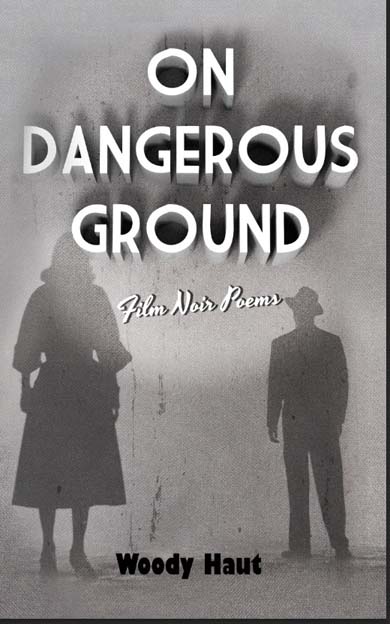
Two recent books, Woody Haut’s On Dangerous Ground and Jim Nisbet’s Pandemic Ditties, offer a case in point.

woody dgcvrWoody Haut’s On Dangerous Ground, Film Noir Poems takes its title from the Nicholas Ray movie of the same name. As the 50 “film noir poems” illustrate, the poet is well informed in the both genres. The author of numerous critical studies of the noir genre including Pulp Culture: Hard Boiled Fiction and The Cold War and Neon Noir: Contemporary American Crime Fiction as well as a couple of noir pot boilers, Cry For a Nickel, Die For a Dime and Days of Smoke, Haut’s poems take their titles from such classics as The Big Sleep, Nightmare Alley, and Touch Of Evil as well as the lesser known films like Where The Sidewalk Ends and I Wake Up Screaming. The poems themselves are prompted by dialogue, interesting camera work, the plot, a particular scene, the acting by the actor/actress, or their depiction of a time, place and social relevance which reveals the author’s knowledgeable immersion in a distinct American genre with a French name.

Woody Haut started out on poetry but soon hit the hardboiled stuff. And he even admits it! “Poetry had been my first port of call, though over the years my relationship had succumbed to disgruntlements and separations.” And yes, the poetry world is not an easy safe to crack, and even if you do, sometimes, although the safe may seem full, the rewards can be empty. Still carrying some of the baggage from that time, he confesses, “stretching back to the mid-1960s, in Los Angeles, then San Francisco, with various publications and a range of mentors, from the academic — Henri Coulette, Philip Levine, Jack Gilbert — to the peripatetic—Michael McClure, Charles Olson, Amiri Baraka and Ed Dorn. More recently, my interest veered towards the more linguistically-oriented, such as Clark Coolidge, Michael Gizzi, and Tom Raworth, and political screeds by the likes of Sean Bonney and Keston Sutherland.” And he is not above spilling the beans and implicating other writers in this amour fou: “Alice Notley, Robert Polito, Geoffrey O’Brien, Nicholas Christopher, and earlier, Weldon Keyes and Kenneth Fearing. Even Raymond Chandler began his writing career composing doggerel for the Westminster Gazette, while the great Dorothy B. Hughes garnered the Yale Younger Poets Prize long before she wrote such classics as In a Lonely Place or Ride the Pink Horse.” And of course the most damning testimony, besides his own words, are the poems themselves.

On Dangerous Ground
(Nicholas Ray, 1952)
Why do you punks make me do it?
growls the cop as he beats the shit
out of a pathetic street hood. As if
the same old same old, aggressor
blaming victim, perking watch and
wonder. Law and order cracking as
inevitable as the saturated light, an
apartment filled with testosteronised
artifacts: what once was, will never
be. Violence, as always, feeding the
conundrum. If only it wasn’t so addictive,
or family of last resort. A jones exiling
him to a sparsely populated snow-
ridden town, viewed-a movie within
a movie-through a windscreen, the
schtumed backseat viewer cachéd
in their own private critique, bleached
out by the death of a young girl at the
hands of a teenager barely knowing
better. With darkness bleeding into
domesticity, a match is lit for unblinking
eyes, and a wounded plea to locate her
brother before revenge can freeze his
tracks. Frightened, the kid invariably
slips from higher ground, recycling a
geology of clichés, footnotes in an
expurgated history of crime and
punishment. Fifty years on, the screen-
writer, blagging in his local coffee shop,
tells a redacted story: how he’d simply
wanted the cop to return to the city a
different person. But the studio’s arc was
non-negotiable. After all, the politics of
money dictates that only a miracle can
suffice. A capitulation, however generous,
not quite more than barely nothing at all

As Haut explains, “the poems in On Dangerous Ground could be thought as distortions, often humorous, of the films under consideration, like scrambled film reviews that exist at a particular moment, distilled through time, whose shelf life will last until the next viewing, by which time another set of linguistic prompts or images might attract my attention.”

Woody Haut’s On Dangerous Ground is available from Close To The Bone Publishing

A longtime member of the Bay Area lit scene who passed away in 2022, Jim Nisbet was an internationally recognized novelist and poet, and a seminal figure in the West Coast Noir Renaissance. His many novels which include Lethal Injection, Windward Passage, Snitch World, and The Syracuse Codex (to name only a few) have been described as “Jack Kerouac meets Tarantino meets David Forster Wallace” which is some kind of hyperbole but fitting of the genre and the author.

PLAGUE+DITTIESNisbet returned to his poetry roots (not that he was ever very far from them) to put the pandemic in pentameters in a selections of poems titled Pandemic Ditties. Jim, in the late 70s was a young poet in San Francisco who wrote and declaimed his poetry in coffee houses and bookstores. He even read at the historic San Francisco Punk Poetry Festival at Terminal Concepts Gallery with such luminaries as Andrei Codrescu, Gloria Frym, Darrell Gray, and the ravishing redhead femme fatale, Victoria Rathbun, straight out of a noir drama. Obviously, as it turns out, poetry wasn’t the only thing he was writing.

The poems, fifty five in all, collected in this slim volume from Molotov Editions, were written over a two year period (March 2020 through June of ’22) and distributed to his email contacts. Informed both by classical tradition and the immediate circumstances of the pandemic, these poems deal in matters political, spiritual, and cultural — but ultimately take the shape of an increasingly personal encounter with the phantasms of the pandemic.
Nisbet has a fine discerning ear and the Oxfordian vocabulary to go with it. The raucous ditties romp and roam, the pace hyperactive, reminiscent of the high wire antics of Nisbet’s prose, walking the line between doggerel and limerick, all the while juggling a ham on wry sense of humor. And like those internationally acclaimed novels, the poems are nothing but lively and thought provoking. An excerpt from “No. 19” written in July of 2020 gives an idea of the gyroscopic wit of the novelist as poet

Safe at home in 1958
We had Doctor Zorba
Who, his eyes turned away at last
From the jitterbugging babe

In The Asphalt Jungle, weekly chalked
On a dusty slate
“Man. Woman. Birth.
Death. Infinity.”

Today, not safe anywhere,
We have Subdoctor Schnorba
Sketching in thin air
“Person. Woman. Man.

Camera. TV.” Repeat ad
     nauseum. Never mind
The incredulity. Expect
Rezids, directly deposited.

The poems in Pandemic Ditties (pace Defoe) demonstrate Nisbet’s great range, from highbrow to lowbrow at the flick of the tongue, resulting in fascinating frenetic high octane linguistic kaleidoscopic versifying. A seat belt, nay, a harness is recommended if you’re going along for the ride: whiplash may occur as the result of sudden sharp turns, changes in direction and orientation, and abrupt stops, all of it like an amusement park ride, entertaining as well as exhilarating. Anyone who has enjoyed Nisbet’s novels will appreciate this selection.

Jim’s Pandemic Ditties is available from Molotov Editions

There is no doubt, as it is quite obvious to the most casual of observers, the genre is infested with poets. Should the reader of pulp be concerned, put in a call to the exterminators? Probably not. Poets and pulps are in a symbiotic relationship, like Louis and Rick in Casablanca, it is a “beautiful friendship.”

That’s my story and I’m sticking to it,
Perry O’Dickle
for Dime Pulp,

Carriers VIII-IX

by Mark DuCharme

-VIII-

“You’re late,” Waycross blurted, testily. He was the Interim Assistant Deputy Director of Transportation— that is, of transporters like me. I never met anyone higher up than Waycross. He felt it, too. He was like a petulant king.

I looked at my watch. I was about a quarter-hour late or so, I was surprised to learn.

“I’m sorry, sir, but I had a carrier incident while off-duty in the middle of the night, and I thought I should try to get the cargo to the facility directly, and thought I could do that and still make it back here on time, but I misjudged the time terribly. I’m so horribly sorry, sir.”

“Well,” he paused, “don’t let it happen again.”  Then he huffed away, just as testily as before, but perhaps a bit incensed at his own uncharacteristic show of relative mercy.

I noticed the New Man several feet away, looking stealthily toward me and observing— observing the whole time, with a most curious and furtive glee.

The New Man was sinister. I felt uneasy in his presence, and so tried to avoid him. There was something odd about him, the way he’d so suddenly replaced Hank, and the silence about it, the whispers, as if nothing had happened at all, as if Hank had never been. And the New Man always seemed to be turning up suddenly at the wrong time, looking about stealthily, behind one’s back, over one’s shoulder, as if he were studying you, as if he wanted to learn your private business, as if he wanted to learn to be you. I half suspected him of being a spy for management. Maybe, it now occurred to me, he was a spy for this Thorne.

I didn’t intend to let myself be late again, but neither could I make much sense of all that had recently occurred. Then I remembered the packet Gruber had left me. I reached into my coat and felt that it was still in my breast pocket. I suddenly became more curious about it. I mean, here was I, who had been fearing that old man— or rather, his remains— and I’d been carrying his final testament, of sorts, the whole time. And why me? I was just a neighbor. Sure, I’d drunk his brandy and listened to his ravings on occasion, but we weren’t close, or so I judged. Why would he have made a point of leaving this for my eyes alone? Why would he have told Ana about it, and why did she feel it was important (if she felt anything at all) that I should get it— especially in that very strange moment when we’d just burst in upon her old daddy’s death scene? What strange jumble of thoughts rambled through her mind at that time, out of which she determined that this was the one thing she wanted to be sure not to forget? It’s not like she remembered it a week later and slipped it under my apartment door; no, she made a point of giving it to me then. Something was mysterious about it, alright. Yet I had no time to look into it now; a full day’s work lay ahead of me.

Must I confess how my curiosity began to grow and fester over the course of that day’s labors, and how my lack of a full night’s sleep only seemed to compound my general state of confusion?

Finally, after endless hours, the sun began its slow descent, and I, after having deposited my cargo, began to make my way home also. I knew as soon as I got there that I would want to read Gruber’s packet. And so I hurried.

When I finally entered my apartment, the night now having fully descended upon the city, I tossed Gruber’s envelope upon the table and removed my coat. I was hungry, but even more so was I curious, so I grabbed a beer out of the refrigerator, stuck a frozen dinner in the microwave, and sat down with the packet that had captivated my thoughts for the better part of that strange day.

I ripped open the yellowed envelope and removed the sheets of folded paper and another sealed packet that had been inside the first. When I read the contents, it became clear to me that Gruber had thought more highly of our “friendship” than I myself.

Dear Johnny,
By the time you read this, I may be dead. That’s how things go in times like these. I’ll try to explain more about that later. Forgive me if I can’t explain it all. There are some things I am about to tell you that defy reason or virtue.
On the last night you came to visit, Johnny, I could sense your skepticism, so I didn’t want to go on about all this.  But nevertheless, I feel it’s important to tell you, because if I’m right, my life is in real danger, and yours is too.
I mentioned one Artemas Thorne that night. It didn’t seem like you’d heard of him. Nevertheless, he’s a very important man in this town. Some say, the most important. But I told you, or I tried to tell, that he is very, very dangerous. You must be on your guard!
Why he’s so dangerous will take some explaining. You probably already think me a little crazy, Johnny, but if you don’t, you surely will after you have finished reading what follows. I can assure you, though, that I am in full possession of my mental faculties, despite my age, even as I imagine that my assurance will not matter much to you, my dear friend. Nevertheless, because your own soul is at stake, as well as mine, I must try at least to convince you, however quixotic that labor may prove.

Johnny, strange things are going on in this city— strange and wicked things. Why do you think that all those bodies have to be brought to the abandoned warehouse before dusk?  What is it your employers are afraid of? Have you ever thought about that?
Johnny— you’re smarter than you pretend to be, but if I can speak frankly, my friend, your problem is that you’re incurious.
Johnny, have you ever heard about the dead returning to life? I don’t mean to life exactly, but to some pale semblance of it. When this happens, some call those returned— those whom I believe you call “carriers”— the undead.
Johnny, please bear with me. I am not as feeble-minded as I think you think I am. I am not feeble-minded at all, in fact. But when I say this, I know you will not believe me.
Nevertheless, I persist, because you are my last hope. My daughter is lost to me. I know few people young enough, strong enough, to carry on this fight. You are both young and strong, Johnny, and if you will but believe, I know that you can see this through— and do what must be done.
You have received the calling card, by now, of Artemas Thorne, I trust. No, it’s not I who put it there! I understand your skeptical nature, Johnny— in many ways, I am a skeptic myself, as I’ve tried to stress to you, though it seems to have fallen on deaf ears.  In any case, perhaps by the time you read this, you might be a bit more curious about him than when we last spoke.
I am a historian by training, if not by profession, as you well know. I have done a fair amount of historical research in my time. I have looked into this Artemas Thorne— for reasons that may become clear to you, but which for now it is difficult to fully explain. In any event, there is no record of a person of that name, man or woman (for in fact, it could be either) ever being born on this continent. And I’ve scoured all the data. I find that rather curious.
The other curious thing is that the only record— again, on this continent— of a person by that name, in any variant spelling, is of a colonist who arrived here on one of the early ships. A birth record has been found for that Artemas Thorne near London, but no death record for that person, born in 1596, has been located. Very strange.
Johnny, I am convinced that the Artemas Thorne who lives here and now and the Artemas Thorne born in 1596 are one and the same! He is one of the undead, Johnny— in fact, he is their leader, of sorts. If I am right about this— and I am almost certain that I am— then it is he who brought this plague upon our city. He is a very wicked man— or should I say, creature?
You’ll want proof. I can offer none, at least until catastrophe strikes. But if you ever wake up in the middle of the night, full of restless dreams, do not look out your south-facing window if you lack courage.
My hope and purpose in writing posthumously (should my guess prove correct, and my daughter, in that event, keep her word) is that you be awakened to this danger and act swiftly, as one should.

Most sincerely,
Augustus Aloysius Gustave “Jim” Gruber

PS: I am enclosing a second sealed letter in this first. I ask that you not read it unless and until you become convinced that I am right. This second letter will instruct you on what to do to rid this city of its plague and of the demon who brought it upon us.
PPS: One more thing, Johnny. My daughter Analeise may call upon you some evening, if she already hasn’t. Don’t let her see this letter or the enclosed one! If I’m right about all of these things, Johnny, she is dangerous too.

I was most perplexed by this strange missive. On the one hand, Gruber here sounds madder than ever before; on the other, he makes a strange sort of sense.

I grew upset. The events of the last few days had cast an unmistakable pall over things. It seemed as if I’d been drawn into some chain of circumstance that led I knew not where, and over which I had no control. I didn’t know what to do or think. I began to wish that I’d told Ana to go the hell away and gone back to sleep. I began to wish that I hadn’t knocked on Gruber’s door that night. O, what to believe?

I finished my meal, then drank another beer, then another. I went to bed at the usual time, but slept fitfully. I would have gladly settled for troubled dreams.

Bild 138

-IV-

I couldn’t very easily get to sleep, and when I did it was only a feeble approximation of rejuvenating repose. I did wake fully, though, around midnight. Old Gruber’s letter had haunted me, chasing back innocence’s rest. But when I glanced up at the clock and saw that it was only 11:58 P.M., I felt despair. And then, those words of Gruber’s came back to me: if you ever wake up in the middle of the night, full of restless dreams, do not look out your south-facing window if you lack courage. Gruber had been crazy, but he could be right about some things. My apartment does have a south-facing window, for example. But what could I see from there, and why would it require courage? The main thing visible from there is that old tower.

I have remarked earlier in my tale upon the unusual construction of the building in which my quarters are located— how the edifice is essentially an old Victorian house that has been added on to over the many decades hence. This is so, and the newer appendages are sometimes odd and ill-suited to the original components of the structure.

Nowhere is this more evident than in the tower. It is probably at least five or six stories in height— easily the tallest edifice for blocks around. It is constructed of mortared stones. It looks rather more like a European structure than one erected on this continent. In truth, it resembles a medieval tower more than anything post-Victorian, and so it fits right in with the odd hodgepodge of architectural styles that is the hallmark of the assemblage I call home. There are windows in that tower (fairly narrow), but there is no door at all outside its circular structure. It is said that an old door that no one ever uses— one that, coincidentally, is to be found just to the left as I exit my quarters and approach the main stairwell— actually leads to a hallway which, in turn, leads into that tower. But as I’ve said, that doorway is never used. It doesn’t seem that anyone has the key. And I have never seen lights in the tower’s somewhat narrow rectangular windows. In truth, I think that no one lives there, nor has anyone for at least as long as I have occupied my quarters.

The more I thought about it, the less sense Gruber’s statement made. You see, if I look out that window at night— or in day, for that matter— just about the only thing I can see is that tower. Now why should that be so frightening?

Here, I suddenly thought to myself, here was a chance to prove Old Gruber the benign lunatic I always took him to be. I got out of bed at once and went to that window. Surely, I would need no courage, because surely all that would be visible would be that old, abandoned tower, the darkness that engulfed it, and perhaps some faint lights down the street. This was brilliant, I thought. Surely all this vague, uneasy feeling would be resolved at once, and I would turn and go right back to bed, and sleep there like a babe in comfort.

I should not need to tell you with what chagrin I had to admit to myself that Old Gruber knew exactly what he had been talking about. For there it was, out my window facing south, that stone phallic structure. And out of one of its narrow, rectangular windows, I saw emerge to my growing horror the figure of a man. Yes, it was unmistakable. But this man did not leap to his doom, nor make some plea to the unheeding night; no. This man, instead, emerged from that window and crawled— yes, that is the right word— he crawled down the side of that building, quite like a spider. He had dark hair and was slender, but not slight, of build. He was clad all in black or dark gray— I could not tell the difference by cloudy moonlight— and his long overcoat paid no more respect to the law of gravity than his body did. When this downward-crawling human arachnid arrived at the narrow window directly below the one he had emerged from, he entered abruptly, and with an insect-like and most inhuman agility. Then— and this is the strangest part— I could see him stand up in the lower chamber he had so unnaturally entered, and turn and face me suddenly— yes, me! He was clearly aware that I had been watching him, and even in the dim moonlight, I could yet detect a malevolent smile curl his lips.

I rushed from my window in horror. Had this all been a dream? No, it couldn’t have been! I was nowhere near a state of sleep conducive to dreams, much less any state of sleep. I was wide awake, yet what I saw struck mortal terror in me in a way no nightmare ever had, even as a little boy. No, this was all too real! And this thing— this spider-creature— was now aware of me, if he hadn’t been before. My blood chilled as I reflected on this new and dreadful development.


Next Time: The Letter Inside The Letter

Cheése Stands Alone XII

by Phylis Huldarsdottir

Cast of Characters (Partial):

lcnew2Captain Lydia Cheése (pronounced “Chase”), Airship Commander for Aerosud, a luxury liner airship company based out of São Paulo in the Empire of Brazil, who is searching for her father, Commodore Jack Cheése, an outlaw and antigovernmental rabble rouser.

jpserrepainProfessor Doctor Jean-Pierre Serre-Pain, proprietor of Madame Ophelia’s Ophidiarium, a traveling snake show, who has abducted Lydia to get her to pilot an illegal unregistered airship to HOAR (the Horn Of Africa Republic) on a mission of mercy in exchange for helping her find her father.

Untitled-1Serpina, a young girl who serves as Serre-Pain’s assistant and snake handler and who is also a psychic Vessel.


vladyovlVlady, an older bearlike man also in the employ of Madame Ophelia’s Ophidiarium and a traveling circus strongman Lydia recognizes from her past.


PyarePyare
, a young man with dreams of being an airship pilot, and member of LBFDS (the League Bousculier Francaise Du Sud) helping Lydia and Serpina rendezvous with Serre-Pain and Vlady at an illegal airship.

pax victorianaPax Victoriana, a period of peace imposed by the Clockwork Commonwealth and its enforcement arm, The Admiralty, dating from the beginning of Queen Victoria’s reign to the present for a total of 180 years which includes the TSR (Temporal Shift Realignment) of 56 PV (1893 AD) after which Commonwealth calendars where recalibrated to reflect Her Royal Majesty’s peaceful rule (following the devastation of the first Pandem and its resurgence 30 years later as Pandem II).

karlakolaChief Inspector Karla Kola, head of the IOTA squad charged with capturing Commodore Jack Cheése and Lydia’s nemesis and pursuer.


Chapter XVII

The stone threshold led to the open door and the darkened interior of the public house. The air was close and smoky as Lydia Cheése stepped onto the roughhewn floor. The amber glow of lights, plasma based or bacterry powered, even some organic bougies illuminated wide tables and the chatter of voices of those around them. Delectable odors made her mouth water.

A large broad shouldered woman, fists to hips, blocked any further progress. Pyare spoke to her a few words in a local dialect. The woman’s eyes narrowed and reconsidered what Pyare had told her and what she was seeing, Lydia and Serpina looking very rough. She inclined her head in the direction of the kitchen and had them follow to an alcove nearby. There was a bench and a stool. From a doorway opposite, the large kitchen fireplace exuded heat. She addressed Pyare with a hand held out.

Pyare turned to Lydia, the hood of her burnoose still drawn close around her face, “She will feed us but we must pay. You have Victorines. Or better, the local currency. They are very suspicious of Victorians.”

Serpina stepped forward. “I have a few old francs.” She retrieved the bills from her wallet, handing them to the woman, and smiled. The woman’s severe demeanor softened and she smiled back as if entranced. She was older, with a pushed in face and large eyes, greying dark hair pulled together under a scarf. “Yes, I speak standard little. I was maid many years in Nouveau Old Orleans. I am Mira. Please sit. I will be back.”

Lydia’s eyes questioned Pyare. He seemed nervous. The murmur of voices from the main room of the Bear & Lion had quieted as the newcomers were silently scrutinized. Serpina sensed Pyare’s anxiety and stood close to him, in his shadow.

“Do you trust her?” Lydia had quickly scanned their environment. A large room occupied by a dozen or more people, eating, drinking, talking. It all seemed very congenial. Until they arrived. A few, men, were on their feet and moving around, some to an adjacent room that also appeared to be occupied.

“Of course. Once we crossed the threshold, the rules of the clan do not allow any harm to come to us. The food will be simple but good. It is once we leave here that I’m worried about. I see some very unfriendly faces at those tables.”

“I’d rather not worry about that on an empty stomach. They can’t all be hostile to us, can they?”

“They will be if they think we are police spies. Or worse, refugees.”

The woman named Mira returned with a large pot and three bowls which she set on a barrelhead nearby. Ladling out portions of murky stew she passed the bowls around. Lydia looked at the congealed brown and orange mass with certain revulsion. She was hungry, the smell was savory but unfamiliar. The thought of it passing through her mouth made her gag involuntarily. Pyare looked at her in surprise as both he and Serpina were already swallowing their first bites. Mira looked at her askance as if it were a comment on the dish.

Pyare nodded vigorously and pointed at the bowl so that the woman would understand that he thought it delectable. Serpina, as well, nodded her appreciations. “Mushrooms,” she said, her eyes widening. “Sausage!” Pyare chimed in.

Each word was like a stab in the gut, but after such reviews, how could she refuse, especially under the returned suspicious gaze of their hostess. She nudged a small portion from the bowl to her lips and past her teeth. A warm sensation flooded her mouth from the surprisingly rich texture of the morsel. It did not taste as unpleasant as it looked. There was a complexity to the flavors that she had sampled only in the most expensive restaurants in Rio Rio. This was not the same old remolded morselized biotein fare that was common throughout the Commonwealth, fauxfillets of fizsh and strings of rehydrated chibz, or ubiquitous  biotein patty pazetree puffs sold in take outlets and automats everywhere. Except in the Massif, apparently. The first bite was followed by a second bite although she was uncertain what to do with the first bit of sausage. She closed her eyes and swallowed so that she could tell herself she had done so without looking.

It wasn’t long before Lydia was running a finger along the insides of the bowl to get every bit of the stew and unhesitatingly accepted the large stein of fermented broth proffered by an approving Mira. Lydia felt full as she had never felt before. And drowsy. If it hadn’t been for the commotion in the main room of the house, she would have drifted off to catch up on much needed sleep.

A man in a tilted hat repeated what he had just proclaimed. “It smells like destruction, I tell you!” He was a round man, tall, with shockingly blazing eyes and a large unruly white moustache overhanging his mouth. Another man seated near him took offense. “No, friend, it smells like good food and warm bodies, especially those of women!” His assertion was met with a few guffaws and a comradely “Hear, hear.”

Lydia stepped between them. “Let me show you mine.” She proffered the identification card with one hand and with the other placed the twin tips of the viper blade under his chin.

“It smells like an evil wind that bodes no good!” the round man continued.

“Maybe it’s a broken wind,” someone else offered to a chorus of laughter.

“He should know” offered another, “He’s a bag of wind. Blow back to your mountain hut, old man, and take your bitter nuts with you!”

“Yar, that he is! And always with the same complaint!” The tone was a little more aggressive. “You don’t belong here. Go back to your wallow!” The accusation had come from a man who had entered from the adjacent room. He was large with a shaggy head of mouse brown hair.

“Ruin! I can smell it in the air. The foul stench of annihilation!”

“Blame it on the wind. It’s blowing your stinking breath back in your face!” Another man in a great coat had stood up menacingly. “We don’t need your kind around here! You are stirring your disturbance in the wrong place!”

Lydia looked puzzled. She wasn’t certain what was happening. What had started as banter had turned abusive. She could tell by Pyare’s posture that he was on the brink of fight or flight. Only Serpina seemed unconcerned, a slight smile turning up the edges of her mouth.

“It is us, all of us, who bring this doom to ourselves. Not the Clockwork Commonwealth or its client states, or the sanctioned republics, but we, the humans who comprise these states of mind, the squirming grubs, the microbic slime of this planet. We are bent on destruction, on self-destruction!” The round man in the tilted hat held a finger up in testament. “And why? Because of time! We have too much of it. Like misers we want to acquire it all, all the time. And what do we do with all this time? We claim that it is necessary for our own self-improvement and satisfaction! Yet look at us, do we look satisfied? If this is improvement, it is only preparation for the grave! The entire mammal world, with one exception, has never once given time to consider how to improve themselves. What can we say about their lack of discontent?”

“Get out with you words,” another man spoke up, “they’re spoiling the taste of my food.”

A few of the men at another table pushed back their bench and stood. The mouse haired man advanced toward the tilted hat who stood defiant in his righteousness. “I’ll teach you to curdle the cream!” he said threateningly.

“Stop!” It was Serpina. She had stepped out of the shadows. She was still smiling, and the men were diverted. “This man has freedom to speak his discontent. It is the winter of his days, one that we will all face, yet you want to deny him this fundamental right to speak the fruits of his experience. Why reject what he is saying when you could engage and glean the substance of his meaning?”

Mira had come to stand by Serpina, Lydia and Pyare cautiously following. “Yes, leave the old man alone, he has a right to his demons.”

The tilted hat bowed to the hostess. “I am only old because I have run out of time, but in my heart burns the eternal flame of love.”

Mouse hair glared at them and then glanced at the standing men around him. “Who are these intruders? Spies, refugees? I’ll want to see you papers!”

“Conan, you haven’t the authority. These are guests under my roof.”

“We’ll see about that.” He approached Serpina, his hand out demanding. “Your papers.”

Lydia stepped between them. “Let me show you mine.” She proffered the identification card with one hand and with the other placed the twin tips of the viper blade under his chin.

“Odette Oday?” Conan gulped and swallowed his insistence. He blinked at the passport. “Third Class Worker?” Stepping back, he shook his head. “Maybe those two.” He pointed with his chin at Serpina and Pyare. “But you, you’re too shiny. Except for the mud on your face, you could be a Victorian, an IOTA spy, for all I know.”

Serpina laughed. “What could IOTA possibly want with a congregation of unwashed farmers and trappers smelling of the field and the wood? Are you plotting a revolution, listening to Commodore Jack and his ICER propaganda over unsanctioned broadcast frequencies on illegally modified boxes? Here in your sylvan redout, you are the powerless of the powerless. The only thing that protects you is your ignorance. Perhaps that is the stench of ruin to which this fellow is referring. Furthermore, we are travelers, not displaced persons. Our path was not chosen for us thus we must follow the one we can find. What is our goal I cannot say only that it is not found here.” With that she bowed to Mira and clasped the woman’s hands in hers. “Thank you for your hospitality, sister.”

Once outside, Lydia caught up with Serpina who seemed propelled by a determination to get away as quickly as possible. “What was all that in there?” What were you doing?”

Serpina shook her head. “Not now. We are still in danger. We have to get out of sight.”

A shout was raised from the house. Pyare on Lydia’s heels, they turned as one expecting the worst. It was the man in the tilted hat hurrying toward them.

Slightly out of breath, he wagged a finger at Serpina. “A foolish thing to do. Stir up a hornet’s nest. They are used to my disputations. They insult me and then forget that I am about. Or should I say they think they can forget what I’ve said, yet I’ve lodged a bug in their berets. Over time their objections are less vociferous although they enjoy the wit of their insults too much to ever stop.” He smiled under the wide brush of his moustache. “Thank you for coming to my defense.” His brow creased, “But your unfortunate disclosure of their anti-government activities has put you in grave danger.”

Pyare confronted the tilted hat. “Who are you?”

Bushy eyebrows raised in surprise, “Of course, how rude of me. Allow me to introduce myself,” hat doffed, “Abraham Etugouda, poet, world traveler, originally from Iberia, citizen in the Republic of Letters.”

Serpina spoke up. “Mr. Etugouda, perhaps you can help us. We are trying to reach. . . .”

“Wait,” Pyare stepped in, “How do we know we can trust him with where we’re going?”

Etugouda gave a body shaking laugh. “I’m an old man everyone thinks is crazy. And who would believe me? And why would I betray you? I’m a stranger here myself. Let me repay your kindness. Tell me your destination, perhaps I can offer some assistance.”

“Autre Lyons,” Lydia replied, “It is imperative that we reach it within the next twenty four hours. Unfortunately following the regular route through the Massif will not allow that.”

Tilted hat nodded thoughtfully. “Yes, yes, I think it can be done. But we must move quickly.” He herded them across the stone bridge and up the hillside to a copse of oaks. “The men at the Bear & Lion have a transmitter in the storeroom. They will have alerted the militia by now. The roads will be watched.”

“What can we do? If you know the path, tell us!” Lydia insisted.

“I will recite a poem.”

“How will a poem ever get us to Autre Lyons?”

“It is an epic poem of local provenance called La Reccourci. It tells the story of a brave young woman who follows an ancient hunter’s path over the Massif to the valley beyond in order to save her father’s life.”

“I don’t see how that is helpful? ”

“As I said, I am a world traveler and a poet. I travel the world collecting the epic poems of various regions, especially epics that describe the topography of the locale. This particular epic contains a map, you might say, landmarks, and directions. It is of the genre known as GPS, Grandes Poemes Secour.”

“Your reciting the poem will require you to accompany us,” Pyare stated suspiciously, “Don’t you have it written down?”

The poet’s moustache raised in a grin and he pointed above his ear. “It’s all up here! I’ve memorized hundreds of epics.” He gazed at their incredulous expressions. “Now if I can just remember how it begins.”


Next Time: The Tides Of History

Contents Vol. 3 No. 8

Welcome to Volume Three, Number Eight of Dime Pulp,
A Serial Pulp Fiction Magazine

CARRIERSfi2Carriers by Mark DuCharme returns with it’s gothic air of  shadowy creatures who might just be the living dead. Carriers is a vampire novella with touches of black comedy and satirical bite, and is told from the perspective of its unreliable narrator and protagonist, Johnny. It takes place during a “plague” that has been going on for two years in an unnamed city. Dead bodies litter the streets, hallways, and homes. A corpse disposal company hires people like Johnny to transport them to a facility at the edge of town with the very important stipulation that the bodies be delivered there before sundown. No one ever says why. Read more in the latest installment of  Carriers, Episodes V-VII .

btdv2n10fiIssue 8 brings to a close Colin Deerwood’s long running serial, Better Than Dead, A Detective Story, featuring the unpredictable peregrinations of private investigator Lackland Ask, aka Stan Gardner, aka Sam Carter, and now Dr. Jerome Paulsen, O.D. leaving on a freighter for Cuba one step ahead of the law, the mob, and the draft board. All the loose ends (and there were many) are tied up or disposed of (are they?), and now the fugitive confidential agent can exit stage left. Find out how the story ends in Better Than Dead, Episode 30.  (A note from the author reminds us that the cover of this issue is from an original Black Mask magazine, c. 1940, and as such was the catalyst and inspiration for the more than 150 pages of serial crime fiction that followed. )

doncoyoteThis issue also introduces a new private eye, Don Coyote,  brain child of Mike Servante, a newbie to the musty (and labyrinthine) halls of serial crime fiction although an aficionado of the genre, in a metatextual story that promises to be a lot of fun, titled The Man From La Mirada Perdida, A Don Coyote & Saundra Pansy Adventure. Read  inaugural episodes i & ii in this latest offering of imaginative crime fiction from Dime Pulp.

Dime Pulp regular authors Pierre Anton Taylor and Phyllis Huldarsdottir were unfortunately caught up in the  seasonal vortices that often cause time displacement, especially as the days get shorter,  and the imprudent certainty that there is still plenty of time to get everything done.  Phyllis’s steampunk adventure, Cheése Stands Alone, will return in Vol. 4, Number 1 in early 2024, as will Pierre’s crimefighter fiction, Just Coincidence.

FYI: Available for readers of Dime Pulp who may have missed a few issues or lost the thread of a serial,  Dime Pulp Yearbook 21, featuring the novels (The Last Resort and Better Than Dead) and the short fiction (Hard Boiled Myth and Gone Missing) of Volume One’s 12 issues,  is joined by Dime Pulp Yearbook 22, featuring the complete pulp Western, On The Road To Las Cruces, continuing episodes of  a detective story, Better Than Dead, the opening chapters of new serial novels, Just Coincidence and Cheése Stands Alone, the short fiction of Hard Boiled Myth and Polka Dot Dress, as well as Dropping A Dime’s pithy pulp observations.  Volume Two’s 10 issues are available for perusal in their entirety by simply clicking on the links in this paragraph or on the menu bar above. Dime Pulp Yearbook 23 will be available in late January ’24 as part of the annual archival review.

If you’ve made it this far, click  on the links above to read the entertaining  serial contents of Volume Three, Number 8

Special Note: Dime Pulp, A Serial Pulp Fiction Magazine has changed its posting schedule from  monthly issues to once every forty-five days (more or less—mostly more). Thus Volume Three will (hopefully) consist of eight issues (much to the relief of the overworked writers and production staff). Thank you for your understanding.

 —Perry O’Dickle, chief scribe
and word accountant


The Man From La Mirada Perdida—i & ii

A Don Coyote & Saundra Pansy Mystery

by Mike Servante

i


—Ever work for a private investigator before?

—I can’t honestly say that I have.

—But you’ve had experience working in an office, answering phones, typing?

—It’s all there in the resume.

—Yes, of course. So why don’t you tell me in your own words.

—I was a receptionist for a law firm, Stag, Stagger,& Staggered. I answered phones, took messages, routed calls, sorted mail and put it in the appropriate mailboxes. And did some light typing. The legal secs did the important stuff.

—Just a minute, did you just say legal sex?

—No, no, legal secretaries, that’s what they were called, legal secs, legal secretaries.

—Alright, go on.

—The firm had an investigator on retainer, but I never saw him. Only his mail.

—Only his mail what?

     “His mail, envelopes, packages, legal briefs, that sort of thing.”

—I see, mail, briefs, packages.

—But that was a while back. I haven’t been in an office environment since I got married.

—You’re married?

—Was. Widow.

—Oh, I’m sorry. My condol. . . .

—It was several years ago.

—Yes.

—And I’ve had to rejoin the workforce.

—Your husband, uh, Mr. Pansy?

—Corrigan, Jake Corrigan. Pansy is my maiden name.

—Ok. Mind if I call you Saundra? Or Sandy?

—If it comes with a pay check, I’m ok with that, though I’m not particularly fond of Sandy.

—Pay check, right, good you brought that up. If you were to accept this assignment I can only use you parttime, three days a week. Monday, Wednesday, and Friday, eight till noon, I will pay you for your time each week on Friday. I hope those are enough hours for you. Maybe once business picks up we can add more time.

—That’s fine. Like I said I’m rejoining the workforce after years of being a housewife. I’d like to take it slow. Plus I get Jake’s pension.

—Oh, yes, pension, that’s good. What did your husband do?

—He was a cop.

—Really? That’s very interesting, a cop?

—He never talked to me about the job. Said he didn’t want to depress me.

—I see. That was thoughtful.

—I have a question. Do I call you Don or Mr. Coyote?

—Boss is fine.


dcovaltxtI’m a good judge of character. She was in her late forties, going gray pixie cut that went with the pixie face, dangling silver earrings, intense blue eyes, mascara thick eyelashes, not so subtle green shadowed and precisely drawn eyebrows. Her lipstick was a synthetic shade of orange and probably applied with a palette knife.     

 What choice did I have? The only other applicant was a high school girl who had arrived with her mother who wisely stayed in the car. She’d snapped her gum while looking around the small office, bewildered, pointed to the typewriter, and asked, “What’s that?”

This woman in the colorful summer dress and gold brocade shrug appeared evasive and reluctant when I asked about her experience. Anyone can write a resume, I wanted to get the depth of her understanding by how she used her words and if she was familiar with the nomenclature.

She brought up sex almost immediately. I don’t want to say that I have that effect on women, but I am not uninitiated in the ways of the world. When I questioned her bringing it up, she covered skillfully and made it out to be a misunderstanding on my part. I don’t make those kinds of mistakes. And as if to further tease, she brought up male briefs and packages. I wasn’t born yesterday. Packages, that was just blatant.

Next she tried the pity angle. Widow. What was I supposed to say? How did he die? And she coldly brushed off my expression of sympathy. I could tell she was desperate to get the job, her repeated emphasis on the need to return to the workforce, but maybe at her age it’s a challenge, and she’s desperate.

I guess that’s something I’ve never known, I come from money. My grandfather was a jeweler, from the Ukraine, one of three Koyoskozko brothers who were headed to Alaska during the gold rush to claim their fortune. Grandpa jumped ship in San Francisco, tired of puking his guts at every swell of a wave. He apprenticed to a jeweler, a fellow countryman, and learned the business. With the ’06 quake, the business was destroyed. Like many made homeless by the catastrophe, he headed north, following the circumference of San Pablo Bay until he reached the wet lands on the northwest side of the bay once owned by General Vallejo. There on a river that drained into the bay sat a relatively untouched settlement known as Petaluma. He took it to be an Indian name. He was successful, changed his own name to something easier to pronounce, Coyote, though at the time he didn’t realize its import as a mythical figure in the lore of his adopted country. Eventually he had jewelry outlets in every major burg in the valley. My father inherited the business and became even more prosperous by investing in real estate. When he died I inherited millions. He’d eased out of the jewelry business a while ago although I had worked for him as a courier when I was going to the University in San Francisco. I often carried satchels of very valuable jewels in the trunk of my Impala as if they were nothing more than a bag full of old tennis togs. I had a permit to carry, then, and still do.

That woman is wily, I’ll give her that. When I politely asked if I could address her by her first name she immediately turned it into an offer of a job.


sandy2ovaltxtI don’t know who he thought he was, thinning red hair, tall and gangly with quite a beak, too. He dressed conservatively for this neck of the woods, slacks, open collar shirt. I’ll admit I was desperate. After Jake’s passing, I had to keep up the house payments and that meant cutting corners on other necessities. Besides, being housebound as a homemaker for a couple dozen years, I was ready to re-experience life as a single woman.

My husband used to say I was a ditz, but what did he know, he was a lummox. Jake worked as a Napa PD patrol officer till he dropped dead at Swank’s Steakhouse in Santa Rosa. The red meat in his gut didn’t agree with the red meat of his heart. As someone from his family said at the wake, “He larded up.” Certainly no one on my side of the family would have said it, out loud, at any rate. And it was true that the slim handsome police cadet I married turned into a wide load, pot-bellied, booze swilling porker right before my eyes. The sorrier he felt for himself, the more pounds he put on, and the meaner he got. He was an accident that didn’t wait long to happen.

I’m from around here, born, bred, and schooled. My folks and their folks and their folks before them were pioneers in these parts, chicken ranching, sheep and cattle, apples and prunes, they did just about anything that had to do with growing or grazing. Of course Coyote Jewelers was known far and wide. My wedding ring came from their showroom in Sonoma, or as my dad used to call it, Sonombula because it was a sleepy little town back then, before it got overrun by grapevines and all the snobby money, snooty attitude, and high prices that followed. Growing grapes was suddenly an art when all it was really was just good farming. That’s my stock. I’m not afraid of honest work and I expect to be respected for doing it.

I knew enough to be on my guard, having worked as a waitress while I was taking secretarial courses at the local business school. Guys always bring sex up and then when you call them on it, they act all offended like and pretend that’s not what they meant. Happened at the office, too. And though I hadn’t expected it to come up in the job interview, there it was. Everyone knows a legal sec is short for legal secretary just as a para is short for paralegal. If I hadn’t got married I think I would have tried for paralegal, get the training and all.

In the meantime, I needed to get work and his acting like a jerk wasn’t making it easy. I wasn’t going to catch the drift? Mail, package, briefs. I come from a big family, brothers, cousins, uncles, all of them brain in the gutter. I’ve heard it all. And I wasn’t going to fall for it. If that’s what he thought, he had another think coming. Saundra Pansy was never a pushover whatever you thought of the name.

Guess he got the drift. Boss said I was to start Monday, eight sharp.


ii

—It’s not electric?

—Um no, but it’s authentic.

—It looks like it weighs a ton.

—It’s a 1939 Royal KMM with the patented Magic Margin system. See, if you hold down the right or left margin lever and slide the carriage to the desired location you ‘magically’ set the margin. It still has the original round glass-topped keys. I paid $5 for it at a flea market, and it still works as well as when it was new. I even ordered extra ribbons.

—Right. . . ribbons. That’s quite a museum piece.

—Oh, it is perfectly functional.

—And this lever?

—That’s the carriage return.”

—Ok, now I remember seeing a video of one being used when I was in business school. We practiced typing on electric typewriters.

—But you assured me you could type!

—Oh yeah, no problem, if it’s qwerty, I let my fingers do the walking, and I can do it blindfolded. I can also do Gregg but it’s been a while so I might be a little rusty.

—Greg?

—Yeah, you know, the shorthand guy.

—Shorthand?

—Transcription. Like I said, it’s been a while.

—Good, good, for now typing will be enough. And this is an elegant machine. You shouldn’t have any problem with it, freshly oiled and cleaned.

—You don’t have a computer?

—No I don’t believe in computers. But look, I even had some stationary printed.

—Stationary?

—I hired a graphics firm to design the letterhead and the logo. Don Coyote & Associates, Private Investigations. I think the howling coyote in the oval frame like that is quite well done.

—That looks like a wolf.

—No, no. I’ve been assured that it is, in fact, a coyote.

—Have you ever seen a coyote in the fur?

—I’ve seen pictures. Many pictures.

—Well, alrighty then, if that’s the case.

—Oh, no, no case yet, but I’m hoping in the near future to develop some leads, lure clients in need of investigative services.

—And in the meantime is there any correspondence you’d like me to write, calls you’d like me to make, appointments you want me to schedule, dictation? I’m ready to get down to business.

—Good, and I don’t know if I have to point this out, but that is what is called a rotary dial on the telephone. It’s a 1937 Stromberg Carlson, very rare.

—It works? I thought it was just part of the décor. Like the typewriter.

—It is in perfect working order, as functional as the day it rolled off the assembly line. It has the original bell. Wait till you hear it!

—I’ll assume it doesn’t take pictures.

—Of course not. The telephone is for the ear, not the eyes. This is not some Dick Tracy outfit with wrist radios and video phones. Don Coyote, Private Eye, is nothing if not authentic!

—Ok, you’re the boss. I’m ready to get to work. I just don’t want to waste your time and money sitting around not doing anything.

—Well, first of all you need to get familiar with the type of job you’ll be doing and probably the best way to do that is to begin by creating a catalog of the files and reference books in my office.

—Like a librarian?

—I have a collection of rare pulp fiction magazines and obscure post war crime fiction paperbacks. Oh, and my film noir library, private eye memorabilia, crime scene photos. I would recommend that you read a few of those novels to get a feel for the business. I’m thinking along the lines of Mike Hamm. . . .

—You’re going to pay me to read?

—Well, no, I see it as something you could take home and do. To bring you up to speed. A private eye’s secretary requires specialized knowledge.

—So I would be doing more than just typing and filing? That sound like I’d need specialized training. On company time.

—Are you going to answer that?

—Don Coyote & Associates, Private Investigations, how can I direct your call? One moment please. It’s for you.


dcovaltxtI don’t know how to say this. My expectations might have been too unrealistic. She chews gum. Maybe she was nervous. I suspect that she is rather unqualified and I will eventually have to let her go. As my father used to quote my grandfather as saying, “The biggest problem in running a business is employees.” She is rather plain in a well-scrubbed sort of way. And maybe someone should have told her that colorful plastic jewelry was no longer as popular as it might have been, if ever, in the fifties, say. And even though she was made up to match the bangles and bracelets, she couldn’t hide her lack of refinement when I showed her to her desk.

That typewriter is a classic machine, indestructible, a workhorse. I couldn’t believe my luck. It was from an estate sale, everything had pretty much sold at auction except for a few odd items, like gooseneck lamps, and the old typewriter. One of the heirs was selling them at a flea market where, on occasion, I browse, looking for old magazines and paperbacks. A hand printed sign propped on the machine read BOAT ANCHOR? $5 or B/O. Finding a typewriter repair shop and restoring it was probably the hardest and most expensive part. Even the repairman had never encountered this old of a model, a 1939 Royal. His experience had been mainly on lightweight plastic chassis portables and dreadnaught electric office machines. He also repaired watches, something else experiencing technological displacement.

As soon as I questioned her competence she immediately brought the conversation around to sex. She said she was alright with quirky, and then something that she had done blindfolded with someone named Greg involving shorthand, whatever kinky fetish that was, but I could just imagine. I can only assume she was desperate. She kept saying that it had been a while. Then she brought up computers. And that’s a sore spot with me. I find them dehumanizing. Unfortunately I can become quite irrational when confronted with the issue. I deflected by showing the stationary I had printed but she wanted to make an argument about whether it was a wolf or a coyote depicted in the oval of the logo. I can see that she has a petty side.

I definitely got the feeling that she was in over her head. She was undoubtedly confused by the rotary dial on the telephone. She tried to laugh it off by making a joke. I have very little patience with mockery especially when it pertains to the degradation of values under assault from the techno sphere. I’ll admit it, I’m a technophobe.

And when I suggested that she educate herself for the role she would play as a secretary to a private investigation firm, she turned it into a labor negotiation. I was about to assert my prerogative as the employer when the phone rang. I’ll admit, she did answer the call quite professionally.


sandy2ovaltxtHoo boy! I didn’t think I realized what I was getting into. That machine, a manual typewriter, was carpel tunnel syndrome waiting to happen. I thought he was kidding. Maybe a monitor would cleverly pop up from a hidden compartment on the mahogany desk. No such luck.

I had to remind him again that I was qualified as a secretary, I’d even included a copy of my diploma from Empire Business College with my resume. I found a clean copy that my crazy friend Lola Lamont hadn’t altered the heading of the certificate to Vampire Business College though in truth that’s what we all called it—they didn’t suck you blood, just your money. But from the look on his face, it might have been TMI, too much information.

Then he trots out this stationary with a heading like it was from a comic book. A picture of a coyote, he says, in a clunky oval frame. It was a wolf. I’ve seen coyotes numerous times. Even shot one on my uncle Brad’s sheep ranch over by Two Rock. I know what a coyote looks like. They’re vermin. But he’d seen pictures.

And speaking of pictures, he had to point out the antique telephone like I haven’t ever seen pictures on ones almost exactly like this one. My gran even had one on her bookshelf, used it as a bookend to hold up her collection of picture albums. He got a little touchy at my joke about taking pictures so I’m going to guess he had his funny bone surgically removed.

But I gotta hand it to the guy, his setup is right out of an old black and white movie which I can’t watch because without the color, there’s no meaning, and I lose interest real fast. The place is on Western just off the main drag in what used to be the original family jewelry store, a three story brick walk-up. The downstairs showroom is now an antique store so he doesn’t have to go far for his décor. His office is on the second floor, the door at the end of the hallway at the top of the stairs. It’s one of those old wooden doors with a frosted glass panel on the upper half and in gold lettering it says Don Coyote & Associates. I haven’t a clue who the associates are but I figure I’ll find out soon enough. Inside is a small reception area with a couple of old chairs up against the wall and across from the big mahogany desk where I’m supposed to work. There’s another door on which is written in the same gold lettering, Don Coyote, Private Investigator, and call me crazy, but I’m guessing that’s where the files and reference books are that he wants me to catalog. And read.

He has another think coming if he thought I was going to take work home. If I learned one thing from Jake Corrigan, it’s don’t take the job home. And the only thing I’m going to flip when I get there is the channels. Even McDonald’s pays you when they train you to flip burgers. I could see that that was going to be a bone of contention. If you want me to do a special job, train me. I’m a fast learner. I was about to let him know where I was coming from when the phone rang. It startled me at first. It was loud. And it was a real bell, not an electronic facsimile. I picked up the handset and immediately went into receptionist mode. It was a woman’s voice. She was sobbing, “Help me, oh please, Don Coyote.”


Next time: la bola desnuda or don’t go bowling naked