Category Archives: Crime Fiction

A Detective Story—5

by Colin Deerwood

Ads24

I was being followed. I had just pushed out from the brass and glass doors of City Bank where I had gone to break down the c-notes to more expendable denominations. A high crowned fedora with the brim turned down topped a slight figure in a long gray overcoat with the collar turned up. I dropped to one knee in front of the entrance to the jewelry shop next door. I retied my shoe glancing up at the reflection in the display window mirroring rings, jewels and watches. The shadow hesitated, dark goggles and wan cheeks peeking out from above the V of  collar. I knew I could probably take him. Unless he had a gun in his hand in those deep overcoat pockets.

            I rose and turned abruptly, striding in his direction. He spun and walked hurriedly out of sight around the giant granite cornerstone of the bank building. Just as quickly I turned and ducked into a cocktail lounge two doors down.

            It was one of those tall, narrow, opaque window, dark interior, shotgun places that catered to bank tellers, bookkeepers, secretaries, and clerks with tables along one wall and an ads bar1enormous mahogany bar along the other that allowed only constricted access to the darker reaches of the back where the facilities were located. And the phone booth. That’s where I headed.
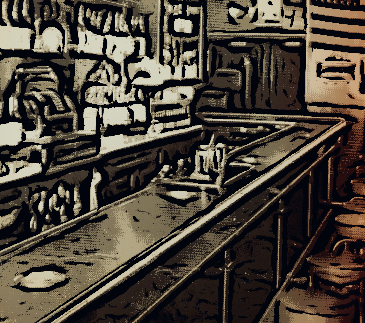
            An older woman in a ratty fox and a dish mop for hair, and an even older purple beezer gent in a rumpled brown suit and shapeless hat pulled down over a ruff of shaggy white feathers looked up from toying with the ice in their tall glasses. The bartender, with whom they had been conversing in earnest hushed tones, was a broad browed palooka with calm guileless gray eyes. He ambled down, a wide door in a dress shirt and a black string tie, to where I had ensconced myself among the shadows and where I had a good view of the entire length of the bar and the entrance. He looked me over as he placed a cork coaster in front of me. I was still wearing the clothes Annie had loaned me, the rough checkered shirt and pair of dungarees, the cracked leather windbreaker. I needed a shave. Maybe he thought I was in the wrong kind of dive. But he understood me perfectly when I held up one finger and then two fingers horizontal to the bar. Double. Whisky. Neat.

            I laid out a fin when he brought me the drink and he came back from the register with three fish and some bait. They must expect some well-heeled patrons at those prices. I didn’t say it out loud. Besides the first sip told me that it was the good stuff and why disturb a sleepwalking giant.

            Someone had left the daily paper in the corner near my elbow. I unfolded it and angled it to catch the light off the bright mirrored back bar. The headlines screamed about the mess in Europe. Under the fold one headline caught my eye. It read, Mob Boss All Wet and then in sub head, Two Still Missing.


Apparently while trying to avoid capture by Federal and local authorities several reputed crime figures crashed their speedboat into a garbage scow on the East River. All but two of the occupants of the speedboat were recovered from the frigid waters. One of the missing men was believed to be Milosz Yamatski, a man known to be second in command to reputed crime boss, Jan Kovic. The other man’s identity was unknown. I reassured myself that Yamatski’s address book was still in my jacket pocket. I was going to give its contents the third degree once I got the chance. Right now I had more immediate things to attend to. The swelling on my face had gone down and only the hint of a bruise outlined my chin line and the cheek under one eye. If I was going to stay in business I was going to need some new duds, clean up, scrape the stubble off my cheeks. Look sharp, feel sharp. First I had to call my crooked lawyer, Ralphie Silver. Not to ask for legal advice. He was the one who referred me to Kovic in the first place. I figured I should warn him as well as give him hell for setting me up like that. I drained the glass. It went down like cool molten gold. I had to have another.

            The old couple looked down my way, annoyed that I was calling away. . .their son? I smiled at the thought and the jolly gentle giant eyed me quizzically.

            “Yeah, one more of the high class joy juice, and whatever your mom and dad are having. On me.”  He laughed a big belly laugh but his eyes were as cold as ten-penny nails. I pushed the fish and bait toward him and laid out another fin. He gurgled the shot until it lapped at the rim.

            I slurped at the excess. I continued to plan my course of action, the one I had begun to form on my way back up the coast. I still had to be careful but I was assuming that Kovic thought I was feeding the eels along with his number two boy. As far as I was concerned that had been a draw. Maybe I was expecting a little more cash for my troubles, but for now what I had was a down payment. The address book was probably worth something to the right people. Maybe a closer inspection of Yamatski’s digs would turn up something else that was my due.

Then there was Al’s sister. That was a prospect I could cut loose though I knew I didn’t have the full picture as far as she was concerned. I went to my wallet and pulled out the pink postal package notice. I had grabbed a deposit envelope while I was in the bank. I folded the pink slip and fit it into the envelope. I called down to Tiny for something to write with and he brought me a stubby pencil. I scrawled my name on the envelope and laid a sawbuck on top of it. I pushed it toward him.

            “I was supposed to meet a friend here but it looks like he’s gonna be late and I gotta be somewhere. Can you hang on to it and give it to him when he comes in? He’ll know to ask for it. His name’s on it. The tenner’s for your trouble.”

            I was talking his lingo. “Yeah, sure, can do.” He smiled like a kid who had just been given a new toy. I watched him stick the envelope in the space behind the ornate cash register on the bar.
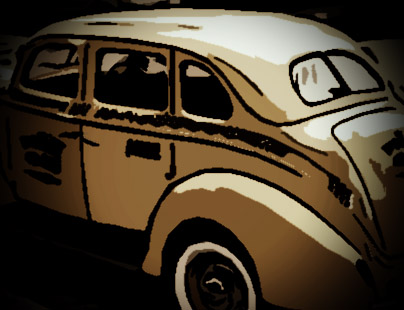
          ADS38_taxi_27Ralphie wasn’t answering so I dialed for a cab from the booth and then strolled to the front door and peered out the small square window. I couldn’t see much from that vantage, just the odd hat bobbing past, and the intermittent shadows of bodies hurrying by. When the cab pulled up, I took a deep breath, pushed the door open, strode across the squares of sidewalk to the curb and jumped in the back almost all in one motion. The cabbie cut back into the traffic flow with a screech of tires. I gave him an address on Second Avenue and glanced out the rear window. A big black town car driven by a tall hat had pulled out from the curb a few cars back. I didn’t want to take any chances.

            “The black town car back there, can you lose him?”

            The cabbie glanced in the side mirror and then into the rear view at me. “That’ll be extra.”

            I slid a sawbuck across the back of the seat to him. I was starting to hemorrhage money.

            “Hang on,” he said, and took the next corner on two wheels.


Ads25

I should have asked for my money back. The cabbie had turned onto a street that was being repaved. Not only that, he rammed right into the back of a dump truck carrying a load of hot asphalt. If that wasn’t enough, the collision triggered the lift on the dump bed and the contents emptied onto the hood of the cab. The cabbie had just enough time to get out before the door was sealed by a mound of steaming black pavement. To top it off, he immediately got into a shouting match with a large man holding a large shovel. I bailed from my side and flattened myself against the bricks of the building. The town car had turned into the street a few cars back. There was nowhere to go. A crowd was gathering and I joined in the flow long enough to duck behind the dump truck and sprint another fifty yards to the narrow shadow of an alleyway. It was blind. Overflowing garbage cans and a few packing crates at the far end up against the brick face of the building and a fire escape that lead up to the roof. I ran to the end and judged the distance from the top of the crate to the bottom rung of the ladder. I could make it. I walked around the crate closest to the building thinking to reposition it at a better angle. I didn’t see the hole. My leg went straight down throwing me face forward against the bricks. It hurt but not as much as my knee wrenched as it was at such an obtuse angle. I collected my senses and saw that I was standing in the entrance to a coal chute. The crate had partly covered the hole and now I was wedged between the wall and the crate. I unstuck myself by pushing on the box, and untwisted my knee. I could feel the side of my face begin to swell and throb. The pain from my knee ripped at my thigh like a claw. I kept my sob to a cough, eyes watering, and realized that I had found my avenue of escape. I lowered myself into the hole and slid the crate to cover it completely. I was in the dark. I felt the wooden hatch cover behind me. It gave way with a slight moan of hinge. I had to assume there was a chute. I set my legs ahead of me and inched forward. There was a ledge and then my feet struck metal, the chute. I went over the edge and gravity took hold. There was a drop and my feet hit, scattering loose coal. Finally after all these years I’d made it to the top of the heap. I was in a coal stall. A faint light leaked through the cracks in the boards. I hoisted myself to the top of the box. There was barely enough room for me to fit between the ceiling and the top edge of the enclosure. My now bad knee wasn’t cooperating and caught briefly on the side along with part of my pant leg. The pain was such that I let go thinking that the drop would not be close to as painful. I was only partly right. My elbow took the brunt of the impact. I lay there for a while, I don’t know how long. I didn’t hear anything that would indicate someone was looking for me. I was in a semi-fetal position, the hand on the arm with the bad elbow cupping the bad knee and the other hand cupping the bad elbow. The shadows of rats crossed the faint light coming from beyond the hulk of brick furnace and boiler. I got to my feet like a man who had just been beat on by six angry stepbrothers.

            The steps the single bare light bulb thoughtfully illuminated led up. I followed them. There was a door at the top. The door led to a large closet arranged with mops brooms and buckets. There was another door on the far side. It led to a hallway and the ground floor business advertised on the glass as a purveyor of fine discount clothing. I’d thought about getting to a tailor, just not in such a roundabout fashion.


Ads26

            Through the window I could see the red, white, and blue sign, YMCA. I was neither young or Christian, and I wasn’t so sure about my associates. While the tailor worked on the alterations, I walked across the street and into the building. The kid at the desk was a bleeding heart, wan from self-abuse. I had a choice, a room for six bits a night which included pool and shower privileges or I could pay two bits and just use the shower, towel, soap, lock and locker included. That’s what the sign on the wall behind him said. I went for the bargain. There was a four bit deposit on the lock. It was no bigger than a matchbook and you could probably open sloanehouseadit with a hard stare. There was an elastic looped through the top of the key. “You can wear that around your wrist when you shower.”  He said it as if were a dirty word. And I just wanted to get clean. The use of a razor with disposable blade was another two bits. I followed the arrows that pointed to the lockers and the shower bay. There were rows of wooden lockers with their doors standing open. I picked one closest to the tiled entrance to the showers and shucked off my clothes. I stood there with my towel in front of me feeling very naked. It bothered me that my wallet and Yamatski’s address book would be vulnerable to anyone who bothered to sneeze on the lock and rifle through my belongings while I was in the shower. Most of the other lockers around mine were empty. I took a chance and removed the items and tucked them at the far back of the top shelf of the locker next to mine. I took a fin out and stuck it in my pants pocket. That done I stepped across the cold wet tiles, hung my towel on the rack at the entrance and up to the first shower head. I was alone. And naked. I stayed naked while the hot water gushed over me with pleasant stinging force. I wasn’t alone for long.

The desk clerk stuck his head into the shower room and goggled at the fallen Charles Atlas. If there’d been sand I would have kicked it in his face.

Ads27

            If you took a wedge of pink skin, thick muscle and bones and stuck it on a pair of chopsticks you’d have what this guy looked like. I imagine that it wouldn’t be that obvious if he had clothes on, or that he had a little spigot like those guys on those Greek statues have. His head sat on his broad muscular shoulders almost like an afterthought. He was either a jailbird or a friend of the prison barber. The bluebirds tattooed at the top of each pec were supposed to make you think he was a creampuff. Maybe he was. I got the feeling I was going to find out. I stepped out of the spray and headed for my towel.

            “Hey, where you going so fast, I just got here!”  He was going to stop me from reaching my towel.

            “Come on pally, I don’t have the time or the inclination to play drop-the-soap.”  I pushed passed him but he grabbed my arm. His grip slipped and I gave a hard shove against his chest, tangling his pipe cleaners with my foot. He went down hard on a cushion of muscle with a grunt. Grimacing he got back to his feet while I planned my next move. I’d only succeeded in making him mad. He rushed at me and I feinted toward the door and then I lost traction on the wet floor and he had me in a bear hug before I knew it. I had to use my head. And I did. I brought my forehead down on the bridge of his nose. It hurt, but it hurt him more. His grip loosened and I broke it bringing my knee up hard between his legs. From his howl I could tell I caused him big pain. I was about to plant my foot in his face but he started crying, begging that I not hurt him anymore. He was a cream puff after all.

            The desk clerk stuck his head into the shower room and goggled at the fallen Charles Atlas. If there’d been sand I would have kicked it in his face. “What’s going on?” he asked alarmed, his eyes darting from me to Samson and back. I got the impression he was more interested in checking out our packages.

            I pushed past wrapping a towel around my waist. “Nothing to get worried about, kid, just a lover’s quarrel.”
 

Ads28

            Smooth as a baby’s ass. Almost. I patted my fresh shaved jaw and eyed what was staring back at me in the mirror above the washbasin. I’d decided to lose the moustache and now my upper lip looked naked and unfamiliar. I imagined with time I’d get used to it. Maybe. It had been a fixture on my map since it was just a fuzzy little caterpillar. But it was the least I could do to change my appearance. Compared to the plum over my right brow where I’d head butted the moose in the shower, the rest of my bruises were fading to a dull bluish amber. Now I just looked rugged, my features chiseled by patent leather shoes and big ringed knuckles. Surprisingly my nose had withstood the onslaught without being permanently bent out of shape. That was a good thing because a peeper needs a respectable looking nose. Someone sees you with a lopsided schnoz and they figure you zigged when you shoulda zagged. Appearance is 99 percent of the presentation I read in the back of a dime magazine once. It made sense. I slicked back my wet hair with a steel comb and gathered up my wallet and the address book from the adjacent locker. My trousers were light the fiver I’d stuck in the pocket. Now it made sense. The ape wasn’t love loony, he was just running interference while his confederate, most likely the kid at the front desk, rifled through my clothes. I figured to collect it when I turned in the useless lock and key. I turned to go and there was Armstrong again.

            “Ya shouldnta done that,” he said and took a swing at me coming from such a long way off I couldn’t have seen it without binoculars. I ducked under it easily and bumped his chest with mine pushing back against the bank of lockers with a loud clatter. I stuck out my tongue and retrieved the steel blue razor blade that had been resting there. I held the edge to the small space between his chin and his chest. He struggled and I slashed the side of his jaw. His yowl brought the desk clerk running. I threw a towel at the bleeder who was now looking at the red on his hands with disbelief. The kid ran to him. “What did you do? What happened?”

            “Looks to me like he cut himself shaving.”  I yanked the kid back by his shirt collar. “And the fiver you took from my trousers, give!”  The kid squirmed and I gripped the back of his neck and squeezed hard. He crumpled to his knees and handed the five to me over his shoulder. I let go and shoved him towards his partner in crime. “A little bit of advice. Next time don’t stand so close to the razor.”


Ads29

            I looked at myself in the tailor’s cheval glass. I was passable as a human being, bruised but clean. I never thought I looked good in tweed, brown’s not my color, but the suit was a nice fit. Maybe it was the new shirt but I almost looked respectable. The shoes fit nicely, who ever had worn them before had done a good job keeping them up. Buffed and polished to perfection, they felt comfortable, like old money.

            The tailor had a nose like a can opener, a little cloth beanie on the back of his head, a cuff of pins and needles on one sleeve, and a yellow tape slung around his neck. He was a little older than me by the white sprinkled in the fringe of red beard along the jaw line. He looked pleased with his work.

            I reached into my newly acquired wallet, courtesy of Yamatski, and pushed the twenty at him. Not a bad price for a dead man’s wardrobe that fit so nicely.

            The establishment was a used clothing store, I’d seen that right away when I emerged from my sojourn in the coal cellar. It was just what I needed. A change of clothes would at the very least give me an edge on whoever it was following me. Business must have been slow and I was able to get a good price on the brown tweed suit and vest. He threw in a pair of new skivvies and undershirt. The tie was extra as was the new Arrow shirt, and shoes, though he was willing to take half off when I balked. The socks were extra as well. I figure he was probably making close to a hundred percent markup considering that he could get a whole closet of suits for that twenty from some widow’s estate.          
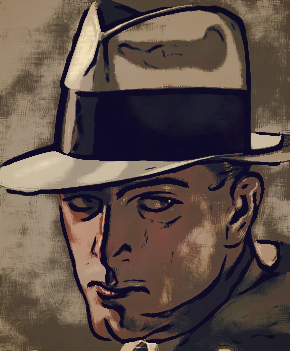
He handed me a hat. “The pièce de résistance.” He said it like he was serving me dessert.

            It looked like a fedora to me. I set it snug on my head and flicked the brim. I was unrecognizable as me. At this point I felt I could splurge and fished for another five in the wallet. Maybe the hat distracted me. I fumbled the address book and it slipped from my hand.

            He was quick to pick it up and hand it back, but not before catching a glimpse of an open page. The color drained from his face and he lowered his eyes, hand shaking.

            He spoke something I didn’t understand. When I didn’t answer, he tried something else I didn’t understand. He looked at me, blue eyes wide, and I watch it dawn on him that I wouldn’t understand anything but a hundred percent Yank.

            “You are not a Slav?” He cocked a large ear at me like my answer was going to give him an idea to run or stay.

            I shook my head. “No, pal, I’m as American as a sawed-off shotgun. What of it?”

            He pointed at the wallet. “The writing in your book is Cyrillic.”

            I looked down at a page with Yamatski’s secret writing. “Is that what that is?”  And “What the hell is it?”

            “Cyrillic is the alphabet used in Greece and many of the countries along the Black Sea. The Russians use it.”

            “Ruskies? Think this is some kind of Communist code?”

            The tailor gave a shrug. “Unfortunately I cannot read it. I only recognized it as written using the Cyrillic alphabet.”

            He was lying. “Yeah, but you spoke to me in it, didn’t you?”

            “Speaking and reading are two different things. Where I come from we learn to speak many pieces of different languages without necessarily reading them.”

            Now it was my turn to lie. “Yeah, I found this in a phone booth in Grand Central station. Somebody musta forgot it. I’d return it. . .”  I looked down at the page, “. . .if I knew what it said.”

            The tailor brightened. “You are in luck. I know a rabbi who can help you. He is an old man well read in many languages including those written in Cyrillic. Allow me to give you his address.”  He retrieved a slip of paper and pencil from his shirt pocket and dropped his cheaters onto his nose.

            I looked over his stooped back to see a beautiful apparition peek through the curtains to a room at the rear of the shop from which emanated the unmistakable smell of boiled cabbage. I smiled at the vision.

            “Hello,” she said.

            The tailor jerked his head around at the sound of the voice and then straightened, handing me the slip of paper. “He can tell you what it means.”  And then, officiously, “What would you like me to do with your old clothes. I can dispose of them for you or I can have them delivered to your address?” 

            I gave him my card. “Yeah, bundle it up and send it to my post office box.” It would be a shame to lose that leather jacket, and maybe the shirt and pants would be an excuse to see Annie again.

            He glanced at the card and frowned. “You are a private police?”

            “Yeah, but I ain’t no cop,” I said still distracted by the comely tomato.

           rebecca The apparition stepped out from behind the curtain. She was beautiful and petite, red curls cut close to her perfectly shaped head. Even in the ankle length full sleeved shift she was wearing, you didn’t need x-ray vision to make out that the proportions were correct and that everything bulged or gave way in the right place.

            “My daughter, Rebecca.”  The tailor introduced with a worried frown.

            “Hello,” she said. Her big blue eyes bored a hole right through my chest.

            “Please excuse, her English is very limited, newly arrived from Salonika.”

            As far as I was concerned she spoke the universal language. My heart was deafening me, and I felt a familiar stirring below the beltline.

            She dropped her head shyly at my hypnotized gaze and clutched her father’s arm. “Gangsta, papa?”

            “Nein,” he answered, “Shimol.”


Next Time: A thousand thousand flies and their thousand thousand eyes

Valentine’s Day—2

by Helene Baron-Murdock

Donovan found the time in the radio log where Sheriff Collins had contacted him and noted it. That was when they shut the investigation down or were shut down by the Feds.

            “Go to channel 12!” Collins wanted to talk to him on his cell phone, but the reception was minimal this far out on the lands. “Channel 12” was code for channel 6, the scrambled channel, meant to confuse the scanner heads who hung on every word transmitted over various law enforcement frequencies. Of course any self-respecting scanner head had a descrambler and going to channel 12 would only fake them out for so long. “Shut it down! I want you to put everything back where you found it, every hair, every shell casing, every fingerprint, all of it, every bit of forensic evidence. I don’t want a trace that would show we’d ever been there.” At his protest, Collins replied, “Just do as I said. The Feds will be out there shortly, hand it over to them and leave. I’ll explain when you get back to the office.”

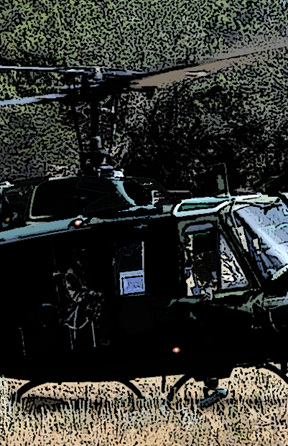
FBI Heli He heard it first, and the black chattering shape grew larger coming in from the southwest. The chopper swept low over the farmhouse and then back toward the access road where he’d been waiting by his sedan. There was a wide spot in the stubble field beyond the gnarly giant live oak near the entrance to the front yard. A tornado of fine beige dust and sand engulfed the chopper as it set down. The rear passenger door opened once the dust settled and two figures stepped out.
            He could tell by the bouncing confident stride that the taller one was a woman. The man was wide shouldered built close to the ground and moved like a perfectly oiled killing machine.

Not your likely Fed duo.

            She held out her hand and introduced herself. “Special Agent Sharon Eckes. You must be Donovan.” 

            He shook her hand, a firm grip, not a perfunctory formality. She was dressed for the field, dark work slacks and the standard issue FBI windbreaker, black lanyard with badge ID, and a standard issue ballcap gathering her sandy blonde hair. Her partner was a little more fastidious in a brown leather jacket over a cranberry polo shirt that detailed a well-defined six-pack. His slacks were knife edge creased and a few shades lighter than his brown desert boots. On closer appraisal, he was an older man by the leathery bulldog jowls of his sun darkened features. The close cropped pate said ex-military, a squared off hand grenade with an aggressive hard stare.

            “This is Wayne Tanner, DOD consultant with DHS. We’ll be taking over the investigation from here on out. Thanks for securing the scene for us.”

            Tanner deigned to speak, and at almost an octave higher than he’d expected. “Is this all exactly how you found it?” He motioned toward the farmhouse.

            Donovan nodded, taking an instant dislike to the man. “Yep, exactly as it was found by the first officers on scene. So except for their footprints in the sand, it’s a pristine crime scene.” He said the last with a hint of a smile.

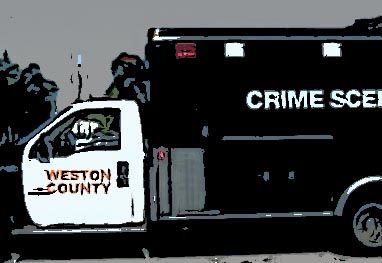
            “We heard you had a crime scene van out here. And animal control?”

            Of course they would have monitored the local LE radio traffic. “Standard Operating Procedure on multi-casualty incidents. Out here, we thought we might need a tracking dog, and the Animal Control vet is also the head of Search and Rescue Team. They were canceled before they could deploy.”

            “What agencies and personnel were at the scene? I’ll need names, ranks, of anyone who was here.”

            Donovan shrugged. Now he was certain that he detested the short stack of muscle and spleen. “County Sheriff’s dispatch can probably fill you in on who the responding officers were. You’ll have to contact HQ at High Point on what Florist Service personnel were out here.”  He’d used a common nickname for the men in the green trucks out on the lands, known also as “greenies”, but it failed to get a reaction. He didn’t mention that by the time the forensics van had packed up he saw Grandma Spider hightail it on her ATV over the rise in back of the ranch house.

            On his way out to the main road just passed the fork in the rutted dirt track he met up with a black Mercedes mini motor home with a couple of bewildered techs in FBI ballcaps. He’d pulled off as far as possible to one side without getting wedged in the drainage ditch to let them pass.

            The driver’s side window floated down. “We on the right track to the scene?”

            “Right you are. Keep following the ruts and bear left when you come to the fork.”  How he loved the Feds. The driver didn’t even give a thank you. And if they followed directions they would soon find themselves down pasture where the road played out amidst nothing but cattle.

              With the time he’d vacated the scene and turned the incident over to the Feds so noted, and with a few, very few, comments appended, the report was done. The Sherriff could embellish his timeline however he wanted to frame the narrative he would spin to the Board of Supervisors and exculpate himself. Except that wasn’t the end of the story.

Donovan knew enough to avoid swinging by the office to report in just yet, given the state of mind the Sheriff would be in, best to let the man have a chance to count to ten a few million times. At Santa Lena General, he was informed by the nurse at emergency receiving that the Apes social worker had left a number for him to call. The old gal, who might have pushed her husband down the stairs on Valentine’s Day, a love story yet to be told, appeared to be sleeping in her wheelchair in the holding room, a sure sign of guilt according to the experts. Let sleeping dogs lie, he thought to himself.

            Patients might gripe about hospital food, but the cafeteria always had a great entrée. He’d learned that as a young deputy. The servings were ample and the coffee always hot. And it was cheap. He’d skipped breakfast and hadn’t even had a chance for his mid-morning power ring, cop talk for “doughnut”. The rigatoni was tempting, and he pointed to it when the server questioned with her dark eyes. The phone to his ear rang twice before it was answered. “Shirley Holmes,” a husky professional voice spoke.

            “Detective Jim Donovan here, I’m at the hospital.” He slid the tray with the heaping plate of rigatoni toward the register, pausing to lift a large paper coffee cup from the stack.

            “She’s as much as admitted that she pushed her husband down the stairs.”

            He grunted an acknowledgement as he fished a twenty from his billfold and handed it to the woman behind the register. “I’m in the cafeteria. If you meet me here I’ll buy you lunch, and we can talk about it. Unless you recorded what she said, it’s really your word against hers. And they’ve got a terrific rigatoni on the menu today.”

            “I’m Vegan.”

            As always when he encountered that assertion he wanted to ask, “Is that a planet in this solar system?” But he didn’t.

            “And I’m slammed with clients, plus my boss wants a prelim report on the quote unquote accident. I could maybe make some time around three-ish?”

            “Ok, here’s what we’re going to do. I’ll set you up with Detective Nelson. He’ll give you a call seeing as how his last case just mysteriously vanished and arrange a meet up to take your statement and the Valentine Day killer’s.”

            “What’s his name again?”

            “Nelson.”

            “Does he have a first name or is it just ‘detective’?”

            “Uh,” Donovan paused at the coffee carafe and gave it a few hearty pumps, “You know, I’m not quite sure. Robert? Richard? I’m guessing. He’s Nelly to everyone in the squad room.”

            “I’ll remember that.”

Donovan parked the sedan on the concrete apron taking up most of his backyard. There was an unwritten rule in law enforcement that a work vehicle should never be parked at the curb of one’s domicile, official language designating place of residence. Too easy and too tempting to break in and or vandalize. The previous owner had poured the slab that covered ninety percent mustangof the small backyard crowded with a detached garage probably built in the early fifties. It was a sturdy two hundred plus square feet that housed his personal vehicle, a Mustang convertible boy toy, a midlife crisis gift to himself. Maybe the original owner didn’t like mowing the lawn although the piebald patch of turf in the front yard had been well maintained when he bought the place almost twelve years ago. He was the one responsible for its current shabby overgrown neglect. So what was he hiding under the slab? Bodies? Something that had occurred to him more than once. Cop thinking, he called it.
            The neighbor’s cat came loping into the yard from a hole in the fence and rubbed against his pant leg as he unlocked the door to the covered porch that housed the washer dryer. The cat raced ahead as the door opened and stood next to the bowl by the washer and gave an imploring mew. Donovan reached into the box of kitten treats on the shelf with the laundry detergent and dribbled a handful into the bowl. It had been more than a few years, he’d lost track, since he’d announced “Honey, I’m home,” to give the bride a chance to stash her stash and straighten herself up, tuck a stray lock behind an ear, pretend she’d fallen asleep while reading the same book she’d been reading for the last couple of months. It was a familiar cop story. So was the divorce.

            The house was cold, and he set the thermostat up a notch as he headed for the front door and the few items of mail scattered on the rubber welcome mat under the mail slot. He stooped to pick them up and the way he grunted they were apparently heavier than they looked. Nothing, nothing, nothing, bill, and more nothing. He set the bill on the table in the entrance way with the other bills and tossed the rest into the circular file that had once been an umbrella stand.

            The day caught up with him as he climbed the stairs to the bedroom, a weariness that had been building over his last shift and the one before that. He was old, no “getting” about it, and retirement, once playfully lobbed around the squad room when the job got too demented or absurd and the endless hoop filled bureaucracy just making it worse, was a serious consideration, especially after the reprimand.

            He tossed his jacket on the bed, placed the hip holster and firearm in the top drawer of the dresser, whipped off the tie, unbuttoned his shirt, dropped his trousers, slipped off his sock, and stepped out of his briefs. The tile floor in the bathroom was cool against his wearied dogs. He didn’t hesitate stepping into the shower and turning it on full blast. First there was the shriveling cold water pelting his bare back and then slowly as the warm water worked its way up the plumbing a warm soothing wash before the scald of hot that made him jump back and adjust the mix.  By then he was wet and the tension, the dust from the lands, the weary knotted road muscles were just washed away.

            He replayed his conversation with the boss as the stinging spray washed across his face. Actually it was less of a conversation, more like a reluctant audience to Tim’s rant against the Feds. “Can you believe it, they want to cover this up, like it never happened!”  Homeland Security had declared the murder scene a classified black site because the killings were obviously a terrorist act. Everyone present at the scene was advised that any disclosure of classified information regarding the terrorist incident would result in hefty fines and or prison time. “Bullshit!” Tim shouted in frustration, and there was no arguing with that.

            Drying himself off he turned on the TV and sat on the edge of the bed to catch the early news. He could have predicted it. A throng of reporters swarmed Sheriff Tim Collins in his gold starred uniform finery as he was leaving Headquarters. The questions were of the “is there any truth” variety and specifically referenced the multiple shooting out on the lands. So much for secrecy. He felt like saying “Houston, we have a problem” but he didn’t talk to the TV. That was his ex-wife’s routine.

            He dressed checking the time and messages on his phone. Royanne from the coroner’s office wished him a Happy Valentine’s Day, and Judy from the DA’s office sent him a picture of candy hearts that said things like “You Rock”, “Got Luv?”, and “Hanky Panky”.  

            He urged the cat out the back door with a light nudge of the toe of a dress loafer. Latching it shut he strode across the yard in the encroaching twilight in a pair of stone washed jeans, a pale blue collared shirt under a sturdy beige canvas windbreaker. He backed the Mustang out of the garage and let it idle a while to warm up the interior, the winter evenings still a little brisk in February. He tuned out the radio news and slipped a favorite Etta James CD into the dashboard slot. Once on the street, he steered east toward Old Town Santa Lena.

              Only two hotels in Santa Lena guaranteed government rates. One was a dive with a big heated pool. The other was almost a dive with a big heated pool and a cocktail lounge. He parked in the lot, no valet service, and walked up the steps into the lobby. He’d been to the Santa Lena Hilton a number of times, probably as many times as the establishment had changed hands so it might not have been part of the Hilton chain anymore, but that’s what everyone called it. The entrance to the lounge was to the left of the reception desk. He stood in the doorway letting his eyes adjust to the dusky light.

            She was sitting by herself at the end of the bar poking at the ice in her tall cocktail with a slender crimson straw. She sensed his approach and turned as he asked, “Buy you a drink?”          Special Agent Eckes gave him a weary smile. “Sunshine Superman. I was wondering if you’d show up.”

            No one had called him Sunshine Superman since his rookie patrol days so that made him feel young as well as in love.

“Chief Warrant Officer Dessy was on an operation in Northern Afghanistan and got caught in an ambush. He is presumed missing in action.”

Donovan made a mental note to renew his health club membership. He stared at the ceiling, one of the myriad shades of gray in the darkened hotel room. His heart rate was dropping back to normal and he was no longer breathing as heavily. All in all, he felt like a wrung out dishrag. She wasn’t a big woman, but she was fit, a runner. That would account for the stamina. She’d held him tight and forced her tongue down his throat. One thing led to another.

            He heard water running through the half open bathroom door. He thought back to their preliminary banter in the lounge over drinks. She’d said, “I know you think we’re just a bunch of overeducated desk bound dummies.”

            “With guns.”

            “What is it with cops? Can’t they accept anyone outside their exclusive blue fraternity to be an armed sworn officer?”

            “Too many guns as it is. It’s a safety issue.” 

And then they got into a back and forth about the classification of the murder scene. He called it a cover-up.

            “You mean a broom and rug operation?”

            “Exactly.”

            “You’ll never hear me admitting that.”

            “And your partner, the DOD DHS universal soldier. . . .”

            “He’s not my partner.”

            “Who is he then?”

            “I’d tell you but I’d. . . .”

            “Yeah I know, ‘have to shoot me’. I think I know the backstory, and if I figured it out, you can bet some investigative snoop will tumble to it.”

            “No comment.”

            “Ok, I’m going to tell you what I think the scenario is and you’re going to blink your big beautiful eyes, one blink is yes, and two is no.”

            “Who am I, Paula Revere? But alright, try me.”

            “Major Jowls is a military gunslinger bounty hunter cleanup man and he had a very specific target. Someone he’s been tracking for quite some time.”

            “What’s the code again? Sorry, that third cocktail went to my head. One yes, two no?”

            “Was that a yes?”

            “No, I think my contact lens is slipping.”

            “I’ll take that as a yes. The person he is hunting, to likely kill, with the help of the FBI I might add, is the mysterious and legendary Oliver Dessy, US Army.”

            “Chief Warrant Officer Dessy was on an operation in Northern Afghanistan and got caught in an ambush. He is presumed missing in action.”

He knew that. Mary Fisher had brought him up to speed on the Dessys as they were packing up to leave. The Army had notified Penny Dessy that her husband was missing in action almost two years previous. That’s when the protectors showed up, men distantly related to the family to provide security for the widow of their hero out in the middle of nowhere all by herself. She’d said it with a hint of ridicule in her voice and he’d wondered how Mrs. Dessy had held off those thugs. The answer was Grandmother Spider, the men were afraid of her power, something she was well known for among all the families. As long as they behaved themselves, they had nothing to fear. And Penny Dessy, always a gracious woman, kept to herself, and her blanket loom, away from the men who were taking advantage of her hospitality by claiming kinship to her late husband. He wasn’t going to attribute the efficiency of the killing to either Penelope Dessy or Grandmother Spider. The men had obviously been caught by surprise. No warning. If it had been a stranger or strangers, old Gus would have raised the alarm. And he hadn’t. Poor old Gus. According to the FBI, old Gus had come out of his stupor just as the bounty hunter was rooting around in the shed. He’d managed maul the man’s thigh before Tanner shot him defending himself.

           The FBI stood at the foot of the bed wearing the complimentary white bathrobe but open in front and leaving nothing to the imagination. She smiled at his smile. “A penny for your thoughts.”

            “I was just thinking about old Gus.”

            “You’re such a romantic. And you never said anything about a dog.”

            “It slipped my mind. I think I was distracted.”

             “If it makes you feel any better, Tanner needed a hundred stitches.”  She crawled toward him across the rumpled sheets and put her chin on his chest so she could look into his eyes. “Were you thinking about anything else?”

            “As a matter of fact,” he said snagging the lanyard with her government identification hanging from the back of the chair next to the bed, “I was just looking at your ID here. . . .”

            “I hate that picture,” she said turning her head to look at it.

            “Did you know that if you used just your first initial with your name it would say ‘sex’?”

            Special Agent Sharon Eckes’ elbows dug into his chest as she got squarely in his face. “Did you know that if I had a dollar for every time some horndog told me that, I could pay off my student loan and still buy a condo on Miami Beach?”

Donovan stared at the blinking cursor at the bottom of the page. He saved the document, attached it to the email addressed to Sheriff Tim Collins and was about to hit send when he looked up to see Nelly standing in front of his desk with a big friendly grin on his face.

            “How’s it going, old man?”

            “I could complain but why be predictable. How’s the love life on planet of the Apes?”

            “You know she calls you ‘Cupid’ now.”

            “That’s gonna be a hard one to live down. I might have to retire.”

            Donovan hit send and watched the document disappear from his screen. Nothing in it said anything about his hunch as to who the killer might be. He’d done a little off the books research on his own. A few months before Dessy was reported missing in action, a drone strike in Northern Afghanistan had targeted and killed a wedding party of non-combatants. It was in an area that Chief Dessy was operating, training a local militia fighting the Taliban. Then there was the report of a top ISS official being assassinated in Karachi. Not long afterward at a clandestine CIA airfield in Pakistan numerous explosions had destroyed or disabled the drone fleet housed there. An attaché to the US Embassy was gunned down in the streets of Lahore. More recently a top Special Operations Command Colonel was found strangled in his home in North Carolina. And around the holidays, the CEO of a government contractor providing mercenaries in Afghanistan was found with his throat cut in a Denver hotel room. Although it was just a guess, the sequence of actions reeked of payback. He’d received a cryptic text from sexy Sharon a week or so past that said, “Picked up the trail in Ithaca.”  He assumed upstate New York as he wasn’t aware of any other place with that name. He also assumed that Chief Warrant Officer Oliver Dessy was armed, extremely dangerous, out for revenge, and so far had managed to elude the government gunslinger.


Contents Vol. I No. 4

Introducing Dime Pulp Number Four

In Issue Four of Dime Pulp, A Serial Fiction Magazine, The Last Resort continues the adventures of Lee Malone, former super model now small town newspaper reporter, and finds her rescued from The Blue Ox, a den of diehard water conservationist if there ever was one, by Blackie, having a cozy coffee with the older man while the rain rages outside and getting nostalgic over the photographic rogues gallery on the motorcycle repair shop’s walls. After a frightening nightmare in which she intuits the identity of the charred corpses, she is awakened by a summons to fly to Chicago to be by her ailing mother’s bedside where her sordid past begins to catch up with her.

For Helena Baron-Murdock’s Hard Boiled Myth series featuring Weston County Sheriff Detective Jim Donovan, a multi-casualty shooting out on the Sage Valley Rancheria has more than a few echoes in mythic lore in this first of a two part story titled “Valentine’s Day.”

A Detective Story
picks up Lackland Ask where he left off, piloting a power boat on the East River and ramming a garbage scow but not before a confrontation with arch nemesis, Kovic, and his thugs, and lands himself in the drink to be rescued by. . .well, why spoil the surprise.

Dime Pulp continues its crime spree with the serialization of two full length novels, The Last Resort and A Detective Story, as well as another short story based on Greek myths under the rubric of Hard Boiled Myth.

If you’ve made it this far, go ahead and follow the links below to reading entertainment with the serial contents of Volume One, Number Four

  —Perry O’Dickle, chief scribe
and word accountant


TLR banner321Deep in the redwood wilds along the Corkscrew River, someone is shooting neighborhood dogs. The year is 1985 and Lee Malone, former fashion model, queen of the runways from Paris to Milan, once dubbed the most beautiful woman in the world, now a part-time reporter for The Corkscrew County Grapevine, is looking for a story to sink her teeth into. When Lee finds the owner of Kelly’s Seaside Resort brutally murdered, it leads her on an adventure that includes a mysterious gray van, another murder, extortion, pornography, sex slavery, and a shadowy organization of militant feminists known as SAPHO.  In the process, Lee Malone’s notorious past catches up with her. 

The Last Resort, Chapters 1-3
The Last Resort, Chapters 4-6
The Last Resort, Chapters 7-10
The Last Resort, Chapters 11-13

HBMbanner421

Greek myth is rife with murder, mutilation, cannibalism, mayhem, and the ever popular incest.  Weston County Sheriff’s Detective Jim Donovan of the Violent Crimes Unit wouldn’t know a Greek myth from a Greek salad, but if he did he would find some troubling similarities to the cases he’s investigating.  Revisited as crime fiction are the strange death of Hippolytus, the agonizing death of Heracles, the slaughter of Penelope’s suitors,  the sparagamos of Orpheus, and the cursed lineage of Pelops. Hard Boiled Myth taps into the rich vein of classical literature to frame these ancient tales in a modern context.

Long Shot I
Long Shot II
Notification Of Kin
Valentine’s Day I

ADSbanner421

Lackland Ask is the name. ‘Lack’ to my friends, ‘Don’t’ to those who think they’re funny. You might have seen my portrait on the cover of Black Mask, the crime friction magazine. This is my story. It starts with a blonde. This kind of story always starts with a blonde. The brownstone was on the Westside and easy enough to find. So was the mug’s yellow roadster. It stuck out like a new shoe in a cobbler’s shop. I was being a sap again. I woke sitting straight up, sweat pouring out and over me, my undershirt drenched. I was going to have to change my shorts. Some dream. They worked me over, demons in dingy cable knit sweaters. They pumped my arms and peered in my face with eyes as black as eightballs.

This kind of story always starts with a blonde
“I was being a sap again.”
“Some dream”
“demons in dingy cable knit sweaters”

A Detective Story—4

by Colin Deerwood

Ads17

I never expected to be drinking gasoline and water.  I’d had just as bad before, but this was East River water, and the gasoline, diesel by grade, was from the overturned powerboat.  It had happened all so fast.

           He had a gun in his hand.  I had my hands on the gun in his hand. 

Kovic or one of his goons was yelling something at me.  I couldn’t tell what – they all sound like they’re clearing their throats.  I realized they were yelling at me about the same time they realized I wasn’t the guy I was supposed to be.  What they were trying to tell me in that gargled tongue of theirs was that I was on a collision course with a tug pulling a barge.  At the same time, the discovery that I wasn’t one of them got two toughs up on their feet lurching toward me, guns in hand.

The barge loomed closer.  I hit the throttle and a hard left on the rudder.  I didn’t know what I was doing but it seemed like the right thing.  The powerboat sleighed on its gunnels as it performed a tight arc away from the barge.  The wheel spun in my hands as the boat rolled back to an even keel.  Now I was headed back the way I’d come.  There were red flashing lights and sirens approaching.  The floodlights of the patrol boat illumed me.

I looked back at my passengers.  There were only three of them now.  And they all had guns aimed at me.  I’m a quick study.  I throttled up and gave a hard right rudder.  I was sure they couldn’t get off a straight shot as I busted my wake.  The bulk of the barge loomed ahead, a dark behemoth hauling its tons of garbage to a landfill in down state.  A shot careened off the dashboard a foot too close for my comfort.  I turned and saw that I still had three men in my tub.  The one lunging at me had a very familiar face.  It was the one I’d been looking for.  He led with his chin and I caught him in the windpipe with a full set of knuckles.  He choked in my face as he landed on top of me and knocked me to the deck.

He had a gun in his hand.  I had my hands on the gun in his hand.  He was stronger than me, but the fact that he couldn’t breathe was in my favor.  It was a draw until the impact.

The gun went off.  He went limp.  We both went flying into the drink.  I was tangled up with him otherwise I would have made my own splash.  We sank like rocks in men’s clothing.  My peacoat was sucking up water like a wino after a three-day bender.  Friend and I had to part ways and I was about to remove my arm from under his when I had the presence of mind to reach inside his suit coat and extract what felt like a small brick, the wallet I had watched him peel the C note from.  I shed the pea coat, a veritable anti-life preserver if there ever was one, and scrambled upward till my head broke the surface.

Ads18

I had never learned to swim.  What I was doing was called splashing, and gasping for air.  I had the memory of doing that once before revisit me.  I must have been ten.  It was at the Municipal Swimming Pool.  I was one of those skinny little kids in the baggy trunks that hung out in the shallow end.  I liked playing in the water, splashing my friends and being splashed back.  But I hated getting water up my nose.  I had water up my nose now and I didn’t like it.

I was also the skinny kid in the baggy trunks who was always getting yelled at by the lifeguard for running around the slippery edge of the pool.  I was hearing that yelling even now.

Once, when I was playing up around the deep end of the pool, someone came up behind me and pushed me in.  I splashed wildly as I began sinking.  There was an older kid nearby who swam to help me.  I remember the dull roar of the watering rushing into my ears as I went under, much like the throbbing roar I was hearing now.  As I sank to the bottom of the pool, I remember grabbing onto the trunks of the kid swimming to help me and dragging them down around his ankles.

I also remember his foot kicked me in the face. It was a lot like the pain I was feeling now as a big white donut hit me on the side of the head.  There were people on the tugboat yelling at me over the roar of the engine to grab the life ring.

Ads19

They worked me over, demons in dingy cable knit sweaters.  They pumped my arms and peered in my face with eyes as black as eightballs.  They jumped on my back and grunted incomprehensible demon words, expelled by breaths that would have pickled squid.  They kept it up until I gave in and released, in a gush, the river I had swallowed.  I had not meant to take it, it was all part of the process of drowning, but still I was being punished.  In this particular hell, large steel cables and giant coils of rope made up my limited horizon.  A steady growl vibrated up through the deck pressed against my face.  It was the machinery of hell.

ADS Annie1Just as I choked and coughed up the last of the East River, the rain began.  It was a hard rain and it hit the scrubbed wood planks of the deck with explosive force, as if each drop were a spark launched upward in the dim amber of the demon lanterns.  I was peppered by its force, wetting me more thoroughly than my baptism in the river.  I resigned myself to the fact that my hell would be a soggy one.  Then the demons rolled me over on my back and teased me with the vision of an angel, a beautiful, blue-eyed angel with red gold wings protruding from her temples.  Her luscious full red lips parted ever so slightly to reveal the pearls of paradise.  I felt her sweet breath on my face and heard her melodious voice.

“Take the lubber down below.”

Ads20

The cup held something hot, and every time I sipped from it, my shivering lessened.  It wasn’t broth, it wasn’t tea, it wasn’t even coffee.  Whatever it was, it had a bite that spun through my insides like torrid devils from Tasmania.  Just what the doctor ordered.  I was slowly making sense of my surroundings, wrapped in a coarse square of gray blanket at the edge of a bunk in an oily stinking noisy space in the innards of some kind of boat.  What didn’t make sense was the vision of beauty before me.

In dungarees, stained by grease and paint, with a wide leather belt that cinched just enough of her waist to accentuate her curves, she filled my narrow horizon.  A rough shirt hung squarely from her wide shoulders, sleeves rolled up to the elbows to reveal the dingy white of a long undershirt down to her wrists.  Her dusty red blonde hair was pulled back in a knot, loose strands dangling at the temples.

The voice, harsh but with a hint of playfulness, didn’t go with the vision.  “So Mr. Yamatski, how did you end up in the drink?”

She was holding a book in her hand and she seemed to be reading from it.

“You work for Kovic?”  Again, her way of speaking, rough, unpolished, a sharp contrast to her pin-up looks.

I shrugged.  “I can’t remember.”

She made a face.  It was a more mature face than I first realized.  There were lines, shiny cheekbones.

“Convenient.  Maybe you got water on the brain.”  I placed her accent.  Coaster, from further south.

A dark dwarf at her side muttered something foreign.  She laughed a laugh that tore me in half and replied in the same guttural tongue.  “Diego thinks we should throw you back.”  She smiled bewitchingly. I wanted to explore her like an ant in a honey pot.

“Ok,” I lied, “I used to work for Kovic. But I made him unhappy so he roughed me up,” I pointed to the bruises on my cheek, “and tossing me in the river was his way of letting me go.  I guess he was too much in a hurry to fit me with a pair of cement socks.”

ADS tugboatx            The dwarf said something else, stepping from the shadows, half addressing me.  I saw that he wasn’t really a dwarf but a truly short stocky man with a thick mass of graying curly dark hair under a well-worn stocking cap.  He was dark enough to be African but his features said   maybe Arab or Portuguese.  The dim light of the bulkhead lamp glanced off the small gold loop in the lobe of his right ear.

“Diego is wondering if they were just going to toss you in the river, why they would have rammed into a garbage scow.”

“Well, I think that them being chased by the cops had something to do with it.  And Kovic’s mugs ain’t exactly sailors.  They got a little excited and lost control of the powerboat.   That’d be my guess.”

“Kovic is a rat.  Anybody on his bad side is on my good side.”  She tossed the book in my lap.  It wasn’t a book.  It was Yamatski’s wallet.  I thumbed through it, a little disappointed.  There were a few large bills, but I was mistaken again.  It wasn’t a wallet.  It was an address book!

She mistook my expression.  “You’ll find everything in your book as it was.  I didn’t take nothing.  Just looking to see who you might be. You had a death grip on that thing.  Figured it must be pretty important to you.”  She looked over at her mate. “You can ask around, they’ll tell you, Captain Annie Bassinger and the crew of the tugboat Narcissus is square.”

I nodded.  “No, no, everything looks fine.  Thanks for fishing me out of the river.”  I proffered one of the C notes in an act of suicidal generosity.  The Portugee was about to step forward to take it but a look from his captain stopped him.

“No need for that.  I can offer you some dry clothes and put you ashore as soon as we get back from down state.”

Ads21

The cops were waiting for us when we docked.  They were Feds and the local gendarmes.  I saw Hogan among them.  They wanted to question Annie about the barge accident. It happened right as the Narcissus was coming down river.  They had a witness who said they thought they had seen her crew fishing a body out of the water.

gmenAnnie nodded.  “Yeah, I thought it was a body too, but turned out it was just a waterlogged tree trunk floated down from upstate.  What are the chances, huh? You see people in the water and you go to save one of them and it turns out to be just a hunk of wood.”

The G-man didn’t change expression.  “I’ll have to see everyone’s identification and their seaman’s cards.”  I felt a certain tightening where the sun don’t shine.

Hogan butted in.  “What’s this bum doing here?”

The agent didn’t like being distracted.  He was the one in charge. I’d heard of him.  His name was Neckker.  “What are you talking about?”

“I know this bum.”  He was pointing at me, “I know this bum.  Whadaya doing on this tub, wisenheimer?  Don’t tell me you decided to wise up and take up honest work.”  He turned to the fed.  “He’s a no-bit wannabe gumshoe. His name is Lackland Ask.  He don’t run with the class of criminal we’re after.”

Neckker was taller than Hogan. He used it to his advantage to look down on him.  “Just let me do my job,” he spoke crisply.

Since I had become the focus of attention, I was first.  It went by the book.

“What’s your name?”

“Like the cop said, Lackland Ask.”

I could see Annie was frowning.

“Let me see some identification.”

I handed him my wallet.

“What are you doing here?”

I glanced over at Annie and caught a barely perceptible nod.

“I’m one of the crew.”

Neckker leafed through the odd scraps of paper, not much of it money, my driver’s license, and my PI permit.  I’d had a guy over in Chinatown make it up for me.  It looked real official.

He held it up to me.  “This is worthless.  Where’s your seaman’s card?”

“I got his papers in the works, chief.”  It was Annie.  “I needed a body in a hurry so I hired this guy while they process them down at the hall.”

I got my wallet back and a raking glare from Hogan as they moved on to check the others.

Ads22

I had gone through Yamatski’s address book on the trip down to the landfill.  He was pretty organized for a thug.  There were the names of dames accompanied by phone numbers and a system of stars next to each that was fairly self-explanatory.  There were other numbers that probably belonged to his associates: Zsebo with a Butterfield exchange, Mikkel with a Melrose exchange, and so on.  Then there were pages with what appeared to be some kind of code, strings of numbers and letters, and writing in an alphabet I wasn’t familiar with. Some sections were underlined with exclamation points. There was also a business card stuck in the front cover that stated simply if found return to Milosh Yamatski for a reward and gave an address on the Eastside and his phone number, a Cedar exchange.  Feeling the slowly diminishing lump below my right eye, I couldn’t help but wonder what kind of reward he might have been offering. The cash that came with the address book amounted to three 100-dollar bills.  I figured that it was my payment for the job I’d done for Kovic and a little extra for my trouble.

She smiled.  It was painful, like staring at the sun.

I’d slept a good part of the trip down to the dump site. Whatever it was in that grog Annie had fed me did the trick.  The crew, Diego and his counterpart, a tall lanky type by the name of Robal, avoided me.  Together they were right out of the funny papers, Mutt and Jeff.

Annie had been coiling hawsers when I came up from down below.  It’s not exactly woman’s work, but she made it look easy.  And sexy.  With someone like her, I could begin to forget about Grace.

I bummed a smoke, dawn showing at the dark, faraway edge of the Atlantic.  She cupped the match to my cigarette.

“You don’t look like the Kovic type.”

I gazed through the smoke at her bright blue eyes.  “You don’t look like the tugboat type.”

She smiled.  It was painful, like staring at the sun.  “This boat belonged to my uncle Wally. I spent most of my life on this tug, and others like it.  My folks died when I was just a baby.  He raised me out here on the river.”  She took a deep drag and then let go a shapely puff.  “He left me the business when he passed. . . .”

“Harbormaster says we got company waiting for us at the docks, Cap,” Robal had called down from the steering house.

She looked at me, gauging my reaction.  “The law, maybe? Suppose they’re looking for you or somebody like you, what should I tell ‘em?”

“That’s up to you,” I replied, feigning nonchalance.  “I don’t have anything against coppers, but I’d like to avoid any official business with them.  If you know what I mean.”

I replayed that scene over and over in the taxi back to my room.  She didn’t have to cover for me, but she did.  I wondered if it might have been my battered and drenched lost puppy dog look.  I considered the more remote possibility that she might have taken a liking to me.  Even when I was being questioned by the fed and my real name came out didn’t seem to make a difference.  She had stuck by her story and the cops had left and soon after so did I.  I should have turned and waved as I made my way down the dock.  I hailed a cab instead.

Ads23

I know the difference between my mess and someone else’s.  This was someone else’s.  The room had been turned upside down.  Someone had been looking for something.  I would never turn a room over like that.  My way of looking for something was to move things around, not upend them.  The drawers to my bedside dresser had been yanked out and overturned, socks, underwear, ties, cufflinks in a pile on my desk. Paper clips, pens, pencils and papers scattered all over the floor.  The mattress was set on edge revealing a hutch of assorted dust bunnies Seins marvy1under the bed frame as well as my private library of French Art magazines.  I stared down at the big red bouche of the brunette on the cover of L’Etoile.  Amazingly someone hadn’t disturbed any of the magazines.  I reached down and pulled out a buried copy of Seins Marveilleux.  The pink postal slip still marked the page where Yvette displayed her substantial endowment.  Maybe that’s what someone was looking for.  I folded it into my wallet. Then I went downstairs and banged on the super’s door with the edge of my fist. 

Curtis opened the door and the stale stench of  decay hit me in the face. He was attired in his usual sweat stained undershirt and matching slacks, one suspender off the shoulder.  The two-day growth of beard didn’t make him any more appealing.  He blinked in the light of the hallway, eyes veined red with road maps to perdition.  “Wadyawan?”

“Curtis, did you let anyone into my room?  Somebody’s been in there and undone all my fine housekeeping.  And I’m missing a cufflink.”

I stared over his shoulder into the brown dimness of his apartment.  A kid was sitting knock kneed on the couch, a glass of something in her hand.

“Yasisteh come lookin’ forya.  Sheyada message forya.  I letterin.”

“I don’t have a sister, you gas bag.  What did she look like?

“Older broad.  Wearin sunglasses, scarf over her head, like she come from a funeral.  Redhead, maybe.”

“Right, my older redheaded sister came looking for me to tell me about a death in a family.”

The kid threw a glance at her elbow when she saw me give her the onceover.  She was all of eleven acting like she was older, twelve or thirteen.  I wouldn’t put it past Curtis.  His fly was down.

I could have let it pass.  “What, you a babysitter now?”

He frowned and then grinned, showing me an uneven row of marbled Chiclets, his pallor growing faintly dark.  A strong wind could have knocked them down his throat.  I just wasn’t that wind.

A female voice shrieked a name from a few stories up.  The kid jumped to her feet and ran to the door.  I walked away.


Next Time: Tailed And Tangled

Valentine’s Day—1

by Helene Baron-Murdock

It was something Mary Fisher, the crime scene tech, had said. “Old Gus has got more barks than a three headed dog.”  She was right. The mastiff, part Rhodesian ridgeback by the looks, had a head the size of a backhoe shovel and bit off its yaps as regular and precise as a stamping mill. That had been five months ago. The case now belonged to the Feds, at their insistence, and was no longer the County Sheriff’s problem. Except that it was.

Jim Donovan, detective with the Weston County Sheriff’s Violent Crimes Unit, watched from the break room window as a rare June rain wet the parking lot and those scrambling to and from their cars who still couldn’t believe that it rained at this time of year. He was avoiding the paperwork that awaited him at his desk. The report was due by eight the following morning for a news conference to be held shortly thereafter.

Weston County Sheriff Tim Collins would be meeting the press to explain to the public, and the County Board of Supervisors, why there had not been any progress in the multiple execution style murders at a remote farmhouse up on the tribal lands. And that he was not part of the cover-up. The fact that his Department been shut out of the case by the FBI had been really hard to swallow. And now the blowback over the cover-up was threatening to call into question his carefully erected reputation as a straight shooter. The “lands”, as the Sage Valley Rancheria was called, sat in his jurisdiction. However, it was also a section in the northeast of the county administered by the Bureau of Indian Affairs, and that meant that his authority was trumped by Washington. Sheriff Collins was a politician as well and he knew when to shift the blame. He hated the FBI and so was not the least averse to showing them in a bad light. Lawyers with guns, he called them.

Donovan sat in his chair and set the coffee cup on the stained notepad as the phone rang. “Donovan.”  He stared at the ceiling. The big boss. “Yeah, Tim, I’m working on it now. I have your notes right here.”  He lifted the coffee cup as if he were unveiling them. “I fit everything onto the timeline. Right up to when we were pulled off the investigation.”

He’d asked it before and he knew the answer, but he asked again anyway, reflexively, as a dig or complaint about the constraint on doing their job, however broadly that was defined. “I thought we signed a Joint Powers Agreement that gave us jurisdiction over the lands within the county. What good is it if the State or Feds can muscle us out of the way any time they want?”

Anything to get Tim going. But apparently not today. The Sheriff was focused and went over in detail once again the points he wanted emphasized.

“Jesus, Tim, think this is my first rodeo? What are you going to do when I retire?”  Donovan listened and scoffed. “Good luck with that.”  And “Are we done? I have to put the final touches to this report.”  He stared at the screen and the document page that was titled Timeline for MCI on Feb 14th Sage Valley Weston County and the blank space below it. “You’ll have it by the start of work tomorrow. Have I ever failed you?”  He took exception to the reply. “That was different.”

Hanging up, he focused on the blank screen, the pulsing cursor, again. He knew what he had to do. Fill in the blanks. Easy enough. He had his pocket notebook. Most of the younger guys used their smart phones or digital recorders. He was old school, admittedly, but writing something down was that extra step that would help trigger a chain of associations.

Shooting, possibly drug related, way out on the lands, at the far eastern end of Weston County, multiple victims, the way it was called in. The big man had wanted him out there for an overview, and to help the new guy, Nelson, who would be the lead investigator. Seemed like more and more the Department was using him to train the rookies. The brass liked to use the word ‘mentor.’  Well, he could have just as easily been driving a desk after the ‘incident’, so he had to consider himself lucky to be out in the field even if it was just hand-holding and nose-wiping.

valentinewall           He remembered the day well, Valentine’s Day. He was on a domestic violence call on the west side of Santa Lena, in an unincorporated neighborhood on High Creek Rd. A rundown two story Queen Anne knockoff in need of some TLC fronted the High Creek address. Just inside the door a shaggy white haired unshaven older gent lay in a heap at the bottom of a flight of stairs. Accident, at first glance, yet the man was naked below the waist, his pants and briefs wrapped around his ankles. That appeared to have been the cause of his fall. At the top of the stairs sat a woman in a wheelchair, close in age to the dead man. With her was a social worker from Adult Protective Services or Apes, as they were sometimes called, a young woman in her thirties with shiny caramel colored hair and a bright green overcoat. She had a pretty face, but it was marred by a frown and severe expression. She was the one who had found the body and called it in. First responders had arrived about the same time as the deputy. They’d both agreed, a coroner’s case. Something the Ape said to the deputy had made him request a detective from Violent Crimes.

The social worker, her id badge hanging from a blue lanyard around her neck displaying a none too flattering photo and her name, Shirley Holmes, explained that there had been previous incidents of domestic violence at this address. When Donovan suggested that maybe the woman had fought back this time, he was informed that the old woman, Ida Karanov, had been the instigator of the previous incidents.

He was just about to begin with some preliminary questions of the woman when Tim called to have him head out to the MCI on the lands. At the suggestion of the social worker, he arranged to have the woman taken to General and placed in one of the holding rooms at the hospital where she could be cared for by the medical staff if need be. She wasn’t going anywhere in that wheelchair.

On the forty minute drive to the Rancheria he’d had a chance to mull over the potential crime scene. Older guy, Jay Karanov, the woman’s husband, falls down a flight of stairs, about fifteen feet, breaks his neck. He has his trousers and briefs wrapped around his ankles. Well, it was Valentine’s Day, after all, maybe he got a little frisky and the old woman didn’t appreciate it. So she pushes him away. He loses his balance and takes the tumble. But why at the head of the stairs? Head at the head, he thought but dismissed it as cynical, the result of his experience over the years with the finer specimens of humanity.

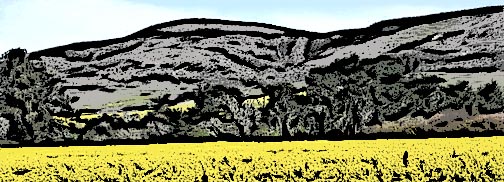
mustard fields2Weston County in February was awash in yellow mustard and acacia blooms. A political compromise in the early 20th Century had created Weston County as a trapezoidal wedge between the conservatives of the Anderson County timberlands to the north, and the well to-do liberals in the agri-burbs of Tolay County to the south. Weston was a sampler of both of those ideologies and equally representative in its topography. To the West, Weston was bound by the rugged coast and the wide blue yonder of the Pacific. Consisting mostly of sparsely inhabited timberland vacation destinations and upscale enclaves notched into and around sheer granite oceanside cliffs, it stretched north to the county line as a continuation of the coastal range. The south and east of the county were taken up by arable lands, home to vineyards, orchards, and truck farms encroached on, steadily and year after year, by housing developments and the attendant paving.

Almost equidistant from the wave tumbled coast and the rolling grass and oak foothills at the Harbin County line to the east sat Santa Lena, the largest population center and the county seat. The heavily traveled north-south State four lane thoroughfare bisected the town and the main east-west artery, known as the Santa Lena Highway, cut across the northeast corner at the city limits.

At one point dispatch had requested his 10-20 and his ETA to the shooting scene. He informed the dispatcher that he’d just cleared the outskirts and was heading east on the Santa Lena Highway, figuring to arrive in about half an hour. He imagined Tim Collins listening to his answer in his office over the monitor speaker because it was his question that had prompted the radio traffic. Sometime later he’d heard the Crime Scene van check in as having arrived at the site. 

—The arrival had been acknowledged by dispatch, and he noted it on the timeline.—

The tributary road off the highway was designated by a government number and had been freshly graded down to granite hard pack. He followed it until he came upon a pale green Forest Service pickup and the Ranger in the driver’s seat who pointed him through the cattle gate and the deeply rutted dirt road beyond. His Crown Vic was just not built for that kind of terrain and he banged his head not a few times as the vehicle jolted, bounced, and balked at the rough going. Things got a little better as he approached a large two story white farmhouse and outbuildings set in among a grove of ancient valley oaks. There were a handful of patrol units and Forest Service pick-ups gathered at the entrance to the fenced-in property. He parked off to the side of the road and checked in with dispatch. Overhead the leaden slab of clouds that stretched without end to the west threatened to mist as a fine drizzle.

—The dispatch log put him there at 10 AM.—

He walked into the yard noting the battered blue Explorer and rust red lightweight pick-up astride a set of extra-large wheels parked in front of the farmhouse. Nelson strode out to meet him, explaining “We’re still waiting on the medical examiner.”  The Crime Scene van was parked off to one side and the tech had deployed the field lab from the side compartment. A large dog penned in near the outbuildings punctuated the air with its aggressive barks.

“All dead?”

“Yeah, five of them, male, non-white. We can go in as soon as the tech gives us the nod. I did a prelim walk through. I’ve never seen anything like that.”

“Bloody  mess?”

“No, that’s not it. All head shots. They never knew what hit them.”

“No witnesses?”

forensic unitNelson indicated the Crime Scene van and the elderly woman seated on the passenger’s side with the door open. “Mrs. Elma Snyder. Lives in the granny unit out back. Didn’t hear a thing. She found the bodies.”  And as an afterthought, “The tech, Fisher, knows her.”

Almost on cue, Mary Fisher, in her blue crime scene coveralls, strode up and handed them each a pair of baby blue rubber gloves and booties to match. “We can go in and do the video walk through any time you’re ready.” She nodded acknowledging Donovan and smiled self-effacingly that was the way of her people.

“You know the old woman? Who is she?”

“That’s Grandmother Snyder though everyone calls her Grandmother Spider. She’s related to just about all the families here on the lands. My great aunt’s cousin. She comes with the place. We can talk to her once you’re done inside. I don’t think she knows anything, you know, about where Penny might have got off to.”

“Penny, who is Penny?”

Penny Dessy was Oliver Dessy’s wife, and she was missing. The ranch was her home, and her husband’s, when Chief Warrant Officer Oliver Dessy wasn’t off with the Army somewhere in the world. Afghanistan, Iraq, The Horn of Africa, he’d been to them all. He was regarded a hero to the people of the lands, his decorations and tales of his exploits, though ostensibly classified, were known to all and relished with the pride of kinship. Penny, his wife was not among the carnage inside the house. That Penny Dessy was missing made her a person of interest.

Donovan walked up the steps carefully appraising what he saw, impressed by the order and cleanliness of the front porch with its well-watered potted plants, white-painted wicker chairs and bright cushions, the worn boards of the deck swept clean of yard sand or tree debris, it could have given a pin lessons in neatness. Someone had devoted a lot of time to presenting a welcoming, thoughtful approach.

Mary Fisher had related the backstory on Penny Dessy, an outsider brought home from Oliver Dessy’s tour as a combat field instructor at West Point. She was the adopted daughter of Brigadier General Otto Likhaus, a native woman from the lands of upstate New York. Her ways were different, and her forthrightness struck some of the Sage Valley residents as snooty and rude. She was a tall woman as well, and slender. Her looks attracted many of the men’s eyes and desires which further alienated the close families on the lands. They had one son, Markus, who ran a telemarketing company based in Tolay County.

glenoaksThe sitting room immediately inside the front door was just as immaculate and well cared for as the verandah. Had it not been for the bodies. The tech had placed yellow A-frame number placards by each of the corpses. Donovan stood in the middle of the room and observed the position of each of the dead men. Number one and two, caught sitting, right between the eyes, mouths still open in surprise. Number three, not quite a center shot and may have been standing by the way he had fallen over the arm of the chair. Four looked like he had a defensive wound on his right hand, but the bullet tore right through it and entered just below the right eye. Number five caught a slug just below the laryngeal prominence and then another at the hairline. The efficiency of the killing was chilling.

—Appeared to be the work of a professional he noted on the timeline—.

The on-scene deputies had searched the grounds but there was no sign of Penny.             “The only place we haven’t looked is in the shed.” Nelson pointed to the weathered outbuilding inside the enclosure guarded by the dog. “We can’t get past the dog.”  He shrugged. “Might have to shoot it.”

Mary Fisher overheard them and shook her head. “No need to do that. Old Gus has got more barks than a three headed dog, but there’s no call to kill him for being who he is and what he does. Besides, I put in a call to Woody over at Animal Control. He’s on his way. And I’ve got ID’s on the victims if you’re interested.”

She led them down to the field lab where she had placed the wallets and various photo identifications laid out to be photographed. Donovan looked over her shoulder as she pointed to each. “Number one and two, Jacob Wiley and Jason Wiley, same Harbin County addresses, probably related, brothers.”

“You know them, don’t you,” he interjected.

With a slight movement of her chin down she caught a breath. “Yes, I have heard of them. Wild, into bad things, associated with white men. They were distant cousins of the Dessy’s, too”

He understood what she was saying. “What about number three?”

“Aaron Wiley, an older cousin of these two, played high school football with Oliver Dessy. Drugs, gambling, extortion. Number four, Thomas Bull.”  She pointed to the driver license photo of a man whose head filled the square of photo. “A mean drunk. He’s my husband’s third cousin and we’ve seen his antics at family gatherings. My husband calls him a ‘wannabe badass’.”

Donavan picked up the photo id of number five. “I know this guy, Eric Badger, we had him for a gang related murder, but the witness conveniently disappeared.”

—Animal Control arrived at the scene and checked in. He noted the time on the timeline.—

toolshedWoodrow Ames, also known as Woody, was an animal behavior vet who deprecatingly called himself a glorified dog-catcher. A green County issue mesh ballcap held down the explosion of curly red hair that topped his skinny frame. And anyone one who knew Woody would agree with the assessment that he was fastidious about his uniform attire. A neat freak as the not-so polite would say. His new assistant, a young woman, retrieved the wire lasso at the end of a length of pole and he directed her to walk parallel to the fence in plain view of the large mastiff, attracting its attention. In the meantime, he retrieved a long dark case, the kind a pool shark might carry his professional cue in and extracted two long hollow tubes that he fit together to form an even longer tube. One end was fitted with a round rubber mouthpiece. He propped the blowgun on the open window of the driver’s side door of his truck, inserted the dart in the opening of the tube, and positioned himself to aim. His assistant, glancing back over her shoulder once, moved closer to the fence and the dog on the other side that had by then worked itself into a froth of rage.

The dog gave a little yelp and then tried to bite its own neck before its back legs buckled followed by its head and front paws, it’s heaving ribs slowly breathing shallower.

As soon as Woody gave the nod that it was safe to go in, they entered the shed to learn that it also served as a workshop of some kind though the saws and various other tools hung on the backboard over the bench appeared not to have been used in a while. Dust and cobwebs had taken over the corners and surfaces.

Shining his flashlight in a corner of the shed taken up by rusted farm equipment, Donovan noticed where the ground had been displaced, a mound of dirt next to an olive green wooden military footlocker. He scanned the faded black stenciling of the name O. Dessy US Army on the dust free surface. He lifted the lid. Empty, but he recognized the faint scent of gun oil.

“Somebody’s been in here, working at this bench, recently,” Nelson proclaimed as if he’d just had a Goldilocks moment. A deputy stepped into the shed. “Sheriff’s on the radio for you, Donovan.”


In Part Two: “Put Every Fingerprint Back!”

The Last Resort, CHPS 11-13

by Pat Nolan

Chapter Eleven
BLACKIE’S HOLE

Blackie had his repair shop at the rear of the antique store. Delicate cut glass and enameled trays, porcelain knick-knacks and art deco jewelry, chipped Chippendale settees and Tiffany lamps filled the gloomy antique space of mirrored shelves and mahogany hat racks.  A heavy beaded curtain disguised the entrance to the brightly lit confusion of motorcycle frames and engine parts. An assortment of wrenches and sockets along with glass jars filled with odd nuts, bolts, springs, and pins were neatly arranged along the back of a workbench.  I examined the collection of mementos above it while Blackie fussed with Mr. Coffee.  Besides the motorcycle jacket framed trophy-like with Blackie emblazoned below the larger patch that read Road Devils, the rogue’s gallery of black and white photos told an intriguing story.

Arlene 2There was a smiling Blackie leaning on a big motorcycle with his arm around a beautiful blonde betty.  Why he was known as Blackie was evident from the commanding jet-black pompadour. Among the assortment of snapshots were a few professional photos of a beautiful woman in a postwar coif smiling confidently at the camera.  There were group pictures: Blackie and his pals with their motorcycles sporting tight sleeveless white t-shirts, sunglasses, cigarettes dangling from their mouths. In one, a young man in an Army uniform looked out of place. Another large group photo depicted a line of young men posing with their machines and attendant women in front of a flat roofed industrial building with a sign that read Blackie’s Hole over the doorway. Blackie’s arm was around the woman in the studio photo. There was something radiant about her smile, one that instantly beguiled.  I knew that smile.  Intimately.  Most of the women were attired in short denim jackets or peasant blouses, pedal pushers and sandals, with their big hair wrapped in decorative scarves.  From her broad smile, one of the girls appeared quite proud of the way she filled out a knit tube top.  She looked very familiar.  Perplexed, I realized I was looking at a young Rhonda.  Blackie had come to look over my shoulder.

“That’s Arlene.”  He said pointing at the photo.

“That’s not Rhonda?”

“Oh, yeah, that’s Rhonda there, next to Chip.  No, this is Arlene here in the picture with me.”  He was smiling at the old memories.  “This is her here, too.  She was a model.  Kinda like you.”

Blackie was right. She had the poise of a fashion model.  And she had the right kind of cheekbones.

“Hell, we were all models back then.  The women you see here were some of the hottest models in Los Angeles.  Most of these guys were surfers or bikers who also did a little modeling, part time.” He looked at me and his smile widened, mischievously. “Hey, there was a demand for photos of tan muscular men.”

“And big breasted women will never go out of style, certainly not in men’s imaginations,” I had to add.

Blackie had an easy laugh that undoubtedly had enchanted more than one young woman. “Oh yeah, well, Rhonda, she graduated.”  The tips of his ears turned pink.  He pointed to the man in the uniform. “That’s my older brother, Al.  He was killed in Korea.  And this guy here, with Rhonda, is Charlie Pierce. Everyone called him Chip.  He was Rhonda’s first husband. He lost a leg in a motorcycle accident.” Blackie shook his head.  “He got hooked on drugs because of it. Rhonda got into her line of work to support his habit. But he overdosed. She really loved the guy.” Blackie cleared his throat of the burr of emotion that had crept in.  “This place in the picture was a garage where we hung out and worked on our bikes. Tommy Perro, this guy here.” He pointed to a short muscular man, cigarette jutting jauntily from the corner of his mouth.  “He’s the one who painted the sign over the door.  We never called it that.  It was always ‘the place’ or ‘the box’.”

Blackies club12JJ had told me a little about Blackie when I had once asked about the good-looking old guy hosing down the sidewalk in front of the office.  She had made some lame joke like ‘Blackie Widower’ but I also learned that his wife, Arlene, had run the antique store while Blackie puttered around in the workshop.  After his wife died, he had kept the business open in her memory.  It had always been called Blackie’s Antiques and Motorcycle Repair Shop.  That had been Arlene’s idea. She thought that the unusual name would bring in the curious. It did, but, according to JJ, the curious just like to look, they rarely buy anything.

“How old are you in this picture?” I pointed to the one with him astride a big motorcycle.  He didn’t look older than seventeen.

Blackie gave a laugh that started as a groan, as if reaching that far back stretched some memory muscles he hadn’t used in a while.  “There?  I’d say about twenty.  Or close to it. I always looked young for my age.  I was being carded well into my thirties.  How old do you think I am?  Now.”

I passed an appraising glance over his trim figure.  He looked solid enough though his leathery weathered face was creased with the erosion of age.  I imagined that it was the full head of hair, even shockingly white, that knocked the years off.   “Oh, sixty something.”

He nodded, smiling appreciatively at the graciousness of my guesstimate just as Mr. Coffee came to life, ejecting a stream of dark aromatic liquid into the carafe amidst a grumble of boiling water.

“How do you like yours?  Cream? Sugar?”

I told him sugar, no cream.  And I had guessed right, he took his black. The rain, as if cued by the coffee maker, started in earnest. It was a heavy rain and it banged on the metal storage shed out behind the shop and fell elsewhere with an earth-denting thud, etching itself onto the tiny dirt-smeared window that let in a skimping gray light. I brought the cup to my lips. I didn’t want to miss a word of what Blackie had to tell me.

Arlene and Rhonda had been inseparable friends when Blackie met them hanging out on Venice beach.  They were young, they were wild, they were supremely confident in their prospects.  His description of the modeling scene in the early fifties confirmed that nothing had really changed or would change in the dog-eat-dog backstabbing world of commercial modeling.  The sheer boredom of photo shoots, the humiliating treatment by the photographers, the indignities suffered, the mammoth egos of dueling star models were all very familiar to me.  He could write a book, he said, name names, about who did what to whom and who wanted it done, all the dirty behind-the-scenes manipulations of the agents and fashion magazine editors.  It was a sad comment on human nature, the blind, lustful, grasping sickness for fame and fortune that only led to certain emptiness. I couldn’t have said it better myself.

redwoodbkcvr1By sheer accident, Blackie and his gang of Road Devils, on a road trip up the coast, had turned inland onto Highway 8 at Feather and stopped in Timberton. Arlene had taken one look around and claimed to have found paradise. The pines, the firs, the redwoods, the river all spoke to her spiritual inner self.  Blackie couldn’t argue with that.  When they got back to LA, they packed a few suitcases, sold everything they couldn’t carry and moved up to the Corkscrew River.

A chair scraping across the floor above broke the spell and reminded me that I was directly below the Grapevine’s office and that the furniture moving was probably being done by my erstwhile editor, JJ.  Blackie’s story had been diverting but I still had to find the Countess.

“She and her boyfriend live a cardboard box under the bridge,” Blackie volunteered. “But don’t go down there now, you’ll get drenched. I’ll go with you once the rain lets up.”

I wasn’t in a hurry to get wet.  Besides, the strong coffee was beginning to have an effect on me. Blackie read my look and pointed to the door near the entrance to his shop and a small, reasonably clean bathroom. With the door closed, the noises from the office above resonated in the confined space.  I heard JJ talking.  She was on the phone.  I tried not to believe my ears.

“No, Miss Malone will be unable to make the appointment with Detective Santos.  I will be taking her place.”


Chapter Twelve
THE CARDBOARD CASTLE

My satin high heels were sucked into the oily mire of the narrow path snaking its way through the tangle of undergrowth. Tall, brown and dead, the weeds on either side blocked any peripheral view. Up ahead, a bridge loomed in tatters of mist. Colorful scraps of food wrappers festooned the occasional shaggy shrub.  Lucky Charms cereal boxes and a scattering of beer cans adorned an open space of matted grass at the edge of the trail.  Dogs barked in the distance.  A rusty bike missing its seat leaned against a fence post.

The trail led down toward the Corkscrew River, a roiling rushing gray mass carrying anything in its path out to the sullen winter sea. Plastic containers, barrels, and old tires bobbed by on the suds-specked waters accompanied by various pieces of lawn furniture. The sign from a local resort jammed against the branches of a large uprooted tree drifted by, its claim to be Close To The River still readable above the water line. Smoke from cooking fires rose in the distance, blue threads against the dark of the mist-bound bridge.

It was taking me forever to get to the homeless encampment.  I thought I heard birds and then spied two rather ratty specimens.  They were in fact attached to sticks held in the hand of an adolescent guttersnipe.  He made bird noises but they were more like the kissing sounds made to call a four-legged pet.  He had been paralleling my path in the tall weeds all along and I hadn’t even noticed.

I was experiencing a kind of tunnel vision that only allowed a view of the world within the narrow frame of a full-length mirror in a dressing room.  In that mirror I was wearing an orange and gold Felliniccio evening gown. I should have never worn the matching high heels.  They were ruined.

I came to a clearing.  A blue tarp was draped over a length of rope between two trees. Sections from a large cardboard box made a kind of floor beneath the blue tent.  Motorcycle parts were lined up on a gray blanket next to a smoldering campfire.  Sheets of discarded newspaper clung to the dingy bushes nearby. The path continued past a cluster of campsites, widening out into a trampled muddy bog.

cardboard castleA dog lunged from behind a shopping cart piled high with empty cans and bottles.  It looked just like Hitler, Goldstein’s old Airedale. Maybe he hadn’t been shot after all.  Maybe he’d just been kidnapped.  The mud-spattered urchin, now a young girl with a wreath of dead flowers braided into her hair, followed me with the artificial birds. They were supposed to be finches but the sounds she gave them were like cats in heat.

Under a large oak dripping with lichen, a man in Bermuda shorts, seedy sports coat and straw hat stood as if waiting for a bus.  The hair showing beneath the man’s hat was made of twists of orange yarn.  The red ball of a clown nose covered his own.  Folded in one pocket of his coat was a pornographic magazine, the pictures of nude flesh neon in the gray light.  He lifted his hat in mute greeting and the curls of wool rose with it.

I was about to ask for directions when I saw it, tucked against the concrete embankment of the bridge like a wasp’s nest. An assemblage of large appliance boxes and packing crates had been fitted together to make a curious dwelling atop the riprap where the Timberton bridge began its span across the river. A turret had been fashioned out of cardboard and spires made of discarded lumber were strung with shabby pennants. The rocky slope to the cardboard condo was covered with green slime.  I lost my footing and tottered over the foul swirling eddies.

When I regained my balance I was sitting inside a rather spacious cardboard room with a low ceiling that read this side up and a tattered Persian rug covering the dirt floor.  A shaggy gray dog snuffled in his sleep behind the back of a woman whose shoulders were draped in an intricately embroidered gypsy shawl.  She was cooking something over a low fire. It struck me as odd that the smoke wasn’t filling the cardboard enclosure. Occasionally, the flames from the cooking fire would rise and encompass her figure like an aura.  A large badly dressed marionette was perched next to her.  Bothered by the absence of smoke, I pushed open a flap that had been cut into the cardboard wall.

What I saw chilled me. I opened my mouth to scream but no sound came out, as if I were posing for Munch’s famous painting.  The two men from the gray van with their Doberman in the lead were running up the path.  I had to hide but there was nowhere to go. Terrified, I clutched my knees and hid my face in my arms.  Maybe they wouldn’t find me. I waited.  When I raised my head, they were standing in front of me, the oily skinny creep and the large bearded brute, grinning menacingly.  The Doberman was inches away from my face, barking, barking like the ringing of a telephone.

I awoke and fumbled with the phone, glancing at the clock on the bedside table.  It was 3:30 in the morning.

“Leeann?  Leeann Malone?”  The man’s voice was gruff, grave.  He didn’t wait for me to answer.  “Leeann, this is Harrison Tucker.”  Harrison Tucker was my mother’s lawyer. And he had been my stepfather’s partner in the investment firm.  My stepfather had another name for him, one not used in polite company. “Leeann,” he repeated, “Your mother’s in the hospital with pneumonia.”

I sighed. A week earlier I had told my mother that I didn’t think I’d be flying back to Chicago for the holidays.  Now, a few days before Christmas, she had found a way of changing my mind.  “How bad is she?” I asked.

“She’s in the intensive care.  They’re doing tests.”

If I knew my mother, the hospital staff being was being tested.  To the limit.

“I’ve taken the liberty of booking you a flight out of Capitol City Airport. It leaves in three hours. I knew that you’d want to be at her bedside in her time of need.” Harrison Tucker assumed too much. My mother had taken up with him after Frank died. And unlike Frank, she had him wrapped around her little finger.  But I wasn’t going to take the chance that this was the one time she wasn’t crying wolf.  Shaking the sleep out of my hair, I wrote down the flight information and hung up.  I dragged myself into the bathroom and startled myself with the bright light above the mirror.  I looked bedraggled, like a bad dream. A wind driven rainstorm pounded the landscape with an urgent howl outside the tiny window. The image of the cardboard palace was still fresh in my mind.

I hate the way these things come to me.  Call it what you want, a hunch, woman’s intuition. The bodies in the burned out gray van had included a dog.  The police report had not indicated whether one of the bodies was that of a woman.  I had a gut feeling that one of them was.


Chapter Thirteen
MY HOME TOWN

Lk MichI hate Chicago.  I hate Chicago in the winter.  I hate that the snow is not white but a sooty gray. I hate that the chill winds swirl through the high-rise canyons, around your legs and up your skirt, so cold and impersonal.  I love the view of Lake Michigan from my mother’s townhouse, sheeted over with ice and snow. I hate my mother’s townhouse.  It’s a museum.  Not a museum of Louis the XIV furniture or art deco lamps or Japanese prints.  It’s a museum of me.

As soon as I landed at O’Hare, I took a cab to the hospital.   Even in her heavily medicated condition my mother had cocked an eye at me and said, “You’re letting your hair grow.” I’d been spending my time between her bedside and the townhouse since I arrived. I couldn’t decide which was worse, being tortured by images of myself on every wall in every nook and cranny of the townhouse or sitting at my mother’s bedside watching her struggle to breathe.

The hospital was putting on its festive face for the holidays. There were decorated trees in all the alcoves.  Strings of tiny lights festooned the frames of the corporate art on the walls. The nurses wore little red and green ribbon corsages by their nametags or sported Christmas ornament earrings. Good cheer was in the air despite the sickness and pain, the daily expirations, and the low ominous hum of the life support machines. I got to know a few of the nurses, some of whom recognized me from the fashion media.  “Say, weren’t you in that perfume ad?” was an often asked question.  “You’re still gorgeous” was the chorus.

lee nude1On the walls of my mother’s townhouse were the constant reminders of how gorgeous I was.  There were poster sized photo portraits of me by the cream of world famous photographers in the foyer.  Discreetly off to one side before entering the glass walled living room was an Oglethorpe nude of me, all white flesh and black background.  I was naked but none of my private parts showed. Not that any of my parts were ever private once I became a professional beauty.  Still it was pronounced the most seductive image of the century.  The oil baron who had privately commissioned the portrait had made that pronouncement.  In the formal dining room, taking up a good part of the wall above the chrome and glass table was the most scandalous portrait of all.  It was the canvas that the controversial painter, René de Ricane, had done of me, a thicket of violent brushstrokes whose suggestiveness left little to the imagination.  My face, as they say, may have launched a thousand ships, but according to the painting, my body was responsible for as many shipwrecks.  It was titled la Siréne, The Siren.

I had spent two weeks alone with de Ricane in an old convent that he had converted into a studio near Pau at the base of the Pyrenees.  When he wasn’t painting, he was drinking red wine made from grapes he grew himself and smoking vile Turkish cigarettes. And he talked constantly, about art, about history, about politics, about the cinema. But most of all about his sex life, wheezing wistfully about his conquests and the one that got away, a glass of wine in one hand and a cigarette in the other on the terrace overlooking his sunset tinged vines.  He had been born before the turn of the century and had known most of the significant artists of his time and judged them all to be charlatans.  At first I tuned out his babble.  He was as bad as cocaine high fashion photographers with their inane chatter. He was certainly more demanding, wrenching me into poses that no fashion magazine would dare show.

Maybe it was turpentine intoxication, but after a couple of days the words started leaking through.  What he was saying actually made sense unlike the double-speak of agents, fashion magazine editors, and sycophants. I started having thoughts of my own. I’d never had this kind of time to myself before. I had to hold poses for interminable hours.  At first there was pain and discomfort, then numbness.  There were times that I felt that I had left my body and was watching myself from a corner of the studio.  What I saw was sad as well as beautiful in the way that birth and death are sad and beautiful.  At the end of the two weeks de Ricane had grudgingly put aside the painting. “It will never be finished,” he proclaimed, “until you come to terms with your beauty.”  He gave up the commission from the wealthy patron and handed the canvas over to me instead. “This will be your Dorian Gray,” he pronounced.  A week later he gave up the ghost.  I was left with a painting worth six figures that ostensibly had supernatural qualities and the conviction that I had to live my life differently.  It’s more complicated than it sounds. In forging a new life, some destruction must take place.  And it did.  With it came the reputation that trails me like a tantalizing scent to this day.

Harrison Tucker insisted that I accompany him to a holiday society gala. I wore an original Jean Claude Penne that mother had saved, preserved in plastic like an artifact in the closet of the bedroom that she insisted would always be mine.  I wasn’t surprised that it still fit. Once I stepped out of the limousine though, I knew it was a mistake.  Bursts of camera flashes greeted me and I was swarmed by emotionally starved men in expensive suits and women who had made the wrong fashion decision, all wanting to have their picture taken with me. I was powerful yet I felt powerless. I signaled the valet and stayed only long enough for the driver to bring the limo back around.

I spent Christmas day at my mother’s bedside.  One of the nurses brought me a plate of dry turkey, chewy mashed potatoes, gooey gravy, and runny cranberry sauce from the cafeteria and wished me a Merry Christmas and a Happy Hanukkah. I was grateful for the lack of attention.  The society columnist with the Tribune that day noted my brief attendance at the gala, intimating that I was either rude, on drugs, or both.  I had to face it.  I was still a bad girl in my hometown.

hospital-fundraisingI held mother’s soft mottled hands and couldn’t help noticing how much mine were beginning to resemble hers.  Sometimes she was there, sometimes she wasn’t.  I would get that glowing look of recognition when she woke to see me or a vague troubled frown when she didn’t recognize her surroundings.  She had been a strong woman once, a gorgeous, vivacious woman, born in the Ukraine. I was a lucky combination of my father’s cocky Irish manner and her classic good looks. The way I looked was money in the bank to her, the epitome of the American dream. I had been packaged and sold.  I’d come to terms with that long ago.

Harrison Tucker made an attempt to get me out for a New Year’s Eve soiree with some society stiffs.  I begged off.  I wanted to start the New Year off with mother.  I’d picked up a doorstop of a paperback at the airport and caught up on my reading while mother slept.

The night nurse peeked in.  “How’s everything going in here?” she asked. I indicated my dozing mother and smiled a “just fine.” She tiptoed over to my chair and whispered, “All the nurses and interns are going to watch the ball drop and have champagne in the waiting room.  You should join us.”

I set the book aside and looked at mother. She wouldn’t miss me.  A small group of nurses and doctors wearing funny hats clustered around the TV in the waiting room.   I was offered a plastic cup of champagne and wished a Happy New Year. The ball dropped and still Dick Clark did not look a year older.  Maybe he was father time.  There was a tiny outburst of cheering suitable for a hospital zone and a lot of kissing.  A young intern in his early twenties wanted to kiss me.  I let him.  One of the nurses had flipped the channel to a news station. A reporter was holding a microphone in a man’s face. It was Blackie! I grabbed the remote from the startled nurse and turned up the volume. Blackie was saying, “. . .well, the river rises like this once every ten years or so, but this is the highest I’ve ever seen it.”  The caption below the report read Corkscrew River overflows banks. . . Evacuations ordered.  It was good to see Blackie in his yellow slicker, rain dripping off his face, apparently unperturbed by it all.  Then it was as if I’d stepped on a live wire.  The TV showed a view of Timberton under water and the camera zoomed in on a man towing a rowboat with a rope down Main Street. Another man was hunched over, shivering, in the boat with a large brown dog.  It was the unholy trio: the large bearded bully from the gray van, his greasy, rat faced partner, and their cockroach colored Doberman.  Very much alive.


Next Time: High Waters & High Priced Lawyers

Contents Vol. I No. 3

Introducing Dime Pulp Number Three

In this third issue of Dime Pulp, The Serial Fiction Magazine, Lee Malone, former super model now small town newspaper reporter, is sent on a mission by her editor, Joyce James, to find the “Countess”. And, oh, she discovers that her neighbors are former porn stars. The Last Resort reveals tiny backwater Timberton to be more than a sleepy little town.
For Helena Baron-Murdock’s Hard Boiled Myths series featuring Weston County Sheriff Detective Jim Donovan, a vehicle accident might not be all that it seems in Notification of Kin.
In A Detective Story, Lackland Ask, bent on murderous revenge, gets in disguise and has a run in with the feds.
Patton D’Arque’s Gone Missing, a story about a couple of dangerous and grumpy old men, an ex-cop and an ex-bounty hunter, wraps up with an unexpected revelation.

Dime Pulp continues its crime spree with the serialization of two full length novels, The Last Resort and A Detective Story, as well as another short story based on Greek myths under the rubric of Hard Boiled Myths, and the conclusion of Gone Missing.

If you’ve made it this far, go ahead and follow the links below to reading entertainment with the serial contents of Volume One, Number Three.

  —Perry O’Dickle, chief scribe
and word accountant

The Last Resort A Lee Malone Adventure

Deep in the redwood wilds along the Corkscrew River, someone is shooting neighborhood dogs. The year is 1985 and Lee Malone, former fashion model, queen of the runways from Paris to Milan, once dubbed the most beautiful woman in the world, now a part-time reporter for The Corkscrew County Grapevine, is looking for a story to sink her teeth into. When Lee finds the owner of Kelly’s Seaside Resort brutally murdered, it leads her on an adventure that includes a mysterious gray van, another murder, extortion, pornography, sex slavery, and a shadowy organization of militant feminists known as SAPHO.  In the process, Lee Malone’s notorious past catches up with her.  A rollicking imaginative romp in the neo-pulp hard boiled genre, THE LAST RESORT is told with the succinct directness of a Hammett, the witty hyperbole and lush locales of a Chandler as well as a sly nod to Nancy Drew and Hardy Boys adventures.

The Last Resort, Chapters 1-3
The Last Resort, Chapters 4-6
The Last Resort, Chapters 7-10

Hard Boiled Myths
Crime Fiction With A Classical Twist

Greek myth is rife with murder, mutilation, cannibalism, mayhem, and the ever popular incest.  Weston County Sheriff’s Detective Jim Donovan of the Violent Crimes Unit wouldn’t know a Greek myth from a Greek salad, but if he did he would find some troubling similarities to the cases he’s investigating.   

Long Shot I
Long Shot II
Notification Of Kin

A Detective Story

Lackland Ask is the name.  ‘Lack’ to my friends, ‘Don’t’ to those who think they’re funny. You might have seen my portrait on the cover of Black Mask, the crime friction magazine. This is my story.  It starts with a blonde.  This kind of story always starts with a blonde. The brownstone was on the Westside and easy enough to find. So was the mug’s yellow roadster. It stuck out like a new shoe in a cobbler’s shop. I was being a sap again. I woke sitting straight up, sweat pouring out and over me, my undershirt drenched. I was going to have to change my shorts. Some dream.

This kind of story always starts with a blonde
“I was being a sap again.”
“Some dream”

Gone Missing

When you think of “grumpy old men” you don’t usually think of an ex-cop and an ex-bounty hunter answering a call for help from their step-daughter “niece” to look for her mother, their ex-wife former girlfriend, who has mysteriously disappeared.

Gone Missing I
Gone Missing II

Notification Of Kin

by Helene Baron-Murdock

He let drop the keys to the sedan into the left pocket of his slacks and walked toward the flashing lights staying to the inside of the flare pattern.

“Hey, Donovan! They got you doing accident investigations now?”

He glanced in the direction of the taunt and waved a hand at Tom Baxter, the fire chief for this stretch of coast highway.  It was a perfunctory wave meaning either ‘hey, howyadoing’ or ‘don’t bother me.’  Baxter was standing by the rescue rig with a few of his volunteers framed against the wide horizon now just a creamy orange line above a placid metallic gray expanse of ocean.

Kyle Bradly, the Park Ranger, intercepted him as he approached the wreck.  “Why’s the Sheriff’s Office even getting involved in this?”

Everything west of the highway was Bradly’s jurisdiction.  What was left of the vehicle had landed on the beach just off the pavement.  The accident itself was in the Highway Patrol’s bailiwick but it was one of those incidents that everyone was going to have a hand in.

Donovan shrugged.  “It’s a CYA operation.  Considering the identity of the road burger, everyone who’s politically connected is going to want to be in on it, if for no other reason than to cover their asses.”  He stopped a short distance from the carnage, a crumpled upended vintage sports car.  “That an old Porsche?”

Bradly nodded.  “Yep, 550 Spyder, James Dean death machine.”

The Highway Patrol officer looked up from her clipboard with a severe frown.  She was young, intense, and concentrated on going by the numbers on the first fatality of her probation.

“Excuse me, you’re. . . ?”  If nothing else, Donovan looked official without trying and she was giving him the benefit of the doubt.

“Jim Donovan, Sheriff’s Office.  I’m here to help you in any way I can.”  When most people heard that line, they usually checked their backs for knives.

“It’s a traffic fatality.  I don’t need any help.”  Her dark eyes snapped resolve.

At least she was standing her ground.  It was going to be a turf tug of war.  How to look good while making the other agencies look bad.  “Being who this is makes it more than just a traffic fatality.”  Donovan dropped to his haunches and took in the length of bloodied partially clothed corpse.

“Dragged himself clean nekid,” Bradly opined.

Donovan blinked and frowned, standing up.  It was one of the worst he’d seen.  At least it was an adult.  And male.   “Tell me that’s not what I think it is.”

The Ranger and patrolman looked at where he was pointing.

“Rumor had it he was a stud, hung like a stallion.”

“I’d hate to see that thing angry.”

They both turned to look at the patrolman.  She rolled her eyes.

“This is my incident.  My accident scene.   The only reason Bradly is any way involved is because the vehicle landed in his sand box.  I don’t remember calling for a County detective.”

“Your shift commander hasn’t contacted you?   There’s to be a thorough investigation by all jurisdictional agencies involved.  T.C. Hughes has a lot of political clout and that’s his kid there with the python between his thighs.”

The patrolman’s ears reddened ever so slightly.  “I haven’t heard anything from my shift commander.”

Donovan smiled thin.  “Be that as it may, notification of kin is done by the coroner who delegates that unpleasant task to the Sheriff’s Office.”  He indicated the young deputy directing traffic.  “Ordinarily that poor bastard would be delivering the bad news.  But you’ve got a high profile casualty here and I pulled the short straw.  That ok with you?”

She nodded looking over Donovan’s shoulder and drawing her lips into an angry line.

The black and white sedan came to a stop behind them and killed the headlights.  The shift sergeant had just arrived.  He would be taking charge of the accident scene.


The patrolman used her hand to describe the path of the vehicle once it got airborne, indicating the bluff and rise of the highway to the south as it first turned east and then made a sharp switch back to the west before dropping in a graceful asphalt parabola to where they were standing and where the front end of the Porsche had come to a stop.

“One of the witnesses said they heard a loud noise like a pop or a thud.  Then they saw the vehicle go airborne right after the first turn.  The victim was ejected, with the vehicle dragging him across the pavement to where the forward momentum was arrested by the berm at the top of the pathway down to the beach.”

“What was it, a pop or a thud?”  The shift sergeant, a large square headed older man, was not happy to be caught up in the political quagmire.  “It can’t be both.”

The patrolman studied her notebook certain she was being harassed because she was a rookie and a woman.  “One witness stated that it sounded like a pop.  Another thought it sounded like a loud thud.  They all said that it happened so quickly they could barely comprehend what was going on until it was all over.”

The sergeant sneered.  “Comprehend?  Did they actually use that word?”  He glanced at Bradly and Donovan and smirked.  “College kids.  Book smart, brain dead.”

Even in the encroaching twilight, the patrolman’s rage, a bright red face containing anger and embarrassment, was more than evident.  “I interviewed a dozen witnesses,” she stated, her voice straining to control her emotions.  “Only three of them actually saw the vehicle flip and crash.  I have their contact information for follow-up if necessary.”

The sergeant had stopped listening to her.  “Yeah, flip and crash, pretty typical out here on the coast highway, wouldn’t you say?”  He addressed Bradly.  “This is a popular spot.  Seems to me there should have been more than just twelve witnesses.”  His smile was sadistic.

“We get a fair share of visitors considering it’s not one of the bigger stretches of sand.”  Bradly pointed out to the water’s edge.  “Locals call it Sculpture Beach because people build things out of driftwood and what have you.  Come the really high tides most of it washes out.  But they keep doing it anyway.  Actually had some pretty well known artists come down and make sculptures recently.”

Donovan pushed himself off the fender of the black and white he had been leaning against and stretched as if he were awakening from a nap.  He glanced at the motley array of driftwood constructions silhouetted against the darkening sky and sea and draped in a fine twilight mist, abstract figures arrested in mid frolic.  “Well, I’ve got work to do,” he said to no one in particular.

“Notification of kin?” the sergeant asked.  “I’ll go with you.”

Not to be left out, Bradly anted up.  “Yeah, I’ll go, too.”

Donovan shook his head.  “I’m delivering bad news, not intimidation.”


T.C. Hughes looked like a Greek god, approximately.   A mat of tight white curls crowned his head, a salt and pepper beard stippling his square jaw and around his liver red mouth.  The blue eyes were clear, untroubled, with no hint of sadness, pain or regret.  “Thank Tim for his discretion.  I appreciate it.”

Donovan nodded.  Tim Collins was the Sheriff, his boss.  A woman was sobbing behind the frosted glass double doors that led out to a balcony.  “Someone has already informed you of your loss, is that correct?”

“Yes, Bobby Temis, a friend of my son’s.  She saw it happen.  She felt it incumbent upon herself to inform us immediately.”

Who talked that way except people who read books and thought of themselves as characters in books.  Donovan flipped open his notebook and scanned the names he had copied from the patrolman’s report.  “Bobby?  A woman?  I don’t have her down here as a witness.”

“Perhaps she didn’t actually witness the accident.  She was there, at the beach, as part of the sculpture event they were having.  My son was on his way to meet her when. . . .”   Hughes didn’t finish, turning his head as if he were hearing the sobbing for the first time.

“How can I contact Bobby?  Temis, was it?”

Hughes smiled vaguely.  “Oh, Bobby. . .Roberta, actually.  She owns the Huntress Gallery in town, on the left after the hairpin curve just past Harbor Road.  She’s an artist.”  He said the word as if it were distasteful.

“Was she your son’s girlfriend. . . ?”  Donovan let the question hang.

It was almost a chuckle.  “No, no, nothing of the sort.  But I don’t see what this has to do with anything, detective.  My son died as a result of a tragic accident.  I appreciate that Tim personally sent one of his top men to make the official notification.  That is, I’m afraid, the end of it.”

“Of course.  Please accept my condolences and convey my sympathies to his mother.”  He was referring to the sobbing unseen female.  And he too could talk like people in books when needed.

Now it was a derisive snort.  “I’ll inform my lawyer and he will inform her lawyer.  His mother and I are not on speaking terms.”  And then following Donovan’s gaze in the direction of the sobbing, “Faye is my son’s stepmother.”

“I see.”

“Again, detective, thank you for your discretion.  Now I must go to my wife.  Please, this way.”  Hughes indicated the massive oak front door with an outstretched arm.

Donovan stared at the notebook, having flipped back a page.  “Two nights ago one of our deputies responded to this address for the report of a domestic disturbance.  Can you tell me what that was about, sir?”

Storm clouds formed above the bushy white eyebrows, the blue eyes flashing electric, angry.  “That has nothing to do with any of this!” Hughes thundered.  “You have a lot of brass bringing that up.  Collins will be hearing from me about your insensitivity and unprofessional behavior!  The door!”

Donovan finished his cigarette before getting back into the sedan.  From the circular drive that led up to the Hughes citadel, a ferrocement monstrosity set in among the gentle folds of the coastal hills, the view was of a dark ragged coast and isolated offshore sentinels against which the sullen sea spent itself as splashes of phosphorescence.  To the north, almost within view, was the accident scene.  He turned back to the mansion.  At night, with its wide sweeping wing-like roof and brightly lit windowed walls, it looked like a cruise ship from another planet.


He opened the folder on his desktop, found the Notification of Kin form, and entered the Coroner’s Case number which linked it to the Coroner’s Report.   The name of the deceased populated the open field.  He tabbed down to the comment field and let the cursor blink while he consulted his notebook.  A lot of the younger guys had smart phones or tiny digital recorders.  He was old school.

The phone rang.  “Donovan,” on the second ring.  “Yeah, Tim, I just now got in.  I was gonna call you. . .he didn’t waste any time. . .yeah, yeah, I know. . unhuh, Parks, Highway Patrol, they all want a piece of the action. . .ok by me. . .whatever, I understand. . .well, you know me, I like to have my t’s dotted and my i’s crossed.”  He laughed with the caller.  “Listen, Tim, I’ll have this wrapped up tomorrow, just a few things I need to follow up on. . .no, no, I know you’re not telling me how to do my job. . .yeah, it just sounds that way. . .yes, I will keep you in the loop. . .don’t I always. . yeah, I know, I’m an asshole, what’s your excuse?  Yes. . Soon as I wrap it up, you’ll be the first. . .ok, bye.”


“Are you interested in art, detective?”  Roberta “Bobby” Temis was lithe and sleek and sophisticated.   Her eyebrows arched up onto her wide brow like the antennae of a big butterfly, the eyes, those of a doe, large wing-like lashes, and the mouth, a double bow between which a pink tongue darted in amusement.

Donovan glanced about the gallery at the large paintings of animals with human faces and the sculptures of humans with animal heads.  “I know what I like.”

“Ah, an expert.”  She smiled.  “I would love to know what you think of my paintings.”

The paintings were rendered realistically, almost photographically.  “Got anything on velvet?”

“Your wit verges on the insolent, how quotidian!”

“I’m not here to talk about art.”  Donovan had unholstered his notebook and flipped to a page.

“Would you like to know my technique?”  She had stopped in front of a painting of a doe with the face of a sad woman.  “I capture my subjects with a camera and project their likeness onto a canvas, in this case superimposing the physiognomy of the hominid over that of the ungulate from which I can then trace their images.”

“Isn’t that cheating?”

“Art is just another word for cheating, detective.”

Donovan shrugged.  He couldn’t argue with that.   “You were friends with Apollo Hughes?”

“Yes, Pol, he hated being called Apollo.  He, Pol, lit us, the world, with his presence.  He was a bright ray, a golden ray of sunlight.”

“You were present when the accident happened?”

“Yes.”  She said it slowly, lingering on the sibilant.   “We were all to meet at the beach to celebrate the high tide and the destructions of our sculptures.”

“Wait a minute, you were celebrating the destruction of your. . . .”  Donovan hesitated.  He couldn’t remember the last time he’d spoken that word.  “. . . sculptures?”

“Of course, nothing lasts forever.  Art is a celebration of the life cycle.  As artists, we party at the creation of our work, and we party at its dissolution.”

Donovan shook his head.  He felt like he was in the middle of a vocabulary quiz.  “Did you see it happen, the accident?”

“No, I was focused on the sea.  It is always such a powerful spectacle.  And the breakers were unusually large that day.  The moon, you know, it’s full.”

“Did you hear a noise, like a pop or a thud?”

“Yes, I heard an explosion, a boom.”

“From the direction of the highway?”

“Oh, it may have echoed up the wash and against the hills, but it came from the sea.   It was a boomer.”

“A boomer?”

“Yes, when a large wave breaks close to shore it makes a thunderous noise hitting the sand.  The ancients called it the ‘bull of the sea.’  They meant Poseidon, of course.”  She pointed to the slide show on a flat screen TV mounted on the wall.  “Here are some photos of the recent sculptures we assembled.  And the artists.  And their friends.”  She froze a frame with the remote.  “And this is Pol.”  The photo was of a young, very handsome man with a long dark mane and a captivating demeanor.

“You saw him?  After the accident, I mean.  How could you be sure he was dead?”

She gave a sad smile that said she did not suffer fools gladly.  “The impact alone would have killed him.  But he was dragged behind his Porsche as well.  His hair, his beautiful long hair, caught on something. . . .”  She hesitated, taking in his full measure.   “. . .after that, death can only be merciful .”

“And you felt that you needed to notify his family.”

“I told his father.   He lives close by.  His mother is Anne Tiope, the actress.   I would assume that Terrence, Mr. Hughes, will somehow communicate the news to her.”

Donovan nodded.  He hadn’t made that connection. The mother starred on TV as an Amazon princess.  “I didn’t get the impression that Mr. Hughes was too broke up about his son’s death.”

“Terrence affects a godlike stoicism. . .it protects his inner child.”

“But the wife. . . .”

“Faye?”  Bobby gave a dismissive laugh.  “Faye D’Era is a child, a spoiled child.  And not very bright.  I don’t think she realized that her selfishness. . . .”  She pursed her lips and blinked innocence as if to indicate she has said too much already.   She drew his attention to the small wood sculpture of a man’s nude body surmounted by a horse’s head.  “Pol was my model for this piece.”

Donovan threw a sidelong glance at the statuette.  At least she had the proportions right.  He referred back to his notebook.  “Three days ago, the Sheriff’s Office received a report of a disturbance at the Hughes estate.  The deputy reported that there had been a violent argument between Mr. Hughes and his son and that it had comes to blows.   Mr. Hughes was adamant about his son remaining on the premises and demanded that the deputy arrest him.   The deputy also reports that some of the statements made by Mr. Hughes could be construed as veiled threats. The deputy concluded that the situation was mitigated by the departure of Apollo Hughes who had declined to press charges.  Do you know anything about this incident?”

Bobby nodded her head and closed her eyes briefly.  “Yes, yes, it is so tragic but so inevitable.  In the classical sense, if you know what I mean.  The situation there was a powder keg.  There was bound to be bad feelings, particularly after that nasty divorce.  And to take a wife who was younger than his own son was like putting fire to the fuse.  Faye was smitten by Pol.  And who can blame her.  He was incredibly handsome.  What most women who fell for him did not understand was that he had no interested in them.”

“You’re saying he was gay?”

“In men?  No interest at all.  He delighted in life.  He was quite evolved.  The carnal aspects of his nature were subsumed within an esthetic of being.  He cared only about fine things. Art, music, poetry.  His image.”  She smiled slightly, remembering.  “To say he was a little narcissistic would be an understatement.  He was drawn, as are most idle wealthy young men, to extremes. . .fast cars. . . sky diving. . .rock climbing. . .but to liaisons of a sexual nature, he was ambivalent.”

“Not even. . . .” Donovan had the insolent thing going for him.

“No, not at all.” The laugh said she thought him ridiculous.  “Pol and I were the best of friends, running buddies, partners in crime.  We were wild in such similar ways.”

“Too bad,” Donovan mused, “He had the equipment.”

“Crass, but true, detective.  However, he considered himself on a higher chakra than most mortals.”

“Ok, so why was that a problem?”

“Faye threw herself at him.  And she took his indifference as a rejection. The night of the blow up, Faye lied to her husband and accused Pol of trying to seduce her.”

Donovan gave an understanding nod.  He saw where it was heading.  “Father and son get into a fight.  Someone calls the cops.  Threats are made.  A couple of days later, son is killed driving vintage sports car belonging to Mr. T. C. Hughes.”  Donovan made to close his notebook.  “End of story?”

“Yes, detective, end of story.  Or end to this cycle of life and on to another.  Nothing sinister. Terrence owns a dozen sports cars and any one of them were available to Pol.  He never drove the Maserati or the Porsche or any one of them two days in a row. There’s nothing more to it than that.  We die and are reborn.  The energy never goes away.”

Donovan closed his notebook and turned to leave.  “Thanks for your time.  Sorry if I inconvenienced you.”  He stopped at a small shelf near the entrance to the gallery to look at a bronze statue of a nude woman with a stag’s head that would make a nice base for a table lamp.  Inscribed on the pedestal was the artist’s signature, R. Temis.
“Aren’t you curious as to what I told Terrence when I delivered the news of his son’s death?”

Hand on the chrome door plate, he turned to look over his shoulder.

She gave a wicked knowing smile.  “I said, ‘Be careful what you wish for.’  And don’t you for one minute doubt that he didn’t know what I meant.  I could read the guilt in those soulless blue eyes.”

Donovan sat in the sedan watching the seagulls fight the steady ocean breeze.  A fog bank like a big chunk of lead sat on the horizon.  There was a certain kind of beauty to the way the muted light settled on every mundane thing and made it somehow special.  He’d have to make the drive out to the coast on his own time one of these days.  He glanced at the glass and chrome door to the gallery pulling away.  Maybe invest in a little art.


The Last Resort, CHPS 7-10

Chapter Seven
NAKED TREES

Soon enough the rains came.  One storm after another marched in from the Pacific and like stiff wind-driven brooms swept all the leaves off the trees.  Leaves gathered in sodden lumps, blocking culverts. Water spread across roadways from the overflowing ditches.  Unprepared downspouts spit like spavined lunatics. Roiling creeks swirled gray with stirred sediment. Soggy downpour days took the heart out of jogging for me. I didn’t fight the urge to curl up on the divan with a fashion magazine or a mindless novel, the gas hearth exuding comfort like a purring cat. The horrible events of the previous week hadn’t been washed away by the dramatic change in the weather, however.

Detective Santos had taken my statement at the crime scene.  Gray at the temples, an inch or so shorter than me, and handsome in a rugged world weary way, his dark eyes fixed me with a studied gaze as he asked his questions.  He jotted notes. He was primarily interested in the timeline.  What time had I arrived at Kelley’s?  What time had I left home?  Had I stopped anywhere along the way?  What was my business with Fashwalla?   When I told him I wrote for the Grapevine, he asked if Ms. James was still the publisher.  Apparently he knew her from a tour of duty he’d done as a deputy at the substation in Timberton.  Years ago.  I caught a hint of something in that information.  Nothing specific, but a woman knows.

I had also voiced my suspicions about the gray van and its occupants. They might have had something to do with Fashwalla’s murder. He’d given me a skeptical squint. “Ok, I’ll make a note of that.” He closed his notepad and stuck it into the pocket of his windbreaker. “I have your number. And please, give me a call if you can think of anything else.  You have my card,” he said as he walked away.

The phone rang.  It wasn’t Detective Santos.  A voice teased, “Bet you don’t know who this is.”  The voice was familiar.  It came from a distant past.  It wasn’t the first.

The publicity from the murder put my name back in lights.  There had been a flurry of phone calls from relatives, old friends, and long forgotten business associates. The reporters from the entertainment media were the worst.  When I didn’t give them what they wanted, they stopped calling.  It took about a week.   JJ called excitedly one evening to tell me that Star Watch had actually insinuated that I was a suspect in Fashwalla’s murder. That had been followed by a panicked phone call from my mother. She must have seen the same show. Then I got a lecture about how inappropriate it was for a grown woman to seclude herself in a shack in the wilderness. The Santa Quinta Daily Republican was much kinder.  They called me an aging former fashion model. That said it all.

The voice continued.  “Don’t tell me you don’t recognized me, missy!” The edge of exasperation was a clue, and only one person called me “missy” and got away with it.

“Rikki,” I said, “so good to hear from you.” Rikki Tanguy had been one of my hairdressers when I was on the Paris, Berlin, Milan, Budapest circuit.

He snickered.  “What’s this I hear, missy, you’re stabbing people in the back?  I thought you retired from the fashion world!”

Rikki thought he was amusing, and sometimes he was.  “I had to get your attention somehow.  The only time you call me is when I’m in trouble.”

I heard him sigh into the mouthpiece. “Well, truth or dare, missy, I wouldn’t have called at all but I’m languishing in a motel room in Santa Quinta.  I’m here with a production company shooting a commercial.  This ghastly rain is creating a disaster with the talents’ coifs and I saw that atrocious item on Star Watch which, believe me, honey, is not you.  I mean, you get high marks in the girl beauty category and all, but very poor in the girly cat-fight-back-stabbing department so I thought why not, I’ll give her a call.  She probably needs a shoulder to cry on.”

“Rikki, it’s all right, I’m fine.  And thanks for your concern?  I think that’s the word I want to use.”

“Listen, girlfriend, I’m bored to tears playing tic-tac- toe with Wallace in this stuffy motel room.  I need to get out or I’ll go crazy! How do I get to your god-forsaken part of the world?  I’m coming out for a visit.”

I gave him the address and directions. Highway 8 from Santa Quinta to Timberton, left on Oak Lane to Vine, right on Vine, up the hill to Primrose Lane, Primrose to the end and Quince.  My cabin was on the corner of Primrose and Quince.

“Primrose, Quince, how quaint, how tres rustique as we used to say in Paree.  I guess it’d be appropriate for me to say I’ll be out there in two shakes of a lamb’s tail.”  Poor Rikki, he hardly ever said anything that didn’t come from someone else’s mouth.  An old friend, but still a walking cliché.

I stared out the window after he hung up.  The rain had stopped and I saw my neighbors who lived on Primrose, Rhonda and Ward, with rakes and shovels working to unplug the culvert in front of Rhonda’s driveway.  Rhonda was a silver haired sixty-something with a ready smile and a loud cheerful voice who always seemed remarkably uninhibited.  She had known my stepdad, Frank Zola, when he used the cabin as a retreat from the world of “stock breaking” as he used to call it. Ward lived with Anna, Rhonda’s neighbor on the upside of Primrose Lane.  I watched as Anna came out to join them.  Anna was close to Rhonda’s age, her raven tresses streaked with white. She was not as gregarious as Rhonda, but certainly pleasant enough when I had a chance to talk with her. She and Rhonda had been in business together before retiring to Corkscrew County.

I busied myself with tiding up the living room and putting the breakfast dishes away.  I replaced the towels in the bathroom with fresh ones. I fluffed the pillows on my bed and straightened the seams of the bedcovers. I ran a brush through my hair twenty six times. I glossed my lips. I put a kettle on for tea, though knowing Rikki, he didn’t drink only tea. From the top shelf of the cupboard, I pulled down the half full bottle of vodka that had been half full when I moved in and dusted the narrow shoulders.  Soon I heard the sound of a car out front.

A black SAAB had pulled up behind my Volvo in the driveway.  I stepped out onto the porch and waved at Rikki and his friend. Rikki had lost some weight and more hair. His friend was a lithe, younger Asian man. Rhonda, Anna, and Ward, still examining their handiwork, looked up and waved.  I waved back.

“You didn’t waste any time getting here,” I said to Rikki as I hugged him and invited them into the cabin.

“The hellhounds of boredom were on my trail.”  He looked around the cabin and sniffed, “But dearie me, I believe I’ve stumbled into their lair!” He handed me an unopened bottle of vodka with a flourish. “For you!  Happy reunion!” And proudly, as if displaying a prized possession, “This is my friend, Wallace Toms. He’s the make-up artist, or artiste, if you prefer, with the production company. Wallace, this is the once fabulous Lee Malone, queen of runways from New York to Paris, Milan to Madrid.  Let this be a lesson to you, dear boy, the next time you put on airs, how far the great can fall.”

Wallace smiled wanly.  “Enchanté,” he said, seeming a little distracted.  I usually don’t have that effect on gay men.  Rikki gave him the hairy eyeball.  Finally, he indicated outside with a discreet motion of his nicely coiffed head, courtesy of Rikki, no doubt.  “Those people out there, on the street, do you know them?”

I was a little perplexed at first. “You mean Rhonda and. . . .” We had come to stand by the window overlooking the street where my three neighbors were casually chatting.  “Ward and . . . .”

“Oh my god! I thought I recognized her!”

“Who?  What are you talking about?”  Rikki did his impression of an agitated owl.  “Who, who?”

“Rikki,” Wallace hissed, “Rhonda. . . .”

“Oh my god, you’re right, it is her!  The Blonda. . . .”

“La Londa!”

“What?” I still didn’t get what they were talking about.  “What?”

“Remember her in Help Me, Rhonda?  She played a nurse who helped men who were, ahem, sexually dysfunctional?”

“Remember! I was make-up on that set!”

“You’ll remember that particular gooey goody starred Wardell. . .”

“The Wad!”

“Ward?”

“Mitchell!” They exclaimed in unison.  I was starting to get the drift, but unwillingly.

“And the dark haired woman, what’s her name?”

“Anna.”

“The banana queen!” Rikki exclaimed triumphantly.

Wallace rolled his eyes. “Oh, what she did with a banana!”

“Well, she did star as a fag hag in one of my favorite movies, United Fruit,” Rikki said dreamily.

“Oh yes, the one with little Jimmy Handcock. . . .”

“Nothing little about Jimmy.”

“I know. . . .”

I looked from Rikki to Wallace and then to the trio in rain gear on the corner of Primrose and Quince.  Was I to believe my neighbors were porn stars? 

Chapter Eight
RAMBLE IN THE BRAMBLES

“Honey, we both made money with our bodies.  You made yours with your face and I made mine with my. . . .”  Rhonda’s words splashed up like the roadside puddle I hadn’t seen. I was running again. The air was thick with the sweet scent of post-storm decay.

I had to admire Rhonda’s candidness. After Wallace and Rikki had gone over to reacquaint themselves, more out of morbid curiosity than auld lang syne, I invited them all in for a drink. Anna and Ward had demurred, but Rhonda was game, and held us spellbound with her anecdotes of life as a porn actress. She was still very sassy and loved to shock as her racy stories demonstrated.  I’m not one to blush, but there were a few times my cheeks burned accompanying my hearty laughter.  I respected and perhaps even envied her tenacity, her toughness. Eventually Wallace and Rikki, having been drunk under the table by the old gal, passed out on the pullout couch and snored away like babies with apnea.  It was then that she spoke those words.  It was a truth I wasn’t going to deny.
I’d awakened, that late night a few days in the past, to the sounds of sirens but once I looked out the window I just assumed that they were clarions to celebrate the gorgeous sun smacked day.  I hurriedly downed my coffee, brushed my hair back into a ponytail, excited at the prospect of running again, and slipped into my jogging togs.

The first few breaths were crisp and cold and I savored them like fine nectar.  Soon my lungs ached with exertion, but it was a delicious ache.  Sweat trickles bumped down my rib cage, the fine hairs at the back of my neck damp, and tiny rivulets traced a course past my ears over my cheekbones to my jaw line. I was light on my feet and feeling as good and gorgeous as the day. Nothing was going to stop me.

Running always cleared my head, and like the fabled blonde, there was nothing behind my striking blue eyes.  Eventually, in rhythm with my breathing, images, like the shadows of hand puppets, imposed themselves on the blank slate. One reminded me of JJ.

JJ, thanks to my recent notoriety, now saw me as an asset rather that a pest and had taken me under her wing.  Not that I particularly cared to be hovered over.  It reminded me too much of my mother, my agent, my boyfriends, my accountant, my lawyer, my mother.  JJ had made me associate editor and placed my name below hers on the masthead, and above those of the regular contributors, some of whom had not penned a word for the Grapevine in years. And I continued working on the dog murders even though JJ had her reservations. The questions she asked when I let her see rough drafts only made me want to dig deeper. I had already met with Deputy Sheriff Charles Randall.

Deputy Randall was nothing if not beefcake, a steaming hunk of virile masculinity.  In his late twenties, with luminescent green eyes that seemed even more vivid set against his coffee complexion, he had a bright naïve knee-weakening grin.  Had he lived in Los Angeles, he’d have been a top model, a movie star, a gigolo, he was that stunning of a specimen.  I was almost old enough to be his mother.  He took his job very seriously.  Had I been his mother, I would have been very proud.  He was reluctant to share the results of the investigation with me.  I did learn, however, that half a dozen dogs had been killed over a three-day period, Goldstein’s Airedale and Creasy’s German shepherd among them. Maggie March over at Animal Control was much more helpful.

Maggie was a large gruff woman who carried her weight well. I had watched her expertly wrestle a reluctant mongrel into a kennel before she faced me to answer my questions. She was matter of fact with her answers. There were actually more than six dogs shot to death. The Sheriff was looking into reports of dog shootings that dated back a couple of months.  All in Corkscrew County.  She’d heard that they were also looking into animal shootings elsewhere.  There didn’t seem to be a common thread. The dead dogs were an assortment of mutts, mongrels and purebreds, large and small.  Some of dogs had been the sole companions to the elderly.  She didn’t understand why someone would do something like that.  And she wanted to know if I was that fashion model who had been in the news a while back.  When I admitted to it, she cocked her head to one side with a bemused smile and a look that said, “what’s that gotta be like?”

I made the turn onto Elm barely slacking my pace.  The brambles in the ditch glistened, draped with curled brown and yellow leaves from the bare trees above them.  Long blades of resurgent grass drooping with moisture beamed a hopeful green.  I was back in the flow, running with the world, as if my feet turned the planet with each step on the rain-damp ribbon of asphalt.

I sailed past Goldstein’s.  I’d heard that he’d taken a turn for the worse.  His daughter had come to stay with him for a while. She was planning to put him in a home. No smoke came from the chimney of his tiny green cube of a cabin. The windows were dark, blank, blind, vacant.  I felt an ache that had nothing to do with my running.  Then I noticed the wisps of dark smoke hovering over the tree line in the distance.

I smelled it first, the acrid stench of burning plastic.  When I came around the corner where River Way turns into Willow, a blind curve obscured by a thicket of bay and wild wisteria falling off into the steep sides of the creek, I saw the patrol car, the fire engine, the ambulance, and the tow truck.  The tow truck was poised to back up into the blackberries near where lazy strings of sooty smoke gathered among the treetops. As I got closer I saw Deputy Randall standing by the open door of the patrol car talking on the radio. I thought of stopping to say hello.  But he looked busy.  The paramedics, the firemen, the tow truck driver watched as I approached at a clip.  They were smiling as if what they were seeing gave them pleasant thoughts. I smiled back at them as I passed.  Their smiles brightened, brains blank with pure pleasure.  It’s atomic in its effect, my smile.

I glanced in the direction of the smoke.  There appeared to be a charred, boxy hulk of some kind of vehicle.  I kept up my pace, resolved to mind my own business and made to pass by the front of the tow truck partially blocking the road.  Then it occurred to me.  I’m a reporter for The Corkscrew County Grapevine.  I can, in an official capacity, ask what is going on.  Deputy Randall, filling out his tan and green uniform so uniformly, looked too intense as he spoke urgently into his police radio. I decided to try one of the firemen, an older man.  He eyed me suspiciously.

When I explained who I was and it suddenly dawned on him that I was the one who had been in the news, he took on a tone of fatherly authority. That’s the way it usually works with older guys. They figure if they can’t be my lover they might as well be my daddy.  Apparently there were, as he put it, crispy critters in the vehicle, bodies, so they had to wait for the coroner. I focused in the direction of the hulk of smoldering metal half hidden by the undergrowth. It was a long rectangle, like a van. I stepped a few paces forward to the edge of the bramble bank and strained for a closer look.  There was a round hole in the upper rear panel.  Below it, a tear of melted plastic adhered to the scorched and mottled gray paint.  It was the van.  My van!
“It’s the gray van!” I shouted at the fireman.

He smiled, weakly, unsure of the proper response.

Chapter Nine
COLD SNAP COLD TRAIL

I looked out over the raw silver of neighboring rooftops, my first cup of java warming my hands. A pale sun streaked the frost-gripped vegetation in the vacant lot across the way.  Blue gray shadows sheathed my side of the road.  I turned slowly in front of the gas heater, doing what the natives call “the California rotisserie.” My mind was occupied connecting the dots.

First there were the dog shootings that I tied to the gray van. Then Fashwalla’s murder, again connected to the gray van.  And finally the van itself, torched along with its occupants. To my mind these were more than just coincidences.  I’d left a message on JJ’s answering machine outlining my suspicions.  She’d been after me to finish a puff piece on Barbara’s Bakery to keep it from going out of business.  I knew I’d never be that good of a writer.  To her greater consternation, my dog shooting story was becoming “labyrinthine.”  That was JJ’s adjective.

The phone rang.  It was a little early for a social call so I guessed that it was her.

“I have some bad news, Lee.” She tried sounding appropriately sad.  “They made an arrest in Fashwalla’s murder.  His brother.  Apparently a business deal gone sour.”

I didn’t want to believe it.  “How can that be?”  The fine web of intrigue I had woven was unraveling like an old hairnet.

“Incidentally, have you finished that bakery piece?”

“How can we be sure they’ve got the right guy?”

“Who knows with cops?  Maybe they’ve heard that ninety percent of all murders are committed by relatives.”

“Something’s not right. . . .”

“And besides, if they can make the case, the guy is guilty.”

“I’m not buying it.  What about the medical examiner’s report?”

“They’re not releasing much. I only heard about it because Miss Nobody from the Daily Republican called to ask me for a comment on the story for tomorrow’s edition.” She paused.  “She really wanted to talk to you.”

“I can call her back.  What’s her number?”

“I took care of it.  Besides, do you think that Miss Big Time Reporter really cares what you have to say?  She’ll only use one or two sentences of the interview, just enough to make you sound stupid, and then she’ll misspell your name.”

JJ was starting to whine. I had to get off the phone.  “I’m done with the bakery piece. I’ll bring it down later this morning.” I was lying. I was going to have to throw something together in a hurry.

Frost had etched crystal patterns on the roof and down across the windshield of my Volvo.  I watched it melt, slowly, defroster on full blast.  Once I got going, it didn’t take me long to realize that sections of the road were slick with black ice.  The orange glare of a late rising sun was just topping the rows of dark leafless silhouettes as the road turned east toward Timberton. A compact sat with its rear wheels spinning, nose in the ditch. I slowed.  A face glowered from the driver’s side window.  I felt the back wheels of the Volvo slip and then grab.  I thought to stop but, as luck would have it, the pickup behind me slowed and flashed its hazards.

The anger on the driver’s face seemed directed at me, like it was all my fault, the freezing temperatures, the ice.  My thoughts turned on that odd reflection.  I had been called an ice queen, aloof, unsympathetic, freezing people out.  Personally I thought of my demeanor as radiant, more often too bright for mere mortals.  I believed in the power of my beauty and the access that it allowed.  And I used it.  The downside was that everyone thought I was unapproachable.  And manipulative.  That wasn’t the real me, though at this point I was still a little fuzzy as to who the real me might be.  Still, I could have been cashing in on any number of aging model endorsements, all legit.  Instead I was writing flack for a two bit rag out in the middle of nowhere for a woman with a serious sugar habit.

A square pink box sat open at JJ’s elbow, half a cruller among the blots of icing and grease.  She held her hand out for the puff piece after hastily wiping it with a napkin.

“Good, good.” She nodded and sipped from a styrofoam cup. “Hmm.” She looked over the chaos of her desk and found the red pencil.  Then she looked for a place to set her cup.  There was a narrow patch near the edge of the desk and she set it down like a Piper Cub gliding into a jungle airstrip.  Unfortunately, she misjudged.  The edge of the cup caught the bulge of a fat envelope and the contents spilled across the page I had just handed her.

JJ moved remarkably fast, like this had happened before.  The beige liquid dripped over the edge of the desk.  She found an old scarf to sop up the spill, muttering apologies mixed with curses.  She held up the baptized page, regarding it, head cocked to one side, with distress.  “I’m so sorry,” she intoned.  Then all sweetness and light, “Can you type up another copy?” She fumbled in the pocket of her oversized sweater and extracted a crumpled bill. “And can you go down to Barbara’s and get me another coffee? Cream, three sugars.”

I had stopped paying attention to her.  Among the papers I had saved from the au lait deluge was a press release from the Sheriff’s Office.  It was two paragraphs long.  One named the suspect, Faheed Fashwalla, the deceased’s brother, age 29, resident of Santa Quinta. The second dealt with the fact that the case had been turned over to the DA for indictment.

“This says nothing!” I eyed the dollar bill JJ had placed on the desk in front of me.

“What do you expect?  It’s a press release.” She was looking for a place to deposit the sopping scarf.

“I’d expect it to say what evidence they have against him.”

“That’s not likely.”  She gave me a little self-satisfied smile.  “But not to worry.”  She eyed the remaining section of donut.  “I’m having lunch with Detective Santos today.”

I guess my disappointment was evident.  I’d been trying to get an interview with him for weeks.  Why wasn’t I having lunch with him?  I had discovered the body.  To my mind that made it my story.

“Now, now, in the meantime, I have an important assignment for you.  I need you to find The Countess.”   The name ‘countess’ didn’t register right away. I’d known so many.  “You know, the Countess, the crazy women who distributes the newspapers for me.”

“She’s missing?

“She hasn’t come by crying for an advance on her paycheck and that’s unusual. And she has to distribute this week’s Grapevine. Try The Blue Ox, someone there might know where she is.”  She noticed my hesitance.  “Use the force, or whatever it is you call it.”  She seemed to be taking perverse pleasure in the fact that my conspiracy theory was falling apart.  “By the way, I forgot to tell you.  They determined that the van fire was an accident.  Faulty valve on the propane tank for the portable stove. They still haven’t identified the victims.”

I was beginning to feel like Nancy Drew.  Find the missing Countess?  She had to be kidding.

“Oh, and don’t forget the coffee!”

Chapter Ten
BABE IN THE BLUE OX

The Blue Ox was a cinderblock bunker painted a neon blue that gave it the look of a very large radioactive brick.  The last big wind storm had caused the rusty representation of the ox on the roof to break from its rear mooring, pitching it forward and miming a nosedive to the pavement below.

Contemplating suicide, I thought to myself as I crossed Main Street.  I was accompanied by an irksome suspicion.  JJ was having lunch with Detective Santos. She knew I had been after him for an interview as a follow-up on my theory that there was a connection between Fashwalla’s murder and the dog shootings. And she had brushed off any suggestion that there had ever been anything between her and Santos while he was a deputy assigned to the Timberton substation. I wasn’t convinced. I had called his office on numerous occasions and thought that I had finally secured an appointment. He said that he’d get back to me to confirm it.   And now she was sending me off on a fool’s errand?  If I didn’t know better I might think she was trying to steal my story.  Maybe I didn’t know better.
The Countess would be hard to miss. Pushing six feet tall, a heap of dirt brown hair piled high on her head and eye makeup the envy of local raccoons, she was often seen stalking Timberton attended by a Russian wolfhound and her male companion, a tall wiry shadow who resembled an exploded chimney brush.  I’d run into her a few times in the Grapevine office. She claimed to have come from Russian aristocracy living in exile in Paris.  When I tried to engage her in a bit of conversational French, she claimed that she had stopped speaking Russian years ago because of, as she hissed, “the Communisssts!” I figured then that the Countess was more likely from Poughkeepsie than Paris. Her accent gave her away, a froth of nasal New Englander and Natasha of Rocky and Bullwinkle.  The dog’s name was Tarzan and her mate was called Puppet.

I pushed open the door to the Ox and brought the light in with me.  A few of the gargoyles supporting the bar blinked. The light hovered around the shoulders of my yak skin jacket like an aura, catching the highlights in my hair and the gold of my earrings. The bar room was a low ceilinged affair or I was just feeling taller in my ostrich skin western style boots.  My motto has always been “dress for any occasion and any occasion calls for a dress.”  Mine was a modest number, a little something I had picked up in Monte Carlo.  It was red and black. I called it my roulette dress because it spun men’s heads

The place stank of cigarettes, stale beer and indigestion. I had dabbed a little Eau d’Or, my fabulously expensive French perfume, behind each ear earlier that morning but it was hardly enough. In the smoky haze off to my right I noticed a hulking shadow circling a green felt table.  Fluorescent lighting lit the grubby mirror behind the bar.  The bartender didn’t even look up from his newspaper at the far end.  A guy with a baseball cap propped on the back of his head was making faces at himself in the mirror, one hand around an empty beer mug.  He looked up at me, squinting, as if seeing me hurt his eyes.

I set my silk Sauzeer designer purse on the bar next to him.  “Buy you a drink?”

His expression said he wasn’t sure he’d heard me right.  I smiled and watched it happen. Suddenly the image he had of himself, not the one he’d been grimacing at in the mirror, but the one that lived between his ears, his self-image, was rapidly being re-assessed in a sudden fit of self-consciousness. Then the realization that he hadn’t shaved, showered, brushed his teeth or changed his underwear in more than a week dawned on him.  He was unprepared to be the stud he thought he was.  His face tightened as if in some desperate resolve but his lip quivered and gave him away.  “You drive that Volvo.”

I wasn’t surprised that he babbled.

“I don’t do Volvo’s.”

“Really?  That’s absolutely fascinating.”

He averted his gaze and stared at his hands.  “Mike,” he grunted at the top of a belch, “Mike, the mechanic.”  He threw a thumb over his shoulder indicating his shop across the street.  “I don’t do foreign cars.”

Our musical repartee had stirred the bartender.  The other denizens were craning their necks and looking down our way, suddenly alert.

“What’s it gonna be?” he asked as he sauntered over.  He was a large balding man with yesterday’s five o’clock shadow on both of his chins and a big belly his dingy t-shirt did nothing to hide. He fixed me with the passive gaze of someone who had seen it all.  He held a toothpick in the corner of his wide leering mouth.

“Beer for my friend.” I retrieved a bill from my purse. “I’ll have a bottle of your finest champagne. This twenty should cover it.”

Mike the mechanic didn’t know the whereabouts of The Countess, whom he referred to as the “gypsy witch,” nor did he much care.  He also informed me a few more times that he didn’t work on foreign cars.  He sucked at the suds of his full glass. A fleeting shadow crossed his brow. He’d just had an idea. It was that idea. The set of my lips told him he didn’t have a snowball’s chance.

I watched the bartender bending the ear of a man whose pointy chin seemed welded to his breastbone. He gave what passed for a nod and stepped over to the cue holding troglodyte at the pool table.  They exchanged words and the pool shooting brute sent a mean glare in my direction.             The champagne was flat. The bottle, however, was genuine heavy glass, a handy weapon and the secret as to why smart women always order champagne by the bottle.

The pool cue preceding the hairless gorilla resembled a large pencil in his mitt.  His shoulders strained the seams of a too small t-shirt whose faded slogan read “Ask Me If I Give A….”  Maybe it was the size of his head that made his eyes seem so tiny. I could only imagine what made them red.  I couldn’t imagine where he’d find the space to put his next tattoo.

“Why you askin’ after the Countess?” He got a little closer than I cared and his body odor told me that I was in the presence of a diehard water conservationist.

I grasped the champagne bottle firmly by the neck.  “Would you care for a glass of champagne?”

He wasn’t amused. “Don’t be stickin’ your nose in somebody’s business.”

I tried to make sense of what “somebody’s business” might be.  After all, I had only come looking for the Grapevine’s gofer. She hadn’t shown up to distribute this week’s edition, the one with my review of the sculpture show at The Mongoose Gallery. His reaction seemed overly dramatic to my way of thinking. My smile had little effect. It annoyed him, like having a mirror flashed in his eyes. I figured it was time to make an exit and take my champagne bottle with me.  It had a good heft as I dropped it down to my side at the ready. He caught the intent and grinned sadistically as if he had snared me in his trap. The use of force was his turf.  He stepped with me as I backed to the door. He was telegraphing his moves and I calculated the arc of my swing. Then he stopped, the sneer on his face replaced by a look of puzzlement. I too stopped, having bumped against a presence behind me.  I turned.  He was a tall man with a full head of silver hair.  He held an aluminum baseball bat against his shoulder as if he were readying to step up to the plate.
“Hello, Lee,” Blackie spoke evenly.  He was the owner of Blackie’s Antiques and Motorcycle Repair Shop downstairs from the Grapevine office. He kept his eyes fixed on the pool player. “I got curious as to why a nice girl like you would want to come into a dive like this so I thought I’d follow you over.”

I nodded at the bat over his shoulder.  “A little early for baseball season, isn’t it?”

“Never too early to bat a few balls around.”

No one objected as Blackie held the door open for me.  I stepped out into a steely gray overcast threatening more winter rain.


Next Time: Motorcycles, Antiques, & a Missing Countess

A Detective Story—3

by Colin Deerwood

I took the bus cross-town. I rattled around in the dim interior like a wooden pin, the only passenger. Raindrops slammed and squirmed into the black window reflecting my battered mug. The swelling had gone down and the bruises on my face were beginning to ripen. The egg on the back of my head had shrunk down to “over-easy.”  I had to take care of first things first. Della’s problem had sidetracked me. I had to get back what little self-esteem I had started out with and that meant I had to settle my score with Kovic and his goon.

There was a little Polish eatery over on 10th that Kovic frequented. Rain was still pouring down when I got off the bus and opened the umbrella. Occasionally a flash of lightning would send a clap of thunder rebounding down the brick canyon. I kept my hand on the butt of the revolver in the pocket of my overcoat. The drops were bouncing knee high off the sidewalk. I found a dark doorway across the street with a good view of the restaurant and settled down to wait.

It wasn’t long before Kovic’s limo swung into view followed by a big blocky sedan carrying the troops. They all hurried inside except for one guy who stayed in the car as a lookout. He wasn’t the one I wanted.
I waited. The rain kept up. The night passed. There was a street light about two doors down. It illuminated the scene in some places. In others it made long shadows. Finally I recognized the shoulders and square head of the gorilla I wanted. He ducked into the sedan, which rocked with his weight. Then the driver’s door swung open and the other mug got out and made a dash for the restaurant.

I waited till the door to the eatery closed and then stepped out of the shadows. I walked up behind the car and knocked on the window staying just behind his shoulder. He had to crane his neck and wipe his breath off the window. Finally he rolled it down.

“Whadyawant?”

I showed him the cigarette in my mouth. “Gotta light?”

He scowled and gave me a hard look. That must have been when he recognized his handiwork. He startled, eyes splayed open and his mouth followed seconds later.

I popped a slug into the dark cavern of his jaw and he slumped forward. I reached into the inside pocket of his coat and extracted his wallet. It felt as thick as a pocket dictionary. My umbrella had shielded the muzzle flash and as I edged away, I dropped the pistol into his lap. Maybe they’d think it was suicide.

I walked away pulling off my gloves. I made it around the corner before anyone came out of the joint to investigate whether it was a backfire, thunder or a gunshot that they’d heard.

My luck seemed to be changing. A yellow cab was dropping off a fare. “Grand Central,” I told him. We were there in no time at all. I pulled a page of currency from the wallet and told him to keep the change. He wasn’t sure.

“Whatsis? A gag? I want some real money.”

No matter how much I assured him, the cabbie wouldn’t take the hundred-dollar bill. I had to fish through my own pockets for the right change. I came up a nickel short. The guy was giving me the mean eyes.

“Gedoudayere!” he said finally.

Day and night Central Station is packed. I shifted from foot to foot in line to the ticket window. I kept glancing back at the revolving doors expecting an army of Kovic’s goons to come charging through, Tommy-guns at the ready.

The clerk wore a mask of complete indifference. He leafed through the pages of the large book at his elbow and quoted me the fare and departure time. I spread the bills on the marble tongue of the ticket window. He, in turn, folded, stamped, and inserted the ticket into an envelope marked with the Railroad’s insignia.

I walked out onto the platform. The din was incredible. People on the platform pushed by each other, maneuvering around clots of humanity standing in one spot, saying goodbye and trying to make themselves heard above the noise of locomotives shuffling and bumping cars around. The railroad men signaled with their lanterns and the engineers answered with a nod of the head or the wave of a hand.

What I first recognized was the back of her head, the way her hair, a shiny lustrous blond, defined the shape. I pushed past a family bidding farewell to their uniformed son and caught up with her.

“Grace?”  I was positive it was her. I wanted to tap her on the padded shoulder of her fox fur.

She turned a sidelong glance on me. It was Kovic’s hop head daughter. I couldn’t believe I’d made that mistake. I felt as if I should rub my eyes, but I just blinked. Then she was Della and she turned to me with a slow seductive smile.


I woke sitting straight up, sweat pouring out and over me, my undershirt drenched. I was going to have to change my shorts. Some dream.

I untangled my legs from the sopping bedcovers and threw them over the side. The cockroaches weren’t expecting me and scurried off to the corners when I pulled on the light. I looked at my face in the discolored mirror above the cracked, stained basin that often doubled as a urinal when the urge was too urgent or I simply didn’t have ambition to make the trek down the hall. My face didn’t look any better. But it was returning to normal.

I thought of climbing back into bed. A pale light was leaking in through the rips and tears in the blinds and around the frayed edges. Morning. No going back on what I had decided to do. I was determined to get my life back on track. First, the matter of Kovic and his wise guys. Then, Al’s sister.

I threw my arms into the sleeves of my burgundy bathrobe and headed down the hall to the shower. I was gonna start off clean.


Occupied. The sound of rushing water, steam curling up from under the door. Oh well, on to the next option.

My old man, he was a seaman and knew about these things, said that just like any other animal we’re always on our guard against predators, be they physical or supernatural. We’re all predators so we should know. And we’re the only ones who prey on the guts of our own species. He was a philosopher of sorts, my old man. He said that this caused us to close up the unconscious so as not to allow the real and secret self to be vulnerable to predation. There are these shields around our unconscious that don’t allow our real selves to come out unless we’re drunk, stoned, sleeping, or hypnotized, he said. He liked to repeat himself, my old man.

There are an infinite number of ways of expressing yourself, he’d say, why not try it. Repetition is the pulse of the universe. It’s so awesome that it terrifies us, which is where we get the word “repulse.”

Once you got my old man going there was no stopping him. No matter how far afield he wandered, he always came back.

“Only one other instance when we let those mental shields down,” I could hear him say. He would pause for effect at this point. “Yup, only one time. ‘ats when you got your dick in your hand and gonna pee. Or when you squat to shit.

“Just working the release on the old sphincter or bladder requires all your concentration. All of a sudden your guard is down and all this stuff comes pouring out. Great ideas, improbable inspiration, solutions to problems, all sorts of things. The greatest minds have all had their inspiration while sitting on the pot. Luther, Einstein, Picasso, Ford, Pythagoras, Archimedes. The great dialogues of philosophy were all conducted on the way to or from the shit house!”

He liked to exaggerate, my old man. He was always saying we should use language to its fullest capacity. Fact is but a seed from which the truth will grow. He was full of shit, my old man. One day he flushed the toilet and went down with the rest of it.

I watched the waters swirl in the yellow, blotched bowl. I knew what I had to do. Shave.


I pulled on a heavy peacoat and fit a stocking cap on my head. A pair of my rattier shoes and I looked like any mug that’d likely be drifting around the riverfront docks and warehouses.

Kovic’s turf was the waterfront. He ran the longshoreman action. He was king rat on the East River. And that’s where I headed. On the way I ran into Alice.

She was coming up the steps from her basement apartment. She had a thin hand on the black pipe railing and was stepping up onto the sidewalk. She fixed me with those deep sad watery eyes of hers. “Hi, Lack, where you off to?”  So much for my disguise.

We went for coffee down at Hopper’s Diner. Her long pale fingers wrapped around the thick white cup. She stared into the depths of the black coffee. It was a while before she said anything. But when she said it, I knew what she was going to say. “Have you heard from Grace?”

Grace was my ex. Alice and she had gone to school together. Alice had married Grace’s brother, Ted. Then he died. That made Alice a widow. Then I died for Grace. She moved to Hollywood. That made her a divorcee.

“No.”

Alice gave one of her sighs and lapsed into more silence. Sipped from her cup, pensive. Her bobbed hairdo fell around her ears like the puff of pantaloons and she was gazing out the window when she said, “I was more alone than I could have ever imagined when Ted died.”
Ted was one of those starving artist types, a small time painter who designed calendars and repaired furniture. He sold bits and pieces of himself just to survive so he could continue doing the same thing over and over again. I never saw any point in it. He also liked to take pills. Something else I never saw any point in. Alice wasn’t an artist. She was a starving widow.

I was depressed enough as it was. I held her limp hand in mine as I got up to leave. I slipped her a fiver. “Pay for the coffee, will ya?”


The Bucket Of Blood was the watering hole Kovic liked to operate from. It was a waterfront dive. The floor was covered in sawdust. The dominant cologne was obviously eau d’urine and essence de fart, and was favored by most of the splinter faced denizens. A haze of cigarette smoke topped the atmosphere like foam on the surface of fermenting juice. The din created by the inhabitants of this festering tide pool was about as soothing and pleasant as a herd of lovesick sea lions, and just as loud. I ordered a beer and found a corner in the shadows where I could keep an eye on the door at the top of the stairs where Kovic had his office. I’d been there before. I knew if I went in I’d recognize the red shag carpet. I didn’t have a plan. I just wanted to get even. I’d play the rest by ear.

I was just about to drain the last of my beer when they walked in. They stood out like terriers in a cat show. They were feds. None of the local gendarmes had the money or the taste for those suits. First there were just two, then six. I caught the bartender reaching beside the cash register for the alarm button. The hubbub had subsided to a murmur. The guys had obviously not come to drink. I spilled the rest of my beer down the front of my coat and staggered to the door. The clot of feds parted to let the drunk pass.

Outside, the street was crawling with suits. I brushed past one and he called to me. “Hey! You!”

Since that wasn’t my name I continued my stagger down to the alley next to the saloon. Once around the corner and in the dark between buildings, I put on speed. The alley was a dead end, a high wooden fence blocking my escape. Over the top went to the East River. Off to one side of the fence was a ladder going down through a square opening in the boardwalk. The fed was being a bit more insistent. “Hey, you, stop! I want to talk to you!”  He had his flashlight out and shined it on me as I hesitated before dropping down through the deck. As I did, I heard shots come from the saloon. The feds had not met with a friendly reception.

Under the wharf there was at first darkness. Then the glow of a red bulb showing toward the outer pilings, and a speedboat parked under it. There was a guy in a watchcap and peacoat standing by it, ready to cast off the line. He didn’t hear me behind him. I used my gat on the back of his head. He slumped to his knees and I rolled him off the catwalk into the water. I climbed into the boat and found the starter. The water bubbled up under the stern as the inboard motor rumbled to life. Then I had visitors. There were five of them. “Ok, ok, shove off!” a voice I recognized ordered. I pushed the throttle to full and the boat shot out of its berth. As I steered the craft out into the river, I looked over my shoulder just to make sure. It was Kovic.


Next Time: Into The Drink