Category Archives: Crime Fiction

The White Room—II

by Helene Baron-Murdock

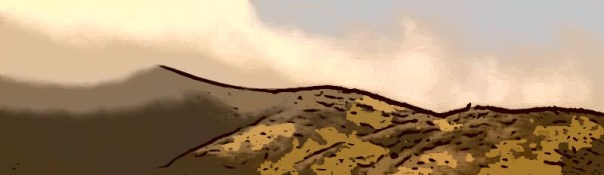
mt oly1Donovan followed Delphi Road up the lee side of Mount Oly. The narrow paved road wound around the base of the coastal peak still shrouded in fog. Vistas of dry yellow grass and oak woodlands, dotted in the near distance by grazing animals, stretched on either side broken occasionally by a trailer home set back under a cluster of trees or a barn and some farm machinery. Driveways were indicated by rural mailboxes and posts marked with large red reflector buttons. Some areas included sheds, corrals, and chutes indicating working ranches. Then a manicured hedge, stone or stucco wall and large wrought iron gates spoke of money that could afford to live that far out and not worry about the commute.

Baxter had remarked when he’d pulled up to the fire station, “They got you driving an unmarked patrol ride now?”

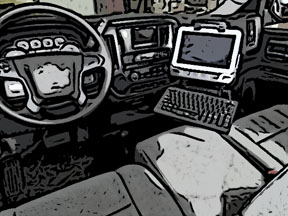
He could have offered the explanation that his assigned vehicle was in the shop for routine maintenance. “It’s a nostalgia ride,” he’d answered instead. And that it was. It certainly rode heavier than his sedan and just tapping the accelerator said that there was more under the hood, much more. It had taken a few miles on his return to the coast to get used to the dashboard mounted shotgun in his field of vision again. And the heads-up display mapping the road ahead along with speedometer and a variety of indicators that he didn’t want to bother deciphering, made him feel like he was in the cockpit of a fighter jet, or what he imagined that would be like. The radio was a new high end digital voice activated model that did just about everything except talk for you. At least the rig was still equipped with a push bar on the front end, a pit bull bar to tactical drivers, that hadn’t changed. It was a familiar space, nonetheless, one he had not been in for many years, more high tec than he remembered, but the sense of consoleidentity as law enforcement, of purpose at its most elemental was still there. Gadget porn was not his thing yet there was also something to be said for its effects.

Curious, he’d checked his console mounted computer for the County GIS topo before leaving the fire station. There in big red letters was the warning, Restricted Area, hashed over with wide red bars obscuring the topographical features along with the small print Federal Code citation. He’d switched to satellite image and encountered a blur no matter how far down he zoomed in. It didn’t make any sense, and that bothered him.

Baxter had laid out an old site map of Camp Minnoknosso across his desk. “This is what it used to look like before the feds took over.”

Donovan followed as the fire chief’s finger conducted the tour. “These squares here represent the tent platforms scattered along the main trail kinda like in a maze. Back then, the site had a functioning fire lookout staffed by the gals here at the high point in a structure they called the Mini-Tower. It’s the highest point on this part of the coast. Unobstructed view all the way to the east side of the county. Of course, no telling what it looks like now.”

“When did all this happen? Was it in the news? I don’t recall it being disseminated in operational bulletins.”

“Oh, probably ten or so years ago. There were protests by the local tree huggers when the land was handed over to the feds.”

Donovan remembered vaguely. He’d been in Narcotics at the time and his focus had been mainly on gangs and drugs. “No one’s been up there since? Folks around here must be curious about what they’re doing up there.”

Baxter shook his head. “There’s some who’ve tried. Met with dogs and armed patrols on ATVs. Scared the bejesus out of most of them. They’ve got a helipad up there and occasionally there’ll be heavy duty whirlybird traffic flying in and out. Road up’s been blocked and according to some when you get up close all of a sudden your GPS and digital gadgets stop working or go glitchy like there’s a big electronic shadow over the whole area. Once you get past the second cattle guard up on Delphi you’re playing by their rules. Some folks report being harassed or being run off the road by security vehicles.” Baxter didn’t hide his disgust. “It’s like someone took a dump on your living room rug and won’t let you get near it.”

Donovan had just bumped over the first cattle guard as the road began winding up through a switchback toward the summit. The landscape had changed from rolling yellow hills to a mix of a tangled foliage, pine, and fir into whose upper reaches the coastal fog lapped. He encountered the first yellow and black road sign, Not A Through Road and Turnout Ahead. He passed the turnout and a few hundred yards later rumbled over the second cattle guard. There followed a red and white sign with a more forceful message Do Not Enter Restricted Area Ahead Authorized Personnel Only. The road had stopped climbing and around the next curve he encountered the barricade with the same red and white sign and an even more dire warning Lethal Force Authorized. The road at that point was too narrow to make a three point turn and he had to back up to a break in the thick roadside understory.

restrict1Once he nosed the front end into the gap, he saw that it was the beginning of an obscured fire road. He steered around the rutted unpaved path several hundred yards in to a clearing and a cyclone fence topped with razor wire. Along with an identical red and white sign threatening lethal force and the specific Federal Codes that allowed the authority was another official sign.

He stepped out of the sedan, following with his eye the fence as it disappeared into the woods on either side of the gate, and walked up to the sign. Large letters stated Defense Advanced Research Projects Agency followed below by an even larger set of initials, IDA, the acronym revealed by the third line as Institute for Dynamic Application.

“There’s a name that says a whole lot of nothing,” he muttered to himself. Requisite fine print followed, restating the prohibition on trespass and the likelihood of death by armed guards.

Before getting back into his rig and returning to Delphi Road, he took a picture of the sign and the fence with his smart phone, and peered through the diamond links at the road continuing further on into an overarching tunnel of trees.

He didn’t noticed at first, occupied with mulling over the implications of the restricted zone, on auto pilot as if he were in his own sedan. The heads up display was showing just a row of meaningless blank squares, the GPS was flashing like it was trying to establish a link to a signal, and the readout on the radio console scanned furiously from one end of the band to the other.

He’d had the training on the new Voicue radios. “Manual” he spoke. The readout scanning stopped and showed a set of red zeros. “Channel 3,” and the frequency flashed on the display once and then read Channel 3. Nothing but static from the speakers. So much for high tech. At least the mirrors were still working.

Donovan glanced in the rearview again. Now the hint of vehicle he’d noticed earlier as a vague shadow rounding a bend in the road behind was gaining steadily and soon was close enough to make out the blocky front end of a government issue Suburban. Then it was in tailgate range.

He maintained his speed anticipating the road ahead while considering his options and any evasive action he might need to take. He gripped the wheel. With a high powered roar, the dark hulk overtook him and passed close enough to cause his ride to shudder and almost leave the pavement. Then the tinted window Suburban was in front and no longer accelerating as the road made a gentle curve in its decent into the switchbacks before the straightaway to the valley floor.

Another glance in the rearview and his suspicions were confirmed. There was another Suburban drawing up behind. Whoever they were, they weren’t playing around.

“10-BOY-9, what’s your 10-20” It was a long shot. The SUV behind was closing fast. He was about to try the coast deputy again when riding a garbled static wave came the transmission, weak, distant, “. . .oy-ni. . .elphi. . .oad. . . .” Whatever he’d said,  it sounded like Greek to him.

Donovan started down the switchback in among stands of eucalyptus, thick foliage on the upside and the downside of the narrowing road. The vehicle in front was slowing, brake lights flashing. He was in a pocket, and it was making him sweat. The adrenaline had kicked in. “BOY 9 confirm you are on Delphi Road.”

“Victor 5, affirm,” the radio crackled.

As the vehicle ahead started into the outside turn, he closed on it. “Code 30. I’ve got two 11-54’s, one on my tail and one hindering forward progress. Code 3 to my location. Evasive tactics in progress.”

bullbarHe took a breath. How long ago had he taken that advanced tactical driving course? Something you don’t get much practice doing once you become a detective. He closed on the bumper, aiming the bull bar for the right rear. Current speed dropping to 30 MPH, he had to hit it just right. Activating the lights and siren as a distraction, he wheeled a sharp turn. The bull bar made contact with the outer edge of the Suburban’s bumper. He accelerated, pushing the large SUV off center to deprive the rear wheels of traction. The Suburban went into a skid, swerved to regain control but only ended up facing the way it had come, what Tac drivers euphemistically called a “committed lane change,” both side wheels dangling over the steep drop.

There was enough of a gap on the inside heading into the next turn. Low branches and  shrubs scraped the driver’s side, snapping the sideview mirror. Donovan pulled a hard right as he approached the bend, engaged the emergency brake long enough to fishtail, cant on two wheels, and come down facing an unobstructed road. Punching the accelerator he skidded around the last switchback at top speed. Out in the clear he had a good view of the road snaking its way up the gentle curve of the coastal hill and the flashing lights of the patrol unit speeding in his direction. A quick glance in the rearview and it appeared that his pursuers had given up the chase.

He pulled over to the side of the road adjacent a sagging rusty barbed wire fence holding back a large field of tall dry grass. And waited for the patrol unit to arrive. He was shaking, breathing hard, the adrenaline sending his heart rate through the roof. His eyes were watering and he had to step out of the vehicle. He held the door open and used it do steady himself.

Royce pulled his unit to a stop and shut down the flashing lights. He stepped out and jogged over to Donovan. “You alright? What’s going on?”

“I had a couple of dreadnaughts on my tail, they tried to get me in the pocket.” He took a breath. “And they weren’t at all friendly about it.”

Royce was nodding, a look of concern in his eyes. “You gonna be alright?”

Donovan laughed. “Yeah, yeah. Just as soon as my asshole unpuckers.” He laughed again, looking back the way he’d come. “I’m good.”

“I thought you knew about the top of Mt Oly being off limits. That’s why when I heard you going 10-8 to the old Girl Scout camp I thought I’d head up to warn you off. But I was all the way down at Argo State Beach coordinating with the new Park Ranger down there.”

“How long’s the restriction been in effect?”

Royce shrugged. “I don’t know. It was that way when I took up this post. That’s what it says in the procedure manual for the coast district. The feds want hands off, no peeks, no peeps, their personnel handles everything up there. It’s their own private country. They get to do what they want and how they want was the way it was explained to me by the coast deputy I replaced.”

“Baxter says there’ve been complaints of threats, intimidation by their security?”

“Yeah, I’ve taken complaints, sent them on for review. Next thing I know the complaint’s been dropped. Word comes back to me to warn potential hikers in that vicinity to steer clear. The ranchers round here know the drill so I don’t hear from them too often.”

Donovan’s head shook in disbelief. “No, this is bullshit. I’ll be looking into this.”

Royce smiled in return. “You mustn’t be planning to retire any time soon. You’re gonna run into an avalanche of paperwork that’ll keep you in the courts till you’re pushing a walker and dragging an oxygen cannister.”

“You’re probably right, but what the hey, if I’m on my way out, why not stir a little shit, light a fire under some bureaucrat’s ass.”

Royce’s radio squawked. “10BOY9, status of VICTOR5?” He keyed his epaulet mic, “Code 4.”

“Request VICTOR5 10-21 SAMOCEAN1,” dispatch returned. “10-4.” Royce answered and then to Donovan, “Sounds like the Sheriff wants a word with you.”

“Won’t be the first time,” Donovan said as he looked up from his device. “Finally got an ID on the flyer, and not coincidentally, a frequent flyer.” He held up his device so Royce could see the booking photo. “Dwight Carey.”

“That’s Ike! Or ‘Ikey’ as he’s known at the Sparta Creek Trailer Park.”

“You know him?”

“I’ve had interactions with him, 5150, disorderly conduct mostly. He gets a little manic when he’s off his meds. Not violent. just what you might say, too happy.”

“That scares people.”

“Apparently.”

“I’d like to go to Sparta Creek Trailer Park and ask around about Ike Carey. Interested in being my tour guide?”

“Follow me.”  Royce started toward his unit. “Aren’t going to call the boss?”

“Why bother, he’s only going to chew me out,” Donovan said, getting back behind the wheel, “and after what I did to his brand new tactical rig, can’t say I’d blame him, but I’m not interested in getting my ass chewed over the phone. If it’s going to happen, I’d rather it be in person, and later in the day. Otherwise, I’ve got work to do.”

trailer-parkThe gravel road into Sparta Creek trailer park ran along a wide dribble of questionable water between sand dunes and beach grass, and was accessed from the paved road that wound up to the parking lot of the overlook popular with hang gliders. A few bright colored sails had drifted down onto the wide beachfront as he turned off the coast highway and followed Royce down the narrow track into the nest of antique trailers, really tiny homes, rusty camper shells, and lean-to’s, most supplemented with one or more blue tarps. He didn’t want to guess how many vehicle violations were parked in front of the dilapidated aluminum dwellings. A profusion of surf boards, either atop of dune buggy type vehicles or leaning against old board fences, spoke of the occupants’ preoccupations.

Royce said he wanted to check up on the victim of the domestic from the previous day. Being a long time resident, she would likely know Ike Carey. Her name was Heron. “Like the bird,” he’d added.

The woman who stepped out from under the awning of the trailer had a young face struggling to stay that way framed by a tangle of gray and blond deadlocks. A bruise burnished one cheek and above the other, a pale blue eye contained by purple lids engorged with blood. Skinny tan arms clustered with tattoos jutted out from an oversized  mauve down vest and across her chest, pale thin lips turned downward, licked by a nervous tongue.

“I wondered where he’d got off to.” She dropped her head and shook her mane, “So sorry to hear. I just thought he’d gone off with Dad.” She paused to give Royce a meaningful look. “Besides I had other things to deal with.” And addressing the deputy “They gonna let Billy go? I ain’t gonna press charges. He was just mad cause I loaned his car without asking.”

“Dad is his father, his next of kin?” Donovan wrote in the battered notepad he carried in his jacket pocket.

“Uh, no, don’t think so, just an old guy everybody calls Dad, kinda looks like that poster of Einstein, you known, big floppy moustache with the tongue sticking out? He stays mostly up in the parking lot with the hang glider schleppers. And so does Ikey. Kinda funny, they are almost like father and son, the way I’ve seen them argue and get on.”

“Schleppers?”

“The guys the hang gliders hire to carry their gear up to the highest point above the overlook.” She pointed up toward the top of the cliff, scrawny wrist bespangled with bracelets. “We call them schleppers, kind like Sherpas, because they have to cart the sail outfits up a skinny dirt trail to the higher point and help with the setup. Course they can’t go to the highest point because of the dogs and barbed wire.”

Of course. The other residents knew about as much as Heron did about Ike Carey, or even less. They all agreed that Dad did not live in the trailer park but showed up every once in a while to watch the hang gliders. He didn’t have wheels according to one resident because he had asked to borrow his Datsun station wagon. “Said he’d give me a hundred bucks, he just had to get to Santa Lena for a doctor’s appointment. I wanted his driver’s license for collateral. That stopped him. But the next day, he shows up with this out of State drivers id. So I said what the heck, a hundred bucks is a hundred bucks.”

“Remember what the name on the id was?”

“Well, it wasn’t Dad, that’s for sure. Daniel something. Something weird like Ailess or Ailuz, I don’t know.”

Donovan sat at his desk where the real work got done unlike how it was portrayed on TV cop shows. Detective work was essentially paperwork, scanning the details, sorting the facts, gathering the evidence. He had a friend who was a program analyst for Social Services and she had put together a timeline spreadsheet template for him. All he had to do was fill in the cells with approximate times and dates, add a few notations, and look for any patterns that might emerge.

Working backward, 12 to 36 hours prior to the discovery, calculating the dates which placed the TOD within a two to three day period. He had interviewed a few idling schleppers in the overlook parking lot. No one had seen Dwight Carey for at least two days prior to his drowning. When informed of the young man’s death, one of the schleppers had mentioned something about going into a “white room.”

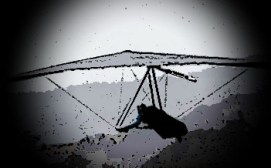
hangglidingHe consulted his notebook. A “white room” was the interior of a cloud and a very dangerous place to be as it was disorienting to the hang glider. Entering the white room was also a term used to signified someone who had died while hang gliding.

Had Ikey gone into the white room and had that led to his demise? Not unless someone else had also been in the white room and gut shot him. The bullet had entered the abdomen above the hip. Whoever shot him would have been positioned lower or below the subject assuming that he was in the air and attached to a pair of homemade wings. He examined the stick figures drawn and numbered in his notebook. Number one was the victim, number two, the assailant. Obviously #1 was in the air. Where was #2 standing when he or she fired the shot? He had a hunch.

Quizzing the schleppers and the gliders waiting for what they called “magic air,” Donovan had learned that there were three spots to launch from: the overlook by the parking lot where mostly beginners were “chucked off the hill” by their instructors, and the next highest point on the bluff overlooking the beach some three to four hundred feet further up where the “sky gods” might “glass off” and no “launch potatoes” were allowed. The third level was for the advanced “airborne,” as they were sometimes called, high enough that sky gods or goddesses might catch a “bullet thermal” and “speck out,” but it was no longer accessible because it was in the restricted zone. That had been the most frequent gripe in all the interviews, that the government was spoiling their fun.

The phone on his desk warbled. He stared at it, distracted. He had a good idea who it might be and let it go to voicemail.

Looking over Carey’s arrest record, he came across an old booking entry, almost a dozen years prior. His first, in fact. Resisting arrest at a demonstration by the local environmental group, EAF, Earth Action Front. He’d required hospitalization and had been released on probation. There’d been a lawsuit, dismissed. All subsequent arrests had been for disorderly conduct, nothing criminal.

Donovan paused his finger on the keyboard and then with a few deft pokes called up the EAF file. It was password protected. He paged back through his notebook. He wondered if they had changed the password since the last time he’d accessed a secure file. They hadn’t.

The EAF dossier was mostly routine. Court orders for communication monitoring, CI interviews, a few audio files indicating listening devices. He was surprised at the extent of the coverage. EAF (the D is silent, as the cops liked to say), once a fairly radical militant group, had not made the news cycle in quite some time, now mostly affiliated with more mainstream enviros, limiting their activities to leafletting and demonstrations. He scanned the membership list. No surprise, there was Dwight Carey’s name.

Dad had come up in the interviews about Ikey with a few of the schleppers. No one knew where he lived. Not at the trailer park, that had been confirmed. He’d show up out of nowhere. Some suspected he was camping up the hill near the old waterfall. He always dressed in the same ratty blue coveralls. Ikey followed him around like a lost puppy. Nor had Dad been spotted in the last few days. One of the schleppers had mentioned that he thought that Dad might have been going somewhere. The last time he’d seen him was the same morning that Ike’s body had been found. He looked different, too, shaved off his moustache, slicked his hair back, might have even cut it, wearing a sports jacket and slacks.

Donovan stared at the notebook where he had written Daniel “Dad” Ailess followed by a question mark. What was his connection to Ike Carey’s death, if any?


Next Time: What Is EAF, Who Is IDA?

Contents Vol. I No. 6

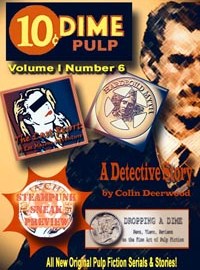
Introducing Dime Pulp Number Six

Dime Pulp, A Serial Fiction Magazine, Issue Six features a large chunk of Colin Deerwood’s A Detective Story, getting into the meat of the first act as Lackland Ask, Confidential Investigations, finds his lawyer gunned down in his office and narrowly escapes the same treatment as he seeks out someone to decipher the Cyrillic writing in the dead hood’s address book only to encounter a breathtaking young frail who just might be the key to untold riches, at the very least enough scratch to let him live comfortably in a style he is not normally accustomed to.

Helena Baron-Murdock’s Hard Boiled Myth featuring Weston County Sheriff’s Detective Jim Donovan, is called out for an unidentified body found in the surf which turns out to be a possible homicide. In the course of his investigation he learns of a top secret installation in the coastal hills that draws his suspicions in a multipart short story titled The White Room that involves hang gliders, environmental activists, and a clandestine government agency.

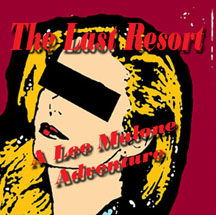
Further in the adventures of Lee Malone, former super model and now small town reporter for the Corkscrew County Grapevine, who has just missed witnessing a murder and now has been called in to be deposed in the original murder she almost witnessed in the continuing chapters of The Last Resort in which she is suddenly reminded of her party girl past while meeting hostility from someone she thought she could trust.

Also in this issue, a sneak preview of a new serial novel slated for future publication in these hallowed (hollowed?) pages as we lift the veil on a Steampunk adventure by nouvelle roman author, Phyllis Huldarsdottir featuring the indomitable Captain Lydia Cheése (pronounced Chase), Airship Commander, whose quest for her father. the legendary Commodore Jack Cheése, might just take her around the world titled Cheése Stands Alone .

Dropping A Dime, News, Views, and Reviews in which yours truly, Perry O’Dickle, aka The Professor, offers up his considered and considerable opinion on the fine art of pulp fiction, reviews of crime fiction, old and new, as well as news of upcoming publications features a book review of Max Allen Collins’ Double Down from Hard Case Crime.

Dime Pulp continues its crime spree with the serialization of two full length novels, The Last Resort and A Detective Story, as well as another short story based on Greek myths under the rubric of Hard Boiled Myth.

If you’ve made it this far, go ahead and follow the links below to reading entertainment with the serial contents of Volume One, Number Six

  —Perry O’Dickle, chief scribe
and word accountant


TLR banner321Deep in the redwood wilds along the Corkscrew River, someone is shooting neighborhood dogs. The year is 1985 and Lee Malone, former fashion model, queen of the runways from Paris to Milan, once dubbed the most beautiful woman in the world, now a part-time reporter for The Corkscrew County Grapevine, is looking for a story to sink her teeth into. When Lee finds the owner of Kelly’s Seaside Resort brutally murdered, it leads her on an adventure that includes a mysterious gray van, another murder, extortion, pornography, sex slavery, and a shadowy organization of militant feminists known as SAPHO.  In the process, Lee Malone’s notorious past catches up with her. 

The Last Resort, Chapters 1-3
The Last Resort, Chapters 4-6
The Last Resort, Chapters 7-10
The Last Resort, Chapters 11-13
The Last Resort, Chapters 14-20
The Last Resort, Chapters 21-23

HBMbanner421

Greek myth is rife with murder, mutilation, cannibalism, mayhem, and the ever popular incest.  Weston County Sheriff’s Detective Jim Donovan of the Violent Crimes Unit wouldn’t know a Greek myth from a Greek salad, but if he did he would find some troubling similarities to the cases he’s investigating.  Revisited as crime fiction are the strange death of Hippolytus, the agonizing death of Heracles, the slaughter of Penelope’s suitors, the Fall of Icarus,  the sparagamos of Orpheus, and the cursed lineage of Pelops.  Helene Baron-Murdock’s Hard Boiled Myth taps into the rich vein of classical literature to frame these ancient tales in a modern context.

Long Shot I
Long Shot II
Notification Of Kin
Valentine’s Day I
Valentine’s Day II
The White Room I

ADSbanner421

Lackland Ask is the name. ‘Lack’ to my friends, ‘Don’t’ to those who think they’re funny. You might have seen my portrait on the cover of Black Mask, the crime friction magazine. This is my story. It starts with a blonde. This kind of story always starts with a blonde. The brownstone was on the Westside and easy enough to find. So was the mug’s yellow roadster. It stuck out like a new shoe in a cobbler’s shop. I was being a sap again. I woke sitting straight up, sweat pouring out and over me, my undershirt drenched. I was going to have to change my shorts. Some dream. They worked me over, demons in dingy cable knit sweaters. They pumped my arms and peered in my face with eyes as black as eightballs. He handed me a hat. “The pièce de résistance.” He said it like he was serving me dessert. The gat fell from his hand and clattered across the marble floor. It looked like something that might have survived the battle at Ypres. 

This kind of story always starts with a blonde
“I was being a sap again.”
“Some dream”
“demons in dingy cable knit sweaters”
“He handed me a hat.”
“The gat fell from his hand”

Sneak Preview

cheesealonevinex8

In March of 1892, a Scotsman by the name of Arthur C. “Artie” Doyle was hanged by the neck until dead after being found guilty of a string of grizzly murders of prostitutes in Whitechapel. At that moment, history veered off its presumed course and headed in a direction all its own in which the Great War never happened because the Kaiser was afraid of offending his grandmother, Queen Victoria, whose life was prolonged by the wonders of biology. The peace of her reign, known as the Pax Victoriana, despite some major environmental disasters, has lasted 180 plus years keeping as many Victorian airs as possible while making accommodations to bio technology. Follow Capitan Lydia Cheése (pronounced Chase), Airship Commander, into a world in which the biological sciences overshadow the physical sciences. Steam engines dominate most modes of propulsion. The skies are filled with lighter-than-air craft and railroads cover most of the globe. Internal combustion engines are banned except in the non-aligned nations of the African continent.  Can Lydia Cheése find her father, the antigovernment turncoat and radical, Commodore Jack Cheése. Will her quest take her around the world in less than 80 days or is it a lifelong journey?  Catch your interest? Below is a sample of how any of that might occur in an alternate world never before explored.

Cheése Stands Alone

dime-reviews-hdrFrom Hard Case Crime  nominated for  numerous honors since its inception including the Edgar, the Shamus, the Anthony, the Barry, the Ellery Queen, and the Spinetingler Award with titles that include Stephen King’s #1 New York Times bestsellers, Joyland and Later; James M. Cain’s lost final novel, The Cocktail Waitress; lost early novels by Michael Crichton (writing under the name “John Lange”) and Gore Vidal (writing as “Cameron Kay”), comes Max Allen’s Collins’ second outing  in the Nolan series , continuing the saga as Nolan and his young, comic book-loving partner, Jon, match wits with a skyjacker and a vigilante slaughtering the members of a Midwest crime family.

Dime One
Dime Two: Come Back, Nolan, Come Back

Dropping A Dime Two

Come Back, Nolan, Come Back

MAX ALLAN COLLINS’ MASTER THIEF, NOLAN, RETURNS IN ALL-NEW EDITIONS OF HIS CLASSIC ADVENTURES 
DOUBLE DOWN | Max Allan Collins | May 25, 2021 | Trade Paperback | 352 pp
 ISBN: 978-1789091410; e-ISBN 978-1789091427
US $13.95; CAN $18.95 

FULL DISCLOSURE: Hard Case Crime provided the review copy of Double Down by Max Allan Collins after these editorial offices begged for any kind of review material, press releases, etc., to post in this column, essentially filler in an effort to give the impression that we here at Dime Pulp are dialed in and ready to drop a dime on the fine art of pulp fiction (which may sound to some like an oxymoron but more on that later).

Hard Case Crime might have even thought that they had merely tossed a crumb our way but it had the effect of opening up a whole new box of donuts. At any rate, the classy pulp tome with its appropriately garish cover remedied an editorial unfamiliarity with Max Allen Collins’ writing and his master thief and heist maven, Nolan. 

Hard Case Crime has built a solid inventory reissuing some underappreciated and long forgotten authors of the paperback pocket book explosion of the 40s and 50s as pulp magazine fare evolved to standalone crime novels. Reprints of Collins titles make available a later iteration of popular adventure/crime novels of the waning decades of the 20th century in what might be termed “pop pulp,” a style readily adapted to graphic novel storyboard treatment. This is not to overlook their emphasis on the work of Donald Westlake, Laurence Block, or the terrific Gregory MacDonald twofer riff on O. Henry’s The Ransom of Red Chief reissued as Snatch. As well, Hard Case has published a few excellent original works, including Von Doviack’s Charlesgate Confidential.

DDownThe great thing about Hard Case Crime paperback novels is the nostalgic eye candy of titillating covers in that postwar Madison Ave advertising style that brings to mind twirling the wire kiosks of paperback novels in the corner pharmacy over by the greeting cards display looking for something to jump out, something lurid, scandalous, colorful at least, in the hues of rebellion. Essentially these Hard Case Crime paperbacks work as artifacts of taste and nostalgia, a repackaging of an idealized past in the history of crime/men’s adventure literature as a popular mode of storytelling. Although the genre will likely remain popular, actual volumes of bound pulp paper with the eye catching covers may become specialized objects much like vinyl LPs, especially with the advent of the more cost effective eBooks. As I write this, public libraries are discarding their mass paperback collections in favor of the less space demanding digital formats. 

Hard Case Crime titles are also repositories and reiterations of some incredibly terrific writing and imaginative storytelling. The writing style of the hardboiled pulp genre is sourced in the Anglo-American idiom with its laconic exaggerations, understated asides, snappy comebacks, and quaint argot. They are in the main imaginary constructs, based to some extent on experience, but passing themselves off as the real world for reading entertainment. Often situations are farfetched and downright improbable but nothing good writing, deft imagination, and diverting dialogue can’t paper over to render the illogical and unlikely readable. What makes the pulp genre an art is the diverse skill of its practitioners.

Max Allen Collins’ genre specific Nolan novellas have a certain tongue-in-cheek air to them that seems more pop than pulp, particularly with their emphasis on comic book collecting as a kind of meta-referent. Pop fetishizes consumer objects for their cultural resonance whereas pulp is a category of materials used in the manufacture of entertainment literature just as film specifies the medium of cinema. Pop pulp subjects relive imagined circumstances through the objects of their obsession, fantasizing situations in which they can partake in tandem or take on the persona of their fixation. Collins clearly defines his protagonists, Jon and Nolan, as separate individuals yet Nolan doesn’t exist without Jon nor can Jon indulge in his fantasy without Nolan. Or, at the very least, the poster of steely-eyed, rock-jawed Lee Van Cleef that eerily resembles, who else, Nolan.

Also, by way of disclosure, there is a certain amount of resonance to the Nolan referent around the editorial offices of Dime Pulp as it is the family name of one of our contributing authors, Pat Nolan, who is also the brain behind this mad pulp caper as well as the man behind the curtain at Nualláin House, Publisher—Nualláin being Gaelic for Nolan, donchaknow, in tribute to that jolly leprechaun of prose, Flann O’Brien (of The Third Policeman fame) whose real name was Brian O’Nolan or O’Nualláin if you’ve an ear for Celtic speak. It goes without saying that Nolans are a pretty fecund lot and can be found, other than their home turf, from Quebec City to Buenos Aires. Most often it’s a last name, but sometimes a first, especially in the Appalachians and rural South where, as indentured servants and criminals let loose in the new colonies, Nolans headed for those hills as soon as their feet hit dry land after a long and horrific Atlantic crossing. Throw a rock in those parts and you’ll no doubt hit a Nolan, first name or last. Nolans are everywhere, but for Max Allen Collins, Nolan is a mononym—it isn’t his first or his last name, but both, and as such underlines his iconic role as the heroic figure.

Double Down was released by Hard Case Crime in May of 2021 following the April release of Two For the Money. As the titles suggest, each volume features two Collins novella reprints from his Nolan series of the 1970s and 80s. The last two volumes, Tough Tender and Mad Money, will follow in 2022 and 2023. Collins opens with a useful introduction to the genesis of the Nolan series, admitting inspiration from the Parker novels of Donald Westlake’s pseudonymous Richard Stark as well as reiterating a firm denial that he was copy/parodying Don Pendleton’s The Executioner series whose main character is a similar sounding “Dolan.”

These are Max Allan Collins’ fledgling works written years before he wrote Road to Perdition, before his Quarry novels were turned into a Cinemax original series, before he was named a Grand Master by the Mystery Writers of America or ghosting the Mike Hammer novels for the late Mickey Spillane. Set against a ground of pop culture nostalgia for comic books, old movies, and golden age cartoons, the stories work as an accessory after the fact to their illustrated four color context. Nolan is the master thief, and young Jon, the comic book aficionado, is the sorcerer’s apprentice. Collins’ narrative style, a casual conversational ramble, allows veracity to the coincidental material that makes up the underworld of criminals or at least reprehensible lifestyles somewhere in the middle of Iowa where,  not so coincidentally, Collins attended the university and its fabled Writer’s Workshop.

In the first novella, Fly Paper, Jon and Nolan fly to Detroit to commit their righteous payback heist where a comic book convention is also being held and which allows plenty of opportunity to nerd out on comic book references, and of course, since they’re flying, there has to be a skyjacking, DB Cooper style. From this story alone one would get the impression that being a thief, albeit an honorable one, is harder work than might first appear.

Collins uses as epigraph at the beginning of the second novella, Hush Money, a quote from 30’s bank robber, Alvin Karpis, to give an inkling of insight into his Nolan character: “A thief is anybody who gets out and works for his living, like robbing a bank, or breaking into a place and stealing stuff. . . .” On the other hand and in direct contrast to Nolan, “A hoodlum is a pretty lousy kind of scum. He works for gangsters and bumps off guys after they’ve been put on the spot.” In this light, Nolan is a working man, not a mob connected mug.

The midwestern locales of Cedar Rapids and Des Moines in the Nolan sagas provide an entirely appropriate set location for the revalorization of a regional culture hero, the bandit, the bank robber, as in the likes of the James Brothers. The Daltons, and half a century later, Machine Gun Kelly, Pretty Boy Floyd, John Dillinger. Nolan has worked managing Mob assets, but he is not a mobster, and he would like to break free from the association but lacks the leverage or is thwarted or suffers a setback which in itself is the MacGuffin to these tales. He wants out of the game, independence, but will the game let him?

The Nolan stories are narrated matter-of-factly, a backstory always close at hand to smooth over any unexpected inconsistency, told with a faux naïve garrulousness that renders the character of Jon as Nolan’s foil, and in some respects, his Watson. The depictions are spare and not averse to cliché, sketched with minimalist efficiency. The characterizations with the exception of the protagonists are also austerely presented. Unfortunately the “love making” and opposite sex encounters have not weathered well the decades since they were originally conceived (pardon the pun).

As we’ve advocated before here at Dime Pulp, the novella is the ideal vehicle for crime fiction and these two novellas by Collins don’t disappoint in their succinct story arc leading to resolutions that invariably beg for further opportunities to thieve and adventure in the spirit of radio/movie serials of the forties, and four color comic books.

In evolutionary terms, comic books and pulp magazines stem from the same source: penny dreadfuls, the National Police Gazette, and sensationalist yellow journalism of the 19th century. Following WWII, pulp novels and comic books emerged as the go-to reading entertainment while monthly magazines lagged into obsolescence and radio dramas morphed into TV shows. The mood and thrust of the postwar pulp novel reflected the upheaval and brutality engendered by another world war. Crime novels of that time depicted unflinchingly the cruelty and disillusionment of desperate men and women with a darkness and fatalism termed noir. Revenge and lawlessness became more prevalent as themes such as injustice must be avenged took prominence. Yet Justice is blind and wields a double edge sword and in the end, the realization that vengeance is a poor substitute for justice. To enter into that self-devouring daisy chain is enter the lair of the viper, Vendetta ®. Literary depictions of violence tend to be one dimensional, fleeting, and unsatisfactory. It is the lead up to the act, and its consequences, that grabs attention as all violence enacted on the screen or on the page is symbolic no matter how well depicted or orchestrated in its intent to trigger the amygdala’s flight or fight response. A successful effort is often judged by how well and how often the symbolic can undermine the suspension of belief and present the reader with real chills. To be able to accomplish such a feat takes imagination and not a little sadism.

In contrast to the violent vengeful dark despair found in the postwar pulps novels, there was a kind of daffy innocence to prewar pulp fiction appearing in monthly magazines, often as cliff hanger serials, and selling at newsstands. And it is this particular tenor Dime Pulp would like to echo even though it is yet another marginal drop in the meta bucket. Serials were a large part of pulp fiction’s appeal, working class epics on the installment plan for one thin dime. As a serial pulp magazine, Dime Pulp, as in the pulpy days of yore, hopes to offer not only high quality serials but garishly appropriate cover renditions. Pruriently attractive colorful cover art and its arousing effect in stirring up the imagination was a main selling point on the newsstands. A fact attested to by Dime Pulp’s A Detective Story by Colin Deerwood as the story is entirely predicated on the author fixing his gaze on the cover of a vintage issue of Black Mask magazine and improvising time travel to an imagined place where such a detective might live, say in the years leading up to Pearl Harbor. As a serial it has unlimited potential for unfolding from the pages of pulp to the pages of panels. As well, the nominal policiers of Helene Baron-Murdock’s Hard Boiled Myth find themselves with a seemingly endless and labyrinthine source of material gleaned from Greek myth and tragedy. Although the stories are episodic, the thread follows a sheriff’s detective toward the end of his career and into retirement. The Last Resort, A Lee Malone Adventure, Pat Nolan’s pastiche of the private eye genre turned on its head (buxom babe with brains vs. splinter faced chisel chin with a breath that could pickle a squid), was based on a character from a short story published serially in a weekly newspaper. The novel too, published in 2012 by Nualláin House, Publishers,, was written in installments over the course of a few years for a monthly writing workshop, and now returns to publication in its serial roots.

Lastly, just to reiterate, in case it was not made previously clear, the aim of Dime Pulp, aside from garnering a few discerning readers, is to indulge in a speculative fiction make-work program for the benefit and amusement of the author(s), and to partake of the imagination. You are welcome to come along for the ride.

That’s my story and I’m sticking to it,
Perry O’Dickle for Dime Pulp

Cheése Stands Alone—Sneak Preview

 by Phyllis Huldarsdottir

~Sneak Preview~

The World of Lydia Cheése

In March of 1892, a Scotsman by the name of Arthur C. “Artie” Doyle was hanged by the neck until dead after being found guilty of a string of grizzly murders of prostitutes in Whitechapel. At that moment, history veered off its presumed course and headed in a direction all its own in which the Great War never happened because the Kaiser was afraid of offending his grandmother, Queen Victoria, whose life was prolonged by the wonders of biology. The peace of her reign, known as the Pax Victoriana, despite some major environmental disasters, has lasted 180 plus years keeping as many Victorian airs as possible while making accommodations to bio lydcirtechnology. Follow Capitan Lydia Cheése (pronounced Chase), Airship Commander, into a world in which the biological sciences overshadow the physical sciences. Steam engines dominate most modes of propulsion. The skies are filled with lighter-than-air craft and railroads cover most of the globe. Internal combustion engines are banned except in the non-aligned nations of the African continent. Brazil has an emperor and holds an empire of its own covering much of the southern landmass, with Sao Paulo as one of the most modern cities in the world, far outstripping Newer New York and Greater London with its lively futuristic culture. The North American States fractured in the early 20th century after the revelation of the imposter president Cleveland. The Supreme Court under Justice White then ruled that the Southern States had the right to secede as they did nearly half a century previous and promptly left the Union to form the USSR, United Slave State Republics. Subsequently the Eastern Seaboard was renamed Newest New England with the Boston Bubble becoming an independent city state much like Newer New York. Albert Einstein was the name of a famous Swiss watchmaker, Henry Ford was tried for sedition for the rebellion at Belle Isle and faced a firing squad, and Guillaume Apollinaire was the last mayor of Paris before its annexation, along with Amsterdam, into the sphere of Greater London’s influence. Can Lydia Cheése find her father, the antigovernment turncoat and radical, Commodore Jack Cheése. Will her quest take her around the world in less than 80 days or is it a lifelong journey? Below is a sample of how any of that might occur in an alternate world never before explored.

Dirigible1ch

Captain Lydia Cheése (pronounced Chase), one hand ungloved, read the memo with a frown.  Her airship, Orinoco III, had been grounded.  An Aerosud cadet stood by at attention in a blue glossy visor cap and the impeccable dark blue company tunic with the distinctive sky blue piping at the collar.  Lydia placed her thumb on the bio wax pad of the message board and then pressed her print at the bottom of the white message square. The cadet knuckled a salute.  Captain Cheése returned it perfunctorily, and with a sigh.  She watched the young woman exit her suite at Watson House, name after the famed inventor of propulsion biology, Dr. John Watson, as she peeled off the other maroon porskine glove. “Pshaw,” she said with gritted teeth. G. B. Pshaw was her supervisor, nemesis, and constant irritant at Aerosud HQ.   She caught a look at herself in the mirror above the marble mantle of the faux hearth as she unfastened the gold frog at her throat and sloughed off her Aerosud officer’s tropical dress tunic.

AIRSHIPIII
What she saw did not please her, a fringe of auburn hair, brow knit into a frown, grey eyes staring back in anger.  Not again, she thought.  Two groundings in as many weeks, and her suspension only just overturned.  Tossing her tunic onto her grandfather’s vraisther smoking chair, she glanced at the stack of documents on the side table.  In particular, she eyed the communication she had set aside the day before when she had been too preoccupied with preparing for her flight out of Lesser London to give it much more than a cursory glance.  Addressed to her, handwritten in green ink, that in itself unusual, on what felt like a slip of parchment. “Parchment, really?” she said aloud. It was just one of the many come-ons and false leads she had received since she advertised a reward for information as to proof of life of Commodore Jack Cheése, her father and the brilliant airship engineer who had disappeared many years ago, around the time she had entered the Air Academy for the freshman term.

The slip of parchment, or faux-par, she wasn’t going to believe that it was actually real, gave an address on Baker Street, Old London, current day, and specifying two in the afternoon.  As it was almost four, she grabbed her walking coat and went quickly to the door.  “Impulsive!” she imagined her mother saying.  But no, not impulsive, an intuition she felt compelled to act on.  The preciseness of the hand that had shaped the words “I can help you” tipped her in favor of the certainty of her hunch.

The elevator man gave a bow of recognition as she stepped on, and slid closed the door grill.  A quiet whirr of machinery brought them down to the main floor lobby.  Off to one side, framed by potted finger palms, was the entrance to the lounge frequented by her fellow lighter-than-air officers.  Collectively they were known as litharians and the ships they flew were commonly known as lithairs.  She would have been welcome at any table or congregation of hale fellows well met as she was known among them for her cutting wit and outrageous pronouncements as well as the sincerity of her companionship.

Watson House, where Lydia Cheése maintained a permanent suite, was a hostel catering to the Navair trade, especially their officer class. Crews of ships officers, pilots, navigators, drive engineers also known as chemists represented dozens of navair companies doing business at the aerodrome on the far western edge of Lesser London lodged at Watson House on layovers from continental and trans-oceanic flights.  They flew passenger rigids and cargo semi-rigids, rigs and semi-rigs to those in the trade.  Their companies were from all over the flown world. Large luxury passenger transports like Rajair and Anglair. Canamair operated both trans-Atlantic passenger and cargo service, as did Aerosud, Lydia’s employer, based out of Sao Paulo.  They offered service to the major ports in Greater London which included Paris, Amsterdam as well as Lesser London where Lydia was now feeling, in a word, ruffled and in no mood for companionship.

The doorman greeted her opening the door, and she crossed the threshold into the torch orange glow of phosphorescent plasma lamps lighting the perpetual brown haze of Lesser London. Her grey walking coat was cut to the knees of the darker grey of her uniform culottes.  Her boots were pointy, at heel and toe, and made of supple maroon psuedo, matching her porskine gloves, and fastened along the calf by large pearlite buttons. They made her appear taller, and she was already tall. On her head was a jaunty little cap of ribbons and silk made to look like a tiny bird had nested in the soft pile of auburn hair.  She strode down the wide granite steps to the cobbled walkway where the carriages for hire and their drivers waited.  She chose one at the head of the line and spoke the address on Baker St.

“Would that be Baker St. West, mum, or would that be Baker St East?” the driver asked over his shoulder, whip testing the haunch of the blocky beast of burden, an equlone, specifically bred for urban drayage.  Like mules, they could not reproduce and their life span was less than five years. Small as a pony but as strong as a full grown natural equine, they were cheaper to maintain.  Unfortunately, as they approached their end date their pace became slower and slower, signaling a reluctance to hasten their passing.

Lydia glanced at the address on the parchment impatiently.  “It just says Baker St.” she said as if that settled it.

“Well, mum, Baker St is a very popular name here in Double L, Lesser London to you, and as I said, there’s East and West Baker St as well as Baker St South, Baker St North, and South Baker St North. Of course there’s also Upper Baker St and Lower Baker St.  Upper Baker St Southwest. And Old Upper Baker St.  If you understand what I’m saying, mum.”

Lydia restrained herself from knocking the man off his bench.  “Take me to the intersection where all these Baker Streets meet!”

“Ah, yes, mum, Baker Square.”  And under his breath, “should have said that in the first place.”

After what seemed like an interminable time, the plodding near death equlone carriage brought a fuming Captain Lydia Cheése to Baker Square, a rather nondescript roundabout, so not literally a square, from which each of the various Baker Streets radiated like the spokes of a wheel. The driver hunched over, shoulders to his ears, as if feeling the heat of her rage.

She disembarked and paid him.  “Here you are, sir, a five Victorine, and not a regina more.  You have hindered me long enough.”

row houses Baker’s Square was hemmed in by blocks of apartment dwellings designed to look like rowhouses, stacked one atop the other.  They were all the same whichever way you looked.  Their sameness caused her a momentary claustrophobia.

A figure approached, steadily, methodically.  When it stepped out of the shadows she saw by the cut and buttons it was a constable.

He smiled and saluted her.  “Be of any service, mum?”  He was a big man. Lydia looked directly into his eyes.  She knew what the tattooed lines radiating from the corner of his left eye meant.

“Yes, perhaps you can.  I seem to be unable to find this particular address.”  She showed him the parchment.  “Is there not simply a Baker St without any of the bothersome directional appendages?”

The constable studied the square she held out to him and scratched his chin.  “Yes, of course there is.”

“Then please be so kind as to direct me.”

“In Old London.”

“Old London, but. . .” It then occurred to her.  Old London, not Lesser London.  Old London, underground London, the London that Lesser London was built upon.

The Constable pointed to the iron gate set in the granite base of the monument at the center of the Baker Square roundabout.  “Tours to Old London just now closed up for the evening.  Too dangerous to go down there now, without a guide, and you being a lady and all.”

“Constable, I will have you know that I served as an ensign at the siege of the Bushwackers.  I know what danger is!”

“Aye, mum, I was in the PanAm Wars meself.”

“Yes, that is evident from your eye tat.  You were with. . . .”

“The Lost Brigade, yes, mum.”

“You are one of the brave, and I respect that.  However, I must to Baker St.  I am already late!”  Lydia strode toward the iron gate.

“It’s not safe, mum,” he called after her.


Dirigible1ch2

At the bottom of the concrete steps joining the cobblestones of Old London the bacterial-sodium lamps dimly lighted shades of grey and black as flat as house paint.  A man in a dusty worn gray shirt, pants, and shoes stood against an almost identically gray wall beside a weathered gray real wood produce cart upon which were displayed row upon row of bright though somewhat desiccated illegal Valencia oranges.  Lydia was about to ask directions when she saw the street name in plain view attached to the side of a dingy gray brick façade.  Real brick, not that faux coral that was used now almost exclusively for building exteriors. She’d always been under the impression that Old London was shuttered after daylight hours yet a goodly press of people, all dressed in the varying shades of gray, black, and brown of their surroundings, shuffled past like shadows, busy about their business. Brighter light splashed out onto the cobbles from storefronts, and distantly, music and singing could be heard.  There were also clots of men clustered around porn boxes listening to the endearments of courtesans.  Others stood in doorways and eyed passers-by.

Lydia proceeded down Baker St searching out the house numbers, peering into alcoves and letting her eye follow the buildings’ truncations as the support to Lesser London.  At least here you could see some of the sky bathed in the rust orange of plasma light between the roadways and the avenues joining the elevated sectors like the bridges over the fabled canals of Venice.

Her forward progress was halted somewhat by the throng of dingily attired Old London denizens in the thrall of street entertainment.  A bear on a chain rolled a large red ball with its feet wearing a red Phrygian cap strapped under his chin.  A tall African in a flowing ostrich cape led the furry apparition around in a circle as if he were holding a magnet in his extended hand.  Lydia paused to observe, a bit distracted by the unusual show.  Live animal acts had been banned aboveground for decades.

As she turned to resume her quest, she was confronted by two coppers.  They had been keeping an eye on the crowd and had noticed her.  She was out of place.  They were young, one barely out of his teens, a tense meager set to his jaw that was trying to pass for determination.  The older one with the light fuzz of lip hair spoke.  “Your papers, mum.”

Lydia reached into her pouch bag and retrieved her Aerosud identification.  She handed it to him, “It’s quite alright, constable, I have an appointment.”

The copper nodded, “Captain Cheese, is it?”

Lydia narrowed her eyes, and for the hundred thousandth time said, “It’s pronounced ‘Chase’.”

“Yes, mum.  And I should be warning you about traveling the depths without an escort, mum.  It is very dangerous.”

The younger one nodded vehemently.  “This lot here would think nothing of kidnapping an upper to sell on the fem market!”

A commotion at the other side of the gathered throng drew their attention and they hastened away.  An explosion sounded, a pistol or fireworks.  The crowd scattered pushing past Lydia caught up in the fleeing mob.  She felt a tug at her waist where her pouch was slung.  She looked down to see a young girl slip effortlessly, eel-like, through the press of legs, arms and torsos.  The bag pouch perceptibly lighter, Lydia understood immediately that she’d been picked.  She forced herself through the crowd after the young girl.

The girl moved away quickly on what appeared to be a crippled leg.  She wore a gray crochet bonnet over dusty brown hair, her shoulders draped in a shawl a shade lighter than her hair, and one arm hooked through a large wicker basket indicating that perhaps she was a flower seller.

lower london The pickpocket veered into the alley between two buildings with Lydia still in the tangle of panicked underdwellers. She kept her gaze fixed on the hobbling figure and once free of the mob ran swiftly to the entrance of the alleyway.  The already inefficient bacso street lamps hardly penetrated the deep darkness of the cleft between buildings. Indignation overrode her sense of caution and she strode into the shadows.  Slowly her eyes gathered the available light and sharpened to the dark. An oversplash of orange from the city above allowed her to discern edges and contours. The young purse snatch bobbed hurriedly toward the light of a parallel street at the other end.

Certain that she could easily overtake the thief, she hesitated for a beat.  Someone had reached the girl first.  Springing from the shadows a wiry figure grabbed for the girl’s shawl.  The undersized shape stumbled. The much larger outline pounced on the fallen child.  It occurred to Lydia that a thief was robbing another thief, one that seemed a little more formidable than a crippled girl.  By then Lydia had caught up to them.  She just wanted her wallet back.  Instead she got the attention of the crippled girl’s assailant.

He was a narrow dagger of a man, drawn emaciated face, stubby hard shoulders extending boney brittle arms and long fingers.  “Now we have ye,” he gargled a mirthless laugh.

Lydia had been taught well.  As she flipped forward she extended a hand and placed it on the attacker’s rib cage, the momentum and force of her acrobatic maneuver was enough to give her thrust the power to unbalance the man. As she landed she swung her right leg and tapped the man’s chin with the toe of her boot at exactly the right spot, rendering him instantly unconscious.  She made all these movements effortlessly as if simply slipping an arm through a sleeve or brushing back a fall of hair.

The young flower seller, now unburdened of her empty basket, scrambled around the corner of the building and out to the lighted thoroughfare.  Lydia stepped over the fallen man after her.  As she emerged into the light, the young thief was nowhere to be seen.  Lydia hurried past a young couple sauntering ahead and then turned and hurried in the opposite direction, their startled gazes following her.  She glanced across the street beyond the hack stand and the motionless equlones.  The girl had disappeared.

Lydia strode to an iron railing on the other side of the alleyway.  She leaned over the bar railing and stared down into the stairwell that led to a basement door.  The door itself seemed to sway slightly as if it had just moments before swung closed.  Lydia trusted her instincts and leapt down the stairwell.  The door pushed open easily and once again she was in pitch black, this time with not enough ambient light to gather for sight.  She turned back the piping on her coat sleeve and massaged the phosphene activator until the piping emitted a faint green glow like low viz string lights. It was a purely decorative feature of her garment, but it had enough phot, 33 lumens per centimeter if she remembered correctly what the salesperson who sold her the coat had claimed. She moved her arm in a slow arch across the front of her body to illuminate the bare edges of the light’s reach.  A passageway opened up in front of her. Attenuated by the lack of the visible spectrum, she heard the whisper of shuffle steps ahead.  She hurried and almost ran head on into the wall where the passageway turned sharply left. The rhythm of the foot falls changed and, after almost tripping, she was now following steps leading up and toward a light, a pale narrow splinter at the edge of a doorway.  Without the slightest hesitation, she flung open the door with such force that it slapped against the inside wall of a small room lit by the soft glow of an oil lamp.  The bear confronting her made her catch her breath.


To Be Continued At A “Future” Date

The White Room—I

 by Helene Baron-Murdock

coast

Abalone divers found the body floating in the surf tangled up in bull kelp. The call landed on Detective Jim Donovan’s desk. He called down to the Weston County Sheriff’s dispatch and talked to the shift supervisor. “Do you have a deputy at scene? I can’t feature driving all the way out to the coast if it’s just a 10-55.”

“Let me check the log. . .appears like it came in as a 10-54 from one caller at Acropolis Cove. Someone else called it in as a 10-32. With all the divers out there, that sounded about right. Then the local volunteer fire and rescue got on scene and when they pulled the body out of the water they thought it might be a 10-71, but definitely a 10-55.”

“Ok, dead body, possible drowning, and a definite coroner’s case, but a shooting? Whose jurisdiction is that out there?”

“That’d be Mount Oly Volunteer Fire Department.”

“Baxter?”

“The same. He’s even saying that it might be a 187.”

“ Murder? Figures, he’s such a drama queen. Where’s the coast deputy? Is he on days off?”

“No, he’s handling a 415 domestic right now at the Sparta Creek Beach trailer park. It got pretty dicey for a bit. They’ve got the abuser in custody but he’ll be tied up for a while.”

“Alright, I’m on my way.”

“Look on the bright side, you’ve been freed from paper work in a stuffy office and you get to enjoy a nice pleasant drive out to Weston County’s gorgeous coast.”

Donovan grunted, not all that convinced. “I’ll 10-97 when I get there. Advise the coast deputy I’m on my way and have him meet up with me when he clears the domestic.”

Donovan headed south out of Santa Lena on the main four lane. He exited the freeway at Corinth Bay Road and drove west. He could tell by the mass of gray clouds on the horizon that the coast was fog bound, so much for enjoying the gorgeous scenery. It would take him forty minutes to reach the coast highway and another quarter of an hour to Acropolis Cove.

Traffic slowed as he approached Dardanelle, the little upscale arts community astride the Corinth road. The tiny burg with its one way streets tended to be a bottleneck but as he got closer to town he saw a fire and rescue unit and Highway Patrol directing cars around a demolished piebald  junker, windshield trashed, twisted like a candy wrapper. The meat wagon was just revving up to head for the hospital and let out an ear splitting howl as its siren screamed down the road back toward Santa Lena. A yellow tow truck was parked at the shoulder with a disgruntled but not too severely damaged tinted window black Suburban on the flatbed. Once clear of the wreck and west of Dardanelle he followed a caravan of cars all in a hurry to get to the coast and the fishing village of Corinth Bay, the coast highway, and points North and South.

Traffic thinned out the further north  he travelled as the highway got windier, steeper, and narrower, cornering around sheer cliffs and then whipping down gullies into hairpin turns and then back up again only to repeat the same course in the next few miles. By the time he reached Acropolis Cove with its distinctive escarpment of eroded columns resembling those of an ancient Greek temple, his arms were cramped  and his neck was stiff. The parking lot was crammed full of RVs and pickups with camper shells.

Donovan notified dispatch he was at scene and parked behind the red Fire & Rescue rig and the bright yellow ambulance. A stiff breeze hit him with a frigid seaborne slap as he exited the sedan and he regretted not bringing a heavier windbreaker. He could tell from Baxter’s expectant expression that he was not a happy camper. `

“You took your damn time!” Baxter accused. He was a short man with a ruff of curly gray hair escaping out from under his fire department ballcap. He had the dark and weathered complexion of a man who lived his life outdoors. Donovan seemed to remember that he was a cattleman or a sheep rancher when he wasn’t being the volunteer chief.

“Someone should have been out here sooner but apparently the coast deputy was delayed on a domestic.”

Baxter nodded in resignation that that was all he could expect in the way of apology for taking up his time. “Yeah, heard that on the radio this morning. Sparta Creek is a cesspool of surfers, druggies, and the homeless. The county needs to clean out that rats nest. It’s a blight on our coastal community.”

Donovan had heard the spiel before. “That our customer?” he asked looking down the embankment to the beach to where a blue tarp bulged over an elongated shape. The wide stretch of sand was dotted with men and women in their black wetsuits and snorkel gear, some emerging from the surf with mesh bags and pry bars. The oppressive overcast like a lead plug gripped everything in its gray light accompanied by the tang of cold ocean air and rotting seaweed. Panoramas of sheer red cliffs, driftwood littered dingy beige sand, spray dashed craggy monoliths, roiling surf, wave after choppy wave all the way out to the swelling shimmering steel gray horizon seemed somehow dreary and unsettling.

Baxter led the way and pulled back the tarp. Donovan made a mental picture of the prone figure before crouching down for a closer look, taking note of the clothing, complexion, hair, and any signs of injury or unusual markings such as tattoos: pale blue coveralls, one tattered sneakers, white, brown, and contusions around the forehead and jaw. He guessed male by the body type. Appeared to be wearing a harness of some sort, straps from the shoulder crossing the back to a belt cinched at the waist.

“Looks like one of them hang glider types. They like to jump the cliffs a little further up Sparta Creek ways,” Baxter offered. “They use that long stretch of Sparta Creek Beach to land.

“No helmet.”

“Yeah, saw that. Banged his head on the rocks a bit, I’d say.”

“The wounds look clean. Could have been washed in the surf.”

Donovan straightened and gazed out at the field of guano covered monoliths splashed in stolid indifference by breakers. A stiff icy breeze pushed against him and he resolved to get back in his sedan as soon as possible. “Where’d they find him?”

Baxter pointed to a pair of almost identical smaller crags closer to the shoreline at the foot of a precipice topped thick with conifers. “Wedged between those two, tangled in the kelp. The divers like that spot beyond the furthest twins where it drops off deep to an underwater cliff jammed packed with sea slugs. They call that spot the New York City of single-footed critters there’s so damn many!”

“You go out there and pull him in?”

Baxter looked at him like he was crazy. “We had the divers run a line out to the body and pulled it to shore.” Then, “What? They were already wet!” And as if to change the subject, he pointed at the left side of the body. “What d’you make of this?”

Donovan had noticed the ragged hole in the jumpsuit just above the waist and below the harness belt. It was surrounded by a large area of discoloration. “Could be blood. Or grease.”

“I think it’s a bullet wound.”

“You looked.”

Baxter didn’t deny it.

“You didn’t happen to find his wallet or identification while you were looking, did you?”

“Nope, not that I could see, and he’s completely nekkid under that jumpsuit.”

Donovan noticed two men descending the path to the beach with a gurney. “Coroner’s van is here, you can release the ambulance and your boys. Thanks for the help.” Then he saw a deputy peering  down from the edge of the parking lot. He recognized him as a kid name of Royce. “Did you get details on the guys who found the body?” he asked Baxter.

“Yeah, a couple of guys from the valley. They’re in their trailer. I told them you probably want to talk to them.”

campgroundDonovan headed back to the parking lot after he’d watched the coroner’s assistants turn the body over and load him onto the gurney. Facing up, the corpse did nothing more than confirm that he was a white male. Royce met him at the top of the path.

“Sorry about the delay, Donovan, but I had a live one. Some dirtbag using his woman for a punching bag. Again.”

Donovan nodded sympathetically. “All in a day’s work. I get paid the same sitting on my ass in the office or freezing my ass off in the fog. Baxter here has the info on the guys who found the body. They’re in a trailer here somewhere in this parking lot.” He pointed with his chin. “Probably those two guys in wet suits over there looking like they have more than a casual interest in what’s going on. Get the story from them and file the interview so I can add it to my report.”

“No foul play like I been hearing on the scanner?”

“Naw, straight up accident. Some people just have an overactive imagination. He’s got some contusions and probably other injuries related to getting banged against the rocks. We’ll let the ME sort that out.”

“Ok, I’ll get to it.” The deputy turned to Baxter whose face had gone a bright red and then as if he’d forgotten to ask something. “Any truth to the rumor that you’re thinking of retiring?” He said it with a boyish expectant grin.

Donovan made a wry face. His retiring would open up the ranks to promotion for certain ambitious young officers. He remembered when he was one of them. “Still in the thinking stage. Been there for the last couple of years. Could be a couple more years before it stops being a rumor.” He laughed at the transparence of the deputy’s disappointment.

“Retire? You gonna retire?” Baxter acted indignant to cover his irritation at the slight. “You don’t want to retire. Man, that’s the last thing you wanna do!”

Donovan and the deputy turned their attention to Baxter to hear his reasoning.

“I knew this guy, worked for Fish and Feathers, put in thirty years. Up and retired, dead in three months.”

“Now there’s a happy thought.”

He didn’t often dream of the dead although in his line of work he’d come across his fair share of corpses. Every once in a while he was awakened by a vivid dream of a dead body, the images lingering in his consciousness as he transitioned to a wakeful state. Sometimes he was in the uniform of his early days as a deputy, other times in his civvies as a detective, and often the corpse belonged to someone he knew or had known even if they were not currently deceased. And at times he had had conversations with them as if being dead was the only way they could get his attention. Always he had the feeling that he was being guided or escorted in these encounters by an accompanying shadow or shade.

“He had to assume the wound would have been fatal had the subject not drowned. That made him primary on a possible homicide. He hated to admit it, but Baxter was right.

The images were still with him as he drove into the office the morning after his trek to the coast. He was on a beach crowded by large crags on all sides anxious to avoid getting doused by the cold ocean spray. There was a covered body hovering at his feet, a long dark, barely discernable cigar shape. There was also a party in progress, drinking, and drunks raising a ruckus, getting soused, shouting it seemed, and singing. The beach transformed into the interior of a bar, and stretched out on the pool table surrounded by votive candles, the body of someone he knew, someone from long ago. He’d awakened with a start at that moment of recognition. They had been in the same class at the Academy, Lopes, Larry Lopes, aka “Lucky” Lopes.

Lucky had been hired as a patrolman for the better paying Santa Lena City PD upon graduation which was how he got the name “lucky.” They weren’t necessarily good friends but buddy enough to grab a beer or two on occasion. Donovan remembered him as wild, cowboy impulsive.

Lopes had responded to a domestic on the west side near the city limits. Protocol demanded that he stage and wait for backup. It had been a busy night for the PD and all their other units were tied up elsewhere, Dispatch had called for mutual aid from the County Sheriff. Donovan had been the closest County unit and was there in five minutes, but it was five minutes too late. The radio had crackled with alerts of shots fired, and then the dreaded triple 9, officer down. Later it came out that Lopes had advised dispatch he was going in alone, not that that had lifted the weight of residual guilt from his shoulders, and it revisited him from time to time.

Deputy Royce’s report was waiting for him when he signed in. It tallied with what Chief Baxter had said. Hector Royas and Charles Yu, both from the burbs south of the Capitol, had suited up and gone out for their first dive of the day, approximately 0900 hours. A large raft of bull kelp obstructed their passage to their dive spot. In moving it out of the way, they discovered the unidentified victim. Originally believed that it was another diver but on closer examination saw that the subject was not wearing diving gear. They hailed someone on the beach to call 911 and stayed with the body until Fire & Rescue arrived. They assisted the volunteers in bringing the body to the beach and awaited the arrival of law enforcement. Dispatch log shows the first report of possible 10-32 at approximately 0913.

The medical examiner had filed a preliminary report cc’d to him and the shift commander. He always marveled at the obfuscating bureaucratese they were couched in. You had to crack them like a walnut just to get at the meat.

The still unidentified decedent, white male, 5 foot 7 inches, 200 pounds, approximately 30 years of age, died in a manner consistent with drowning. Because he was in the water for an indeterminate amount of time, the TOD was between 12 to 36 hours prior to recovery. Contusions on the head and hands were post mortem. Entry and exit wound to lower right side of torso consistent with gunshot was not.

He had to assume the wound would have been fatal had the subject not drowned. That made him primary on a possible homicide. He hated to admit it, but Baxter was right, it was a 187.

Toxicology report indicated traces of amphetamine, cannabis, and a few other as yet unidentified residues, possibly psychotropic. The harness found on the deceased appeared to be nonmanufactured for its specific purpose. Identity via fingerprinting and facial metrics still pending.

Donovan knew he’d need another cup of coffee if he was going to continue to read the passive voice mind mush. He made his way to the breakroom and immediately realized that he had been elected to make a fresh pot. As he was banging around, tossing out the old grounds and looking for the filters, Nina Vaughn, the Violent Crimes Unit SOA and de facto den mother, looked in smiling and asked, “Anything I can help you with, short timer?”

Nina had one of those husky sassy voices that made you pay attention.

“What do you mean,  short timer?”

“You know exactly what I mean.”

“I’m just looking for some coffee filters.”

“Don’t change the subject.”

“What was the subject?”

“Don’t play dumb.”

He smiled at her. “I’m only as smart as my pay grade will allow.”

“That is definitely a short timer attitude.” She smiled back at him in a rather flirtatious den mother way. “Did you get the message that Chief Baxter called early this morning. I left the number on your desk. He said it was important.”

“If it’s from Baxter, it’s self-important. No I didn’t, but then you know the state of my desk.”

“Not only are you a short timer, but you’re short sighted as well. I put the pink sticky note right in the middle of your keyboard.”

“You should’ve put it on the mouse. I avoid the keyboard whenever I can. In fact, I hate the keyboard so much once I’m retired I’m never going to touch another keyboard again.”

“Aha! I was right!”

The phone answered after the second ring. “Mount Oly Volunteer Fire Department, Chief Neil Baxter speaking, how can I help you?”

“Baxter, Donovan, what do you have for me?”

“Hey, detective, yeah, thanks for calling back. I found something, or rather one of my boys found something yesterday when we were out on a call for a cliff rescue. Some damn tourists, like they always do, think they can climb down to the beach but never think about how they’re gonna get back up. And then the tide comes in. . . .”

“Cut to the chase.”

“Well, like I said, the boys were doing a cliff rescue and one of them found your victim’s wing.”

“Wing? I’m not getting what you’re talking about.”

“Well, going on the assumption that he was a hang glider, this would have been his gear.”

“You’re the only one going on that assumption. What makes you so sure it belongs to the deceased?”

“Remember that harness he was wearing? I’ve done a lot of hang glider rescues and I never seen one that looked like that. Theirs are more like cradles. And if I don’t miss my guess, that guy’s harness looked DIY.”

“Do-it-yourself?”

“Right, and this wing we found is definitely homemade. What you wanna have me do with it?”

mountoly sta

Mount Oly volunteers had brought the wing back to the station in Orcala, a coastal community of the retired well to-do with prized coastal vantage just off the main highway consisting of a post office convenience store gas pump, a hotel restaurant, a driftwood souvenir shop, and the volunteer fire station. Numerous dwellings dotted the steep hillside overlooking the Pacific like the nests of sunset worshipers.

“Not like any hang glider sail I’ve ever seen.” Baxter had propped the wing up against a wall in the engine bay. A collection of odd fabric squares resembling a quilt was stretched over most of a lattice made of interlaced bamboo lashed with fine wire. It had suffered some damage in the surf but was still remarkably sturdy for something that appeared so delicate. “And I think it had a twin. If you look at the design, it actually looks like a bird’s wing. And see this little do-hickey here, with the handle? I’ll bet if you pull on this mechanism it makes the wing flap at these hinges.”

“Can you show me where you found it?”

“I can take you there or I can show you on a topo in the office.”

“Whatever’s most convenient.”

Inside the small office with a desk, a radio squawking staticky incomprehensible chatter, and a jumbled assortment of firefighter turnouts and helmets, Baxter pointed to the wall map. “This here is our jurisdiction. We go as far south as Argo State Beach and as far north as the county line.” He placed his finger on a spot on the map. “This is Acropolis Cove where we found the body. And here, less than a mile up is where we found the wing.”

Donovan stared at the map. It meant a whole lot of nothing to him, and even though he had a general knowledge of the county’s topography he once again thanked his lucky stars that he’d never been assigned coast duty. Nothing said out in the middle of nowhere as much as this stretch of coast did.

“This up here is Sparta Creek Beach, right?”

“That’s right, and right there in that bow in the hillside is the Sparta Creek drainage and where the trailer park is nested.”

“So if I was a hang glider, where would I launch from?”

“This highpoint here at the south end of the beach.”

“Why not from up here? The elevation’s considerably higher.”

Baxter grinned. “Right there is an abandoned Girl Scout summer camp, Camp Wannaseeme, as the locals used to call it, cause the gals liked to go skinny-dipping in the dammed up feeder to Sparta Creek and weren’t particularly shy about it. That’s a hush-hush restricted zone of the Area 51 variety now.”

“You pulling my leg?”


In Part Two: Moonshine Maneuvers

The Last Resort, 21-23

by Pat Nolan

Chapter  Twenty-One
I SEE THE LIGHT

The killing at The Mint had made the front page of the Daily Republican but below the fold. It didn’t say much more than what I had already gleaned from my conversation with Detective Santos. Alice Franklin was being held at the County Jail under a suicide watch. Hollis Ryan was Blackie’s given name. That I didn’t know. The murdered man was Bruno Fitzwaller, aka Bear, and had a criminal history that included extortion and assault. I could have guessed that. He had also been arrested on charges of animal cruelty in the past. That made sense. My name was not mentioned. That was a relief.

The cops were being tight lipped as this latest murder had put a wrinkle in their case against Fashwalla’s brother. The gray van had been incinerated. The driver had been killed. And I had just spotted his partner and dog, live and evil. My story was beginning to sound plausible again.

I set the newspaper down on the long mahogany table in the conference room of the law offices of Hogan, Carpenter and Eldridge. At the far end, the stenographer, an Asian woman with severe bangs above perfectly round pink framed glasses, sat impassively, hands on either side of her machine. I had made them wait. Now they were going to make me wait. I glanced at my watch. I figured that I probably had another half an hour to go. The stenographer didn’t seem to mind, but then she was being paid by the minute. I didn’t doubt that Preston Carmichael was enjoying making me wait. How the powerful liked to play god.

In the fashion business it’s all about presentation and representation. You have a publicist and you have a lawyer. One gets you into trouble, and the other gets you out.

I was at a transitional stage in my life when I became aware of Preston, a gregarious middle-aged man with a certain amount of charisma, and the poise and cocksureness of someone who was used to getting his way. Being who I was, I wasn’t all that impressed.

“Wrong, beefcake breath. Preston’s name, spoken by his lackey, was the password that unlocked a secret door in my head.

In those days I had a publicist, Helen Weil, who provided me with an entourage of sycophants who in turn, to emulate me, had their own hangers-on and groupies. And then there were what I called the minor aristocrats, the younger more impoverished European nobility whose mode of survival was to mooch at all the soirees and events thrown by the very very rich, and who cultivated a decadent faux vampirism. They liked to be seen, and in those days I was very visible. And being young, I suppose I was thought of as frivolous and an attraction to others of that nature. Which is to say, my corner of anywhere was always the noisiest, and I was invariably surrounded by mordant wit, silk handkerchiefs, plunging necklines, expensive perfume, hip nonchalance and arched eyebrows. You had to do more than just be there to get my attention no matter how rich and powerful you were.

Preston left messages for me with Helen but I never returned them. I already had a lawyer, Helen’s brother, Curt, whom everyone called “Mack, The Knife” for no other reason than to do so. Helen’s assessment of Preston was that he was very well connected but she didn’t like some of the people he was connected with. Then she said, “This is Europe, we originated making pacts with the devil.”

All the extravagant parties and expensive restaurants were hard on the waistline. And at twenty-six I was well aware of the footsteps of younger, slimmer models on the runway behind me. I needed to drop some weight. There were two choices, bulimia or heroin, and I hated the bitter taste of vomit.

It might have been a year or so after I began noticing Preston Carmichael on the periphery of my society. I was driving back from Ronnie’s country estate with some friends. We had just reached the outskirts of Paris when we encountered a police roadblock. There had been a bombing in Neuilly and they were stopping all cars going in and out of the city. In the trunk of the Mercedes they said they found a quarter kilo of heroin. The driver, my friend Michel, was arrested. So was I. They said they found a bindle in my luggage. It was a lie. I never carried. That’s what friends are for.

tlrtab2comboI called my lawyer. He wasn’t answering. Later I learned why. He’d overdosed on the very same drug I had been arrested for. I knew Curt to be an occasional user, but never intravenously. A syringe had been found on the floor next to his body. Then Preston showed up. I was released on my own recognizance. Michel was also let go on Preston’s say-so. I couldn’t go anywhere afterwards without the blinding strobe of camera flashes. Preston was very helpful. He hired guards to keep the preying paparazzi at bay. When I appeared before the magistrate, it was he who did the talking. All I had to do was sit there and be as beautiful and as innocent as I had always considered myself to be.

The press coverage of the incident had seemed particularly brutal. I thought that perhaps it was because world politics was experiencing one of its unpredictable lulls that I had become the focus of their feeding frenzy. I just wanted it to stop. Preston introduced me to the Prince. The media attacks stopped.

The door to the conference room opened and a hunk with panda eyes walked in. He flashed his expensive dentistry at me. I took him to be an ex-college jock, probably football. A tailored dark gray cashmere sports coat hung elegantly from his broad shoulders.

“Brendon Ross, I am an associate of Mr. Carmichael’s.” He shook my hand, the gold Navigator watch dangling loosely around his wrist, and he allowed a superior smile to offset his handsome chiseled features. He had everything the perfect man should have except for the eyes. They were cold predatory pools. As he sat at the table next to me I caught a whiff of his cologne. It smelled like new money.

“Preston had to fly to Paris so I’ll be taking your deposition.” He seemed pleased by my reaction as if he had stunned me with his rugged good looks and now I was speechless.

Wrong, beefcake breath. Preston’s name, spoken by his lackey, was the password that unlocked a secret door in my head. It was as if I had opened my closet and all my shoes had come tumbling out. I’d had vague suspicions but had dismissed them as petty paranoia. After all I should have been grateful. That bastard! Preston had the dope planted in the trunk of my Mercedes, and in my luggage. Curt’s overdose. Preston stepping in and getting the charges dismissed as if nothing had ever happened. My introduction to the Prince. The timing was too perfect to be mere coincidence.

“JJ, let’s get something straight. If you had married this guy, he’d be trading you in for a trophy wife by now. That’s what rich men do. They upgrade to a woman whose youth and beauty is equal to the power of their money.”

Chapter Twenty-Two
NAKED BLADE

JJ was crying her eyes out. A copy of the Daily Republican was spread open on her desk. I’m normally a sympathetic person, but this was JJ, with whom I was becoming increasingly annoyed. Maybe Barbara’s Bakery had finally closed. Or her love life, nebulous as it was, had taken another turn for the worse. She pointed to the black and white photo of a slightly balding man. “He had a crush on me in high school.”

I looked a little closer. It didn’t appear to be an obituary. “He passed away?”

She shook her head. “No, no, no. . . .” They were almost sobs. “He was this geeky guy who was fixated on me in my senior year. I was head cheerleader.”  And as if it were all coming back to her, “And Homecoming Queen. I think he even stalked me.”

I fanned myself with the manila folder in my hand. “So. He’s dead?”  It was going to be another July full moon scorcher.

“No!”  Now it was an angry sob. “Read!”  She thrust the paper at me.

I glanced at the caption under the picture. The name meant nothing to me. Something about a science prize, nominated for the Nobel. The lighting was bad and the office was stuffy and I had to hold the paper at arm’s length.

“Oh, I know what you need!”  It was a kind of chirp. JJ reached into a desk drawer and came up with a handful of eyeglasses. She held out a blue pair. “Here, try these, they match your eyes.”

“I don’t need glasses.”  I adjust the distance of the text to where I could just about read it without squinting. Fortunately JJ told me what I was reading. “He was this science geek in high school. Kinda goofy looking. So I just ignored him. He asked me to the prom and I laughed in his face.” She sighed. “The article says he’ll make billions just from the royalties on his patent for doing something with NDA.”

“DNA?”

“Whatever. Billions. He was in love with me. I could have married a billionaire. If I had only known.”

“You can’t be serious.”

She wrinkled her forehead and stared at me with her red-rimmed eyes. “You have no idea what it feels like to lose an opportunity like this. You were an international party girl. You went through men like a chain smoker goes through a pack of cigarettes. You can have any man in the world!”

I’d heard this rant before. I could have answered her, told her that the power of beauty is a double-edged sword as she herself should have realized. Beauty entitles you to nothing but itself. And along with beauty come expectations. Cruelty is one of them. JJ had been acting in a manner consistent with the status her teenage beauty had bestowed upon her.

“JJ, let’s get something straight. If you had married this guy, he’d be trading you in for a trophy wife by now. That’s what rich men do. They upgrade to a woman whose youth and beauty is equal to the power of their money.”

Like a bullfighter waving a red cape, I had distracted her from her self-pity and she focused her frustration on me. “What’s that in the file folder, the latest episode on the dog murders by Lee Malone, Girl Detective?”

I looked down my nose at her. “JJ, it’s been nearly nine months since I started writing that piece. Its moment has passed, wouldn’t you say?”  I could have added “thanks to you.”  Her averted eyes and the set of her chin told me she was secretly gloating. “As for that other matter, you know as well as I do that the Kelly’s Resort murder and The Franklin Family Resort killing are linked somehow, but I’m going to let the Sheriff’s Office puzzle that out. If you ask me, they’re taking their sweet time about it. I guess the wheels of justice turn slowly. Fashwalla’s out on bail, and the way the defense and the prosecution are lobbing motions back and forth, they might as well be playing ping pong.”

I handed her the folder, “This is the publicity article for the Montague Winery Charity Fashion Show you asked me to write. And you wanted me to help you with something else?”

JJ sat up erect in her swivel chair. “Oh yes! The Fashion Show!”

“I told you, JJ, the puff piece is the extent of my involvement. I don’t do fashion shows any more. I hardly do fashions.”  That was a lie.

“No, that’s not it. Tommy asked me to model a few outfits for the show and I was wondering if you would give me some pointers. I modeled a little when I was in college.”

I had seen those pictures. She had appeared in a men’s magazine co-ed dorm feature of mostly well-developed young women in skimpy underwear. “Ever model on a runway?”  I was hoping I wouldn’t have to start from scratch.

“No,” she shook her head mournfully and held up a shopping bag, “but I have my shoes.”  She pulled out a pair of black Italian stilettos whose high heels were well over the legal limit.

“Wow.” I was impressed. “Where did you get those?”

She fit her feet into them, tying the ankle straps with some effort. “In New York City, about five years ago, on a total whim. I saw them in the display window of some chichi shoe store on Fifth Avenue and I just had to have them. This is the first time I’ve had a chance to wear them.”

I certainly understood the impulse. I had a closet of footwear that testified to that urge. I watched JJ stand and almost tip over. She steadied herself with her hand on the edge of the desk. “Well, this might take some practice.”  And took a few wobbly steps. Gaining her balance, she strode to the other side of the room before her right ankle crumpled and she caught herself on the bookshelf. She turned and smiled bravely.

I leaned against the desk and wondered how long this was going to take. The office was already hot enough to incubate eggs and I was intent on finding some place cool real soon. A drive to the coast was beginning to sound like the solution. “You need to relax. Shoulders back, chin up. Now put your right foot in front of your left foot.”  She moved her left foot and then corrected herself. “And left in front of right. And repeat, right, left. That’s good. Now step with determination. You walk the earth like the great and awesome beauty that you are.”

JJ giggled. “This is fun.”  She was standing in front of me.

“Pivot on left heel slowly, keeping your head turned toward me, looking over your shoulder as you do.”  I steadied her with the flat of my hand. “Now show me your sassy I’m-leaving-now strut.”

She looked at me, questioning. “What kind of strut?”

“The catwalk sway, the runway sashay. You’re showing off your butt, a woman’s most seductive asset after her breasts. Why do you think women wear high heels? Not because we like to torture our feet! Because it elevates and accentuates! So do the fanny flaunt!”

She regarded me again, puzzled.

“Think of it this way,” I said. “You have a cat, right?”

“Yes, my blonde Persian, Waltzing Matilda, I call her Matty because. . . .”

I cut her off before she launched into another one of her cat stories. “Visualize how your cat struts away from you, tail up, poised like a question mark, putting one paw in front of the other. Walk like that.”

A light went on behind her eyes. “Oh,” she cocked her head to the right, “I know exactly what you mean.”  She advanced across the room, confident.

“Hand on hip, break the other wrist, turn,” I instructed.

“I think I’m beginning to get the hang of this.”  She smiled broadly. “Shouldn’t I have a book on my head or something?”

I laughed. “No one uses a book anymore.”

“Really? What do they use?”

“They use a pencil.”

“A pencil?”  She stepped behind her desk to retrieve a pencil from the drawer. One of the floorboards creaked.

I glanced at the phone and thought back to a rainy day months ago. I had been in Blackie’s repair shop below and heard everything that was said in the Grapevine office. “Remind me to call the DA,” I said in a louder than normal voice.

The pencil rolled off the top of JJ’s head and under the chair. “Why?”  She was distracted, considering whether to stoop and pick it up.

“Something just occurred to me that might be an important detail in the Kelly’s Resort murder.” I spoke as if I were trying to be heard over a loud background noise.

Now I had her attention. “What, what is it? Tell me!”  She was puzzled by my raised voice.

“I don’t have time to get into it right now. I’m going to head for the coast before I melt,” I annunciated clearly.

She shrugged. “You might consider bringing a jacket or something to cover up. It’s bound to be at least ten degrees cooler out there and the way you’re dressed would probably get you arrested in any number of countries.”

The light in the stairwell still hadn’t been replaced and I felt for the handrail. In the dark descending to the street below, JJ’s comment about covering up brought back the memory of an equally sweltering summer day in Paris many years before when for some reason I had decided not to spend the summer on the Riviera with friends. The odor rising from the famous satin sheetssewers of the City Of Light was that of a litter box long overdue for a cleaning. I was in bed, a satin sheet covering only part of my naked body. Mohamed had just stepped out of the bathroom babbling about the superiority of his culture again. I’d about had it. The heat was making me cranky. “Listen, Mo,” I said. He hated it when I called him Mo. “That’s just a lot of goat crap. In your culture you make women wear bags to hide their bodies,” I said, and he stood over the bed looking down at me fitting a cufflink in to the starched sleeve of his tuxedo shirt, and said, “Burqa,” and I said “Burqa, bag, what’s the difference, you oppress women by making them cover every inch of their bodies when they’re in public. That’s pretty medieval, don’t you think?” and he gave me one of those condescending looks like I was some half naked bimbo laid out on satin sheets who didn’t know anything and said, “I’m surprised, Lee, that you, of all people, underestimate the power of the unadorned female form. Uncovered, the female body is like a brandished sword, a naked symbol of the raw power over life and death. Imagine a society where these razor sharp instruments were always on display, the anxiety and tyranny they would foster. The streets would run with blood. We have learned to respect our women as we respect our scimitars. We keep them sheathed.”  And I had said, “Goat crap, Mo, pure, unadulterated goat crap.”

I stepped out into the swelter of Main Street. I peered into the window of Blackie’s shop. No light was visible from the workshop in back. I caught a glimpse of myself in a large antique mirror, a lacy see-through bolero jacket over an orange tube top that emphasized my ample bust. A pair of tan hiking short shorts I had picked up in Santorini years ago and handmade leather sandals from the Amalfi coast completed my ensemble. I fit my Fabregianni sunglasses over my eyes and fluffed my sun streaked blonde hair. I had to admit I looked sharp, lethal, like a naked blade.

“No, you’re a tough cookie,” he said with a hearty laugh, “but you know what happens to cookies, don’t you? Eventually they crumble.”


Chapter Twenty-Three
CHICKEN FISH

I parked in the lot alongside the Chicken Fish Bar & Grill in Feather. The ocean wind whipped my hair into a tangle. I looked down at where the mouth of the Corkscrew pressed against the wide flank of the Pacific. Seagulls, wings outstretched, hovered as if suspended by invisible wires. JJ was right. It was easily a good ten degrees cooler at the coast.

whicker chicken fishThe Chicken Fish, perched on the bluff overlooking an expanse of driftwood strewn beach, had been a way-station for booze smugglers during Prohibition. I had a view all the way back to where Highway 8 joined the Coast Highway, now just a gray shimmer in the distance. Wind-shaped oaks and cypress dotted the far yellow hills. Up from the intersection, the shabby white of Kelly’s Seaside Resort and its semi-circle of cabins looked like a wagon train that had lost a battle with the natives. A relic of the past when rumrunners occupied the clapboard boxes awaiting their shipments, it was holding its ground even if it was just powder fine dirt and stunted snarls of vegetation. Cleared acreage hemmed the dingy swath of sand and weathered wood on three sides. Heavy machinery stood idle, waiting for the go-ahead to bulldoze the last remaining obstacle. Somebody big wanted to build something on that spot and some tiny tumbledown shacks were in the way.

The wooden door to the Chicken Fish made a loud slap when it snapped back on its spring hinge. It caused the bartender’s head to jerk up from his newspaper. The air was heavy with the smell of cooking oil. There were only two entrees on the Chicken Fish menu, fried chicken, mashed potatoes and gravy, and fish and chips, hence its name. Their soup of the day was always clam chowder and the safest bet.

The bar fronted the dining room, a long narrow affair furnished with a row of knotty pine booths along one short wall and a scattering of round tables and captain’s chairs. A young couple and their toddler had a table near the wide window and were pointing to the beach below with exaggerated expressions and noises for the child’s benefit. Hopefully, he wouldn’t get the idea his parents were idiots.

The bartender was smiling like he knew me. He didn’t. “What’ll it be?”  He was talking to my breasts.

“Something with bubbles, non-alcoholic, a twist of lime and some ice,” I answered, not that it changed his focus. I pointed at the knotty pine alcove to the left of the front door. “Ladies?”  I had to do something about my hair.

When I came back, my bangs somewhat tamed, the drink was waiting squarely in the center of the red edged cocktail napkin. The lime looked more like a lemon and I hadn’t ordered a cherry.

“Want some grenadine with that?”  Now he was just being cute. It didn’t suit him. He was an old surf rat, cheeks creased like sofa leather and a spiky salt bleached haystack topping a pointy head.

“Do I look like Shirley Temple to you?”

He swallowed like he’d been caught saying something he shouldn’t. I could have complained to management but I doubted that they’d care. I had two questions for him. “Where’s the public phone?” and, reaching into my purse, “what do I owe you?”

To the first, he pointed at the front door, “out front and to the right” and then offered, “but you can use the bar phone if it’s local.”  The large hand lettered sign next to the cash register clearly stated No Personal Phone Calls. To the second he indicated the first booth in the dining room where Blackie, his back to me, had turned and waved. “Drink’s on the gentleman in the booth.”

I waved back. Blackie motioned me over, grinning like a canary eating cat.

“Escaping the heat?” he asked as I slid into the booth.

I raised an eyebrow. “How did you guess?”  The bottle of beer and drained glass in front of him said he’d been there a while.

“You’re not exactly dressed for a ride on the back of a chopper.”  He chuckled and tugged the zipper of his leather motorcycle jacket.

I had made an assumption and I was wrong. I’d stopped at The Last Gasp gas station to put a couple of bucks in the tank and make a phone call before heading for the coast. I stirred the ice in my drink with the red straw. “Is that an invitation?”

“You wouldn’t last a mile in those clothes.”  I detected a hint of sarcasm, like he didn’t approve of my outfit.

“You think I’m some kind of cream puff who can’t put up with a little wind in her hair?”  I had not seen him pass by while I gassed up nor did any motorcycles overtake me on the way out.

“No, you’re a tough cookie,” he said with a hearty laugh, “but you know what happens to cookies, don’t you? Eventually they crumble.” He poured the last of his beer in the glass.

His attitude seemed hostile. I’d had to rethink my relationship with Blackie. After what happened at The Mint, I had an uneasy feeling about him. Also, I had the impression that he’d been avoiding me. Not that we didn’t bump into each other in my comings and goings from the Grapevine office, but our exchanges were always brief and curt like we were embarrassed to have found ourselves in that disquieting situation. Underlying it all was my suspicion that there was more than happenstance to Blackie’s being in Alice Franklin’s bedroom that night.

“Taking a break from being an investigative reporter?” he asked, changing the subject.

“Not much to investigate these days,” I said wanly. I couldn’t remember if I’d voiced my suspicions about the gray van to him, but from his repair shop I was certain he would have overheard me arguing with JJ over its relevance in the Fashwalla murder. In that case he also knew that I was being less than candid. “JJ has me doing the usual color pieces that she’s apparently too busy to tackle. I’m currently writing something on the Corkscrew County Palette Club art show at the new coffee house and bakery up in Healy. Oh, and I just finished a piece on Montague Winery for the. . . .”

“Montague Winery, really?”  Suddenly he was interested though I would never have pegged Blackie as a wine drinker, more of the beer and shot type.

“Yes, they’re holding a charity fashion show. . . .”

“And you’re gonna be in it. Figures. You’d be a big draw.”  He took a sip of beer. “And they’d be into something like that.”  The way he said it sounded more than just an offhanded comment.

“Well, no, actually, I’m done with strutting down runways. The article is the extent of my involvement.”  The puff piece I had written was based largely on information JJ had supplied me. After all, how much did I need besides date, time, place, participants, and hyperbolic praise for the Grapevine’s biggest advertiser and do-gooder? “But, I’m curious, what do you know about them?”

Blackie stared at the last of the beer in his glass. “There are certain things better left alone. If you get my drift.”

That was probably the worst thing to say. Now my interest was piqued. I laughed. “Come on, Blackie, I’m sensing a story here. What do you know about Montague Winery?”

He shook his head and growled, “Just because you write for that imaginary newspaper doesn’t make you an investigative reporter. You’re kidding yourself if you think that your looks, your feminine wiles, will get you whatever you please or allow you to do whatever you want. That idea you have of yourself is an illusion.”

This was not the congenial Blackie I knew. What I expected to be playful banter was turning sinister.

“You had the bad luck to stumble on two murder scenes,” he continued. “Don’t make it any more than it is. You’re just an innocent bystander, but sometimes innocent bystanders get hurt.”

“Blackie, why are you telling me this? It sounds like a threat.”

“Hey,” he spread his hands out in front of him, “I’m just pointing out the realities of the situation. Play with fire and you get burned.”

I didn’t want him to think he was intimidating me though my heart rate shot up and the tang of adrenaline filled my mouth. “Well, let me ease your mind. I have nothing to go on except speculation, and JJ won’t print that. The Sheriff’s Office isn’t volunteering any information. It’s old news. I’ve had to let it go.”

Blackie nodded but the malevolent hardness of his eyes didn’t change.

“But, for the sake of argument, let’s say I did get a lead on who’s behind Fashwalla’s murder and . . . .”

He didn’t let me finish. “You’d find a dead end.”

There was no mistaking the intent of his words. But then why was I smiling?

“Lee, good, you’re still here.” Chandler Wong strode over to the booth, gray suit coat over one shoulder, shiny green tie loosened at the neck, radiating a big goofy grin. “I got caught up with something last minute at the office or I would have been here sooner.”  He turned and extended his hand to Blackie. “Hi, I don’t believe we’ve met. I’m Chandler Wong, Assistant District Attorney.”


Next Time: Five Million Dollar Baby!

A Detective Story—6

by Colin Deerwood

Ads30

The cab took me crosstown to my lawyer’s office building. It wasn’t the best address, but these days all you need is a telephone and a listing in the yellow pages to run your operation. It was a six story brick that had seen better days, but that might have been before I was born. It had an elevator. Unfortunately, it was usually out of service.

Nothing had changed, my footsteps echoing across the chipped marble floor of the deserted lobby. An old guy in a shapeless hat and a shapeless smock sat on the shoeshine platform reading a racing form. I knew him as the elevator operator, too, from the times the elevator had been working. He looked up at me with a mournful expression, his brown cheeks as wrinkled and creased as some of the shoes he’d shined.

“Shine?”

I shook my head. “Elevator. How long’s it been out of service?”

“Oh, couple of days, I’d say.” That’s what he’d said the last time. “Still waiting on Otis to come fix it.”  That too.

“Guess I’ll have to get the top the old fashioned way.” And as an afterthought, “Seen Mr. Silver around lately?”

We both glanced at the lobby tenant board in the metal frame by the elevator door with its list of business. They were mainly garment industry offices or pattern mills, talent agents, dime magazine fronts, and booking agents who only dealt in odds. The fourth and fifth floor had been given over to sweat shops making Fifth Avenue knockoffs. My lawyer, Ralphie Silver, had the entire sixth floor to himself even though he only occupied a tiny office on the far end of the hall with a window overlooking an air shaft and the back of a building almost identical to this one.

“Not in a couple of days.” It was always a couple days with this guy.

I didn’t think much of it. Going up six flights you take your time, run into people you’d ordinarily miss if you were on the elevator. A couple of dolls who looked like they jumped off the cover of a crime magazine stepped by, the vest and shirt sleeved office weasels scurrying up and down the stairwell, always in a rush, a swell or two without a care in the world, and clots of head scarf wearing women babbling in something that just did not make sense.

By contrast the fifth floor was eerily quiet. In the past it had always been a hive of activity. I looked around before pulling open the door to the next flight up. The air hung pale gray and heavy with the smell of cotton dust. I doubted that the workers were on holiday. And a light was on, a single bare bulb, behind the frosted glass partition at the far end of the hall. Bookkeeper working late on the second set, most likely.

I was not exactly winded but I was breathing a little harder than usual when I came through the door onto the sixth floor. My mistake. The air was close, packed with the stench of an open cesspool the size of Lake Erie. I tried not to gulp but that only made it worse. There was a window on the landing. It was wide and led out to a fire escape. It looked like it hadn’t been opened in a long time, sill and casement seamlessly painted in one continuous coat of the same chipped and cracked brown. I gave the brass handles a tug and it rose surprisingly easy.

cluster-of-flies

The stink roared past me as I held my hand over my nose and mouth. If Ralphie wasn’t noticing the gut churning reek, he must have a really bad head cold. He had to notice the buzzing. It sounded angry, coming from behind the door to his office which I at that moment pushed open and came face to face with a thousand thousand flies and their thousand thousand eyes. They swarmed me and then gave way as I barged through the whirring cloud and stopped at the front of Ralph Silver’s desk.

Ralphie was in the office alright, but he was going to miss that late commuter train up state. There were a couple of big bloody holes in his face encrusted with scintillating blue green bodies. And he smelled like he’d gone bad, really bad.

Ads31

My mouth filled with adrenaline laced saliva, my eyes grew to the size of truck tires and my hearing sharpened enough to pick out a gnat’s fart. Flies were throwing themselves at me. Maybe they knew something I didn’t. The thumping in my ears was definitely not a gnat. It could have been my racing heart. Or footsteps padding down the hall in my direction.

I ducked behind Ralphie’s desk and wedged myself into the foot well. My hand planted in a puddle of sticky blood, my face up against the stalactites dripping from the seat of his swivel chair. I would have spewed but there was nothing in my roiling gut but the golden dew I had imbibed earlier. I tried to make myself smaller by holding my breath not that the overwhelming stench wasn’t already an incentive.

I wasn’t the only one affected. I figured there were two of them by the thudding clunk of their large shoes on the floorboards and the exchange of their words.

“Oh, that stinks!”

“I don’t see him.”

“He mustacominyere. Look behind the desk.”

“Jeez, that’s just disgusting.”

“Whadaya allofasudden squeamish?”

“Fresh I don’t mind. It’s when they start going bad.”

A shadow passed over the light from the one window in the office. “Naw, nothing here but the stiff. Let’s gedouttayere.”

“But the shine said he come up here. Unless. . . .”

“The window at the end of the hall! It was wide open!”

“Ya think he went to the roof?”

“If he did, we got him trapped. Let’s go!”

I waited till their footsteps receded and eased myself out from under the desk. The flies were happy to see me again. My palm was covered with blood and I smeared a print across the back of Ralphie’s shirt and got most of it off. I looked at the wet blob on one knee and realized I must have knelt in some of it too. I sidled up to the open door and peeked around the corner. The coast was clear. I made a dash for the stairwell. I could hear the goons clomping around on the roof above me. No time to waste I took the stairs two and three at a time practically leaping from landing to landing. When I finally rattled out into the lobby, my eyes were crazed like a rat with a cat on its tail. I glanced at the shoeshine stand and the surprised expression of the dark man next to it. I was on him in a bound. He reached into a drawer under the step-up and I knew it wasn’t for polish. I grabbed his wrist and head butted him adding another prune to my forehead. One more and I’d have a jackpot. The gat fell from his hand and clattered across the marble floor. It looked like something that might have survived the battle at Ypres. Now it was mine.

I bolted through the front door and kept my back to the bricks until I came to the corner. Two blocks over and one block down to a subway entrance. I waited for a gaggle of women from the garment factory to move across the intersection and joined them. I heard what sounded like a shout from the rooftop. I didn’t turn or react until I got to the next corner and then sprinted like a mad man for the stairs leading down to the subway, my hat still firmly on my head. If the thugs were stuck up on the roof I had a good head start, but I didn’t want to take the chance that they were the only ones on the lookout for me.

Ads32

Larry Jakes lived up in the triple digits, a part of town where I stood out like a Chiclets in a box of chocolate. But it was a part of town where no one asked questions and no one gave answers, willingly at least. I could lie low.

I’d given the hoods the slip by grabbing a train heading uptown. At the next stop a downtown train was pulling in and I got off and doubled back. When the train came to a stop in the station where I had originally boarded, I scanned the platform for any sign of the mugs, and there they were as painfully obvious as a couple of sore thumbs casting mean looks around and scaring old ladies and kids. Why they thought that I might have been on a train that just pulled in was beyond me. I waited till they boarded the car behind mine and just as the doors were about to slide closed, squeezed through and back onto the platform. I took the next uptown train to Larry’s neighborhood.

Larry was an artist making his living as a sign painter. He also knocked out some pretty lurid covers for the magazine trade under a variety of assumed names. Dime Detective, all the Spicy magazines, Black Mask, you name ‘em, they all bought his cover art. He specialized in buxom half-dressed blondes and square jawed ham fisted brutes with blazing irons.

larry jakes            He took one look at me standing in the doorway and ushered me into his studio. “Sit, sit over here under this light.” He pointed to the bruise under my eye. “That’s exactly the color purple I’ve been looking for!”  Excitedly he grabbed a palette and brush and began mixing up colors on the spot. “Not as dark as plum and not quite maroon. Ok, needs a little yellow. Man that is ripe!”  He grinned at me. “Wait, this is too good, I’m going have to sketch you right now. Oh, and those welts on your forehead. That one looks like it’s casting a shadow. Don’t move now. I need to get that color just right.”

Larry was West Indian, a tall cinnamon colored man with a polished dome offset by a dark beard and a wide big lipped smile. His lively brown eyes flicked across my face translating what he saw onto the pad in his hands. He spoke like a limey which was a reminder that he was an educated guy. Why he moved to this country to be treated like mud I could never figure. But he’d proven himself a good friend in the past and I needed his help to stay out of sight.

“Good to see you, too, Larry.”

Ads33

Larry’s studio was on the second floor above a down home eatery known as The Bull Weevil. He let me flop on a cot in a room facing the street. At night I could look down from the window and see the flickering green and orange neon outlining the image of a boll weevil with the rack of a Texas Longhorn. Larry had designed the sign for Mavis “Ma” Stubblefield, the proprietor and cook. On weekend nights the swinging sounds of Kansas City jazz drifted out to the lively street from the back of the place. I was tempted to join the revelers but I knew I had to stay invisible until I figured my next move. On the other hand, it was hard to resist Ma Stubblefield’s inch thick fifty cent steak not to mention the mountain of mashed potatoes and greens that came with it.

harlem rest           I’d cleaned myself up a bit in the last couple of days. I was still trying to get used to my map without the ‘stache. Even Larry had objected, and when he finished up the sketch of my mug, he penciled it in. I scanned the daily blat for any hint that my lawyer’s corpse had been discovered, but if it had, it wasn’t deemed newsworthy.

I looked up to see Ma standing by my booth with a tin pot of coffee. “More coffee, sugah?” and when I nodded to the affirmative, she said, “Your steak’ll be along in a minute.”  I thanked her and waited for her to top off my cup with scalding java.

The Bull Weevil was also a hangout for students from the University across the parkway. For that reason I wasn’t the only face in the joint though the way I was dressed in my natty new tweeds I might have been mistaken for a professor. I looked the part, a professor in the school of hard knocks.

They were a noisy lot slinging their slang like it was their own private language. It was difficult not to eavesdrop though I wasn’t always sure of what they were saying.

“I just got back from a clam bake on the island and it was a real ring-a-ding-ding. . . shine your lamps on this brownie she gave me. . .Murder, she’s a pip! I wouldn’t mind making whoopee with her. . .does she have a sister? I have to get this kitten on the blower. . . She’s only like that when she’s guzzling the giggle juice. . .save your breath, she’s a gold digger. . .a walking clip joint, she only wants to see the color of your kale. . .yeah, well I’m so beat I can’t even afford dog soup besides I’ve been burning the midnight oil I’m so far behind on the grind and any more minuses on my grades and the old man’ll drop me like a bad habit. . .she cost me a sawbuck and I only got to nuzzled her neck. . .and I thought she was a classy twist. . .that’s got to be some expensive whiff, pally.”

Ads34

I dropped a couple of buffalos on the table next to my empty plate after I paid the bill.

“Prez in town,” Ma said from behind the counter. “He might drop by after hours for a session, him and some kids from Kansas City.”

She knew I was fond of the man in the pork pie hat. But the kids. I’d heard them before. They were a little wild for my tastes. “I’ll be there,” I lied setting my hat on my head and pushing out the door to the street. I lit up and dropped the match to the gutter. I’d been going over my options and a gut full of food got me thinking straight. I had a plan.

The street lights blinked on and cast different shadows on the backs of shopkeepers locking up. I stood under one such beacon and read the address on the scrap the tailor had given me. It was further uptown in a posh district I didn’t often have the occasion to visit. To avoid the gendarmes in that neck of the woods a cab would be necessary. And it wouldn’t be cheap. The postal notice I had squirreled away at the cocktail lounge would stay put until a time when the post office was open. The other option was Yamatski’s place. The way the tailor had reacted when he read the hocus-pocus in the address book gave me the idea that there was more to the scribble gobble then he let on. I had considered availing myself of an inventory of Yamatski’s possessions from the start. Maybe locate that tome of hundred dollar bills or something close in value. My rates as a private investigator are reasonable but double cross me and suddenly they’re sky high. And I had yet to feel fully compensated. Yamatski’s digs also had the advantage of being close to the subway line.

I stepped down into the lighted tiled pit and stopped at the bottom of the stairs. It wasn’t the beat cop leaning on the lip of the token kiosk yakking with the guy in the cage so much as the fellow in the fedora nearby, shoulders hunched to his ears, giving the fag end in his mouth the benefit of his breath that made me do an about-face. In my business someone like that might as well have been wearing a sandwich board with “I’m a mug” painted in bright red letters all over it. Maybe I was being overly cautious. Could it be that Kovic’s apes had all the subway stations under surveillance? They’d been waiting for me to turn up at Ralphie’s office so they probably figured I wasn’t feeding the fishies at the bottom of the East River. Maybe Yamatski’s body had washed up some place and they were figuring to even the score. I considered a list of other maybes including maybe I should go back to lying low or even skipping this burg and lighting out for someplace that wasn’t so hot. All that consideration had brought me to Broadway where I hailed a cab. It was dark by then and I kept my hat pulled down around my ears and the collar of my coat up around my chin. If the subways were being watched, the word was probably out to all the cab drivers. All I needed now was a green scarf to pull over my nose and I’d be nothing but a shadow.

Ads35

The massive brick apartment building anchored the block at the corner of the intersection where the cabbie let me off. Further down the avenue, the entrance to the address I’d been given was shaded by a couple of elms not that there was need for shade at that time of evening. The whole block was treelined and kept smart befitting the swells out strolling with their pet terriers. A couple of places had awnings and guys in uniform paid to hold the door open for you. And the heaps parked at the curb looked like they spent most of their time in a garage waiting to be polished by the chauffer. I tripped up the marble steps and into the foyer through a fancy grilled double door with a big brass door handle. The place smelled of wood polish and floor wax. A little bald headed guy in a tie, vest and pinstriped pants stepped out of a door just inside the lobby with a newspaper in his hand, cheaters resting on the tip of his nose. He looked at me with a cant of his head and a fist on each hip. Obviously I wasn’t a tenant and the paradiddle on my map made him frown. I showed him the address the tailor had given me and told him I was there to see the rabbi about Cyril. That made his frown deeper and his mouth purse like he’d just tasted something sour. He stepped back into his cubby hole and I heard the stutter of the dial as he made the call. The talk sounded like yid. Live in this city long enough and you can recognize yid from kraut or any other non-native yammer. When he came back out he uptilted his chin and spoke. “Third floor, apartment three” but the way he said it, it sounded like “turd florr, aparrtement tree.”  A polished mahogany banister curved up to the mezzanine and then accessed the broad stairway up. It was a well-kept joint, no doubt about that. The carpets on the stairs and the well-lighted hallways were stain free, thick and cushioned. Apartment Three had a shiny little brass numeral on the door just above the peep hole. I rapped my knuckles on the oak and adjusted the knot on my tie.

bride-of-frankenstein-           She was a narrow dame in a black dress with a white doily around the neck line, not exactly Elsa Lancaster in the Bride of Frankenstein, but a cause for the shivers all the same. She had the kind of severe pale face and cavernous eyes that made you want to say sorry wrong number and hang up even though you weren’t on the telephone. Her hand reached for my card like the claw of a predatory bird as I introduced myself and repeated the bit about Cyril. She stood aside and let me pass into the apartment, closing the door behind. Once inside, the dim lighting and the somber shades of brown and shadow, the lingering smells of an unfamiliar menu, I knew I was in a different world, and the little hairs at the back of my head were looking for a place to scram.

Ads36

Maybe I’d come at a wrong time. I walked past the dining room and noticed it was set up for a meal. I followed Olive Oyl into the smoking parlor where there was a congregation of somber men in suits standing or sitting around an old guy with a pile of white whiskers and a black beanie on the back of his head. They all turned to give me the once over. No one said anything. And for once the cat had got my tongue. From a cluster of bent elbows on the other side of the parlor I recognized the tailor who came toward me smiling and nodding his head.

“Ah, you’ve come. I thought you might have forgotten.”  And again admiring his handy work, “That suit is a perfect fit for you, yes, yes.”  He worked his mouth as if he were chewing his words working up to say something else complimentary. An older guy with white streaked temples, a Herr Doktor goatee and a stub of a cigar in his hand cleared his throat. At least that’s what it sounded like. Maybe he said something because the tailor suddenly stiffened and allowed a worried look to cross his face.

He spoke to the cigar man deferentially. They were words I didn’t understand though I did get the drift that they were about me. It wasn’t difficult to see that they were about me as every pair of eyes was glommed onto me like bubble gum under a theater seat.

Now the cigar guy gave me the real once over. He spoke to me through a veil of phlegm. “You have something for Rabbi Joseph to see?”

“Yeah, some kinda gobble de gook I ain’t been able to figure out.”  I gave them the benefit of my dumb Yank pose. “Your rag cutter here said maybe the old guy might be able to read it.”  I reached into the inside pocket of my suit coat. It was like it was contagious because every shmoe in the parlor did the same thing though I figured they weren’t reaching for a slip of paper. I handed the page over to mister cigar who stared down at it, turned it over, and then looked back up at me and then over my shoulder at the tailor with a glare.

“This is all, one page? You’re bothering the rabbi with one page?”

The old guy who was obviously Rabbi Joseph had a smile like an idiot, rheumy eyes in inflamed sockets, and a set of square spectacles on a healthy honker and seemed to be oblivious to our conversation.

I shrugged. “Yeah, one page, what’s the problem? You don’t think he can read it?”  I wasn’t a complete fool. No need to tip my whole hand. Judging from the tailor’s initial reaction the doodles might be worth something and I needed to get a fix on their value.

Now it was the tailor’s turn to get agitated. “You had a whole book, an address book, yes?”  He eyed me suspiciously and everyone else in the room, except the rabbi, did the same.

“Oh, yeah, but I didn’t bring it with me,” I lied. “I mean, what if the old gent can’t read it. You ain’t my only option, you know. I got a friend works at the Metropolitan knows a guy who can read off the wall writing like that.”

While we talked the old rabbi had taken the page and looked it over. He turned as white as his beard and moaned before his chin dropped to his chest.

Ads37

Everyone was looking at me like I’d just ordered a ham and cheese in a kosher deli. A phalanx of roly-poly women in headscarves and aprons rushed into the den, their hands to their heads, wailing. Among them was the tailor’s daughter. She wasn’t roly or poly. I caught her eye and she looked away quickly. One of the older women gently slapped the rabbi’s cheeks and spoke his name insistently. The rabbi came to as if he were struggling out of the clutches of something grabbing at him. His eyes snapped open with a fixed resolve and a sigh of relief, breeze-like, passed through the room.

Now that the little drama had simmered down the gent with the pointy chin beard bent stiffly to the rabbi’s ear. The women had filtered out through the crowd of suits like cigarette smoke. The rabbi nodded a couple of times and pointed to the torn page in his hand.

I’d ripped that page out randomly as I’d approached the apartment door and stuck the address book down the back of my pants. Now that I looked around the room I realized I was going to have to have an ace in the hole, or close to it, and I was glad that I did. You could cut the hostility and fear with a razor and only nick it, that’s how thick it was. I gave them the what-for back and that seemed to work for most of them. A couple still glowered and sidled over to box me in while adjusting their muscles.

Rabbi          Pointy beard called the tailor over and said something that caused the tailor to nod a few times in quick succession and then say something long and involved while referencing the address book page. Then they turned their attention to me, even the rabbi, one eye a large milky marble, and stared me down. At that the stuffed suit gave me a big phony smile and held out his hand apologetically. “Mr. Ask, of course, please excuse this unfortunate incident.” As I shook his hand he added, “The rabbi is an old man. It is not unusual.”  He put his arm around my shoulder in a companionable way at the same time. “Why don’t we adjourn to the study and discuss this piece of paper? The rabbi will be joining us shortly.”

Ads38x

The study turned out to be a room with shelves to the ceiling and on just about every wall that didn’t have a window or a door and stacked both vertically and horizontally with an assortment of books squeezed into every available space, and, along with those books, years of accumulated dust. I sneezed. Pointy beard threw a frown that growled in my direction and then placed a finger alongside his nose before turning his back to me to make what sounded like spitting. A large map was draped across some of the shelves. I looked at it and didn’t recognize the location but then I was never big on geography. I figured it wasn’t upstate or down in the tidewaters mainly because the names were written in the same cockamamie alphabet as Yamatski’s address book. Little flags were stuck on various locations. It was probably ‘over there,’ as the doughboys used to say.

“Mr. Ask, I must beg your pardon. In all the confusion I neglected to introduce myself.”  He made a little bow, bringing his heels together. “Doctor Soloman, Abraham Soloman.”  He made his way behind the large cluttered desk and opened a fancy box and pulled out a fresh Havana. He didn’t offer me one, but then I was partial to smaller amounts of tobacco wrapped in white paper. When he finished preparing the torpedo, he lit it with a flame that belonged on the Statue of Liberty. It was his move so I waited, taking in more of the library and figuring that this was a place where some kind of planning was done by the table off to one side cluttered with an assortment of more maps.

Soloman cleared his throat and started in with how bad things were across the Atlantic what with Herr Moustache and Mister Loony stirring up trouble. It wasn’t anything I didn’t know about from the newsreels at the movie theater. Of course newsreels were the perfect time to get popcorn before the main feature. He went on and on and I was starting to get a hankering for salt and butter. Maybe even a nickel soda and a pocket half pint. He must have seen that he was losing me because he aimed a question at me.

Seal_of_the_Black_Hand “Have you ever heard of the Black Hand, Mr. Ask?”

I shook my head. “I’ve heard of Black Mask, the detective magazine.”

He made a face like he’d just tasted something awful and it made his pointy beard shift off to his left. “Mano Negra? That is not familiar to you? Or” and he said a name that rhymed with ‘shirt’ “as it is known to them.”

“You got me looking on all counts, doc. Nary a one rings a bell.”

Soloman smiled and indicated the map on the bookshelves with his cigar. He puffed himself up with the authority of what he was about to tell me and strode from behind the desk like a professor from behind a lectern. He tapped a place on the map with a fat finger. “Here, in these hills, live bandits, kidnappers, criminals, smugglers, extortionist. They have led this way of life for centuries, millennia even.”

I groaned inwardly. I was reminded of Miss Peabody’s history class and how she would whack me with her pointer whenever I dozed off. I could feel my eyelids getting heavy already.

“Here in this harbor city,” he said pointing to a small dot marked by a flag “is a peaceful community of merchants who have lived here in prosperity and peace just as long as the bandits have lived in the hills. In the past there have been the isolated kidnappings or robbery of unwary merchants. A wise man knew how to stay out of their clutches. Only the foolish and greedy would take the chances that would attract the attention of these bandit clans.”

I’d put my hand up to my mouth to stifle a yawn. If this kept up I was going to need a stiff shot of something to keep my mind from wandering.

“Recently,” Soloman droned on, “the bandits have become more brazen and are now robbing people in their sleep or even worse kidnapping children and demanding ransom with the threat that if the ransom is not paid they will sell them into slavery, or worse, to the Nazis.”

I was wondering when the main feature was going to begin when he held up the page from the address book. “This belongs to someone connected with the Black Hand and the bandits in these hills. They are smuggling the gold and jewels they have stolen into this country. I believe that the address book in your possession could be the key to uncovering this smuggling operation and recovering the property of those who have been robbed. It is written in Cyrillic and in code but I think we can determine the names and locations of their operations. Once we have that information, we can turn it over to the authorities.”

I was catching the drift. What I had was valuable. And Soloman and crew wanted it. I was not too overly convinced about the last part, about turning the information over to the cops. That seemed counterproductive. But then I was distracted. The tailor’s daughter and Rabbi Joe leaning on her arm had just entered the study.


Next Time: A Diamond’s Best Friend

Contents Vol. I No. 5

Introducing Dime Pulp Number Five

Dime Pulp, A Serial Fiction Magazine, Issue Five features a seven chapter chunk of Lee Malone’s adventures in The Last Resort as the former super model now small town newspaper reporter finds another body, this time while visiting with friends at the Franklin Family Resort, aka The Mint, and the knight on a motorcycle, Blackie, falls under a shadow of suspicion as the plot thickens. And what of this mysterious kidnapping in her past?

Helena Baron-Murdock’s Hard Boiled Myth featuring Weston County Sheriff’s Detective Jim Donovan, wraps up with the concluding part two of Valentine’s Day in which a mass shooting out on the Sage Valley Rancheria is taken over by the FBI and a DHS bounty hunter.

Lackland Ask, a little richer, thanks to a purloined wallet/address book, and drier, thanks to Tugboat Annie and her crew, is being followed, but by whom? A Detective Story picks up with Lack Ask on the run, pausing for a change of clothes, and having his hard heart go pitter-pat at the sight of a comely tomato, the tailor’s daughter. And all of a sudden that address book with the strange indecipherable writing might be worth something.

Also in this issue, the start of a new feature, Dropping A Dime, News, Views, and Reviews in which yours truly, Perry O’Dickle, aka The Professor, will offer up his considered and considerable opinion on the fine art of pulp fiction, reviews of crime fiction, old and new, as well as news of upcoming publications and links to like-minded pulp sites

Dime Pulp continues its crime spree with the serialization of two full length novels, The Last Resort and A Detective Story, as well as another short story based on Greek myths under the rubric of Hard Boiled Myth.

If you’ve made it this far, go ahead and follow the links below to reading entertainment with the serial contents of Volume One, Number Five

  —Perry O’Dickle, chief scribe
and word accountant


TLR banner321Deep in the redwood wilds along the Corkscrew River, someone is shooting neighborhood dogs. The year is 1985 and Lee Malone, former fashion model, queen of the runways from Paris to Milan, once dubbed the most beautiful woman in the world, now a part-time reporter for The Corkscrew County Grapevine, is looking for a story to sink her teeth into. When Lee finds the owner of Kelly’s Seaside Resort brutally murdered, it leads her on an adventure that includes a mysterious gray van, another murder, extortion, pornography, sex slavery, and a shadowy organization of militant feminists known as SAPHO.  In the process, Lee Malone’s notorious past catches up with her. 

The Last Resort, Chapters 1-3
The Last Resort, Chapters 4-6
The Last Resort, Chapters 7-10
The Last Resort, Chapters 11-13
The Last Resort, Chapters 14-20

HBMbanner421

Greek myth is rife with murder, mutilation, cannibalism, mayhem, and the ever popular incest.  Weston County Sheriff’s Detective Jim Donovan of the Violent Crimes Unit wouldn’t know a Greek myth from a Greek salad, but if he did he would find some troubling similarities to the cases he’s investigating.  Revisited as crime fiction are the strange death of Hippolytus, the agonizing death of Heracles, the slaughter of Penelope’s suitors,  the sparagamos of Orpheus, and the cursed lineage of Pelops. Hard Boiled Myth taps into the rich vein of classical literature to frame these ancient tales in a modern context.

Long Shot I
Long Shot II
Notification Of Kin
Valentine’s Day I
Valentine’s Day II

ADSbanner421

Lackland Ask is the name. ‘Lack’ to my friends, ‘Don’t’ to those who think they’re funny. You might have seen my portrait on the cover of Black Mask, the crime friction magazine. This is my story. It starts with a blonde. This kind of story always starts with a blonde. The brownstone was on the Westside and easy enough to find. So was the mug’s yellow roadster. It stuck out like a new shoe in a cobbler’s shop. I was being a sap again. I woke sitting straight up, sweat pouring out and over me, my undershirt drenched. I was going to have to change my shorts. Some dream. They worked me over, demons in dingy cable knit sweaters. They pumped my arms and peered in my face with eyes as black as eightballs. He handed me a hat. “The pièce de résistance.” He said it like he was serving me dessert.

This kind of story always starts with a blonde
“I was being a sap again.”
“Some dream”
“demons in dingy cable knit sweaters”
“He handed me a hat.”

dime-reviews-hdrThe focus is on the novella as a medium for crime fiction as exampled by Daniel Pyne’s Catalina Eddy and Stephen Hunter’s Basil’s War. Primarily utilized in YA fiction, the novella is perhaps underrated as a form ideally suited for the terse, largely cinematic, action focused prose that characterizes much of crime fiction.  The novella doesn’t have time to waste with aimless ruminations, flabby Freudian conjecture, or Clancy Bloat, aka geek bait (really just footnotes inserted into the narrative), that invariably activates the “cut-to-the-chase” mode to scan the page looking for something germane to jump out.

Dime One

Dropping A Dime—One

by Perry “The Professor” O’Dickle

Catalina Eddy, A Novel in Three Decades, Daniel Pyne, Blue Rider Press, 2017
Basil’s War, Stephen Hunter, Mysterious Press, 2021

Primarily utilized in YA fiction, the novella is perhaps underrated as a form ideally suited for the terse, largely cinematic, action focused prose that characterizes much of crime fiction. Ranging from approximately 120 to 200 pages, the novella shares qualities with the screenplay in that its length is more or less analogues to a 90 or 120 minute feature as well as with its emphasis on dialogue in developing the story. Pulp fiction’s breezy, sly, ironic, idiomatic, sardonic, satirical, prone to hyperbole style of storytelling, couched largely in the American vernacular, constitutes much of its entertainment value. Pulp fiction has always been about the reading experience as entertainment. Driven by the action needed to keep the reader’s attention and the constraints of its length, the novella doesn’t have time to waste with aimless ruminations, flabby Freudian conjecture, or Clancy Bloat, aka geek bait (really just footnotes inserted into the narrative), that invariably activates the “cut-to-the-chase” mode to scan the page looking for something germane to jump out. The crisp concision of the novella is its charm, a quick easygoing read demanding no more than a suspension of belief in the turning of a page.

As per example, the successful utilization of the novella as a medium for pulp fiction is well illustrated in the two books under review, Catalina Eddy, A Novel in Three Decades by Daniel Pyne (Blue Rider Press, 2017), and Basil’s War by Stephen Hunter (Mysterious Press, 2021).

dime eddyCatalina Eddy is in effect three novellas under one cover: 1. The Big Empty, taking place in 1954, 132pp; 2. Losertown, in 1987, 170pp; 3. Portuguese Bend, 2016, 168pp. All the action in each time frame begins in the June gloom following the May gray of the Southern California coastal climate. The Catalina eddy is a weather pattern feature (as one of the characters explains), and weather is the ground against which these stories are set, how it influences moods as a gripe about something you can’t do anything about, a SoCal regional trope much as was Raymond Chandler’s Santa Ana winds.

Heavy in irony, pulp references and allusions, Catalina Eddy might be classified as meta-pulp. The tough guy narration of The Big Empty, a play on The Big Sleep, has a Chandleresque sense of place (LA) although the prose style is more reminiscent of a later generation lean and mean PI pulps. If there is any doubt as to its ironic undercurrent, the PI’s name is Lovely. TV reportage of the atomic bomb tests on Bikini Atoll that open the first novella serves as a political time stamp, as does Reagan’s war on drugs and California politics in Losertown aka San Diego, and the new century’s dysfunction of obscene wealth contrasted with the corruption, greed, and poverty that it is built upon, set in the contemporaneous Portuguese Bend.

The Big Empty, also a nod to Ellroy’s The Big Nowhere, employs many PI tropes: the PI gets his phone messages at an Asian grocers, his office is a counter in a coffee shop, hangs out in a jazz club, in love with the chanteuse, and so on—he may be a tough guy but he’s a soft touch. Pulp fiction aficionados will likely get all the PI nods and nudges. The ironic twist is that the de rigueur body the PI stumbles upon also happens to be that of his ex-wife. In the process of investigating her murder, he encounters a religious cult and a government protected scientist who is a serial killer. The Big Empty offers a cleanly delineated, no frills narrative, all straight lines and right angles as if it were a kind of pulp Cubism.

Losertown opens on a Deputy US Attorney briefing his new boss, an evil Nixon appointed female US Attorney ideologue, as well as the affair he’s having with a married FBI agent. Of the three novellas, this is the most subtly nuanced. A drug bust of a wealthy former surfer and smuggler is used to pressure the mayor of Losertown. The twist is that the man they bust is innocent of the charges and has to endure the inept politically framed machinations of the government that lead to the death of his partner and the destruction of everything he has. Throw in a firefight with a rightwing nut job and a subtle resolution revelation at the end to tie things up and you have a nicely framed story. Pyne’s screenwriter chops serve him well here. He doesn’t miss a beat.

Portuguese Bend is probably the most lyrical of the three novellas, thanks in part to Susan Sontag’s writing on photography, as its protagonist is a freelance crime photographer working for the Long Beach Police Department, a nod to Arthur Fellig aka Weegee, who has an intuitive feel for framing his crime scene shots verging on artistic genius. A doctored photo leads the photographer to suspect the cover up of a shootout that left a female undercover cop paralyzed from the waist down. Enter the wheelchair and shades of Ironsides, the cop and the photographer team up to get to the bottom of a murder that involves crooked cops and a homicide detective by the name of Terry Lennox (!). The title, Portuguese Bend, refers to a geographical feature on the southern coast of the Palos Verde peninsula, incidentally the wealthiest zip code in the US, located west of the urban sprawl of the greater Los Angeles area, and where the Catalina eddy wind pattern is often centered. There’s a pop feel to the last story in this masterful triptych of crime fiction, a certain ineffable casualness in the pacing and attention to the characters who, despite the flying bullets and impossible situations, get to ride off into the sunset, a Southern California sunset once the coastal fog clears.

Each novella evokes a style consistent to the era in which they are set: classic first person voiceover, law & order procedural, and HD Widescreen pilot. Additionally, the device of having a peripheral character in one novella become a central figure in a subsequent story works as a subtle linkage connecting a sequence of well told tales.

Daniel Pyne is the author of five novels, including Catalina Eddy, and a raft of TV and screen writing credits, among them Miami Vice and the remake of The Manchurian Candidate.


Dime BasilStephen Hunter’s Basil’s War from Mysterious Press hit the stands yesterday (5/4/21). Its 288 printed pages doesn’t qualify it as a novella, but the wide margins, line spacing and font size would argue for fewer pages in manuscript (perhaps by 88?). But no matter, Basil’s War is a gem, a scrumptious hors d’ oeuvre from the author of the Bob Lee Swagger sniper franchise, and a perfect example of the succinctness and directness a novella demands.

Basil St. Florian, a British playboy and wealthy ne’er-do-well, a kind of ginger David Niven now serving in British Army Intelligence, possesses just the right mix of duplicity and audacity to make him, in the later years of World War II, a perfect spy. His mission is to track down a handwritten manuscript from the 17th century which holds a clue to the identity of a mole in the British cryptography section at Bletchley Hall, and for which he must parachute behind enemy lines, get to Paris, photograph the manuscript, which he does (of course), all the while staying one step of the SS and German intelligence, and somehow getting back to HQ in London with the goods. The novel follows a fairly straightforward story arc, replicating the tone of popular fiction of that day as is found in the G8 & His Flying Aces adventures, except that it is British, very British, and very droll (a French loan word).

One of the tells of a potentially good story is an E. B. White opening (“Where’s Papa going with that ax?”), usually the first sentence, but at least within in the space of the first few paragraphs. Basil’s War opens tantalizingly with tantalizing dialogue. The reader is transported to a boudoir and the arch repartee of its two occupants, male and female, one of whom but not both could be David Niven or Maureen O’Hara. The depiction is that of a Hollywood war movie in grainy black and white. But it is wit and sparkling language that powers Basil’s War as the action slaloms between the mission briefing and the actuality of getting to Paris, paced cinematically so that there is always new information or new action. The technical and period details are authoritative but not overwhelmingly so and key to the clever denouement. The witty ironic dialogue with a touch of Wildean bite could have been lifted from a Noel Coward play. All of it is amusing, quite accurate, and very well done.

The reader must wonder at one point whether the author had as much enjoyment in writing it as the reader has in reading it. The added bonus is that Basil’s War is a master’s class on how to write succinctly with the spare deftness of a journalist’s touch. As a former film critic for The Washington Post, Hunter is knowledgeable in the art of storytelling employed by the cinema, how the action unfolds with each revelation, building to the surprise resolution in perfectly timed steps. Besides the writing, which is terrific, the plot lines are tied together with cunning plot turns appropriate for all those who wish to experience their guilty pleasures. A number of famous names from that period are provided with cameo appearances, among them Winston Churchill and Alan Turing, and a well-known film couple that dropping a dime on would spoil the clincher. If there is such a thing as proof to the pudding, i.e., the novella, it is found in these pages.

Stephen Hunter, former film critic for The Washington Post, is the chief honcho of the successful Bob Lee Swagger franchise, and a Pulitzer Prize recipient for Criticism in 2003.


Word Out:

A shout out to Dave of Dave’s Pulp And Mystery Reads for his amazing pulp bibliographic blog which has done wonders for my reading list.

Also to The Thrilling Detective’s Kevin Burton Smith for a really terrific site focused on the permutations of the iconic private eye.

And last but not least, the guys at the Paperback Warrior blog and podcast for their expert commentary on various and sundry aspects of paperback novels.

The Last Resort, 14-20

by Pat Nolan

Chapter Fourteen
HIGH WATER HIGH ANXIETY

I suspect that some security guards liked to make me go through the metal detector twice just to watch me walk. I save that special smile for them and usually that’s all they really want. Some people always find a way to have fun at work. I also avoid the VIP lounge. There are too many people there who think they know you and touch you like they think they can. I stand in line like everyone else. Often there are looks of recognition, but mostly it’s just a troubled frown trying to match the face with a name. Some frantically dig into their purses or wallets looking for a scrap of paper upon which they request I scribble something. I’m gracious. I scribble something. Mostly though, people are respectful, as I am, of personal space. But boarding my flight back to the coast, it was the anger with my mother still burnishing my cheeks that warned I was in no mood.

I’d walked off the elevator onto my mother’s floor at the hospital late New Year’s day. I hadn’t slept much, maybe four or five hours. I’d been trying to reach JJ at the Grapevine. I had to alert her to the video of the flood and the men from the gray van. All I got was her answering machine. I tried Blackie’s shop. The phone rang and rang. He didn’t have an answering machine. I got tired of flipping through the news channels back at the townhouse looking for but not finding the footage of the men with the rowboat. I finally went to bed exhausted yet haunted by that image.

I was a little puzzled when the shift nurse at the nurse’s station greeted me with a dark lowered brow. Then the floor supervisor brushed past me as I approached my mother’s room, her face flushed with distress. Something was wrong. When I turned into the room I understood why. There was mother, propped up in her bed, perky as a new perm. It was a miracle. It was a miracle that I didn’t strangle her right then and there.

I was caught up with the replay in my head. It must have shown in my glare when the flight attendant stopped me from getting to my seat.

“Oh no,” he said, arching his eyebrows. He indicated the empty seat near the front of the plane. “We can’t let you ride cattle class.”  He took my carry-on bag and stowed it in the compartment rainy tarmacabove. He winked. “We’ll just call it an ‘in-flight’ upgrade. Let me know if you need anything.”
I didn’t argue. And I’m not going to claim that it hadn’t happened before. I gazed out the small port, a steady sleet obscuring all but the blur of colored flashing lights on the tarmac. I was preoccupied by my run-in with mother less than twelve hours earlier. She had said “Happy New Year!” and I replied “Mother, my, what a quick recovery you’ve made” and she said, “That’s because you spent the holidays with me, it had such a curative effect” and I said, trying to restrain a scream, “You vastly overestimate my powers, mother, dear” and she said “now, now, no need to make a fuss. We spent some quality time together and that’s all that should matter. I knew you didn’t want to come out for the holidays with all the dinner parties and hoopla of benefit galas. So I thought, what better way for a daughter to spend time with her mother and reacquaint herself with everything she’s left behind for an extended campout on the West Coast? It’s been the most relaxing holiday I’ve had in my life, and yours too, admit it” and I said “Mother, an Oscar worthy performance, but that’s not how I see it” as I stormed out of the room. I remembered that she called out “Think of it as a dress rehearsal!” The complimentary glass of champagne helped but I’ve always slept well on airplanes and first class seating is very comfortable.

I was still a little bleary eyed as I steered my Volvo out of the airport parking lot and onto the freeway, dawn breaking in my rearview mirror. I had two hours of driving toward the dark brooding horizon before I got to Timberton. The rolling hills were a pale yellow green dotted with darker blurs of oak. Soon enough I was traveling through more familiar territory. I took a back road to avoid Santa Quinta. The road threaded through a canyon densely wooded with redwood and fir. I was home. The darker clouds had started to pelt the already wet asphalt with large drops. At one point a stream of beige water gushed down from the clearing of a wide raw vineyard scar. It crossed my mind that I knew who had bought that property but couldn’t be bothered to recall, intent on getting to Timberton and the Grapevine office.

There was a roadblock on the highway into town and I slowed behind the car in front of me. A deputy in rain gear leaned in and spoke to the driver and then waved the car through. I rolled forward, my window down. It was young Deputy Randall. A raindrop dripped off the bill of his cap, his green eyes even more luminescent in the rainy grayness. He was a luscious specimen but I couldn’t decide if my feelings for him were maternal, sexual or if I just wanted to serve him up in an exotic sauce. When he smiled in recognition, I decided. He was yummy.

“Oh, hi, Ms. Malone. We’re only letting residents through to the flood area. The river’s gone down but there’s still a lot of debris and slides across the roads and the power’s out in a lot of places. Drive carefully.” And he waved me on. Just like that.

I crossed the bridge, a very lively silt brown river still surging underneath, carrying snags and back porches down to its ocean outfall. Once in town I saw the loaders, the rubber booted workers, and the piles of soggy debris spilling over the sides of the huge metal dumpsters. There were clots of people gathered under umbrellas along a stretch of muddy Main Street that looked like it belonged in a cow town. Some were there officially, hard hats in evidence, and some casually, locals, their grim looks testifying. The lower end of town on the river side had suffered the most from the flooding. The light was on upstairs in the Grapevine office.

JJ was seated behind her desk, a fork and a small plate at her elbow with what looked like chocolate cake crumbs. She beamed, “Lee, I have the most wonderful news! I just landed a new advertiser! But not just any advertiser! A full page advertiser! For a six month contract! I’m so excited! Do you know what this means?!  I can actually pay some bills!” 

I felt like popping each of her excited little exclamations like bubbles. “That’s great, JJ, but did you ever get my phone mess. . .?”

“Don’t you even want to know who it is?”

“Who is what?”  I was still in a travel fog.

“Montague Winery! For six months! And they might even extend to a whole year!”

CCGVThe name of the winery reminded me who was responsible for the man-made erosion on the way into town.

JJ brushed some crumbs from the front of her too tight ski sweater and leaned forward confidentially. “I think I may be able to get some financial backing from them,” she whispered. “If I play my cards right.”

I couldn’t imagine what cards those might be and I could have said so, but my attention was drawn to the front page of the Daily Republican on her desk. The banner headline read Evacuations Ordered with a panoramic shot of the flooded river. What caught my eye was the story in the lower left hand corner. “He’s getting a new lawyer?”  I said half to myself.

JJ was collecting the remaining crumbs on her plate with a finger. “Who?”

“Fashwalla’s brother. He’s getting a new lawyer.”

“Oh, yeah, he fired the public defender, and recanted his confession. Claims he didn’t do it. Some kind of misunderstanding with the detective who arrested him.”  My involuntary gasp turned her head. “What?”

“The lawyer. . .”                              

“Some high powered international attorney is all I know. How this guy could rate. . . “

“Preston Carmichael.”

“Right. You know of him?”

Preston Carmichael had been my lawyer in Paris. A sudden feeling of dread took my breath away. “He’s bad news” was all I could manage.

Chapter Fifteen
SEDUCTION

My insides were straining like the rigging on the Flying Dutchman in heavy seas. I checked the calendar even though I knew I didn’t have to. Right on time. I took a long hot shower. It helped but not completely. I felt thick even though my mirror image didn’t show any difference. It would get worse before it got better. I found that brushing my hair worked as a sedative. I brushed the right side one hundred and one times. I brushed the left side one hundred and one times. And from the chignon forward, the same. I poked at my face. I examined the lines, the wrinkles, the craters, the tiny brittle hairs. I daubed and plucked. Nothing in the one bedroom that served as my closet appealed to me. I chose a black tunic with gold trim around the neck and at the wrists from the hanger and found a pair of matching Capris. They fit my mood.

I stood at the window closest to the heater. It faced the end of the block visible in the gray light through a screen of leafless branches. Rhonda’s white head bobbed into view. The way one arm was outstretched I knew her little poodle dog, Pussy, was pulling her along, its silky white coat curled and tight as Rhonda’s hairdo. Slowly behind them Ward and Anna followed, Ward with the aid of a walker. He had taken a turn for the worse.

Returning from a run one day during a break in the foul weather, Rhonda had nodded approvingly, “Smart, you’re keeping healthy.”  Then she confided, indicating the house next to hers with the up tilt of her chin, “He used to be a body builder, now look at him. It’s his immune system, it’s eating him alive.”  She cocked a confidential eyebrow. “They say all the gays are dying from it.”  She had shuddered saying it. I shuddered remembering. Spumes of mist lifted off the tops of conifers in the distance and gathered above as a gray opaque froth.

I had work to do. On an end table under a small reading lamp nearly two weeks’ worth of mail was waiting for me to sort through. I set my cup of tea on the coffee table and removed the rubber band from the bundle. I flicked through the advertisers and come-ons. Two long legal size envelopes stood out with an officious urgency. I set them aside. There were half a dozen square envelopes with familiar return addresses, the Christmas cards I should have been home to receive. I made another pile with them. I debated what to do with the three postcards. The way I was feeling, it was a big deal. I pulled a small metal wastebasket decorated with irises out from under the end table and tossed the advertisers from Save-on, then a reminder from the Volvo dealership that I was due for an oil change. Vogue wanted me to renew. I should have been getting a lifetime subscription considering all the magazines I had sold for them. Into the wastebasket. Real Estate agents smiled in unflattering mug-shots on oversize postcards claiming to have sold the most houses in Corkscrew County and were ready to make me an offer. Why bother. The small wastebasket filled in a hurry.

I turned my attention to the long envelopes in front of me. One return address was from the law office of Hogan, Carpenter and Eldridge. The other was from the Corkscrew County DA’s office. I had an idea what they were about. I pulled open the small drawer on the end table and found the letter opener. It was gold plated and shaped like a scimitar. The tiny red gems set in the curved onyx handle were real, a gift from an admirer.

Even though my address had been neatly typed, the letter on law office stationary was handwritten. I was familiar with the tight, precise hand. It was Preston Carmichael’s. I allowed myself to think, yes, that’s what the devil’s handwriting looks like.

“Dear Lee,” it began, “I look forward to seeing you again after so many years, even if it is under such impersonal circumstances. As you no doubt know, I am representing Mr. Faheed Fashwalla and since you were involved in the discovery of his brother’s body, it is necessary that I take your deposition. Please contact me within the next week at the number on the letterhead and make an appointment that is convenient for you. I await your reply.”  There was a postscript. “I am appealing to you personally for your cooperation because of our past friendship. A summons is so pedestrian. And I can’t ask you to dinner with a summons.” Smooth as ever. The carrot and the stick. But that’s what it would take, a summons to even get me near him. I glanced at the wastebasket at my feet. That was certainly the proper place for it.

A business card fell out of the envelope from the DA’s office. It identified Chandler Wong, Corkscrew County Assistant District Attorney and gave his phone number. The form letter told me that I had to appear at the County Courthouse, Room 506 and gave the date and time. It was signed with a thick unreadable scrawl. I set it next to the letter from Preston. I would have to deal with them eventually.

I wandered into the kitchen and heated some more water. I glanced at the clock above the refrigerator. JJ was due to come by in a couple of hours. I had asked her over to discuss my story on the dog murders. She had been reluctant at first, citing lunch with a new account. I mentioned that a friend had sent me a tin of Swedish butter cookies and I had yet to open them. She caved, saying that it might not be till late afternoon.

Late afternoon and the spongy mist slowly lifted to reveal what was left of a blue sky among the long gray shadows of distant conifers. I didn’t recognize the car when it pulled up in front of the cabin. JJ stepped out, a little unsteady I thought, and waved at the front door before starting up the steps. It must have been an important meeting judging by the too tight black dress with spaghetti straps and ample show of cleavage. She hefted her familiar blue carryall purse onto one shoulder and grasped an open bottle of white wine with the other hand. She seemed a little out of breath when she stepped into the front room. Her eyes were wide, excited. “I need to use your bathroom!”  I pointed down the hall.

I had a platter of cookies set out on the coffee table when she returned, the sound of rushing water following her. JJ flopped down on the couch and expertly examined the plate. “Hmm, these look good.”  She smiled at me with one already in her fingers. “I thought my bladder was going to burst!”

“That must have been some lunch.” I sat next to her and poured the wine.

Her eyes gleamed again, “Yes, yes it was. I was meeting with Tommy from Montague Winery and his friend, Roger, who owns a string of video stores. Armchair Theaters. That’s what they’re called. I’ve got them on a six month contract with a half page! And Tommy’s going to direct a few more business friends of his my way!”

I had to be happy for her. Her joy was infectious. “That’s great. And you have a new car, too.”

She nodded, flicking a crumb from a corner of her mouth. “Well, it’s not new new, it’s last year’s model. And it’s Japanese. I’ve landed half a dozen accounts in the last couple of months. The publicity from the murder has really helped.”  She giggled, maybe because she realized how callous she sounded. Crumbs had landed on her ample bosom and she brushed them off, tucking her chin in to look down on the mounds of flesh. “Well, if you’ve got them, use them,” lee vogueshe laughed. “And oh, I wanted to show you!”  She retrieved a magazine from her purse and handed to me. “It’s an old copy of Vogue I found.”

I saw that. I even vaguely remembered posing for the cover.

JJ opened the magazine to the photo spread. I was wearing designs from Lorenzo Leonardo Benaldo’s Florenzi collection. That year sheer and diaphanous was in. She leaned forward so that we were both looking at the pictures of distant palm trees, white sand and me. “Where was that? It’s gorgeous.”  She gawked at me dreamily.

“Aruba, I think.”

“Oh, you’re so lucky. It must have been wonderful!”

I get a little prickly when someone insinuates how wonderful my life has been, especially if they can’t keep the envy from showing. “I think I had food poisoning or the flu and had been puking my guts all over the pristine white sand. The shoot started before dawn because the photographer wanted to get the first light. I’m dressed in what is essentially tissue paper. And it was so cold I thought my nipples were going to explode!”  I didn’t add that despite it all I still looked devastating.

JJ gave a little laugh. She got the drift. There was an awkward silence while she took a long sip of wine. Then she sighed, “I guess we should look over your article.”  From her purse she pulled a sheaf of papers, creased and crumpled like they had been sat on by a variety of large bottoms. The clean typescript was covered with a red scrawl.

“Ok.” She donned her reading glasses. “First of all, this is very well written. It’s almost too literary to be journalism. The way you describe things is wonderful, but it’s too much. It gets in the way of what you’re trying to say. It’s a distraction. And that brings up the question, what are you trying to say? Is it about a few dogs being killed by some psychos or something else? You’ve done some good legwork, but it’s still vague. There’s no point to it. It’s a fear piece. If I published what you have now, I would just be feeding into the general paranoia of the public to no purpose. What you need to do is frame this in a larger context, like cruelty to animals. Get statistics. And not just cruelty to dogs, but cats, horses, goats, even cows. Work in something about experiments on animals by cosmetic manufacturers. Make it a larger issue. Then I can use it as a feature article.”

I was beginning to wonder if she’d even read my article, if she even realized the implication of what I was getting at. “The men in the gray van,” I began, “the Countess. . . .”

She waved a cookie at me. “I don’t know where you’re going with that. You have no proof that they’re even connected to what you call the dog murders, if that’s even what they are. All of this gray van stuff is pure conjecture. I couldn’t print any of it.”

“What about the autopsy report? Was I right? Is one of them a woman?”

She shook her head and helped herself to another big glass of white wine. “Lee, Lee, you’re seeing a conspiracy where there is none.”  She knocked back half the contents in one gulp. “Besides, the medical examiner is in Hawaii on vacation and they can’t release the report without his ok.”

I was getting steamed. I didn’t like being taken lightly. I was certain that my suspicions were correct. And all she could do was sit there like a big cream puff in a black dress that bulged in all the wrong places. She was, I also realized, very drunk. The dreamy crooked smile on the painted oval of her face told me that.

She sighed. “Lee, do you even know how gorgeous you really are?” 

I gave my standard answer to that question. “You think it’s easy being beautiful? I’m lusted after by every man alive and hated and resented by most women.”

“Not by me,” she said as she leaned toward me, shifting her right leg over her left knee. Her dreamy look had become earnest in a puppy dog sort of way. She brought her face close to mine. Her lipstick needed refreshing and her mascara clung in little globs at the base of her eyelashes. Her nose was pink as a rabbit’s and fine veins decorated the tip like stray red threads.

“JJ,” I whispered, squaring myself to her. I had seen that afflicted look more times than I cared to remember, but mostly on men.

Her breathing deepened, wine sour yet cookie sweet, lips inches away from mine. She moved a hand close to my thigh.

I placed my hand against her shoulder. “JJ,”I spoke as gently as possible, “I have a really bad headache.”

Chapter Sixteen
DON’T GET ME WONG

The engraved plaque on the desk read This Wong makes it right. Assistant District Attorney Chandler Wong’s hair was parted precisely from left to right, a dark curve of bang shadowing a broad brow and spectacled intelligent eyes. His smile was genuine, shaking my hand, holding a wild marbled tie against his beige shirt with his left as he rose. “A pleasure to meet you, Ms. Malone. Please have a seat.”

I set my purse down, leaning the handle of my umbrella against the front of the desk in his tiny cubicle and shedding my raincoat over the straight-backed office chair. He seemed nice enough.

Charlie-chanADA Wong looked up at me expectantly. “Still raining out there?”  Behind him, taped to the side of a file cabinet, was a Charlie Chan movie poster someone had scrawled across Charlie Chan(dler), congrats on winning your first conviction! It was signed Number One Son. There were also numerous little gold Buddhas of various sizes weighing down stacks of paper and lining the edge of a small bookshelf.

“The rain let up just as I drove into Santa Quinta.”  I must have looked perplexed.

 “I’m actually Catholic,” he assured me and shrugged. “But because I’m Chinese, people just assume I’m Buddhist so the office staff drop them off and say things like ‘I saw this in a shop at the mall and just had to get it for you’.” He tapped his pen on the dossier in front of him. “If you ask me, I think they’re really getting them for themselves and my office is the only safe place to keep them. And they can come and visit them whenever they want.”

I was intrigued. “You must be very popular.”

He cleared his throat nervously. “I like people.” He opened the case file in front of him.

A framed photo on the wall to the left above his desk pictured an older Chinese couple and a young man in a cap and gown, obviously ADA Wong at graduation. They all wore big smiles. Beneath the photo a neatly printed placard read The Two Wongs That Made Me Right. Unfortunately, the sentiment was marred by someone who had crossed out some of the words and substituted Didn’t Make You White.

Wong had followed my gaze. “But a few people don’t like me.” He shrugged. “I could take it down. File a complaint. It wouldn’t do any good. So I don’t say anything. People come in, see it, and realize there’s a jerk in their midst. Everyone knows who it is.” The smile hinted at resignation belonging to an ancient face. “We have business to conduct.”

I had to show him my driver’s license. He wrote the number in a box on the form, holding it a moment to compare the photo with my present physiognomy. “And this is your correct age?”  I wasn’t talking. He handed it back with a smile. “You’re the only one I’ve ever met whose DMV photo actually looks like them.”

“I have a way with cameras.”

 Wong showed a row of even teeth. “Of course, you would.” 

I glanced at my watch. I had parked in a one-hour parking enforcement zone in order to be close to the County Courthouse.

“We’ll make this as painless as possible, Ms. Malone. I will be asking you about the events of November 15th, 1985 and to verify the statements you made to Detective Santos regarding your discovery of Mr. Fashwalla’s body. I will be recording this interview and the transcription will require your signature.”

 ADA Wong continued his well-rehearsed speech. I watched his lips move. He was actually kind of cute. He turned a page over to me and pointed to the two places I had to sign and date. He pulled a portable tape recorder from the bottom drawer of the file cabinet. “We’ll be conducting the interview in the conference room.” He indicated the way with an outstretched arm. “You might as well bring your coat and umbrella. You are free to leave afterwards.”

In the hallway, a tall gray haired man in a dark blue suit stopped to talk. From the first leer, I knew he was swine. A large Adam’s apple sat atop the knot of a screaming red tie. It occurred to me that perhaps today was ‘wild tie day’ at the office. In an exaggerated whisper he confided “Wong, you must be doing something right.” He forced a tight smile at me, greening at the gills. I suddenly knew who had defaced the placard in Wong’s cubicle. He raked me from my knees to my collarbone with a suggestive gaze. I returned his look, my eyes boring into his, the intensity melting something insignificant in his briefs.

Wong closed the door to the conference room and set the tape recorder on the table. “That was very unprofessional, and I apologize.”

I sat across the table from him and shrugged. “Welcome to my world.”

Wong spoke into the microphone and then rewound the tape. His voice repeated the test, calm, authoritative, in a timbre I hadn’t noticed in conversation. He placed the mike between us. “Well, let’s begin.”

Wong went over the facts with me. They included the kind of car I drove. A ‘69 Volvo. What was I doing at Kelly’s Resort? I was selling advertising for the Corkscrew County Grapevine. I had an appointment with Mr. Fashwalla. When had I last spoken to him? The previous evening, I couldn’t remember the exact time, sometime after six.

“It’s all there in my statement to the detective.”  I was beginning to realize that this process might take longer than the time I had on the meter.

“I have to verify the details.”

“Do any of the details say anything about two men in a gray van?”

Wong scanned the page and turned to the next. “Hmm, there’s a note here from Detective Santos. Uh. . .you made the statement that you believe two men and a dog in a gray van are responsible or at least involved in Fashwalla’s murder. ‘Cannot be substantiated.’  Does that sound right?” 

“Two weeks after the murder, a gray van was torched in my neighborhood. It was the van that I saw on the highway before I got to Kelly’s Seaside Resort.”

“You’re sure of this?”

“Two bodies burned beyond recognition and the remains of a dog were found in the van.”

“And they are the bodies of the two men you suspect of Fashwalla’s murder?”

“That’s what I thought at first, and this may sound odd, but I had a dream that the bodies incinerated in the van were not the two men, but two homeless people, the Countess and her boyfriend, Puppet, who lived in Timberton and have gone missing.”

“You dreamed that two homeless people had disappeared.”

“No, I didn’t dream that, I dreamed that they had been incinerated. In the van.”

 “Was it their van?”

 “No, they were homeless. They lived under the bridge.”

 “But they burned up in a van that didn’t belong to them.”

“Don’t you see? Whoever committed the murder found out that the cops were looking for two guys in a gray van so they conveniently provided what they thought would be a dead end. Two bodies in a torched van.”

“With a dog. They killed their own dog?”

“No, that was Tarzan.”

Wong sat back in his chair, folded his hands and fixed me with a classic inscrutable stare.

“Their Russian wolfhound, Tarzan.”

“I have to say that all this sounds intriguing, but I don’t have any of it in my file. Faheed Fashwalla confessed to the homicide. The fact that he recanted the confession doesn’t change the fact that we will prosecute him for murder. The medical examiner should have determined the gender of the bodies by now. Would it surprise you if they were both males?”

“That’s just it! They can’t be!”

“What makes you so sure?”

“I saw them on TV?”

 Wong sighed and glanced at his watch. Maybe he was parked in a parking enforcement zone, too. “On TV?”

“I was in Chicago. New Year’s Eve. I saw footage of the flood in Timberton. They were floating down Main Street in a rowboat!”

Wong glanced around the room warily. He turned off the recorder and, leaning toward me, growled, “Did someone put you up to this?”

 “No, that’s what I’m trying to tell you! I think there’s been a cover-up. Aren’t you suspicious that Fashwalla’s brother confessed to the murder and then recanted and now has retained Preston Carmichael, a very expensive criminal lawyer, as his attorney? How can he afford him? You can bet that it’s not pro bono. That’s not Carmichael’s style. The real murderers are still on the loose and somebody, a very wealthy somebody, doesn’t want you to find them. They don’t even want you to know about them.”

“Ms. Malone, I wish I had the time to continue on this speculative track but I have the facts of the case against Mr. Fashwalla to consider, this interview being a very small part of the overall investigation.”  He restarted the tape.

I got out of there with minutes to spare. I gazed over the tops of the parked cars from my vantage on the Courthouse steps. The parking enforcement scooter was cruising the opposite side of the street from where I was parked. A couple of large drops slapped my cheek and I reached for my umbrella. Then I saw the camera and microphone. The TV news crew from the local station was aiming to catch up with me at the bottom of the steps. My car was a hundred yards away. I stepped briskly. I have long legs.

“Lee, remember me? Marty Steele, KSQU News.” The news reporter, the short man with short hair and short stride I had met at Kelly’s puffed with a mike at my elbow. “Lee, uh, Ms. Malone can you tell us. . . .” 
county courthouseI wasn’t having any of it. I sprung my umbrella open in the reporter’s face. I had stepped to the curb. A limo rolled up. The door swung open. I got in. It was a reflex action. I had performed that curbside dance on so many occasions that it seemed perfectly natural. That was my mistake.

Preston Carmichael greeted me with mock self-assured surprise. “Lee, so nice of you to drop in.”  A scrub of red hair topped a face that through plastic surgery and expertly applied makeup appeared ageless the way a wax dummy appears ageless. A navy blazer and charcoal slacks fit his wiry frame like a glove although the trim manicured hand he extended toward me vaguely resembled latex. “Does it remind you of the old days when you were tabloid fodder?”  His fastidious superiority was irritating as was the garish ascot setting off a well-sculpted jaw line. It dawned on me. It was ‘crazy tie day’ in the world and no one had told me about it! “You ignored my invitation, Lee. I could have just as easily had you subpoenaed. I was hoping that our past association would have at least granted me that small favor.”

The TV news crew. It was beginning to make sense. Who would have tipped them off that I was being interviewed by the District Attorney? I was sitting next to him in the limo. It was the last place I wanted to be. The limo sped toward the exit of the County complex. The white linen handkerchief held to his off-the-shelf nose reminded me of something I had learned about Preston Carmichael when he represented me in Paris, and that was his legendary phobias and multiple, likely psychosomatic, allergies.

“Oh shit! Preston.”  I looked for the door handle that should have been there.

“Lee, my dear, there’s no need to take that attitude. I can have you declared a hostile witness. Make it easy on yourself. Have dinner with me.” 

“No, that’s not what I mean, Preston. I think I stepped in dog poop getting into the limo.”

Preston’s eyes bulged as he gasped, choking into the handkerchief. “Driver, stop the car!” he commanded as he visibly shrank into the crevice between the seat and the door panel.

It started to pour as I walked back to my Volvo. Good thing I had my umbrella. And I hadn’t stepped in dog poop after all. I didn’t mind the rain. I did mind the parking ticket wrapped in plastic stuck under the windshield wiper on the driver’s side.

Chapter Seventeen
HEARTBREAKER

I’m a heartbreaker. Old men suck in their guts, young men straighten their spines when I stroll across the Save-on parking lot. Disappointment marks their faces once I pass by. Their lives will never be the same.

heart breakerI grabbed a shopping cart and dropped my purse into the basket, pushing through the automatic doors. I’m the queen of hearts, my smile as clean and sharp as a guillotine. But irony of ironies, row upon row of red heart-shaped boxes and balloons blocked my path to the produce department. I can never look at the symbols for Valentine’s Day without remembering what Mohamed said about them.

Mohamed el-Ipir, head of the Prince’s security detail, and I were having a quiet repast one rainy February evening at a tiny restaurant in the Montmartre district of Paris, directly across from a bohemian hangout known as Le Lapin Agile, The Frisky Rabbit. I too had felt like a frisky rabbit, as my dangerously illicit affair with Mohamed was purely physical, acrobatic even. Not that Mohamed wasn’t appealingly handsome. He could have passed for Omar Sharif’s better-looking cousin.

Foggy eyed and giddy from a hot romp and expensive champagne, I had noticed a man in a large overcoat hurry to a nearby table where a demur young woman waited with a glass of white wine. The man reached into his coat and produced a small heart-shaped box as if he had pulled it out of his own chest.

I thought the scene precious and had called it to Mohamed’s attention. He turned back with that slow enigmatic smile that usually meant he thought he knew something I didn’t. Finally he said, “European culture never ceases to amaze me. Even though I was educated at Cambridge, certain things that are opaque to most Europeans appear transparent to me.”  Mohamed was always full of interesting if not esoteric observations.

“The heart symbol is about sex,” he continued, “not about sentiment. Take the shape, two arcs joined to form a valley, the other two segments joined in a point below.”  This much I knew, but he’d drawn it in the air with his finger anyway. “Quite an ancient shape, actually, examples of which abound in the early clay pottery of prehistoric Mesopotamia.” He had read in Archeology at Cambridge. “Now transcribe a line from the point where the two arcs join down to the point below.”  He’d paused, as he was naturally dramatic. “Place a dot at both points of termination and what do you have?”  I wasn’t quite following. “It’s believed that this so-called heart shape originated in the impressions made by women sitting along muddy river banks after bathing.” He had lost me. It must have shown. “Then imagine a naked woman seated on a glass table as seen from below.” 

I walked straight through the produce department lost in remembrance. At the time, I’d laughed at the outrageousness of the image while thinking to myself, you’ve actually seen something like this, and when, where?

The meat department appeared almost hostile in the harsh white of fluorescent lighting, the sausages glowing a pasty pink, skinned chicken breasts stark naked, and the throbbing red trays of beef. My ears burned as if from embarrassment. Waves of intense heat swept through me like I had an atomic flare at my core. Little beads of moisture formed on my upper lip. I felt the urge to strip off my clothes. Sweat gathered at my hairline and around my eyes as I swung my cart into the brightly lit freezer aisle. I open the door to the cold case and stared at the stacks of frozen pizzas, the cooling air rushing out to envelope the torch of my body. I was having what a friend had called a ‘power surge.’  I had experienced it only once before and at the time I thought I was going crazy. Women start getting them around my age. I’m told I’m going to have to get used to them.

“Well if it isn’t the queen of everything. And she does her own shopping.” I turned. Rikki and his friend, Wallace, beamed like gargoyles in a cold vaporous light.

“What are you guys doing in Timberton? I thought you had gone back down south after your commercial. . . “

Rikki didn’t wait for me to finish. “Missy, it’s a long story, but the short version is remember when I was saying all those nasty thing about living out here in BFE among the country louts and bad food and no entertainment and just a hell of a long way away from everything?” 

Wallace, his hair spiked with frosted tips, smiled over Rikki’s shoulder. “It turns out that’s exactly what we were looking for!”

“We don’t have to live in LA to do our work.”  Rikki waved his hand dismissively as if the lower half of the State could just go away. “There’s plenty of location work that all the home fries with husbands and wives and little kiddies don’t want to take.” He looked mystified that I continued to hold the freezer door open so I closed it. The surge had subsided leaving only a vague tingling on the surface of my skin.    

“We’re renting a cabin at The Franklin Family Resort for now.”

“Oh, The Mint,” I interjected. “That’s what the locals call it. It used to be the most popular place on the river in the forties and fifties and they made money hand over fist so it became known as the Franklin Mint. Or just The Mint. It’s the last operating resort along the Corkscrew.”

“Aren’t we something, Miss Local Color. And you do your own make-up, too.”  Rikki’s eyebrows decamped to the top of his forehead. His make-up was perfect.

“And the locals are so friendly,” Wallace added. “We’re looking for a place to buy. We’ve even met people who know friends of ours back in LA. We ran into them shopping here a couple of days ago.”

“Oh, yeah, Save-on,” I agreed, “It’s kind of like the de-facto community center. I see my neighbors here more often than I do in my own neighborhood.”

“That is so quaint, don’t you think, Wallace?” Rikki jabbed a well-manicured finger in my direction. “You must come over for a drink. We can take up where we left off last time. I read in the paper that Preston Carmichael has raised his ugly head nearby.”

I was no longer looking at Rikki. At the far end of the freezer aisle closest to the registers a very familiar mass of frizzy dark hair bobbed past followed by a sauntering loose-limbed figure. It occurred to me that their wolfhound, Tarzan, must be tied to the bike rack outside. The Countess and Puppet, they were alive!

Rikki mistook my reaction. “Of course you should be alarmed. The man is evil incarnate.”

I grabbed my purse from the empty shopping cart. “I’m sorry, I’ve got to run.”  I hurried to the end of the aisle and scanned the people waiting in line. I hadn’t been imagining them, I was certain. With the Countess and Puppet alive, my conspiracy scenario was in shambles. But where had they been all this time? I made my way through the throng at the express check-out and past the sighs of the automatic doors. Outside, the sun had just dropped behind the forested ridge to the west of the parking lot, a ribbon of high ice clouds fluttering across the darkening blue

The Countess lit a smoke as I strode up to them, Puppet untying Tarzan from the bike rack.

“Where have you guys been? I thought. . .” I stopped. “I mean, JJ had me looking for you. . .”  I must have sounded stupid. “That was a couple of months ago. . .”

The Countess looked at Puppet and then back at me. “Ve go Mexico in vinter. Here is too cold. The rains, the floods.”  Her crooked teeth reminded me that the Countess had never taken advantage of the Royal orthodontist. “JJ know this.”

JJ knew? Walking away, the Countess called out an “adios” as I stood there putting two and two together. She had got me again. JJ had known all along. I was not pleased and the large man blocking my return to the supermarket did not make me any happier.

“You Lee Malone?” he demanded.

I backed up a step, reaching into my purse. I felt around for the pepper spray that I knew was in there somewhere. But I couldn’t tell it from my eyelash brush. I didn’t even know if it worked. I’d never used it before.

He was a professional. “Take it easy, lady.”  He reached into the inside pocket of his jacket. “No need to get jumpy.” He wasn’t smiling. “I ain’t gonna hurts ya.”  He handed me a long white envelope. “This is a summons to appear at the law offices of Hogan, Carpenter and Eldridge on behalf of Preston Carmichael in the criminal action against Faheed Fashwalla. You’ve been served.”

I about had a heart attack. 

Chapter Eighteen
CHAMPAGNE & RASPBERRY JAM

“Go ahead, ask her why she never made movies,” Rikki demanded.

I was seated in the only chair, a faded green wicker armchair, in their tiny cabin at The Franklin Family Resort. Antique sconces lit the knotty pine walls with a faint amber glow. A shaft of white light from the partially closed bathroom door crossed the corner of the bed where Wallace was perched.

“But she was in a movie. I remember seeing it,” Wallace insisted. “It was some spy thriller. . . .”

I Spy Everywhere,” Rikki insisted. He was wearing a black and lavender Hawaiian shirt over a flamingo hued t-shirt, dark slacks, and very large shoes. Such big feet and a mouth to match, I thought to say, but he had the floor. “Probably one of the worst action thrillers ever made.” He raised an eyebrow in my direction daring me to object.

I had accepted Rikki and Wallace’s invitation to join them for champagne in their temporary cabin home at The Mint. I’m a sucker for champagne, even in a plastic cup. Besides, I was still a little shaky with JJ’s betrayal. To make matters worse, I had been served with a summons. Champagne and Rikki’s antics were just the diversion I needed. 

franklin rdwds2I’d followed Rikki’s Saab to the resort about a mile east of Timberton and then down the narrow paved roadway lined with pillar-straight redwoods where tiny dilapidated cabins leaked light like torn paper lanterns. Their cabin, a dirty white affair with peeling green trim, was adjacent to the large two-story house that served as the owner’s residence and resort office. A long narrow building like a shoebox with windows across from their cabin was brightly lit by fluorescents from within. A sign above the gaping bright doorway read Laundromat Video Games. Another smaller sign near where a gaggle of teenagers had gathered read No Loitering. Alongside the building a few large dumpsters piled with flood debris served as reminders that when the Corkscrew breached its banks, The Mint got wet.

“Oh, I agree. Acting is not something I do well.”

“I’ll say,” Rikki snorted, “by the end of the shoot they were calling you Natalie Wooden.” 

I laughed. Rikki always got me to laugh.

Wallace joined in. “That’s awful, Rikki! It can’t be true.” He glanced at me, expecting a defense. I simply sipped at the bubbles in the flimsy plastic cup.

“They don’t call the truth awful for nothing,” Rikki continued. “Now, think of it, was there ever any scene in that, pardon the expression, movie that she spoke her lines on camera? No, not a one. Were there ever any scenes in which she did anything but pose and look pretty? No. Not a single frame. This is not to say that she was not filmed moving, but all those scenes ended up on the cutting room floor!”

Wallace fixed me with astonishment, assuming I’d counter Rikki’s dish.

“When you’re right, you’re right, Rikki.” I winked at Wallace. “Posing for a still camera and for a movie camera are two entirely different things. With a still shot, all the angles are figured, the lighting, the makeup, all of that is meticulously prepared beforehand. As a fashion model you are essentially an object to the photographer, an inanimate object, a mannequin, a still life.”

“You were a still life alright, honey, a pear and two grapefruit.” Wallace shrieked at Rikki’s outrageousness. He had me laughing again. It was just like old times on the Euro-trash fashion circuit. He tipped more bubbly into my glass. “You were saying?”

“On the other hand when you’re in front of a movie camera, acting, moving, no matter how much preparation goes into doing your hair and makeup, you are in motion and angles change. The light that one moment caressed you betrays you in the next. I remember that they constantly had to stop the action if I made the slightest move of my head or spoke my dialogue. Not that I had many lines of dialogue, mind you.”

“Exactly,” Rikki chimed in, “if you saw that movie again, and I wouldn’t wish it on my worst enemy, you would see that all her lines are spoken off camera. All of her scenes are essentially still shots, gazing dreamily at the leading man, perching on a promontory looking out over the Aegean as the hero sails off in his luxury yacht. . . .”

“Apparently when I moved I was fracturing the way light reached the camera lens so that the image looked something like Marcel Duchamp’s Nude Descending A Staircase.”

Wallace looked at me blankly. Rikki groaned. “That is so typical of a model. Blame the camera!”

We all laughed heartily at that. A loud hollow explosion punctuated our laughter, rattling the panes.

Rikki parted the threadbare green curtain at the front window and stared out into the darkness. “Those damn kids!”  He poured the last dribble of bubbly into his cup with a world-weary expression. “They like to bang on the side of the dumpster like it’s a gong. They’ve done it a couple of times before. They think it’s cute. I had to go out and yell at them. They are so needy.” He raised his plastic cup in a toast. “Here’s to finding a house of our own! And soon!”        

The champagne must have gone to Wallace’s head. He held me with a glazed rapt expression. Finally he sighed, “You’ve lived such a fascinating life.”

“Ha!” Rikki jeered. “And you haven’t even heard about the kidnapping!”

 I thought Wallace was going to tumble off the bed. “Kidnapping?”

Rikki never knew when to shut up. That was the problem. I gave him one of my daggers to the heart looks. His big foot had lodged squarely in his big mouth. I waited to hear what else he would say. All I heard was a wail.

It came from outside, low and mournful. Rikki was at the door. “That tears it. I’ll give those pimply faced little snots something to howl about!”

I followed him down the steps from the cabin, Wallace behind me. “Wait, Rikki!”  It came again, this time an anguished shriek, but it wasn’t coming from the teens. They were clustered around the door of the Video Arcade Laundromat looking up at the large white house where a red neon sign spelled out Office. It was coming from in there. A familiar old black pick-up was parked at the bottom of the steps that led up to the verandah and the front door.

Rikki looked at me quizzically. “Do you think we should ask them to turn down their TV?”

I started up the steps. “I don’t think that’s a TV, Rikki.”  The mournful bawl was a cry of distress.

Once inside the office I encountered an eerie silence. If this wasn’t a déjà vu I didn’t know what was. “Hello?” I called out. I glanced at Rikki frowning and Wallace wide-eyed with panic. Here I was, Nancy Drew with the Hardly Boys. A scuffling called my attention to the ceiling. Upstairs! The moaning started up again though at a lower pitch. It was a sorrowful sound.

I led the way up the carpeted stairs to the second floor. At the top, the semi-dark hall led to a bright open doorway. I turned to see if my backup was still following, and then, like toy ducks on a string, I led them into the bedroom.

Stretched out across the bed was a large bearded man, completely naked. It looked as if someone had smeared an entire jar of raspberry jam all over his chest. On the floor next to the bed was a pale blonde woman, also completely naked. She appeared to be spooning a double-barrel shotgun. Some of the raspberry jam had splashed on her face, arms, and thighs. Her half open mouth was the source of the disembodied moaning. Standing by the bedside table, phone to his ear, Blackie spoke in a low solemn voice.

Chapter Nineteen
THE GOOD ONES ARE ALWAYS TAKEN

Morning shone like a jewel, wild plums in full bloom. Large baubles of dew clung to the new grass drooping over the edge of the pewter pavement. The slant of early morning sun picked out gems strung on labyrinthine webs in the tangle of old blackberry cane. Tall furry limbed trees glistened crystal green.

I don’t want to sound jaded, but I couldn’t be bothered. The core of my focus was to put one foot in front of the other as fast as I could. I ran at a speed that made my eyes water. I knew what I was running from, the hot breath of memory on my neck.

The naked man spread eagle across the bed at the Franklin Family Resort was not only dead, I realized, but he was also the bearded driver of the gray van. The inconsolable woman was the Resort owner, Alice Franklin, sole survivor of the Franklin clan. Despite the blood splattered on her face and torso, she was unharmed. Both barrels of the shotgun had been fired. Cause and effect were obvious. On the other hand, Blackie being there just did not add up.

Once he hung up the phone and informed me that he had just called the Sheriff and that they were on their way, he asked me and my friends to step out of the room while he attended to the hysterical woman. I didn’t think it unusual. He seemed like a man experienced in this kind of tragedy, calm, in command. Why he was there in the first place just didn’t make sense.

I heard the explanation Blackie gave the first deputy to arrive. He had a pick-up load of trash and garbage from cleaning up after the flood, and rather than drive ten miles to the county dump, it was easier for him to unload it in the dumpsters at the Resort. Alice didn’t mind, he claimed, the cost of the dumpsters being covered by the insurance company. All it proved was Blackie knew an opportunity that would save him time and money when he saw one. He’d heard the shotgun blast just as he was getting ready to drive away. Without a thought for his own safety, he had run up the stairs and into the bedroom to discover Alice standing over the man with the shotgun in her hands. That sounded like something Blackie might do. Still, I was pestered by the incongruity of two naked people, one dead, one hysterical, and Blackie, not surprisingly I suppose, dressed all in black. Maybe it was the black gloves.

A white sedan was parked in front of the steps leading to my cabin when I returned from my run. It stood out like an absence against the green haze of azaleas, ferns and Japanese maples that landscaped the hillside against which my rustic hideaway was perched. I walked up to the driver’s side and waited while Detective Santos rolled the window down.

“Beautiful morning for a run,” he informed me.

I didn’t know if I was more annoyed with him for being there or for stating the obvious. I allowed myself a nod of agreement. Besides, in touch with my animal self after a run, I often find myself mute, as if I had a million years of evolution to catch up on.

I stepped back as he opened the door and got out of the sedan. A beige windbreaker fit snugly over a green polo shirt and a pair of sharply creased dark blue trousers. He pursed his lips in apology. “I’m sorry to inconvenience you, Ms. Malone, but I want to go over the statement you made to the deputy at the Franklin Resort.” He retrieved a notebook from his inside pocket.

I motioned with my hand toward the front door in invitation.

His faint smile was a question.

I made the supreme effort, sucking in a gulp of air and moistening my lips. My throat was dry even though I was dripping with sweat. “Please.” I started up the steps. “Come inside. We can talk.”
vintage-formica-table1The full-length mirror on the wall opposite the front door offered an unflattering glimpse of my flush complexion and soggy ringlets. My ponytail hung abjectly, confused and knotty from trailing in my wake. I had to take a shower. I led him into the kitchen and invited him to sit at the fifties vintage green formica and chrome table. “I have to be in Santa Quinta in an hour and a half to be deposed by Preston Carmichael. Why don’t you have a cup of coffee while I jump in the shower?” I set a white coffee mug in front of him. My man, Mr. Coffee, had kept the pot I’d made earlier at precisely the right temperature. “Help yourself. I won’t be more than five.”

“Ms. Malone. . .” he began, but I’d already undone my hair heading down the hall to the bathroom. “Milk’s in the fridge.” I said over my shoulder.

Fifteen minutes later I joined him for coffee in my white extra fluffy terry cloth robe, wet hair turbaned in a towel. I was refreshed, my skin tingled, my eyes were clear, and my mind focused, ready to talk.

Detective Santos glared at me with hard narrowed eyes and a set chin. He was not pleased that I had kept him waiting. I smiled my patented Lee Malone smile, the one that had conquered the world. It never failed me.

He indicated the sun brightened yellow kitchen. “You have a very cozy place here.”  He had a human side after all. He dropped the official mask and looked at me quizzically, perhaps seeing me for who I am for the first time. It was a dangerous thing to do.

He hinted at a smile, self-assured, and leaned forward confidentially. “Before we review your statement, I hope you don’t mind if I offer a few observations.” Well spoken, too. “Corkscrew County has had two homicides in the space of six months that have been committed using the same kind of weapon.”  His eyes shone with a curious, subtle humor. “And you were involved in the discovery of the body both times.”  Attractive, engaging, someone I’d enjoy getting to know. “I’d say that was quite a coincidence, wouldn’t you?” His left hand grasped the coffee mug and he brought it to his lips. A plain gold band encircled the ring finger.

I didn’t have an answer. I had a question. Why is it that the good ones are always taken?


Chapter Twenty
CASTLE MONTAGUE

I took the scenic route. I was going to be late anyway. The back road out of Timberton was a climb up Calico Ridge, a narrow paved switchback that crisscrossed Calico Creek’s watershed down to the Corkscrew River. Calico Ridge’s mix of deciduous species, a patchwork of hues among the dark veins of conifers and live oak, was the source of its name. The payoff, on the last stretch of road before it crested the ridge, was a magnificent unobstructed view of the Corkscrew, its wending vice flowing toward the mouth at Feather in a white haze of sea air and angling rays of a midmorning sun.

My session with Detective Santos took longer than I had anticipated. He was a stickler for detail. And very married, I might add. When men are in the habit of prostrating themselves before you, it’s refreshing to find a man confident enough to be himself without the pretense of gender superiority. I had watched men suffer in my presence since kindergarten. In Junior High, I collected male egos like a sprinter collects medals at a track meet. By the time I was in High School, I was a professional and that was no longer allowed. So I turned my attention to wealthy and powerful men who, for the most part, hadn’t really left kindergarten. The power I had to tie a man’s tongue in knots was something I wielded indiscriminately in my late teens and early twenties. At Columbia, I was paired with Congressmen’s sons and seen with Senator’s daughters. Their consequence was never as all-encompassing or as thrilling as that of my charisma. Most were smart enough to understand that and defer to me. Those who didn’t suffered the agony of knowing their own inadequacy. But by then I had become unapproachable. I had to leave the country.

In Europe, I encountered real power, ancient power. First there was Ronnie Thrubury, Lord Ronald Thrubury, notorious playboy and scion of a family that traced its ancestry to Eleanor of Aquitaine. He had estates in England as well as in the foothills of the Pyrenees where his family had once ruled their own independent kingdom. I met him at a party in London thrown by The Stones, tragically a week before Brian Jones was found floating face down in his swimming pool. Ronnie was a sweetheart, harmless to all except himself. When we were married, the tabloid press went ballistic. At the time, Lord Ronnie was sixty-four to my twenty-three. And I was allowed access to an aristocratic society that had existed since before the troubadours. Everywhere I went I was surrounded by a claque of handsome perfumed young men who were generally more interested in each other than in me. Ronnie played the fool in that company though I soon came to realize that he was much wiser and accomplished than anyone imagined.

Even though he could have me any time he wanted and gladly would I fly to him, self-doubt harried him. His death acknowledged, in the most telling of gestures, his helplessness before the all-devouring goddess. He had believed that having a brazen young beauty by his side would somehow ward off the final reckoning. He knew better but had succumbed to hope. The tabloids reported that he’d drenched himself in hundred year old cognac and set fire to himself like a big flambé. I prefer to think that he just got too close to the flame. He had been drinking. The cognac laced crepes he loved to make had been his downfall.

Then there was Prince Za’ud el-Haz’r, a man so outrageously rich that his fortune and certainly much of his power dwarfed that of some nations. I met first with his emissaries, obsequious men who were obviously clerics in their own culture. Their concerns were legalistic, their questions couched in the kind of language that would normally show up in a pre-nuptial agreement. I had to ask them to leave. But then the advances of one of the wealthiest men in the world are hard to fend off. From that moment on, my money was no good, anywhere. The lease on my posh apartment in Montmartre had been extended indefinitely requiring not a sou from me. My travel arrangements were paid for in advance or I had the use of a private jet if I wished. A limousine was always at my disposal. My meals in the most exclusive and expensive of restaurants on the continent were compliments of the house, my most indiscreet extravagances covered by an invisible purse. I finally had to come to terms. They were deceptively simple.

The Prince was even older than Ronnie. He had a harem, a stable of women he used strictly for sexual purposes. On the other hand, he had, over the years, supported, by gift and friendship, some of the most beautiful, intelligent and sophisticated women in the world. Their only obligation, if it could be called that, was to appear on the Prince’s arm in public whenever he asked. Nothing more was expected. I was flattered that such a tribute would be paid to me. Curious as always, I had accepted.

In the rear mirror, I caught a last glimpse of the sun-dappled dazzle of the Corkscrew shimmering in the distance as the road crested at the final bend of the Calico switchback and then wound down into the tiny community of Ox Tooth. The post office, a narrow wooden structure planted on a berm above the main drag, was fronted by an extra-large version of the Stars and Stripes that partially blocked the view of a megalithic granite nub that someone, years ago, had thought resembled an ox’s tooth. Adjacent to the pile of rocks, an old oxtoothramshackle livery stable, now an Italian restaurant, testified to the incursion of gentrification. A shiny black Mercedes and an old pickup truck were parked out front. The brick box across the street dispensed beer, cigarettes, and bait. At the far edge of Tooth, as it was called by the natives, the original gas station, now an antique store, displayed a crudely painted sign advertising Arty Fakes for sale. The ancient gasoline pump, its manikin shape topped with a frosted glass globe that still bore the faded imprint of a red horse with wings, was just another nostalgia signpost.

 The white minivan tailing me since Timberton had dropped back during the climb. Now it loomed in the rearview mirror. I let the weight of the Volvo take me downhill, my foot barely tapping the brake pedal to control the speed of my descent. The road had a more gradual decline on the south side of the ridge. In the gaps between the trees, I caught glimpses of the rectangular street grids that patterned the valley floor. Hillsides were marked with regular rows of vineyards to the left and right of me. Below the fringe of trees at the base of the ridge, rolling hills of vines stretched out to the very limits of the Santa Quinta. Half way down the hillside, a fairy tale castle surrounded by vineyards stood out like the proverbial sore thumb in the grand tradition of American pretentiousness. It was Montague Winery’s architectural monstrosity looking like something that had escaped from the magic kingdom.

I made out two men in the cab of the minivan nipping at my tailpipe. I knew of a narrow pullout around the next bend. I angled sharply to the right and stood on the brakes. The van swerved to avoid my rear bumper and then careened past and around the next bend, its brake lights flashing frantically.

I took a deep breath and noticed that I had a death grip on the steering wheel. I had been shadowed by paparazzi before, usually trailing my limos on Vespa scooters. It came with the territory. I got used to it. Except for that one time, that one time on the road between Prague and Budapest. I had asked the driver to take the scenic route. A black Mercedes had cut off my limo, and a green panel truck had boxed it in. There had been guns and black hoods. I took a few more deep breaths and let myself calm down.

I eased my Volvo cautiously back onto the roadway, drifting slowly, warily downhill. Near the bottom, at a hairpin curve right after the alabaster columns that were Montague Winery’s elaborately tasteless front gate, the white minivan lay on its side like a discarded Chinese food take-out carton. Seated dissolutely by the roadside and holding his head with both hands I recognized the reporter from the local TV station. His partner, the Vietnamese cameraman, had the back doors wide open, pulling out equipment. Maybe he was going to film the accident. At eleven, your news team in action. Or, out of action.

I slowed and carefully steered into the oncoming lane. Once again, my foot jammed on the brake. A greasy twig of a man, oily forelock curled across a pasty forehead, was directing traffic, a cockroach colored Doberman choke-chained by his side. He signaled me to stop. There was no mistaking him, the bearded man’s partner, and the other occupant of the ghostly gray van.

A large gravel truck shouldered by in the opposite direction, and once it passed, I was waved through. I hoped he hadn’t recognized me. In the side-view mirror I caught beady weasel eyes tracking me, the twist of a sneer creasing taut sallow cheeks.


Next Time: Naked Blade