Tag Archives: Jean-Pierre Serre Pain

Cheése Stands Alone XI

by Phylis Huldarsdottir

Cast of Characters (Partial):

nouveau lydia1ovlbluCaptain Lydia Cheése (pronounced “Chase”), Airship Commander for Aerosud, a luxury liner airship company based out of São Paulo in the Empire of Brazil, who is searching for her father, Commodore Jack Cheése, an outlaw and antigovernmental rabble rouser.

serpainovl2Professor Doctor Jean-Pierre Serre-Pain, proprietor of Madame Ophelia’s Ophidiarium, a traveling snake show, who has abducted Lydia to get her to pilot an illegal unregistered airship to HOAR (the Horn Of Africa Republic) on a mission of mercy in exchange for helping her find her father.

Untitled-1Serpina, a young girl who serves as Serre-Pain’s assistant and snake handler and who is also a psychic Vessel.
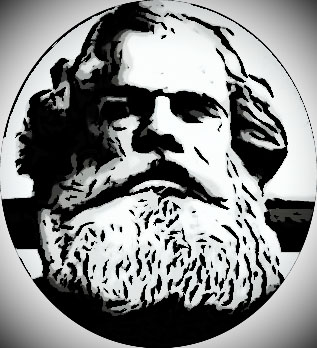
 

vladyovlVlady, an older bearlike man also in the employ of Madame Ophelia’s Ophidiarium and a traveling circus strongman Lydia recognizes from her past.


PyarePyare
, a young man with dreams of being an airship pilot, and member of LBFDS (the League Bousculier Francaise Du Sud) helping Lydia and Serpina rendezvous with Serre-Pain and Vlady at an illegal airship.

pax victorianaPax Victoriana, a period of peace imposed by the Clockwork Commonwealth and its enforcement arm, The Admiralty, dating from the beginning of Queen Victoria’s reign to the present for a total of 180 years which includes the TSR (Temporal Shift Realignment) of 56 PV (1893 AD) after which Commonwealth calendars where recalibrated to reflect Her Royal Majesty’s peaceful rule (following the devastation of the first Pandem and its resurgence 30 years later as Pandem II).

karlakolaChief Inspector Karla Kola, head of the IOTA squad charged with capturing Commodore Jack Cheése and Lydia’s nemesis and pursuer.


Chapter XXV

Lydia felt dirty. She hadn’t washed in days, really washed bio clean in weeks. Her pores were caked. And a hard rain was falling, chilling the air and blocking the light. They had made it to the chapel just as the rain began. The primary reason the chapel was abandoned was that it did not have a roof. A stone archway and overgrown trellis provided a refuge of sorts out of the rain from the downpour. Pyare had removed the slot velo’s bioweave tarpaulin from the boot and they clustered under it as large drops splashed in the pooling rain at their feet.

Serpina had withdrawn into herself, huddled, arms folded acrost her chest. Pyare was agitated, scowling and fidgeting. They had hidden their vehicles in the underbrush overtaking the crumbling stone walls at the edge of a deep darker wood. Now they awaited a let up in the weather. They could travel cross country following the occasional stream or animal track and the contours of the landscape keeping to a southwest direction. They would undoubtedly run into clansmen. Everything depended on which of the clans they encountered. If they were Fourierists or Communards, there could be a problem. Briefly that was Pyare’s plan and he assured Lydia that he had an acutely sensitive sense of direction.

Lydia had not been impressed. With the best of luck it would take them at least two days to reach Autre Lyons. The biobars were not enough to sustain them over that time.

“We’ll have to go raw,” he’d offered cavalierly, “We’ll forage, berries, wild fruit, gardens, maybe even fish.”

The thought still alarmed her. Organic material. Lydia shuddered.

Why am I here? She stared at her hands clasped before her around her knees. It was simple enough, or started out that way. She remembered her father as the most reasonable of men, except. There was a flash point. She’d heard stories, and witnessed once while her grandmother, Brie, was dying, the incredible energy of his anger. The last time she saw him was when he wished her good luck as she left to train at the Admiralty Air Academy. Brie had passed the year before and left her son a small fortune, large even by Commonwealth standards. He was never around much, traveling. She never really knew him as an adult. And now ten years later she was a hunted fugitive because she was looking for him.

Jack Cheése had retired as a ranking officer in the Admiralty Medical Corps, a top bio research clinician with the rank of Commodore, as had been his father, Harvey T., and the aged patriarch, great grandfather Bart who had been in the forefront in the fight against the global black mold infestation and variant spoors which some had claimed was an invasion from a hostile planet, disproved by great grandfather and his formulated bacterial strain that neutralized the spread of the invasive rapidly reproducing mold. Bart was one of the heroes of Pandem One, as they called it, a team of men in white lab coats conducting tests, analyzing, experimenting, failing, succeeding, and finally producing a strain that would stop the replication. From that work a number of novel bacterial strains were developed and later refined to serve industry and society. A second outbreak, long after the great Bart had retired, of a mutating fractal variant that further devastated large regions of the globe, especially in the Northern Hemisphere, wiping out vast tracts of forests and grass lands down to mineral soil. Grandfather, Harvey T, was involved in what was dubbed Pandem Two, but primarily in research on the campus of the Mendel Institute for Biological Research which had developed the reproductive drive, the technology that revolutionized modern airship transportation. She had never learned what her father’s work involved only that it was top secret. His retirement from the Corps was unexpected, hardly anyone retired from the Admiralty, but was attributed to his mother’s death.

When she returned at holiday break after her first semester she found him gone, He had disappeared, leaving not a word. His friends in Rio Paulo were mystified. Everyone feared the worst, an accident. Polite inquiries were made with the police, hospitals, a missing person’s report filed. IOTA was notified as he was a retired Admiralty officer. The men in the black hats had interviewed her, asking their probing insinuating questions. She was put off by their arrogant demeanor.

And then it was time to return to the Academy overlooking the dunes of Gdansk. She’d considered dropping out when she received a message in the most unlikely place. She had wandered into a bookstore in a plaza near the family home in Rio Rio which everyone pronounced Rio-io. She was browsing for something to keep her mind off the worry for her missing father and resigning her dream of becoming an airship captain.

She’d picked up a book titled Don’t Tell Anyone, the story of an illicit affair late in the reign of the Queen, around the time of her rapprochement with her nephew, Wilhelm. It was by the bestselling Commonwealth author Anthony Blair, also available on voice box. It was on a table display of a new memoir of a Panam War veteran titled, I Am Alive. She was also attracted by a rather bold spine that read Have Faith in large gilt letters.

Lydia had returned to the Triple A, as the cadets called it, and resumed her studies and training under the sponsorship of the Brazilian airship behemoth, Aerosud Luxury Air Ships. Friends in Rio Rio kept her apprised of any news of which there was none. Jack Cheése had disappeared without a trace. The Emperor’s secret service had closed its investigation. She had friends and in-laws at the Court in Nova Brasilia because of her Guzman connection, her husband being one of that royal clan. No one knew anything or was saying anything if they knew. He was missing and presumed dead.

She had graduated at the top of her class with distinction as well as a gold medal in combat arts in her final year, defeating the reigning champion, her Russair rival, Karla Kola. Her compulsory two year service in the Admiralty Air Corps was spent in an intelligence brigade stationed at the Clockwork Commonwealth’s embassy compound in Greater Houllas in the Slave State Republic of Texas in charge of the lighter than air transport pens, an assignment certainly well below her abilities. She did distinguish herself during the Bushwhacker Rebellion, ferrying hostages to safety after the ceasefire. She should have been stationed at the Admiralty Headquarters in Greater London, but that post went to Karla Kola, her raven haired nemesis. The feeling that she had been singled out, sidelined, isolated from the real intelligence action stayed with her through her service. Upon discharge she began her career as an airship pilot, rising in rank to Captain with the honorific of Commander when she was put in charge of the large luxury dirigibles.

It was while she was stationed in Greater Houllas that she’d first heard the rumors of an anti-government agitator known as Commodore Jack. She had gone to the favelas that had grown up around Greater Houllas and found herself in an early American artifact shop. The shopkeeper, obviously a native with long white hair and a scar on his forehead, had eyed her suspiciously. She browsed among the artifacts of the old West, native bead work and antique weapons, arrowheads and real skin moccasins. On the door to the shop was an announcement for a boxcast titled The Queen Is Light, The Victorian Mirage, one whose subject would be banned in the CC, by an underground boxcaster who went by the name of Commodore Jack. She noted that the broadcast was on a prohibited band, one most certainly monitored by IOTA as not only was it illegal to tune in to the frequency but it required some illegal modifications to the box receiver filter. In the lawless USSR, those prohibitions were regularly ignored, despite the treaty with the Crown.

The modifications were easy enough to make on an unsanctioned box she bought on the black market. She recognized the voice of the boxcast immediately and it shock her so that she had to power down the device. Once the spinning of her thoughts subsided and the realization that it was her father’s voice, she tuned back in to the banned frequency. Yes, it was her father spewing toxic chemtrails, a soup of gibberish antigovernment conspiracy theories and ICER propaganda, and invective against the royal family, especially the crown prince, Victor, whom Commodore Jack claimed was a hologram. It was trash and she was mortified that it was in her father’s voice. She soon learned, after discrete inquiries, that Commodore Jack’s boxcasts were immensely popular in the unaffiliated states of North America and on the African and Indian subcontinents. She couldn’t comprehend that her father would subscribe to such sloppy thinking and base idiocy. It disgusted her.

Nonetheless, she was determined to find him. Perhaps he had been kidnapped by anti-monarchists and rebel environmentalists who were predicting a climate change that would cover the earth in glaciers. She felt that she had to talk to him, convince him of his error, and if all else failed, commit him to a care facility in Rio Rio. Her first inquiries resulted in visits from the men in the black hats with more of their insinuations. She realized then that she was under surveillance by IOTA.

She had hit upon a solution. She remembered that her father read the London Tines, a micro-macro manufactured food gastro culture magazine, religiously. He read every word even the classified ads at the back of the magazine. She had placed her notice asking for information to his whereabouts using her father’s childhood nickname of “Pepper” along with a tidy reward to be paid in Victorines.

The answer had come in the person of Jean-Pierre Sere Pain and his itinerant medicine snake show at which point she was effectively kidnapped to pilot an unregistered airship from the vicinity of Autre Lyons to Djibouti in the Horn Of Africa Republic, a rat’s nest of air pirates, Icers, and anti-Commonwealth discontents, on a mission of mercy. In return for her assistance, she would be reunited with her father or at least receive assurances of his proof of life.

Which was how she found herself listening to the rain beat on the tarp covering her and her two companions and watching pearls of light form along its frayed edge.


Chapter  XXVI

A house stood attended by large oaks and surrounded by a gaggle of geese, picking and rooting and disputing loudly suddenly alert to their presence. The house was quiet in itself and a lazy canopy of smoke hovered about the chimney and indicated that it was inhabited. The road leading up to it appeared well traveled and as Lydia and her companions drew closer they could make out a faded signboard hanging over the entrance. It depicted a lion and a bear in an embrace, either dancing or fighting. The geese raised a ruckus and reared back with their wings flapping in challenge to the intruders.

The trio had spent the previous day slogging through the underbrush. Once the rain had let up, they had left the soggy shelter of the abandoned chapel, their destination, the vague misty shape of the steep sided razorback ridge of the upper Massif. They made their way slowly, laboriously, climbing higher, scurrying across the barren fields from copse to copse of trees and in the shadows of large boulders. They’d watched the air activity taking place below, close to where they had just left, from their vantage point on the steep hillside. The gendarmes had deployed observation blimps and light gliders that circled over the tree tops like birds of prey.

Once the sun went down, they had had to take shelter under a rock outcropping on the upside of the slope. The bio energy bars had long been devoured and their trek having itself devoured the consumed energy, they ended up hungrier than ever. Fortunately Pyare had had the presence of mind to roll up the tarp, slinging it over his shoulder, and they huddled under it, keeping close to each other and sharing their exhaustion and sweaty body heat.

The earthy scents assailed Lydia’s nostrils. It reminded her of bivouacking with the other cadets in her squad at the Air Academy. It had been pleasant because of the camaraderie of her peers. And she didn’t dream that years later she’d ever be called to experience exposure to the elements again. She didn’t feel like making small talk, numb as she was from the encroaching cold. And Pyare’s enthused optimism had retreated to dour brooding. Yet Serpina’s physical closeness to the young man had turned her cheeks rosy, eyes half closed as if she were seeing something at a distance.

The discomfort of the makeshift shelter had caused them to continuously shift position and displace previously advantageous perches in trying to seek some comfort on the rough rocky ground. Finally, Pyare rolled himself up into a ball and Serpina spooned him, Lydia having no other choice but to wrap her arms and the trap around both of them.

First light found them cresting a ridge and staring down into a rough rock strewn valley coursed with ravines and fissures. Conifers and oak groves dotted the rolling expanse as clumps of bright greenery.

Serpina had pointed down to a layer of smoke hovering above a row of oaks. There was a small settlement in the crook of a paved road. They knew that they could get food in the village but also ran the risk of being detained by the local militia. They’d agreed to keep to the fields and the hillside, avoiding the inhabitants if at all possible. They could easily be mistaken for refugees and turned over to the authorities.

Pyare had gone ahead of them to reconnoiter, looking for a farm or an orchard where food might be found. He’d returned shortly grinning, a smear of purple around his mouth. He had found an abandoned vineyard and had retrieved a few clusters of grapes the birds and animals had missed.

Serpina had plucked the fruit eagerly. Lydia was a little more cautious. Ingesting unprocessed organic matter was something she was not wild about. She had brought the deep purple pearl to her nose to gauge its scent, but that told her nothing. She put it in her mouth and rolled it around her taste buds. Earthy, but then she was covered in dirt so why should it matter. She bit down. The liquid that filled her mouth shocked her and she’d almost spit it out. A sweet sourish taste that wasn’t entirely unpleasant led her to sample a few more until she was no longer concerned that the fruit was not factory grown.

Somewhat refreshed they’d followed a stream from which Lydia had wet a handkerchief to wipe some of the dirt from her face but according to Serpina’s comments, now her face was streaked with mud and she looked like a wild savage.

It was about then that they crossed a little stone bridge to find themselves before the public house at the sign of the bear and the lion guarded by a flock of geese. Accompanying the honking fowl was the aroma of cooking food which hasten their advance at the behest of their stomachs.

Lydia in the lead paid no heed to Pyare’s comment that they were about to encounter one of the clans, the most dreaded of them all, the Ancient Order of the Phalange, if the sign board said what he thought it meant.
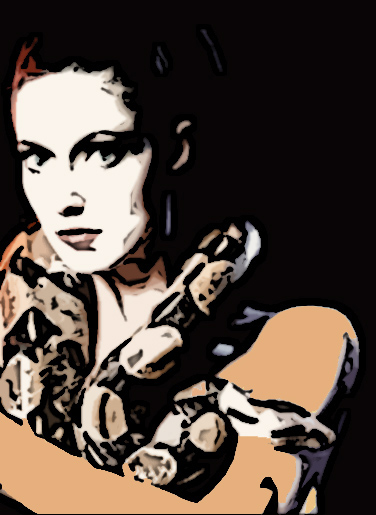

Next Time:  The Ancient Order Has An Odor

Cheése Stands Alone X

by Phylis Huldarsdottir

Cast of Characters (Partial):

nouveau lydia1ovlbluCaptain Lydia Cheése (pronounced “Chase”), Airship Commander for Aerosud, a luxury liner airship company based out of São Paulo in the Empire of Brazil, who is searching for her father, Commodore Jack Cheése, an outlaw and antigovernmental rabble rouser.


serpainovl2Professor Doctor Jean-Pierre Serre-Pain, proprietor of Madame Ophelia’s Ophidiarium, a traveling snake show, who has abducted Lydia to get her to pilot an illegal unregistered airship to HOAR (the Horn Of Africa Republic) on a mission of mercy in exchange for helping her find her father.

Untitled-1Serpina, a young girl who serves as Serre-Pain’s assistant and snake handler and who is also a psychic Vessel.


vladyovlVlady, an older bearlike man also in the employ of Madame Ophelia’s Ophidiarium and a traveling circus strongman Lydia recognizes from her past.


PyarePyare
, a young man with dreams of being an airship pilot, and member of LBFDS (the League Bousculier Francaise Du Sud) helping Lydia and Serpina rendezvous with Serre-Pain and Vlady at an illegal airship.


pax victorianaPax Victoriana, a period of peace imposed by the Clockwork Commonwealth and its enforcement arm, The Admiralty, dating from the beginning of Queen Victoria’s reign to the present for a total of 180 years which includes the TSR (Temporal Shift Realignment) of 56 PV (1893 AD) after which Commonwealth calendars where recalibrated to reflect Her Royal Majesty’s peaceful rule (following the devastation of the first Pandem and its resurgence 30 years later as Pandem II).

karlakolaChief Inspector Karla Kola, head of the IOTA squad charged with capturing Commodore Jack Cheése and Lydia’s nemesis and pursuer.


Chapter XXII

Lydia Cheése, Airship Commander, cast an eye across the small fenced courtyard cluttered with an array of rusted hulks and parts to land conveyances. The chaos was reflective of the way she saw her own predicament, also chaotic. She had been abducted into this other world less than two weeks earlier. She had been grasping at straws in finding ways to reach her father. She was desperate, and that straw had floated her up the Loire to Oldest Orleans, from whose ramshackle suburbs she was trying to flee. Now she was looking at sorry excuses for transportation. That wasn’t the only thing that made her heart race. There was no telling how soon the two policemen they had overcome and trussed up would be discovered and raise the alarm.

Serpina stood off to one side as Pyare pushed open the iron door to the large rusted metal shed with broken windows replaced by the thick webs of the gallows spiders and a faded sign that read “Steam Is Clean. There was the stink of lubricant and bio sludge among the innards of bio drives tinged with surviving colonies, some as large as a hand, iridescent, and imploded bio batteries leaking a pale florescent coral ready to burst at a touch like giant puff ball mushrooms.

The door to the shop groaned open. In the dark unlit space, Lydia recognized the shiny bulk of the heavy transport SLOT, the Spring Loaded Overland Transport. The spring turbine took up two thirds of the triple track axles giving the vehicle its wedge shape. They were notoriously slow and she couldn’t imagine outrunning police flitters or even their bio boosted velos in one of them.

Pyare must have read her thoughts, or perhaps Serpina had read them and transmitted them to him. He yanked at a tarp to uncover the double wheeled SLOT V model. It was an updated version of the ones she remembered from the SLOT V races she attended when she was enrolled at the Admiralty Air Academy. Often her fellow cadets would compete on the tarmac in the shadows of the large dirigible pens. That had been long ago, forever, it seemed. This particular SLOT with the magnetic torque rewinder could be quite fast. It still looked like a segmented bug with the seat and wide handlebars in front of its oversized turbine.

“There’s only one problem.” Pyare made a face. “It can only carry two.”

“Yes, Serpina and myself.”

“You won’t be able to traverse the Massif without my help. And there are the Clans.” At Lydia’s frown, he added, “And have you ever driven a SLOT V? It can be pretty tricky.”

Something had caught her eye otherwise she would have made a point of decisively correcting his assumptions with a litany of her accomplishments on spring loaded velos. She had made out the shape of the hoop behind a stack of boxes and shelving. It had been a while since she’d seen one or even thought of them, an item from her youth in São Paulo, competing in the Junior Brazilian Monoroda League tournaments, a monowheel. She strode closer to get a better look. The gilded letters of its manufacturer said it was a Hemming. She glanced over her shoulder at Pyare, “Does the monowheel still run?”

Pyare laughed, “It does if you want a broken arm. Or head.” When Lydia continued to move the large wheel out from behind the clutter, “Only maniacs can ride that thing. And Doyle, the guy who owns this shop, is the only maniac I know who’s been able to stay in the saddle for more than a kilometer!”

“Too bad I can’t show you my first place trophy from the LBJM, Liga Brasileira Júnior de Monoroda. My ability to steer one of these was one of the factors that qualified me for the Air Academy. An Airship is a snap compared to these contraptions.” All of a sudden she felt elated, here was something she could control and it solved their problem. “Serpina can ride with you and I will follow on the mono.”

Lydia rolled the wheel out into the courtyard. The seat had collected dust and some harmless mold, the kickstand resisted at first but finally sprung loose to prop the monowheel up so that she could examine it more closely. The gyro gear was stiff and she had to give it a few turns before it responded. The traction hub looked well lubricated. And the ratchet lever on the spring mount took a few kicks before the key began to wind. She straddled the seat within the hoop of the wheel, gripped the handlebars and released the clutch. The monowheel leapt forward like an eager colt.

Chapter XXIII

There had to be a plan. Lydia insisted. Mere setting out across open country in the belief that they would arrive in Autre Lyons without a map or a guide was folly. What were the expectations of success without proper planning? Her Academy training was showing. First, how many klicks would they have to cover?

Pyare said he had heard of a man who had traveled the distance in two days, dawn to dusk. The man had been shown the secret path by an old clansman, an ancient track traveled by the local inhabitants for hundreds, even thousands, of years.

The Massif had been spared the infestations that had devastated the countryside to the Northwest, a vast area now under the governance of the Clockwork Commonwealth since the very first viral bio infestation, more than a hundred years ago, and administered from Greater London, the seat of the Crown and the Admiralty. Every country that had been afflicted was in some way indebted to the Commonwealth for its quick work in staunching and containing the spread of the toxic bacteria. Large tracts of land around the world, some the size of small countries, bore the scars of these vast deserts. Some blamed the weather patterns and, of course, bio pollution. It was learned only too late that the biologic solution to stopping the spread of the plague on photosynthetic life acted as well as a petro-phage, reducing much of the world’s underground oil wealth to mere brackish water, coal veins collapsing to dust, mountains crumbling, sink holes undermining, entire villages swallowed up by the earth.

The great devastation occurred worldwide leaving large swaths unlivable and even contaminated. The countryside suffered the most and then the urban centers suffered from the influx of refugees. There were food shortages as once arable land had been rendered barren. And riots. It was brutal. Many many people lost their lives to the “human epidemic” as it was sometimes called. What humans did to each other was madness in the service of survival.

The Clockwork Commonwealth under the direction of the Queen and the Admiralty had signed an agreement with most of the world’s countries and independent states, including the Empire of Brazil and its subsidiary clients on the African continent, but particularly those of the Northern Hemisphere affected by the worst loss of territory—the snow dunes of Siberia, the dead lands of subarctic Canada, the wastelands of St. Louis, the Missouri breaks, and the Mississippi trickle—that they would work together to never allow a situation like that to develop again. But all that was ancient history.

“But of course, some areas like the Massif have survived.” It was almost like Serpina was reading her mind. “And because it has survived, it has become a special property, frozen in time by governmental edict, penetrable but impenetrable. People have been known to disappear travelling through the Massif, never to be seen again. Nothing has changed there in over a hundred years, probably even longer, eons perhaps. It is populated with robbers and thieves, poachers, secret blood thirsty cults, and peasants.”

“Don’t believe what you’ve heard about the Massif. Most of the horror stories are put out by those who live there. They don’t want people nosing about, especially refugees.” Pyare shrugged, “And they don’t like strangers—can’t say I blame them.”

“Then how do you propose to cross this so-called hostile terrain. We can’t very well fly over it.” Although at that very moment, Lydia wished that she could. She was a sky pilot, her feet did not belong on the ground.

“There’s something else. I need to find something else to wear. This makeshift skirt will not last long on the monowheel. I need trousers!”

Serpina giggled.

Pyare quipped, “Yes, I was wondering about your Frida the Fearless outfit. Is it some kind of costume?”

“Your trousers!”

Serpina laughed out loud.

Pyare smiled at Serpina and Lydia, and then stopped. “You’re serious.”

Chapter XXIV

Lydia slipped into Pyare’s trousers. The urgency of their plight didn’t leave any room for argument thought that certainly was the young man’s intent, Serpina had laid a hand on his arm at his first objection. The legs were long and required a few upward turns to clear the ankles of her heavy real leather boots. The belt with the large brass clasp depicting Frida the Fearless cinched her waist waspishly. “This is real wool? Not lab manufactured?” She ran her hands over her hips. “Rough but with. . .substance. I will return them when I can find suitable exchange, perhaps when we arrive in Autre Lyons.” She folded the hood of the burnoose back keeping it fastened at the neck and over the shoulders of her snakeskin jacket. She fit the bullet shaped helmet she had found under the seat compartment, along with the gauntleted gloves, on her head.

Pyare had to be satisfied with the saggy stained coveralls that belonged to the mechanic who was shorter and not as slim. He glared at Lydia as he seated himself on the SLOT V with Serpina mounting behind him. “You look formidable.”

Lydia touched two fingers to her temple in salute and bade him to go ahead with a wide but grim smile. “You don’t look so bad yourself.” She was referring to the dark purple tugglemus he’d wrapped around his head. A large shop smock engulfed his makeshift outfit making him seem larger, intimidating. The turbine whined straining against the clutch before the SLOT V shot out onto the road

She eased the monowheel forward to follow them. It was going to be a bumpy challenge considering the road’s patchwork of pavements and pot holes. The monowheel was designed for the smooth surface of the racing tracks in the velodromes. She had rarely taken one out of the stadium, and then only her great skill had averted any spills, the centers of gravity so unpredictable but she finally got the wobbles under control. She raced to catch up with Pyare and Serpina who had disappeared around a curve on the road ahead. Leaning into the turn, she felt it. What it was like to be in full control as a singular force of being and machine returning as a visceral memory. How old had she been then? That ambition and that drive, a certain recklessness. It had been tucked away, a memento of a transition into life as a cadet in the air academy, graduating as a lighter than air pilot with a gold medal in the close combat competition, and her term of service as an ensign with the Admiralty at the embassy in Greater Houllas, the capitol of the United Slave State Republics, during the Bushwacker’s Insurrection. Her installation as a pilot with the Aero Sud fleet upon her release from service. And soon, as had been planned by her mother and aunts, she wed.

In no time, Lydia had sight of Pyare and Serpina as they were emerging out into the countryside, leaving behind the sparsely populated edges of Outer Orleans. Now the roads followed the contours of the terrain. Terraced knolls and fields were covered with bio tents where workers tended the rows in wide straw hats. The original plan had been to join one of these labor gangs as a way out of Oldest Orleans. Until Chief Inspector Karla Kola, her nemesis from their Air Academy days, and whose Russair team she had helped defeat in the close combat competitions, showed up at the checkpoint with a squad of her IOTA agents. At least now they were well away from the city. But by now the police were likely on the alert, and they had become fugitives and refugees. The road sped past tangles of growth reclaiming the ground where houses sat abandoned. The few heavy transports, steamers or the lumbering cargo SLOTS, were easily overtaken and passed without peril. She was feeling comfortable in her monowheel, still alert to any quirks, like the gyro ratio always needed adjustment, especially after navigating curves. But it had the requisite power. At one point in the road, a stretch that ran like a straight line to the horizon, she sped up and passed Pyare with the wave of her gloved hand. He glared back at her grimly, Serpina, a beatific smile on her lips, her head pressed against the young man’s back, arms secured around his waist, and holding on like she was riding on a cloud.

Lydia’s sense of triumph didn’t last. The wheel was losing speed, the rotations slowing like the spring had come unwound. A peculiar odor said the power pack under the seat had overheated. She should have checked the coolant before they set off. But this model usually had an auxiliary. Unless it had been cannibalized. She hated dealing with chemistry. She came from a family of scientists and doctors. A lot of her Academy mates had gone into industrial bioengineering when they couldn’t pass the flight requirements but elected to stay in the Navair sector. She would have just as soon joined the circus, like her mother, than become an airship drive chemists. They all had God complexes.

Pyare screeched to a stop. He wasn’t gloating. “A good thing you stopped.” He pointed further down the road. “Serpina says we’ve gone too far. Something’s there, beyond those trees. Something lurking.”

“Lurking?”

Serpina nodded solemnly. “Yes, I feel it. Anxiety. Elation. Fear. Rage.”

“Possibly police, a checkpoint?”

Pyare nodded. “Possibly. Or a farmer’s market. Either way we don’t want to take any chances.” He pointed behind them, “There’s a road a few klicks back. It leads to an old abandoned chapel. We can hide the slot and the wheel there. Then we walk.”

Lydia nodded in agreement, staring at the open drive compartment. The odor of the power pack spelled trouble. “The pack is baked. I have to change it out. If there is an auxiliary.”

Pyare dismounted, the spring of his velo whining at the restraint. “Doyle always kept one.” He opened a compartment on the inside rim of the wheel behind the seat. He reached in and held up a charged power pack wrapped in a coolant net. He pulled back when Lydia reached for it. “Let me do it.” He yanked the pungent spent pack out with the thongs set in the compartment door. It crackled when it hit the ground. The auxiliary unit fit snuggly and engaged immediately, the wheel chain spinning with new energy.

Reversing course, Lydia followed close behind the slot velo and considered their future prospects. Walking would require energy and unlike the monowheel they didn’t have auxiliary packs for themselves. How were they going to cross the Massif on foot without food or drink? Pyare had liberated a few bio power bars from the mechanic’s pantry that smelled as unappetizing as they looked. Still, the future looked bleak as if they were staring into an abyss of uncertainty. The path she was on had started out of concern for her fugitive antigovernment father, Commodore Jack Cheése, and now she had become a fugitive as well, pursued by agents of IOTA. Soon enough, they arrived at the turn off and the rugged road to the abandoned chapel. There was something else she didn’t care for and there wasn’t anything she could do about it. Dark ominous clouds had rushed across the sky and blocked the light of the already hazy sun. It was going to rain.


Next Time: The Clans of the Massif

Cheése Stands Alone IV

by Phyllis Huldarsdottir

Chapter Nine

Serpina was quite a practiced liar, and practical joker. Her laugh, a shrill whinny, was playful yet dangerous. Lydia had to reassess her assumptions about the young woman. Nor was she very talkative, and often inobtrusive as if she could make herself invisible. Orphy, the python, was kept soporific on a steady diet of who knows what, Doctor Serre-Pain didn’t specify or explain after he had rushed into the cabin at Lydia’s scream and had once again soothed her nerves with his calm, hypnotic voiced assurances, gently patting the blood back to her cheeks. His disapproving frown had caused Serpina to pout and after a long deliberate silence to mutter a reluctant “sorry.” Lydia would not have to interact with the other snakes, Serre-Pain swore, with the exception of Orphy, and then only on briefly while they were at the festival.

tristan_0123The inspection official and two sinister looking men in black hats had roamed over the barge examining the cargo, and when they came into the cabin, stared wide eyed at her propped up in one of the bunks with the python wrapped over shoulders. Her terrified look might have suggested an otherwise haughty imperious annoyance at the intrusion. The station inspector apologized profusely, and the IOTA agents, not in the habit of showing deference to the general public, dropped their gazes awkwardly.

Once past the inspection station and well up the Loire River approaching Oldest Orleans, the doctor had Vlady bring in a big trunk into the cabin. She had not seen much of the large man on their journey up the river. He spent most of his time on the deck of the barge with Serre-Pain. In the light of day, without the bear suit. he was still an imposing figure with a thick mane of steely gray hair that hung down to his shoulders. His dark eyes seemed to laugh as did the large white beard punctuated by the red dot of an imbiber’s nose. There was something unsettlingly familiar about his manner toward her.

“We have to change your attire,” Serre-Pain was saying, “Your fashionable dress will make you stand out as a privileged Victoriate, especially where we are headed. In the trunk you will find clothing that might fit you and conceal your identity. Even if where we are going is technically outside of IOTA’s jurisdiction, they have spies and informers everywhere. It is important that we avoid any hint of suspicion.”

Serpina stood back as Lydia lifted the heavy lid. The blouses befitting a snake priestess were laid out in layered trays, billowy sleeved embroidered with flowers, birds, animals, and snakes. Colorful skirts, long tasseled and tiered, none of which she felt she could wear with any conviction. Nor was it bioweave but actual antique cotton and silk. And could she ever convince herself to don someone else’s underwear? Pulling away another tray, she uncovered on the bottom a pair of folded trousers much like Serpina was wearing, possibly wool by the feel of the material, and a robust rust fabric shirt with a wide collar, two items she thought she could live with. There were also several pairs of spangled gold slippers that didn’t appear to be made for walking.

She pulled her hand back quickly when she felt under them. And she looked closer with Serpina peering over her shoulder and drawing a breath. For a moment she thought that it might be another of Serpina’s tricks. Then she made out the sleeve and lapels. An overcoat. But one of snakeskin. Dark mottled scales outlined the sleeves, large turned back cuffs lined with dark blue satin, the three quarter length of the coat ending with a slight upturn at the skirt and fitted with large slant pockets. The row of ovoid buttons were of a faded amber. And Lydia recognized them. Orphy had an identical pair. Holding it out at arm’s length, the scales seemed to undulate, tricking the eye with their meandering pattern. The coat lining was also a dark blue satin. A faded label sewn beneath the rear collar read SA I   E RO and spoke of its antiquity. “This is gorgeous!” Lydia exclaimed in spite of herself.

stilettoThe yoke fit comfortably across her shoulders as she shrugged into the coat, the sleeves extending a little ways past her wrists, the hem, past her knees. She was surprised, expecting it to be heavier. Her hand in the right pocket extracted a heavy dark blue cotton scarf. The left pocket was empty although it was shaped as if some object had had a permanent residence there. Lydia pulled on the lapels pleased by the way the coat fit. She felt something hard nudge under her left breast. Inside she found the pocket and the narrow object protruding from it. Throwing open the coat she extracted a long ornate double blade stiletto.

Serpina nodded her head, looking at the gleaming blade admiringly. “The fangs,” she said.

Chapter Ten

The streets of Oldest Orleans were filled with rubble, dust, debris, and choking air. The Victorianasance Faire was held in arcades along the perimeter of Place D’Arc. Outside the walls of the old city, in Older Orleans, vapors from the bioturbines of the factories warped the air adding a gloomy orange pall over the rooftops and the refracted rainbow sparkles of larger particulates gleaming like minor stars. Serre-Pain always staged his performances at dusk when the shadows were long. One of the Medicine Show wagons converted to a stage with a proscenium. At the back behind a red velvet curtain was a narrow antique settee upon which she was obliged to lounge with the coils of Ophy across her shoulders for several excruciating minutes while she was introduced as the descendant of an ancient Minoan queen who was in possession of the secret recipe for an antivenom elixir. Once the pitch was made, Serre-Pain would begin his lecture on the fascinating history and myths of snakes, and  the reason snakes were believed to be immortal. By then the curtain had come down and Serpina would come to get Orphy off her neck.

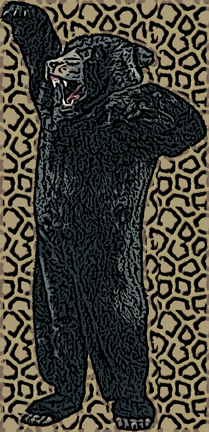
In the side closet Lydia changed out of her priestess garb and donned the snakeskin coat, wrapping the dark blue scarf around her head and over her nose, masking all but her eyes. She stepped down from the wagon and into the space behind where she saw Vlady getting into his Bear suit. He was just about to fit the head on when he turned and smiled at her with such childish mirth that she felt compelled to smile back. It was the sparkle of his eye. Once the costume was complete he maneuvered his prop, a large ball painted with serpents and moons, ready to make his entrance at Serre-Pain’s cue, and with amazing agility leapt to the top of the ball and rolled it with his feet to maintain a casual balance.

arcadeAt the cheers from the crowd Lydia made her way out from behind the large ophidiarium on wheels that attested to Serre-Pain’s claim of herpetology and proof of his knowledge, like an old library full of old books. The crowds had thinned out further under the arcade where merchants had set up their wares, most everyone wearing a face covering, and some, goggles, against the silicate laden air. Serre-Pain had asked her not to go out in public unaccompanied by one of them. She would appear out of place and thereby attract attention. She was willing to chance it. She had friends who might be able to help her slip back to Sao Paulo. Even though The Empire of Brazil had an extradition treaty with the Clockwork Commonwealth, she doubted that the Emperor’s court would allow it over such a trivial matter as a Citizen of the World Order searching for her paternity. She would have to stay out of IOTA’s jurisdiction which would make her an exile from the world hub of Greater London. She would certainly not be allowed to pilot airships outside of the Empire’s zone of influence which spanned the southern hemisphere and the Atlantic to the inter desert zone of New Mali and Congola further south. She would no longer be an airship commander in the glamourous passenger fleets like Aerosud or Canamair. Most of the navair traffic in the Free Corridor of Cancer was freight and third class which meant much of the world’s poor and retched, refugees from the camps adjacent the dead regions and the encroaching tundra.
A loud noise startled her and she turned to seek it’s origin. A crowd had gathered in front of the stall from where the noise was emanating. She glanced over a shoulder at the edge of the gathering. She could see clearly a man standing in front of a square block of gray bioluminium that was vibrating to a low purr of its working. A propeller whirling at one end and a small tube emitting gray vapors at the other. She identified it immediately. An internal combustion engine. Icers. She didn’t know why she was surprised. Many nonaligned nations allowed the development of petrol powered engines despite the scarcity of the fuel. The Scarce Resources Treaty of Pax Victoriana 80 had banned oil as a fuel source, with the exception of lighting. The bacteria that had been released to eradicate the Black Mold infestation of Pax Victoriana 75 unfortunately had had the characteristics of a petrophage and rendered practically the entire oil reserves of the Northern Hemisphere to a watery nonvolatile solution of less than seven percent accelerant.

She shouldn’t have been surprised. The most standard motor source in the Commonwealth’s zones of influence was the bug drive, the bio repro engine that powered everything. The giant factories that produced the bacterial strains, or seeds, were the same ones that were polluting the skies above Oldest Orleans and stretched further north up the valley past the precincts of Old Orleans. The waste accumulated in piles, attaching itself to the lifeless sands of the devastated deadlands, was blown about in the atmosphere by fierce hyperborean winds. The giant windmills erected around the perimeter of the old city on biostyl stilts were not that effective at deflecting the bitter cold of the poisonous sand storms of the north.

The man in front of her stepped back unexpectedly and stepped onto her slippered foot. He glared at her as if it was her fault after she had pushed back. She apologized. No need to draw attention to herself. She quickly moved through the throngs and clots to the end of the arcade where it made another turn paralleling the edge of the square. She could see the orange bacsodium lights of the medicine show and Serre-Pain leading the faux bear in the open space in front of the wagon. Serpina was likely in the tiny dressing space behind the stage fitting into her snake costume. The young woman’s contribution to the entertainment was her hyperflexability. She could literally twine herself around herself, but mostly she slithered along the stage and up the wall and then provocatively curled around a projection overhanging the top of the stage at which time a red round object like an apple appeared in her mouth.

To this backdrop the snake doctor made his pitch. The little pamphlet he held high over his head contained the secrets of Madame Ophelia’s most famous recipes for making antivenom, revealed for the first time, which he offered for a meager sum but within the affordable range of most everyone in a crowd of people who were not particularly interested in reading. As a bonus he offered free of charge with the purchase of Madame Ophelia’s Secret Recipes, a sample bottle of one of her most potent antivenom elixirs.

After the entertainment  ended and the crowds drifted away, the stretch of the Place D’Arc where the snake show had been held was littered with pamphlets but not one tiny bottle. Serpina had told her that the secret recipe’s ingredients were a local fruit distillate mixed with cayenne, the “dash of snake venom” Serre Pain claimed in his sales pitch.

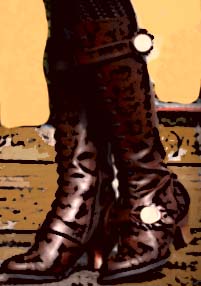
Lydia look down to see a women pointing at her slippers. She had stopped in front of a footwear stall. Arrayed on neat shelves were a variety of sabots, some painted bright colors, others with intricate designs burned into the particulated nearwood. They were quite popular in Greater London where there was a strong artisan market and certain guilds and houses were recognized by name, their products highly sought after. Along with the display of shoes, apparently locally sourced, was a collection of boots. They attracted Lydia’s eye by their sturdy design, one pair reaching to calf length made of a stiff dark material, some kind of fauxhide. The boots had round pale buttons near the top and across the ankle. She was partial to that type of footwear, similar to the style she always wore but more rugged. She felt the dark material between her thumb and forefinger as the woman in the stall nodded approvingly. At first touch she realized that she had been mistaken. It was real leather, a forbidden pleasure as along with ivory and live animal pets, it had been banned by treaty among the states aligned with the CCCP, the Clockwork Commonwealth Cooperative Protocols that were at the foundation of the Pax Victoriana, hammered out over a hundred years ago. She fingered the buttons, tapping one with a fingernail. Bone, maybe ivory.

steampunkThe woman nodded her head and spoke a single word in dialect, “O.” And again pointed at Lydia’s slippers seeming to infer how puny they were when compared to the rugged specimen Lydia was holding in her hand.
Lydia asked, “Is this real leather?”

The woman canted her head to one side as if making a calculation and then nodded. “Queer.”

Lydia understood the problem. She had assumed the woman spoke Standard. She’d come across these language gaps before. Often they could speak Standard but chose not to in resistance to contempt that World Standard had for their native language that was thousand years in the making while WS was an Anglo-Saxon based universal language only recently seeded over the breadth and width of the Victorian Empire.

“Do you speak Standard?” Lydia was casting a practiced eye over the foot of the boot and at the same time removing her right foot out from the slipper.

The woman in the stall held up her thumb and forefinger to indicate how little, shrugging her shoulders in the heavy blanket coat covering her stooped figure. She too had a scarf wrapped around her head and pulled across her nose. She made agreeable noises as Lydia pulled the boot up around her ankle.

“How much,” she asked, “How much do you want for these boots?”

“Katrevaindees.”

Now it was Lydia’s turn to calculate. She shook her head. “How much? In Victorines.”

The woman showed her a faded piece of paper. The number 90 followed by three zeros was written on it, and slightly below, the letters nfr, meaning New Francs.

“All I have are Victorines. Is there somewhere I can exchange them for the local currency?”

The woman looked over Lydia’s shoulder and held up her hand to wave someone over. “Iceepyare!”

A young man in a beret, scarf slung below his wispy little chin beard and showing the beginnings of a moustache joined them. The woman rattled off something to the young man while pointing at Lydia, the young man nodding in understanding. Suddenly Lydia felt very conspicuous.

“I can help you with the exchange.” He reached into his inside coat pocket and retrieved a large mouchoir enveloping a sheaf of cash. “You wish to buy these boots it will cost you one hundred victorines not counting the exchange fee of ten percent.”

Lydia was astounded. She couldn’t believe her good luck. She had paid twice that much for her cold weather zipper boots and the workmanship had been shoddy. She tried to cover her elation by negotiating. “Ninety, but I’ll go as high as one hundred victorines to include your commission.”

The young man shrugged and turned to walk away, returning the cash to his pocket and revealing the dagger in the sheath at his waist. Lydia was reminded of the stiletto in her inside breast pocket. At the fringes of the civilized commonwealth a knife fight would not be unlikely.

The woman in the stall implored the departing banker. He stopped and looked over his shoulder at Lydia. He had read her.

She sighed and nodded her acquiescence. “Very well, one hundred and ten victorines.” She had a thousand victorines in her wallet. She was an easy mark when it came to footwear. And they fit perfectly as if they were made for her. She admired how nicely they suited her, the square stubby toe and sturdy utilitarian heel.

The woman in the stall was delighted to make such a big sale, shaking Lydia’s hand as did the young man congratulating her on her purchase. He looked at her closely.

“You are not from here. A guest of the Victoriannesance Festivities, perhaps?”

Lydia pointed across the square at the snake show. “I am with Doctor Serre-Pain.”

“Ah,” the young man raised his eyebrows, “The mysterious Madame Ophelia, am I correct?”

“At times,” Lydia admitted and at once realized that she might have revealed too much. She disengaged and moved swiftly away. She had acted frivolously and dallied too long. She was due back to the wagon for the finale of the snake show. Serre-Pain would raise the alarm and come looking for her.

Light spilled across her path from an alcove and she glimpsed the empty tables of a café from which emanated the sounds of Einstein’s first violin concerto, Relativity, her favorite, E in Minor C sharp. And it was the first thing in her flight from IOTA that beckoned to her with its familiarity. She found a table in a dark corner beneath some anti-IOTA graffiti, a common sentiment in the old city she had come to realize. It was time to consider her next step.

bear1Having spent time in an Admiralty intelligence unit when she was stationed at the Commonwealth embassy in Houllas in the Republic of Texas, she knew that she would have to secure new papers if she were going to cross physical borders. And that she would have to avoid travelling by air. It would have to overland until she was safely out of the reach of IOTA. The Capricorn Free Corridor was her best bet. Surely there was someone in Older Orleans who could provide her with a passport that would escape detection, especially if she stayed off the main routes and avoided the busy checkpoints. The strains of the violin concerto had a soothing effect on her although at times she knew that it could also be quite stimulating. She closed her eyes for a moment, amusing herself with the fact that the President of the ISR, the Invincible Swiss Republic, was Albert III, the great grandson of the world famous musician. Unexpectedly her mental image changed, as often happens in reverie, to that of Vlady fitting the bear head onto his own and she realized then why he seemed so familiar to her. How could she had forgotten?
When she opened her eyes there were two uniformed men standing in front of her table. Their patches and canted berets identified them as local gendarmes. “Your papers, please,” the shorter one spoke.


Next Time: The Massive Escape

Cheése Stands Alone—Sneak Preview

 by Phyllis Huldarsdottir

~Sneak Preview~

The World of Lydia Cheése

In March of 1892, a Scotsman by the name of Arthur C. “Artie” Doyle was hanged by the neck until dead after being found guilty of a string of grizzly murders of prostitutes in Whitechapel. At that moment, history veered off its presumed course and headed in a direction all its own in which the Great War never happened because the Kaiser was afraid of offending his grandmother, Queen Victoria, whose life was prolonged by the wonders of biology. The peace of her reign, known as the Pax Victoriana, despite some major environmental disasters, has lasted 180 plus years keeping as many Victorian airs as possible while making accommodations to bio lydcirtechnology. Follow Capitan Lydia Cheése (pronounced Chase), Airship Commander, into a world in which the biological sciences overshadow the physical sciences. Steam engines dominate most modes of propulsion. The skies are filled with lighter-than-air craft and railroads cover most of the globe. Internal combustion engines are banned except in the non-aligned nations of the African continent. Brazil has an emperor and holds an empire of its own covering much of the southern landmass, with Sao Paulo as one of the most modern cities in the world, far outstripping Newer New York and Greater London with its lively futuristic culture. The North American States fractured in the early 20th century after the revelation of the imposter president Cleveland. The Supreme Court under Justice White then ruled that the Southern States had the right to secede as they did nearly half a century previous and promptly left the Union to form the USSR, United Slave State Republics. Subsequently the Eastern Seaboard was renamed Newest New England with the Boston Bubble becoming an independent city state much like Newer New York. Albert Einstein was the name of a famous Swiss watchmaker, Henry Ford was tried for sedition for the rebellion at Belle Isle and faced a firing squad, and Guillaume Apollinaire was the last mayor of Paris before its annexation, along with Amsterdam, into the sphere of Greater London’s influence. Can Lydia Cheése find her father, the antigovernment turncoat and radical, Commodore Jack Cheése. Will her quest take her around the world in less than 80 days or is it a lifelong journey? Below is a sample of how any of that might occur in an alternate world never before explored.

Dirigible1ch

Captain Lydia Cheése (pronounced Chase), one hand ungloved, read the memo with a frown.  Her airship, Orinoco III, had been grounded.  An Aerosud cadet stood by at attention in a blue glossy visor cap and the impeccable dark blue company tunic with the distinctive sky blue piping at the collar.  Lydia placed her thumb on the bio wax pad of the message board and then pressed her print at the bottom of the white message square. The cadet knuckled a salute.  Captain Cheése returned it perfunctorily, and with a sigh.  She watched the young woman exit her suite at Watson House, name after the famed inventor of propulsion biology, Dr. John Watson, as she peeled off the other maroon porskine glove. “Pshaw,” she said with gritted teeth. G. B. Pshaw was her supervisor, nemesis, and constant irritant at Aerosud HQ.   She caught a look at herself in the mirror above the marble mantle of the faux hearth as she unfastened the gold frog at her throat and sloughed off her Aerosud officer’s tropical dress tunic.

AIRSHIPIII
What she saw did not please her, a fringe of auburn hair, brow knit into a frown, grey eyes staring back in anger.  Not again, she thought.  Two groundings in as many weeks, and her suspension only just overturned.  Tossing her tunic onto her grandfather’s vraisther smoking chair, she glanced at the stack of documents on the side table.  In particular, she eyed the communication she had set aside the day before when she had been too preoccupied with preparing for her flight out of Lesser London to give it much more than a cursory glance.  Addressed to her, handwritten in green ink, that in itself unusual, on what felt like a slip of parchment. “Parchment, really?” she said aloud. It was just one of the many come-ons and false leads she had received since she advertised a reward for information as to proof of life of Commodore Jack Cheése, her father and the brilliant airship engineer who had disappeared many years ago, around the time she had entered the Air Academy for the freshman term.

The slip of parchment, or faux-par, she wasn’t going to believe that it was actually real, gave an address on Baker Street, Old London, current day, and specifying two in the afternoon.  As it was almost four, she grabbed her walking coat and went quickly to the door.  “Impulsive!” she imagined her mother saying.  But no, not impulsive, an intuition she felt compelled to act on.  The preciseness of the hand that had shaped the words “I can help you” tipped her in favor of the certainty of her hunch.

The elevator man gave a bow of recognition as she stepped on, and slid closed the door grill.  A quiet whirr of machinery brought them down to the main floor lobby.  Off to one side, framed by potted finger palms, was the entrance to the lounge frequented by her fellow lighter-than-air officers.  Collectively they were known as litharians and the ships they flew were commonly known as lithairs.  She would have been welcome at any table or congregation of hale fellows well met as she was known among them for her cutting wit and outrageous pronouncements as well as the sincerity of her companionship.

Watson House, where Lydia Cheése maintained a permanent suite, was a hostel catering to the Navair trade, especially their officer class. Crews of ships officers, pilots, navigators, drive engineers also known as chemists represented dozens of navair companies doing business at the aerodrome on the far western edge of Lesser London lodged at Watson House on layovers from continental and trans-oceanic flights.  They flew passenger rigids and cargo semi-rigids, rigs and semi-rigs to those in the trade.  Their companies were from all over the flown world. Large luxury passenger transports like Rajair and Anglair. Canamair operated both trans-Atlantic passenger and cargo service, as did Aerosud, Lydia’s employer, based out of Sao Paulo.  They offered service to the major ports in Greater London which included Paris, Amsterdam as well as Lesser London where Lydia was now feeling, in a word, ruffled and in no mood for companionship.

The doorman greeted her opening the door, and she crossed the threshold into the torch orange glow of phosphorescent plasma lamps lighting the perpetual brown haze of Lesser London. Her grey walking coat was cut to the knees of the darker grey of her uniform culottes.  Her boots were pointy, at heel and toe, and made of supple maroon psuedo, matching her porskine gloves, and fastened along the calf by large pearlite buttons. They made her appear taller, and she was already tall. On her head was a jaunty little cap of ribbons and silk made to look like a tiny bird had nested in the soft pile of auburn hair.  She strode down the wide granite steps to the cobbled walkway where the carriages for hire and their drivers waited.  She chose one at the head of the line and spoke the address on Baker St.

“Would that be Baker St. West, mum, or would that be Baker St East?” the driver asked over his shoulder, whip testing the haunch of the blocky beast of burden, an equlone, specifically bred for urban drayage.  Like mules, they could not reproduce and their life span was less than five years. Small as a pony but as strong as a full grown natural equine, they were cheaper to maintain.  Unfortunately, as they approached their end date their pace became slower and slower, signaling a reluctance to hasten their passing.

Lydia glanced at the address on the parchment impatiently.  “It just says Baker St.” she said as if that settled it.

“Well, mum, Baker St is a very popular name here in Double L, Lesser London to you, and as I said, there’s East and West Baker St as well as Baker St South, Baker St North, and South Baker St North. Of course there’s also Upper Baker St and Lower Baker St.  Upper Baker St Southwest. And Old Upper Baker St.  If you understand what I’m saying, mum.”

Lydia restrained herself from knocking the man off his bench.  “Take me to the intersection where all these Baker Streets meet!”

“Ah, yes, mum, Baker Square.”  And under his breath, “should have said that in the first place.”

After what seemed like an interminable time, the plodding near death equlone carriage brought a fuming Captain Lydia Cheése to Baker Square, a rather nondescript roundabout, so not literally a square, from which each of the various Baker Streets radiated like the spokes of a wheel. The driver hunched over, shoulders to his ears, as if feeling the heat of her rage.

She disembarked and paid him.  “Here you are, sir, a five Victorine, and not a regina more.  You have hindered me long enough.”

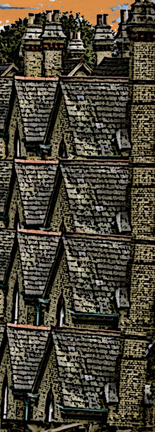
row houses Baker’s Square was hemmed in by blocks of apartment dwellings designed to look like rowhouses, stacked one atop the other.  They were all the same whichever way you looked.  Their sameness caused her a momentary claustrophobia.
A figure approached, steadily, methodically.  When it stepped out of the shadows she saw by the cut and buttons it was a constable.

He smiled and saluted her.  “Be of any service, mum?”  He was a big man. Lydia looked directly into his eyes.  She knew what the tattooed lines radiating from the corner of his left eye meant.

“Yes, perhaps you can.  I seem to be unable to find this particular address.”  She showed him the parchment.  “Is there not simply a Baker St without any of the bothersome directional appendages?”

The constable studied the square she held out to him and scratched his chin.  “Yes, of course there is.”

“Then please be so kind as to direct me.”

“In Old London.”

“Old London, but. . .” It then occurred to her.  Old London, not Lesser London.  Old London, underground London, the London that Lesser London was built upon.

The Constable pointed to the iron gate set in the granite base of the monument at the center of the Baker Square roundabout.  “Tours to Old London just now closed up for the evening.  Too dangerous to go down there now, without a guide, and you being a lady and all.”

“Constable, I will have you know that I served as an ensign at the siege of the Bushwackers.  I know what danger is!”

“Aye, mum, I was in the PanAm Wars meself.”

“Yes, that is evident from your eye tat.  You were with. . . .”

“The Lost Brigade, yes, mum.”

“You are one of the brave, and I respect that.  However, I must to Baker St.  I am already late!”  Lydia strode toward the iron gate.

“It’s not safe, mum,” he called after her.


Dirigible1ch2

At the bottom of the concrete steps joining the cobblestones of Old London the bacterial-sodium lamps dimly lighted shades of grey and black as flat as house paint.  A man in a dusty worn gray shirt, pants, and shoes stood against an almost identically gray wall beside a weathered gray real wood produce cart upon which were displayed row upon row of bright though somewhat desiccated illegal Valencia oranges.  Lydia was about to ask directions when she saw the street name in plain view attached to the side of a dingy gray brick façade.  Real brick, not that faux coral that was used now almost exclusively for building exteriors. She’d always been under the impression that Old London was shuttered after daylight hours yet a goodly press of people, all dressed in the varying shades of gray, black, and brown of their surroundings, shuffled past like shadows, busy about their business. Brighter light splashed out onto the cobbles from storefronts, and distantly, music and singing could be heard.  There were also clots of men clustered around porn boxes listening to the endearments of courtesans.  Others stood in doorways and eyed passers-by.

Lydia proceeded down Baker St searching out the house numbers, peering into alcoves and letting her eye follow the buildings’ truncations as the support to Lesser London.  At least here you could see some of the sky bathed in the rust orange of plasma light between the roadways and the avenues joining the elevated sectors like the bridges over the fabled canals of Venice.

Her forward progress was halted somewhat by the throng of dingily attired Old London denizens in the thrall of street entertainment.  A bear on a chain rolled a large red ball with its feet wearing a red Phrygian cap strapped under his chin.  A tall African in a flowing ostrich cape led the furry apparition around in a circle as if he were holding a magnet in his extended hand.  Lydia paused to observe, a bit distracted by the unusual show.  Live animal acts had been banned aboveground for decades.

As she turned to resume her quest, she was confronted by two coppers.  They had been keeping an eye on the crowd and had noticed her.  She was out of place.  They were young, one barely out of his teens, a tense meager set to his jaw that was trying to pass for determination.  The older one with the light fuzz of lip hair spoke.  “Your papers, mum.”

Lydia reached into her pouch bag and retrieved her Aerosud identification.  She handed it to him, “It’s quite alright, constable, I have an appointment.”

The copper nodded, “Captain Cheese, is it?”

Lydia narrowed her eyes, and for the hundred thousandth time said, “It’s pronounced ‘Chase’.”

“Yes, mum.  And I should be warning you about traveling the depths without an escort, mum.  It is very dangerous.”

The younger one nodded vehemently.  “This lot here would think nothing of kidnapping an upper to sell on the fem market!”

A commotion at the other side of the gathered throng drew their attention and they hastened away.  An explosion sounded, a pistol or fireworks.  The crowd scattered pushing past Lydia caught up in the fleeing mob.  She felt a tug at her waist where her pouch was slung.  She looked down to see a young girl slip effortlessly, eel-like, through the press of legs, arms and torsos.  The bag pouch perceptibly lighter, Lydia understood immediately that she’d been picked.  She forced herself through the crowd after the young girl.

The girl moved away quickly on what appeared to be a crippled leg.  She wore a gray crochet bonnet over dusty brown hair, her shoulders draped in a shawl a shade lighter than her hair, and one arm hooked through a large wicker basket indicating that perhaps she was a flower seller.

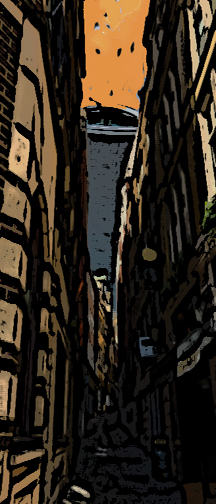
lower london The pickpocket veered into the alley between two buildings with Lydia still in the tangle of panicked underdwellers. She kept her gaze fixed on the hobbling figure and once free of the mob ran swiftly to the entrance of the alleyway.  The already inefficient bacso street lamps hardly penetrated the deep darkness of the cleft between buildings. Indignation overrode her sense of caution and she strode into the shadows.  Slowly her eyes gathered the available light and sharpened to the dark. An oversplash of orange from the city above allowed her to discern edges and contours. The young purse snatch bobbed hurriedly toward the light of a parallel street at the other end.

Certain that she could easily overtake the thief, she hesitated for a beat.  Someone had reached the girl first.  Springing from the shadows a wiry figure grabbed for the girl’s shawl.  The undersized shape stumbled. The much larger outline pounced on the fallen child.  It occurred to Lydia that a thief was robbing another thief, one that seemed a little more formidable than a crippled girl.  By then Lydia had caught up to them.  She just wanted her wallet back.  Instead she got the attention of the crippled girl’s assailant.

He was a narrow dagger of a man, drawn emaciated face, stubby hard shoulders extending boney brittle arms and long fingers.  “Now we have ye,” he gargled a mirthless laugh.

Lydia had been taught well.  As she flipped forward she extended a hand and placed it on the attacker’s rib cage, the momentum and force of her acrobatic maneuver was enough to give her thrust the power to unbalance the man. As she landed she swung her right leg and tapped the man’s chin with the toe of her boot at exactly the right spot, rendering him instantly unconscious.  She made all these movements effortlessly as if simply slipping an arm through a sleeve or brushing back a fall of hair.

The young flower seller, now unburdened of her empty basket, scrambled around the corner of the building and out to the lighted thoroughfare.  Lydia stepped over the fallen man after her.  As she emerged into the light, the young thief was nowhere to be seen.  Lydia hurried past a young couple sauntering ahead and then turned and hurried in the opposite direction, their startled gazes following her.  She glanced across the street beyond the hack stand and the motionless equlones.  The girl had disappeared.

Lydia strode to an iron railing on the other side of the alleyway.  She leaned over the bar railing and stared down into the stairwell that led to a basement door.  The door itself seemed to sway slightly as if it had just moments before swung closed.  Lydia trusted her instincts and leapt down the stairwell.  The door pushed open easily and once again she was in pitch black, this time with not enough ambient light to gather for sight.  She turned back the piping on her coat sleeve and massaged the phosphene activator until the piping emitted a faint green glow like low viz string lights. It was a purely decorative feature of her garment, but it had enough phot, 33 lumens per centimeter if she remembered correctly what the salesperson who sold her the coat had claimed. She moved her arm in a slow arch across the front of her body to illuminate the bare edges of the light’s reach.  A passageway opened up in front of her. Attenuated by the lack of the visible spectrum, she heard the whisper of shuffle steps ahead.  She hurried and almost ran head on into the wall where the passageway turned sharply left. The rhythm of the foot falls changed and, after almost tripping, she was now following steps leading up and toward a light, a pale narrow splinter at the edge of a doorway.  Without the slightest hesitation, she flung open the door with such force that it slapped against the inside wall of a small room lit by the soft glow of an oil lamp.  The bear confronting her made her catch her breath.


To Be Continued At A “Future” Date