
What is it about poets and pulps? The easy answer is imagination and vernacular. One might throw in a dash of ubi sunt just because it is truly about nostalgia, a nostalgia for a certain kind of storytelling that dispenses with the metaphysical and is driven by narrative inspiration and colloquial dialogue. The storyteller was not always defined by paragraphs and pagination. And poets are the ur-storytellers, singing of valorous and miraculous interludes in the myths of yore—it’s something poets, even contemporary poets, feel at their roots. Of course a lot has changed since, as Aram Saroyan once remarked, campfires were the first TV. In the post industrial world, the wood pulp paper used in the publication of disposable literature from newspapers to magazines to novels for most of the 20th century became the designation of a genre.
Pulp can also be an acronym for Popular Undervalued Literature Publications. There is something common, déclassé about pulps. That’s why that kind of reading is called “guilty pleasures.” All popular literature delights in the sordid and the vulgar in which the reader can catch a glimpse of themselves in de facto complicity.
Noir is often conflated with pulp, but there is a distinction. Penzler suggests that noir began with Hammett in the American canon. Police procedurals depict an unromanticized look at our venial selves, and thus the abysmal pessimism of “noir.” Noir can be characterized by irony and cynicism, the modern malaise.
Pulp writing, on the other hand, represents a certain naivety, a suspension of belief that speaks to a kind of anti-existentialism, an escape to the realm of fantasy and fanciful storytelling. With a few notable exceptions, the popular men’s magazines in the 1920s and 30s featuring lurid stories of crime, the unusual, and the future, “true” or otherwise, can be considered “pulp.”
Postwar, the pulp heroes and villains grew capes and fled to the comic books, leaving the field open to an angst driven sardonic despairing self-righteousness of the survivors of a world cataclysm, winners and losers, but mostly losers, now defined as noir.
It is not unusual to find poets engaged in writing or reading pulp or noir, or for a novelist to pen a collection of poems. As writers write, one or the other becomes their maître and is recognized as such. Almost a hundred years ago, the poet Kenneth Fearing published acclaimed crime fiction in the pulps. James Sallis, author of the Lew Griffin PI series, is an accomplished poet, yet it is for his skillful novellas that he is known. Jim Harrison, author of Legends Of The Fall and the Detective Sunderson novels, was also known for his poetry. Poet Alice Notley, an admitted fan of the genre, published an epic “noir” poem titled Negativity’s Kiss in France (where the word originated), managing to synthesize the bleakness of crime fiction with the abstraction of the avantgarde. Kerouac and Burroughs (Williams S.) wrote Hippos Were Boiled In Their Tanks, as a paean to the hardboiled pulps. Roberto Bolaño, a poet whose novels are more well known than his poetry, cashes in on the cachet of pulp and noir with the title of his remarkably dark narrative, The Savage Detectives. James Ellroy might fancy himself a poet, pushing the stylistic envelope as poets do. And for countless other writers, known and unknown, poets or novelists, the genre of imagination and vernacular holds a peculiar fascination. It is, in a sense, a return to the source. Just sayin’: scratch a poet and find a storyteller, and vice versa.
Two recent books, Woody Haut’s On Dangerous Ground and Jim Nisbet’s Pandemic Ditties, offer a case in point.
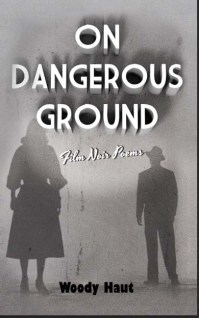 Woody Haut’s On Dangerous Ground, Film Noir Poems takes its title from the Nicholas Ray movie of the same name. As the 50 “film noir poems” illustrate, the poet is well informed in the both genres. The author of numerous critical studies of the noir genre including Pulp Culture: Hard Boiled Fiction and The Cold War and Neon Noir: Contemporary American Crime Fiction as well as a couple of noir pot boilers, Cry For a Nickel, Die For a Dime and Days of Smoke, Haut’s poems take their titles from such classics as The Big Sleep, Nightmare Alley, and Touch Of Evil as well as the lesser known films like Where The Sidewalk Ends and I Wake Up Screaming. The poems themselves are prompted by dialogue, interesting camera work, the plot, a particular scene, the acting by the actor/actress, or their depiction of a time, place and social relevance which reveals the author’s knowledgeable immersion in a distinct American genre with a French name.
Woody Haut started out on poetry but soon hit the hardboiled stuff. And he even admits it! “Poetry had been my first port of call, though over the years my relationship had succumbed to disgruntlements and separations.” And yes, the poetry world is not an easy safe to crack, and even if you do, sometimes, although the safe may seem full, the rewards can be empty. Still carrying some of the baggage from that time, he confesses, “stretching back to the mid-1960s, in Los Angeles, then San Francisco, with various publications and a range of mentors, from the academic — Henri Coulette, Philip Levine, Jack Gilbert — to the peripatetic—Michael McClure, Charles Olson, Amiri Baraka and Ed Dorn. More recently, my interest veered towards the more linguistically-oriented, such as Clark Coolidge, Michael Gizzi, and Tom Raworth, and political screeds by the likes of Sean Bonney and Keston Sutherland.” And he is not above spilling the beans and implicating other writers in this amour fou: “Alice Notley, Robert Polito, Geoffrey O’Brien, Nicholas Christopher, and earlier, Weldon Keyes and Kenneth Fearing. Even Raymond Chandler began his writing career composing doggerel for the Westminster Gazette, while the great Dorothy B. Hughes garnered the Yale Younger Poets Prize long before she wrote such classics as In a Lonely Place or Ride the Pink Horse.” And of course the most damning testimony, besides his own words, are the poems themselves.
On Dangerous Ground
(Nicholas Ray, 1952)
Why do you punks make me do it?
growls the cop as he beats the shit
out of a pathetic street hood. As if
the same old same old, aggressor
blaming victim, perking watch and
wonder. Law and order cracking as
inevitable as the saturated light, an
apartment filled with testosteronised
artifacts: what once was, will never
be. Violence, as always, feeding the
conundrum. If only it wasn’t so addictive,
or family of last resort. A jones exiling
him to a sparsely populated snow-
ridden town, viewed-a movie within
a movie-through a windscreen, the
schtumed backseat viewer cachéd
in their own private critique, bleached
out by the death of a young girl at the
hands of a teenager barely knowing
better. With darkness bleeding into
domesticity, a match is lit for unblinking
eyes, and a wounded plea to locate her
brother before revenge can freeze his
tracks. Frightened, the kid invariably
slips from higher ground, recycling a
geology of clichés, footnotes in an
expurgated history of crime and
punishment. Fifty years on, the screen-
writer, blagging in his local coffee shop,
tells a redacted story: how he’d simply
wanted the cop to return to the city a
different person. But the studio’s arc was
non-negotiable. After all, the politics of
money dictates that only a miracle can
suffice. A capitulation, however generous,
not quite more than barely nothing at all
As Haut explains, “the poems in On Dangerous Ground could be thought as distortions, often humorous, of the films under consideration, like scrambled film reviews that exist at a particular moment, distilled through time, whose shelf life will last until the next viewing, by which time another set of linguistic prompts or images might attract my attention.”
Woody Haut’s On Dangerous Ground is available from Close To The Bone Publishing
A longtime member of the Bay Area lit scene who passed away in 2022, Jim Nisbet was an internationally recognized novelist and poet, and a seminal figure in the West Coast Noir Renaissance. His many novels which include Lethal Injection, Windward Passage, Snitch World, and The Syracuse Codex (to name only a few) have been described as “Jack Kerouac meets Tarantino meets David Forster Wallace” which is some kind of hyperbole but fitting of the genre and the author.
 Nisbet returned to his poetry roots (not that he was ever very far from them) to put the pandemic in pentameters in a selections of poems titled Pandemic Ditties. Jim, in the late 70s was a young poet in San Francisco who wrote and declaimed his poetry in coffee houses and bookstores. He even read at the historic San Francisco Punk Poetry Festival at Terminal Concepts Gallery with such luminaries as Andrei Codrescu, Gloria Frym, Darrell Gray, and the ravishing redhead femme fatale, Victoria Rathbun, straight out of a noir drama. Obviously, as it turns out, poetry wasn’t the only thing he was writing.
The poems, fifty five in all, collected in this slim volume from Molotov Editions, were written over a two year period (March 2020 through June of ’22) and distributed to his email contacts. Informed both by classical tradition and the immediate circumstances of the pandemic, these poems deal in matters political, spiritual, and cultural — but ultimately take the shape of an increasingly personal encounter with the phantasms of the pandemic.
Nisbet has a fine discerning ear and the Oxfordian vocabulary to go with it. The raucous ditties romp and roam, the pace hyperactive, reminiscent of the high wire antics of Nisbet’s prose, walking the line between doggerel and limerick, all the while juggling a ham on wry sense of humor. And like those internationally acclaimed novels, the poems are nothing but lively and thought provoking. An excerpt from “No. 19” written in July of 2020 gives an idea of the gyroscopic wit of the novelist as poet
Safe at home in 1958
We had Doctor Zorba
Who, his eyes turned away at last
From the jitterbugging babe
In The Asphalt Jungle, weekly chalked
On a dusty slate
“Man. Woman. Birth.
Death. Infinity.”
Today, not safe anywhere,
We have Subdoctor Schnorba
Sketching in thin air
“Person. Woman. Man.
Camera. TV.” Repeat ad
nauseum. Never mind
The incredulity. Expect
Rezids, directly deposited.
The poems in Pandemic Ditties (pace Defoe) demonstrate Nisbet’s great range, from highbrow to lowbrow at the flick of the tongue, resulting in fascinating frenetic high octane linguistic kaleidoscopic versifying. A seat belt, nay, a harness is recommended if you’re going along for the ride: whiplash may occur as the result of sudden sharp turns, changes in direction and orientation, and abrupt stops, all of it like an amusement park ride, entertaining as well as exhilarating. Anyone who has enjoyed Nisbet’s novels will appreciate this selection.
Jim’s Pandemic Ditties is available from Molotov Editions
There is no doubt, as it is quite obvious to the most casual of observers, the genre is infested with poets. Should the reader of pulp be concerned, put in a call to the exterminators? Probably not. Poets and pulps are in a symbiotic relationship, like Louis and Rick in Casablanca, it is a “beautiful friendship.”
That’s my story and I’m sticking to it,
Perry O’Dickle
for Dime Pulp,
 Dime Pulp