Captain Lydia Cheése (pronounced “Chase”), Airship Commander for Aerosud, a luxury liner airship company based out of São Paulo in the Empire of Brazil, who is searching for her father, Commodore Jack Cheése, an outlaw and antigovernmental rabble rouser.
Professor Doctor Jean-Pierre Serre-Pain, proprietor of Madame Ophelia’s Ophidiarium, a traveling snake show, who has abducted Lydia to get her to pilot an illegal unregistered airship to HOAR (the Horn Of Africa Republic) on a mission of mercy in exchange for helping her find her father.
Serpina, a young girl who serves as Serre-Pain’s assistant and snake handler and who is also a psychic Vessel.
Vlady, an older bearlike man also in the employ of Madame Ophelia’s Ophidiarium and a traveling circus strongman Lydia recognizes from her past.
Pyare, a young man with dreams of being an airship pilot, and member of LBFDS (the League Bousculier Francaise Du Sud) helping Lydia and Serpina rendezvous with Serre-Pain and Vlady at an illegal airship.
Emile Etugouda, poet, philosopher, world traveler, raconteur, and general all around know-it-all whose memory of an ancient epic poem helped Lydia, Serpina, and Pyare cross the Massif and on to their rendezvous in Autre Lyons.
Chief Inspector Karla Kola, head of the IOTA squad charged with capturing Commodore Jack Cheése and Lydia’s nemesis and pursuer.
Pax Victoriana, a period of peace imposed by the Clockwork Commonwealth and its enforcement arm, The Admiralty, dating from the beginning of Queen Victoria’s reign to the present for a total of 180 years which includes the TSR (Temporal Shift Realignment) of 56 PV (1893 AD) after which Commonwealth calendars where recalibrated to reflect Her Royal Majesty’s peaceful rule (following the devastation of the first Pandem and its resurgence 30 years later as Pandem II).
Chapter XXII
The liftoff was sublime. Lydia, back in her element, felt the same way. At quarter speed, the repro drives murmuring, turbine fans whirring, the dirigible edged away from the hillside enclosure and out over the valley casting a shadow on the rolling farmlands and villages three hundred feet below. She brought the wheel around in alignment with the compass heading and nodded in satisfaction as the large airship responded. “Steady as she goes,” she said, and had Pyare take the helm. She went back to her calculation, noting the chronometer and notching the chart with calipers. Glancing out of the wide windows of the gondola at the receding bulk of the Massif to starboard and then back at the map, “Half speed,” she commanded. Pyare adjust the antiquated lever up another notch. The thrum of engines deepened.
Binoculars to her eyes she scanned the horizon to the south, the direction they were heading. As they approached Autre Lyons, the air traffic would increase and they would have to blend in with the other rigs and semirigs, avoid the recreational solid shell low altitude maneuverable dirigibles known as flitters and keep an eye out for the air patrol silrigs (self-inflatable long range gliders).
They were flying under a commercial freight banner until such time as they reached the point in the flight path where they would switch their identification flags to those of the Russair cargo rig. The valley floor drifted below, a patchwork of farms and forests intersected by the dull gray curves and straightaways of roads. The increase in surface traffic was noticeable as they drew closer to the urban industrial cluster that was Autre Lyons. Various modes of land transportation including antique steam beetles, tea kettles, bug buggies, whistlers, dreadnaughts, and land arks created a vapor haze with the lumbering properties of ground fog.
Lydia, in command, took a breath. How did she, a well-respected airship commander, not to mention someone married to a member of the court in Novo Sao Paulo, end up breaking the law by illegally piloting an unauthorized airship in restricted airspace. It should not have felt right, but it did. What she had experienced since that fateful day several weeks past in her meeting with Professor Doctor Serre-Pain in Old London began to make sense of her current predicament in an odd sort of way. She had gone to the underground in order to contact her father, Commodore Jack Cheése, the notorious anti-Clockwork Commonwealth critic, labeled “traitor” and rabble rouser. That in itself was a marginally illegal act under Admiralty law to begin with, and now she was in the middle of committing a full blown criminal act.
A mission of mercy, as the old Professor had explained to her several times. He had to get to a remote village in the Goda Mountains northwest of Djibouti in the Horn Of Africa Republic where there was an epidemic of poisonous snake bites due to an unusual explosion in the birthrate of that particular species. They were in dire need of an anti-venom that only Serre-Pain could provide. Unfortunately the Horn Of Africa Republics were nonaligned states embargoed by the Clockwork Commonwealth and its allies and trading partners. Consequently commerce, whether it be industrial, chemical, or medical was prohibited from being transacted with the rebellious ICER infested anti-Commonwealth member states, a confederation of piratical enclaves and republics scribing an oblique triangle from the Red Sea to the southern tip of Madagascar to Bombay and back to Djibouti, known also as the Arabian Triangle, a vast body of water as mysterious as the equatorial night sky. From the archipelagos of minute islands, some only large enough to house an air strip and hangers for the winged internal combustion heavier-than-air craft outlawed in most of the Commonwealth controlled treaty zones, the ICER pirates plied the trans Arabian shipping lanes looting unguarded commercial rigs of their cargo.
Serre-Pain, Lydia reminded herself, was an enigma. He was a Black man with a wooly white iron jaw beard, who had the aura of an ancient being or of belonging to an ancient order of beings possessed of a primal knowledge. When she inquired about his supply of antivenom, he smiled enigmatically and held up a scarred ebony arm and replied, “In my blood.” Lydia was even more surprised to learn that when they reached their destination, the locals would supply him with a fresh specimen of the poisonous snake which the good Doctor would then allow to bite him. He would feel the full effect of the venom as it coursed through his blood stream seeking to shut down his functioning muscles until he asphyxiated. His immune system would then respond and transform the poison into the serum for an anti-venom. His blood would then be cloned into an effective anti-venom specific to that particular species of serpent. From the scarification on his arms, it was obvious that Serre-Pain had done this procedure numerous times before.
Now she was doing what she knew how to do best, pilot an airship, thanks to the snake doctor, in a way that was as exhilarating as when she first sought to become an airship pilot, the sense of adventure and competence. Her promotion in rank to commander had taken her away from the day to day working of piloting a dirigible. And her becoming an airship commander in the Aero Sud luxury fleet at a young age was probably as much of an acknowledgement that she was married to a member of the court as it was of her administrative skills. It was her skills as a pilot and as a leader that were being called upon. Turning toward the comms cabin where the others were seated, speaking among themselves, she was confident that she could get Serre-Pain to his destination and complete the mission. The fact of her father, Commodore Jack, and the promise of contacting him remained as the goal, yet it was the completion of the current task that spurred her on.
Captain Lydia Cheése (pronounced “Chase”), Airship Commander for Aerosud, a luxury liner airship company based out of São Paulo in the Empire of Brazil, who is searching for her father, Commodore Jack Cheése, an outlaw and antigovernmental rabble rouser.
Professor Doctor Jean-Pierre Serre-Pain, proprietor of Madame Ophelia’s Ophidiarium, a traveling snake show, who has abducted Lydia to get her to pilot an illegal unregistered airship to HOAR (the Horn Of Africa Republic) on a mission of mercy in exchange for helping her find her father.
Serpina, a young girl who serves as Serre-Pain’s assistant and snake handler and who is also a psychic Vessel.
Vlady, an older bearlike man also in the employ of Madame Ophelia’s Ophidiarium and a traveling circus strongman Lydia recognizes from her past.
Pyare, a young man with dreams of being an airship pilot, and member of LBFDS (the League Bousculier Francaise Du Sud) helping Lydia and Serpina rendezvous with Serre-Pain and Vlady at an illegal airship.
Emile Etugouda, poet, philosopher, world traveler, raconteur, and general all around know-it-all whose memory of an ancient epic poem helped Lydia, Serpina, and Pyare cross the Massif and on to their rendezvous in Autre Lyons.
Chief Inspector Karla Kola, head of the IOTA squad charged with capturing Commodore Jack Cheése and Lydia’s nemesis and pursuer.
Pax Victoriana, a period of peace imposed by the Clockwork Commonwealth and its enforcement arm, The Admiralty, dating from the beginning of Queen Victoria’s reign to the present for a total of 180 years which includes the TSR (Temporal Shift Realignment) of 56 PV (1893 AD) after which Commonwealth calendars where recalibrated to reflect Her Royal Majesty’s peaceful rule (following the devastation of the first Pandem and its resurgence 30 years later as Pandem II).
Chapter XX
Lydia stood in the wheelhouse of the airship like she was visiting an old friend, a very old friend. It was a text book reconstruction of the control panel, down to the mahogany framing, analog instruments, chrome highlights and gleaming brass, the outsized rudder wheel, elevator wheel and panel, altimeter, gas board, and engine telegraph dating back almost a hundred years. Pyare could barely constrain himself, a child in a museum, wanting to touch everything and make equivalences to what he knew of current airship dashboards with their plasma displays and their analogous functions. She was relieved by his apparent familiarity with procedures and that it wasn’t all braggadocio. She was going to require a second if they were to accomplish their mission. Pyare, who had accompanied them across the Massif, had decided to continue with them to North Africa. He had no reason to return to Old Orleans now that the gendarmes were after him. Apparently Leon had confessed to everything and exposed the organization’s network, naming names, his among them.
She shouldn’t have been surprised that Serre-Pain and Etugouda were acquainted. They were of a second Pandem generation and wore similar world weary expressions around their eyes. It was during their exchanges of when they had last crossed paths that her real identity was revealed. Not Odette Oday as her identity papers claimed, but Lydia Cheése, airship commander, who was to pilot their mission to Djibouti.
Etigouda had cocked an appraising eye at her and asked, “You’re not related to Nye Cheese, are you? The Queen’s Chancellor for a brief period during the period following 1906 current era, Pax Victoriana Year 69 or some such, and just ahead of the first BMI Pandemic. An obtuse character if there ever was one. He considered himself quite the philosopher but was actually completely mad. The Admiralty Board put an end to his conciliatory concessions with the powerful Romanovs over the administration of Eurasia and its contiguous states, especially in its rivalry with the Empire of China for the Independent Republic of North Pacific Archipelagos, or Manchatka, as it is commonly known.”
Of course she wasn’t. Her family name was pronounced “chase.” And she wasn’t going to get a word in edgewise. The old poet’s idea of a conversation was a monologue, preferably his.
Once they’d gained the sanctuary of the remote farmhouse with its massive stone barn carved into the hillside where the dirigible was penned, Lydia had set about the inspection of the airship, a medium sized transport. She had trained on similar rigs but none quite as old. The principles were the same.
Serre-Pain outlined the plan over the large chart table before their departure. They would be flying unauthorized through the commercial airspace and subject to interception by the customs authorities. It all depended on timing. A Russair cargo dirigible of similar vintage was making its way down on the opposite side of the Massif. He pointed to the map and where the monitoring stations were along their flight path. The one to the south of Autre Lyons was the one they would have to deceive. All cargo transports were required to keep to a strictly enforced schedule as well as elevation. If the Russair transport could be delayed at their last cargo stop, they would have a narrow window to impersonate its flight signature and fool the monitors. That would take some calculation.
Lydia had quickly worked it out, estimating the airspeed of that class of dirigible, especially laden, taking into consideration the time of day, and what upswells of wind current could be expected descending into the littoral plain. It had been a while since she had actually had to work out a flight plan—her staff on the Orinoco II had usually taken care of the navigation requirements, but it was something she felt perfectly confident doing.
“Once we get underway, we’ll have to average 50 knots to meet the point where the airship can intercept the flight path undetected,” she pointed to the spot on the map. “Our cruising altitude will be 200 meters unless we encounter cloud cover. Once we make it past the last monitoring station we will be into the autonomous zone of the Ligurian League, and by then, out of IOTA’s effective jurisdiction.”
The grizzled old snake doctor nodded his head with approval. “But their agents are everywhere and we must remain discrete. Once we determine that the delay has been effected, we can untether.” At Lydia’s questioning look, he added, “We will depend on Serpina for that confirmation.”
Orphaned, a refugee, Serpina had joined them when she was very young, and she had immediately bonded with the mute bear.
And it was true, the young woman had been unusually pensive in the preparation for boarding and getting underway. She had never been on an airship she had confessed to Lydia once the reality of the prospect had been confirmed. And Lydia, too, had sensed the rivalry for Vlady’s attention. The old strongman had once been her hero, and now it was obvious from their affection for each other, that he was Serpina’s as well.
Her reunion with Vlady had been a little awkward because he had been Samson Trismegistus when she knew him as a child, the strongman in the circus in which her ballerina mother had performed as a tightrope walker. Now he was pleased that she had finally realized his identity. He was still a bear of a man, mute as he had not been before. She had remembered his voice as a rough growl. But he had acknowledge with a sage expression that he knew who she was. And he admitted with a nod when she recalled that he had saved her mother and her from the fire in the arena tent set by vindictive clowns and carnies. Serpina had finally spoken up. “He is very happy to be reunited with you.” To which the large man assented.
Lydia understood then the bond between the two of them. Those thousand unasked questions, the ones she wanted to pose, were answered in the conversations during the ride up to the estate of a local landlord and the location of the clandestine dirigible. The six legged steam beetle was a farm tractor used for hauling hay wagons. Serre-Pain had switched carts when he suspected that Leon might be induced to reveal their plan.
From what she could gather from her inquiries of Serre-Pain, and somewhat reluctantly, Serpina, Vlady had been tortured by the Tsar’s secret police, the Oprichniki, for being an enemy of the Russian Empire. After the fire in the big top, he had returned to his hometown in the trans-Caucasus where his mother lay dying. Because he had lived outside the Empire during his travels with the circus, he was accused of being a spy and had had his tongue cauterized with a hot iron. He escaped from the prison camp where he had been left for dead, and made his way across the Carpathians with a group of refugees from Kazakhstan. He chanced upon Dr. Serre-Pain and the Original Madame Ophelia’s Ophidiarium with the original Madame Ophelia, on the outskirts of Sarajevo. They were being set upon by a gang of Ottoman thugs, and he had intervened. Serre-Pain had been on a mission to provide antivenom to save the life of a young man who had been bitten by a horned viper, the deadliest in the region. From then on, he had accompanied the snake doctor across vast stretches of the post pandemic continent, skirting the BMI devastations and avoiding the authorities. Orphaned, a refugee, Serpina had joined them when she was very young, and she had immediately bonded with the mute bear. It was only later that they had discovered her receptivity as what is commonly called a “vessel.” And that she was implicitly sensitive to Vlady’s frequencies and could read him like a mood ring. In many ways, he was a beacon onto which she could home.
Lydia understood also that she would not be the one to get between Serpina and Vlady, and that Pyare didn’t realize that he might. And considering their latest trek, she was beginning to wonder who was leading whom.
Chapter XXI
Lydia gladly shed the rough cloth of the burnoose when she was given the uniform of a Russair airship captain with the gold and red piping, the square billed cap and its glossy green visor. At least she no longer looked like a refugee, although the uniform was decidedly out of date, like much of the Russair operation. Out of his country togs and in his own Russair uniform, Pyare presented an impressive figure and looked the part of an airship pilot. She had given Vlady a quick lesson on the engine telegraph in the engine room. With Pyare at the helm, she would be free to respond as navigator, rigger, comm operator, and engineer if the need arose. Her crew on her Aerosud luxair, Oricono II, consisted of a minimum of fifty specialists, not counting the passenger attendants, and kitchen staff, but a small transport such as this usually operated with a dozen airshipmen. Serpin, the Doctor, and the poet would stay out of sight in the comm room in the keel until they had made it past the final monitoring station.
Until then they would have to wait for the acknowledgement from Serpina that the Russair ship had been delayed. And Etugouda had not stopped talking, jumping from topic to topic, like a flat stone skipping across a still pond. How he had landed in the Massif, escaping from the displeasure of the Spanish King’s family for a poem he had delivered to the Court. He had found himself penniless and at the mercy of the clans. They were descendants of Fourierists and fugitive Communards who mingled with the locals who were themselves much later descendants of persecuted Huguenots. It was a world outside the law of the Clockwork Commonwealth. They were missing a fool in their midst, he explained, someone who could utter the forbidden of what they all thought. As a poet, he was perfectly suited for the job. He had survived for the last five years on scraps and the generosity of the frequenters of the Lion & Bear, taking up residence in an abandoned shepherd’s stone shelter. His life at the Spanish court was another story. And he thought that he might never return to the normal world of hubris and ambition that his profession required.
“And when you three showed up, I understood that you were an omen, more than met the eye, and the passport out of my exile. But if you must know, it was fated that my friend Jean-Pierre and I should be reunited. It seems like a thousand seasons have passed since we were face to face, and the world has changed since then, drastically. Before I landed in the Spanish Court, I was travelling in the Americas with a group of aristo vagabonds from Greater London when we just barely missed the resumption of the Pan-Am war. The United Slave State Republics led by the Republic of Texas were making claims on Ultra Mezzistotec territory south of the Rio Grande, again, and of course the Bush Whacker Rebellion within their own member states. It wasn’t the only upheaval in the former United States and Territories. And now there is more trouble brewing, this time from the tribes of the Dakota Prairie Republic, if what Jean-Pierre is telling me is true, and I have no reason to doubt him. They’re claiming that since the central government in the District of Columbia is no longer a government entity, that the treaties they signed with the then United States almost two hundred years ago were no longer binding. It is understandable that they might want to leave territory devastated by black mold and the attendant anomalous weather for what they claim as their homeland. They are seeking the return of their lands from the southern Appalachians to the Mississippi. Needless to say the Republic of Tennessee Georgia, known to everyone as ROTNG, and its citizens have rejected the idea. I remember when this claim was first broached in their pleas for support from the Admiralty right after Pandem II and during a meeting of the newly formed Conglomeration Of Affiliated Nations of which the USSR was not a part”
The snake doctor looked directly at her and nodded gravely. It was time to spark up.
Lydia had had it with the self-inflated gasbag. She was in no mood to listen to prattle about current affairs or world history, especially when it was beginning to veer into speculation and conspiracy theories. She stared at the ceiling of the observation room at the rear of the gondola. Above her in their rigid shell were the gas bags she was concerned about. Unlike the older models that used hydrogen, this airship had been retrofitted with the less volatile biogen gas cells, standard for at least the last half century, if she remembered her history correctly. Biogen pellets were mixed with water at the base of the cells which caused the release of the biogas that inflated the biosilk envelopes. They had taken on enough ballast to mimic a laden transport, and the bug drives were primed to bring the H2O solution to a boil, and off-gassing the steam to spin the two outboard turbines that would propel the airship. The bug drives, as the engines were called, operated on Euler’s theoretical equation of a relation between the velocity, pressure and density of a moving fluid using a system based on the Rayleigh-Benard convection dynamic. Or so she remembered from Basic Aeronautics, a class that was guaranteed to put her to sleep, the drone of the lecturer’s voice that stupefying.
Etugouda’s voice was having a similar effect and she snapped her eyes open and shook her head. Now he was going on about the reason behind the first Black Mold Infestation, often referred to as BMI One or Pandem I, that had killed millions of people and devastated vast tract of the Northern Hemisphere.
“Many would like to place the blame on the Admiralty for the epidemic, the first one. I don’t directly believe that they were behind it, but they did capitalize on it to consolidate their power into the Clockwork Commonwealth. What was the cause of this poison that was sown into our soil, killing the plant life and its attendant biosystem? Historically we know that in the current era 1906 or Pax Victoriana Year 69, if you wish, the earth’s orbit passed through the tail of a gigantic comet, a flaming planetoid. The resultant diffusion of the meteoric matter through the aether sheathed the northern part of the globe with its alien presence, effacing the existing flora and fauna. Many believe that it was an invasion from another world that sought to extinguish us. Scientists, in what was then known as the Prussian Alliance, before it became a part of Greater London, developed a biocide that neutralized the black mold and stopped it’s advance. Unfortunately the solution had the unexpected side effect of being a petrophage, and before. . . .”
Now Lydia was in her history class at the Air Academy, another lecture course that had bored her to tears. She was about to counter what, to her, sounded like ICER propaganda when she noticed that Serpina had crossed the room to say something to Serre-Pain. The snake doctor looked directly at her and nodded gravely. It was time to spark up.
Captain Lydia Cheése (pronounced “Chase”), Airship Commander for Aerosud, a luxury liner airship company based out of São Paulo in the Empire of Brazil, who is searching for her father, Commodore Jack Cheése, an outlaw and antigovernmental rabble rouser.
Professor Doctor Jean-Pierre Serre-Pain, proprietor of Madame Ophelia’s Ophidiarium, a traveling snake show, who has abducted Lydia to get her to pilot an illegal unregistered airship to HOAR (the Horn Of Africa Republic) on a mission of mercy in exchange for helping her find her father.
Serpina, a young girl who serves as Serre-Pain’s assistant and snake handler and who is also a psychic Vessel.
Vlady, an older bearlike man also in the employ of Madame Ophelia’s Ophidiarium and a traveling circus strongman Lydia recognizes from her past.
Pyare, a young man with dreams of being an airship pilot, and member of LBFDS (the League Bousculier Francaise Du Sud) helping Lydia and Serpina rendezvous with Serre-Pain and Vlady at an illegal airship.
Emile Etugouda, poet, philosopher, world traveler, raconteur, and general all around know-it-all whose memory of an ancient epic poem helped Lydia, Serpina, and Pyare cross the Massif and on to their rendezvous in Autre Lyons.
Chief Inspector Karla Kola, head of the IOTA squad charged with capturing Commodore Jack Cheése and Lydia’s nemesis and pursuer.
Pax Victoriana, a period of peace imposed by the Clockwork Commonwealth and its enforcement arm, The Admiralty, dating from the beginning of Queen Victoria’s reign to the present for a total of 180 years which includes the TSR (Temporal Shift Realignment) of 56 PV (1893 AD) after which Commonwealth calendars where recalibrated to reflect Her Royal Majesty’s peaceful rule (following the devastation of the first Pandem and its resurgence 30 years later as Pandem II).
Chapter XVIII
Lydia had had enough. The old man, the poet Emile Etugouda was trying her patience. Not that she wasn’t thankful that he was helping them evade the clan militias by offering a shortcut to their destination, but he wouldn’t shut up. He talked about himself endlessly, the famous authors he knew, as well as his friends in high places. Lydia recognized some of the names he’d mentioned from the Emperor’s court in Rio Rio, but they were mostly from another era, her grandfather’s generation. She had never heard of the poets he mentioned, but that was no surprise. Even in her schooling, she had never been interested in the sentimental and fantastical, the frivolous. And for all she knew, what he was claiming could be a complete fiction.
The first instance that warned her of things to come was his forgetfulness. And since the trail they were following to get to Autre Lyons depended on his remembering of the epic poem, La Reccourci, a good memory was essential. They had traveled a couple of miles before Etugouda realized that they had taken a wrong turn because he had conflated “hair” with “lair of the Maiden” which was actually a detail from a completely different epic altogether. And from there they had veered off in another direction only to be confronted by a sheer wall of water at the top of the winding stream along whose banks they had trudged with increasing difficulty.
That was frustrating enough, but combined with his insistence on reading their auras and relating what the colors said about their personalities, it was grating on her nerves. Here they were desperate to reconnect with Professor Serre-Pain, and their guide, such as he was, wanted to play parlor games. He’d first fixed on Pyare as it was his suspicion he wished to allay, and because a male, make an ally.
“But enough about myself. How about you, my boy, what is your name? You seem to be the least out of place of your trio. Are you from these parts?”
“Pyare,” the young man spoke cautiously, “Pyare Aucarray. I grew up in the suburbs of Old Orleans. I worked in the fields in the valley, summers when I was going to school. We would often venture into the Massif to go hunting or swim in the streams.”
“Yes, yes, I sense that about you. Rugged orange, adventurous, with a hint of yellow to underscore your easygoing nature but also energetic red highlights. You are at peak spectrum. You have great potential and I would assume that you have many talents that are just waiting to be put to the test. Have you ever considered flying?”
Pyare looked askance as if he’d been asked a trick question. “How do you mean?”
“As an airship pilot, of course, you are just the caliber of man that would do well in the Navair trade.”
Pyare threw Lydia a triumphant look. “Exactly.”
Lydia suppressed her guffaw. “An airship pilot, imagine that,” she said at Serpina’s snigger. “Had we known, we could have flown to Autre Lyons instead of bumping into dead ends and following false nonexistent trails.”
Etugouda ignored her sarcasm and turned his attention to Serpina. “And what did you say your name was again?”
Serpina threw a glance at Lydia before answering. “I didn’t say, but it is Addy.”
“Yes, yes, Addy, there is something about you I can’t quite place.” The old poet ran a hand over his large mustache. “ There is a bit of the blue about you, a mysteriousness, a depth unfathomable, a spirituality. And a green that speaks of a garrulous nature. Also an underlying yellow, much like our young man here.” He smiled as Serpina’s cheeks pinked, and nodded, “As I suspected.”
When he looked at Lydia his eyebrows drew together and shaded his fierce discerning eyes. “But you, I cannot fathom. Your papers say your name is Odette Oday, if I heard correctly, and yet somehow that does not fit. And your credentials say you are a third class worker, but that is belied by your appearance and demeanor. As Conan at the Lion & Bear said, you are too shiny, and indeed you are. You radiate a dark red, almost purple, which mean you are not only determined but spontaneous, grounded but not easily cowed by convention. There are undulations of orange which I take to be of a cautious nature. As well some green around the edges that would indicate someone who is comfortable commanding others.”
Lydia returned the old poet’s gaze. There was a smugness about his pronouncements that galled her, something that she encountered mostly from men who were always in a hierarchal mode, like somehow they knew better or were better. Her boss and nemesis, Commodore Crenshaw, at Aerosud Headquarters, held a similar attitude toward her and the other female airship pilots. Airship commander was still a very much male dominated occupation. There was also something decidedly archaic about the old man, as if he belonged to another era. His clothing was a patchwork of styles, the tilted hat, the bulky scarf draped around his shoulders like a mantle of office, and the rough canvas jacket of many pockets, a faded blue. His trousers, patched at the knees, were cinched at the waist by a wide purple sash. The cuffs, turned up at the ankles, offered a glimpse of dark gnarled toes shod in sandals. A sturdy staff in one hand and the dark satchel slung over the other shoulder marked someone long experienced in travelling afoot.
“Your assessments of our personalities are entertaining and diverting, Monsieur Etugouda, but so far we seem to be taking one step forward and two steps back, and you have not brought us any closer to Autre Lyons. As for the palette of colors you ascribed to me, their combination would not be the most complimentary. Are you saying my aura is muddy?”
“Again, your wit distinguishes you from who you appear to be,” the old poet chortled, “And you are right to be skeptical. Your impatience is understandable but not entirely correct.” He pointed to the water cascading down the side of the gorge. “This waterfall is the Maiden’s hair of the poem. The next verse instructs us to push the hair aside to speak into her ear and ask for her protection and guidance.”
Lydia glanced up at the roaring falls and then at Etugouda as if to say, “and just how are we going to do that?”
Serpina had gone ahead. “I think I see a path up to the ledge above.” She was pointing up the sheer incline. “There, up there to the left, there seems to be a gap!” she insisted.
“A gap,” the poet smiled mischievously, “Something like an ear, perhaps? An orifice?”
Lydia followed where Serpina’s finger was pointing. “How are we going to get up there? We’re not mountain goats.”
Pyare proved that that he was true to his colors, energetic and adventuresome, by ducking through the underbrush to the base of the escarpment. The others, followed with Lydia bringing up the rear.
As if a natural feature of the landscape, a faintly discernable narrow track ran up the face of the cliff at an oblique angle. “Ah,” Etigouda exclaimed, “the nape of her neck will lead you to the lobe of her ear, as the poems says!”
Pyare had already started climbing cautiously, placing a tenuous hold on the craggy face of the sheer cliff and a careful foot on the narrow jutting edge. Once around a slight bend, the path appeared less treacherous although the roaring fall of water and the mist it raised was daunting enough. Wrapped in a cloak, Serpina’s lithe young frame seemed not to be troubled by the narrowness of the path. Etugouda glanced over his shoulder at Lydia before starting up. Lydia’s eyes traveled the path mapping its contours to the shaded terminus near the top of the falls. She looked at her feet as if willing them to begin their ascent. I’m an airship commander, she thought to herself, why am I spending so much time on the ground. She was out of her element. She needed to be in the air.
Chapter XIX
Lydia stood alone, off to one side of her companions, and gazed across the valley and at the air traffic in the sky above it. She was looking at the north south commercial air corridor up from Autre Lyons. Dirigibles, rigs and semi rigs, private silrigs as the Self-Inflatable Long Range Gliders were known, and even a few solid shell low altitude maneuverable dirigibles called flitters, usually in the service of the authorities, flecked the horizon like so many large dark birds. Lydia felt pangs of longing at the sight of them. She had not been at the helm of an airship in almost a month. A strong wind pushed the tall grass of the hillside where she was standing and tugged at the edges of her burnoose. South, she assumed was the direction of Autre Lyons.
The epic poem had been right she had to grudgingly admit. And she’d been prepared to give Etugouda his due but for the fact that he was too busy expounding on facets of the poem and how it reflected the geography far more ancient than the poem itself. And that this path had been used by humans and animals for tens of thousands of years to travel across the Massif to the valley below which was why water nymphs figure so prominently in the ancient local folklore because they were recognized as the source of life and regeneration. And on and on like a man in love with what he was saying, he kept up his chatter even in the roar of the waterfall as they passed under it and on up a narrow cleft to the crest of the ridge and the grassy rolling hills below. Or maybe their guide had known of the shortcut all along and the epic poem was merely a fanciful charade. That had yet to be determined.
At the forefront of Lydia’s thinking was how to make their way to the urban center and what to do once they got there. They were all in the same mess, it was no longer just about her flight from the scrutiny of IOTA to a safe refuge in Rio Rio and the court of the Empire of Brazil. She would honor her agreement with the snake doctor and pilot his clandestine airship to Djibouti and the capitol of ICER conspiracists. The other pressing concern was her hunger. That was proving to be a big distraction. And did nothing to improve her humor.
In the distance among a cluster of trees at the edge of the grass fields, the angled arrangement of earthen roof tiles was discernable. A dwelling would indicate that some kind of road or thoroughfare might be nearby. Serpina was already making her way down the slope in that direction and Lydia naturally fell in behind her. The grass slapped against her thighs and she stumbled over the loose uneven ground. She glanced back at Pyare whose strides soon overtook her and brought him up beside Serpina. Etugouda struggled with the descent, one hand holding his hat in place, his satchel slung over his shoulder bouncing on his hip, staff a third leg.
Lydia scramble up a little rise in the hillside at the top of which Pyare and Serpina had stopped. Below them was a double rut leading down. In the distance she heard faintly what sounded like a steam engine accompanied by the sound of machinery. Etugouda’s labored breathing made her turn and extend her hand to grasped his and pull him up. His moustache widened in a smile reflected in the twinkle of his eyes. “Not so muddy,” he rasped as he reached the top.
Already Serpina was following the dusty rut, moving determinedly, almost possessed, Pyare on her heels with a concerned frown. Lydia had little choice but to chase after them, leaving the old man to make his own way down. At one point beneath an arc of oaks, the road opened into a wide obviously well-traveled stretch. Serpina increased her pace to a steady jog, her mouth set in grim determination, eyes intent on the road ahead, a hound on a scent. She was oblivious to Etugouda’s entreaties to wait or Pyare’s alarmed appeals that she tell him why or what she was doing. At the sight of a bend in the road ahead, the young girl started a sprint, the flounce of her long skirt held high so as to not impede her speed.
Lydia picked up her pace to a run, matching her stride to Pyare’s. She rounded the bend at his shoulder. Ahead she could see Serpina racing toward an antique six legged steam beetle attached to a large wagon. Two figures were standing next to the multilegged contraption from the pre-Pandem II years, the exhaust stack sending up little gray puffs of smoke. Serpina extended her arms as she reached them.
And Lydia laughed, stopping in her tracks to catch her breath. She recognized the two men, one tall and lanky, and the other, bear-like, stocky and wide. It was Jean-Pierre Serre-Pain and Vlady. And as she followed Serpina up to them, she caught Vlady’s wide grin. She had so much to talk to him about, so many questions. If only he could talk. The Professor’s kind eyes smiled at her, at her relief and exhilaration.
She turned as the old poet, gasping and wheezing, came up behind her. The look on his face was one of complete astonishment, an expression she would have never expected from the old claven, as know-it-alls are often called. She heard Serre-Pain announce his own surprise, “Emile Etugouda?” To which their guide replied, “Serre-Pain, I should have known.”
Captain Lydia Cheése (pronounced “Chase”), Airship Commander for Aerosud, a luxury liner airship company based out of São Paulo in the Empire of Brazil, who is searching for her father, Commodore Jack Cheése, an outlaw and antigovernmental rabble rouser.
Professor Doctor Jean-Pierre Serre-Pain, proprietor of Madame Ophelia’s Ophidiarium, a traveling snake show, who has abducted Lydia to get her to pilot an illegal unregistered airship to HOAR (the Horn Of Africa Republic) on a mission of mercy in exchange for helping her find her father.
Serpina, a young girl who serves as Serre-Pain’s assistant and snake handler and who is also a psychic Vessel.
Vlady, an older bearlike man also in the employ of Madame Ophelia’s Ophidiarium and a traveling circus strongman Lydia recognizes from her past.
Pyare, a young man with dreams of being an airship pilot, and member of LBFDS (the League Bousculier Francaise Du Sud) helping Lydia and Serpina rendezvous with Serre-Pain and Vlady at an illegal airship.
Pax Victoriana, a period of peace imposed by the Clockwork Commonwealth and its enforcement arm, The Admiralty, dating from the beginning of Queen Victoria’s reign to the present for a total of 180 years which includes the TSR (Temporal Shift Realignment) of 56 PV (1893 AD) after which Commonwealth calendars where recalibrated to reflect Her Royal Majesty’s peaceful rule (following the devastation of the first Pandem and its resurgence 30 years later as Pandem II).
Chief Inspector Karla Kola, head of the IOTA squad charged with capturing Commodore Jack Cheése and Lydia’s nemesis and pursuer.
Chapter XVII
The stone threshold led to the open door and the darkened interior of the public house. The air was close and smoky as Lydia Cheése stepped onto the roughhewn floor. The amber glow of lights, plasma based or bacterry powered, even some organic bougies illuminated wide tables and the chatter of voices of those around them. Delectable odors made her mouth water.
A large broad shouldered woman, fists to hips, blocked any further progress. Pyare spoke to her a few words in a local dialect. The woman’s eyes narrowed and reconsidered what Pyare had told her and what she was seeing, Lydia and Serpina looking very rough. She inclined her head in the direction of the kitchen and had them follow to an alcove nearby. There was a bench and a stool. From a doorway opposite, the large kitchen fireplace exuded heat. She addressed Pyare with a hand held out.
Pyare turned to Lydia, the hood of her burnoose still drawn close around her face, “She will feed us but we must pay. You have Victorines. Or better, the local currency. They are very suspicious of Victorians.”
Serpina stepped forward. “I have a few old francs.” She retrieved the bills from her wallet, handing them to the woman, and smiled. The woman’s severe demeanor softened and she smiled back as if entranced. She was older, with a pushed in face and large eyes, greying dark hair pulled together under a scarf. “Yes, I speak standard little. I was maid many years in Nouveau Old Orleans. I am Mira. Please sit. I will be back.”
Lydia’s eyes questioned Pyare. He seemed nervous. The murmur of voices from the main room of the Bear & Lion had quieted as the newcomers were silently scrutinized. Serpina sensed Pyare’s anxiety and stood close to him, in his shadow.
“Do you trust her?” Lydia had quickly scanned their environment. A large room occupied by a dozen or more people, eating, drinking, talking. It all seemed very congenial. Until they arrived. A few, men, were on their feet and moving around, some to an adjacent room that also appeared to be occupied.
“Of course. Once we crossed the threshold, the rules of the clan do not allow any harm to come to us. The food will be simple but good. It is once we leave here that I’m worried about. I see some very unfriendly faces at those tables.”
“I’d rather not worry about that on an empty stomach. They can’t all be hostile to us, can they?”
“They will be if they think we are police spies. Or worse, refugees.”
The woman named Mira returned with a large pot and three bowls which she set on a barrelhead nearby. Ladling out portions of murky stew she passed the bowls around. Lydia looked at the congealed brown and orange mass with certain revulsion. She was hungry, the smell was savory but unfamiliar. The thought of it passing through her mouth made her gag involuntarily. Pyare looked at her in surprise as both he and Serpina were already swallowing their first bites. Mira looked at her askance as if it were a comment on the dish.
Pyare nodded vigorously and pointed at the bowl so that the woman would understand that he thought it delectable. Serpina, as well, nodded her appreciations. “Mushrooms,” she said, her eyes widening. “Sausage!” Pyare chimed in.
Each word was like a stab in the gut, but after such reviews, how could she refuse, especially under the returned suspicious gaze of their hostess. She nudged a small portion from the bowl to her lips and past her teeth. A warm sensation flooded her mouth from the surprisingly rich texture of the morsel. It did not taste as unpleasant as it looked. There was a complexity to the flavors that she had sampled only in the most expensive restaurants in Rio Rio. This was not the same old remolded morselized biotein fare that was common throughout the Commonwealth, fauxfillets of fizsh and strings of rehydrated chibz, or ubiquitous biotein patty pazetree puffs sold in take outlets and automats everywhere. Except in the Massif, apparently. The first bite was followed by a second bite although she was uncertain what to do with the first bit of sausage. She closed her eyes and swallowed so that she could tell herself she had done so without looking.
It wasn’t long before Lydia was running a finger along the insides of the bowl to get every bit of the stew and unhesitatingly accepted the large stein of fermented broth proffered by an approving Mira. Lydia felt full as she had never felt before. And drowsy. If it hadn’t been for the commotion in the main room of the house, she would have drifted off to catch up on much needed sleep.
A man in a tilted hat repeated what he had just proclaimed. “It smells like destruction, I tell you!” He was a round man, tall, with shockingly blazing eyes and a large unruly white moustache overhanging his mouth. Another man seated near him took offense. “No, friend, it smells like good food and warm bodies, especially those of women!” His assertion was met with a few guffaws and a comradely “Hear, hear.”
Lydia stepped between them. “Let me show you mine.” She proffered the identification card with one hand and with the other placed the twin tips of the viper blade under his chin.
“It smells like an evil wind that bodes no good!” the round man continued.
“Maybe it’s a broken wind,” someone else offered to a chorus of laughter.
“He should know” offered another, “He’s a bag of wind. Blow back to your mountain hut, old man, and take your bitter nuts with you!”
“Yar, that he is! And always with the same complaint!” The tone was a little more aggressive. “You don’t belong here. Go back to your wallow!” The accusation had come from a man who had entered from the adjacent room. He was large with a shaggy head of mouse brown hair.
“Ruin! I can smell it in the air. The foul stench of annihilation!”
“Blame it on the wind. It’s blowing your stinking breath back in your face!” Another man in a great coat had stood up menacingly. “We don’t need your kind around here! You are stirring your disturbance in the wrong place!”
Lydia looked puzzled. She wasn’t certain what was happening. What had started as banter had turned abusive. She could tell by Pyare’s posture that he was on the brink of fight or flight. Only Serpina seemed unconcerned, a slight smile turning up the edges of her mouth.
“It is us, all of us, who bring this doom to ourselves. Not the Clockwork Commonwealth or its client states, or the sanctioned republics, but we, the humans who comprise these states of mind, the squirming grubs, the microbic slime of this planet. We are bent on destruction, on self-destruction!” The round man in the tilted hat held a finger up in testament. “And why? Because of time! We have too much of it. Like misers we want to acquire it all, all the time. And what do we do with all this time? We claim that it is necessary for our own self-improvement and satisfaction! Yet look at us, do we look satisfied? If this is improvement, it is only preparation for the grave! The entire mammal world, with one exception, has never once given time to consider how to improve themselves. What can we say about their lack of discontent?”
“Get out with you words,” another man spoke up, “they’re spoiling the taste of my food.”
A few of the men at another table pushed back their bench and stood. The mouse haired man advanced toward the tilted hat who stood defiant in his righteousness. “I’ll teach you to curdle the cream!” he said threateningly.
“Stop!” It was Serpina. She had stepped out of the shadows. She was still smiling, and the men were diverted. “This man has freedom to speak his discontent. It is the winter of his days, one that we will all face, yet you want to deny him this fundamental right to speak the fruits of his experience. Why reject what he is saying when you could engage and glean the substance of his meaning?”
Mira had come to stand by Serpina, Lydia and Pyare cautiously following. “Yes, leave the old man alone, he has a right to his demons.”
The tilted hat bowed to the hostess. “I am only old because I have run out of time, but in my heart burns the eternal flame of love.”
Mouse hair glared at them and then glanced at the standing men around him. “Who are these intruders? Spies, refugees? I’ll want to see you papers!”
“Conan, you haven’t the authority. These are guests under my roof.”
“We’ll see about that.” He approached Serpina, his hand out demanding. “Your papers.”
Lydia stepped between them. “Let me show you mine.” She proffered the identification card with one hand and with the other placed the twin tips of the viper blade under his chin.
“Odette Oday?” Conan gulped and swallowed his insistence. He blinked at the passport. “Third Class Worker?” Stepping back, he shook his head. “Maybe those two.” He pointed with his chin at Serpina and Pyare. “But you, you’re too shiny. Except for the mud on your face, you could be a Victorian, an IOTA spy, for all I know.”
Serpina laughed. “What could IOTA possibly want with a congregation of unwashed farmers and trappers smelling of the field and the wood? Are you plotting a revolution, listening to Commodore Jack and his ICER propaganda over unsanctioned broadcast frequencies on illegally modified boxes? Here in your sylvan redout, you are the powerless of the powerless. The only thing that protects you is your ignorance. Perhaps that is the stench of ruin to which this fellow is referring. Furthermore, we are travelers, not displaced persons. Our path was not chosen for us thus we must follow the one we can find. What is our goal I cannot say only that it is not found here.” With that she bowed to Mira and clasped the woman’s hands in hers. “Thank you for your hospitality, sister.”
Once outside, Lydia caught up with Serpina who seemed propelled by a determination to get away as quickly as possible. “What was all that in there?” What were you doing?”
Serpina shook her head. “Not now. We are still in danger. We have to get out of sight.”
A shout was raised from the house. Pyare on Lydia’s heels, they turned as one expecting the worst. It was the man in the tilted hat hurrying toward them.
Slightly out of breath, he wagged a finger at Serpina. “A foolish thing to do. Stir up a hornet’s nest. They are used to my disputations. They insult me and then forget that I am about. Or should I say they think they can forget what I’ve said, yet I’ve lodged a bug in their berets. Over time their objections are less vociferous although they enjoy the wit of their insults too much to ever stop.” He smiled under the wide brush of his moustache. “Thank you for coming to my defense.” His brow creased, “But your unfortunate disclosure of their anti-government activities has put you in grave danger.”
Pyare confronted the tilted hat. “Who are you?”
Bushy eyebrows raised in surprise, “Of course, how rude of me. Allow me to introduce myself,” hat doffed, “Abraham Etugouda, poet, world traveler, originally from Iberia, citizen in the Republic of Letters.”
Serpina spoke up. “Mr. Etugouda, perhaps you can help us. We are trying to reach. . . .”
“Wait,” Pyare stepped in, “How do we know we can trust him with where we’re going?”
Etugouda gave a body shaking laugh. “I’m an old man everyone thinks is crazy. And who would believe me? And why would I betray you? I’m a stranger here myself. Let me repay your kindness. Tell me your destination, perhaps I can offer some assistance.”
“Autre Lyons,” Lydia replied, “It is imperative that we reach it within the next twenty four hours. Unfortunately following the regular route through the Massif will not allow that.”
Tilted hat nodded thoughtfully. “Yes, yes, I think it can be done. But we must move quickly.” He herded them across the stone bridge and up the hillside to a copse of oaks. “The men at the Bear & Lion have a transmitter in the storeroom. They will have alerted the militia by now. The roads will be watched.”
“What can we do? If you know the path, tell us!” Lydia insisted.
“I will recite a poem.”
“How will a poem ever get us to Autre Lyons?”
“It is an epic poem of local provenance called La Reccourci. It tells the story of a brave young woman who follows an ancient hunter’s path over the Massif to the valley beyond in order to save her father’s life.”
“I don’t see how that is helpful? ”
“As I said, I am a world traveler and a poet. I travel the world collecting the epic poems of various regions, especially epics that describe the topography of the locale. This particular epic contains a map, you might say, landmarks, and directions. It is of the genre known as GPS, Grandes Poemes Secour.”
“Your reciting the poem will require you to accompany us,” Pyare stated suspiciously, “Don’t you have it written down?”
The poet’s moustache raised in a grin and he pointed above his ear. “It’s all up here! I’ve memorized hundreds of epics.” He gazed at their incredulous expressions. “Now if I can just remember how it begins.”
Captain Lydia Cheése (pronounced “Chase”), Airship Commander for Aerosud, a luxury liner airship company based out of São Paulo in the Empire of Brazil, who is searching for her father, Commodore Jack Cheése, an outlaw and antigovernmental rabble rouser.
Professor Doctor Jean-Pierre Serre-Pain, proprietor of Madame Ophelia’s Ophidiarium, a traveling snake show, who has abducted Lydia to get her to pilot an illegal unregistered airship to HOAR (the Horn Of Africa Republic) on a mission of mercy in exchange for helping her find her father.
Serpina, a young girl who serves as Serre-Pain’s assistant and snake handler and who is also a psychic Vessel.
Vlady, an older bearlike man also in the employ of Madame Ophelia’s Ophidiarium and a traveling circus strongman Lydia recognizes from her past.
Pyare, a young man with dreams of being an airship pilot, and member of LBFDS (the League Bousculier Francaise Du Sud) helping Lydia and Serpina rendezvous with Serre-Pain and Vlady at an illegal airship.
Pax Victoriana, a period of peace imposed by the Clockwork Commonwealth and its enforcement arm, The Admiralty, dating from the beginning of Queen Victoria’s reign to the present for a total of 180 years which includes the TSR (Temporal Shift Realignment) of 56 PV (1893 AD) after which Commonwealth calendars where recalibrated to reflect Her Royal Majesty’s peaceful rule (following the devastation of the first Pandem and its resurgence 30 years later as Pandem II).
Chief Inspector Karla Kola, head of the IOTA squad charged with capturing Commodore Jack Cheése and Lydia’s nemesis and pursuer.
Chapter XXV
Lydia felt dirty. She hadn’t washed in days, really washed bio clean in weeks. Her pores were caked. And a hard rain was falling, chilling the air and blocking the light. They had made it to the chapel just as the rain began. The primary reason the chapel was abandoned was that it did not have a roof. A stone archway and overgrown trellis provided a refuge of sorts out of the rain from the downpour. Pyare had removed the slot velo’s bioweave tarpaulin from the boot and they clustered under it as large drops splashed in the pooling rain at their feet.
Serpina had withdrawn into herself, huddled, arms folded acrost her chest. Pyare was agitated, scowling and fidgeting. They had hidden their vehicles in the underbrush overtaking the crumbling stone walls at the edge of a deep darker wood. Now they awaited a let up in the weather. They could travel cross country following the occasional stream or animal track and the contours of the landscape keeping to a southwest direction. They would undoubtedly run into clansmen. Everything depended on which of the clans they encountered. If they were Fourierists or Communards, there could be a problem. Briefly that was Pyare’s plan and he assured Lydia that he had an acutely sensitive sense of direction.
Lydia had not been impressed. With the best of luck it would take them at least two days to reach Autre Lyons. The biobars were not enough to sustain them over that time.
“We’ll have to go raw,” he’d offered cavalierly, “We’ll forage, berries, wild fruit, gardens, maybe even fish.”
The thought still alarmed her. Organic material. Lydia shuddered.
Why am I here? She stared at her hands clasped before her around her knees. It was simple enough, or started out that way. She remembered her father as the most reasonable of men, except. There was a flash point. She’d heard stories, and witnessed once while her grandmother, Brie, was dying, the incredible energy of his anger. The last time she saw him was when he wished her good luck as she left to train at the Admiralty Air Academy. Brie had passed the year before and left her son a small fortune, large even by Commonwealth standards. He was never around much, traveling. She never really knew him as an adult. And now ten years later she was a hunted fugitive because she was looking for him.
Jack Cheése had retired as a ranking officer in the Admiralty Medical Corps, a top bio research clinician with the rank of Commodore, as had been his father, Harvey T., and the aged patriarch, great grandfather Bart who had been in the forefront in the fight against the global black mold infestation and variant spoors which some had claimed was an invasion from a hostile planet, disproved by great grandfather and his formulated bacterial strain that neutralized the spread of the invasive rapidly reproducing mold. Bart was one of the heroes of Pandem One, as they called it, a team of men in white lab coats conducting tests, analyzing, experimenting, failing, succeeding, and finally producing a strain that would stop the replication. From that work a number of novel bacterial strains were developed and later refined to serve industry and society. A second outbreak, long after the great Bart had retired, of a mutating fractal variant that further devastated large regions of the globe, especially in the Northern Hemisphere, wiping out vast tracts of forests and grass lands down to mineral soil. Grandfather, Harvey T, was involved in what was dubbed Pandem Two, but primarily in research on the campus of the Mendel Institute for Biological Research which had developed the reproductive drive, the technology that revolutionized modern airship transportation. She had never learned what her father’s work involved only that it was top secret. His retirement from the Corps was unexpected, hardly anyone retired from the Admiralty, but was attributed to his mother’s death.
When she returned at holiday break after her first semester she found him gone, He had disappeared, leaving not a word. His friends in Rio Paulo were mystified. Everyone feared the worst, an accident. Polite inquiries were made with the police, hospitals, a missing person’s report filed. IOTA was notified as he was a retired Admiralty officer. The men in the black hats had interviewed her, asking their probing insinuating questions. She was put off by their arrogant demeanor.
And then it was time to return to the Academy overlooking the dunes of Gdansk. She’d considered dropping out when she received a message in the most unlikely place. She had wandered into a bookstore in a plaza near the family home in Rio Rio which everyone pronounced Rio-io. She was browsing for something to keep her mind off the worry for her missing father and resigning her dream of becoming an airship captain.
She’d picked up a book titled Don’t Tell Anyone, the story of an illicit affair late in the reign of the Queen, around the time of her rapprochement with her nephew, Wilhelm. It was by the bestselling Commonwealth author Anthony Blair, also available on voice box. It was on a table display of a new memoir of a Panam War veteran titled, I Am Alive. She was also attracted by a rather bold spine that read Have Faith in large gilt letters.
Lydia had returned to the Triple A, as the cadets called it, and resumed her studies and training under the sponsorship of the Brazilian airship behemoth, Aerosud Luxury Air Ships. Friends in Rio Rio kept her apprised of any news of which there was none. Jack Cheése had disappeared without a trace. The Emperor’s secret service had closed its investigation. She had friends and in-laws at the Court in Nova Brasilia because of her Guzman connection, her husband being one of that royal clan. No one knew anything or was saying anything if they knew. He was missing and presumed dead.
She had graduated at the top of her class with distinction as well as a gold medal in combat arts in her final year, defeating the reigning champion, her Russair rival, Karla Kola. Her compulsory two year service in the Admiralty Air Corps was spent in an intelligence brigade stationed at the Clockwork Commonwealth’s embassy compound in Greater Houllas in the Slave State Republic of Texas in charge of the lighter than air transport pens, an assignment certainly well below her abilities. She did distinguish herself during the Bushwhacker Rebellion, ferrying hostages to safety after the ceasefire. She should have been stationed at the Admiralty Headquarters in Greater London, but that post went to Karla Kola, her raven haired nemesis. The feeling that she had been singled out, sidelined, isolated from the real intelligence action stayed with her through her service. Upon discharge she began her career as an airship pilot, rising in rank to Captain with the honorific of Commander when she was put in charge of the large luxury dirigibles.
It was while she was stationed in Greater Houllas that she’d first heard the rumors of an anti-government agitator known as Commodore Jack. She had gone to the favelas that had grown up around Greater Houllas and found herself in an early American artifact shop. The shopkeeper, obviously a native with long white hair and a scar on his forehead, had eyed her suspiciously. She browsed among the artifacts of the old West, native bead work and antique weapons, arrowheads and real skin moccasins. On the door to the shop was an announcement for a boxcast titled The Queen Is Light, The Victorian Mirage, one whose subject would be banned in the CC, by an underground boxcaster who went by the name of Commodore Jack. She noted that the broadcast was on a prohibited band, one most certainly monitored by IOTA as not only was it illegal to tune in to the frequency but it required some illegal modifications to the box receiver filter. In the lawless USSR, those prohibitions were regularly ignored, despite the treaty with the Crown.
The modifications were easy enough to make on an unsanctioned box she bought on the black market. She recognized the voice of the boxcast immediately and it shock her so that she had to power down the device. Once the spinning of her thoughts subsided and the realization that it was her father’s voice, she tuned back in to the banned frequency. Yes, it was her father spewing toxic chemtrails, a soup of gibberish antigovernment conspiracy theories and ICER propaganda, and invective against the royal family, especially the crown prince, Victor, whom Commodore Jack claimed was a hologram. It was trash and she was mortified that it was in her father’s voice. She soon learned, after discrete inquiries, that Commodore Jack’s boxcasts were immensely popular in the unaffiliated states of North America and on the African and Indian subcontinents. She couldn’t comprehend that her father would subscribe to such sloppy thinking and base idiocy. It disgusted her.
Nonetheless, she was determined to find him. Perhaps he had been kidnapped by anti-monarchists and rebel environmentalists who were predicting a climate change that would cover the earth in glaciers. She felt that she had to talk to him, convince him of his error, and if all else failed, commit him to a care facility in Rio Rio. Her first inquiries resulted in visits from the men in the black hats with more of their insinuations. She realized then that she was under surveillance by IOTA.
She had hit upon a solution. She remembered that her father read the London Tines, a micro-macro manufactured food gastro culture magazine, religiously. He read every word even the classified ads at the back of the magazine. She had placed her notice asking for information to his whereabouts using her father’s childhood nickname of “Pepper” along with a tidy reward to be paid in Victorines.
The answer had come in the person of Jean-Pierre Sere Pain and his itinerant medicine snake show at which point she was effectively kidnapped to pilot an unregistered airship from the vicinity of Autre Lyons to Djibouti in the Horn Of Africa Republic, a rat’s nest of air pirates, Icers, and anti-Commonwealth discontents, on a mission of mercy. In return for her assistance, she would be reunited with her father or at least receive assurances of his proof of life.
Which was how she found herself listening to the rain beat on the tarp covering her and her two companions and watching pearls of light form along its frayed edge.
Chapter XXVI
A house stood attended by large oaks and surrounded by a gaggle of geese, picking and rooting and disputing loudly suddenly alert to their presence. The house was quiet in itself and a lazy canopy of smoke hovered about the chimney and indicated that it was inhabited. The road leading up to it appeared well traveled and as Lydia and her companions drew closer they could make out a faded signboard hanging over the entrance. It depicted a lion and a bear in an embrace, either dancing or fighting. The geese raised a ruckus and reared back with their wings flapping in challenge to the intruders.
The trio had spent the previous day slogging through the underbrush. Once the rain had let up, they had left the soggy shelter of the abandoned chapel, their destination, the vague misty shape of the steep sided razorback ridge of the upper Massif. They made their way slowly, laboriously, climbing higher, scurrying across the barren fields from copse to copse of trees and in the shadows of large boulders. They’d watched the air activity taking place below, close to where they had just left, from their vantage point on the steep hillside. The gendarmes had deployed observation blimps and light gliders that circled over the tree tops like birds of prey.
Once the sun went down, they had had to take shelter under a rock outcropping on the upside of the slope. The bio energy bars had long been devoured and their trek having itself devoured the consumed energy, they ended up hungrier than ever. Fortunately Pyare had had the presence of mind to roll up the tarp, slinging it over his shoulder, and they huddled under it, keeping close to each other and sharing their exhaustion and sweaty body heat.
The earthy scents assailed Lydia’s nostrils. It reminded her of bivouacking with the other cadets in her squad at the Air Academy. It had been pleasant because of the camaraderie of her peers. And she didn’t dream that years later she’d ever be called to experience exposure to the elements again. She didn’t feel like making small talk, numb as she was from the encroaching cold. And Pyare’s enthused optimism had retreated to dour brooding. Yet Serpina’s physical closeness to the young man had turned her cheeks rosy, eyes half closed as if she were seeing something at a distance.
The discomfort of the makeshift shelter had caused them to continuously shift position and displace previously advantageous perches in trying to seek some comfort on the rough rocky ground. Finally, Pyare rolled himself up into a ball and Serpina spooned him, Lydia having no other choice but to wrap her arms and the trap around both of them.
First light found them cresting a ridge and staring down into a rough rock strewn valley coursed with ravines and fissures. Conifers and oak groves dotted the rolling expanse as clumps of bright greenery.
Serpina had pointed down to a layer of smoke hovering above a row of oaks. There was a small settlement in the crook of a paved road. They knew that they could get food in the village but also ran the risk of being detained by the local militia. They’d agreed to keep to the fields and the hillside, avoiding the inhabitants if at all possible. They could easily be mistaken for refugees and turned over to the authorities.
Pyare had gone ahead of them to reconnoiter, looking for a farm or an orchard where food might be found. He’d returned shortly grinning, a smear of purple around his mouth. He had found an abandoned vineyard and had retrieved a few clusters of grapes the birds and animals had missed.
Serpina had plucked the fruit eagerly. Lydia was a little more cautious. Ingesting unprocessed organic matter was something she was not wild about. She had brought the deep purple pearl to her nose to gauge its scent, but that told her nothing. She put it in her mouth and rolled it around her taste buds. Earthy, but then she was covered in dirt so why should it matter. She bit down. The liquid that filled her mouth shocked her and she’d almost spit it out. A sweet sourish taste that wasn’t entirely unpleasant led her to sample a few more until she was no longer concerned that the fruit was not factory grown.
Somewhat refreshed they’d followed a stream from which Lydia had wet a handkerchief to wipe some of the dirt from her face but according to Serpina’s comments, now her face was streaked with mud and she looked like a wild savage.
It was about then that they crossed a little stone bridge to find themselves before the public house at the sign of the bear and the lion guarded by a flock of geese. Accompanying the honking fowl was the aroma of cooking food which hasten their advance at the behest of their stomachs.
Lydia in the lead paid no heed to Pyare’s comment that they were about to encounter one of the clans, the most dreaded of them all, the Ancient Order of the Phalange, if the sign board said what he thought it meant.
Captain Lydia Cheése (pronounced “Chase”), Airship Commander for Aerosud, a luxury liner airship company based out of São Paulo in the Empire of Brazil, who is searching for her father, Commodore Jack Cheése, an outlaw and antigovernmental rabble rouser.
Professor Doctor Jean-Pierre Serre-Pain, proprietor of Madame Ophelia’s Ophidiarium, a traveling snake show, who has abducted Lydia to get her to pilot an illegal unregistered airship to HOAR (the Horn Of Africa Republic) on a mission of mercy in exchange for helping her find her father.
Serpina, a young girl who serves as Serre-Pain’s assistant and snake handler and who is also a psychic Vessel.
Vlady, an older bearlike man also in the employ of Madame Ophelia’s Ophidiarium and a traveling circus strongman Lydia recognizes from her past.
Pyare, a young man with dreams of being an airship pilot, and member of LBFDS (the League Bousculier Francaise Du Sud) helping Lydia and Serpina rendezvous with Serre-Pain and Vlady at an illegal airship.
Pax Victoriana, a period of peace imposed by the Clockwork Commonwealth and its enforcement arm, The Admiralty, dating from the beginning of Queen Victoria’s reign to the present for a total of 180 years which includes the TSR (Temporal Shift Realignment) of 56 PV (1893 AD) after which Commonwealth calendars where recalibrated to reflect Her Royal Majesty’s peaceful rule (following the devastation of the first Pandem and its resurgence 30 years later as Pandem II).
Chief Inspector Karla Kola, head of the IOTA squad charged with capturing Commodore Jack Cheése and Lydia’s nemesis and pursuer.
Chapter XXII
Lydia Cheése, Airship Commander, cast an eye across the small fenced courtyard cluttered with an array of rusted hulks and parts to land conveyances. The chaos was reflective of the way she saw her own predicament, also chaotic. She had been abducted into this other world less than two weeks earlier. She had been grasping at straws in finding ways to reach her father. She was desperate, and that straw had floated her up the Loire to Oldest Orleans, from whose ramshackle suburbs she was trying to flee. Now she was looking at sorry excuses for transportation. That wasn’t the only thing that made her heart race. There was no telling how soon the two policemen they had overcome and trussed up would be discovered and raise the alarm.
Serpina stood off to one side as Pyare pushed open the iron door to the large rusted metal shed with broken windows replaced by the thick webs of the gallows spiders and a faded sign that read “Steam Is Clean. There was the stink of lubricant and bio sludge among the innards of bio drives tinged with surviving colonies, some as large as a hand, iridescent, and imploded bio batteries leaking a pale florescent coral ready to burst at a touch like giant puff ball mushrooms.
The door to the shop groaned open. In the dark unlit space, Lydia recognized the shiny bulk of the heavy transport SLOT, the Spring Loaded Overland Transport. The spring turbine took up two thirds of the triple track axles giving the vehicle its wedge shape. They were notoriously slow and she couldn’t imagine outrunning police flitters or even their bio boosted velos in one of them.
Pyare must have read her thoughts, or perhaps Serpina had read them and transmitted them to him. He yanked at a tarp to uncover the double wheeled SLOT V model. It was an updated version of the ones she remembered from the SLOT V races she attended when she was enrolled at the Admiralty Air Academy. Often her fellow cadets would compete on the tarmac in the shadows of the large dirigible pens. That had been long ago, forever, it seemed. This particular SLOT with the magnetic torque rewinder could be quite fast. It still looked like a segmented bug with the seat and wide handlebars in front of its oversized turbine.
“There’s only one problem.” Pyare made a face. “It can only carry two.”
“Yes, Serpina and myself.”
“You won’t be able to traverse the Massif without my help. And there are the Clans.” At Lydia’s frown, he added, “And have you ever driven a SLOT V? It can be pretty tricky.”
Something had caught her eye otherwise she would have made a point of decisively correcting his assumptions with a litany of her accomplishments on spring loaded velos. She had made out the shape of the hoop behind a stack of boxes and shelving. It had been a while since she’d seen one or even thought of them, an item from her youth in São Paulo, competing in the Junior Brazilian Monoroda League tournaments, a monowheel. She strode closer to get a better look. The gilded letters of its manufacturer said it was a Hemming. She glanced over her shoulder at Pyare, “Does the monowheel still run?”
Pyare laughed, “It does if you want a broken arm. Or head.” When Lydia continued to move the large wheel out from behind the clutter, “Only maniacs can ride that thing. And Doyle, the guy who owns this shop, is the only maniac I know who’s been able to stay in the saddle for more than a kilometer!”
“Too bad I can’t show you my first place trophy from the LBJM, Liga Brasileira Júnior de Monoroda. My ability to steer one of these was one of the factors that qualified me for the Air Academy. An Airship is a snap compared to these contraptions.” All of a sudden she felt elated, here was something she could control and it solved their problem. “Serpina can ride with you and I will follow on the mono.”
Lydia rolled the wheel out into the courtyard. The seat had collected dust and some harmless mold, the kickstand resisted at first but finally sprung loose to prop the monowheel up so that she could examine it more closely. The gyro gear was stiff and she had to give it a few turns before it responded. The traction hub looked well lubricated. And the ratchet lever on the spring mount took a few kicks before the key began to wind. She straddled the seat within the hoop of the wheel, gripped the handlebars and released the clutch. The monowheel leapt forward like an eager colt.
Chapter XXIII
There had to be a plan. Lydia insisted. Mere setting out across open country in the belief that they would arrive in Autre Lyons without a map or a guide was folly. What were the expectations of success without proper planning? Her Academy training was showing. First, how many klicks would they have to cover?
Pyare said he had heard of a man who had traveled the distance in two days, dawn to dusk. The man had been shown the secret path by an old clansman, an ancient track traveled by the local inhabitants for hundreds, even thousands, of years.
The Massif had been spared the infestations that had devastated the countryside to the Northwest, a vast area now under the governance of the Clockwork Commonwealth since the very first viral bio infestation, more than a hundred years ago, and administered from Greater London, the seat of the Crown and the Admiralty. Every country that had been afflicted was in some way indebted to the Commonwealth for its quick work in staunching and containing the spread of the toxic bacteria. Large tracts of land around the world, some the size of small countries, bore the scars of these vast deserts. Some blamed the weather patterns and, of course, bio pollution. It was learned only too late that the biologic solution to stopping the spread of the plague on photosynthetic life acted as well as a petro-phage, reducing much of the world’s underground oil wealth to mere brackish water, coal veins collapsing to dust, mountains crumbling, sink holes undermining, entire villages swallowed up by the earth.
The great devastation occurred worldwide leaving large swaths unlivable and even contaminated. The countryside suffered the most and then the urban centers suffered from the influx of refugees. There were food shortages as once arable land had been rendered barren. And riots. It was brutal. Many many people lost their lives to the “human epidemic” as it was sometimes called. What humans did to each other was madness in the service of survival.
The Clockwork Commonwealth under the direction of the Queen and the Admiralty had signed an agreement with most of the world’s countries and independent states, including the Empire of Brazil and its subsidiary clients on the African continent, but particularly those of the Northern Hemisphere affected by the worst loss of territory—the snow dunes of Siberia, the dead lands of subarctic Canada, the wastelands of St. Louis, the Missouri breaks, and the Mississippi trickle—that they would work together to never allow a situation like that to develop again. But all that was ancient history.
“But of course, some areas like the Massif have survived.” It was almost like Serpina was reading her mind. “And because it has survived, it has become a special property, frozen in time by governmental edict, penetrable but impenetrable. People have been known to disappear travelling through the Massif, never to be seen again. Nothing has changed there in over a hundred years, probably even longer, eons perhaps. It is populated with robbers and thieves, poachers, secret blood thirsty cults, and peasants.”
“Don’t believe what you’ve heard about the Massif. Most of the horror stories are put out by those who live there. They don’t want people nosing about, especially refugees.” Pyare shrugged, “And they don’t like strangers—can’t say I blame them.”
“Then how do you propose to cross this so-called hostile terrain. We can’t very well fly over it.” Although at that very moment, Lydia wished that she could. She was a sky pilot, her feet did not belong on the ground.
“There’s something else. I need to find something else to wear. This makeshift skirt will not last long on the monowheel. I need trousers!”
Serpina giggled.
Pyare quipped, “Yes, I was wondering about your Frida the Fearless outfit. Is it some kind of costume?”
“Your trousers!”
Serpina laughed out loud.
Pyare smiled at Serpina and Lydia, and then stopped. “You’re serious.”
Chapter XXIV
Lydia slipped into Pyare’s trousers. The urgency of their plight didn’t leave any room for argument thought that certainly was the young man’s intent, Serpina had laid a hand on his arm at his first objection. The legs were long and required a few upward turns to clear the ankles of her heavy real leather boots. The belt with the large brass clasp depicting Frida the Fearless cinched her waist waspishly. “This is real wool? Not lab manufactured?” She ran her hands over her hips. “Rough but with. . .substance. I will return them when I can find suitable exchange, perhaps when we arrive in Autre Lyons.” She folded the hood of the burnoose back keeping it fastened at the neck and over the shoulders of her snakeskin jacket. She fit the bullet shaped helmet she had found under the seat compartment, along with the gauntleted gloves, on her head.
Pyare had to be satisfied with the saggy stained coveralls that belonged to the mechanic who was shorter and not as slim. He glared at Lydia as he seated himself on the SLOT V with Serpina mounting behind him. “You look formidable.”
Lydia touched two fingers to her temple in salute and bade him to go ahead with a wide but grim smile. “You don’t look so bad yourself.” She was referring to the dark purple tugglemus he’d wrapped around his head. A large shop smock engulfed his makeshift outfit making him seem larger, intimidating. The turbine whined straining against the clutch before the SLOT V shot out onto the road
She eased the monowheel forward to follow them. It was going to be a bumpy challenge considering the road’s patchwork of pavements and pot holes. The monowheel was designed for the smooth surface of the racing tracks in the velodromes. She had rarely taken one out of the stadium, and then only her great skill had averted any spills, the centers of gravity so unpredictable but she finally got the wobbles under control. She raced to catch up with Pyare and Serpina who had disappeared around a curve on the road ahead. Leaning into the turn, she felt it. What it was like to be in full control as a singular force of being and machine returning as a visceral memory. How old had she been then? That ambition and that drive, a certain recklessness. It had been tucked away, a memento of a transition into life as a cadet in the air academy, graduating as a lighter than air pilot with a gold medal in the close combat competition, and her term of service as an ensign with the Admiralty at the embassy in Greater Houllas, the capitol of the United Slave State Republics, during the Bushwacker’s Insurrection. Her installation as a pilot with the Aero Sud fleet upon her release from service. And soon, as had been planned by her mother and aunts, she wed.
In no time, Lydia had sight of Pyare and Serpina as they were emerging out into the countryside, leaving behind the sparsely populated edges of Outer Orleans. Now the roads followed the contours of the terrain. Terraced knolls and fields were covered with bio tents where workers tended the rows in wide straw hats. The original plan had been to join one of these labor gangs as a way out of Oldest Orleans. Until Chief Inspector Karla Kola, her nemesis from their Air Academy days, and whose Russair team she had helped defeat in the close combat competitions, showed up at the checkpoint with a squad of her IOTA agents. At least now they were well away from the city. But by now the police were likely on the alert, and they had become fugitives and refugees. The road sped past tangles of growth reclaiming the ground where houses sat abandoned. The few heavy transports, steamers or the lumbering cargo SLOTS, were easily overtaken and passed without peril. She was feeling comfortable in her monowheel, still alert to any quirks, like the gyro ratio always needed adjustment, especially after navigating curves. But it had the requisite power. At one point in the road, a stretch that ran like a straight line to the horizon, she sped up and passed Pyare with the wave of her gloved hand. He glared back at her grimly, Serpina, a beatific smile on her lips, her head pressed against the young man’s back, arms secured around his waist, and holding on like she was riding on a cloud.
Lydia’s sense of triumph didn’t last. The wheel was losing speed, the rotations slowing like the spring had come unwound. A peculiar odor said the power pack under the seat had overheated. She should have checked the coolant before they set off. But this model usually had an auxiliary. Unless it had been cannibalized. She hated dealing with chemistry. She came from a family of scientists and doctors. A lot of her Academy mates had gone into industrial bioengineering when they couldn’t pass the flight requirements but elected to stay in the Navair sector. She would have just as soon joined the circus, like her mother, than become an airship drive chemists. They all had God complexes.
Pyare screeched to a stop. He wasn’t gloating. “A good thing you stopped.” He pointed further down the road. “Serpina says we’ve gone too far. Something’s there, beyond those trees. Something lurking.”
“Lurking?”
Serpina nodded solemnly. “Yes, I feel it. Anxiety. Elation. Fear. Rage.”
“Possibly police, a checkpoint?”
Pyare nodded. “Possibly. Or a farmer’s market. Either way we don’t want to take any chances.” He pointed behind them, “There’s a road a few klicks back. It leads to an old abandoned chapel. We can hide the slot and the wheel there. Then we walk.”
Lydia nodded in agreement, staring at the open drive compartment. The odor of the power pack spelled trouble. “The pack is baked. I have to change it out. If there is an auxiliary.”
Pyare dismounted, the spring of his velo whining at the restraint. “Doyle always kept one.” He opened a compartment on the inside rim of the wheel behind the seat. He reached in and held up a charged power pack wrapped in a coolant net. He pulled back when Lydia reached for it. “Let me do it.” He yanked the pungent spent pack out with the thongs set in the compartment door. It crackled when it hit the ground. The auxiliary unit fit snuggly and engaged immediately, the wheel chain spinning with new energy.
Reversing course, Lydia followed close behind the slot velo and considered their future prospects. Walking would require energy and unlike the monowheel they didn’t have auxiliary packs for themselves. How were they going to cross the Massif on foot without food or drink? Pyare had liberated a few bio power bars from the mechanic’s pantry that smelled as unappetizing as they looked. Still, the future looked bleak as if they were staring into an abyss of uncertainty. The path she was on had started out of concern for her fugitive antigovernment father, Commodore Jack Cheése, and now she had become a fugitive as well, pursued by agents of IOTA. Soon enough, they arrived at the turn off and the rugged road to the abandoned chapel. There was something else she didn’t care for and there wasn’t anything she could do about it. Dark ominous clouds had rushed across the sky and blocked the light of the already hazy sun. It was going to rain.
Lydia watched from the shadows of a river willow above the expanse of the Loire marshes as Pyare negotiated with the stooped dark shrouded figure. He shook his head and waved his hands, showing fingers. The shrouded figure turned and walked away. Pyare held up his arms in surrender, shouting something, and the booter stopped. Further negotiations ensued. Then he raised an arm to summon them.
Lydia followed as Serpina hurried down from the copse where they had been hidden. Lydia was surprised to find that the booter Pyare had engaged as their guide was an old woman with lively dark eyes, her nose and mouth hidden behind the scarf that also enveloped her head. The dark eyes took the trio in with little curiosity and then turned immediately to disappear into the tall tangle of reeds and shrubs. Pyare signaled them to follow. Lydia exchanged glances with Serpina and scrambled after the guide through the low brush.
A stench of death and decay accompanied them along the barely visible track. The expanse of marsh was not uniformly flat. Small mounds and sandbars alternated with patches and bands of oozing oleaginous mire. Some stretches of the bog were safe enough to trod through although the wet clay clung to their feet and threatened to cement them in place. They had to move quickly and lightly, the sound of the suctioning mud reminding them of the fate that awaited them if they lingered. The old woman outpaced them, seeming to skim over the surface of the marsh, not waiting on them.
Lydia glanced back over her shoulder. Pyare was nowhere in sight.
Lydia caught a movement in the reeds out of the corner of her eye. Serpina had seen it, too. “Rats,” she breathed in Lydia’s ear, “Big rats.” They quickened their steps to reach a mound that rose out of the muck. Once over the top, the populated far bank their destination was now in view. Their mud clotted feet descended onto a broad marshy plain dotted with little islands of vegetation. Here the water visibly flowed and the guide stopped to examine the water’s edge until she found a number of partially submerged rocks which she lithely stepped across to firmer ground. They were to follow. Serpina went first, splashing quickly across, a look of satisfaction brightening her worried countenance. Pyare indicated that he would bring up the rear and had Lydia proceed ahead of him.
Scrambling across Lydia caught the shadow of something flitting over the surface of the water. she looked up, distracted, thinking that it was a large bird and missed her step, a foot plunging deep into the icy flow, soaking her thoroughly. She felt strong hands grasp her arm to help her onto the bank and met the determined look of the old woman and then past her at the object set against the lightening sky.
It was na SOB, a Single Operator Biowing. She had flown them herself when she had been stationed in the transport pool at the Commonwealth embassy in Greater Houllas, the capitol of the United Slave State Republics. They were used by IOTA for surveillance. She could tell by the SOB’s altitude that it was surveying a large area near the bridge crossings. And she knew enough about its telemetry that there was a certainty that their variances had been registered. The scanners would indicate their heat signatures as data sets, executing alignment searches for anomalies in the performing patterns, and relay the biofo to an entangled platform monitor, sometimes half a planet away.
The old woman was making urgent noises and pointing to the underbrush prompting them to take cover. Lydia glanced back over her shoulder. Pyare was nowhere in sight.
Chapter XVIII
Could it get any worse? Lydia glanced around, wet but alert. It was just Serpina and her and the old woman to guide them to the far bank. They had to keep going. But once they got there, without Pyare, they would have no idea how to continue. The look on Serpina’s face saying she understood their predicament, they hurried behind the old booter who did not once look back, lithely skipping from the marshy island to the wider rubble strewn shore and then up stone steps to the settlement that crowded the river’s edge.
Lydia paused at the top of the stone embankment to look back. There was no sign of the brash young man who said he had a plan. The old woman pointed down a long street crowded with homes and shops and set off in the opposite direction. They were on their own.
The sun had risen above the morning haze and sounds of doors slamming and feet thumping and scurrying as daily activity came into the light. Their rough work cloaks were not out of place among the passing populace, many riding or pushing velos, opening shops, setting up tables in the crowded narrow lanes. There was a queue for the java bar with its large copper kettles. And they were lost. Pyare was to meet up with someone who would then take them overland through the Massif. But who was he, and how could they find him?
“You are not the Pyare we are looking for,” Lydia spoke frostily. “We’ll just wait here until the Pyare we want meets with us.”
Serpina touched Lydia’s sleeve and nodded in the direction of the java bar where a man had detached himself from the throng of java juicers and was coming their way.
Lydia perceived the threat. He was of average height, perhaps a little shorter than her, a muscled dark face with a wispy chin beard, wiry in a cocksure manner. If she had to, she could subdue him, and as a reminder, the stiletto in the sheath of her snake skin jacket nudging a rib beneath the soaked burnoose. She kept him in focus as he walked past them and met his sideways glance. Out of the corner of her eye she saw him pause a few paces past them and then turn. Serpina stepped into the shadows of the nearby doorway.
“Hey, you two look lost,” he said approaching and eyeing them curiously. His knit faux-laine hat had earflaps and he was trying on a smile. “Maybe I can help you,” her leered on the word “help”.
“Do you know Pyare?” Serpina asked emerging from the shadows.
The man looked startled and then laughed. “I am Pyare! Why do you ask?”
“She means a different Pyare,” Lydia replied, suspicious of the man’s intent and his addressing them in standard rather than in the local patois. “A taller man, younger.” Their disguise as laborers was thin at best.
The man sighed, “Yes, that’s the way it always is, isn’t it? Always taller and younger.”
“Do you know another young man names Pyare?” Serpina tried.
“Ah, a love interest, perhaps? I wish I were that lucky Pyare.”
Serpina blushed. “You are not the Pyare we are looking for,” Lydia spoke frostily. “We’ll just wait here until the Pyare we want meets with us.”
“You are all wet!” dark Pyare said, pointing at her and shaking his head. “You are not from around here that is easy to tell. If you stand around too long, you will be reported for soliciting. Then what will you tell your tall young Pyare?” He laughed to show his big teeth.
“What would you suggest we do?” asked Serpina sweetly.
The man’s face brightened. “Ladies, please, let me assist you. I have a domicile close by, and a high speed heat extractor which belongs to my landlady but she will let me use it and we can dry your wet clothing.”
Lydia thought to refuse but it occurred to her that they had nowhere else to go and the man’s offer would allow them time to reconsider and reconnoiter how to proceed. Serpina had apparently come to the same conclusion. “So kind of you, and you are right, we are strangers here. Lead the way.”
Chapter XIX
Following the man who called himself Pyare down the narrow lane between the backs of houses and vacant lots, barking dogs and scrambling cats, feral or illegally kept as pets in violation of the Pax Victoriana Proclamation On The Interaction Protocols With Nonhuman Sentient Beings, Lydia spoke in a bare whisper her caution. “I don’t trust him but we have no choice. To remain in public will only expose us to discovery. Be alert to his actions and stay close to me. I can deal with him if he tries anything.” She set her lips resolute with what she was capable of as an assertion to Serpina.
The man in the knit hat and floppy flaps glanced over his shoulder at the sound of her voice and grinned. “Just a little further,” he indicated with an arm outstretched in the direction they were heading. Faces appeared in windows as they paraded by, a woman scrubbing a stairwell entrance to a doorway looked up briefly to pass a wrist across her brow and glance at them with questioning eyes. They halted abruptly in front of a square structure with white plaster walls and a red faux coral tile roof. A low barrier wall enclosed the dirt and weeds of the unattended yard. They followed him to the blue door where he stopped and rapped on it sharply three times.
“I live around the back.” He pointed to the moss covered flagstones making a path leading around the corner of the house. “Madame will likely let you use the expeller to dry your cloak and trousers.” A look of confusion flashed across his face. “I’m sorry. I do not know your names.” And he shrugged at the afterthought, “in case Madame asks.”
Lydia was about to speak her name when she remembered the false papers Leon had provided her. “My name is Odette and this is. . . .” She indicated Serpina as she realized that she didn’t know the name the young girl was using.
“Addie!” Serpina spoke up, smiling at her secret joke.
“Very well, Addie and Odette, Madame may require a small consideration for the use of her machine,” he said as the door creaked partially open and in the narrow shadow of the darkened room behind her, a woman in a bright headscarf frowned at them. The man talked rapidly in the local patois, gesticulating dramatically, pointing to the house and then to the two women in the rough brown worker’s cloaks, all the while smiling and bowing in abject supplication.
The woman in the doorway was not amused or convinced by the obsequious display and looked them over suspiciously. She spoke forcefully, pointing to the palm of her hand, and with a final word slammed the door.
A hookah on the self above the headboard dangled its ebony tipped hose over the side, a shapeless blanket crumpled beneath it.
The man who called himself Pyare tried to hide his disappointment by laughing. “Madame is a busy woman but she will allow the use of the extractor if you are kind to her. She is in a bad mood because people take advantage of her generous nature. You must be generous in return.”
He led them around the corner of the larger dwelling to a smaller square structure with similar white plaster walls and a dingy yellow door. An orange cat scampered away at their approach. He fumbled with the latch and then shouldered the door open. He laughed as he led them inside. “The door always sticks. I should complain to the landlord but then she’d ask for the rent.”
They were standing in a small square room with a barred casement window on one wall, an alcove with a mottled and stained uni, a large scorch mark on the wall behind it. A stale scent assaulted their noses, an air that had not been disturbed in a while with hints of burnt wood and charred organic matter over the pungency of sour mold. A mattress on a low frame was pushed against the windowless wall. A hookah on the self above the headboard dangled its ebony tipped hose over the side, a shapeless blanket crumpled beneath it. A large wardrobe stood against the wall next to the alcove. The stone paved floor revealed its previous purpose as a garden shed.
“If you will remove your wet clothing, I will stand outside and Addie can hand them to me. And if you have an appreciation for Madame’s generosity, now would be most useful.” He stepped outside and pulled the door closed.
“I think this is called getting in on the ground floor,” Lydia said shucking the wet burnoose. The extent of the soaking the mired pants had taken was obvious. She felt along the seam at the back. “And my rear has come apart.”
Lydia stiffened. The men in the black hats had her worried. Then she saw the woman in the long black coat, blonde, taller than most men. Karla Kola. She felt a jolt of genuine fear. Serpina had noticed her alarm. She glanced to the rear of the old trolly and the back exit, the way out. She stood and inclined her head toward the gathering of black hatted agents and their blonde superintendent out the window. Serpina recognized the chief inspector and followed Lydia exiting the tram.
In their hooded work parkas they mingled with the merchants setting up their market stalls, keeping away from the officials yet uncertain in which direction to head. Lydia felt a presence behind her but before she could turn to look, a voice said, “Turn at the second arch by the vegetable stall.” It was Pyare.
He caught up with them in the shadows beyond the arch. “Quick, follow me,” and led them away from Place D’Arc toward the riverfront and the granite edifice of an old church. Once inside, they hurried toward the vestibule. Pyare led them behind the tall ornate altar with its oversized crucified figure. Pulling aside a large sideboard in an anteroom revealed an opening in the wall and plank steps leading down. Pyare handed Lydia his bacso torch as he dragged the big piece of furniture back over the hole in the wall. Once at the bottom of the stairs, Lydia could hear water dripping and the musty earthiness of what appeared to be the beginning of a tunnel assaulted her nostrils with caustic ferocity. Serpina sneezed, and Pyare led the way. After not a considerable distance, slogging and splashing through rivulets of dank water and ducking under creeping roots and vines dripping with moss, they were met with a clear bright light to assail their dim unaccustomed eyes. Steps had been carved into the earth on the incline up and at the top a screen of river willows gave out to a slight rise overlooking the wide mudflats of the Loire.
“Quite a few temporal hiccups happened in this period globally which why it is referred to by some researchers as the Doppelganger Era.”
Pyare addressed their perplexity. “The local superintendent of the police arrested Leon at AOTA’s request shortly after we had all met with him and agreed to the plan. He will tell them everything he knows in the guise of knowing all along that you were a fugitive and that he was planning to turn you in himself. He is the mayor after all.”
“Thank you. I think.” Lydia offered, still a little skeptical. “What of the original plan? Obviously that is no longer an option.”
Pyare grinned. “There is no plan except to get you out of the old city. And with AOTA this close you will have to find a refuge where you won’t be looked for. I have friends who will take you and Serpina up into the hills, and from there you will need a guide to cross the Massif Central and to the outskirts of Autre Lyons. But in doing so we must be aware of the Clans.”
“The Clans, what are the Clans?” She didn’t hide her agitation with Pyare’s nonchalance.
“You know, the people in the white robes, the Fourierists, the phalanges.”
“The only Fourier I know is the man whose heat theories from pre-Victorian times are instrumental to the development of the bug drive. We had a whole quarter on Joseph Fourier’s laws of energy conduction at the Academy.”
Pyare laughed. “No, this Fourier is the social philosopher. The clans are descendant from the phalanges of long ago, back, as you say, in pre-Victorian times but around here known as the Old Empire. Much of that history has been censored by decree of the Lord High Admiral and the Privy Council. Charles Fourier’s teachings have been suppressed and his followers arrested, You can imagine how they feel about strangers and interlopers into their redoubts in the mountains.”
“I have never heard of him. It is his relative who has world renown in the field of bioenergy.”
A strange look came over Pyare’s face and he shook his head as if to clear it. “It doesn’t matter, really, they are the same entity. A temporal slippage occurred in the mid-18th century when, as the result of a Little Bang event that had taken billions of years to reach this region of the universe, the Kandinsky bubble, named after the famed physicist who postulated the event, caused a temporal retardation that lasted almost a decade but meaningless in cosmic terms, and certain anomalies were essentially repeated. Charles and Joseph Fourier are the same person. The same essence merely entered the time stream further down the bank so to speak and kept the same surname but was realized as distinct entities in historical time, each with their own particular genius. Quite a few temporal hiccups happened in this period globally which why it is referred to by some researchers as the Doppelganger Era.”
Lydia blinked. “That’s the most outlandish story I’ve ever heard! Do you expect me to believe that. Here we are in this dire situation and you are spouting folk tales.”
Pyare blinked back and twisted his neck as if trying to straighten out a crick. “Yeah, I dunno. I guess I just knew it. Except I didn’t know that I knew it.”
Serpina sniggered and caught their attention. Pyare nodded his head in affirmation. “Of course! She’s a vessel!”
Chapter XVI
A Vessel? Lydia knew about vessels or had viewed a plasmavid documentary on one of her flights from Rio to Greater London. PVs were reserved for luxury class, all other passengers were afforded the standard public docubox broadcasts. What she could remember of the rather fantastic claims of the feature was that vessels were people with a quantum sensitivity
“You can read my thoughts?”
Serpina glared at her.
Pyare shook his head. “I don’t think she can read them. She can only send them to another. Also she can probably pick up frequencies of people she has synced with. She entangles with them. She feels what they feel at the same moment as they feel it.”
“How do you know this?”
Pyare shrugged. “I don’t know, I just do. She’s a vessel. They can do that kind of thing.”
“How do I know she’s not transmitting those thoughts to you?” Lydia looked at Serpina, her hands folded in her lap, eyes lowered.
“They can’t be her own thoughts. She’s a vessel. Besides we haven’t been in proximity long enough to be entangled.” He glanced at Serpina. “Have we?”
Serpina blushed, but Lydia wanted to know, “Then whose thoughts are they?”
“What does it matter. The Clans aren’t the only thing we have to deal with. There’s also the Boo.” Pyare pointed to the gray brown expanse of the mud flats dotted with clumps of dense vegetation. “They are treacherous to navigate. Full of sink holes and sand pits. There is no distinct path across. We will have to wait for the booters.”
“Booters? What are booters?”
“They are the people who live along the East Bank of the river in shanties in the shadow of the workers quarters of Old Orleans . They are scavengers and smugglers. Their nights are spent picking through the tourist trash in Oldest Orleans, especially after festivals and carnivals like the Victorianaisance. Some are musicians and perform in all night cabarets. What they do is not sanctioned and they can be arrested for not passing through the official checkpoints and showing the proper papers.” He pointed at the dark figures in the distance. “There are two of them now.”
“Let’s follow them!” Lydia leapt to her feet.
Pyare pulled her back. “If they see us they’ll hide, or worse, lead astray us into the deeper mud and we’d never get out. In the meantime we wait for the solitaries, the ones who travel alone. It will cost us, but there is no other choice.”
“Can we trust them? What if they betray us to the police?”
“They dislike the police more than you can imagine. They think of themselves as a free people, outside the laws of the regime. Among themselves, they are known as freebooters.”
Lydia stared out through the scrim of trees at the opposite shore and Old Orleans. She was somewhat familiar with the area from the tourist pamphlets that proliferated in kiosks at the airship ports, and had overheard airship staff chatting about their vacations in the region. The biowines were exceptional and the accommodations were extravagant yet very affordable. Oldest Orleans, the old city was the main attraction, and there was Old Orleans for the more adventuresome, all contained within the prefecture of Orleans which was the hub of international biologic industry hosting such large pharmacorps as Freud Werke and Jung Industries. And not to be confused with the Orleans of North America, Old New Orleans and the city state of Newest Orleans, an independent entity in the heart of the USSR and on the border of the backward swamp republic of Floruisabama.
Her gaze returned to Pyare and Serpina. They were not the companions she would have chosen for this misadventure, or any sort of adventure for that matter. She hadn’t in her wildest dreams imagined that she would find herself on the run from IOTA in the company of a double jointed mind reading teenage girl and an unsophisticated country boy with airship pilot ambitions. She as Doña Lydia de Belize Gutman-Cheése should have been attending galas, soirees, and salons at the Brazilian Court with her husband, Seignior Professario Cornado de Belize Gutman, on one of his infrequent visits to the Pan Rio enclaves from his research station at the headwaters of the Orinoco. But the infrequency of their time together could also be blamed on her very busy, until late, flight schedules as an airship commander.
Aerosud was one of the most fashionable and popular transport companies and consequently much in demand. She held her high status not only to her connections to the Emperor’s inner circle through her sister-in-law, but also as a competent no nonsense captain in Aerosud’s fleet of luxury liners. She’d become accustomed to the privileges that accrued in such positions despite her rather stormy pedigree. The Cheéses were renowned in the field of microbiology and medicine as well as for their outspokenness.
“To deal with this uncertainty principle I need to be predisposed. I am not particularly predisposed to you.”
She disliked tilling the soil of her past. It seemed to hold too many surprises. She had turned away in her thoughts and now considering the two of them, Pyare on his haunches peering out over the mudflats, and Serpina watching him with equal parts of fascination and infatuation.
“Serpina, I have a question.”
The young girl looked up hesitantly at Lydia who had taken her commander stance of fists on hips and imperious authoritative demeanor. “If you have to get to know someone before you can transmit to and from their. . . ,” she wanted to say “minds” but that didn’t seem precise enough, “their mental processes, why have you not used your skills on me?”
Serpina tried to hide her mischievous smirk. “The Doctor asked me not to,” and then with a frown, “And you have a challenging spin.”
“A spin?”
“Yes, some people have an up spin which is easy to tune in to. They operate on pleasant frequencies. Others have a down spin and are not always open to reception or transmission which makes their frequencies difficult to untangle. And others have strange erratic spins that are very unpredictable. You are a down spin with a bit of strange.”
“I assure you I can be very charming under the right circumstances. I belong to the Court of Brazil!”
Serpina laughed aloud. “You don’t want to be a charm spin. They are very unstable and subject to self-destruction.”
“But you could still transmit mental states to and from me?”
Serpina shrugged. “Yes, it can be done but it would be tiresome. It is not like tuning in to a music box broadcast of popular compositions by Gell-Mann. To navigate the various frequency fields takes skill, like a pilot, but unlike a pilot, it is a skill that cannot learned. It is intuitive. These frequencies reside in the subtle body. And there are other spins that interact with the ones I’ve already explained. There is the top spin which is a dominant mode but would not exist if it were not for the bottom spin. The bottom spin maintains a drone for the various spins to harmonize with while the top spin, because of its speed, is prone to wobble and must constantly readjust its orientation to maintain a balanced harmony. These anomalies are what is transmitted and received as cogent mental matter. The top and bottom spins can also reverse themselves which makes synchronization difficult and entanglement haphazard. To deal with this uncertainty principle I need to be predisposed. I am not particularly predisposed to you. Beside the fact that Serre-Pain, who overlooks most of my antics, said not to, and I do as he asks.”
Lydia was near speechless. First Pyare, and now Serpina, expounding from depths their surfaces couldn’t possibly mask. And for once she was intrigued. There was something reassuring about the words spoken by the two however unlikely their own, and she was gaining an insight into a self that she didn’t know existed. She had to know more.
“You are loyal to Serre-Pain, I understand. Is he a relative of yours? A guardian?”
Serpina raised her chin proudly. “Obviously the Doctor is not a relative. He is African. But he is my guardian. I was very young when he found me. I was lost. I had been with a group of refugees. They were sick and dying. They did not do so quietly and their agony was felt across all frequencies. I can’t recall my mother, only a unique tone I associate with her. When I hear that tone again, we will be reunited. The refugees I was with were all grouped together in a single house in what were called special lots. We had to flee because the house was set on fire and burned to the ground. Doctor Serre-Pain found me in a barrel in the rubble on the streets of Dusseldorf where I had gone to get out of the cold. He was passing by with Madame Ophelia and his Ophidiarium wagons. Vladimir was with them, too. Vlady is a transomatic. He sensed my presence and signed the Doctor to look for me. Vlady knew right away that I was a vessel.”
Lydia had been holding her breath. Vlady again. She softened her curious gaze at Serpina. “I too was a young girl when Vlady protected me and my mother from the clowns and the carnies. Although his name was not Vladimir then, and he still had a tongue to speak.”
Serpina’s face grew red, eyes narrowed. “Vlady is mine! You can’t come back and take him away. Look at what you’ve done. Now we’re forced to hide and run without them. And Vlady is not here to protect us!”
Pyare glance over his shoulder at the commotion. “Hey, quiet down, you two. Get ready to leave. I think I see a prospect.”
Startled, at first Lydia didn’t quite understand the request, the policeman’s accent being of a rough sort. She was still struggling with the image she had of Vlady, but he was not known as Vlady then, he was Samson Trismegistus, the circus strongman who had carried her on his broad shoulder as if she were nothing but a sparrow, a three year old sparrow, and even then only offered silent protection to her, her mother, and the acrobat troupe from their rivals, the clowns and the carnival attractions. That was the reason behind Vlady’s mystifying and knowing smiles.
The short policeman emphasized his demand by speaking it louder and adding contempt to the twist of his mouth. “Your papers!”
Lydia stood, and realizing that she was in danger of being found out, echoed him questioningly, “My papers?”
The taller one leaned his narrow head toward her, “Are you under the influence of controlled substances?” Now they were both on alert. The short one had his hand out.
Lydia held up her own hand signaling she would comply and fumbled for her shoulder bag. There were only two of them, with her training and the element of surprised she could render them unconscious. She didn’t want to have to kill them, the viper stiletto nudging against her ribs. But that would only complicate things. Her Aerosud Executive Airship Pilot’s ID identified her as Lydia Cheése, Airship Commander, and if Doctor Serre-Pain’s words were true, the authorities within IOTA’s sphere of influence, as Oldest Orleans was, would be alerted to her fugitive status.
“I’m afraid that I don’t have them with me. How foolish of me,” she said appeasingly and gestured toward Place D’Arc, “but I’m with. . . .”
Now the tall one’s eyes narrowed, “A vendor? Where is your vendor’s permit?” And he nodded to his companion. “You will have to accompany us to headquarters so we can verify your identity. We have a plasmoviz there that will verify who you say you are.” The shorter one emphasized, “It is unlawful to be in public without proof of identity.” They each moved to encircle her to ensure her compliance.
Lydia had to act, and damn the consequences.
A voice hailed them. “Ah, there you are, Louise!”
The gendarmes pivoted, annoyed. A rotund man in an elaborate topcoat and purple gray tuglemust was approaching with his hand raised. “Louise, there you are. We thought we’d lost you!” He had the jolly confident smile of man who often got his way, the latest gasket frame eyewear giving him an almost comical appearance.
The tall officer gave a nod of recognition, “Lord mayor.”
The other one looked perplexed. “Do you know this person, your honor?”
“Of course! Don’t you recognize her? This is Louise Bouchdor. An honored guest of the Victoriannasence Festival.”
The policemen looked at each other and then at Lydia and then back at the mayor. “You mean the Louise. . . ,” said the one. “Bouchdor?” said the other.
“Of course,” said the mayor, “the porn box courtesan, nothing to be ashamed of. Her voice has titillated men the world over. I would ask her to give you a little trill but that would be very unprofessional.”
“So she is with you, your honor?”
“My party of guests. We were returning from viewing the entertainment by Madame Ophelia,” and he gave her a knowing look, “when she must have wandered off. The newly released bio-vintage is particularly pleasant this year, and perhaps unusually strong.” The mayor inclined his head conspiratorially to the officers, “Especially for fairer constitutions,” and they agreed with knowing smiles.
“Very well, lord mayor, if you vouch for her then we will be on your way,” the short one said magnanimously. He saluted Lydia with a little bow and a smirk, “Madame Bouchdor, always a pleasure.”
When the two patrolmen left to return to their rounds, the roly-poly man’s face angrily confronted her. “Do you know what you’ve done? You’ve jeopardized the entire plan!” He seized her by the arm with a surprisingly strong grip. “We must hurry!”
Lydia resisted, ready with a defense move. “Wait! Who are you? The mayor? Did I hear correct? You said I was a porn box courtesan?”
The mayor turned to her fiercely, “A mere diversion, I assure you. My apologizes if you are offended. That is of no matter now. Serre-Pain, and transporting he and his skills, is what is important. I am Leon. With the League Bousculier Francaise Du Sud. We are charged with getting the good doctor and his wagons to a rendezvous with an airship for which you are the pilot, if I am not mistaken. Lydia Cheése. daughter of the infamous Commodore Jack. A pleasure to meet you despite the circumstances. But we must hurry. They will have to report their encounter and will learn that Louise Bouchdor left Oldest Orleans a few days ago.” He led the reluctant airship commander down a narrow path between the towering walls of the old town. “This way,” he hissed.
A shadow separated itself from the stone wall around the next turn. Lydia recognized him as the money changer at the boot stall. He was clearly a confederate. Leon instructed him, “Take her to the cellar until we are ready to leave.” He gave Lydia a meaningful look. “I will return, with Serre-Pain.”
The young man motioned to her to follow unaware that she was looking for an opportunity to bolt. She was on her last nerve, and didn’t like the feeling of desperation that was creeping up on her. She took a breath, she would have to bide her time. The guide proceeded down steps under a narrow stone arch and to a large wooden door. When he shouldered it open, she could tell it was a wine cellar from the sour fetid air that escaped. He activated a small bacsodium lamp from inside and set it on a shelf by the rank of barrels. Lydia saw her chance and turned to leap back through the doorway. A large shadow crossed the threshold and a hand reached in to slam the door shut in her face.
Chapter Twelve
Lydia had the money changer by the throat, the viper stiletto to the point of his chin. “Open this door!” she growled through her gritted teeth.
The young man caught by surprise held his arms up in surrender. “Please, the door locks from the outside, there is nothing I can do!”
“You have the key! Give it to me!” she insisted, scanning his alarmed expression.
“No! No! The door is barred from the outside! I am in the same fix as you. This is what Leon wants.”
“To hold me prisoner? Why are you here?” Lydia had not let loose of his collar nor toned down her vehemence.
“To keep you company. You are not a prisoner. More of a guest of the LBFDS. And to keep you safe while Leon and the snake doctor come up with a new plan. The local security force works closely with IOTA. I have been shown a plasmovid bulletin with a description and a biosketch with a striking resemblance to you.” The money changer caught his breath staring down at the tip of the viper blade. “You are Airship Commander Lydia Cheése. I am a great admirer of your father, Commadore Jack. All my life I have wanted to be an airship pilot. Please, I mean you no harm, but we are here together until Leon returns.”
SONY DSC
Lydia relaxed her grip and pulled the stiletto back but ready to strike. “You expect me to believe you?” She took in the low ceilinged cellar in the amber glow of the bacso lamp and saw that there was no other exit, merely rows of wine casks, a low bench and a crude table set against a stone wall.
“I can offer you a drink,” he pleaded, “Dried fruit, dates?”
Lydia released him and pushed him away, sheathing the viper blade. “Well, this is awkward,” she admitted, eyes still alert for any means of escape. She fixed his awkward smile with a hard stare and resigned herself to the situation. She was locked in a wine cellar with a not unhandsome young man who was offering her wine and dates. It was almost comical. She was going to have to make the best of it. And not let down her guard. Any drink might be drugged, any food tainted. “Sit over there,” she motioned to the bench, “Where I can keep an eye on you. And I should warn you I have been trained in combat martial arts and can disable you with one blow. What’s your name?”
The young man let a relieved amused smile cross his face. “Pyare. And I am pleased to make your acquaintance, Captain Cheése, I much admire airship pilots. I myself have applied to the Admiralty Air Academy under the Affiliated States quota but unfortunately I did not pass the examination. I have studied aerodynamics and hydrodynamics, my understanding of reproductive drives is not great but I don’t want to be a drive engineer. I want to be a pilot!”
Lydia was disarmed by his earnestness. She remembered her own enthusiasm in the pursuit of a berth at the triple A. Becoming an airship commander had been her singular goal, and she came from a long family line associated with the Crown and the Admiralty. “You can retake the exam,” she offered and remembered that she had passed the exam on her first attempt.
Pyare shook his head. “I didn’t realize how heavily the historiopolitical weighed toward the final grade. I don’t understand what any of that has to do with piloting a double hulled luxury liner.”
Lydia had heard that complaint often, especially among the quota candidates, and especially those without a sponsor. As a citizen of the Commonwealth and sponsorship from Aerosud, her own appointment had been assured. The reason for the grievance had been explained to her by a young Panafrika officer, a woman like herself, who was quite cynical about it. “They want to make certain that you believe what they want you to believe, their version of history, the Succession, the myth of Pax Victoriana!” It was all nonsense as far as she was concerned. She had no patience with conspiracy theories. The irony was that her father was one of the leading theorists of conspiracies
“The Admiralty takes history and politics very seriously. Piloting a luxury liner requires more than just knowledge of the ferro-mechanics. Comportment toward the passengers, the crew, and ancillaries is also part of an airship commander’s job, and that is accomplished by a good working knowledge the politics of history.”
“I’ll bet you aced the WorldPol section of the exam,” Pyare said sullenly.
Lydia could have admitted that she actually had. “Just the fact that you say you admire my father is a strike against you. Even if you had passed the exam, you would have likely failed the IOTA background check with opinions like yours.”
“You don’t know what my opinions are!”
“If I’d venture a guess, I’d say you dispute the Succession, and judication of the GSC, the Global Supreme Council.”
“I don’t care about any of that!” Pyare was getting red around the collar. “Politics doesn’t mean anything to me. Piloting is what I want to do!”
“You could always get a commercial license,” Lydia offered by way of appeasement.
“No, no,” the young man shook his head, “No rigs or semirigs for me, nothing less than full flex certified dirigible!”
“Navair companies will not hire you without Admiralty approved training.”
“Why would an airship company care if I could name all the Slave State Republics in the USSR? Aren’t they all under sanctions as rogue states? ”
Lydia remembered an old history professor’s comment that the Northern Hemisphere’ west was a puzzle whose pieces were always changing shape. While the world was fracturing into numerous hostile states in the early years of the Pax Victoriana, the London Berlin Moscow Accords had forged a stable alliance that eventually became the foundation of the Clockwork Commonwealth. The old academic was well known for his pronouncements, particularly, “The Past will always revenge itself on the Future.”
“I speak Standard well enough,” Pyare continued his complaint, “I have skills, ambition. I would be a good airship captain! Just because I did not make the distinction between the Republic of Texas and the Republic of Tennessee. And what of the Panam Wars? Those border hostilities have been going on forever. Who can keep up? These are things in which I have no interest!”
Lydia nodded her understanding. “Yes, ROT and ROTN are two distinct entities withing the United Slave State Republics and I can see how they might be confusing. Nomenclature is political, it is the ownership of boundaries and superstructure. It is as necessary as knowing Euler’s Equation, or the workings of Bénard Cells or Fourier’s Theorem if you are to navigate the GCC, Greater Commonwealth Cooperative and prove your citizenship to the Crown and Pax Victoriana.”
Pyare snorted his contempt, “Pax Victoriana is a sham! There are still parts of the globe that have no intention of complying with the Jubilee Calendar Reset and resist the Crown’s Global Recalibration. As for peace, the wars may be smaller but there are more of them.”
“You have obviously been listening to ICER box propaganda and anti-globalists like my father. The JCR and the CGR are the basis for the Cooperative of Nations in which all geopolitical entities signed on as partners and that would include the APT, Artisan Protection Treaty of 55 PV, the CET, the Carbon Emission Treaty of 75 PV, the Hydrogen Helium Concorde, the H2C of the same year, the AFSP, the Antiseptic Food Safety Provisions of 80, The FAC, Famine Alleviating Commission formed in 90, and ACSA, the Admiralty Commonwealth Security Accords which were finally signed in 100 PV. The world is a much better place for the many. The few who have to suffer will always complain.”
Lydia was surprised by the irony that she had just parroted something spoken by the Lord High Admiral at her graduation from Admiralty’s Airship Officers Academy. She had accepted it without question. Why did it seem so hollow when she spoke it herself? “There are those who would willingly undermine the protection that the Pax provides for its global citizenry, whether it’s in the Empire of Brazil and its African Colonies or the unaffiliated Western Pacific polystates that run like a backbone from the Aleutians to the Isthmus, predators and thieves sheltered by rouge states who would fatten themselves on the spoils of a fractured Commonwealth if they could.”
“Ha!” Pyare replied accusingly, “You sound just like one of those police kiosk plasmovids. Spreading a biowashed version of history. If I can’t be a lithairian, I’ll settle for being a heavairian.”
Lydia shook her head. “You would be a heathen? You must be contemplating suicide. What if your noisy contraption runs out of petrol, and who can afford black gold but bandits and the super-rich, you will plummet like a large odiferous stone. Flight in a lighter-than-air is dignified transport whereas the noisome roar of internal combustion would vibrate you to a jellied mass. The internal combustion engine is an ICER invention that was never sanctioned by the Crown, especially after bioclean reproductive drives were developed. Even if eradication after the first global Black Mold Infestation led to the unexpected mutation of the biocide used to control it into a petrophage that essentially turned all the oil reserves in the Northern Hemisphere to ash, the wasteful application of the precious resources to an inefficient technology goes against everything the RCA, the Resource Conservation Act of 60 PV, stands for.”
“All that’s ancient history as far as I’m concerned. And who is to say that the BMI actually happened, that it was not a ploy by the Admiralty to extend its dominion over the dissident and defiant masses? No one is allowed into the Blank Forest Zones, the BFZ as you would have it. There are parts of the Northern Hemisphere that are still highly toxic, especially along the Baltic Estuary, and the North American Outback. Everything there has turned into a depolarized particulate cement landscape allowing no regeneration of any sort up from under its crust. It is uninhabitable and only fools and adventurers dare stray into the fringes with their wind driven sail trollies. The Lords of the Admiralty control all information and entry to the Access Restricted Zones. Yet where are the multitudes coming from? The north, the majority from above the 48th parallel. And no one is talking about this migration. Is it like the ICERs say, the world is cooling at its poles and if we don’t do something soon, the globe will be encased in ice?”
Lydia sighed, put her fists to her hips and gave her predicament another once over. What had started as an inquiry into her father’s whereabouts had turned into a kidnaping by a carnival snake doctor to have her pilot a humanitarian mission to non-aligned HOAR, the Horn Of Africa Republic, in exchange for a way to connect with the elusive and controversial anti-globalist, Commadore Jack, someone IOTA would very much like to get in their grasp, and the reason why she was wanted for questioning. And now she was trapped in a musty damp wine cellar with one of her father’s disciples, an ignorant country boy and ICER sympathizer. Men are such idiots. Was she going to have to set him straight?
Serpina was quite a practiced liar, and practical joker. Her laugh, a shrill whinny, was playful yet dangerous. Lydia had to reassess her assumptions about the young woman. Nor was she very talkative, and often inobtrusive as if she could make herself invisible. Orphy, the python, was kept soporific on a steady diet of who knows what, Doctor Serre-Pain didn’t specify or explain after he had rushed into the cabin at Lydia’s scream and had once again soothed her nerves with his calm, hypnotic voiced assurances, gently patting the blood back to her cheeks. His disapproving frown had caused Serpina to pout and after a long deliberate silence to mutter a reluctant “sorry.” Lydia would not have to interact with the other snakes, Serre-Pain swore, with the exception of Orphy, and then only on briefly while they were at the festival.
The inspection official and two sinister looking men in black hats had roamed over the barge examining the cargo, and when they came into the cabin, stared wide eyed at her propped up in one of the bunks with the python wrapped over shoulders. Her terrified look might have suggested an otherwise haughty imperious annoyance at the intrusion. The station inspector apologized profusely, and the IOTA agents, not in the habit of showing deference to the general public, dropped their gazes awkwardly.
Once past the inspection station and well up the Loire River approaching Oldest Orleans, the doctor had Vlady bring in a big trunk into the cabin. She had not seen much of the large man on their journey up the river. He spent most of his time on the deck of the barge with Serre-Pain. In the light of day, without the bear suit. he was still an imposing figure with a thick mane of steely gray hair that hung down to his shoulders. His dark eyes seemed to laugh as did the large white beard punctuated by the red dot of an imbiber’s nose. There was something unsettlingly familiar about his manner toward her.
“We have to change your attire,” Serre-Pain was saying, “Your fashionable dress will make you stand out as a privileged Victoriate, especially where we are headed. In the trunk you will find clothing that might fit you and conceal your identity. Even if where we are going is technically outside of IOTA’s jurisdiction, they have spies and informers everywhere. It is important that we avoid any hint of suspicion.”
Serpina stood back as Lydia lifted the heavy lid. The blouses befitting a snake priestess were laid out in layered trays, billowy sleeved embroidered with flowers, birds, animals, and snakes. Colorful skirts, long tasseled and tiered, none of which she felt she could wear with any conviction. Nor was it bioweave but actual antique cotton and silk. And could she ever convince herself to don someone else’s underwear? Pulling away another tray, she uncovered on the bottom a pair of folded trousers much like Serpina was wearing, possibly wool by the feel of the material, and a robust rust fabric shirt with a wide collar, two items she thought she could live with. There were also several pairs of spangled gold slippers that didn’t appear to be made for walking.
She pulled her hand back quickly when she felt under them. And she looked closer with Serpina peering over her shoulder and drawing a breath. For a moment she thought that it might be another of Serpina’s tricks. Then she made out the sleeve and lapels. An overcoat. But one of snakeskin. Dark mottled scales outlined the sleeves, large turned back cuffs lined with dark blue satin, the three quarter length of the coat ending with a slight upturn at the skirt and fitted with large slant pockets. The row of ovoid buttons were of a faded amber. And Lydia recognized them. Orphy had an identical pair. Holding it out at arm’s length, the scales seemed to undulate, tricking the eye with their meandering pattern. The coat lining was also a dark blue satin. A faded label sewn beneath the rear collar read SA I E RO and spoke of its antiquity. “This is gorgeous!” Lydia exclaimed in spite of herself.
The yoke fit comfortably across her shoulders as she shrugged into the coat, the sleeves extending a little ways past her wrists, the hem, past her knees. She was surprised, expecting it to be heavier. Her hand in the right pocket extracted a heavy dark blue cotton scarf. The left pocket was empty although it was shaped as if some object had had a permanent residence there. Lydia pulled on the lapels pleased by the way the coat fit. She felt something hard nudge under her left breast. Inside she found the pocket and the narrow object protruding from it. Throwing open the coat she extracted a long ornate double blade stiletto.
Serpina nodded her head, looking at the gleaming blade admiringly. “The fangs,” she said.
Chapter Ten
The streets of Oldest Orleans were filled with rubble, dust, debris, and choking air. The Victorianasance Faire was held in arcades along the perimeter of Place D’Arc. Outside the walls of the old city, in Older Orleans, vapors from the bioturbines of the factories warped the air adding a gloomy orange pall over the rooftops and the refracted rainbow sparkles of larger particulates gleaming like minor stars. Serre-Pain always staged his performances at dusk when the shadows were long. One of the Medicine Show wagons converted to a stage with a proscenium. At the back behind a red velvet curtain was a narrow antique settee upon which she was obliged to lounge with the coils of Ophy across her shoulders for several excruciating minutes while she was introduced as the descendant of an ancient Minoan queen who was in possession of the secret recipe for an antivenom elixir. Once the pitch was made, Serre-Pain would begin his lecture on the fascinating history and myths of snakes, and the reason snakes were believed to be immortal. By then the curtain had come down and Serpina would come to get Orphy off her neck.
In the side closet Lydia changed out of her priestess garb and donned the snakeskin coat, wrapping the dark blue scarf around her head and over her nose, masking all but her eyes. She stepped down from the wagon and into the space behind where she saw Vlady getting into his Bear suit. He was just about to fit the head on when he turned and smiled at her with such childish mirth that she felt compelled to smile back. It was the sparkle of his eye. Once the costume was complete he maneuvered his prop, a large ball painted with serpents and moons, ready to make his entrance at Serre-Pain’s cue, and with amazing agility leapt to the top of the ball and rolled it with his feet to maintain a casual balance.
At the cheers from the crowd Lydia made her way out from behind the large ophidiarium on wheels that attested to Serre-Pain’s claim of herpetology and proof of his knowledge, like an old library full of old books. The crowds had thinned out further under the arcade where merchants had set up their wares, most everyone wearing a face covering, and some, goggles, against the silicate laden air. Serre-Pain had asked her not to go out in public unaccompanied by one of them. She would appear out of place and thereby attract attention. She was willing to chance it. She had friends who might be able to help her slip back to Sao Paulo. Even though The Empire of Brazil had an extradition treaty with the Clockwork Commonwealth, she doubted that the Emperor’s court would allow it over such a trivial matter as a Citizen of the World Order searching for her paternity. She would have to stay out of IOTA’s jurisdiction which would make her an exile from the world hub of Greater London. She would certainly not be allowed to pilot airships outside of the Empire’s zone of influence which spanned the southern hemisphere and the Atlantic to the inter desert zone of New Mali and Congola further south. She would no longer be an airship commander in the glamourous passenger fleets like Aerosud or Canamair. Most of the navair traffic in the Free Corridor of Cancer was freight and third class which meant much of the world’s poor and retched, refugees from the camps adjacent the dead regions and the encroaching tundra.
A loud noise startled her and she turned to seek it’s origin. A crowd had gathered in front of the stall from where the noise was emanating. She glanced over a shoulder at the edge of the gathering. She could see clearly a man standing in front of a square block of gray bioluminium that was vibrating to a low purr of its working. A propeller whirling at one end and a small tube emitting gray vapors at the other. She identified it immediately. An internal combustion engine. Icers. She didn’t know why she was surprised. Many nonaligned nations allowed the development of petrol powered engines despite the scarcity of the fuel. The Scarce Resources Treaty of Pax Victoriana 80 had banned oil as a fuel source, with the exception of lighting. The bacteria that had been released to eradicate the Black Mold infestation of Pax Victoriana 75 unfortunately had had the characteristics of a petrophage and rendered practically the entire oil reserves of the Northern Hemisphere to a watery nonvolatile solution of less than seven percent accelerant.
She shouldn’t have been surprised. The most standard motor source in the Commonwealth’s zones of influence was the bug drive, the bio repro engine that powered everything. The giant factories that produced the bacterial strains, or seeds, were the same ones that were polluting the skies above Oldest Orleans and stretched further north up the valley past the precincts of Old Orleans. The waste accumulated in piles, attaching itself to the lifeless sands of the devastated deadlands, was blown about in the atmosphere by fierce hyperborean winds. The giant windmills erected around the perimeter of the old city on biostyl stilts were not that effective at deflecting the bitter cold of the poisonous sand storms of the north.
The man in front of her stepped back unexpectedly and stepped onto her slippered foot. He glared at her as if it was her fault after she had pushed back. She apologized. No need to draw attention to herself. She quickly moved through the throngs and clots to the end of the arcade where it made another turn paralleling the edge of the square. She could see the orange bacsodium lights of the medicine show and Serre-Pain leading the faux bear in the open space in front of the wagon. Serpina was likely in the tiny dressing space behind the stage fitting into her snake costume. The young woman’s contribution to the entertainment was her hyperflexability. She could literally twine herself around herself, but mostly she slithered along the stage and up the wall and then provocatively curled around a projection overhanging the top of the stage at which time a red round object like an apple appeared in her mouth.
To this backdrop the snake doctor made his pitch. The little pamphlet he held high over his head contained the secrets of Madame Ophelia’s most famous recipes for making antivenom, revealed for the first time, which he offered for a meager sum but within the affordable range of most everyone in a crowd of people who were not particularly interested in reading. As a bonus he offered free of charge with the purchase of Madame Ophelia’s Secret Recipes, a sample bottle of one of her most potent antivenom elixirs.
After the entertainment ended and the crowds drifted away, the stretch of the Place D’Arc where the snake show had been held was littered with pamphlets but not one tiny bottle. Serpina had told her that the secret recipe’s ingredients were a local fruit distillate mixed with cayenne, the “dash of snake venom” Serre Pain claimed in his sales pitch.
Lydia look down to see a women pointing at her slippers. She had stopped in front of a footwear stall. Arrayed on neat shelves were a variety of sabots, some painted bright colors, others with intricate designs burned into the particulated nearwood. They were quite popular in Greater London where there was a strong artisan market and certain guilds and houses were recognized by name, their products highly sought after. Along with the display of shoes, apparently locally sourced, was a collection of boots. They attracted Lydia’s eye by their sturdy design, one pair reaching to calf length made of a stiff dark material, some kind of fauxhide. The boots had round pale buttons near the top and across the ankle. She was partial to that type of footwear, similar to the style she always wore but more rugged. She felt the dark material between her thumb and forefinger as the woman in the stall nodded approvingly. At first touch she realized that she had been mistaken. It was real leather, a forbidden pleasure as along with ivory and live animal pets, it had been banned by treaty among the states aligned with the CCCP, the Clockwork Commonwealth Cooperative Protocols that were at the foundation of the Pax Victoriana, hammered out over a hundred years ago. She fingered the buttons, tapping one with a fingernail. Bone, maybe ivory.
The woman nodded her head and spoke a single word in dialect, “O.” And again pointed at Lydia’s slippers seeming to infer how puny they were when compared to the rugged specimen Lydia was holding in her hand.
Lydia asked, “Is this real leather?”
The woman canted her head to one side as if making a calculation and then nodded. “Queer.”
Lydia understood the problem. She had assumed the woman spoke Standard. She’d come across these language gaps before. Often they could speak Standard but chose not to in resistance to contempt that World Standard had for their native language that was thousand years in the making while WS was an Anglo-Saxon based universal language only recently seeded over the breadth and width of the Victorian Empire.
“Do you speak Standard?” Lydia was casting a practiced eye over the foot of the boot and at the same time removing her right foot out from the slipper.
The woman in the stall held up her thumb and forefinger to indicate how little, shrugging her shoulders in the heavy blanket coat covering her stooped figure. She too had a scarf wrapped around her head and pulled across her nose. She made agreeable noises as Lydia pulled the boot up around her ankle.
“How much,” she asked, “How much do you want for these boots?”
“Katrevaindees.”
Now it was Lydia’s turn to calculate. She shook her head. “How much? In Victorines.”
The woman showed her a faded piece of paper. The number 90 followed by three zeros was written on it, and slightly below, the letters nfr, meaning New Francs.
“All I have are Victorines. Is there somewhere I can exchange them for the local currency?”
The woman looked over Lydia’s shoulder and held up her hand to wave someone over. “Iceepyare!”
A young man in a beret, scarf slung below his wispy little chin beard and showing the beginnings of a moustache joined them. The woman rattled off something to the young man while pointing at Lydia, the young man nodding in understanding. Suddenly Lydia felt very conspicuous.
“I can help you with the exchange.” He reached into his inside coat pocket and retrieved a large mouchoir enveloping a sheaf of cash. “You wish to buy these boots it will cost you one hundred victorines not counting the exchange fee of ten percent.”
Lydia was astounded. She couldn’t believe her good luck. She had paid twice that much for her cold weather zipper boots and the workmanship had been shoddy. She tried to cover her elation by negotiating. “Ninety, but I’ll go as high as one hundred victorines to include your commission.”
The young man shrugged and turned to walk away, returning the cash to his pocket and revealing the dagger in the sheath at his waist. Lydia was reminded of the stiletto in her inside breast pocket. At the fringes of the civilized commonwealth a knife fight would not be unlikely.
The woman in the stall implored the departing banker. He stopped and looked over his shoulder at Lydia. He had read her.
She sighed and nodded her acquiescence. “Very well, one hundred and ten victorines.” She had a thousand victorines in her wallet. She was an easy mark when it came to footwear. And they fit perfectly as if they were made for her. She admired how nicely they suited her, the square stubby toe and sturdy utilitarian heel.
The woman in the stall was delighted to make such a big sale, shaking Lydia’s hand as did the young man congratulating her on her purchase. He looked at her closely.
“You are not from here. A guest of the Victoriannesance Festivities, perhaps?”
Lydia pointed across the square at the snake show. “I am with Doctor Serre-Pain.”
“Ah,” the young man raised his eyebrows, “The mysterious Madame Ophelia, am I correct?”
“At times,” Lydia admitted and at once realized that she might have revealed too much. She disengaged and moved swiftly away. She had acted frivolously and dallied too long. She was due back to the wagon for the finale of the snake show. Serre-Pain would raise the alarm and come looking for her.
Light spilled across her path from an alcove and she glimpsed the empty tables of a café from which emanated the sounds of Einstein’s first violin concerto, Relativity, her favorite, E in Minor C sharp. And it was the first thing in her flight from IOTA that beckoned to her with its familiarity. She found a table in a dark corner beneath some anti-IOTA graffiti, a common sentiment in the old city she had come to realize. It was time to consider her next step.
Having spent time in an Admiralty intelligence unit when she was stationed at the Commonwealth embassy in Houllas in the Republic of Texas, she knew that she would have to secure new papers if she were going to cross physical borders. And that she would have to avoid travelling by air. It would have to overland until she was safely out of the reach of IOTA. The Capricorn Free Corridor was her best bet. Surely there was someone in Older Orleans who could provide her with a passport that would escape detection, especially if she stayed off the main routes and avoided the busy checkpoints. The strains of the violin concerto had a soothing effect on her although at times she knew that it could also be quite stimulating. She closed her eyes for a moment, amusing herself with the fact that the President of the ISR, the Invincible Swiss Republic, was Albert III, the great grandson of the world famous musician. Unexpectedly her mental image changed, as often happens in reverie, to that of Vlady fitting the bear head onto his own and she realized then why he seemed so familiar to her. How could she had forgotten?
When she opened her eyes there were two uniformed men standing in front of her table. Their patches and canted berets identified them as local gendarmes. “Your papers, please,” the shorter one spoke.

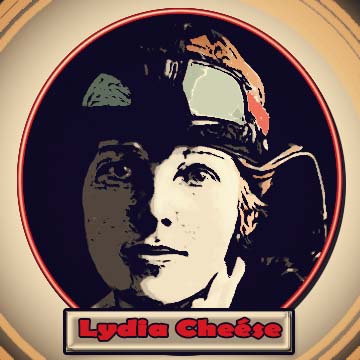 Captain Lydia Cheése (pronounced “Chase”), Airship Commander for Aerosud, a luxury liner airship company based out of São Paulo in the Empire of Brazil, who is searching for her father, Commodore Jack Cheése, an outlaw and antigovernmental rabble rouser.
 Professor Doctor Jean-Pierre Serre-Pain, proprietor of Madame Ophelia’s Ophidiarium, a traveling snake show, who has abducted Lydia to get her to pilot an illegal unregistered airship to HOAR (the Horn Of Africa Republic) on a mission of mercy in exchange for helping her find her father.


 Emile Etugouda, poet, philosopher, world traveler, raconteur, and general all around know-it-all whose memory of an ancient epic poem helped Lydia, Serpina, and Pyare cross the Massif and on to their rendezvous in Autre Lyons.
 Pax Victoriana, a period of peace imposed by the Clockwork Commonwealth and its enforcement arm, The Admiralty, dating from the beginning of Queen Victoria’s reign to the present for a total of 180 years which includes the TSR (Temporal Shift Realignment) of 56 PV (1893 AD) after which Commonwealth calendars where recalibrated to reflect Her Royal Majesty’s peaceful rule (following the devastation of the first Pandem and its resurgence 30 years later as Pandem II).
 Serpina, a young girl who serves as Serre-Pain’s assistant and snake handler and who is also a psychic Vessel.
 Vlady, an older bearlike man also in the employ of Madame Ophelia’s Ophidiarium and a traveling circus strongman Lydia recognizes from her past.
 Pyare, a young man with dreams of being an airship pilot, and member of LBFDS (the League Bousculier Francaise Du Sud) helping Lydia and Serpina rendezvous with Serre-Pain and Vlady at an illegal airship.
 Pax Victoriana, a period of peace imposed by the Clockwork Commonwealth and its enforcement arm, The Admiralty, dating from the beginning of Queen Victoria’s reign to the present for a total of 180 years which includes the TSR (Temporal Shift Realignment) of 56 PV (1893 AD) after which Commonwealth calendars where recalibrated to reflect Her Royal Majesty’s peaceful rule (following the devastation of the first Pandem and its resurgence 30 years later as Pandem II).
 Chief Inspector Karla Kola, head of the IOTA squad charged with capturing Commodore Jack Cheése and Lydia’s nemesis and pursuer.
 Captain Lydia Cheése (pronounced “Chase”), Airship Commander for Aerosud, a luxury liner airship company based out of São Paulo in the Empire of Brazil, who is searching for her father, Commodore Jack Cheése, an outlaw and antigovernmental rabble rouser.
 Professor Doctor Jean-Pierre Serre-Pain, proprietor of Madame Ophelia’s Ophidiarium, a traveling snake show, who has abducted Lydia to get her to pilot an illegal unregistered airship to HOAR (the Horn Of Africa Republic) on a mission of mercy in exchange for helping her find her father.
 Lydia held up her own hand signaling she would comply and fumbled for her shoulder bag. There were only two of them, with her training and the element of surprised she could render them unconscious. She didn’t want to have to kill them, the viper stiletto nudging against her ribs. But that would only complicate things. Her Aerosud Executive Airship Pilot’s ID identified her as Lydia Cheése, Airship Commander, and if Doctor Serre-Pain’s words were true, the authorities within IOTA’s sphere of influence, as Oldest Orleans was, would be alerted to her fugitive status.
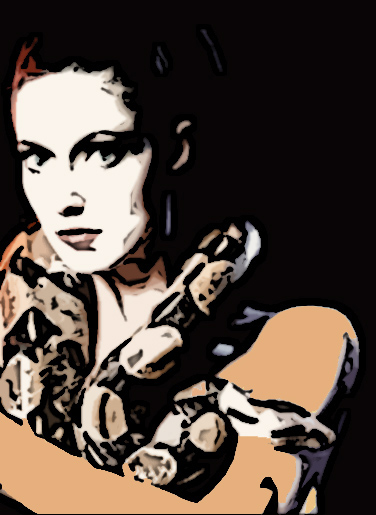 The inspection official and two sinister looking men in black hats had roamed over the barge examining the cargo, and when they came into the cabin, stared wide eyed at her propped up in one of the bunks with the python wrapped over shoulders. Her terrified look might have suggested an otherwise haughty imperious annoyance at the intrusion. The station inspector apologized profusely, and the IOTA agents, not in the habit of showing deference to the general public, dropped their gazes awkwardly.
 The yoke fit comfortably across her shoulders as she shrugged into the coat, the sleeves extending a little ways past her wrists, the hem, past her knees. She was surprised, expecting it to be heavier. Her hand in the right pocket extracted a heavy dark blue cotton scarf. The left pocket was empty although it was shaped as if some object had had a permanent residence there. Lydia pulled on the lapels pleased by the way the coat fit. She felt something hard nudge under her left breast. Inside she found the pocket and the narrow object protruding from it. Throwing open the coat she extracted a long ornate double blade stiletto.
 At the cheers from the crowd Lydia made her way out from behind the large ophidiarium on wheels that attested to Serre-Pain’s claim of herpetology and proof of his knowledge, like an old library full of old books. The crowds had thinned out further under the arcade where merchants had set up their wares, most everyone wearing a face covering, and some, goggles, against the silicate laden air. Serre-Pain had asked her not to go out in public unaccompanied by one of them. She would appear out of place and thereby attract attention. She was willing to chance it. She had friends who might be able to help her slip back to Sao Paulo. Even though The Empire of Brazil had an extradition treaty with the Clockwork Commonwealth, she doubted that the Emperor’s court would allow it over such a trivial matter as a Citizen of the World Order searching for her paternity. She would have to stay out of IOTA’s jurisdiction which would make her an exile from the world hub of Greater London. She would certainly not be allowed to pilot airships outside of the Empire’s zone of influence which spanned the southern hemisphere and the Atlantic to the inter desert zone of New Mali and Congola further south. She would no longer be an airship commander in the glamourous passenger fleets like Aerosud or Canamair. Most of the navair traffic in the Free Corridor of Cancer was freight and third class which meant much of the world’s poor and retched, refugees from the camps adjacent the dead regions and the encroaching tundra.
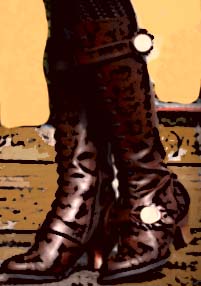 The woman nodded her head and spoke a single word in dialect, “O.” And again pointed at Lydia’s slippers seeming to infer how puny they were when compared to the rugged specimen Lydia was holding in her hand.
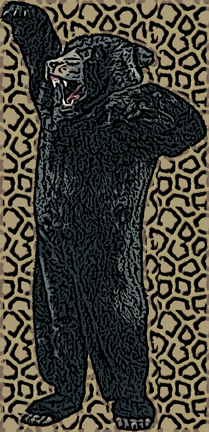 Having spent time in an Admiralty intelligence unit when she was stationed at the Commonwealth embassy in Houllas in the Republic of Texas, she knew that she would have to secure new papers if she were going to cross physical borders. And that she would have to avoid travelling by air. It would have to overland until she was safely out of the reach of IOTA. The Capricorn Free Corridor was her best bet. Surely there was someone in Older Orleans who could provide her with a passport that would escape detection, especially if she stayed off the main routes and avoided the busy checkpoints. The strains of the violin concerto had a soothing effect on her although at times she knew that it could also be quite stimulating. She closed her eyes for a moment, amusing herself with the fact that the President of the ISR, the Invincible Swiss Republic, was Albert III, the great grandson of the world famous musician. Unexpectedly her mental image changed, as often happens in reverie, to that of Vlady fitting the bear head onto his own and she realized then why he seemed so familiar to her. How could she had forgotten?
 Dime Pulp