by Pierre Anton Taylor
Wayne made his way through Joe Kerr’s warehouse maze of shelves and bins alert to any hint that he was being followed. The door to the street was unsecured. He slipped the lock and stepped out onto the pavement before glancing back. No one was there. He pulled the collar of his long black overcoat up around his ears and set out into the blustery freezing afternoon. He didn’t expect Kerr or his goons to offer a ride back to the Battery Works.
He’d received a message on his pager when he’d been talking to the crime boss. He glanced at the readout. He knew the number. He would call Robin on a secure line when he got to the satellite phone the Lab had installed in his Plymouth Fury. Otherwise, he was looking at a slog back through the neighborhood to the Lab’s temporary office.
Trash piled up along the curbs only emphasized the squalid conditions of the old neighborhood. He’d walked these streets as a youngster reveling in the vibrant activity of manufacturing shops giving machine rhythm to his pace. Most of those were now empty lots and crumbling bricks adorned by mounds of old gray snow. Cars raced by screeching around deserted corners in a hurry to get away from nowhere going nowhere. In his memory, the streets bustled with people in and out of businesses when Central was a busy local shopping district. Now the storefronts were shuttered, their boarded windows and doors gathering litter and graffiti. A pool hall in the middle of the block was still functioning as a meeting place for truants and delinquents looking for opportunities that would likely get them arrested. He passed by giving barely a glance at the wide windowed entrance where dim overhead lighting picked out hunched shoulders and silhouetted cues.
He rolled to the ground as the sedan sped past, gunfire bursting from the passenger’s side.
On the opposite side of the street between two abandoned cars a group of youngsters were playing an improvised game of hockey on a wide patch of ice, the result of a leaking pipe from the used appliance store closed by the police as an outlet for stolen goods. They paused their game to consider the lone dark figure striding toward the bright entrance of the Korean convenience store, neon liquor logos beaming a sour red. Adult foot traffic was unusual unless they were derelicts or lost. Too easy to get jacked on foot. Anyone who was anyone had wheels even if it was just two on a board.
As Wayne approached the end of Central where it teed into Battery, Penn Quinn’s Tavern was a grimy oasis of light illuminating the dark peripheries of a fading winter afternoon at the dead end occupied by the Battery Works. By the number of cars parked along the curb, the tavern was doing good business undoubtedly drawn by a televised sports event.
A car pulled up at the corner, idling as he approached. He changed his course and crossed the street between the unoccupied parked cars. If he had to, he could duck into the bar. He was naturally suspicious, and if it was paranoia, he’d count it as a survival skill. He didn’t slacken his pace, judging the distance from the curb in front of Quinn’s to the deserted candy store across the street and further down the block to the secure gate of the Battery Works. He wasn’t going to be intimidated. He wasn’t lacking in pride which often overrode caution. His best option was to keep to the cover of the few vehicles and the abandoned van parked near the old apartment building behind the tavern.
Wayne tensed as he heard the engine rev up and glanced back in its direction. The dirty white Trans Am maneuvered slowly onto Battery, cruising slowly past as he stepped into the shadows of the abandoned van. Once the Trans Am reached the dead end of the street and would have to turn around, he planned to make a run for the gate.
His move had been anticipated. As he stepped out into the roadway, the muscle car accelerated in reverse, tires smoking. He rolled to the ground as the sedan sped past, gunfire bursting from the passenger’s side. He could hear the thud of the rounds hitting the side of the van as he made himself small and dove between the parked cars. He poked his head up to peer over the front fender of an old 50’s Dodge dreadnaught and saw the Trans Am squeal to a stop, its front end rotating ninety to point back down Central. A few more round erupted from the driver’s side before it sped away narrowly missing a motorcyclist turning onto Battery.
He stepped back out onto the roadway, the single headlight of the motorcycle bearing down on him. He put up his arm to shield his eyes. The motorcycle skidded to a halt as it reached him skidding a half circle. He recognized the 1980 Suzuki Katana and the green, red, and yellow leathers of the rider. Robin.
The visor of the black helmet went up and a smirk appeared. “Let me guess. You forgot to tip.”
“We need to follow the shooters. Find out who they are!”
Robin nodded and handed him the backpack. “Ok, hop on. You get to wear the hump.”
Wayne donned the backpack and settled in the saddle behind Robin, The Katana reared on its back wheel like a trusty paint and sped after the shooters. Their taillights were visible racing down Central. Then the brake lights blinked briefly as they took a corner and disappeared. The Suzuki was at the corner in no time at all, cutting in behind a passing car making the turn. They were headed toward the Arnold Expressway. The Suzuki was closing fast as the Trans Am made for the onramp. At the last minute it swerved off, jumping the low barrier, and sped down the surface street running under the overpass.
The Suzuki leapt the divide to follow, fishtailing as it landed, Wayne gripping the frame with his knees and clutching the sides of Robin’s leathers.
An arm and a shoulder appeared out of the passenger side along with a muzzle flash and then another. Wayne tapped Robin on the shoulder and pointed to the side of the road, “Pull over!”
As they watched the car speed away, Wayne shook his head. “Not worth getting you shot over this. I have an idea.” He pointed after the car disappearing from view. “They’re heading for the gravel pits and the abandoned asphalt plant. There’s no exit in that direction. Maybe they think we’ll follow them and they can ambush us.” He indicated the dirt track going up the side of the embankment. “I used to ride dirt bikes up that way as a kid. The main rail line from the cement factory is up there too. They’re going to have to take a detour around the gravel pits and pass under the railroad trestle bridge before they get to the asphalt plant. That’s where they’re likely to make their stand. If we go offroad we can beat them to the bridge.”
Robin didn’t need any urging, goosing the Suzuki up the narrow dirt path among the frozen weeds and the low tangle of wiry shrubs. The ground was muddy in spots but they crested the rise and came up to the railroad track. The gravel and rock along the rail bed was enough to give them traction and the Katana raced toward the trestle bridge that crossed the ravine and the unpaved road below.
From that vantage Wayne could see the Trams Am skirting the largest of the water filled gravel pits the size of a small lake. He hopped off the saddle and sprinted to the edge of the bridge, searching for something. He bent down and found a large black railroad tie that had been abandoned at the side of the tracks. He ran back to Robin. “You wouldn’t have a rope in that backpack would you. And I’m going to need your helmet.”
“No rope, just some cargo bungees I use to tie down the bike with in the back of my pickup.” Robin unclasped the chin strap, pulling the helmet up and letting the cascade orange hair fall to her shoulders. “I hope you’re not thinking of jumping off the bridge. This is a very expensive helmet.” Concern didn’t show on her rosy cheeked pale complexion.
Wayne has zipped open the backpack and removed the two long bungee cords. “What are these, three footers?”
Robin nodded, “Yeah, and they’ll stretch to twice that length. You’re not thinking of doing what I think you’re going to do?” she asked with bright surprise.
“That remains to be seen. What else have you got in here?” Wayne held up a can of black spray paint.
Robin blushed, accentuating her robin breast red hair. “Uh, a little hobby I indulge myself in my off hours.” She laughed and then, “A girl’s got to have a life, especially after dark. Besides, someone’s got to save the world.”
Wayne could see the Trans Am taking the final bend around the gravel pit and heading toward the trestle bridge. Then he heard it before he saw it, the large diesel engine with its bright cyclopean eye taking up the horizon of the tracks and sounding a few warning hoots of its horn.
Helmet on his head, he collected the bungees, slipping the can of spray paint into his pocket, and raced to the trestle bridge. He lifted the nine foot long railroad tie to his shoulder and then walking the rumbling rail like a tightrope to put himself directly over the road below. The large diesel hooted frantically as it approached, a shriek of brakes being fruitlessly applied. He could see through the gaps in the rails that the Trans Am was still kicking up dust as it began passing under the bridge. He had to time it just right. He let the tie drop, and not waiting to gauge the impact, loosened the two bungees, hooking them together with one end attached to the gleaming smooth steel of the rail. He jumped.
It was easily a thirty foot drop and he had to release his grip when the bungees reached full extension, not before, and not after it began retracting. But the diesel didn’t allow him that choice. He felt the tug as the bungee caught but almost immediately as it passed overhead, the slack as he fell the rest of the way to the road below. He landed hard rolling forward to lessen the impact as he’d been taught in sky diving practice. His right shoulder and the helmet caught the brunt of the shock in the somersault to land him shakily on his feet.
Wayne snatched up the weapon and pointed it at the kid trying to squeeze himself past the wood pillar.
The dirty white Trans Am had skidded to a stop further down the dirt road, it’s front end hanging perilously over the ice caked waters of a gravel pond. The railroad tie had impaled the roof just behind the windshield like a toothpick through a club sandwich.
Wayne reached the driver as he staggered out from the wrenched open door of the skewered muscle machine. He was a short stocky man in a red hooded sweatshirt with a chrome .45 in his hand. He appeared bewildered, looking back at his wheels with the creosote ornament and then at the dark helmeted figure nearly on top of him. He raised the gun at Wayne. He did not expect the cloud of misted black paint to blind him. He shrieked clawing at his eyes.
Wayne head butted him sending the man to his knees. He kicked the gun out of the driver’s hand and it skittered across the frozen dirt of the road, over the berm at the edge the gravel pit, and settled on the thin ice crust which gave way under its weight and sank from view.
Wayne heard the yells, and calls for help, from the passenger trapped inside the two door sedan. He ducked his head in to catch a glimpse of the inside and a shot brushed him back. The passenger, a big overweight kid with a short dark ponytail, was stuck with the choice of opening the door on his side over the frigid waters of the pit or crawling out through the driver’s side. The railroad tie was blocking one option. The dirty white hardtop was on the verge of tipping into the gravel pond from the passenger’s struggle with obstacle.
“Help me out, please, I promise I won’t shoot!
“Throw you gun out and then we can talk.” Wayne kicked the rear bumper for emphasis.
“Okay, okay!” The chrome pistol careened off the door frame before dropping to the ground.
Wayne snatched up the weapon and pointed it at the kid trying to squeeze himself past the wood pillar.
“No, no, don’t shoot!” he pleaded falling back against his door and causing the car to wobble a little more.
Satisfied the panic was genuine or he would have used another weapon if he’d had one, Wayne tossed the chrome to join its twin in the drink. Hopping on the trunk and then the roof, he set his shoulder on the protruding tie, wrapped his arms around it and pulled up. It didn’t budge. The tottering car shifted forward.
The shooter inside screamed, “What are you doing?!”
Wayne tried again, giving the tie a twist and another tug to loosen it, and pulled it up part way. He jumped to the ground as the kid scramble to get his bulk across the seats for the open door. The combined motion of the two caused the Trans Am to shift its center of gravity and the front end slowly started sliding into the pond.
The kid began a panicked wail as Wayne edge to the door and tossed in one end of the bungee cord. Bracing himself on the berm, he held tight and pulled when he felt the tension of the bungee in the kid’s grip. The Trans Am lurched sideways, the right front submerged. Stretched to the limit, the line allowed the kid to pull himself free from the sinking sedan scrambling through the pond’s edge. Wayne hauled him up and over the berm like an old truck tire.
He set his boot on the large boy’s back as he tried to get up. “You made a mistake. Whoever put you up to this made a mistake. Killing someone is a mistake. Missing them is an even bigger mistake.”
“No, no,” the kid protested, “we wasn’t supposed to kill him! Just scare him is all.”
“You should be the one who is scared. Vengeance is swift for those who commit crimes on my turf,” he growled, “I’m the new boss and what I say goes. Pass it around.” Over his shoulder, the Trans Am continued in its icy baptism by showing its underside, lurching forward, sinking deeper.
Later that evening, the East Central precinct sent a patrol car to investigate the report of gunfire near the railroad overpass on the road to the old asphalt plant. They found two men secured to the beams of the trestle bridge with bungee cords and a sedan that had been reported stolen earlier in the day partially submerged in a gravel pit.

 Bion had looked up from his cup and said, “What you call this, Rick, coffee or taffy? The cream just sits on top.”
 He forced himself to don his sweats and stretch the aches out of his bruised muscles. He didn’t want to overdo it, but he had to get blood flowing, working out the stiffness and swelling. He had a call in with the service and made an appointment for some body work in half an hour. By then he might be in good enough shape to face another board meeting. One of the things to be broached was the renovation of the old battery works in memory to his father and founder of Bruce Enterprise. And how that would be funded through a number of grants, federal and state, as well as the charitable foundation BE WELL, founded by Trish, his mother,. He had the votes and only Harold was against it. The consensus though was that it was a positive public relations move. They could feel good being civic minded without really having to do anything, aristo cake crumbs to the plebs in proclamation of their benevolence. If Harold made too much of a fuss, he would have to bring up the toxic site review and explain what the BATS lab has discovered. Harold was nervous over the government contracts being paused while the leadership issues were being worked out. He was heading to DC after the meeting with a plane load of lawyers for a big pow-wow with Agency lawyers.
 And then there was the nostalgia market that gave new value to well preserved auto relics of the past. His fire engine red 1954 Studebaker Commander Convertible, a restoration from a barn find, and from another company that did not make the postwar transition especially after its failed merger with Packard, taking down the venerable carriage company known for its elegance and reliability. It wasn’t about quality anymore, especially if the consumer was buying a new car every year, it was about looks. Now everyone appreciated the durability of the older cars like his 1948 Chevrolet Fleetmaster Coupe, a pale green over forest green, it was built like a tank but totally uneconomical to manufacture. For personal use, the public wanted something light, fast, the kind of transportation that might appear in comic books or science fiction movies.
 The out of service number was telling him something he was convinced. Nor did he think of it as random. He knew he would obsess over it. So why not start at the source, his father’s old office in the very building he was currently renovating. He resolved to find out and suited up in his riding leathers, the most obvious conveyance to make a stealth approach to the battery works was the modified Spyder XR he kept in storage and easily accessible. The black balaclava under the lightweight off road helmet was for an especially cold longer night.
 He’d followed them, keeping to the shadows cast by the partial moon playing peekaboo with trundling clouds ready to drop more of their cold wet. They’d disappeared around a brick corner on Central and when he’d given a quick glance in the direction they had headed, they were no longer in sight. A few doors down was the entrance to the apartment space above an abandoned vacuum cleaner store. The door was open to the stairs leading up. A bare bulb flickered at the top of the landing. Unless they’d raced down to the next block where a street light illuminated the frozen air with a brilliant halo, they would have had to veer off. The stairwell was the only likely and immediate option.

 He was occupying his father’s penthouse apartment now, a perk on the company dime. He could survey the entire city from his perch at the wide window looking out onto the marble deck of the balcony. The landing lights of a passenger jet heading for the municipal airport that the city council was now slated to vote on naming the Wallace W. Bruce Airport crossed his field of vision. The parallel arrays of lighted city streets and the winking red tail lights and white bright head light beams that travelled them. The cacophony of neon marking nightclub entertainment and dining, the garish ostentation of major brand billboards, the imposing corporate skyscrapers with their lighted empty offices emblazoned with their two story logos. Bruce Enterprise being one of the pretentious eyefuls with it cryptic minimalist brand of three horizontal lines followed by a full height vertical line and the three mirrored parallels again. BE, a minimalist icon if there ever was one. How many times had he stood at that window, taken in the night lit panorama and stopped his gaze at the office tower only to be nudged by that famous quote he often parodied: “To be or not to be is not the question.”
 The car service had picked him up and taken to the country club, his regular driver, Cornell, affirmed. That was just before ten. The country club listed his tee time for a foursome at ten. Linus Pall was one of the quartet, Aldo Ring, a city councilman, and also a name that was not familiar to him. One of the staff at the Pro Shop said she’d heard that there had been a loud argument in the locker room between Doctor Pall and another man who was not a club member but a guest. The restaurant staff served Mr. Bruce at his usual table and he had had his usual French Dip and iceberg lettuce salad with tomato and mayonnaise. And of course iced tea.
 When Wayne showed up at the club, it was closed but someone was inside cleaning up. It was a large open warehouse bay, painted black, catwalks skirting what was ostensibly a dance floor, cluttered with the debris of the previous night’s activity. There was a bar near the front of the door. The man sitting at the bar stool with the push broom in his hand was the manager as well as one of the bartenders, the DJ, and sometimes the doorman. His name was Peter. He’d looked at the corporate photo of Wallace Bruce and shook his head.
 Accompanying by his cogitations, Wayne’s pacing in the book lined study had brought him in front of the gas fireplace and the large portrait oil of his father that hung above the marble mantel. The old man hated the painting Trish had made him sit for as a mark of his status as a captain of industry. Old Dad had made many disparaging comments about the painting, particularly at the pretentiousness of such a display, and had hidden the canvas at the back of the wardrobe in master bedroom of the penthouse. Wayne had found it and restored to its spot above the flickering flames of the fireplace.
 The late afternoon sky, losing some of its color, was hastening toward dark. A barricade of clouds hemmed in a sinking autumn sun, scattering its light as feeble rays. The hazmat team from the BATS Lab had packed up after a forensic sampling of the soils at various depths of the contaminated area and a thorough scanning of the site with sniffers. He could expect results overnight. He folded and stowed his protective gear in the utility box in back of his ’79 Land Rover. It was a souvenir of his time in Mali. The thing he liked about the old rugged square cab Rovers, although they weren’t built for speed, was that they came in any color you wanted as long as it was green. As well, the bed was long enough to hold his matte black BMW R12 motorcycle in its canvas sheath. If he wanted to go fast. The beeping pager brought him out of his reverie.
 Wayne Bruce retrieved the device from the pocket of his leather jacket and scrolled through the display. Uncle Harold had called multiple times. Everything was Urgent and ASAP with him. And a number he remembered as belonging to Detective Gordon James with Metro Homicide. There was a third number that he didn’t recognize. Very few people had his pager number and he was certain he knew all of them.
 “I might have figured as much. Do you remember Laverne Early or was that after you were sent away to school?” At Wayne’s shrug, he continued. “When the battery business started booming and your old man began diversifying, they expanded the accounts department. That’s where Laverne worked for a couple of years. There was a rumor that she might have been seeing the boss’s brother, your uncle Harold. He was in charge of sales back then. He was quite the ladies’ man in his younger days I heard tell.
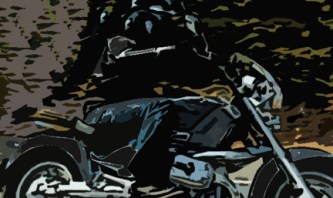 Once on Grant, the traffic was considerably heavier than in the old neighborhood it bordered. He weaved through traffic, stopping at the light before the freeway entrance. No sign of them. His choice was to continue down Grant or get on the freeway. But would they stick to surface streets considering that the raised four lane could take them further and faster? That was the question. He raced up the onramp at the change of the light and encountered the going home gridlock. No one was going to go anywhere fast. It was like a slow moving parking lot. There likely was an accident further down, but as far as he could see, it was a horizon of rooftops inching up the overpass incline. And there in the middle of it, in the number two lane, was the black box he was looking for.
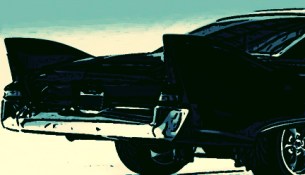 “That’s quite an antique.” A square shouldered black man on the step leading up into the store spoke the words. He was referring to the black sedan parked at the curb.
 “The Battery Man. I remember the billboards. Nobody Beats A Bruce! You that kid? I heard about you. Come on, come on in.” He pushed the door open and the hinge squeaked like a cry for help. “He’s in the back, come on.”
 Wayne paused to recall. “A quarter.” And then, “But I remember when they went up to fifty cents because I came in one day and all I had was twenty five cents, two dimes and a nickel, and you told me that the price had gone up. But you sold it to me anyway, that I could pay the rest next time.”
 Wet occupied the air and chilled it. In the yellow-brown light of the doorway to Quinn’s Tavern, the rain striking the concrete jumped like sparks off a hot griddle. The door opened quietly, disturbing neither the wide shouldered man with the bar towel over his shoulder, gaze intent on the square of color TV mounted above the bar, who laughed along with the track, a rheumy asthmatic rasp, or the other two hunched over in the shadows of a back booth, laughing, giggling, but not at the TV, a sitcom about people who frequent a bar similar to this one although certainly less sinister.
 Dime Pulp