
As Kevin Burton Smith of The Thrilling Detective said after nominating Better Than Dead’s Lackland Ask as Dick Of The Day, “I’m just amazed you’ve been able to keep this up for so long.” Admittedly, Dime Pulp is a low key, under the radar operation akin to a church bulletin, but it does what it is intended to do. Dime Pulp reaches out to the faithful few, the few faithful aficionados of the golden era of pulp and its cheap and tawdry yet unique contribution to American culture. In the manner of Dumas and the serial authors of the 19th Century feuilletons in French newspapers (where The Three Musketeers first appeared) and likely the beginnings of serial literature as we know it, Dime Pulp has stepped up to the plate.
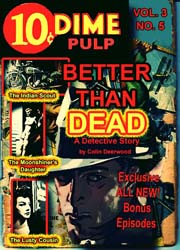
This issue marks the fourth year of Dime Pulp’s shoestring enterprise as purveyor of serial pulpy nostalgia in the guise of crime, western, steampunk, gothic, and crimefighter fiction. Over the last three years, Dime Pulp has managed to serialize three complete novels and/or novellas with a fourth, Mark DuCharme’s Carriers, soon to be completed in the next couple of issues. They are Pat Nolan’s The Last Resort, featuring ex-super model and nosy reporter Lee Malone, and the based-on-a-true-story novella, On The Road To Las Cruces, about the last day in the life of a legendary Western lawman. As well, Colin Deerwood’s long running 1940’s detective story, Better Than Dead, was brought to a dubious close in Volume 3, Number 8—will there be a sequel? Time will only tell.
As for the current lineup, Phyllis Huldarsdottir’s steampunk adventure, Cheése Stands Alone continues to develop through mishap after mishap as can only befit its swashbuckling steampunk heroine, Airship Commander Lydia Cheése (pronounced “Chase”). And Pierre Anton Taylor’s Just Coincidence piles on the coincidences as it delves deeper into the darkness of its crimefighter protagonist, millionaire playboy Wayne Bruce. Dime Pulp can also anticipate the return of Helene Baron-Murdock’s serial short stories featuring (now retired) Weston County Sherrif’s Detective Jim Donovan in the Hard Boiled Myths series. And on deck, set to beguile Dime Pulp readers, is a new contemporary serial crime novel by Thierry Le Noque titled Die Like A Man.
So yes, Dime Pulp, conceived during the early months of the pandemic, might just have something to crow about. Volume 4 will continue pushing the pulp envelope with new and exciting serial fiction. Stay tuned.
PS: Just a reminder that Dime Pulp Yearbooks 21, 22, & 23, featuring Crime, Western, Crimefighter, Gothic & Steampunk pulp serial fiction for each year are also available from the menu bar above.
Please note that all written material on this site is © copyright by the authors.



Gallery: Volume Three Covers






Gallery: Volume Two Covers









Gallery: Volume One Covers












What is pulp fiction, anyway? Immediately the lurid color illustrations of pulp magazines covers depicting a damsel in some sort of distress or at least dominating the picture plane and advertising an unspoken prurience come to mind. For many, the bygone era of pulp fiction was reading entertainment before movies, radio and then television replaced that particular skill. No one reads anymore, but despite that fact, writers still write. The kind of fiction that appeared in the pulp magazines of the 20s, 30s, postwar 40s is still being written but it has been resurfaced and streamlined to reflect much more of society and the world at large than the underworld demimonde that was largely the subject and landscape of the pulp genre’s narrative. Whatever designation anyone might want to tack on to it, pulp is a unique American prose style based on the economy of storytelling needed to fit into the word count constraints of the magazines that published them. Many of those pulp writers were also journalists skilled in succinctness and cutting to the chase. While much of the writing could be considered uncouth, déclassé, or trash, the penny-a-word hacks churned out a kind of fantastic storytelling that’s been around since practically the invention of writing (if one is to believe Mikhail Bakhtin). In more modern times it can be traced to the serials of Alexander Dumas appearing in the popular press and the cheap editions of Jules Vern’s fantastical adventure novels. Crime fiction itself has an American origin, in Baltimore, from the pen of Edgar Allen Poe. The superstars of that genre, Hammett, Chandler, and Gardner, were published in the highly respected Black Mask Magazine but also in magazines like Dime Detective, and Spicy Detective. To get an idea of how those stories stand up to today’s postmodern standards, Otto Penzler’s anthologies, The Big Book of Pulps and The Big Book of Black Mask Stories are a good place to start. An abundance of irony and a certain cynicism set the requisite tone. There are only bad people and less bad people and they don’t even think of themselves in that way. The modern gaze is blurred in discerning right from wrong because we inhabit the age of relativity. It’s all very dark, particularly after the war, some might even say “noir.” Crime fiction and westerns are where the tough hombres and mujeres live, lines are drawn in the sand or around corpses and someone is always on the wrong side (or so it seems). In the early pulps, those shady characters were roughly drawn, sketchy, succinct, the dialogue terse, wisecracking, the action constant.
 Dime Pulp